Saturday, 23 November 2024

ROBSON & JEROME: Take Two

Take Two (Robson & Jerome album) - Wikipedia


(#561: 23 November 1996, 2 weeks)


Track listing: What Becomes Of The Broken Hearted/True Love Ways/Something’s Gotten Hold Of My Heart/Elenore/Saturday Night At The Movies/Bring It On Home To Me/You’ll Never Walk Alone/Oh Pretty Woman/Keep The Customer Satisfied/The Price Of Love/Silent Night/What Becomes Of The Broken Hearted (Gospel Version)/Ain’t Misbehavin’/A Nightingale Sang In Berkeley Square/The Kiss Polka


“No, this, she felt, was real life and if she wasn’t as curious or passionate as she had once been, that was only to be expected. It would be inappropriate, undignified, at thirty-eight, to conduct friendships or love affairs with the ardour and intensity of a twenty-two-year-old. Falling in love like that? Writing poetry, crying at pop songs? Dragging people into photo-booths, taking a whole day to make a compilation tape, asking people if they wanted to share your bed, just for company? If you quoted Bob Dylan or T.S. Eliot or, God forbid, Brecht at someone these days they would smile politely and step quietly backwards, and who would blame them? Ridiculous, at thirty-eight, to expect a song or book or film to change your life. No, everything had evened out and settled down and life was lived against a general background hum of comfort, satisfaction and familiarity. There would be no more of these nerve-jangling highs and lows. The friends they had now would be the friends they had in five, ten, twenty years’ time. They expected to get neither dramatically richer or (sic) poorer; they expected to stay healthy for a little while yet. Caught in the middle; middle class, middle-aged; happy in that they were not overly happy.”

(David Nicholls, One Day; London. Hodder & Stoughton: 2009)


My friend Mark Sinker recently made a pointed observation on Bluesky. In response to some talk about tribute bands getting all the gigs these days, as opposed to new artists, he did suggest that the overwhelming majority of the history of popular music has consisted of, as he puts it, reproductions of reproductions. Palais dance bands copied what they learned from records, households sang and played what they knew from the sheet music. Street peddlers might offer their own variations on known songs but were accepted as a factor of living. Groups starting out, including the Beatles, were obliged to know and be able to play and sing all of the big hits, whether ballads, rockers or novelties.


By and large – and pointedly excluding the Beatles – everybody who performed those songs, in whichever manner they opted to perform them, knew in their gut that their version would never be as good as the recorded original (which in itself might be a polished British cover of an American song; consider, for example, the difference between Artie Shaw’s “Begin The Beguine” and the Joe Loss/Chico Henderson rendition of same).


Or, if you must go back to the Beatles, think of Ray Morgan’s “The Long And Winding Road,” a minor hit single in 1970 (since the original never received a UK single release). Now, Mr Morgan was something of a veteran of what we might call “the club scene” (early-mid seventies British cabaret clubs being demonstrably different from, say, CBGB’s) and performs “The Long And Winding Road” in the manner, of…well…a club singer, performing for an audience older than the Beatles generation, or systematically alienated people of that generation (the cloakroom attendants who gave up on them after “Strawberry Fields Forever” and instead settled for comfort, familiarity and Humperdinck).


Morgan’s record might by some parties be diplomatically described as “cheesy.” Johnny Arthey’s orchestration and the recorded-in-a-telephone-box-six-bathrooms-away production seem to date it instantly. The singer’s voice settles for an even keel rather than the worrying wanderings of McCartney.


However, he does sound as though he means it, this song he’s been given to sing – not that McCartney didn’t mean it (his final, grief-exhausted “yeah yeah yeah, yeah” might be the saddest moment of any Beatles record) but Morgan sings the song as though he’s singing for his life, even though he does so in a manner that suggests it is still 1950. His version fades rather than ends, as if he were caught in a loop as fatal as the Presley of “Suspicious Minds.”


(For an interesting early seventies parallel, listen to Mike Westbrook’s Solid Gold Cadillac’s 1973 rendition of Frankie Laine’s “I Believe,” still the longest-non-consecutively-running UK number one single – and a song already covered by Robson & Jerome [do you see where we’re going here?] – which might have been intended as a throwaway overgrown student prank, with George Khan’s electric sax throbs and Malcolm Griffiths’ downright insolent trombone solo. Even singer Phil Minton proffers a vaguely hammy talkover reading of the song’s second verse.


Yet, somewhere and somehow, Minton begins to believe – ha! – what the song is saying; you can hear it as his voice steadily rises higher and higher and there is no irony at all in how he finishes his performance. The joke? – it isn’t a joke.)


I have already spoken, on more than one occasion, about the soundalike hits albums which were allowed to preside in the album charts of the early seventies (that period again) and suggested that they represented a slightly distended variety of folk music insofar as their success proved that what mattered to most people was the song, its very existence, rather than who necessarily sang it or how it was sung.


These records possibly also cast the canonical certainty into which rock had already been shoehorned into question. As Dave Thompson says in his excellent extended diatribe I Hate Old Music, Too: How Familiarity & Overuse Killed Our Favorite Music, if critics’ Best Albums Of All Time polls tell people what they ought to like, the charts tend to represent the people’s response to that, which is: thanks, but we’d prefer to stick with those ones…after a while, the chart compilers sought to exclude those albums from their weekly lists, as though they were causing a malodorous embarrassment in the polite drawing room. Lowering the tone, those below-stairs orders.


This all takes me back to Mark, and his remark that the whole of what we call pop and/or rock, with its emphasis on ceaseless originality, invention and newness might simply represent “a cultural blip.” For as long as it has existed, music has de facto relied upon reproductions, or their fancier-named cousins “interpretations.” We hear a piece of music and our first instinct, if we find that we do not loathe it, is to copy it, feed it into what might clumsily be termed the societal mainstream (although “aorta” is, I think, a better means of putting it). The song sings something about us to the most intimate and hardwired segments of us, and we carry those songs, bear them subconsciously in our bodies like phantom limbs of narrative.


The other factor to consider as 1996 reaches its vaguely messy end is that many of popular music’s consumers had, at that stage, lived through everything that had happened. They were also by biological necessity getting older, and by then had maybe heard and seen enough. So they largely retreated to the elements they knew, which had stirred them long, long ago when they didn’t have to worry about anything life or the world might do with or to them – and in an important way it didn’t matter about who had been responsible for the stirring; it was the evanescent, semi-abstract breeze of the song, blowing through their complete (though not yet completed) histories, which proved to be enough in itself…


(q.v. that quote from Nick Tosches’ Dino: Living High In The Dirty Business Of Dreams: “The sum of Dino’s instincts had to do with the old ways, those ways that were like a wall, ways that kept the world lontano, as the mafiosi would say: distant, safely and wisely at bay. That was how he liked it: lontano, like the flickering images on the theater screen that gave him pleasure as he sat alone, apart from them and unknown to them, in the dark.”)


…the breeze which would keep them away from the young, who were more frightened of the old than vice versa, from the noisy frontloaded detritus of, oh what do they call it again, British Pop, I say…


There is an article in The Independent newspaper of 10 December 1995, co-written by a young reporter named Andy Beckett (with Nick Varley), in which “an elderly lady from Hackney named Irene” is spotted in an unspecified North London branch of Woolworth’s with her husband. They are engaging in a lively debate about whether or not to purchase the first Robson & Jerome album, on cassette. The husband is unconvinced but Irene insists they must get it because “it’s got ‘Unchained Melody’ on it.”


After a long and thoughtful pause, the husband, perhaps with a degree of reluctance, agrees that they can buy it. About 1,800,000 others thought and did likewise. On further questioning, Irene admits that “We don’t normally buy many tapes” – and there are, overall, very few people who do – but adds, “I just fancied that one. You can hear what they’re singing. What they have on Top Of The Pops is just rubbish – they’re just shouting.” Having buttoned up her green mackintosh, Irene beamingly concludes: “And I’ve got the originals of all these from the Sixties.”


Irene, as with so many fans of Robson & Jerome, was chasing a lontano, attempting to rediscover and recapture the breeze which had bewitched and entranced her a third of a lifetime before; “Unchained Melody, “White Cliffs Of Dover” and “I Believe” have a provenance which stretches some way before “the Sixties” but the timescale actually isn’t very relevant here – what matters is this utopia called “the Sixties” which serves as shorthand for younger and (so it is hoped) easier (to understand, if not to live through) times.


It is a central and utterly unavoidable fact of life that humans get older. It comes to us all, as David Peace had Bill Shankly say, and what matters is how we individually deal with it. Do we give up and shelter in the past, or try with intact dignity to keep pushing ahead? A time shelter (see Georgi Gospodinov) may prove a suffocating bunker which might, if unchecked, erase us all.


Or, as with the two main protagonists of David Nicholls’ One Day, we systematically “grow up” with remorseful, melancholic reluctance. It is difficult to sum up that novel without offering a digest of its plot, which is what Wikipedia and Google are for. Both principal characters are, I think, fundamentally unlovable, except perhaps by each other, and the contrivances which keep them linked throughout two decades, or indeed bring them together in the first place, are somewhat mechanical and unlikely.


In the Independent article I mentioned above, the adjective most used – and it repeats with the rhetorical resistance of a dagger – is “polite.” Robson & Jerome’s version of “Unchained Melody” is “polite,” as is their first album. Their function as popular entertainers is not to disturb or disrupt. Not to cause a fuss. Not to upset anybody.


The procedural in One Day seems to wind down – not up, as some readers, and possibly the author himself, would prefer us to believe – from the time of life when one cares loudly and persistently about things which matter (racism, sexism, the environment, indie pop) to one where such notions are grinningly (but keep an eye on their eyes) dismissed as childish, sublimated to and superseded by the business of conventional middle-aged, middle-class “life.” A conservatism (possibly capitalise that “c”) which accepts the status quo because it’s too tired to contemplate and act upon any alternative.


And yet, when the book comes most alive is, paradoxically, when bad things happen to its main characters. I will not offer any plot spoilers if you have not yet read One Day, but the account of what happens to Dexter Mayhew after the worst of all things happens to him is approximately concomitant with what happened to me in the last few months of 2001. And if, like me, you yawn pre-emptively at the prospect of a chapter entitled “Fathering,” Nicholls very cleverly subverts the expected norm of such situations and shows Mayhew utterly fucking up left, right and centre.


Still, just as the dreary and reactionary ending of Hornby’s High Fidelity does – again, let’s put away all that noisome puerile rot and absorb ourselves into the gleeful and unapologetically centrist mainstream – there is the notion that Art Garfunkel is always, always going to triumph over Solomon Burke. This isn’t necessarily the way things go – it’s about different timbres and emotional deployments – but it winds up meaning you make do and mend, go with the flow, settle for twelfth best.


And I have little doubt that, had the story of Emma and Dexter played out differently, they’d have ended up having the neighbours round for dinner, set up their karaoke machine and had a pleasant evening singing, or attempting to sing, the songs they know, as opposed to the songs they love (but won’t ever admit it; not at this stage of their lives – it’s far too impertinent). Content over ecstasy (then again, whom exactly am I kidding? It’s what we will all ultimately want. Trust me). Because doing or thinking anything else will drive both parties irrevocably and irreparably mad.


All of which leads me, inevitably, to the second Robson & Jerome album, another menu of impolite songs delivered and manufactured as politely as possible. It is as though Simon Cowell, in conjunction with producers and arrangers Mike Stock, Matt Aitken and Nigel Wright – a different SAW – had instructed everyone involved to ruthlessly extract every last atom of punctum from some of the greatest songs that have ever been written, aiming for cast-iron reassurance that the music will not offend the various Irenes, from Hackney and elsewhere, happier to recall Buddy Holly and the Everly Brothers than, say, Jimi Hendrix or Bob Dylan (one could never imagine Robson & Jerome being made to tackle “The Wind Cries Mary” or “Can You Please Crawl Out Your Window?” “What Becomes Of The Broken Hearted,” yes, “Cloud Nine,” no).


The sales demographics seem to suggest that nobody under the age of forty-five was likely to have bought either Robson & Jerome album, except for housewives in their thirties who fancied them on (or off) the telly and serving soldiers (the duo proved to be really big in Army barracks up and down the land). The fact was that the median age for pop music consumption had steadily increased over the forty or so years of the “rock” era and that the proportion of that amount of consumption devoted to actual “rock” (or any of its outlier neighbours) had diminished almost exactly inversely.


And, because people get old, they naturally look back to the music of their youth, or the Selective Amnesia remix of it at any rate, with far greater fondness, and want that youth – at the very, very least, its spirit – reproduced. These were people who, like Irene, bought the original recordings of these songs (or, if not the originals, the Righteous Brothers’ cover versions) at the time and maybe just wanted to be reminded of them, to feel reassured in a world which they perceived to be rapidly disintegrating.


Because older people generally have more disposable income, they tend to be fussier about what they spend their money on – that may be a paradox, but if you were brought up in the post-war Britain of ration books and make-do-and-mend, that inner fear of nothingness never truly recedes – and what they usually desire or require is an airbrushed photograph of their past rather than a contemporary snapshot (hence, for instance, the multiple hoops through which retro chart shows on the radio have to jump in order to allow for changing tastes – what wowed thirtysomething housewives in 1968 is extremely unlikely to attract their modern equivalents) cancelled performers and so forth). Their past, with the awkward, odd and downright bad meticulously edited out by the sober scalpel of hindsight.


Robson & Jerome’s “What Becomes Of The Broken Hearted” is therefore what becomes of a great song after it has been put through the Fairy Snow wash (with added perborate, because Take Two is precisely the sort of album someone like Craig Douglas might have recorded in, say, 1971). As Bob Stanley has already pointed out elsewhere, one knows this version is doomed to fail from its very own introduction, which evens out the deliberately unsettling three-bar prelude to Jimmy Ruffin’s reading (so that you’re immediately and unexpectedly plunged into the Appian Way of misery) to four bars, for no good reason other than potential buyers might find three-bar introductions confusing (see also the stupid 1987 remix of the Temptations’ “Papa Was A Rolling Stone” with all its multi-rhythmic subtleties brutally replaced by thump-thump-thump prescription pacemaker beats, and don’t even get me started on the Was [Not Was] cover).


When Jimmy Ruffin sang the song, more or less as a Civil Rights metaphor, or even when Colin Blunstone, with the other Dave Stewart, rendered it as an allegory for Thatcher’s denuded Britain, it felt like a profound soliloquy, complete with a Hamlet-style turnaround in its closing moments (the Ruffin version, anyway; the Blunstone/Stewart reading leads to an inconclusive question-mark of a fadeout), Robson & Jerome perform it dutifully, as though ticking off items on a Somerfield’s grocery shopping list, with no audible evidence of hurt or desertion. Even the video for the song, which enacts what might have been an alternate ending for One Day – no one is innocent – cuts more deeply than the record itself. Even when the San Fernando Valley Community Gospel Choir are roped into the proceedings to provide suitable soulful, passionate and honest back-up, they cannot dispel the record’s underlying nullity, which is not helped by an asinine closing key change, a repeated chant (“NOW DEPARTED! NOW DE-PAR-TED!!”) and a pointless final major key shift.


The duo proceeds to work its way through pop music as, presumably, Cowell wanted their audience to remember it. Actually I have just thought of an intriguing alternate-universe parallel for Simon Cowell, especially given that the first record he bought was apparently “Chirpy Chirpy Cheep Cheep” – both men born either side of the beginning of “the Sixties” (1959 and 1961 respectively), both attracted to a warped but curiously correct notion of the priceless disposability of what might seem to be the crassest pop music, both pursuing their very singular individual visions of pop, both in their differing ways deliberately veering away from, or perhaps (respectively) above and below the mainstream. Even on stations like Boom Radio, you never hear any of what can be termed “Cowell Pop”; Pete Waterman has marvelled at the fact that Cowell succeeded in creating his own category of pop music which really had nothing to do with pop music as most people felt and remembered it.


It is equally valid to say that you never hear any of what I might term “Lawrence Pop” anywhere either but it is interesting to come to that fork in the road and imagine Cowell taking one path and Lawrence taking another. Go-Kart Mozart is as happily removed from the primary flow of things as Gareth Gates*. I tend to think that both men would have been happier if they’d been about ten years older and ready and available to prosper in that Neil Reid and Handley Family world of the early seventies.


(*Obviously this writer finds himself on the Lawrence side of the fence, having followed his music since the first Felt single “Index” when the fifteen-year-old me thought to myself “I could have done that.” Will Hodgkinson’s book about the man, Street-Level Superstar: A Year With Lawrence  – a literal labour of love – is a recommended, if frequently gloomy, read. Think of the man as Derek Bailey’s gauche spiritual nephew but arrive at your own conclusions with regard to much of his behaviour.)


How a Take Two administered by Lawrence would have sounded is anyone’s guess, but it would have been infinitely more interesting if markedly less profitable than the Take Two which actually exists. This “Something’s Gotten Hold Of My Heart” positively eviscerates the remotest hint of wonder or blood which Pitney, Cave and Almond variously donated to the song. It isn’t even on the Darren Burn level of commitment. Robson & Jerome recite the song as schoolchildren might do in a Music Appreciation class; the notes are all present, but the soul is a blank. It sounds like A.I. pop.


The cull of politesse goes on. “Elenore” is stripped of irony. “Saturday Night At The Movies,” never the best of songs to begin with (look, I saw the Dechmont House Show in the late spring of 1977*, I know what I’m talking about!), is traduced further to spineless slapstick and a ‘phoned-in trumpet solo.


(*Annoyingly obscure reference to Uddingston Grammar School “House Shows,” revues of songs in costume which were organised annually when I was a pupil there in the mid-to-late seventies. We were all divided into five “Houses,” each named after different rivers, or more accurately Clyde tributaries, which flowed in and around Uddingston – Calder, Clyde, Kelvin, Dechmont and Douglas. The “Houses” were arranged alphabetically by surname, hence I was in Calder House [for pupils with surnames from A to C). Since participation in those “House Shows” was not mandatory, I never contributed to any of them. I don’t regret not doing so.])


While the duo’s attempt at “Bring It On Home To Me” is vocally and emotionally woeful, the song’s orchestral arrangement – presumably done by Nigel Wright – is surprisingly inventive and strikes when strings suddenly swoop up mid-song like a newly-awakened bat and drag the track into a different dimension. Much as David Whitfield did with Mantovani’s orchestra, unfortunately, the voices do not follow the arrangement’s implications at all.


That is a rare example of inventiveness intruding into the record. I do not see the point of this “You’ll Never Walk Alone” with its bargain basement synthesiser presets, which neither pauses nor crescendos and provides no useful reassurance at all, simply a faded memory of something that might once have meant something. Which brings me to another comparative observation…


Take Two is literally nothing more (or less) than what it says it is and what it is meant to be. The record does not offer interpretations of songs, other than their systemic neutralisation. It does not re-examine songs in ways that give you clues to the singers’ own lives and experiences.


In short, and particularly in view of the fact that both records offer versions of “You’ll Never Walk Alone,” Take Two is not Kevin Rowland’s My Beauty (which appeared less than three years later) which latter, much like the B.E.F.’s Music Of Quality And Distinction Volume One, seems to want to render popular music as unpopular and avant-garde as possible. Rowland takes sick-of-hearing-them standards from “The Greatest Love Of All” to “Rag Doll” and turns them inside out to provide a motor for telling the story of how he as a human being related to and was altered by these songs. By the climax of his “I Can’t Tell The Bottom From The Top,” a nearly-forgotten Hollies hit from 1970, he sounds ready to shoot himself. Yet he manages to pull himself out of the morass, or more importantly allows someone else to help out with the pulling, which is precisely why the record should never have lost “Thunder Road,” in which Rowland makes his escape from Hell*.


(*I should at this stage overturn the standard line that Bruce Springsteen’s people, or possibly Springsteen himself, said no to Rowland changing the lyrics to “Thunder Road.” What seems far likelier to have happened is that Rowland’s label boss at Creation, who at that stage was still Alan McGee, on account of being Alan McGee, simply put the letter to Springsteen’s people asking permission to change the words in a desk drawer somewhere and forgot to send it. Hence Bruce never actually knew about Rowland’s cover, let alone had heard it, and it was not until many years, and possibly decades, later that he finally got to listen to it and said, that’s fine, go ahead. So the complete My Beauty with “Thunder Road” restored to its rightful place finally appeared in 2020.)


Coming out of “Thunder Road,” we find a fine performance of the Marmalade song (and, for many, an actual “anthem”) “Reflections Of My Life,” where Rowland seems as keen as the Spice Girls did in “Take Me Home” to go back to what matters – a performance so good that it was praised fulsomely on YouTube by Junior Campbell, the man who wrote the song. In this context his “You’ll Never Walk Alone” acts as catharsis; that song you’ve heard and maybe even sung millions of times which suddenly, as the last millennium drew to a fretful close, was heard to matter again and viewed as a beacon – a way out.


My Beauty was an important album to me in 1999, a point where my life seemed to be collapsing into confused pieces and I…but those thoughts are not for here (far too raw). I was driving into a metaphorical brick wall at around 500 miles per hour and this record stopped me, persuaded me to look at things and perspectives anew and realise…you know, there are ways to dig yourself out of this tunnel – just keep digging (see also “Hunger Games” by Bob Vylan). And I have managed to talk about the album without once mentioning its cover.


If Robson & Jerome had attempted such a cover for Take Two they most likely would have been run out of the country, never mind town. In an anti-culture of loaded laddism, My Beauty didn’t really stand a chance (although, again pace the standard story, it actually did somewhat better commercially than was indicated at the time).


But Cowell would never have dared to allow them to try that, nor do I think that they would have tried it anyway (it would not be in their character). An avant-garde Robson & Jerome is a contradiction in terms (you cannot picture them tackling “The Electrician”). Therefore we get a largely de-sexed “Oh Pretty Woman” – the “mercy!” remains intact to tickle the housewives but Orbison’s leonine growl after verse two doesn’t – with absolutely no indication that the singers’ emotions have been upended by the woman walking back to him; shock and awe being presumably deemed too unseemly. It’s just a moderately pleasant song about a woman who’s pretty. Perhaps Irene from Hackney never viewed it as anything more than that.


Simon and Garfunkel’s “Keep The Customer Satisfied” – then already more than a quarter of a century old – is the most modern this record dares to venture and sounds like a Hot Hits Number Whatever cover. Worse is the video for the song which unsuccessfully attempts to convince us that everybody in the club is raving and going mad over two awkwardly closely-positioned men in fifties suits, standing at close right angles to each other as though marooned in the middle of a non-existent packed train and as if rock ‘n’ roll had never actually happened (as I suspect, deep down, Cowell fervently wishes that it hadn’t). Not even in Jack Good’s direst dreams could such a scenario have come to pass. In its way, the video is as much of a misfire as Streisand’s lounge-act-at-rock-festival routine in A Star Is Born (and if you can amass the strength to read through the endless, unedited and possibly uneditable My Name Is Barbra, you’ll see that Streisand and her people charged an actual fee for admission to this performance; you may not be surprised to learn that she ended up being booed offstage. Laura Nyro she was, and is, most assuredly not).


Take Two’s take on the Everlys’ “The Price Of Love” seems to take after Bryan Ferry’s 1976 cover, mariachi trumpet intro inclusive, but the Beat Boom purposiveness of the original is disengaged. The album’s natural end comes with “Silent Night” – since it was almost Christmas; let’s all hold hands solemnly around the tree – but the unanticipated power of its predecessor’s “Danny Boy” is absent and its muted ending (most if not all things about this album are muted) putters out like a prematurely-exhausted fuel tank. Even Bros managed to interpret the song better.


As I said, that would seem to indicate the end of this album, but there are four “bonus” tracks still to come. One of those, the “Gospel Version” of “What Becomes Of The Broken Hearted,” is a reprise of track one but minus the rhythm track. Sheer value – I marvel that Cowell didn’t think of putting together a Robson & Jerome Stack-o-Tracks album of instrumental backings (“for EVERYONE IN THE FAMILY to SING ALONG to!”).


The other three take Take Two into strange, and not necessarily, intriguing territory, namely that of pre-rock big bands. Of Robson & Jerome’s variation on Fats Waller’s “Ain’t Misbehavin’” – a song that, despite its surface jollity, is actually about a deeply lonely and possibly disturbed man imagining that a lover will eventually materialise in his life, although he seems to be going out of his way to avoid such a thing ever happening in reality – there is little to be said (it shouldn’t be sung as a duet, for a start); they opt for mannered coarseness.


Their “Nightingale Sang,” which one of them (Robson?) sings in a manner very akin to Paul Heaton, does not work as an uptempo big band “romp,” and is anyway derailed by a final, pointless and mood-shattering “I know ‘cos I was there!” What are you (Jerome?), James Murphy? These utterly stock-standard big band arrangements are, it has to be admitted, for many people the main stumbling block they have with RAYE’s “Genesis.”, emerging from the lurid darkness of Part II to the chugging light of Part III. Some feel that section spurious, disappointingly conventional and unconvincing. But I don’t know that a throw-it-all-up-under-endless-crisscrossing-lines Mike Westbrook approach would have done anything other than obscure RAYE’s message – and, crucially, one has to watch the song’s video, with the very young schoolchildren inventing their own dances anyway and THEREBY MAKING THE PERCEIVED CLICHÉS WORK ONCE MORE.


Not that Take Two is concerned about bringing in light, in its wider meaning. Apart from my patience, it isn’t there to challenge. At least not until we reach its fifteenth and final track, and the record’s real wild card, “The Kiss Polka,” a foxtrot recorded by the Glenn Miller Orchestra for the movie Sun Valley Serenade in August 1941 (on its original 78 rpm release, it was the B-side of “It Happened In Sun Valley”). On Miller’s lively and ebullient original, Paula Kelly, Ernie Caceras and the Modernaires all pitch in with their vocals. Whereas Robson (I think?) simply proves how inept he is at singing jazz, even in its simplified swing form. When Caceras switches into Mexican Spanish, he sounds affectionate and enthusiastic, but Green simply hams it up and aurally resembles a bad seventies television impressionist, with smacking-lips sound-effects which are really beneath contempt.


That is, if what or whom we are hearing really is, or was, Robson & Jerome. In his authorised autobiography from 2003, I Don’t Mean To Be Rude, But…, Simon Cowell was less than complimentary about the duo, and the feeling appeared to be mutual. More seriously, allegations were made about whether the two actors actually sang on any of their records. If you listen carefully to Take Two and think you’ve heard one of those voices before somewhere, then you wouldn’t necessarily be wrong, since one of the three session singers drafted in to “help” the pair was Des Dyer, formerly of the band Jigsaw (“Sky High” etc.).


In fact, Dyer approached a newspaper with his allegations at the time, and although Mike Stock managed to obtain a court injunction in order to prevent Dyer from telling his story, he did eventually (in 2008) admit that session singers had been involved; Dyer as a surrogate Jerome and two others (as yet unnamed) to cover for Robson in general and also Robson’s high notes. The head of the duo’s record label BMG, one John Preston, also decided to pay £75,000 to Dyer – at Simon Cowell’s direct request – and deducted the differential from Stock’s producing royalties.


Nevertheless Stock remained adamant that the actual Robson & Jerome did sing on their own records, that this wasn’t another Milli Vanilli. Yet there is a curiously logical point to all of this - and it's commoner in popular music than you might think - in that it didn't really matter who was actually doing the singing on Robson & Jerome's records; it was the "brand" of Robson & Jerome that mattered, the symbolism of the two providing the "front" to the concept (theirs should not be termed an "act"). They stood there to be seen and were the effective "voices" of the entire project - and, for most of the 1,200,000 people who purchased and presumably adored Take Two (the returns were down somewhat from the record's predecessor but remained outstanding), their palpable presence was enough, in just the same way that hardly any of the Byrds appear on "Mr Tambourine Man" or the hits of Love Affair were largely performed by studio session musicians, or Bobby Farrell was really Frank Farian on all of those Boney M hits you pretended not to like in 1978.


It didn't matter; the appearances were sufficient, since the human species has always judged its fellow humans with its eyes in the first instance. As was the existence of The Song, regardless of who sang it or how it was interpreted and produced, because - and this maybe should have appealed to the stalwart socialists that Robson & Jerome, not so deep down, were and are (even at the time, they made no secret of their political affiliations; Robson Green decried Tony Blair as a shallow fake, Jerome Flynn donated at least £27,000 of the duo's royalties to Greenpeace) - what their music reminded people of was the semi-derelict, on-the-verge-of-being-abandoned notion of communality; a mutually dependent world in which people relied on each other to get everything done, shared the same joys, woes and...songs.


One suspects that Simon Cowell has never voted in an election in his life; he always seems as though he has more urgent and pressing business to which he must attend. But what he inadvertently allowed into the front room of Britain with Robson & Jerome was perhaps the last stand of "the People's Music" - just as the offspring of Robson & Jerome fans discovered that communality in the early work of Oasis, so did their parents make one final, valiant attempt to pull together and unite. Does anyone still care for the music nearly three decades later, other than perhaps those who remember it from their childhood?


Because, as I said earlier, that's the odd thing about Cowell pop; you simply do not hear it being played or praised anywhere today. Was it a mirage that never actually mutated into solid matter? Or was the underlying aim, perhaps unknown even to its chief perpetrator, to try to prevent society from falling apart? In his series of Bluesky posts which I mentioned at the beginning of this piece, Mark goes on to mention that just as the post-war rationing consensus began to come apart - the way it does in bad films - the war children simply picked up their parents' washboards and tea chests and proceeded towards skiffle. A new communality unknown to anybody older than the people for whom it was meant. It has never actually...departed.


"Many songs were suppressed during those bleak years, but André Midani, who continued to oversee many of the era's best recordings, has insisted that repression provided Brazilian music with the healthy stimulation of an enemy. A common sentiment expressed in seventies lyrics was 'one day...'; what the singers were waiting for remained unsung, but listeners understood."

(Joe Boyd, And The Roots Of Rhythm Remain: A Journey Through Global Music. London: Faber & Faber Limited, 2024; chapter 7, "Chega de saudade")


Envoi


Simon Cowell offered Robson & Jerome £3 million to record a third album but they declined his offer and returned to acting and "extreme" fishing. For Robson Green, the decisive break came while he was watching an episode of BBC1's Animal Hospital, where a woman came into the practice with two guinea pigs named...Robson and Jerome. "What seems to be the problem?" asked the vet. "It's Robson," the woman replied, "he's not right." Green knew bad karma when he saw it and called a halt to the exercise.


Not long afterwards, on 1 May 1997, the Conservative government of John Major was voted out in favour of the Labour government of Tony Blair, who gained a majority of 179 Parliamentary seats. A compilation album, Happy Days: The Best Of Robson & Jerome, was released in November of the same year. It peaked at number twenty and sold about 100,000 copies.


Though marketed as symbols of Britain at war, Robson Green and Jerome Flynn are actually pacifists.

Saturday, 16 November 2024

The SPICE GIRLS: Spice

Spice (album) - Wikipedia


(#560: 16 November 1996, 1 week; 7 December 1996, 8 weeks; 8 March 1997, 1 week; 22 March 1997, 4 weeks; 17 May 1997, 1 week)


Track listing: Wannabe/Say You'll Be There/2 Become 1/Love Thing/Last Time Lover/Mama/Who Do You Think You Are/Something Kinda Funny/Naked/If U Can't Dance

Bonus tracks (Punctum's Version): Take Me Home/Feed Your Love/One Of These Girls/Bumper To Bumper/Spice Chat 2: "Shall We Say 'Goodbye' Then?"


I remember the Wednesday afternoon I bought the CD single of “Wannabe” as a new release; Wednesday 26 June 1996, to be pinprickingly exact. I was in the Virgin Megastore on Tottenham Court Road and added it to the rest of that day’s purchases, which included a two-CD recording of Steve Reich and Beryl Corot’s opera The Cave - "who for you is Abraham?" - and the compilation Artcore 4 - The Art Of Drum & Bass (chief pick, although all twelve tracks are extremely fine: "Find Me" by Skanna).
 
 
The gentleman behind the counter refused to believe that I was sincere in my purchasing the single since – to his eyes – it jarred so outrageously with, or against, the other contents of my basket. Unbeknown to me, the Spice Girls - who, confusingly, were signed to the Virgin record label - had done a personal appearance in the shop just a couple of hours beforehand, and my server was convinced that I was a Virgin PR man trying to buy the single into the charts. Even after I, with characteristically benign cheer, attempted to put him aright in polite, long-form terms, he did not quite believe that I was not the late Robert Sandall.


I was rather put in mind of another cheerfully open-minded musical theorist, John Stevens, the then-recently departed drummer who from the mid-sixties onward had been responsible for putting together the Spontaneous Music Ensemble (SME), a purportedly ego-free unit whose members all worked equally towards a common musical good, regardless of genre or gender. On two SME pieces – namely 1968’s “Oliv, Part One,” and 1971’s live 21-piece big band tribute “Let’s Sing For Him (A March For [the then-recently deceased] Albert Ayler)” – Stevens deploys a chorus of improvised (but directed) female singers. On “Oliv, Part One” they furnish lengthy sustained drones (together with Trevor Watts' soprano saxophone) as a backdrop for the piece’s main featured players (Kenny Wheeler and Derek Bailey - pianist Peter Lemer acts as a sort of midpoint between the two settings), while on “Let’s Sing For Him” they sing the titular chant over and over until they begin to modify it and improvise within it, finally breaking out into celebratory/commemorative atonal freeform cackles and screeches.


The five singers who appear on "Let's Sing For Him" are Maggie Nicols and her sister Carolann (the latter reappeared on record several decades later as Caroline Jackman), Julie Tippetts (the Face of '68 formerly known as Julie Driscoll), Norma Winstone and Pepi Lemer, and if on “Let’s Sing For Him” especially (in which all five participate) the notion that they sound as though they are giving birth to the Spice Girls seems farfetched, it should be noted that the last named of these women, Pepi Lemer (wife of the abovementioned Peter, who also contributes limpid Fender Rhodes to the swirlingly abstract middle section of "Let's Sing For Him"), went on to become the Spice Girls’ principal vocal tutor, teaching them many of the techniques which she (in conjunction with Stevens and Maggie Nicols) had deployed in the SME a generation previously (details of the exercises in question can be located in Stevens' important manual Search And Reflect: A Music Workshop Handbook).


It would appear from the admittedly limited capacities of searching Google that the Spice Girls are still held in some critical derision; bland, phoney puppets and so forth and no fifth. This of course has a lot to do with the misogyny which remains inherent within the British music establishment, the kind which confines women to either of the dual permitted roles of feisty, independent rocker or trembling, victimised waif. Hence when girl groups succeed in pop – in other words, when women have the temerity to compete with their male peers on equal showbusiness terms, to access the same level of opportunity – they are routinely denounced. Thus Riot Grrl’s concept of Girl Power (and subsequent brokering of same into the mainstream by Shampoo, aided and abetted by, of all unlikely pop stars, Lawrence of Felt, Denim etc.) is lauded whereas the Spice Girls’ simple modification of Girl Power is damned, at least in the blinkered eyes of those who don’t realise that “Her Jazz” and “Wannabe” – both sung and largely performed by women, but both co-written and produced by men - are two sides of the same coin of advancement.


Furthermore, most of the aesthetic concept behind the Spice Girls came from the Spice Girls; Richard Stannard and Matt Rowe wrote and produced most of their music but the words were those of the Spices (and, on a seemingly too obvious parallel note, whither Bacharach and David’s Dionne Warwick, or Shadow Morton’s Shangri-Las, or Spector’s anyone?). Simon Fuller acted as their second would-be ringmaster but, as he quickly found out, he was not an indispensable male glue to the girls’ bonding; as were not the father and son team Bob and Chris Herbert of Heart Management who in 1994 had advertised for singers in the hope of creating a female equivalent to Take That and East 17, or indeed Michelle Stephenson, who made it to the initial five-piece group and may well have been technically their best singer, but either jumped or was pushed, depending on whom you talk to, for reasons of incompatibility and/or family/personal problems.


Seeking a replacement for Stephenson, the Herberts looked to Pepi Lemer, who recommended a girl whom she had recently been tutoring separately and individually, one Emma Bunton. She bonded with the other four immediately. They then sang, danced, rehearsed, rehearsed and rehearsed. The group was initially named Touch; the Herberts' ambition seemed to be to create a British equivalent of TLC (or perhaps a slightly cooler modification of Eternal, whose song "Stay" all four hundred or so applicants had to sing and dance their way through in the initial auditions for the group in March 1994).


From those auditions, Melanie Brown (Mel C), Victoria Adams (as she was then still known), Stephenson and one Melanie Coloma were selected, with eight others, to proceed to a second set of auditions. Melanie Chisholm (Mel C) had been unable to attend that second audition because of tonsilitis, but when Coloma was found wanting, the Herberts called Mel C back anyway after Geri Halliwell had encouraged them to do so.


Ah yes, Geri Halliwell. She had not turned up to the first set of auditions at all and had given various dubious excuses for her absence - yes, oh definitely yes she would have come, wouldn't have missed it for the world, but she had contracted laryngitis or had burned her face in a skiing accident and I'm so SO sorry Chris, please forgive me, please let me audition, pretty please, I'll turn up this time I promise!


Chris Herbert was eventually persuaded to let Geri into the second set of auditions; when she burst through the door, he was so impressed by her cheekiness, campness and confidence that he knew she'd be the perfect fit for the group, even though her singing capacities were, let's say, slightly limited. Not that this bothered anybody in particular - Mel C called her "a self-confessed bullshitter" but in an admiring rather than admonitory tone. Her bullshit fit the disparate cast of characters that the Herberts were intent on assembling. I'll get back to her contributions later.


The group spent a lot of time in the three-bedroom house at Maidenhead which Heart had provided for them and in nearly recording studios, practising and performing songs (as well as perfecting associated dance routines) which were aimed at a very young (under-tens) female audience, none of which appears to have survived, as well as painstakingly learning how to write or co-write songs themselves. One of the latter was entitled "Sugar And Spice," which encouraged the group to change its name from Touch to Spice.


By the end of 1994, Spice were growing uneasy and restless with what Heart Management wanted from them, as opposed to what they, yes, really, really wanted (it's corny, I know). An industry showcase performance was set up in December of that year at Nomis Studios in Sinclair Road, Brook Green, meeting an extremely positive reaction, not least from Richard Stannard, who was in attendance; his songwriting partner Matt Rowe also became subsequently involved.


Encouraged by all of this, Heart Management prepared what would have most likely been a severely binding contract with the group, which, after due discussion with several outside parties (including Victoria Adams' father), they declined to sign. In March 1995 they split from Heart - absconding with the mastertapes of their compositions while doing so - and set about preparing demos with some of the people they'd met at Nomis. Simon Fuller, then of 19 Management, heard and was impressed by the demos and the group were happy to sign a contract with him.


Interest in Spice escalated, and following a bidding war Virgin signed them in July 1995. Fuller then took the group to Los Angeles to meet up and make contact with various important industry figures. Since there was a rapper already using the name "Spice" it was decided to lengthen the group's name to the Spice Girls, in part as a reaction to how they had been sneeringly described by some members of the music business ("oh yeah, those Spice girls, hyuk hyuk").


The group then prepared to record songs for their first album, but their way was blocked by needless and finally rather flimsy obstacles. Nobody seemed to want "Wannabe" as their first single. The industry wanted a straightforward R&B "banger." Much encouraging noise was made about launching the group's career with "Say You'll Be There" instead. But the contract they had signed stipulated that they would have the final say about single releases, and they were insistent that "Wannabe" needed to be a game-changing or possibly even (Britpop/Loaded laddism) game-closing declaration of principle, up there with (or preferably a lot better than) "Anarchy In The U.K." - "I'll tell you what I want, what I really, really want" could be interpreted as a direct, demolishing response to Lydon's "Don't know what I want, but I know how to get it." They knew the song had to matter, needed to represent so much more than what it seemed to offer; Geri referred to it as a "strange family member."


Nor were Smash Hits particularly interested in them at the time, although they cheerfully invaded publishing offices, radio stations and nightclubs, dancing around and shoving the future in the tired faces of jaded employees. The then-editor of Smash Hits seemed marooned in Britpop; her idea of cover stars in 1996 was the Bluetones. However, the editor of the BBC's Top Of The Pops Magazine, Peter Loraine, spotted the wind of change that was about to start blowing - unlike Ms Thornton, he did not stay in his office when the Spice Girls paid a visit to the premises - and realised that the magazine really had to get on their case, and quickly; so much so that Loraine and his team came up with the nicknames - Scary, Sporty, Baby, Ginger and Posh Spice - which stuck with everybody who was sick to death of grey, stony cod-indie and desired the return of primary colours and brightness.


The most obvious point which male critics (and they are nearly always male) choose to miss is that the Spice Girls’ intended audience was girls, and that regardless of the mechanics of their construct, the old adage of what the consumer gets out of the music and the musicians being the key factor was what vitally mattered; beyond question they were role models for young girls, growing up and not quite sure of their place in the world. Note how “Wannabe” places the emphasis on female friendship over quick male fixes (“If you wanna be my lover/You gotta get with my friends/Make it last forever/Friendship never ends” – in other words, the latter comes first) and the easy sharing out of the lead vocal between four out of the five girls; Mel C offering authority, Emma innocence, Geri knowingness and Mel B utterable mischief.


Moreover, the group's image was principally tailored towards (as in welcoming) girls, if “tailored” is the right term; in conventional boy perspective terms they were not especially sexy, but neither were they a robotic construct – there is something deeply marvellous about their dance routines not quite gelling together (echoes of Bananarama), their voices not always in perfect pitch (Geri’s “If you really bug me” for instance), their outfits clashing loudly rather than blending politely. Like Bananarama, they looked like the product of half an hour’s frenetic improvising at the dressing table, making do but mending pop in the process.


In the video for “Wannabe,” which everybody in The Business hated at the time (their original intention was for a glamorous, glossy video to be made in Barcelona), they cavort through the Midland Hotel in St Pancras with such shameless glee that they make New Kids On The Block look like the Four Freshmen with baseball caps that they always basically were – thus they take on the characteristics of the boy band and outdo them (Mel C’s somersault!) in one continuous Touch Of Evil-style tracking shot. They look like the happiest and luckiest girls on the planet, and much of that radiates through the record itself, from its introductory puffing and panting up the stairs to be met with a derisory – or conspiratorial? – roar of laughter before the track itself kicks in with Mel B’s immediate stranglehold of “I’ll tell you what I want what I really really want,” the “HA!”s slashing like newly-sharpened kitchen knives before coming down to land in the warm pool of “Zigazig-ah!” – the latter the greatest expression invented in pop since “Awopbopaloobopalopbam-boom!” and (according to Mel C) meaning pretty much the same thing.


All the elements which make girl groups great, and the greatest pop Goddess-like, come into audacious play throughout “Wannabe”; the close-miked harmonies against wah-wah funk guitars recall the Supremes of “Stoned Love,” the harsh but cuddly consonants revive the Shangri-Las, the ice cold Coke can bursting open of the drums/piano relationship reminding us of that forgotten girl group, the Jackson 5 (Motown goes androgynous!), the general sharp bustle descending from the preparatory examples of Neneh Cherry and Betty Boo (the double entendre of “We got G like MC who likes it on her…” abruptly cut off by Emma dreaming about “Easy V”), the “zigazig-ah!” itself and the climactic “slam your body down and wind it all around” deriving from ska flowing into reggae and betrothing “Uptown Top Ranking.” Beyond all that, Stannard and Rowe’s production and arrangement are near-perfect with lots of teasing touches of punctum; the sly rhythmic segue into the second verse (“Whatcha think about that?”) the music dropout on the first line of the second chorus, the spiral staircase of Mel B’s defining “You gotta, you gotta, you gotta, you gotta” landing on an emphatic, euphoric “SLAM!,” the final lasciviously descending “Slam your body down and zigazig-ah.”


It sounded like nothing else on the airwaves in the summer of ’96, and even then I thought it the greatest bubblegum debut since “I’m A Believer” (strictly speaking “Last Train To Clarksville” came first, but the real story, as with this particular story, begins with “Believer”) as well as the saviour of pop as pop; at a time when both opposing poles defined by Oasis and Take That were growing grey and ponderous, “Wannabe” smacks in at an efficient 2:52. It went to number one everywhere; in Britain it had the year’s longest run at the top (seven weeks), sold a million and a half copies (in the year-end sales rankings it came a very narrow second to the Fugees' “Killing Me Softly”) and made not only veterans believe in pop again, but also encouraged millions of people to believe in pop – and the wider message the song conveyed – for the first time. And for those benighted Virgin Megastore assistants who continue to fail to grasp the story from A to Zee, it may be worth reprinting the following reminiscence which originally appeared in a 2003 obituary:


“One of my fondest memories…was the time spent on another of his madcap ideas. He came up with a concept called SubRosa, who were to be an all-women band. They had to be ‘modern, empowered, talented and sexy.’ I thought this was just a ruse to meet women, which made him laugh hysterically. He would write all their songs, control their image, write their press hand-outs, produce the whole thing and generally be the Phil Spector character. We duly advertised in the Melody Maker, auditioned some girls and chose the band. Of course, they were very suspicious of this svengali character and immediately rebelled, having recorded the album, made a video, and done a performance at the Piper Club in Rome. Five years later, The Spice Girls became quite successful…”


The obituarist was Phil Manzanera, and the “svengali character” was Ian MacDonald. If only he had been aged between 14 and 30 when “Wannabe” came out; as it was, stiflingly golden rock history stood no chance against the friendly but firm female insistence upon nowness and fun…and life.


The difference between "Say You'll Be There" and its predecessor at number one in the British singles chart is roughly the same as the difference between life and death. Coming out of the grey, stolidly worthy gruel of five boys being forced to dress, act and sing like fifty-year-olds and into the shockingly blue 3D colour of five happy girls taking turns to pull faces at the camera in an evidently blazingly hot Mojave Desert and giving themselves daft aliases (Katrina Highkick! Trixie Firecracker! Blazin’ Bad Zula! Enid Blyton remixed by Russ Meyer!) is akin to being pulled out of the grave. Where Boyzone touch the hem of the Bee Gees’ garment and miss their substance entirely, the Spice Girls’ feeling about “retro” is summed up with admirable succinctness in the intro to their second chart topper, one of the first to use the needle-to-the-scratched-groove simulacrum; a fifties cocktail hubbub of voices, electric piano and vibes is rapidly zipped up into a luxuriously squelchy stride through an “Atomic Dog” rhythm, over which the audibly smiling Spices pledge “I’m giving you everything” and actually sound as though they are.


Once again the writer’s head can only bow in the wonderfully pluralist architecture of the record; Emma’s confidential purr (swim in the riveting rapids of her “tell me” in the first verse – is she familiar with Olivia Newton-John’s old treadmill?) balanced out by Geri’s pitch-imperfect and wobbly but thoroughly enterprising vocals (and who needs robotic perfection here when we are celebrating all that is great about imperfect human beings?).


Alhough the song on its surface is a slightly impatient request to an indecisive would-be lover to make up his mind and commit, it comes across more as a confirmation of renewed female solidarity and mutual trust (“And all that I want from you,” they sing to each other in the chorus, “is a promise you will be there” – and note how the chorus itself admits the existence of doubt and poignancy with the minor key dip in its third and seventh bars).


"Say You''ll Be There" cunningly combines old memes and new – the traditional harmonies of the bridge after the second verse are immediately succeeded by a collective shriek of a rap (led by Mel B) – “Yeah, I want you!” – after which a harmonica solo from Judd Lander (his first number one since “Karma Chameleon” and another touch of arranging genius; a harmonica in the middle of an utterly 1996 pop record!) leads into an even more frantic cheerleading yell of the first two lines of the chorus which wouldn’t have been out of place on a Fuzzbox or Kenickie (or, more pertinently, a Shangri-La’s) record, before all climaxes at the final chorus with the dramatic high entry of Mel C, leading the promise, beseeching the blessing. A brilliant piece of teamwork by the group, in tandem with writers Jonathan Buck and Eliot Kennedy and dance production team Absolute, “Say You’ll Be There” confirmed to all bar the wilfully deaf that New Pop was still at that supposedly late stage continuing to find unexpected ways in which to renew itself.


The release of the "2 Become 1" single was delayed by one week in order to allow the Dunblane charity record "Knockin' On Heaven's Door/Throw These Guns Away" to reach number one just before Christmas 1996. One does shudder at how easily Thomas Hamilton’s face could have fitted onto the cover of the Prodigy's “Firestarter.” Since it was a year when the girls took the lead in pop over the boys, however, there really was no other way to end 1996 than with the group which had restored lightness to both the music and its attendant, or integrated, spectacle.


Again, comparisons with Boyzone cannot be evaded; here was the Spices’ third number one, the third of three completely different and utterly fresh approaches to different facets of the pop song, and their first ballad. Where the Irish boys strove to make their ballads Portentous Yet Epic Statements (look how big ours is, as it might have been), the Spices relax, float and let newness seek its way in like unspoiled rays of nascent yellow.


Craig Armstrong’s string arrangement underlines the extremely subtle inroad which Massive Attack’s tactics had made into mainstream pop. But there are other, more important pointers to “2 Become 1”’s final triumph. Remember how 1996 started; with a desolate, bereaved survivor of the original New Pop (or, more properly, its immediate aftermath) grasping for indicators in his lover’s dying smile, trying to touch the vanished loved one in the coldest of nights, numbed but not yet ready to stop breathing himself. “2 Become 1” is the many-faceted voice of the saviour, the lover who comes to visit him at night except, now that his tears are dried and his eyes clear, he sees that it is a new lover entirely.


The video was shot against a blue screen of stop-motion  footage filmed in Times Square (the blue screen, and therefore also the video itself, was actually in a studio in London); the girls, huddling in long, colourful coats, drift spectrally in pairs and trios while life blurs at indefinable speeds around them. The song too is not quite anchored; voices, such welcoming voices, swim through its pools of hope. Where Boyzone belch bravado, the Spices persuade; they make no attempt at Soul, Passion or Honesty, rightly believing that if the art and emotion are sufficiently strong then such qualities will be inherent, rather than having to be drawn out with stern Stax pliers – the only deviation from the contours of the song comes with Mel B’s gorgeously selfless trisyllablic hiccup of “one” before the second chorus.


It may be an exaggeration (though not a sizeable one) to claim that most great pop ballads of the last twenty years have some connection, however tenuous or ethical, with “Moments In Love,” but “2 Become 1” certainly oozes like a final, belated justification of ZTT’s silver phials of newly romantic punctum; she wants it, he’s a little nervous, but she’s not going to force him to come or sneer at him if he doesn’t, or can’t…both know that it will all come in good time, although the record's most radical element might be Emma's “Be a little wiser baby, put it on, put it on” in the song's final bridge - slush was expected, but instead at the song's centre there's a message about contraception, and how many minds did that touch? - Finally, they sweetly sing a lullaby of fulfilment: “Set your spirit free…it’s the only way to be” over a three-part harmonic twist which trembles with a 1967 Dusty shiver, and which Armstrong extends in the coda to become a near-raga. With harmonies of dignified beauty and essences of apparent near nothingness which reveal a totality of perfect spiritual and carnal union, “2 Become 1” sees the Spice Girls become virtually untouchable, and the perfect resolution to the grief expressed at the year’s opposing end; 1 has somehow become 2 again (in order to become truly 1), the future of life is restored, and they walk off hand in hand down the same unspecified international avenue of peace. Or, given its open refusal to let New Pop die, you could consider the journey from “Jesus To A Child” to “2 Become 1” to represent the transference of a candle from one spirit to another, the flame renewed. Bodhisattva.


Much of the rest of Spice suggests a standoff; repeated musical attempts to place the band in the Eternal/internationally-successful girl group category – the straightforward Newish Jill Swing of “Love Thing,” the Mary Jane Girls variation of “Last Time Love” – are systematically blockaded and diverted by the girls themselves, as though TLC had now consisted of three Lisa “Left Eye” Lopeses; witness the ambiguous “Ow!” of Mel C which introduces “Love Thing” or the snarky playground yells of “DREAMING” in each chorus of the same song, as though they are singing along to New Kids On The Block at the back of the bus.


More important, however, is the subversion of those compromised musical environments by rebuffing The Man’s attempts to get with any or all of The Girls; in “Love Thing” they make it perfectly clear that the Mr Loverman/macho bloke approach isn’t going to get him anywhere – “I’m not afraid of your love” they repeatedly insist, because their bond matters infinitely more than his pushing or shoving. Geri and Mel B nudge the point home by quoting the final two lines of the song “Sisters,” written by Irving Berlin for the 1954 film White Christmas and sung by Rosemary Clooney and Vera-Ellen – thereby reminding us not only of the girls’ younger days watching seasonal television, but also of their subtle umbilical attachment to the world of British Light Entertainment (which they are absolutely intent on inverting inside out).


The seduction offered – up to a point – in “Last Time Lover” (the song was initially called “First Time Lover” but it was felt that went a little too far carnally) is part genuine, part sardonic, as though the would-be lover is being mocked as gently as he is being guided. Geri’s rap section is performed as though she’s stopping herself from laughing, or yelling. They are intent on him being their last lover, though raise a collective eyebrow at the prospect that Mr Assured Loverman might really be Mr Awkward Newbie (“Could it be your first time, maybe?”).

 
The next two songs seem to point a decade away in opposing directions. “Mama” uses the acoustic guitar/compressed string section/hip hop lite beats recipe which has in subsequent decades been charmed to death by several operatives yet to appear in this tale, and is a pleasant enough but rather bland ode to motherhood in general; worlds away from the Shangri-La's' “I Can Never Go Home Anymore,” the girls acknowledge with warmed-up rationalism that “she used to be my only enemy and never let me be free” but now know that “all that you did was love.” And we get the inevitable gospel choir at the end though they do not get too Soulful – whereas in mother-fixated pop songs (Lennon for an instantly karmic instance) some degree of hysteria does tend to work; see for example, Barry Ryan’s hysteria/tonality-redefining “My Mama” from 1969, the missing link between Al Jolson and Scott Walker's “Jolson And Jones”).
 
 
Whereas “Who Do You Think You Are?” energetically revisits the eighties – and in great part 1987-period Bananarama – with smiling slaps of funk, dazzling expanses of sustain (under and over the first extended “Whoooooo” leading to the chorus) and confident, but not cocky, assurance (the juicy interplay between “trust it”s, “use it”s, “prove it”s and “groove it”s) suggesting that the recent past might be preferable to the imminent future. But then the Spices were at this stage all-rounding with enviable efficiency, striving to appeal to doting grandmothers and tyro rebels alike in the knowledge that the latter will inevitably end up as the former. As yet their expansion was not concomitant with overreaching.


Of Spice’s remaining songs, “Something Kinda Funny” is fairly routine R&B-lite filler, while the closing “If U Can’t Dance” – the midrange staccato voicings in its choruses put me in mind of ABBA – is entertaining but curiously inconclusive. Into a moneyed desert of abandoned-future samples – The Jimmy Castor Bunch’s “It’s Just Begun” and Digital Underground’s “The Humpty Dance” are recognisable, if the song’s overall feeling has more in common with “Connected” by The Stereo MCs – burst decidedly yet deliciously impolite irruptions; Mel B’s broad Leeds rap (is this suddenly The Three Joans?) and Geri’s snappy Spanish spoken interlude. Indie-dance? The Spice Girls had that market cornered too. As an album closer, however, it leaves several key questions dangling in the spangled air.


One of these questions, and perhaps the profoundest of them, is raised by the song which comes between those two – “Naked,” the Spice Girls’ greatest and most neglected achievement. Unlike any of the record’s other nine songs, and making little fuss of its singularity, the slowly-undulating tripping-hopped undercurrent of “Naked” is the most plaintive pair of eyes to pierce the hollow glamour that listeners might think is otherwise being offered. It sees right through all of your shit.


The song’s main protagonist we can safely take to be Emma, with Geri as her harsh conscience (“She knows exactly what to do with men like you”). She is with an unspecified Him, maybe wanting to do something, more likely trying to avoid doing anything. It is no longer a question of two becoming one but of one striving not to split in half.


Because she harbours a secret, and like the average protagonist of an Eley Williams short story, she’s not about to tell you anything frankly, out loud. To an extent you have to intuit her subconscious, place the pieces together. The other girls wander in and out of the song’s undusted cloisters in the manner of a strolling Greek chorus.


The song’s mood is nocturnal and evanescent, although this is not the peaceful night of “2 Become 1” but rather a restless and possibly ominous one, when you imagine that the clock’s been put back by two hours and it’s always going to be 3 a.m. (Eternal). It bears words about the child being deprived of goodness – though not of strength (“Past encounters have made her strong/Strong enough to carry on…and on”).


At the heart of “Naked” are two voices. One – and it is the album’s single most disturbing moment – is Emma, speaking over the telephone, audibly shattered and exhausted, possibly talking to Him, clumsily trying to apologise for…well, what (“I’d rather be hated than pitied”)? Her voice sounds drained, empty, scared, angry. “Maybe I should have left it to your imagination – I just want to be me.”


Upon which erupts Mel C’s scream of rage, the second of these voices: “THIS ANGEL’S DIRTY FACE IS SOFT!” It is clear that the girl was abused, in some way or another, as a child – see, this is where your rock’s rich tapestry of little girls and sweet sixteens gets them – and is perhaps even being abused right now, but is too confused or frightened to call Him out on it. She wanders in perpetual half-light because the actual light was snatched away from her at a point in her life where darkness was not desired.


The spell which “Naked” casts throws the rest of Spice’s songs into a darker light; in this context you can see why the defiance and cheek are needed, the fun and colour to cancel out or conceal the anger and darkness. You fucked us up as girls, now we’re going to fuck you about as women – that is their central message, their real manifesto. Cutting up your loaded laddism, your pusillanimous guitars, your canon of the permitted, rendering you as lesser beings. It’s been a long time coming. Shuffle along, you redundant grey ghosts of geezers.


But it still doesn’t conclude the album, even though the song sums up its central ethos with stark beauty. I didn’t feel that we could leave things with “If U Can’t Dance” back then and still don’t. I have therefore taken the liberty of preparing a “special edition” of Spice with bonus tracks of my choosing (link to playlist in the track listing at the top).


Firstly, I had to include “Take Me Home,” which at the time was consigned to the B-side of “Say You’ll Be There” but remains one of the Spice Girls’ most remarkable works. Here are the young girls, sitting in a white room and dreaming of a misleading notion of paradise, only and eventually to realise that it isn’t what they want; hence the plaintive echoes of the song’s title in the choruses, accompanied by a snatched alto saxophone lament of a sample. Its further venture into the world of trip-hop is amplified by intermittent gnarled, throaty drawls – you could scarcely term it “rapping” -  from Geri which sounds like nothing and no one less than…Tricky!


I could only follow that meditation with “Feed Your Love,” a song excluded from Spice at the time because its dissection of sexual fulfilment was considered perhaps too near the knuckle for an intended audience of sub-teen girls. Perhaps the group also thought it too close, stylistically, to “2 Become 1” and felt that the record needed more “bangers.”


In any event, the song did not appear in public until its inclusion on the 25th Anniversary Deluxe edition of Spice, and it’s a shame (though understandable) that it wasn’t on the original album since it answers many of the questions some of the record’s other songs ask and finds the Spice Girls – happy and fulfilled. It is also maybe their most sheerly beautiful song, five very patient minutes of gradually-unfolding keyboards and beats – a direct descendant of the Art Of Noise’s “Moments In Love” really - which finds its ultimate release in the blissful silence into which the end of the track recedes, like a setting yet satisfied sun (“I really wanna share my secrets with you”).


I felt that it was then time to turn the temperature and rhythm up, so the next song I selected was “One Of These Girls,” a B-side to the single of “2 Become 1” which more or less lays out the template for Xenomania and Girls Aloud, in which the girls merrily flirt with that fourth wall – “Do you think they’ve got it?/Well, I’ve got it!/I’ve always had it/No way; they won’t get it,” “CAN’T YOU SEE WE’RE ALL PLAYIN’ A GAME?” This is a concept of which Kathleen Hanna or Liz Phair would have been mightily proud.


The last song, as such, on “Punctum’s Version” of Spice does not appear on the 25th Anniversary Deluxe edition of the album and indeed has not appeared on any Spice Girls album at all; it has remained the B-side of “Wannabe,” the single which I bought from the Virgin Megastore just as the summer of 1996 commenced.


But “Bumper To Bumper,” perhaps perversely, is one of my favourite uptempo Spice Girls songs and, although the group have obviously viewed it in a dim light, I think it would have furnished a splendid sticking-tongue-out coda to Spice. Written in conjunction with Cathy Dennis – not a name one normally sees in this company – the song is cheeky, saucy and all those other loathsome adjectives which the unthinking application of camp has debased over the last twenty years. The sexual metaphors are unconcealed and the girls are audibly having a lot of fun with the song, voicing the title a dozen different ways before settling for Mel B and Geri’s climactic femipunk screech of “BUMPAH-TOO-BUMPAAAAH!!”


I chose to end my version of the album with a 48-second segment of the girls cheerily and hoarsely saying and yelling goodbye to their fans and listeners, everyone keen to get in the last word, or at any rate the last farewell. The concept works – everything pop does is gonna be female from now on, we’ve taken over from the boys and welcome all of you to our significantly improved world.


Spice is one of the most sheerly welcoming of number one albums since Please Please Me. To me it stands as both a fabulous pop record in itself and an incisive commentary on what we ought to expect from pop music, which isn’t quite what some might have imagined.


And, again and again, I am drawn on this record towards Geri Halliwell and the absolute necessity of her being A Spice Girl. What does she do? It is abundantly clear from listening to both Spice, and the albums which came after it, that she is the group’s agent of punctum. Over and over she disrupts songs, unsettles expectations of how A Girl Group would handle pop, puts a bug into the serene system. Maybe the Phil Manzanera comment at the head of this piece isn’t too far from signifying what Geri represents – as an earnest but flashy, if courtly, “non-musician” whose main function seems to have been to feed ideas and philosophies into the Spice Girls’ music – which is that she is the group’s Brian Eno; and yet, as she also acted as the main focus and de facto leader of the Spice Girls, she also manages to become the group’s Bryan Ferry. I wonder if Ian MacDonald saw that coming.


“BECAUSE we must take over the means of production in order to create our own meanings.


BECAUSE viewing our work as being connected to our girlfriends-politics-real lives is essential if we are gonna figure out how we are doing impacts, reflects, perpetuates, or DISRUPTS the status quo.


BECAUSE we recognize fantasies of Instant Macho Gun Revolution as impractical lies meant to keep us simply dreaming instead of becoming our dreams AND THUS seek to create revolution in our own lives every single day by envisioning and creating alternatives to the bullshit christian capitalist way of doing things.


BECAUSE we are unwilling to let our real and valid anger be diffused and/or turned against us via the internalization of sexism as witnessed in girl/girl jealousism and self defeating girltype behaviors.


BECAUSE I believe with my wholeheartmindbody that girls constitute a revolutionary soul force that can, and will change the world for real.”

(Excerpted from Riot Grrrl Manifesto, BIKINI KILL ZINE 2, 1991)


“Assemble some of the elements in a group and treat the group.


Feed the recording back out of the medium.


Listen to the quiet voice.


Not building a wall but making a brick.


Don’t be frightened of clichés.


Think of the radio.


Change nothing and continue with immaculate consistency.


What would your closest friend do?


What wouldn’t you do?”

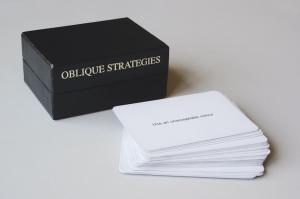
(Excerpted from Oblique Strategies by Brian Eno and Peter Schmidt, 1975)


Bikini Kill #2 – Hampshire College Zine CollectionOblique Strategies

Saturday, 9 November 2024

BOYZONE: A Different Beat

A Different Beat (Boyzone album) - Wikipedia


(#559: 9 November 1996, 1 week)


Track listing: Paradise/A Different Beat/Melting Pot/Ben/Don’t Stop Looking For Love/Isn’t It A Wonder/Words/It’s Time/Games Of Love/Strong Enough/Heaven Knows/Crying In The Night/Give A Little/She Moves Through The Fair


(Author’s note: later international editions of this album added “Picture Of You” as its lead track, which is logical, but since it’s also the lead track on entry #591, I will adjourn discussion of the song until then.)


By now, Take That were gone – for now – and Louis Walsh must have glimpsed the gap in that market. Hence it was no longer sufficient for Boyzone to be The Irish Take That; they were instead expected to take on the world and become “international.” This may explain the rather portentous opening seven-and-three-quarter minutes of their second album. It really wasn’t a wonder that overseas markets subsequently elected to frontload the record with “Picture Of You,” possibly just to wake listeners up. “Paradise” is slow, ponderous and self-consciously epic, as though auditioning for the Lion King musical – although despite the song’s characteristically cautious banality, I recognise that Ronan Keating’s vocal stylings are not a million miles away from those of Paul Heaton, and wonder what The Beautiful South would have made out of the same semi-cooked material.


The title song, which fans automatically sent to number one as a single – the second chart-topper from this album – was evidently intended to stand as Boyzone’s “Back For Good,” their big crossover moment. Unlike “Back For Good,” however, the music and words for which I have remembered for almost thirty years, I forgot how the song “A Different Beat” went even as I was listening to it. Nevertheless, and paradoxically, one knows exactly what it is going to sound like before you even hear it - perhaps syntactically baffling lyrics such as "Let unity become/Life on Earth be one" provide an easy clue.


And sure enough, the tick sheet is fully inscribed; there be the ersatz tribal chanting and drumming, the dawn over Kilimanjaro slow motion synth and piano, the forlorn Celtic pipes, and yea e'en unto the humpbacked whale samples. "A Different Beat" was Boyzone's answer to "Earth Song"; it was their first "self-composed" number one, although additional composer credits to producer Ray Hedges and arranger Martin Brannigan probably indicate who did the real donkey work here (a Peruvian donkey, mark you; Keating doesn't claim to have seen the sun rise over Maccu Picchu but has experienced rain in Africa, presumably in the footsteps of Toto, snow in Alaska and mist in Niagara so he knows what it's all about), and replaces Jackson's anguish and rage with pseudo-benign hands across the table we-are-all-one off-the-peg reassurance ("people," sometimes in rhetorical triplicate, are duly encouraged to "look around us" and "take a stand," though for or against what or whom remains non-specific; while "face" submits to being rhymed with "grace" for the millionth time).


The song barely exists, with no discernible tune or chorus apart from the equally obligatory "Ee-yay-oh" chant, and is even more ludicrously bombastic than you might expect, although there is a minute puzzlement at the record's end; according to the lyric sheet, "rain does not fall on one roof alone" forms the words of the closing climax, but Keating's exclamation of "one roof alone" sounds awfully close to "one rule for all" and is promptly followed by a brief bout of military tattoo drumming. Was he trying to tell us something subversive there?


The remainder of the album is well-behaved, sometimes irritatingly so. The old Blue Mink one-world ancestor of “A Different Beat,” “Melting Pot,” duly turns up with Madeline Bell herself dropping by and doing her skilful, tactful best not to let you think that she is effortlessly upstaging the rest of the group (in case you wondered, the problematic line about Chinese people has been modified to a not entirely convincing “Oriental sexy”). Stephen Gately turns Michael Jackson’s rat ode “Ben” into what we now know was a coded gay love song – his solo features throughout A Different Beat sound as though his voice has been tweaked and varispeeded upwards, offering the impression of androgyny; although, on his “Ben” in particular, his excited vibrati sound like a direct parent of Olly Alexander.


The covers, though, illustrate a fundamental problem with Boyzone and the protégés who would follow them; the disquieting harmonies of “Ben” – the unexpected dovetailing into the minor key at the beginning of its second verse, for example - are simplified and ironed out. And I’m not sure that Boyzone or Walsh – or possibly even the Gibb brothers themselves, who presumably sanctioned the cover – really get what “Words” is meant to be about; in its original form it is a small, hesitant, timid song with occasional and relatively shocking explosions of something in the suburbs of frustration – Barry Gibb vocally sounds like he’s aiming for a suburban Aaron Neville – all the better to outline the gulf between what the hopeful lover is able to say, as set against what he feels but dare not express (see also The Beautiful South’s “Blackbird On The Wire”).


Yet both boy band and their arrangers/producers overkill the song with glutinous Formica – worried that their fans might be scared of silence, they instead fill all spaces with heaps of nothing. Fatally the key line (“You think that I don’t even mean a single word I say!”) is delivered in Ralph Reader Gang Show sub-barbershop harmonies. Strings sweep when they should remain silent. Not that any of it mattered; all the fans heard was a simple, or simplified, love song onto which they could project their own fantasies. It’s just too bad that those fantasies seemed to be identical to those of their parents, or perhaps I fail to grasp something very basic about the behaviour of humans.


Actually, it's worth going into this in a little more detail. Just as Take That Mk I had their last number one with a Bee Gees cover version, so there was something of a deliberate symmetry about Boyzone having their first number one with a Bee Gees cover version. “Words” is a minefield of a Gibb Brothers song to cover, since it is all about suggestion and implication rather than overt emotionalism. Released as a single at the beginning of 1968, but recorded in October 1967, the Bee Gees original works as an extremely subtle essay in metapop; Barry Gibb sings tremulously, not of a love affair needing rekindling, but as the hopeful artist trying to convince the undecided listener (“A smile can bring you near to me”), wanting the listener’s undying devotion (“Talk in everlasting words/And dedicate them all to me”), varying his vocal towards the desperate in the axiomatic line “You think that I don’t even mean a single word I say,” but dropping it again to an immediate whisper, not confirming or denying that he means what he is singing, but simply saying, plaintively, “It’s only words…and words are all I have to take your heart away.” The production is relatively simple, with a mildly distorted piano – psychedelia seeped everywhere – and Bill Shepherd’s very delicate strings, harp and French horn arrangement providing the main backdrop to Gibb’s metamusings. At the end the music is more or less taken away entirely apart from a curious electric guitar which seems to be coming from a hundred miles away so that Gibb can crouch towards the listener and quaver in his best Aaron Neville quaver: “And words are all I have…to take your heart away,” that last “away” wavering like Charybdis.


Unsurprisingly Boyzone – in tandem with, or in submission to, their producers and arrangers – ignore the original’s subtlety and even its basic architecture; as soon as the gloopy piano, dentist’s drill high-pitched string synthesiser and Linn tympani make their bombastic entrance (at around two seconds into the track), Keating initially adopts a Gibb-type vibrato but soon bends towards bombast and overemoting. It all plods along on the same grey department store level of fake sophistication, but much, much worse is the feed of the “This world has lost its glory” declaration directly into the chorus, which not only sounds hopelessly awkward but destroys the methodical, slow build-up of the song as it was written in that it loses the emotionally crucial “Right now, there’ll be no other time” section. To rub acid into the wounds, the mess is reiterated at record’s end, and by the time the muffled Thus Spake Zarathustra timps thump their way out of the song we are left with no notion of what words might or might not mean, since Barry Gibb of course realises that it’s not just about words, but also the way in which you sing them. But the record certainly did help to “start a brand new story”; one of obedient talent show contestants, neutralised niche mass marketing and bland pseudo-global broths in which words were perhaps the least essential component.


The songs on A Different Beat do not tend to be “bad,” as such – the only blatant misfire appears to be the tacky New Jack Swing (or, more likely, MN8) photocopy of “Strong Enough” – but neither are they particularly inspiring, and never are they funny or outrageous. Yes, Carlin, you just want Boyzone to be The Beatles. Maybe Boyzone did too.


“Isn’t It A Wonder” and “Crying In The Night” are efficient and forgettable variations on the old aw-little-kid-you’ve-got-so-much-to-learn “Father And Son” theme (although the pause and key change heard towards the close of the former give an early indication of how Boyzone's anointed successors will successfully jerk a lot of knees). There are hints of inventiveness elsewhere on the record, for instance the pleasing bumps in the harmonic road throughout the choruses of “Don’t Stop Looking For Love” and the verses of “Games Of Love.” “Give A Little” is actually quite good in an Everything Changes-filler manner. Set against that are the transient piano descents punctuating “It’s Time” – did they sample a Russ Conway record? – although the arrangement is overall far too jovial for what is fundamentally a break-up song.


The essential problem with A Different Beat is summed up by its final track, a reading of that ancient Celtic warhorse “She Moved Through The Fair.” Few could hope to surpass the supreme interpretation by Van Morrison and The Chieftains, as heard on 1988’s Irish Heartbeat, where they convert the song into a free-form drone, somewhere just outside of tempo and reason – it would segue very naturally into the opening of the third side of Frames by Keith Tippett’s Ark – although Julianne Regan didn’t do a bad job at all with her slightly straighter rendition on the first All About Eve album from the same year.


Boyzone hired Phil Coulter, no less, to arrange and produce their version. But Coulter, an honourable man in numerous ways, really ought to have known better; here the song is ensconced in proto-Lord Of The Rings soundtrack bombast, all echoing “LET THIS BE THE HOUR WHEN WE DRAW SWORDS TOGETHER!” drums, winsome Celtic piping and Gandalfian gulfs of space. The mission seemed to be to nullify any strangeness in the history of music and render it palatable – i.e. neutralise it – to gain the biggest potential audience. Outside the United Kingdom, the Republic of Ireland and (unexpectedly) Taiwan, A Different Beat did not make the top ten so the international gambit didn’t particularly pay off. But Boyzone’s “She Moved Through The Fair” seems to me as well-meaningly absurd as The Bachelors tackling “The Sound Of Silence.” The final drum rattle sounds like the door of the tomb being closed on the record’s ambitions.

Saturday, 2 November 2024

The BEAUTIFUL SOUTH: Blue Is The Colour