Saturday, 25 February 2012

Rod STEWART: Atlantic Crossing


(#158: 30 August 1975, 5 weeks; 11 October 1975, 2 weeks)

Track listing: Three Time Loser/Alright For An Hour/All In The Name Of Rock ‘N’ Roll/Drift Away/Stone Cold Sober/I Don’t Want To Talk About It/It’s Not The Spotlight/This Old Heart Of Mine/Still Love You/Sailing

The thing most immediately noticeable when one looks at the inner sleeve of Atlantic Crossing is the huge, dark, blank space. At the foot, in some kind of Art Deco typography, are listed the credits; a long, impersonal list which doesn’t even bother to tell you who plays on what (a situation, I regret to report, not rectified by 2009’s 2CD deluxe reissue). There is, provocatively, no matiness whatsoever; no photos of Rod goofing around with the musicians, no self-deprecating, self-penned sleevenote…and certainly none of the musicians who had contributed to his British records. Make no mistake; Atlantic Crossing stands, or was made to stand, for a complete break with the past, the putting away of childish things and the assumption of a new seriousness.

This was understandable in the circumstances – Stewart’s solo contract with Mercury had expired and he was now fully signed to Warner Brothers; he had fallen in love with Britt Ekland; he didn’t fancy having to pay 83 per cent top rate income tax, so decamped from London to Los Angeles – but this did not stop, indeed may even have encouraged, some of the worst and most damning reviews of a rock album I can remember. Their gist was the same: Our Rod has sold out, he has ditched the Faces for anonymous, shiny sessionmen, he is a traitor to his own art, he has stopped being Our Rod and turned himself into Rod Stewart plc, an international brand for anonymous hotel lobbies and airport lounges the world over. He has become a decadent.

The facts, as usual, lie somewhere in between, and since it is not the job of this blog to recycle received wisdom but to assess fairly what is in front of it, the facts here may prove helpful. When Stewart left for the States and commenced preparatory work on his new album, he did not intend to abandon the Faces, indeed was contractually bound to do one more tour with them. But Stewart and producer Tom Dowd listened attentively to them in LA, at work in the studio, for an hour before regretfully agreeing that they could not provide a suitable backdrop to the kind of music he wanted to make. Moreover, Stewart did ask his old songwriting foil Martin Quittenton to make the journey with him and help write some of the new songs, but since this would have entailed being on the road with the Faces, the mild-mannered Quittenton settled for a quiet life.

Not unnaturally, this long-standing fan of Stax and Atlantic wanted to avail himself of the best musicians he could find. He met up with the MGs (if not Booker T) and got on well enough with them, although none of their initial collaborations made it to the final cut (they appear on the second CD of the 2009 reissue, including a scorching reading of the Bee Gees’ “To Love Somebody”) and there is no track where all the MGs appear together. Hence the sessions with Muscle Shoals’ finest, at the Hi studios in Memphis, and also in New York, LA and Miami, all with first division American session musicians (drummer Nigel Olsson, on loan from Elton John’s band, is the only other Brit to appear). The notion was not to make the album a series of soundalike tracks, but the central problem here had nothing to do with geographical disparities.

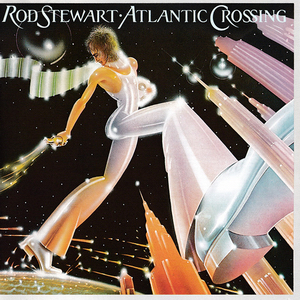
On the advice of his then manager Billy Gaff, Stewart divided Atlantic Crossing into two halves, a “Fast Side” and a “Slow Side,” and it is on the “Fast Side” that the album’s shortcomings become apparent. The symbolism of the cover was clear; Stewart has one platformed foot placed in the New World, but he is looking backwards at the Old Country, and more significantly has one foot still on British ground. True, he couldn’t have stayed with a formula which had outstayed its welcome; Smiler really had been the last hurrah for that method of working, and although it sold well enough to get to number one in the UK (and therefore into this tale), it only stayed on the album chart for twenty weeks, compared to the eighty-one weeks racked up by Every Picture Tells A Story.

But when “Three Time Loser” gets into its stride, you can’t help wondering whether Rod wants to have his cake and eat it. Yet another Jack-the-lad (or Rod-the-Mod) shaggy dog story (this time about venereal disease), it doesn’t take long for the casual listener to notice the disparities; the musical backing is a little too clean, the backing singers too efficient, the tenor sax soloist too smooth, and, above all, Rod, a little too desperate to impress with his whoops, trying his damnedest to convince us that he’s still the same old pub-rocking Rod Stewart despite his full knowledge that the goalposts have been moved. The problem is actually quite simple; he is obviously trying to find his feet in a new environment, and although the musicians are evidently more than keen to help him along with this material, he and they are not quite speaking the same language, and so there is a problem with aesthetic incompatibility.

The problem continues to manifest itself in “Alright For An Hour,” another would-be lad’s rave-up which guitarist and co-writer Jesse Ed Davis seems more determined to turn into pop reggae (although Davis’ unfailingly inventive guitar playing is a real benefit here, as is the bass playing, whoever is playing it). With “All In The Name Of Rock ‘N’ Roll,” Stewart makes his first lunge towards an all-out rocker, complete with police siren and horn section, but despite many inventive touches – for example, a drum intro which squarely predicates the Undertones’ “Teenage Kicks” followed by a minimalist John Cale top register one-note piano riff – he doesn’t quite pull it off, and here another problem becomes extremely noticeable; Stewart’s voice is too far back in the mix. He doesn’t impose himself upon a song like he used to be able to do. Hence, although the band works up a reasonable head of steam, and the central guitar riff is good and compelling, the track simply drags on for too long and has no choice but to come to a fairly abrupt halt, like a train having run out of fuel. Nor does Stewart’s cover of “Drift Away” help solve matters (this is not exactly a “fast” track); Dobie Gray’s original was almost by definition a record of the Watergate period, a reflection by a survivor on what had brought him to this state of resigned acceptance in the first place. Fatally, Stewart substitutes the “free” in the chorus of “Give me the beat, boys, to free my soul” for a second “soothe” and it just doesn’t carry emotional weight; the same can be said of Steve Cropper’s pointillistic and frankly over-fussy guitar lines – again, he seems to want to turn the track into reggae, and the overmiked wah-wahs on the choruses are uncalled for.

The side’s closer, “Stone Cold Sober,” a Stewart/Cropper collaboration, is also, however, the side’s saviour; if the “Fast Side” is a chronicle of two supposedly incompatible musical camps struggling to learn each other’s language, then “Stone Cold Sober” is the result of their finding a common ground. At last, voice and band seem to breathe in and out of each other, rather than being flashily superimposed; for the only time on this side, we get a picture of musicians pounding away in a studio. Furthermore, it is the latest entry in the “Out-Stone The Stones” contest – Ronnie Wood in particular must have heard this and growled his fury – and by some distance the record’s best rocker. Here everything – rhythm, horns, voices – blends together with a great naturalism, and it is from this point that the likes of Primal Scream derived their inspiration. The track fully merits the enthusiastic studio applause which ends it. Rapprochement has been reached.

Then, on the “Slow Side,” Stewart is given the pace and air for his interpretive voice to breathe and flourish – something which certainly wasn’t the case with the ballads on Smiler. His famous cover of Danny Whitton’s “I Don’t Want To Talk About It” brought out a sensitivity and compassion in his performance which had for some time been absent from his work. The 1971 Crazy Horse original falls apart while it is in the process of being performed; if I had not known better, I would have taken it for one of those Lou Barlow lo-fi Sebadoh tryouts on the early Dinosaur Jr albums. But here, Stewart is not rushed by the guitars or bass, or by Arif Mardin’s strings; they all appear to be in conversation with him, or at any rate listening to him. And Mardin’s final key change and huge question mark of an ending are touches of genius.

“It’s Not The Spotlight,” co-written by Gerry Goffin, is also a fine track, helped greatly by David Lindley’s excellent mandolin playing and some awe-inspiring bass work; my guess is Lee Sklar, but my apologies go to Donald “Duck” Dunn, Bob Glaud and David Hood, the other bassists listed in the credits, if one of them was responsible. More important than any of that, however, is Stewart’s magisterially reflective performance; this is an exhausted but happy love song for adults, performed by and for people who have lived through the unimaginable, and opened up an area hitherto largely ignored by rock; what happens when the rockers start to age?

Stewart’s slowed-down Al Green-style reading of the old Isley Brothers hit “This Old Heart Of Mine” – recorded in Hi studios with Green’s musicians, including the unmistakable (and, sadly, soon to be late) Al Jackson on drums – is also a nicely inventive touch, and well executed, the singer coaxing the song’s subtext of insatiable craving out into the open. But the key track here is “Still Love You,” the only song on this side bearing Stewart’s input as a composer. It comes across as a sort of “Maggie May: The Morning After” and has many recognisable elements, including the mandolin, celeste, organ and solo violin. But the “drugstore” reference places the song firmly in Stewart’s new home, and the music isn’t quite the same as it was in 1971 or 1972 (the despairing “Here I am again, writing this letter” is a direct reference to “You Wear It Well”) – once more it is a case of unfamiliar musicians slowly learning and assimilating the singer’s language, and once you get past that barrier, the performance, by singer and band alike, is deeply convincing. The drumming in particular is intelligently placed – if not Olsson or Jackson, it could have been Willie Correa, or Roger Hawkins – and in crucial sections, e.g. the “Two hearts gently pounding as that morning train…” sequence, the whole band appear to pause for breath and crouch down beside Stewart. Thus he is able to sing the “All I’m trying to say in this awful way” refrain with truthfulness, and the “I….I still love you” payoff, though probably rhetorical, and marred by inapt voice-echo, is suitably chilling. I also admire Stewart’s ingenuity as he signs off with a direct Isley Brothers paraphrase: “Guess I’ll always love you…”

All that remains is the venerated “Sailing.” The Sutherland Brothers Band’s 1972 original was not unknown to American audiences – here it flopped, though was included on K-Tel’s 22 Dynamic Hits Volume 2 - and perhaps as a result Stewart’s version didn’t do particularly well in the States as a single (although one has to correct the underselling of Atlantic Crossing’s success in the 2009 sleevenote; the album still made #9 on the Billboard chart and was certified gold). Elsewhere, however, and particularly in Britain, the single of “Sailing” went through the roof and was instrumental in introducing Stewart to a larger audience who wouldn’t necessarily have bothered with, or even heard of, Never A Dull Moment or Ooh La La - and it was certainly crucial in making Atlantic Crossing, for which the song stood as both finale and symbol, the staggering success it was here; reissues included, it stayed on our charts for a total of eighty-nine weeks.

How does Stewart’s “Sailing” stand up, however? Lena ventured the opinion that the song was a sort of compromise between Randy Newman’s “Sail Away” and Steam’s “Na Na Hey Hey Kiss Him Goodbye.” Myself, I note the involvement of Steve Cropper and the general theme of water and would label it the obverse of “Dock Of The Bay” – this is no aimless roam; Stewart sounds vulnerable at times but knows exactly where he is going and how to get there. He sounds regretful – as only he could – because he knows he’s leaving an entire life, a whole history, behind him. But, as with so many “classic” rock singles, “Sailing” makes far more sense in its original context; Mardin’s strings swell up as Stewart pulls away into the sunset, towards the darkness – the singer is saying his true farewell to “us” so long as he can remember who “we” are supposed to be. So the blank, dark space represents the unknown, and Atlantic Crossing, though fitful in finding its goals, deserves more than the history which it possibly gave to itself, as ready-made as the modest pun latent in its title.

Saturday, 18 February 2012

The CARPENTERS: Horizon


(#157: 5 July 1975, 2 weeks; 26 July 1975, 3 weeks)

Track listing: Aurora/Only Yesterday/Desperado/Please Mr Postman/I Can Dream Can’t I/Solitaire/Happy/(I’m Caught Between) Goodbye And I Love You/Love Me For What I Am/Eventide

“Some of them smile and it’s phony
Some of them smile and it’s okay
Some of them never tell you
Just how much love they’ll give away”
(American Music Club, “Last Harbor,” 1988)

“As we eye
The blue horizon’s bend
Earth and sky
Appear to meet and end
But it’s merely an illusion
Like your heart and mine
There is no sweet conclusion”
(Irving Kahal and Sammy Fain, “I Can Dream Can’t I,” 1937)

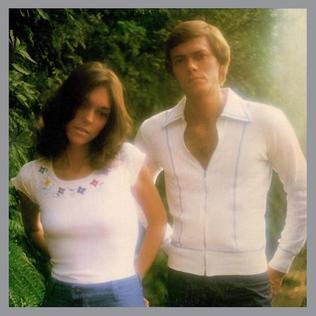
Neither of them appear especially happy on the deliberately over-exposed cover photo – Karen is doing her best to pretend the camera isn’t there - and despite the presence of a song entitled “Happy,” this is far from a happy record. In contrast to the Bay City Rollers, and the chirpy songs Paul McCartney wrote for his kids, this is also not an album for the young; “Please Mr Postman” was already fourteen years old, and it had been a quarter of a century since the Andrews Sisters had been at number one on Billboard with “I Can Dream Can’t I.”

One could therefore superficially dismiss Horizon as yet another symptom of the increasing shift in the albums market towards an older, more conservative demographic. But even if the Carpenters had made the record for no other reason than it was time to make a new album, there is something else going on here that the above does not quite explain. Put together as a concept album, mimicking the progress of a day from dawn to dusk (“Aurora” and “Eventide” are different versions of the same tune), there are songs about gambling (“Desperado,” “Solitaire,” “Happy”) but mostly songs about waiting for something - anything - to happen; waiting for the postman to deliver a letter, or dithering over whether to leave or stay with her lover, the ageing cowboy waiting for a miracle to come, the lonely man pretending no miracle will ever come.

With “Aurora” a new day dawns, and the echoes of sadness die away, or are hoped to die away (for this album never escapes the cloud of sadness which casts a huge, enveloping pall); “Only Yesterday” with its white bread Spectorisms (including surprisingly forceful drumming from Jim Gordon) tries its best to pretend it’s liberated (the opening line goes “After long enough of being alone” – already she is trying too hard), it never quite convinces; nor does the very similarly orchestrated Marvelettes cover, with Karen on drums and good solos from Bob Messenger’s tenor and Tony Peluso’s guitar. Both of these can be traced back to the oldies medley on Now And Then bookended by “Yesterday Once More” and share the foreknowledge that the past can never be reattained – on both, castanets rattle like buried snakes, and bells toll. “Desperado” doesn’t approach the barren poignancy of the Langley Schools Music Project reading and makes no more sense of the song’s confused poker analogy, but in the “hunger” of “Your pain and your hunger,” Karen’s voice cracks for the first time.

It cracks several more times throughout the epic reading of “I Can Dream Can’t I,” the record’s deliberate centrepiece; for instance, the “belong” of “You’ll never belong to me,” the “disillusion” of “There’s much disillusion there,” the penultimate “dream,” the second “sad affair” of “My heart is a sad affair.” Above all, Karen seizes and sits on the “conclusion” of the song’s prelude quoted at the top of this piece, and that prelude seems to me the cynosure of the record, the point where fantasy and reality meet to create a horizon. Billy May, then in his late fifties, was prevailed upon to provide an arrangement (here co-credited with Richard), and treats it as he would any Sinatra ballad; quiet rhythm rising to meet strings, a Dorsey-echoing trombone chorale, a wandering Pete Jolly piano solo, and a strings/harp coda to end. If only Richard had resisted the temptation to harmonise with Karen in the song’s closing ninety seconds – presumably intending an Andrews Sisters pastiche – this would have stood as one of Karen’s great solo performances; as it stands, it is one of the great Carpenters records, and also one of the most unnerving.

Side two commences with “Solitaire,” a song Karen didn’t particularly like, and despite its good moments – Joe Osborn’s initially inventive bass, Gordon’s increasingly rhetorical drumming, a particularly emotional and committed second verse vocal – it doesn’t quite work; the string arrangement is too slushy, and as a performance the song compares unfavourably with (in Britain at least) Andy Williams’ more famous reading (a top five hit here in early ’74) due to different verse lyrics but mostly to Karen’s obligation to sing the song in the third person (“And keeping to himself/He plays the game”), which necessarily places some emotional distance, as opposed to Williams’ first person delivery (his version works because he is able to convey his inner pain; you never doubt that he is singing about, and to, himself). Meanwhile, “Happy” isn’t a bad song per se but the listener remains unconvinced about any happiness, a feeling not dispelled by the strange Moog solo and the even stranger one hand clapping to fade.

By now the light of the afternoon is beginning to usher in the uncertainty of twilight, and the already dark mood grows even darker. John Bettis considers “(I’m Caught Between) Goodbye And I Love You” his best collaboration with Richard, but despite the moderately inventive, steel guitar-dominant arrangement and a fine vocal by Karen (including a very bleakly delivered second verse: “Then I may have to let you go/If only to survive”), the song suffers from a weak chorus and generally underpowered playing.

The song, however, does set the stage for the remarkable “Love Me For What I Am.” Ostensibly a variant on the old “You’ve Lost That Lovin’ Feelin’” template (“You’re always finding something/Is wrong in what I do”), albeit with the occasional phased guitar solo, the chorus sees Karen staring straight through the fourth wall, at her brother, at her record company – at her audience, especially – and so is worth quoting in full:

“You’ve got to love me for what I am/For simply being me/Don’t love me for what you intend or hope that I will be/And if you’re only using me to feed your fantasy/You’re really not in love/So let me go – I must be free.”

This is strong stuff, and although Bowie or Patti Smith could\have come up with these words, I doubt whether they could have poured as much conviction into their performance as Karen does; she is tearing down the cosy middle-of-the-road façade, demanding to be taken seriously – yet still caring enough to deliver that final, tender, pleading “free.” Walking a bridge between the Carly Simon of “That’s The Way I’ve Always Heard It Should Be” and the Aimee Mann of I’m With Stupid, this is one of the key feminist songs of its decade, and a palpable declaration of principles.

And so the day ends, with the ghostly chord changes of “Eventide”; whereas in the morning she walks down an alleyway, she returns walking up an avenue. And yet this is hardly catharsis: “Lying under barren skies,” “Weary to be home again”; these are not the warm words of a returned spirit, and somewhere, out beyond the realm of the palpable:

“Candles burning by the sea/Are waiting for me/Patiently/I wish the same/For you.”

She is aware of the existence of eternity and does not fully turn her back on it. If Horizon is one of the bleakest albums I have covered in some time, it is also one of the most satisfying of albums; it yearns to escape the known Carpenters straitjacket, and as a discrete whole makes perfect architectural and emotional sense. In the USA it proved too much to take, becoming their first album to miss the Top 10 after five straight hits, but here it stayed on the chart for fully six months, and in its combination of emotional limbo and subtle experimentation, perhaps a quote from another, not dissimilar, 1975 album might be in order:

“I’ve been down the road and I’ve come back
Lonesome whistle on the railroad track
Ain’t got nothing on those feelings that I had”
(Neil Young, “Mellow My Mind,” 1975)

Saturday, 11 February 2012

WINGS: Venus And Mars


(#156: 28 June 1975, 1 week; 19 July 1975, 1 week)

Track listing: Venus And Mars/Rock Show/Love In Song/You Gave Me The Answer/Magneto And Titanium Man/Letting Go/Venus And Mars – Reprise/Spirits Of Ancient Egypt/Medicine Jar/Call Me Back Again/Listen To What The Man Said/Treat Her Gently – Lonely Old People/Crossroads

“I mean, if this goes on like we’re saying it’s going on, it looks like that might be kind of the thing, y’know…”
(Paul McCartney interviewed by Charles Shaar Murray, NME, 26 July 1975)

“Rock on lovers everywhere, because that’s basically it”
(Wings, conclusion to sleevenote, Venus And Mars)

It occurred to me that Paul McCartney is the Jamie Oliver of pop, and not just because Jamie was born in May 1975, into (or about to go into) the world of Venus And Mars; both practise very hard at being chipper, can-do-anything chappies, irrepressible, imperturbable, Everymen loved by infant and grandmother alike, and it may be because that’s what they’re really like; conditioned not to be bowled over by anything life might throw at them. I doubt whether McCartney would have been particularly perturbed by the prospect of being interviewed by CSM, whose piece makes it plain what he thinks of Venus And Mars, namely, “not only one of the worst albums I’ve ever heard from a so-called ‘major artist’, but…also the most decadent.” McCartney, of course, sees him coming a mile off and puts up his steel ring of Fab Wacky Macca Thumbs Aloft, with plenty of non-committal “really”s and “y’know”s (and constant interruptions of whatever Linda might have to say) to conceal the fact that he doesn’t have very much to say about the record, or indeed about anything (the Common Market, taxation, politics – all disappear into a vacuum of “y’know”s), much to the chagrin of CSM, who is desperately trying to think of a diplomatic way of saying “Your album is so godawful I wouldn’t use it to line a budgie cage even if I had a budgie.”

Maybe Macca just wanted to lie back and have a good time. The album was recorded in New Orleans, a relative comfort following the toughness of Lagos, but where Band On The Run worked against the toughness and loneliness – the artist forced back onto his own resources - Venus And Mars frequently sounds too comfortable (i.e. drunk and/or doped), as though McCartney no longer has to try. And, in truth, he didn’t; if he wanted to make an album for his kids full of thirties pastiches and whimsical Marvel Comics homages, then didn’t (as he saw it) he have the right?

If this had been anybody in 1975 then I doubt a single word would have been expended on the record. But this was McCartney, from whom one expected a certain quality threshold – still, how do I define that “one” in the face of the ten million people who bought and loved the record? For them, McCartney still existing was enough, and from the American point of view I’m sure songs like “Rock Show” and “Magneto” sounded ideal on a sunny morning, cruising past the Wells Fargo Bank and the Biltmore Hotel.

But where Band On The Run benefited from its surrounding tension, such that every track sounds like a single, virtually nothing on Venus And Mars is still played today with the exception of “Listen To What The Man Said.” In addition, the argument for this being the first “Wings album” – i.e. the first one conceived and recorded as an integrated band – is rather undermined by the sleeve photos, which only show the members as distant figures. Paul and Linda can be seen grooving away at a Mardi Gras-type parade in New Orleans, but an attendee’s left shoulder blocks out Denny Laine. Nor was the record the work of an integrated band; drummer Geoff Britton left after completing only three tracks – he didn’t get on with Jimmy McCulloch – and his replacement Joe English was hurriedly hired and coached. Still, the McCartneys did their best; although Linda never gets to sing a Wings track, “Spirits Of Ancient Egypt” was largely given over to Laine to sing, while McCulloch both co-wrote (with one Colin Allen) and sang “Medicine Jar.”

This timid democracy, however, helped ensure the flimsiness and inconsistency of Venus And Mars. I don’t agree that McCartney simply slacked his way through the record; some care was obviously taken with the sequencing and segueing, and it is clear from the title track reprise, at least, that some concept took root in his mind. The trouble is that the good and clear moments are so distantly spaced as to be rendered meaningless, and the gaps are filled by largely irredeemable tosh.

The title track, for instance, is pretty and heartfelt enough, despite McCartney’s sometimes arch diction (“sports a-re-NAH”), and its bridge somewhat more than that (it later returns with more echo on McCartney’s voice, various Moog noises and an impressive, improvised choral line which put me in mind of Granddaddy’s The Sophtware Slump as well as the wheaty spirit of 1975 which the likes of Advisory Circle and Goldfrapp try so hard to recapture). But no further are our minds engaged than we are shoved into the limp “Rock Show.” Despite Allen Toussaint’s piano (taking “Lady Madonna” back to its rightful home at fadeout) and the song’s occasional moments of invention (e.g. the tuned clock chimes in the extended middle eight), the song is misguided in both conception and execution (it sounds like a half-hearted Kiss having a go at Elton’s “Love Lies Bleeding”) with its jibes at Jimmy Page and glam rock (the latter set against, I ask you, cod-reggae and spoken in McCartney’s comedy “posh” voice, crowned with deranged howls of “KIT-TAY!”) and stupid lyrics (“It’s Silly Willy with the Philly Band” – might I suggest that the line “The tension mounts, you score an ounce” contains more than its allotted modicum of truth?) making the 33-year-old Paul suddenly sound very old and reactionary indeed (having a go at glam in 1975?). It seems nothing more than an attempt to crowbar famous venues into one song, and the music hardly suggests a brighter tomorrow.

“Love In Song,” in contrast, is one of the simplest and most moving songs Paul ever wrote, a straightforward and clearly heartfelt dedication to Linda, delicately outlined by harpsichord and modest Moog with its refrain of “Happiness in the homeland,” together with subtle strings and McCartney’s most committed vocal performance on the record; hear how his voice falters at the end of the line “My eye cries out a te-ee-ear.” This song is so good I can imagine the Stylistics doing it justice.

When McCartney drops the pose and tells his truth, his music works; but “Love In Song” is quickly succeeded by the ridiculous “You Gave Me The Answer,” the latest of McCartney’s interminable line of straw boater/megaphone vaudeville period pieces, and by some distance the least convincing, not just because of the opening piano improvisation on “Maybe I’m Amazed,” but because as a pastiche the song sounds uncomfortable, ill-fitting; the melodic progression and McCartney’s at times over-passionate vocal both threaten derailment. “Magneto And Titanium Man” still carries a bit of thirties sauce about its seventies AoR strut – there’s a bit of Billy Swan’s “I Can Help” and quite a helping of Steely Dan’s “Reelin’ In The Years” – with some incongruous blasts of McCulloch guitar. McCulloch does better with his solo on “Letting Go” which again betrays McCartney’s familiarity with mid-seventies American FM radio (think Linda Ronstadt’s “You’re No Good” with extra horns and Moog). The latter song, another ode to Linda which might properly be retitled “If You Love Somebody, Set Them Free,” sees McCartney’s voice working back towards commitment without ever touching it; he drops out before any primal scream catharsis can be attained.

“Spirits Of Ancient Egypt” is just plain weird, and not in a good way (the track has, according to McCartney, “a couple of T. Rex touches” – what the hell was he thinking, or on?), coming across as an ungainly halfway house between Gene Vincent (Laine’s brave but desolate “You’re my baby”s, but then he has to cope with driving a Cadillac across the Irish Sea) and Midge Ure’s Ultravox (when Paul and Linda come back for the chorus and synths take centre stage). McCulloch’s “Medicine Jar,” meanwhile, sounds as a generic a 1975 rock track as one could find; it could literally be anyone or anything, and only McCulloch’s vague vocal resemblance to Ringo suggests why this was given the time of day anywhere, let alone points from a multimillion seller. This notion of “democracy” certainly doesn’t help with the record’s flow.

Nor does the tortuous “Call Me Back Again,” a forlorn, and unending, attempt to recapture the spirit of “Oh Darling.” McCartney admittedly doesn’t help matters with his vocal, which begins painfully out of tune, and despite some subsequent improvement his performance is quite overcooked, descending easily into pseudo-Plantisms (“When I-hi-hi-hi-hi-hi was a just a little baby boy”; look, McCartney, when you were a little baby boy you didn’t HAVE a telephone). The track, like too many tracks here, drags on and on under the impression that it’s “Hey Jude,” which it most definitely isn’t.

A moronic introduction of counterfeit jive talk notwithstanding, “Listen To What The Man Said” shows how good Wings could be when McCartney dropped the Fab Wacky nonsense and concentrated on writing pop songs. Here he finds confluence with the seventies AoR stream, helped I suspect to a major extent by guest guitarist Dave Mason and guest soprano saxophonist Tom Scott – the flow is irresistible, the Moog bass non-gratuitous and the lyrics erring on the side of simplistic rather than foolish. The build-up to the climax – “The wonder of it all, baby” – is exciting, the group sounds committed, and the transition from lead guitar to ‘cello (and thereupon the full string section, and the slow section) is both unexpected and wholly natural (rivalled only by the similar section near the end of Paul Simon’s Lennon tribute “The Late, Great Johnny Ace”).

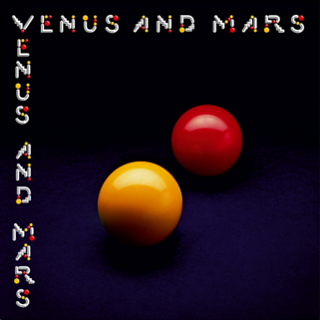
The trouble here, again, is that, having created a variety of possible directions with that final section, McCartney settles for the most mundane. The “Treat Her Gently/Lonely Old People” sequence strives to emphasise with the plight of the old, but has nothing of the acrid poignancy of Scott Walker’s “Two Ragged Soldiers” or the basic good humour of Bob Hope’s many versions of “Thanks For The Memory”; instead we have a sagging waltz with the only inspired arrangemental touch being the sudden, stinging surge of string synthesiser – like an injection of sodium pentathol – succeeding the second statement of the phrase “old people’s home.” Finally, the old people being represented (“Nobody asked us to play”) presumably wander off camera to the strain of Tony Hatch’s theme from Crossroads, heading back to their televisions to watch the surreal interplay of actors and camera booms, improbable plot turns, ripe overacting and unscheduled Pinterisms which that singular soap opera encapsulated. McCulloch plays the tune as though it were still “Something In The Air” and the day fades to a Macca mutter and a cover which suggests not so much Botticelli’s painting of Venus And Mars as a couple of snooker balls in space. Wings went on to score more number one albums in the States, but not here; songs like “Let ‘Em In,” “Silly Love Songs,” “Mull Of Kintyre” and “With A Little Luck” proved them to be one of the great singles acts of the decades who never managed to make a good album (Band On The Run being largely a solo McCartney effort). I’m sure McCartney still isn’t bothered by that, really.

Saturday, 4 February 2012

The BAY CITY ROLLERS: Once Upon A Star

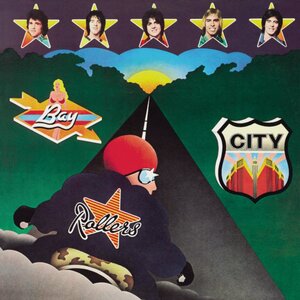
https://upload.wikimedia.org/wikipedia/en/e/ec/Once_Upon_a_Star_%28Bay_City_Rollers_album_-_cover_art%29.jpg

(#155: 3 May 1975, 3 weeks)

Track listing: Bye Bye Baby/The Disco Kid/La Belle Jeane/When Will You Be Mine?/Angel Baby/Keep On Dancing/Once Upon A Star/Let’s Go/Marlina/My Teenage Heart/Rock And Roll Honeymoon/Hey! Beautiful Dreamer

Back so soon, boys? Actually I do derive more than a shred of comfort from the fact that, had Twitter been going in 1975, it would have been overrun, not by Beliebers, but by their spiritual ancestors, the Rollermaniacs; and, like Our Justin, the appeal of the Rollers at their peak was practically sexless, or ignorant/blissfully unaware of sex – their blanket was one of comfort and security, and we shouldn’t forget that their second number one album, much like their first, is aimed at twelve-year-old girls rather than Steely Dan fans.

Whether the Rollers listened to Pretzel Logic in their own time and agonised is another question, but what is clear from Once Upon A Star is that they had been riled, badly, by the print about session musicians on their hits, about being Martin and Coulter’s puppets, and were determined to prove that they themselves were the attraction. Thus Martin and Coulter were shown the door (whereupon they immediately turned their attention to, amongst others, a promising Glasgow band called Slik) and replaced by former Sweet and Alex Harvey producer Phil Wainman, who, with Johnny Goodison, came up with three of the album’s dozen tracks. Two others were covers, leaving seven tracks written by Eric Faulkner and Woody Wood (with Les McKeown helping out on two of these).

The results are inevitably mixed and present a picture of a band in a tug of war with itself. Of the Wainman/Goodison songs, “When Will You Be Mine?” is a lame rewrite of “When Will I Be Loved?” clumsily superimposed on the standard rolling piano Rollers template, “Let’s Go” is the Archies doing the Glitter Band, strangely bloodless, even with its “Saturday Night’s Alright For Fighting” guitar line and key change (though, as Lena pointed out, speed the song up a bit and make it more antisocial, and you have the Ramones), and “Rock And Roll Honeymoon,” belted out by an enthusiastic Alan Longmuir, is perfectly serviceable power pop, complete with “Here Comes The Bride” Roy Wood-ish sax interlude, which would be venerated had it been Eric Carmen and the Raspberries.

Of the two covers, “Bye Bye Baby” was the biggest hit they ever had, McKeown sounding strangely elated about being torn between two lovers while the Roller formula met its apogee (one has only to listen to the flaccid “My Teenage Heart” to appreciate how difficult this formula was to reproduce), while “Keep On Dancing” was a mechanical retread of the 1971 original, deprived of Jonathan King’s production tricks and Johnny Arthey’s arrangemental genius – wah-wah guitar replaces organ and the false ending is substituted by McKeown bellowing over the least convincing crowd noises I have ever heard on any record; is that a baby squealing towards the end?

Left to Faulkner and Wood’s devices, one can sense how brave the struggle was for the group to assert themselves; the question being whether they had enough resources as a group to carry out their ambitions. On this listen my answer must be no, although it’s hardly for want of trying; if nothing else you are witnessing the sound of a band trying their damnedest. One’s heart does not warm up with expectation, for instance, at the prospect of a song entitled “The Disco Kid,” which if you were a Roller is about the last title, or idea for a song, you’d use. And McKeown’s introductory grunts of “Check it out!” and “UUHHH!!” do not exactly raise hopes. That being said, it’s a fair attempt, the wah-wah and clavinet work turning it into a sort of Junior Showtime “Trampled Under Foot,” with an interesting use of echo (“He’ll shake you DOWN!”), if an ultimately unconvincing one (“They call him Disco Kid!” announces McKeown at one point; presumably he doesn’t mean the guitarist who three years later appeared on Sun Ra’s Lanquidity). Similarly, “Angel Baby” isn’t much more than an attempt not to be “Be My Baby,” but I can’t think of any twelve-year-old 1975 girl who wouldn’t have melted at McKeown’s Morningside talkover.

It’s when they stretch their limbs in other directions that the Rollers really begin to engage my interest. “La Belle Jeane” thinks it’s The Band’s “When I Paint My Masterpiece,” with its ample mandolin and accordion deposits and tricky Franglais, but it’s not a bad thing to think, and the track gets truly interesting when the band try to cut the dummy loose, with Derek Longmuir’s minimalist drumming and its sections of dissolute harmonies, the chord structure at times reminiscent of Roy Harper’s “When An Old Cricketer Leaves The Crease.” The closing “Hey! Beautiful Dreamer” is a Beatles pastiche – Harrison guitar, verse and chorus, Lennon piano and middle eight (“How can you feel nothing is real?”) – which nearly pulls it off, its disjointed ethereal harmonies resolving in an angelic harmonic ascent towards fade, as though the band are fading from our grasp forever.

But the Faulkner/Wood Rollers work best, unsurprisingly, when dealing with the subject of fame and stardom (yes, this is classic, slightly self-conscious second album syndrome). The title track has ambitions beyond its grasp, looking for harmonic adventure and arrangemental imagination (well, there are a couple of clarinets) although stylistically it rather resembles Carl Wayne’s New Faces theme “You’re A Star” with perhaps a dash of CSN’s “Our House.” Still, it’s a sad but generous reflection on the transience of fame, etc. (“Your friends all drinking champagne from your hands”). And “Marlina,” one of the two tracks co-written with McKeown, cuts the deepest (although the sleeve is at pains to point out that the names “Marlina” and “Jeane” are “purely fictitious”); about a young girl seeking fame (and escaping from her “silver stallion” fantasies, although the song already knows that she won’t), Faulkner goes for the full Rod Stewart violin/mandolin deal, but the song is sung a lot more generously; McKeown’s voice is at times not a million miles from that of Roddy Frame, and overall the song structure, with only slight alterations, is that of Teenage Fanclub’s “What You Do To Me.” Here, though, is the impression that the group actually cares about what they’re saying.

Indeed three of the last four tracks on Once Upon A Star would not have been out of place on, say, Grand Prix or Songs From Northern Britain; and perhaps it’s a truism that the Rollers’ real legacy lies in their intended, and unintended, subsequent influence on pop. It’s also probably true that the average 1975 Rollermaniac wasn’t too bothered about self-authorship and just wanted to luxuriate in the sound and spectacle of the Rollers being themselves. But, at least here, the Rollers don’t get another chance; Wouldn’t You Like It?, which followed just a few months later, is overall a stronger album but only peaked at #3, and 1976’s Dedication was a dignified swansong (not that it was intended as such) but by its time sorely out of place. By that time the fleeting Stateside success had already fizzled out, and the real story of a decent but trapped group – nervous breakdowns, attempted overdoses, personnel changes, internecine band fights, court battles over unpaid royalties, not to mention the extremely thorny question of Tam Paton, the Walton Hop, and all that – had begun to leak out. For now, however, here stand the Rollers, a group who probably would have had a much better chance on Creation Records in 1995, if not an equivalent Twitter overload.

Saturday, 28 January 2012

The STYLISTICS: The Best Of The Stylistics


(#154: 19 April 1975, 2 weeks; 24 May 1975, 5 weeks; 16 August 1975, 2 weeks)

Track listing: You Make Me Feel Brand New/Betcha By Golly, Wow/Rockin’ Roll Baby/Break Up To Make Up/You’re A Big Girl Now/I’m Stone In Love With You/Stop, Look, Listen (To Your Heart)/Let’s Put It All Together/You Are Everything/People Make The World Go Round

Bowie missed a trick with Young Americans. If only, instead of dessicated soul-liloquies (although one senses the desperation lurking within “Can You Hear Me” and watches as the “human” is systematically eradicated altogether in “Fascination”) he had issued a series of lushly-orchestrated, androgynous serenades – who knows what impact that might have had, since no album sold more in 1975 Britain than this one. Smooth, silky, a perfect soundtrack for Martini-pouring…that is, if you don’t listen too clearly or take in its implications too fully.

The Stylistics as represented on this collection were less a soul group, more a laboratory experiment, a way for Thom Bell to expound and develop the theories he had conceived while working with the Delfonics. There was Philly soul, true enough, but other than its not-Motown serene smoothness, Bell’s work has little to do with that of Gamble and Huff; Kenny Gamble gets a co-writer credit on “Break Up To Make Up,” and most of these tracks were recorded at Sigma Sound with Philly musicians, but the relationship is otherwise parallel, close to non-existent.

The group came together in 1968 as a merger of two Philadelphia street bands, the Percussions and the Monarchs. Evidence that they didn’t yet know what to do with themselves can be found in their 1970 debut single “You’re A Big Girl Now,” co-written and co-produced by road manager Marty Bryant. It was done for $400, and sounds it; following a mock-oriental guitar opening and some referencing of Hendrix, a distorted Del Shannon-esque organ takes over, merging with the falsetto of Russell Thompkins, Jr, and the overall feeling is one of a JA dubplate, complete with melodramatic basso profundo talkover (it’s like the Ink Spots meeting the Paragons). Nonetheless the single sold healthily in Philadelphia, and provided their passport for signing to Avco; Bell was generally unimpressed with their demos and signed the group solely on the potential he heard in Thompkins’ voice. Almost from the start, Thompkins was the focus of Bell’s Stylistics, so forcefully that several of their early cuts are effectively solo Thompkins performances.

Bell, and his lyricist partner Linda Creed, opted to work with the group almost purely on a ballad basis; he was about to sign the Spinners for the uptempo stuff. It was a gamble that worked; of this record’s ten tracks, only one is uptempo, the rather unconvincing “Rockin’ Roll Baby,” a sort of Osmonds distortion of Bobbie Gentry’s “Fancy” (and which I fancy had originally been intended as a Spinners track) whose nice Carole King-ish groove cannot obscure wince-inducing words (“his little orthopaedic shoes” indeed!). And, apart from “You’re A Big Girl Now,” the only non-Bell track here is the (then) most recent; 1974’s autumn top tenner “Let’s Put It All Together” – now under the aegis of producers Hugo & Luigi and arranger Van McCoy, who must have thought that putting together a song in the Bell style was the easiest thing ever, the song sounds clumsy, stretched and over-simplistic; “My lips and your lips – what more is there to say?,” “You love me and I love you” – these words evoke Sesame Street, or possibly chapter one in a Teaching English As A Foreign Language handbook, and the song’s only saving grace is the unexpected suspended D major seventh chord which ends it.

Of the remaining selections, no less than five come from the group’s eponymous 1971 debut album – “Big Girl,” being one of them, set aside, these songs set out the template with which Bell intended to play. Intending to return to this source, though, the later songs are worth examination; “I’m Stone In Love With You” (1972) finds the singer’s soul still stoned, his mind largely occupied by aimless dreaming, culminating in him fantasising about owning the first house on the moon (“No population boom”). “Break Up To Make Up” (also 1972) is almost French in its melodic and orchestral constructs, moving both into neoclassical soul and a harbinger of New Pop, in that the lushness camouflages the hurt that is actually being sung about (“First you love me, then you hate me,” and its second verse casts a paranoid, askance eye on that of the O’Jays’ “Backstabbers”).

1973’s “You Make Me Feel Brand New” is in many ways the apogee of the Bell/Stylistics approach, and the group’s biggest pre-Hugo & Luigi UK hit single. As it was also a number two single, I have to be careful what I say about it here, but sufficient to notice the return of the electric sitar from “You Are Everything” with empathetic piano accompaniment, the subtlest key change perhaps in any pop record (from first chorus to second verse), the song’s near hymnal construction – there are multiple references to faith, “precious” and God, and note how Airrion Love’s voice trembles on “love,” “hands” and “again” – and, above all, what I believe to be the central premise of Bell’s Stylistics, namely the androgynisation of soul; the song ranges from Love’s bass to Thompkins’ falsetto, in other words from male to female, and in the end everybody and everything sounds as one. This goes beyond anything Bowie might have been thinking in 1975, the song’s lyrical clumsiness notwithstanding.

But if I have to return to the four remaining, peerless cuts from their debut, it is because they represent the group and producer’s best and most adventurous work. Oboe begins both “Betcha By Golly, Wow” and “Stop, Look, Listen” but each song diverges down a very different track; “Betcha” sticks to the psychedelic soul template, perhaps owing a little to Charles Stepney’s work with Rotary Connection, with its quietly elated references to skies, rainbows, candy smiles and “Catch A Falling Star,” but primarily with its exquisite melodic construction. In contrast, “Stop, Look, Listen” demonstrates how well the group worked as a harmonic conductor; the oboe is accompanied by pizzicato strings, giving way to glockenspiel, and guitar lines which alternate chunky chords with fluent single-note runs. The group’s triple ascents of “Lord” indicate how major an influence the Beach Boys must have been on Bell, as does the arrangement, with its solitary French horn resting on a bed of bass trombones. “You Are Everything” is the record’s most obviously psychedelic track, its electric sitar drowned in generous phasing, as Thompkins ponders about mistaking other women for his Other – the music plays as a stoner soul variant on “Kashmir” and the song proves Thompkins’ unexpected range, from troubled contralto to wretched sopranino; his voice is sweet always, but never less than sharp.

Best, and most visionary, of all, however, is the final track, “People Make The World Go Round,” which even in this abbreviated form remains their masterpiece. It comes across as a comfort variation on “Ball Of Confusion”; Moog howls and wind chimes give way to low electric piano, sighing bass and menacing Whitfield strings…and, eventually, a marimba. Politically the song is confused beyond belief (“Buses on strike, want a raise in fare/So they can help pollute the air”) but is redeemed by Bell’s brilliant arrangement – sour flugelhorns signifying a Wall Street gone to seed – the close relationship of the song’s melody and rhythm with Bacharach, and Thompkins’ weary, resigned yet still hopeful delivery. It’s like that, and that’s the way it is, he seems to sing, but does so like an angel, so persuasively that it’s difficult not to follow his instruction to “Go underground, young man.” The song proceeds with imperial patience, and finally, when the song might seem unable to go any further, Thompkins repeats the title phrase, over and over, further and further from the microphone, until in the end he becomes just another element in the framework, a stray leaf fallen in the pasture. Had I compiled this album I would have included the song in its six-and-a-half-minute entirety, since as Thompkins fades from view, or at any rate hearing, the song continues to drift, nowhere in particular; there are long, languid solos for guitar and flute (the latter played by Harold Vick, and drawing immediate comparison with Charles Lloyd’s work on the Beach Boys’ “Feel Flows”) and the music slowly vanishes into nowhere and nothing. A soulboy’s “Surf’s Up” (and released in the same year), this track opens up long-banished memories for me; I bought the original album – featuring the group reclining in a field of endless hay – on LP for a pound one languid Tuesday afternoon about a dozen years ago from a junk shop in Wandsworth (which didn’t know what it was selling) and took it back with me to Oxford, and it is memories of a disappeared Oxford which the song now engenders (apart from being a forebear of everything to come, including New Pop and Massive Attack); sensations of fugitive foxgloves in the declining shade of Botley Park, abandoned roundabouts and furniture warehouses, the shades of Ruskin and Wilde at the top of Ferry Hinksey Road, unexpected blossoms by canals, stiles which deposit one, via dog tracks, to the middle of Iffley, always the sunset, Air’s “All I Need” and Bill Fay’s “Some Good Advice,” Cumnor Hill of a Sunday mid-morning, a turning world, shivers in Port Meadow, getting towards dusk, becoming ever darker, across the universe.

Saturday, 21 January 2012

Tom JONES: 20 Greatest Hits


(#153: 22 March 1975, 4 weeks) 


Track listing: It’s Not Unusual/Only Once/I’ll Never Fall In Love Again/What’s New Pussycat?/Till/Runnin’ Bear/Green, Green Grass Of Home/Thunderball/Love Me Tonight/She’s A Lady/Pledging My Love/Funny Familiar Forgotten Feelings/With These Hands/Delilah/I’m Coming Home/To Make A Big Man Cry/Help Yourself/The Sun Died/Daughter Of Darkness 


I suppose it stands as a relative measure of how big they were at the time. Whereas Engelbert had to make do with a single sleeve and a dozen tracks, Tom gets a twenty-track double album with grandiose “Tenth Anniversary” subtitle and lavish gatefold sleeve picturing the Welshman with his many celebrity pals, and a motley lot they are too – after the expected Sinatra and Elvis, there are Joni Mitchell, Ray Charles, Wilson Pickett, Smokey Robinson, Little Richard, Charles Aznavour, Tony B and Sammy DJ, but also snapshots (presumably all taken from the This Is Tom Jones TV series) of the man with Bob Hope, Matt Monro, Harry Secombe and Victor Borge; a conflict between aesthetic aspiration and the demands of light entertainment which I think penetrates to the very core of Jones’ music.


Like the Humperdinck collection (and inevitably there’s a shot of Engelbert and a bearded Tom, grinning and resembling no one as much as Godley and Crème) the track selection is slightly random; just as bona fide hits such as “I’m A Better Man” and “Too Beautiful To Last” are absent from His Greatest Hits, so were only fifteen of Jones’ twenty tracks actually “hits”; conspicuous by their absence are the likes of “Detroit City,” “A Minute Of Your Time,” “Without Love (There Is Nothing),” “I (Who Have Nothing)” and the dreaded “The Young New Mexican Puppeteer.”


What we are left with is a portrait of a man in battle, not so much with the material he is given to sing but the way in which it is given to him. It’s arguable that no one really knew what to do with Jones from the word go. In his 1972 survey Voxpop: Profiles Of The Pop Process, author Michael Wale undertook a series of lengthy, detailed interviews with the prime movers of the day. Among them was Les Reed, who as composer and/or arranger and/or producer had a hand in Jones’ most famous hits. When pressed by Wale as to what unique qualities he detected in Jones, Reed volunteered the following reply: “I consider Jones has got a voice which nobody else in the world has got. He’s so detached from the rest of the world, singing-wise, that if one is au fait with his records and recordings to a point where you know where his next phrase is going to be without even thinking about it, then you have to write a song in that mode, even if it means embarrassing yourself by singing it yourself and all that, but you’ve got to get hold of Tom’s phrasing, his range and the type of lyric that he would like to sing about…he’s a man but he doesn’t want to show it too much on record…Tom can’t get sentimental. He’s a real man’s man, he’s got inward feelings, and so you have to put it in such a way that it’s not embarrassing to him for the public to listen to him singing something schmaltzy. It sounds very much round the bush but that’s how it works.”


Not everybody dealing with Jones had the patience to go round the bush. Reed, for instance, is very insistent that he would approach a Humperdinck song in a different manner from a Jones song, but too much of what is here veers towards the wrong side of schmaltz. Clive Westlake’s “Only Once,” for example, with its precious Spanish guitar, raspberry brass, regretful mutters about “the way young people always do” and general air of a failed Eurovision entry, is clearly a romantic/Hispanic song meant for Humperdinck, and so when Jones does it, it doesn’t work; similarly, the high camp of “Help Yourself” and “Love Me Tonight” are Engelbert environments in which Jones sounds utterly lost. But, as I say, perhaps Jones was lost from the beginning.


This collection begins, as I believe all Jones compilations are legally obliged to begin, with “It’s Not Unusual,” a powerhouse performance which must have sounded like emissions from another planet in 1965. Rejected by Sandie Shaw as an A-side, Jones grasps the song’s contours with as many limbs as he can spare, and Reed astutely limits the orchestral backing to fortissimo trumpets, ruminative baritone sax and Joe Morello’s pained lead guitar. It went straight to number one – there was, after all, literally, no competition – but immediately set its own limitations. The British male solo star was a nearly extinct species in that age of Beatles and Stones – chart regulars like Roy Orbison, Gene Pitney and the transported Texan P.J. Proby being Americans – and it is true to say that for the best part of two years Decca had no idea how to handle Jones, instead trying him in all directions.


From this period comes his reading of “With These Hands,” an early try at his Big Ballad template ruined by an over-florid, cheesy, Liberacean piano and an over-fruity vocal delivery (it is possible that Jones had Bobby Hatfield’s performance on the Righteous Brothers’ “Ebb Tide” in mind). He fared better with film themes; John Barry pushes him to his physical limits on the Bond tune “Thunderball” – how better were the Bond songs when they were about the villain! – forcing a climactic high C following which Jones fainted in the studio. And “What’s New Pussycat?” is odd and misleading enough to keep Jones on his toes (even though he indignantly demanded an explanation of the lyric from Hal David).


Only with “Green, Green Grass Of Home,” hitherto an obscure Jerry Lee Lewis album track, did Jones hit on his winning formula; tearful but unsentimental balladry sunk by battalions of ‘50s strings and choirs. Where on his original reading Lewis sounded unconcerned, resigned, about going to the gallows – and why is he to hang? What has he done with “sweet Mary”? – Jones never quite extinguishes the dread from his voice. Still, the single marked a bend in the road, where the adventure which had been straining at the leash throughout 1966’s groundbreaking series of 45s suddenly cut loose and sailed towards the more welcoming arms of the album format, leaving the charts more or less at the mercy of unambiguous, easily-felt balladeers.


The format continued unabated throughout 1967; Mickey Newbury’s “Funny Familiar Forgotten Feelings” is treated as the slushy country ballad it isn’t. “I’ll Never Fall In Love Again” – co-authored by a resurgent Lonnie Donegan – comes closer to identifying Jones’ dilemma. Here he is, this honest soulman who listens to Otis, to Solomon Burke and Joe Tex, and in my opinion doing his best to give an authentic portrait of a destroyed, betrayed soul.


Yet so much about the record conspires not to place it alongside “The Dark End Of The Street,” principally the same Radio 2 legion of gloopy voices and strings which dogs so many of Jones’ record; ultimately Jones is driven to faux sobs and growls just to stay afloat. This is a not uncommon problem; his reading of “Pledging My Love,” for instance, starts out as a fine and obviously heartfelt performance before the arrival of the schmaltz battalion (and needless final verse key change) force him into shouting and bellowing. Likewise, he does his manful best with the old Ray Charles chestnut “The Sun Died” but is immediately torpedoed by weeping wah-wah guitar and a confusing melange of brass, strings and voices; there is simply too much going on in the background.


At the same time, Decca (and, it must be said, Gordon Mills) did their best to paint Jones as a “badder” boy than Humperdinck; the Stones to Gerry Dorsey's Beatles, perhaps. “I’m Coming Home,” his ’67 Christmas offering, for example – why has he been away so long, and why does he think she’ll take him back, considering all he’s supposed to have done (has he been released from the penitentiary, or from the Army?)? He sings of unutterable emptiness (“My world is falling around me/I’ve got nowhere to hide”) but the song resolves nothing, emphasised by the early fade.


In 1968’s “Delilah” – a song, significantly, written with P.J. Proby originally in mind, as I have said before – Jones makes no bones about it; for the second time in his career, somebody in the song dies, and multiple layers of Three Amigos trumpet camp cannot hide the fact that it is a squalid, cheap song about sexual inadequacy and murder. Even Jones couldn’t follow that; hence the forced jollity of “Help Yourself” (Jones’ ad lib cackling suggests that “round the back for a bit of the old brandy” had indeed come to pass) although poor old Ken Woodman (mislabelled here as “Ken Wood”) tries his utmost to keep the package holiday portrait afloat.


Beyond 1968 there is frankly not much to say (and so his reading of “Without Love,” one of his more convincing deep soul attempts of the period, is doubly missed). “To Make A Big Man Cry” is Reed trying to be Bacharach again, to little avail (“BeCAUSE it HAPpened to ME!” squeals Jones at one point). As for his forlorn early seventies, the less said, the better: in “Daughter Of Darkness” he is reduced to wishing the woman away, and although Martin Fry is anticipated more than once (“Sharing together the magic of love”) the whole sounds like a dodgy ITC detective show theme tune (Jones’ increasingly abstract ad libs appear to back this up).


Paul Anka’s “She’s A Lady,” a Billboard number two, sees Jones doing his best to be Modern, and although Big Jim Sullivan’s guitar knows what time it is, the song, which essentially compares the singer’s wife with the lead trombone player in Anka’s band, patently doesn’t. Old school London Palladium belters like “Till” – a UK number two – kept the dowager demographic happy (complete with its closing “You Only Live Twice” rip) but one has to say an emphatic no to his interminable 1973 demolition of “Runnin’ Bear,” complete with “funky” rhythm and atrocious fadeout “chant” – “Indian Reservation” it is not (and is he, as Lena thought, really singing “happy hunting GOWN” at the end?).


By 1974 Jones was down to the compulsory jauntiness of “Somethin’ ‘Bout You Baby,” which, with its “Billy Don’t Be A Hero” horn lines, is the cheapest-sounding track here, and certainly the smallest hit (it was lucky to reach #36). In sum, then, Jones’ Decca contract, like Humperdinck’s, was nearing its end, and as a straight Greatest Hits package issued exactly one year earlier had failed to penetrate even the top ten, the TV-advertised route must have seemed irresistible. I am sure that Abigails the country over must have bought this for their dinner parties, but even this is undervaluing the man; for a period (I’d say ’66-9) he was Britain’s Elvis, the deepest and shallowest repository of his audience’s desire and fears, and little wonder that they ran back to him when times began to look tough again. There he is, his shirt wide open, baring whatever is left of him to bare, or bear; and look at him at the back, bowing down with a rose in his teeth, and hope it doesn’t suffocate him.

Monday, 16 January 2012

LED ZEPPELIN: Physical Graffiti


(#152: 15 March 1975, 1 week)

Track listing: Custard Pie/The Rover/In My Time Of Dying/Houses Of The Holy/Trampled Under Foot/Kashmir/In The Light/Bron-Yr-Aur/Down By The Seaside/Ten Years Gone/Night Flight/The Wanton Song/Boogie With Stu/Black Country Woman/Sick Again

“Sick Again”? That’s putting it mildly. A funny thing about falling seriously ill; you are forced to take stock of everything and make a snap(py) decision about how much, or if, it matters, and more often than not you find it’s less important than you think.

Since last I wrote here – indeed, as I was preparing to write about this very record – I’ve been a hospital inpatient, firstly at the Friends Stroke Unit at King’s College Hospital, then at the specialist stroke care unit at St Thomas’ Hospital, having suffered what specialists call a transient ischaemic attack, or as you and I might call it, a mild stroke. No joke at all was my condition throughout the first couple of days of admission when I was essentially unable to move, eat or speak; things could only improve from there, and they did, so dramatically that I was able to go home on Friday – a fine tribute to the plentiful and kind teams of physicians, nurses, therapists and other specialists who made my recovery possible. However, these same world-renowned teams have made it starkly clear to me that I had a lucky escape, am lucky to be anywhere at all, let alone in front of a computer; the stroke was precipitated by a long history of undiagnosed hypertension and what cardiologists term atrial fibrillation – abrupt bursts of arrhythmia in my heartbeat. My father survived eleven days into his fiftieth year before being struck down by coronary thrombosis, and as I am now just over two years ahead of hitting fifty, I have been told that the only way I’m going to make it even that far is to change pretty much everything about my life. Continuing to write about British number one albums is an early indicator of stepping in the wrong direction, but there you are.

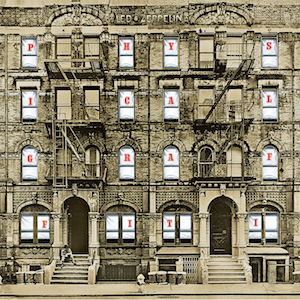
In any case I doubt I would have much of consequence to say about Physical Graffiti but I am more convinced than ever that it doesn’t matter nearly as much as it would like. There it stands, the imposing New York brownstone, containing seemingly all life, but on closer examination it’s the same combination of Google Images, band mugshots and Noddy Holder anyone might expect. The same goes for the music; had the CD existed in 1975, this would not have been a double. Zeppelin reconstituted at Headley Grange in 1974 to lay down some new tracks, ending up with eight, the material taking up around fifty-three minutes of time – too long for a single album, too short for a double. So the decision was made to bung the package up to speed with what is basically Led Zeppelin’s Odds ‘n’ Sods; hitherto unreleased and buried masters from 1970-72, including Houses Of The Holy’s previously unavailable (for it failed to make the original cut) title track. What these seven selections do is increase the record’s running time to just under eighty minutes – with delicious irony (or ironic delicacy?) a little too much for just one CD.

But I don’t think that the extra material adds to the record’s imbalance so much as the fact that there are two records to take into mind here. Left alone, I’m sure that the first half, a compact thirty-five minutes, would have stood as one of the great Zeppelin albums, even though two of its six tracks are makeweight additions. On the same level, it’s impossible to flee the notion that the new material is very consciously conceived and executed to reinforce the idea of Zeppelin as World’s Number One Rock Band, and that the old stuff still finds them in a state of catch-up. Even routine rockers like “The Wanton Song” and the aforementioned “Sick Again” carry an expressionist determination absent from the daft “Black Country Woman” with its Don Partridge/McGuinness-Flint jugband mood and Percy Plant going beyond parody (his climactic “Whassa matta wit’choo mamma?” put me in mind of any number of questionable British comedians of the seventies attempting Burton Cummings, roast beef and all). Likewise, “Night Flight” trundles between channel-hopping genres to no great effect (R.E.M.’s “Bandwagon” sprung to mind) whereas the drone rock of “In The Light” is never less than clear about its intent, from the relationship between John Paul Jones’ sardonic harpsichord commentary and the band’s characteristic collapsing-into-itself angle of rock, to the unexpected materialisation of the leitmotif “Let me share your love” against backdrops prophetic of Aaliyah’s “We Need A Resolution.” The lazy sidestep shuffle of “Down By The Seaside” coasts by on its cocktail of “This Guy’s In Love” electric piano and Page’s iridescent Martin Denny marker pens without ever exceeding it (“Still do the Twist?,” asks an audibly exasperated Plant toward song’s end), but “Ten Years Gone” has enough passive reflection in its harmonic exquisiteness to make us realise where and how Jeff Buckley came into the picture. Next to that – “Boogie With Stu” finishes with a nice breakbeat.

On the first album, both “The Rover” and “Houses” earn their place; “Custard Pie” is nothing more than stock, inviolable state-of-the-1975-art Zeppelin of the sort which justifiably made Jack Bruce exclaim “Pah! Why are you playing me session musicians?” with its let’s-fox-the-pub-tribute-bands chordal and rhythmic structure but its dynamics are sufficiently alluring that the increasing dominance of Bonham in the track (especially noticeable from the last verse onwards) is accepted as natural. Set against this, the angst of “The Rover” is appealing – Plant moving from mournful (“My love, she is lying on the dark side of the globe”) to cautiously confident (“IF WE COULD JUST/IF WE COULD JUST/IF WE COULD JUST/IF WE COULD JUST…JOIN HANDS!!”) while the song’s second half is nothing less than “For Tomorrow” by Blur. Even “Houses” gets by on its cowbell-powered “Gudbuy T’Jane” motor (though it’s clearly a B-side).

Of the record’s three big setpieces, “In My Time Of Dying” is great fun, a three-cornered battle between Plant’s mortally wounded protagonist, Page’s guitar, hovering between Sumlin wail (the whole is really an elongated meditation on the Stones’ “Little Red Rooster”) and triple-bound rock rebound, and Bonham’s pitiless drums (the Page/Bonham synchronicity is particularly apparent here). Plant’s voice is content to moan in the background (“I never did no wrong” etc.) where Page’s guitar leaps out of the speakers like a jaguar when soloing, articulating Plant’s desired marching angels. On he goes, summoning whoever will come down to meet him – at times his “Oh my Jesus” sounds like “Oh my dealer” – and when Plant finally checks out, he finds himself unaccountably euphoric; “Oh, feels pretty GOOD!” He won’t unsink his teeth from the song, however, and the band finally have to resort to end-of-the-pier hi-jinks to get him out of there.

That leaves “Trampled Under Foot” and “Kashmir,” both justifiably celebrated (and, I’d wager, the main, or only, reasons why people keep Graffiti), yet note how the cumulative impact of each track depends on accumulated power and momentum. Yes, “Trampled” is Tom Jones just having heard Innervisions - in Rock Classic terms it’s roughly halfway between “Superstition” and “Long Train Running” (“Talkin’ ‘bout love”) – and Plant bawls far too much through it (in fact my central difficulty with Graffiti boils down to a surfeit of Percy) but its trail is unstoppable; you don’t want the damn thing to stop, even when it accelerates towards the end, and it’s authentically funky in the same way as its direct descendent, Franz Ferdinand’s “Take Me Out.” Similarly, “Kashmir” makes for the post-’67 epic with its “I Am The Walrus” insouciance, Bonham’s fundamentalist (if carefully phased) drumming and Jones’ genuinely euphoric string and horn charts, marching between the twin key poles of D major and Gm7. And certainly the inner shudder – or is that disguised euphoria? – materialises the nearer the music strikes towards the Other, the exoticism and dreaminess powerful enough to make you forget that Kashmir is not in Morocco or Rawalpindi, but in the Himalayas; and while Plant’s impeccably imprecise “Let me take you there”s cannot be argued with, there is still the feeling of a big band flexing their muscle, letting us know that nobody in 1975 could compete with this (I mean…the Moody Blues? ELO?? Please!), but not yet telling us what they can add to the tale. Still, there you have it, a two-step “Hey Jude” for a dispossessed generation; you know that the Cazale character in Dog Day Afternoon would have taken both steps deadly seriously.