Saturday, 28 January 2012

The STYLISTICS: The Best Of The Stylistics


(#154: 19 April 1975, 2 weeks; 24 May 1975, 5 weeks; 16 August 1975, 2 weeks)

Track listing: You Make Me Feel Brand New/Betcha By Golly, Wow/Rockin’ Roll Baby/Break Up To Make Up/You’re A Big Girl Now/I’m Stone In Love With You/Stop, Look, Listen (To Your Heart)/Let’s Put It All Together/You Are Everything/People Make The World Go Round

Bowie missed a trick with Young Americans. If only, instead of dessicated soul-liloquies (although one senses the desperation lurking within “Can You Hear Me” and watches as the “human” is systematically eradicated altogether in “Fascination”) he had issued a series of lushly-orchestrated, androgynous serenades – who knows what impact that might have had, since no album sold more in 1975 Britain than this one. Smooth, silky, a perfect soundtrack for Martini-pouring…that is, if you don’t listen too clearly or take in its implications too fully.

The Stylistics as represented on this collection were less a soul group, more a laboratory experiment, a way for Thom Bell to expound and develop the theories he had conceived while working with the Delfonics. There was Philly soul, true enough, but other than its not-Motown serene smoothness, Bell’s work has little to do with that of Gamble and Huff; Kenny Gamble gets a co-writer credit on “Break Up To Make Up,” and most of these tracks were recorded at Sigma Sound with Philly musicians, but the relationship is otherwise parallel, close to non-existent.

The group came together in 1968 as a merger of two Philadelphia street bands, the Percussions and the Monarchs. Evidence that they didn’t yet know what to do with themselves can be found in their 1970 debut single “You’re A Big Girl Now,” co-written and co-produced by road manager Marty Bryant. It was done for $400, and sounds it; following a mock-oriental guitar opening and some referencing of Hendrix, a distorted Del Shannon-esque organ takes over, merging with the falsetto of Russell Thompkins, Jr, and the overall feeling is one of a JA dubplate, complete with melodramatic basso profundo talkover (it’s like the Ink Spots meeting the Paragons). Nonetheless the single sold healthily in Philadelphia, and provided their passport for signing to Avco; Bell was generally unimpressed with their demos and signed the group solely on the potential he heard in Thompkins’ voice. Almost from the start, Thompkins was the focus of Bell’s Stylistics, so forcefully that several of their early cuts are effectively solo Thompkins performances.

Bell, and his lyricist partner Linda Creed, opted to work with the group almost purely on a ballad basis; he was about to sign the Spinners for the uptempo stuff. It was a gamble that worked; of this record’s ten tracks, only one is uptempo, the rather unconvincing “Rockin’ Roll Baby,” a sort of Osmonds distortion of Bobbie Gentry’s “Fancy” (and which I fancy had originally been intended as a Spinners track) whose nice Carole King-ish groove cannot obscure wince-inducing words (“his little orthopaedic shoes” indeed!). And, apart from “You’re A Big Girl Now,” the only non-Bell track here is the (then) most recent; 1974’s autumn top tenner “Let’s Put It All Together” – now under the aegis of producers Hugo & Luigi and arranger Van McCoy, who must have thought that putting together a song in the Bell style was the easiest thing ever, the song sounds clumsy, stretched and over-simplistic; “My lips and your lips – what more is there to say?,” “You love me and I love you” – these words evoke Sesame Street, or possibly chapter one in a Teaching English As A Foreign Language handbook, and the song’s only saving grace is the unexpected suspended D major seventh chord which ends it.

Of the remaining selections, no less than five come from the group’s eponymous 1971 debut album – “Big Girl,” being one of them, set aside, these songs set out the template with which Bell intended to play. Intending to return to this source, though, the later songs are worth examination; “I’m Stone In Love With You” (1972) finds the singer’s soul still stoned, his mind largely occupied by aimless dreaming, culminating in him fantasising about owning the first house on the moon (“No population boom”). “Break Up To Make Up” (also 1972) is almost French in its melodic and orchestral constructs, moving both into neoclassical soul and a harbinger of New Pop, in that the lushness camouflages the hurt that is actually being sung about (“First you love me, then you hate me,” and its second verse casts a paranoid, askance eye on that of the O’Jays’ “Backstabbers”).

1973’s “You Make Me Feel Brand New” is in many ways the apogee of the Bell/Stylistics approach, and the group’s biggest pre-Hugo & Luigi UK hit single. As it was also a number two single, I have to be careful what I say about it here, but sufficient to notice the return of the electric sitar from “You Are Everything” with empathetic piano accompaniment, the subtlest key change perhaps in any pop record (from first chorus to second verse), the song’s near hymnal construction – there are multiple references to faith, “precious” and God, and note how Airrion Love’s voice trembles on “love,” “hands” and “again” – and, above all, what I believe to be the central premise of Bell’s Stylistics, namely the androgynisation of soul; the song ranges from Love’s bass to Thompkins’ falsetto, in other words from male to female, and in the end everybody and everything sounds as one. This goes beyond anything Bowie might have been thinking in 1975, the song’s lyrical clumsiness notwithstanding.

But if I have to return to the four remaining, peerless cuts from their debut, it is because they represent the group and producer’s best and most adventurous work. Oboe begins both “Betcha By Golly, Wow” and “Stop, Look, Listen” but each song diverges down a very different track; “Betcha” sticks to the psychedelic soul template, perhaps owing a little to Charles Stepney’s work with Rotary Connection, with its quietly elated references to skies, rainbows, candy smiles and “Catch A Falling Star,” but primarily with its exquisite melodic construction. In contrast, “Stop, Look, Listen” demonstrates how well the group worked as a harmonic conductor; the oboe is accompanied by pizzicato strings, giving way to glockenspiel, and guitar lines which alternate chunky chords with fluent single-note runs. The group’s triple ascents of “Lord” indicate how major an influence the Beach Boys must have been on Bell, as does the arrangement, with its solitary French horn resting on a bed of bass trombones. “You Are Everything” is the record’s most obviously psychedelic track, its electric sitar drowned in generous phasing, as Thompkins ponders about mistaking other women for his Other – the music plays as a stoner soul variant on “Kashmir” and the song proves Thompkins’ unexpected range, from troubled contralto to wretched sopranino; his voice is sweet always, but never less than sharp.

Best, and most visionary, of all, however, is the final track, “People Make The World Go Round,” which even in this abbreviated form remains their masterpiece. It comes across as a comfort variation on “Ball Of Confusion”; Moog howls and wind chimes give way to low electric piano, sighing bass and menacing Whitfield strings…and, eventually, a marimba. Politically the song is confused beyond belief (“Buses on strike, want a raise in fare/So they can help pollute the air”) but is redeemed by Bell’s brilliant arrangement – sour flugelhorns signifying a Wall Street gone to seed – the close relationship of the song’s melody and rhythm with Bacharach, and Thompkins’ weary, resigned yet still hopeful delivery. It’s like that, and that’s the way it is, he seems to sing, but does so like an angel, so persuasively that it’s difficult not to follow his instruction to “Go underground, young man.” The song proceeds with imperial patience, and finally, when the song might seem unable to go any further, Thompkins repeats the title phrase, over and over, further and further from the microphone, until in the end he becomes just another element in the framework, a stray leaf fallen in the pasture. Had I compiled this album I would have included the song in its six-and-a-half-minute entirety, since as Thompkins fades from view, or at any rate hearing, the song continues to drift, nowhere in particular; there are long, languid solos for guitar and flute (the latter played by Harold Vick, and drawing immediate comparison with Charles Lloyd’s work on the Beach Boys’ “Feel Flows”) and the music slowly vanishes into nowhere and nothing. A soulboy’s “Surf’s Up” (and released in the same year), this track opens up long-banished memories for me; I bought the original album – featuring the group reclining in a field of endless hay – on LP for a pound one languid Tuesday afternoon about a dozen years ago from a junk shop in Wandsworth (which didn’t know what it was selling) and took it back with me to Oxford, and it is memories of a disappeared Oxford which the song now engenders (apart from being a forebear of everything to come, including New Pop and Massive Attack); sensations of fugitive foxgloves in the declining shade of Botley Park, abandoned roundabouts and furniture warehouses, the shades of Ruskin and Wilde at the top of Ferry Hinksey Road, unexpected blossoms by canals, stiles which deposit one, via dog tracks, to the middle of Iffley, always the sunset, Air’s “All I Need” and Bill Fay’s “Some Good Advice,” Cumnor Hill of a Sunday mid-morning, a turning world, shivers in Port Meadow, getting towards dusk, becoming ever darker, across the universe.

Saturday, 21 January 2012

Tom JONES: 20 Greatest Hits


(#153: 22 March 1975, 4 weeks) 


Track listing: It’s Not Unusual/Only Once/I’ll Never Fall In Love Again/What’s New Pussycat?/Till/Runnin’ Bear/Green, Green Grass Of Home/Thunderball/Love Me Tonight/She’s A Lady/Pledging My Love/Funny Familiar Forgotten Feelings/With These Hands/Delilah/I’m Coming Home/To Make A Big Man Cry/Help Yourself/The Sun Died/Daughter Of Darkness 


I suppose it stands as a relative measure of how big they were at the time. Whereas Engelbert had to make do with a single sleeve and a dozen tracks, Tom gets a twenty-track double album with grandiose “Tenth Anniversary” subtitle and lavish gatefold sleeve picturing the Welshman with his many celebrity pals, and a motley lot they are too – after the expected Sinatra and Elvis, there are Joni Mitchell, Ray Charles, Wilson Pickett, Smokey Robinson, Little Richard, Charles Aznavour, Tony B and Sammy DJ, but also snapshots (presumably all taken from the This Is Tom Jones TV series) of the man with Bob Hope, Matt Monro, Harry Secombe and Victor Borge; a conflict between aesthetic aspiration and the demands of light entertainment which I think penetrates to the very core of Jones’ music.


Like the Humperdinck collection (and inevitably there’s a shot of Engelbert and a bearded Tom, grinning and resembling no one as much as Godley and Crème) the track selection is slightly random; just as bona fide hits such as “I’m A Better Man” and “Too Beautiful To Last” are absent from His Greatest Hits, so were only fifteen of Jones’ twenty tracks actually “hits”; conspicuous by their absence are the likes of “Detroit City,” “A Minute Of Your Time,” “Without Love (There Is Nothing),” “I (Who Have Nothing)” and the dreaded “The Young New Mexican Puppeteer.”


What we are left with is a portrait of a man in battle, not so much with the material he is given to sing but the way in which it is given to him. It’s arguable that no one really knew what to do with Jones from the word go. In his 1972 survey Voxpop: Profiles Of The Pop Process, author Michael Wale undertook a series of lengthy, detailed interviews with the prime movers of the day. Among them was Les Reed, who as composer and/or arranger and/or producer had a hand in Jones’ most famous hits. When pressed by Wale as to what unique qualities he detected in Jones, Reed volunteered the following reply: “I consider Jones has got a voice which nobody else in the world has got. He’s so detached from the rest of the world, singing-wise, that if one is au fait with his records and recordings to a point where you know where his next phrase is going to be without even thinking about it, then you have to write a song in that mode, even if it means embarrassing yourself by singing it yourself and all that, but you’ve got to get hold of Tom’s phrasing, his range and the type of lyric that he would like to sing about…he’s a man but he doesn’t want to show it too much on record…Tom can’t get sentimental. He’s a real man’s man, he’s got inward feelings, and so you have to put it in such a way that it’s not embarrassing to him for the public to listen to him singing something schmaltzy. It sounds very much round the bush but that’s how it works.”


Not everybody dealing with Jones had the patience to go round the bush. Reed, for instance, is very insistent that he would approach a Humperdinck song in a different manner from a Jones song, but too much of what is here veers towards the wrong side of schmaltz. Clive Westlake’s “Only Once,” for example, with its precious Spanish guitar, raspberry brass, regretful mutters about “the way young people always do” and general air of a failed Eurovision entry, is clearly a romantic/Hispanic song meant for Humperdinck, and so when Jones does it, it doesn’t work; similarly, the high camp of “Help Yourself” and “Love Me Tonight” are Engelbert environments in which Jones sounds utterly lost. But, as I say, perhaps Jones was lost from the beginning.


This collection begins, as I believe all Jones compilations are legally obliged to begin, with “It’s Not Unusual,” a powerhouse performance which must have sounded like emissions from another planet in 1965. Rejected by Sandie Shaw as an A-side, Jones grasps the song’s contours with as many limbs as he can spare, and Reed astutely limits the orchestral backing to fortissimo trumpets, ruminative baritone sax and Joe Morello’s pained lead guitar. It went straight to number one – there was, after all, literally, no competition – but immediately set its own limitations. The British male solo star was a nearly extinct species in that age of Beatles and Stones – chart regulars like Roy Orbison, Gene Pitney and the transported Texan P.J. Proby being Americans – and it is true to say that for the best part of two years Decca had no idea how to handle Jones, instead trying him in all directions.


From this period comes his reading of “With These Hands,” an early try at his Big Ballad template ruined by an over-florid, cheesy, Liberacean piano and an over-fruity vocal delivery (it is possible that Jones had Bobby Hatfield’s performance on the Righteous Brothers’ “Ebb Tide” in mind). He fared better with film themes; John Barry pushes him to his physical limits on the Bond tune “Thunderball” – how better were the Bond songs when they were about the villain! – forcing a climactic high C following which Jones fainted in the studio. And “What’s New Pussycat?” is odd and misleading enough to keep Jones on his toes (even though he indignantly demanded an explanation of the lyric from Hal David).


Only with “Green, Green Grass Of Home,” hitherto an obscure Jerry Lee Lewis album track, did Jones hit on his winning formula; tearful but unsentimental balladry sunk by battalions of ‘50s strings and choirs. Where on his original reading Lewis sounded unconcerned, resigned, about going to the gallows – and why is he to hang? What has he done with “sweet Mary”? – Jones never quite extinguishes the dread from his voice. Still, the single marked a bend in the road, where the adventure which had been straining at the leash throughout 1966’s groundbreaking series of 45s suddenly cut loose and sailed towards the more welcoming arms of the album format, leaving the charts more or less at the mercy of unambiguous, easily-felt balladeers.


The format continued unabated throughout 1967; Mickey Newbury’s “Funny Familiar Forgotten Feelings” is treated as the slushy country ballad it isn’t. “I’ll Never Fall In Love Again” – co-authored by a resurgent Lonnie Donegan – comes closer to identifying Jones’ dilemma. Here he is, this honest soulman who listens to Otis, to Solomon Burke and Joe Tex, and in my opinion doing his best to give an authentic portrait of a destroyed, betrayed soul.


Yet so much about the record conspires not to place it alongside “The Dark End Of The Street,” principally the same Radio 2 legion of gloopy voices and strings which dogs so many of Jones’ record; ultimately Jones is driven to faux sobs and growls just to stay afloat. This is a not uncommon problem; his reading of “Pledging My Love,” for instance, starts out as a fine and obviously heartfelt performance before the arrival of the schmaltz battalion (and needless final verse key change) force him into shouting and bellowing. Likewise, he does his manful best with the old Ray Charles chestnut “The Sun Died” but is immediately torpedoed by weeping wah-wah guitar and a confusing melange of brass, strings and voices; there is simply too much going on in the background.


At the same time, Decca (and, it must be said, Gordon Mills) did their best to paint Jones as a “badder” boy than Humperdinck; the Stones to Gerry Dorsey's Beatles, perhaps. “I’m Coming Home,” his ’67 Christmas offering, for example – why has he been away so long, and why does he think she’ll take him back, considering all he’s supposed to have done (has he been released from the penitentiary, or from the Army?)? He sings of unutterable emptiness (“My world is falling around me/I’ve got nowhere to hide”) but the song resolves nothing, emphasised by the early fade.


In 1968’s “Delilah” – a song, significantly, written with P.J. Proby originally in mind, as I have said before – Jones makes no bones about it; for the second time in his career, somebody in the song dies, and multiple layers of Three Amigos trumpet camp cannot hide the fact that it is a squalid, cheap song about sexual inadequacy and murder. Even Jones couldn’t follow that; hence the forced jollity of “Help Yourself” (Jones’ ad lib cackling suggests that “round the back for a bit of the old brandy” had indeed come to pass) although poor old Ken Woodman (mislabelled here as “Ken Wood”) tries his utmost to keep the package holiday portrait afloat.


Beyond 1968 there is frankly not much to say (and so his reading of “Without Love,” one of his more convincing deep soul attempts of the period, is doubly missed). “To Make A Big Man Cry” is Reed trying to be Bacharach again, to little avail (“BeCAUSE it HAPpened to ME!” squeals Jones at one point). As for his forlorn early seventies, the less said, the better: in “Daughter Of Darkness” he is reduced to wishing the woman away, and although Martin Fry is anticipated more than once (“Sharing together the magic of love”) the whole sounds like a dodgy ITC detective show theme tune (Jones’ increasingly abstract ad libs appear to back this up).


Paul Anka’s “She’s A Lady,” a Billboard number two, sees Jones doing his best to be Modern, and although Big Jim Sullivan’s guitar knows what time it is, the song, which essentially compares the singer’s wife with the lead trombone player in Anka’s band, patently doesn’t. Old school London Palladium belters like “Till” – a UK number two – kept the dowager demographic happy (complete with its closing “You Only Live Twice” rip) but one has to say an emphatic no to his interminable 1973 demolition of “Runnin’ Bear,” complete with “funky” rhythm and atrocious fadeout “chant” – “Indian Reservation” it is not (and is he, as Lena thought, really singing “happy hunting GOWN” at the end?).


By 1974 Jones was down to the compulsory jauntiness of “Somethin’ ‘Bout You Baby,” which, with its “Billy Don’t Be A Hero” horn lines, is the cheapest-sounding track here, and certainly the smallest hit (it was lucky to reach #36). In sum, then, Jones’ Decca contract, like Humperdinck’s, was nearing its end, and as a straight Greatest Hits package issued exactly one year earlier had failed to penetrate even the top ten, the TV-advertised route must have seemed irresistible. I am sure that Abigails the country over must have bought this for their dinner parties, but even this is undervaluing the man; for a period (I’d say ’66-9) he was Britain’s Elvis, the deepest and shallowest repository of his audience’s desire and fears, and little wonder that they ran back to him when times began to look tough again. There he is, his shirt wide open, baring whatever is left of him to bare, or bear; and look at him at the back, bowing down with a rose in his teeth, and hope it doesn’t suffocate him.

Monday, 16 January 2012

LED ZEPPELIN: Physical Graffiti


(#152: 15 March 1975, 1 week)

Track listing: Custard Pie/The Rover/In My Time Of Dying/Houses Of The Holy/Trampled Under Foot/Kashmir/In The Light/Bron-Yr-Aur/Down By The Seaside/Ten Years Gone/Night Flight/The Wanton Song/Boogie With Stu/Black Country Woman/Sick Again

“Sick Again”? That’s putting it mildly. A funny thing about falling seriously ill; you are forced to take stock of everything and make a snap(py) decision about how much, or if, it matters, and more often than not you find it’s less important than you think.

Since last I wrote here – indeed, as I was preparing to write about this very record – I’ve been a hospital inpatient, firstly at the Friends Stroke Unit at King’s College Hospital, then at the specialist stroke care unit at St Thomas’ Hospital, having suffered what specialists call a transient ischaemic attack, or as you and I might call it, a mild stroke. No joke at all was my condition throughout the first couple of days of admission when I was essentially unable to move, eat or speak; things could only improve from there, and they did, so dramatically that I was able to go home on Friday – a fine tribute to the plentiful and kind teams of physicians, nurses, therapists and other specialists who made my recovery possible. However, these same world-renowned teams have made it starkly clear to me that I had a lucky escape, am lucky to be anywhere at all, let alone in front of a computer; the stroke was precipitated by a long history of undiagnosed hypertension and what cardiologists term atrial fibrillation – abrupt bursts of arrhythmia in my heartbeat. My father survived eleven days into his fiftieth year before being struck down by coronary thrombosis, and as I am now just over two years ahead of hitting fifty, I have been told that the only way I’m going to make it even that far is to change pretty much everything about my life. Continuing to write about British number one albums is an early indicator of stepping in the wrong direction, but there you are.

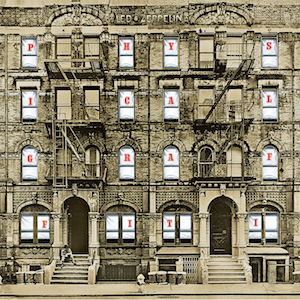
In any case I doubt I would have much of consequence to say about Physical Graffiti but I am more convinced than ever that it doesn’t matter nearly as much as it would like. There it stands, the imposing New York brownstone, containing seemingly all life, but on closer examination it’s the same combination of Google Images, band mugshots and Noddy Holder anyone might expect. The same goes for the music; had the CD existed in 1975, this would not have been a double. Zeppelin reconstituted at Headley Grange in 1974 to lay down some new tracks, ending up with eight, the material taking up around fifty-three minutes of time – too long for a single album, too short for a double. So the decision was made to bung the package up to speed with what is basically Led Zeppelin’s Odds ‘n’ Sods; hitherto unreleased and buried masters from 1970-72, including Houses Of The Holy’s previously unavailable (for it failed to make the original cut) title track. What these seven selections do is increase the record’s running time to just under eighty minutes – with delicious irony (or ironic delicacy?) a little too much for just one CD.

But I don’t think that the extra material adds to the record’s imbalance so much as the fact that there are two records to take into mind here. Left alone, I’m sure that the first half, a compact thirty-five minutes, would have stood as one of the great Zeppelin albums, even though two of its six tracks are makeweight additions. On the same level, it’s impossible to flee the notion that the new material is very consciously conceived and executed to reinforce the idea of Zeppelin as World’s Number One Rock Band, and that the old stuff still finds them in a state of catch-up. Even routine rockers like “The Wanton Song” and the aforementioned “Sick Again” carry an expressionist determination absent from the daft “Black Country Woman” with its Don Partridge/McGuinness-Flint jugband mood and Percy Plant going beyond parody (his climactic “Whassa matta wit’choo mamma?” put me in mind of any number of questionable British comedians of the seventies attempting Burton Cummings, roast beef and all). Likewise, “Night Flight” trundles between channel-hopping genres to no great effect (R.E.M.’s “Bandwagon” sprung to mind) whereas the drone rock of “In The Light” is never less than clear about its intent, from the relationship between John Paul Jones’ sardonic harpsichord commentary and the band’s characteristic collapsing-into-itself angle of rock, to the unexpected materialisation of the leitmotif “Let me share your love” against backdrops prophetic of Aaliyah’s “We Need A Resolution.” The lazy sidestep shuffle of “Down By The Seaside” coasts by on its cocktail of “This Guy’s In Love” electric piano and Page’s iridescent Martin Denny marker pens without ever exceeding it (“Still do the Twist?,” asks an audibly exasperated Plant toward song’s end), but “Ten Years Gone” has enough passive reflection in its harmonic exquisiteness to make us realise where and how Jeff Buckley came into the picture. Next to that – “Boogie With Stu” finishes with a nice breakbeat.

On the first album, both “The Rover” and “Houses” earn their place; “Custard Pie” is nothing more than stock, inviolable state-of-the-1975-art Zeppelin of the sort which justifiably made Jack Bruce exclaim “Pah! Why are you playing me session musicians?” with its let’s-fox-the-pub-tribute-bands chordal and rhythmic structure but its dynamics are sufficiently alluring that the increasing dominance of Bonham in the track (especially noticeable from the last verse onwards) is accepted as natural. Set against this, the angst of “The Rover” is appealing – Plant moving from mournful (“My love, she is lying on the dark side of the globe”) to cautiously confident (“IF WE COULD JUST/IF WE COULD JUST/IF WE COULD JUST/IF WE COULD JUST…JOIN HANDS!!”) while the song’s second half is nothing less than “For Tomorrow” by Blur. Even “Houses” gets by on its cowbell-powered “Gudbuy T’Jane” motor (though it’s clearly a B-side).

Of the record’s three big setpieces, “In My Time Of Dying” is great fun, a three-cornered battle between Plant’s mortally wounded protagonist, Page’s guitar, hovering between Sumlin wail (the whole is really an elongated meditation on the Stones’ “Little Red Rooster”) and triple-bound rock rebound, and Bonham’s pitiless drums (the Page/Bonham synchronicity is particularly apparent here). Plant’s voice is content to moan in the background (“I never did no wrong” etc.) where Page’s guitar leaps out of the speakers like a jaguar when soloing, articulating Plant’s desired marching angels. On he goes, summoning whoever will come down to meet him – at times his “Oh my Jesus” sounds like “Oh my dealer” – and when Plant finally checks out, he finds himself unaccountably euphoric; “Oh, feels pretty GOOD!” He won’t unsink his teeth from the song, however, and the band finally have to resort to end-of-the-pier hi-jinks to get him out of there.

That leaves “Trampled Under Foot” and “Kashmir,” both justifiably celebrated (and, I’d wager, the main, or only, reasons why people keep Graffiti), yet note how the cumulative impact of each track depends on accumulated power and momentum. Yes, “Trampled” is Tom Jones just having heard Innervisions - in Rock Classic terms it’s roughly halfway between “Superstition” and “Long Train Running” (“Talkin’ ‘bout love”) – and Plant bawls far too much through it (in fact my central difficulty with Graffiti boils down to a surfeit of Percy) but its trail is unstoppable; you don’t want the damn thing to stop, even when it accelerates towards the end, and it’s authentically funky in the same way as its direct descendent, Franz Ferdinand’s “Take Me Out.” Similarly, “Kashmir” makes for the post-’67 epic with its “I Am The Walrus” insouciance, Bonham’s fundamentalist (if carefully phased) drumming and Jones’ genuinely euphoric string and horn charts, marching between the twin key poles of D major and Gm7. And certainly the inner shudder – or is that disguised euphoria? – materialises the nearer the music strikes towards the Other, the exoticism and dreaminess powerful enough to make you forget that Kashmir is not in Morocco or Rawalpindi, but in the Himalayas; and while Plant’s impeccably imprecise “Let me take you there”s cannot be argued with, there is still the feeling of a big band flexing their muscle, letting us know that nobody in 1975 could compete with this (I mean…the Moody Blues? ELO?? Please!), but not yet telling us what they can add to the tale. Still, there you have it, a two-step “Hey Jude” for a dispossessed generation; you know that the Cazale character in Dog Day Afternoon would have taken both steps deadly seriously.

Sunday, 1 January 2012

STATUS QUO: On The Level


(#151: 1 March 1975, 2 weeks)

Track listing: Little Lady/Most Of The Time/I Saw The Light/Over And Done/Nightride/Down Down/Broken Down/What To Do/Where I Am/Bye Bye Johnny

A couple of images from the music of late 1974 to early 1975. First, the love that has died, the bitterness in breaking up, the consequent directionlessness, words which go something like this: “It’s no good trying to make it better/You know it doesn’t feel right to do/Everything we shared together/Would break in two.” The spectre of the train, the coexistence of “somewhere” (or “a somewhere”) with “nowhere” and are the two really that different? Second, the music, reflecting, echoing the sound of the train the singer has been vainly trying to catch (before finally jumping on it at the end), streamlined, absolutist without being rigid, set out as neatly and meticulously as a grid, a music so seamless and faultless that it could have been breathed by the sweetest machine. One sometimes searches for evidence of the human hand, but of course it’s some of the most human music imaginable.

I am not talking about Blood On The Tracks or Autobahn but the unlikely record which conjoins the two. Its obsession with trains may mean that On The Level is actually Quo’s Trans-Europe Express but it’s all there, just as nearly all of it is as evanescent and elusive as the Ames room on the cover (from “Down Down”: “I have all the ways you see/To keep you guessing/Stop your messing with me”). Think you have Quo nailed down? Think again.

Everywhere on the record are mine traps designed to snare the unwary. “Little Lady” has Rick Parfitt being walked out on by his lady; there is this street, and she goes down and out of it, he goes up and down the same street with other ladies and eventually she comes back up, also now walked out on; all this is done against a standard fast Quo template but as the song reaches its turnaround point, everything dwindles down to a tiny pastoral Mike Oldfield interlude of twinkling guitars before a hard-pressed drone muscles its way back in. Rossi’s “Most Of The Time” starts out with the seeming intent of a quiet, quasi-acoustic rumination before the group quite unexpectedly thunders into the picture with a loud, slow blues workout topped by Rossi’s extremely anguished lead guitar. “I Saw The Light” – not the Todd Rundgren song – concerns itself with resigned disappointment but even the singer finally gives up halfway through; nonetheless he is paralysed (“Standing on a platform/Watching all the trains go past/Keep on trying to catch one/But you know they’re much too fast.” All around are the ashes of the past, the burning need to get away, to escape.

Bassist Alan Lancaster – for me the album’s star; see his sighing bass at the climax of “Over And Done”’s instrumental break, his astonishing about-turn at the end of the full-length “Down Down,” his ceaseless, intelligent commentary on “Broken Man” – contributes perhaps the album’s two bitterest songs; the furious concentration of “Over And Done” is rather intimidating in its complete assurance – take away the blues tropes and mournful vocal, replace with Farfisa organ and French Situationist lyrics and you have Stereolab (listen to that almost inhuman, or superhuman, rhythm). The shambling loss of “Broken Man” recalls, of all rock bassists, Ronnie Lane with added boogie, and as he drunkenly stumbles through the ruination of his life, he sees her again – he is sure it’s her, but he can’t quite connect, possibly in himself can no longer truly recognise her – and runs away, back to nowhere. Parfitt’s “Nightride” tries for hope against desperate hope (the slightly wrecked atmosphere of the song is emphasised by the slowing down of the rhythm section as it moves from intro to verse) to look forward to reconciliation, perhaps even newness. But throughout lurks that paraphrase from a past life, from “Wild Thing,” the motif of “You you you, you move me.”

“Down Down” becomes more remarkable – and radical – every time I listen to it. How did such an uncompromising single get to number one (indeed is the Quo’s only number one single to date, if you don’t count “Rockin’ All Over The World” topping the NME chart in autumn ’77)? They were on tour, probably at the peak of their popularity – but even those factors don’t fully explain this modernist phenomenon. Throughout the song Rossi plays hide and seek with the listener and the song’s subject – and who’s to say the two are different? Sometimes he is almost taunting (“You’ll be back to find your way/Again again again again again again again again”). The music, meanwhile, looks sternly forward to punk; there is that same clean division of lines found in the early work of the Ramones – separate channels for separate guitar lines, all notes clean and scrubbed, everything scientifically in its spontaneous place. Added to that are the tantalising hold ‘em poker drumless interludes which break down and rekindle our expectations of a further explosion in ways which directly anticipate, say, Daft Punk (“One More Time” in particular). It is one of the most inscrutable number ones, and one of the least resistible.

Rossi’s “What To Do” takes its lead fairly directly from “Broken Man” with kaleidoscopic “Reelin’ In The Years” guitar curlicues, abstracting the latter song’s landscape into a discussion of life and direction and ways which, set down on the lyric sheet, might stand as Pinter:

“I told her of a life.
Of a strange one.
Pre-arranged one that I dreamt of anyway.”

Parfitt takes over again for the modestly cathartic “Where I Am” wherein the protagonist finally awakens (to the atypical landscape of a synth-drenched 6/8 ballad) to the world and to himself, and is now ready to re-enter the world. And finally, back to the roots, back to Chuck Berry, and the song that ties all the album’s loose ends together, a furious, hammering assault on “Bye Bye Johnny,” a song which doesn’t quite undermine its own modest hopes – the boy is off to Hollywood, his mother is tearful but happy, he makes it and promises to come back and build a mansion, and every night his parents wait patiently by the kitchen door, not even entertaining the notion that he might never come back. Nor the possibility that in truth he hasn’t made it, is wandering around in “a nowhere.” It is not quite the reassuring ending that this album requires, even though it makes great play of its ending, obliquely referring to “Also Sprach Zarathustra,” onomatopoeically representing the train slowing down (like the ending of “Trans-Europe Express”) and acknowledging “A Day In The Life” with its final sustained chord. Then, after an interval of seconds, the sound of a crowd, singing a song from the beginning of this story, “You’ll Never Walk Alone.”

I can’t quite put my finger on why this album proves so unexpectedly moving, other than it (again) disproves the idea of Quo as three-chord ponies; it seems to me a very compassionate record; virtually none of the songs could be described as “happy” and yet hope is never banished from their grooves. Apart from Parfitt’s occasional keyboard overdubs, there is nothing and nobody else on the record but the core quartet, mostly playing live in the studio, and it remains a potent steamboat of resistance against whatever else sought to suppress spirits at the time (and now). Where Humperdinck’s world (as represented in the previous entry) is finally a rather claustrophobic one, the Quo manage to charm and caress their way through the barriers, and thereby reach another level.

Monday, 26 December 2011

Engelbert HUMPERDINCK: His Greatest Hits


 His Greatest Hits

(#150: 8 February 1975, 3 weeks)

Track listing: Release Me/Quando Quando Quando/Les Bicyclettes De Belsize/Spanish Eyes/Am I That Easy To Forget/There Goes My Everything/A Man Without Love/Another Time, Another Place/Love Me With All Your Heart/The Way It Used To Be/Winter World Of Love/The Last Waltz

There is a famous photograph from 1967 which features Engelbert Humperdinck and Tom Jones, Decca and the year’s golden boys, lounging back, grinning, against their respective Rolls Royces, as if in affable disbelief – how come they haven’t rumbled us yet? Or, more precisely, the Likely Lads of post-Beatles British balladry, or, more floridly (according to the late Billy MacKenzie) “Thunderbirds in pop.”

For a while, to the public, they were inseparable – hanging out together, appearing on each other’s TV shows – and must have seemed like two sides of the same coin. These days, though, I think of Humperdinck as a kind of Pacino to Jones’ de Niro; the two styles need each other but Jones’ persona is the less trustworthy, the more evasive – he is able to scurry under his varying masks of toughness and roughness, stutters and mumbles in his songs, gives the impression he’s always two further corners round the corner than you might find comfortable. Whereas Humperdinck wouldn’t have a heart if he didn’t wear it on his sleeve; he is painfully conscious about setting his own record straight (as a singer) – Jones laughs or hiccups off sorrow and suffering, but Humperdinck thrusts his loneliness in our faces.

And lonely he was fated to be, just like Gene Pitney and George Michael (two other singers whose audiences have not taken well to finding happy – look at the top row of photos on the rear of His Greatest Hits, taken, as with the star shots for Elton John’s Greatest Hits, by Terry O’Neill, and you’d swear it was George circa 1985); it was for a time his oxygen, his lifeline. Never forget that when “Release Me” blasted off from the bottom of the bill at Sunday Night At The London Palladium and into the world, he was already thirty with nearly a decade of failure behind him; sometime nightclub performer, both as singer and saxophonist, he had been laid low for a fatal while by TB, and by the time Gordon Mills proposed the name change from Arnold (“Gerry”) Dorsey he was struggling to support his wife in a cold, bare flat in Hammersmith. This was his last roll of the dice; if “Engelbert” didn’t work, it would be proper job time.

But it did work, and not necessarily in the venerable “you’re too beautiful to suffer” trope of pop idolatry; there was that Anglo-Indian unplaceable exoticism about him – more pronounced than that other Anglo-Indian re-import, Cliff Richard – and the idea that he popped out from nowhere and seemed to come from everywhere provided sufficient allure for the demographic Lena has elsewhere termed “the Housewives of Valium Court”; left alone by their day job husbands to dream of other and better things. In his palpable suffering, he provided a relief projection screen for the pains of his audience.

Not that Humperdinck has ever been a tortured soul, or at least not in ways he has decided to divulge to us; he is generally self-deprecating, amiable, wears “vain” like a Better Badge. When hustled onto a package tour in early ’67 with Hendrix’ Experience and the Walker Brothers he surprisingly bonded with Jimi, who would study his act closely from the wings and to whom the older man would offer tips on how to work an audience. Once he even provided understudy guitar for Humperdinck (“You can’t do this, Jimi! You’re a star!” “Oh don’t worry, I’ll stand behind that curtain and nobody will know it’s me”), who remarked (approvingly) that it was like being backed by three guitars. In more recent times he has happily provided the vocal for “Lesbian Seagull,” and upon discovering Damon Albarn had asked him to participate in Gorillaz’ Plastic Beach and that his management had turned Albarn down flat, an appalled Humperdinck promptly dismissed the team and installed his son as manager.

It’s a remarkable story in many ways, but it’s all the sadder that, despite the Pacino comparison, Humperdinck had for the most part to deal with the equivalent of – Val Guest, or Gerald Thomas. The arrangers who contribute to these twelve songs are none of them awful as such – on the contrary, they include top names of the period such as ex-Joe Meek conspirator Charles Blackwell, Johnny Harris and Mike Vickers – but none seems to have been inspired to provide more than the obvious. Too many of these songs follow an identical formula, with tinkling piano, obligatory key changes for the final verse (to show off Humperdinck’s range) and, worst of all, a horribly obtrusive Light Programme choir who seem intent on pushing the singer towards heaven, or hell, as quickly as possible. You can tell why something like “Am I That Easy To Forget?” didn’t do quite as well as his ’67 trilogy of hits; the Horlicks singers are blocking Humperdinck’s emotional path, the watching-as-she-walks-out-on-me scenario too familiar; the formula was becoming tired.

Those ’67 trilogy of hits, however, the three biggest selling singles of a year which supposedly opposed all that these songs stood for; if anything, quite apart from providing some sort of reassurance to maturing screamers finding Revolver a bit much, these performances solidify and refract their inbuilt misery. “Release Me” was built on the template of Little Esther Phillips’ 1962 version, but holds none of the knowing sass of the impetuous and bored fourteen-year-old girl playing patient emotional table tennis with her backing singers. And just because Phillips’ version is the more “approachable” or “authentic” (in relation to what?) does not necessarily make hers the superior reading. Humperdinck captures his own mounting desperation very effectively, starting low and gradually building up to the point where, when he finally reaches the top C of the final “So,” he can barely balance himself. It is almost like a plea from the future to the past to let it escape, and live, and maybe has more in common with “Strawberry Fields Forever” than it cares to admit. In a nation where no-strings divorce had not yet quite been legalised, this cut through to a lot of disappointed hearts, and the single remained on the chart for well over a year (in part bolstered by its ebullient B-side “Ten Guitars” which latter sadly does not appear on this compilation). At least in “Release Me” he has another (and realer) love to go to, or go off with, but the two follow-ups cut off these escape routes. “There Goes My Everything” is enhanced by John McLaughlin’s imaginative guitar comping but cannot be taken seriously due to a bumptious bass trombone which plods through the arrangement like a doped elephant, let alone the “there goes my only possession” leitmotif (is he waiting for the repo men to come and pick her up?). With “The Last Waltz” there is little left save piano, and echoes (both oddly reminding me of Ultravox’s “Vienna”) and the trail of the song is anyway confusing; in its tenure he appears to meet the girl and finish with her in the space of two minutes. Muscially, too, Les Reed achieves a crafty fusion of new and old; the verses are a competent Bacharach pastiche but the chorus could have come out of Victorian operetta. But it doesn’t seem to presage anything approaching a desirable future.

Even when Humperdinck is “happy” there is always a sting in his wink. “Quando Quando Quando,” one of his most popular tracks (though a surprisingly under-performing single in the UK) and certainly one which I heard in my youth performed by endless Italian wedding bands, does well with Harris’ criss-crossing vertigos of strings and woodwind, but he hasn’t won her yet and it’s debatable whether he will. His “Spanish Eyes” is also less assured (and wobblier on the diction front) than Al Martino’s hit version, and brings out some of the song’s innate absurdities (suddenly they’re in Mexico! Say “si si”!). Still, we recall that in The Good Life, when Paul Eddington’s henpecked executive Jerry is having a rare afternoon off, he stretches himself out on the sofa, pours out some liquor and revels in a Humperdinck album; here is also the man many men of their time wished they could be.

The loneliness, meanwhile, gets worse. If not tackling Les Reed/Barry Mason originals, he’d most often be found reworking translated Italian San Remo weepies. Thus “A Man Without Love” strolls merrily on its ground of sprightly acoustic guitar, French horn, harp and accordion, such that we hardly notice what he’s singing: “I cannot face this world/That’s fallen down on me.” Like David Ruffin in “I Wish It Would Rain,” he cannot even leave his room. He even cites “If You Go Away” (“slowly dying”). “Les Bicyclettes De Belsize,” written by Reed and Mason for a scatty short film about a bloke on his bike and a billboard model who comes to life, tries to breathe carefree but again and again the mourning chords (and muted trumpets) drag it down. “Come the dawn,” concludes Huperdinck, “they are all dead – yes, they’re dead.” We could almost be listening to Scott 3.

1969’s “The Way It Used To Be” is possibly Humperdinck’s most tortured record, in that Mike Vickers’ orchestra and chorus seem to pummel into his head – there he is, out of his room, but he’s in the dark corner of a restaurant, on his own, and everyone and everything else in there seems to be laughing at him, ganging up on him. As with Herman’s Hermits’ contemporaneous “My Sentimental Friend,” he asks the band to strike up an old love song, in the meagre hope that “she” might be passing by and look in, and be changed “even if the words are not so tender.” His mirthless laugh of “Ha!” is bitter, and the song tries very hard not to be “You Don’t Have To Say You Love Me” (“It’s quite easy to let go/Then the song begins again”). Note the “crowded room” appearing yet again, like a harsh reminder of earlier and better times.

Reed’s arrangement of his and Mason’s “Winter World Of Love” does show some imagination, progressing from the icy “Il Silenzio” trumpet at the beginning to the hearth rug of Home Service strings which end the song, with Humperdinck progressively modifying his “O-ho”s to “Oh no” – but are they really going to stay in their bunker “until summer comes again” (well, it is the end of the sixties)?

As the seventies rolled around the Brtish hits began to dry up, although Humperdinck’s personal popularity did not and, if anything, increased abroad, especially in the States; 1970’s “Love Me With All My Heart,” a variation on “Love Is A Many Splendoured Thing,” did no business in the UK (there is a case for Humperdinck as inventor of X-Factor pop, with those bravura high notes, climactic key changes and choirs). His most interesting record of this period was 1971’s “Another Time, Another Place,” written by Mike Leander and Eddie Seago, which with its whirlybird arrangement is almost the anti-“Quando Quando Quando”; here is perhaps Humperdinck’s greatest torture – he keeps running into his ex no matter where he goes, and it’s always friendly and she’s almost always with somebody else – but the Strictly Come Dancing flourishes of Laurie Holloway’s aptly garish arrangement serve to mask deeper pains (“And I try desperately to hide”). Occasionally he even breaks into proto-Martin Fry mock-exasperation. And again, that word which keeps cropping up through the record, “regret.” Regret for not being hip, for sticking himself in , or to, the past?

But never, unlike Jones, does he do revenge songs. No, his is the epitome of pure romantic suffering; it’s a wonder that Mills didn’t think to rechristen him Heathcliff – it’s that intense and windblown. And that quality was still being clung to by a number of people, enough to get this last-ditch best-of to number one and on the chart for thirty-four weeks (last-ditch in that Humperdinck’s Decca contract was coming to an end, and so Decca took note of what K-Tel, Arcade and Ronco had been doing and advertised the record aggressively on TV; a signifier of a trend set to dominate the top of the album chart for the next fourteen years or so – single-artist retrospectives, and eventually the return of “Various Artists,” all aimed at relatively undiscriminating Woolworth’s buyers). But things were changing; Humperdinck, realising it was all finally rather ridiculous, if admirably so, ensconced himself happily on the Vegas circuit (and went on to score many more hits everywhere except Britain), Barry Manilow was waiting round the corner, and this year of 1975 will end in a quite different place, with another exotically glamorous, reinvented man of uncertain pedigree. But here we start, with the way it used to be, and who would ever think of trading in those Rolls Royces or conspiratorial schoolboy winks?

Tuesday, 20 December 2011

Elton JOHN: Greatest Hits


(#149: 23 November 1974, 11 weeks)

Track listing: Your Song/Daniel/Honky Cat/Goodbye Yellow Brick Road/Saturday Night’s Alright For Fighting/Rocket Man/Candle In The Wind/Don’t Let The Sun Go Down On Me/Border Song/Crocodile Rock

(Author’s Note: the above track listing refers to the UK and Australian edition of the album; in the USA and Canada, the non-single “Candle In The Wind” was replaced by “Bennie And The Jets,” and on the 1992 CD edition which has now become standard, both tracks appear)

At some point on the day this album began its second week at number one, Nick Drake died.

He died of an overdose of prescription drugs, almost certainly accidentally, but this didn’t stop the cult of explicable depression rising in popularity in tandem with his posthumous reputation. His death was noted in the music press at the time but not many words were expended on it; in November 1974 hardly anyone had heard him, or even of him, and the NMEs and Street Lifes of the time had bigger ghosts to pursue, the living phantoms of Syd Barrett and Brian Wilson being just two of them. It maybe wasn’t until later in the seventies, or even with the ascent of a new generation in the mid-eighties, that Drake’s life, work and anti-work were pulled into a spotlight of belated golden, with the accompanying romanticisation of untimely death and thwarted beauties that has kept a thousand lesser poets in bread slicings since the days of Chatterton.

What this means is that it’s difficult to listen to Drake’s music without the curse of foreknowledge. The act of dragging oneself back into a period when all of this was new, sort of hip and smart in its internal chat is a difficult one, not helped by the greying elegy offered by Ian MacDonald in The People’s Music, and which I now see was really an extended attempt to excuse MacDonald for whatever awful decisions he might take; the rationalisation of depression, the convenient cloak of the Horrid Modern World (with all those computers; the irony being that, at the time of his death, Drake was looking into training as a computer programmer) – above all, the refusal to face both himself and the inconvenient truth that depression is a thing, a condition, that happens, no matter how firmly you shut yourself off from the world or how courageously you attempt to continue walking in the world with a world of people to support you.

What this is all leading to here is the possibility of the existence of a benign double, an odd doppelganger (emotionally if not physically) who, unlike the depressive, is able to face the world and take it on, a lot of the time against his tightest will. Or perhaps this is simply a disguised self-meditation on whether it’s better to cut yourself off from the world or fight your way back into it, a question you wouldn’t think would require any hesitation in answering, but that presupposes the absence of a darkness.

Back in 1970, when Drake was still in a condition to face the world – up to a point – Joe Boyd hired Elton John to record an album’s worth of songs by other contemporary British songwriters; John was then just beginning to make a name for himself, and Boyd thought that this friendlier approach would be a way of getting unsuspecting listeners into the world of sprites like John and Beverley Martyn, and Drake himself. Elton recorded four Drake songs and his readings take the songs’ furrowed brows and point them some way towards the sun (especially the fatalistic “Saturday Sun”). It didn’t really do Drake any good – largely because, scarred by a misguided season of playing Northern working men’s clubs, he then ran a mile from any live work – but the work indicated that here was someone a little braver than Drake, someone not without his own demons (as even a cursory listen to Empty Sky will confirm) but who was crucially able to laugh them off. There’s a famous Val Wilmer photo of Elton from ’68; it is winter, he is standing warily at the side of a dirt track backed by a few trees, but is wearing a fur coat and a large, fetching hat. You couldn’t imagine Drake making any effort beyond wriggling into his creased jacket. And at the time Elton was just another Denmark Street hustler; with Taupin, he was attempting to churn out off-the-peg bubblegum before being taken under the wing of the two Rogers – Cook and Greenaway – who encouraged the duo to find their own voices and develop them, rather than follow the charts (Cook himself appears as one of many backing vocalists, in addition to Paul Buckmaster’s choir, on “Border Song” along with the likes of Tony Burrows, Lesley Duncan and Madeline Bell - the session singing Premier League, in other words – and one can explain its inclusion on Greatest Hits as a nod to his mentor, as well as a reminder that as a session pianist he had recently appeared on the Hollies’ “He Ain’t Heavy, He’s My Brother.” It is naïve but not unpleasantly so, and you can already tell that he wants to get someplace else; Aretha heard the song and subsequently took it over).

But there are strong reasons why “Your Song” has had a million plays on oldies radio and become a standard and “Northern Sky” has not; imagine, if you can, and I realise it may be almost impossible, that you have never heard this song, this record, before. It made the top ten in both the States and Britain in early 1971, and it’s fair to say that it was quite unlike anything else in those lists, even the seemingly compatible singer-songwriter musings of the likes of Cat Stevens. For one, it buckles at the thought of bedsit-compatible vulnerability; this is a song which knows exactly what it’s doing, which is deconstructing the notion of writing a song, wondering about the purpose and eventual vision of a song, how it can best touch another’s heart even if you can’t remember what colour her eyes are. The hesitation (“Anyway…the thing is…what I really mean…”) is theatrical (since it’s all done with perfect actorly timing) but what it’s trying to express is pretty well worth expressing, even if it is that all this writing and balled-up paper isn’t going to replicate the electricity, the ecstasy, of falling in love or expressing your love for another, it’s better than keeping it all hidden, cradled away from anyone’s vision. It is the overgrown student, still living in his virtual hall of residence, not quite sure of what he wants to do other than he wants to do something and that something is better than nothing, or nothing-ness (I don’t believe Drake ever gets near nothing-ness, not even with “Black-Eyed Dog,” but his music is something you view with a telescope, or listen to with the benefit of twenty years in Oxford behind you for context; come closer and he’ll scratch, just a little, but just enough). Even for a Nick Drake to carry on living, whatever it took, and have no reputation as such beyond his peers, to be another veteran of the circuit, just like Keith Christmas or Howard Werth or John Howard (the latter is the exact missing link between Elton and Drake; hear 1975’s Kid In A Big World for someone wrapped up in himself but inquisitive enough to pierce the parcel’s paper), or be like Bill Fay, shrug your shoulders when the first and second albums don’t sell and return to the day job, fitting in songwriting and music in your spare time.

And “Your Song” is a smart record, too; Barry Morgan’s drumming is a minor masterclass in stoical response to compressed emotional turmoil (his impatient tick-tocking before finally setting off in the second verse) and Buckmaster’s strings don’t overwhelm or drown the singer. Nowhere does he make any mention of being dead, even though (as it would transpire) he had already attempted suicide once. You come back from that, you stay away from it or end up playing hide and seek with it until it (like it did with MacDonald) corners you.

And there is so much trouble in the seemingly benign lanes of Elton’s Greatest Hits, a very cleverly sequenced set of songs (and punchier and crisper than their album equivalents, too; these were clearly taken from the 45 mixes and therefore sound like the intended souped-up pocket transistor), yet also so much good humour. The backbone of “Daniel” is solemn but Elton’s playful semi-yodelling “Spayayayayain” puts me in mind of Steve Bent’s “I’m Going To Spain” (“The factory floor/Presented me/With some tapes of Elton John”). But then there are two differing songs on the same subject; disillusion with the Big City (read: Modern World) and desire to return home, as impossible or impractical as that may now be. So “Goodbye” swoons with its echoed regret, but “Honky Cat” swaggers along in a self-defeating James Garner fashion (“I QUIT those days and my…REDneck ways!”). Actually John’s vocal on “Cat” might be my favourite of his; whooping (those high “New” and “fools”) and regretting nothing in a damn-you way. His piano is enjoyably bombastic, towards the end veering towards Taylor forearm-to-keyboard blocks and Tippett-like runs (never forget where he got the “Elton” from – stalwart Keith Tippett right-hand men Elton Dean and Marc Charig once played with the erstwhile Dwight in Bluesology).

It also characterises an utterly British approach to American music; the Beatles never really grew out of being fans, and neither did Elton, the ultrageek, collector of and keen listener to virtually every record released; and thus both were able to relate very naturally to American audiences. “Yellow Brick Road” for instance clearly takes its lead from The Band in its weary, knowing trudge but in ways which could only have come out of power-cut early seventies Britain. The omniscient approach was also Elton’s greatest weapon; listening to Greatest Hits is akin to having a jukebox in your home, almost machine-like in its affable and infallible versatility. You want supra-Stones rock? There’s the blitzing “Saturday Night’s Alright For Fighting” (“It’s seven o’clock and I wanna ROCK!” Bryan Adams is 14). Sensitive memoria? The original “Candle In The Wind.” A plea for life and a future that Drake could never quite summon enough of himself up to express? “Don’t Let The Sun Go Down On Me,” complete with Spectorian/Wilsonian tambourine (and, of course, actual Beach Boys in the middleground). There’s the affectionate slug to the shoulder of pop history that is “Crocodile Rock” (Prince is 12). There’s the detail (Nigel Olsson’s shivering triple snare drum flourish in response to John’s “switchblade and a motorbike” in “Saturday Night’s Alright”).

And there may also be the suspicion that this is as good as Elton might get. Add “Bennie” (with its processed audience effects, the bridge between Simone’s “Ain’t Got No – I Got Life” and “Purple Rain” – those PURPLE flashes of synth!) and you effectively have here the entire range of songs on which his reputation has been built. Worldwide it’s still his best-selling album, and while there will be more hits and sidetracks to come (many of which this tale will go on to address) there is in this Greatest Hits the air of a summing-up, the conclusion of a phase, a period. This turned out to be the case; Elton, having been written about four times in two years, now disappears from TPL for almost sixteen years, and, as a new year begins and the 150th entry looms, there begins a bend in the road and the start of a very different set of priorities in our number one albums. But for now, think of Drake dressing up as Marie Antoinette, wowing a Vietnam/Watergate/recession-depressed American public, making out like Jerry Lee Lewis were merely a tougher version of Liberace, and conclude that whatever life throws at you, sometimes, when it matters (and it almost always matters) a custard pie remains the best response. Look at the white stick sitting astride the piano, directly behind Elton on the Terry O’Neill cover; not a crutch, but a walking stick. A guide, rather than an end.

(and in case you're wondering, "Rocket Man" was a #2 single in the UK, and so is mostly for Lena to evaulate and write about, but all I'm going to say at this point is that I can't think of any harsher, more alienating portraits of a deadening "straight world" than this; "zero hour, 9 a.m." is sung as though heading for the gallows, there is the question of whether he really is a rocket man - "I'm not the man they think I am at all" - and the multiple subtexts of "in fact, it's cold as hell" and "I'll be as high as a kite by then," together with Davey Johnstone's guitar lines which swoop and climb like someone else we might know, may suggest what might have happened had Drake invested in a synthesiser and how hard his fall might otherwise might have been.)

Sunday, 11 December 2011

Rod STEWART: Smiler


(#148: 19 October 1974, 1 week; 2 November 1974, 1 week)

Track listing: Sweet Little Rock 'N' Roller/Lochinvar/Farewell/Sailor/Bring It On Home To Me-You Send Me/Let Me Be Your Car/(You Make Me Feel Like) A Natural Man/Dixie Toot/Hard Road/I've Grown Accustomed To Her Face (Instrumental)/Girl From The North Country/Mine For Me

As the game became bigger, so the music diminished. Every Picture was a bunch of guys in a small but happily crowded room, swapping stories and feelings; Dull Moment was a slightly larger group of people in the mouth of a goal, and Smiler is a pub lock-in (the Prince of Wales pub in Holland Park, to be exact). The old faces (and Faces) are back, perhaps with too many new ones added, but there is no disguising that the singer, despite his continued, matey, now faux self-deprecating liner notes, is no longer existing on rice and beans and is a multimillionaire (or soon on his way to becoming one). A certain distance is growing, and along with it comes a similar degree of carelessness, and not the joyous kind.

Smiler was Stewart’s last album for Mercury (and held back for several months because of contractual dispute between Mercury and Warner Brothers), and the last of his “British” albums, and so, despite there being nothing about goodbyes in the packaging, there is definitely a sense of something ending, as in falling to bits rather than careful resolution, not that the latter was what the early seventies Stewart was ever about. Take it on its surface and it’s a fine, drunken fall-about of a record, the kind of louche, fuck-non-giving record which Primal Scream would love to be able to produce (but possess too much self-consciousness and history to do so). But peer a little closer and the exuberance is forced, the juxtapositions of loose playing and ultra-professional backing vocals and horn/string charts too ill-fitting. “Sailor,” for instance, flays like a ship flung between two icebergs; a T Rexy stomp (complete with possibly speeded-up backing vocals) and a barely controlled wind-formed monument of impassibility; pianist Pete Sears gives up keeping up and settles for Taylorish forearms to the upper keyboard, and the whole thing blows itself out into a free passage for tenor, guitar, organ and bass, Stewart meanwhile shouting exuberance, or confused instructions. Few tracks have controlled beginnings or endings; Berry’s “Sweet Little Rock ‘N’ Roller” begins like the end of Pet Sounds, with dog barks, and some noodling improv from Ronnie Wood which eventually unfolds into the song – certainly this track contains the album’s most creative rock playing, with drums and guitars impressively managing to criss-cross and maintain two different tempi at once, vigorous enough to ignore the probability that twenty-nine-year-old Rod is a little too old to be slavering over nineteen-year-old girls any more.

Everybody involved is just trying too hard and becoming exhausted as a result; but then maybe the formula itself was close to exhaustion. “Farewell” tries for the old “Maggie May” magic, complete with Martin Quittenton’s acoustic guitar and Ray Jackson’s mandolin, but the song simply isn’t there and its sentiments standard and banal; despite being a comfortable top ten hit single (#7 in the UK), the song has to my knowledge never been played on radio since. Indeed Dick Powell and Wood’s violin/guitar unisons become uncomfortably jagged towards song’s end and the music degenerates into disorganised busking, perhaps with a hopeful ear to John Cale (but likewise Fear or Helen Of Troy this is not).

The messiness finally becomes oppressive rather than liberating; by inviting all his friends round to the virtual pub, Stewart manages to drown out everything about himself that made him worth our attention. Elton pops up to contribute the rocker “Let Me Be Your Car” – by the sound of it, a Caribou reject – whereupon the record immediately turns into an Elton John record, with Rod reduced to distant backing vocals on his own album. Similarly the front line of Chris Barber’s Jazz Band, absent from TPL for twelve years, comes close to drowning Stewart out on “Dixie Toot.”

Elsewhere the extra voices are intrusive. Vanda and Young’s “Hard Road” – another of the album’s songs on the subject matter of leaving – tries for hangdog laxity but Ray Cooper’s bongos are far too prominent in the mix and Doreen Chanter’s “Sweet Home Alabama” background yelps obscure any intended poignancy or weariness. Like most of the rest of the record, the track thinks it’s outrocking the Stones, but isn’t. His reading of “Girl From The North Country” similarly seems disinterested; whatever closeness he once might have felt is rendered opaque by the over-miked drums, various aircraft/ambient sound effects, overzealous zigzag strings – little wonder that when he reaches the “And I never, never, never, never, never…” section he gives the impression that he wants nothing more than to retire. And the Sam Cooke medley/tribute is a shambles; not even approaching the still shocking, multiphonic, cataclysmic mash-up offered by Cooke onstage in 1963 (see Live At The Harlem Square Club, complete with approving byline by Stewart himself), the music limps into being from a strange, out-of-tempo intro, and again any spontaneity is immediately cancelled out by an absurd Chinese Opera/Radio Clyde string section – Stewart’s chatter and laughter seem pressurised, unreal. Possibly the lowest point is reached by Stewart’s well-meaning but hopeless re-genderisation of Aretha’s “Natural Woman” which is fundamentally wrong in all senses, from syntax to word flow to delivery; there isn’t the sense of shocked self-rediscovery, the justified reclaiming of one’s rights, nothing approaching catharsis (the track instead potters out of the door in an unremarkable fadeout).

The lack of direction persists. Why the harpsichord (or clavinet?) and acoustic guitar interludes? Where is the sense of any human contact with another human being? If all you want is an unregulated blowout, then Smiler is the album for you – the presence of stalwart Andy Newmark and Willie Weeks on “Let Me Be Your Car” once more implies a damn-you Sally Can’t Dance subtext (if Rod were capable of imagining one) – but offers little to touch or retain. The two tracks which stand out, as gum wrappers might stand out in a peat bog, are the closing reading of McCartney’s “Mine For Me” (a Paul-Linda co-write which McCartney himself does not seem ever to have recorded) which, although ostensibly working against the theme of leaving home (it’s all about leaving the “sweet painted ladies” behind and coming back), is set rather gloomily, as gloomily opulent as Ferry at the end of “Sunset” (if less creatively or emotionally expressed); Stewart even essays a couple of McCartney impressions (“Don’tcha know that the woman who love me…”) as a steel band approximates exotica in the background, before signing off with a resigned, knowing “Yeah, yeah, yeah”; and the other is the aforementioned “Dixie Toot,” which at least offers some sense that doing what he is doing is ridiculous (“I might even lose my trousers”); the repeated, diminishing emphases on “a good time” – beginning with the mourning that “It’s been so long since I had a good time” (and listening to Smiler, one can easily agree) and ending with the sod-it-I’m-off-to-heaven reveries of “Let’s have a good time really.” Finally he becomes more bitter, and realising the futility of all of this smoke and mirrors, signs off with a mutter: “I didn’t give a fuck/I had a good time.” Though the package attempts to emulate the feeling of all-mates-together, it is documented fact that by late 1974 the Faces (or what was left of them) hated each other, had grown tired of attempting to carry on making music together (and yet, at their death throes, they reconstituted for one last single, which may be the best thing they ever did: “You Can Make Me Dance, Sing, Or Anything…”), and that, equally tired of 93% top-rate income tax, Stewart was looking for a way out. Or perhaps just somewhere where he could be more easily heard – like in the old days, when all he had to worry about was whether to have one bar on the electric fire switched on, or both. Before, as the cover of Smiler suggests, he became another wee hairy Highlander, mocking the tourists.