Saturday, 28 June 2014

Paul YOUNG: The Secret Of Association


(#313: 6 April 1985, 1 week)

Track listing: Bite The Hand That Feeds/Every Time You Go Away/I’m Gonna Tear Your Playhouse Down/Standing On The Edge/Soldier’s Things/Everything Must Change/Tomb Of Memories/One Step Forward/Hot Fun/This Means Anything/I Was In Chains/Man In The Iron Mask

Out of action for most of 1984 due to vocal cord trouble, Paul Young seems to have been determined to slow down and calm down for most of his second album. But not for all of it. The trailer single, a cover of Ann Peebles’ “I’m Gonna Tear Your Playhouse Down” – though Young’s performance sounds as though it is taking its lead from Graham Parker’s reading on Stick It Out – was the last to feature The Fabulous Wealthy Tarts prominently (“PUSH, PUSH!”) and was, if anything, more extreme even than anything on No Parlez; when Young complains that “you make our lives a stress and strain/Using the power ploy,” you wonder whom he has in mind; a cheating lover, or Mrs Thatcher? Laurie Latham spares no extremities; there are Art of Noise jackhammer beats, Fairlight thunderbolts, Gothic organ and a guitar solo as meticulously unhinged as anything on Bad Moon Rising (two guitarists are credited on the album – Steve Bolton, once of Atomic Rooster, and John Turnbull, who played on the Get Carter soundtrack – so I’m not sure who plays what, but here and elsewhere he/they is/are as extreme as Thurston Moore or Lee Ranaldo).

There are a few other uptempo songs on Association – the opening (and presumably symbolic, as a warning to record buyers expecting No Parlez II) “Bite The Hand That Feeds” with car brake squeals and synthesised Mariachi trumpets, which was a cover of a song by Orange County surf/punk band Agent Orange; “Hot Fun,” which appears to send up the No Jacket Required school of loud optimism – his voice doesn’t really convince you that he is having any fun, and Big Jimmy Paterson’s grumpy staccato trombone solo confirms the suspicion (we are only a few months away from the noticeably less circumspect Don’t Stand Me Down) – and the complex “Tomb Of Memories,” part “Seven Rooms Of Gloom,” part Northern Soul and part “Love’s Unkind,” with Squeeze’s Difford and Tilbrook dropping by to rub the singer’s face in it (“THE HURT! IT DON’T STOP!!”).

But otherwise the tempo is slow – and occasionally non-existent – and the mood superficially reflective. But although Association is less showy a record than Parlez, I think that it is a considerably deeper one. The prevalent subject matter is that 1984-5 favourite, lovers falling out and/or misreading each other. “Every Time You Go Away” may sound like everyone’s favourite romantic serenade, but is actually a rather bleak song (as the LP version, bookended by abstract electronic whorls, emphasises) whose protagonist is a shit but is begging her not to go, or to keep going (written by Daryl Hall, it is a tribute to Young that he sounds remarkably like Hall here, yet still remains unmistakably himself). In the context of rather menacing songs like “Standing On The Edge” – written by long-time friend and collaborator Drew Barfield – which paints a pitiless and sometimes contemptuous picture of someone who opts for unhappy safety rather than own up to herself, and to the singer, that the heart knows better, or “This Means Anything” which, like “Tomb Of Memories,” wonders what words of love are really worth (the Fairlit string section, alternating with a hesitant and shortlived percussive break – “’I’ll be with you again’/Words without credence/Oh” – it is as if the Colin Blunstone of One Year has been bruised one time too many), it does anything but reassure.

There is also “Everything Must Change,” a deserved Christmas top ten hit, with the Fabulous Wealthy Tarts replaced by a sturdy male backing vocal trio (which mutated out of the Olympic Runners and eventually became the foundation of Londonbeat). Here Young owns up to his cussed, love-destroying stubbornness, knowing he’s not perfect but still gasping for air and at life. The moment where most of the instruments drop out and he offers a defeated, close-miked “Awwww, let me know” is shiver-inducing, as is his prematurely exhausted plea of “Please let me be right for once!” The occasional oldie radio plays also omit the crucial middle section where all the voices break down into a semi-free call-and-response gospel routine and the music suddenly, if momentarily, becomes harsher. The whole is so compelling that one notices only belatedly that the incongruous but entirely fitting pedal steel guitar of BJ Cole has been present all along (cf. James Carr’s “Tell Me” and Young’s thanks to Elvis Costello in the sleeve credits; this is a very comparable study of emotional nakedness).

But there are also two anti-war songs; it had been scarcely three years since the Falklands, but the Irish question had not been resolved (think of the faint ley line between Young’s “I can’t go on sayin’ the same thing” on “Every Time” and Kevin Rowland’s “It all sounded the same”/”What do you think about BEL-FAST?” interjections on “One Of Those Things”). Of these, “One Step Forward” is the more immediately convincing, finding Young as the rookie soldier on duty – it could be anywhere – carrying a rifle and not being entirely sure why he is doing so. I’m not sure his “Soldier’s Things” entirely comes off. The Tom Waits original is an exquisitely painful miniature; the bare inventory drained of life and point carries its own inherent poignancy, and Waits never really has to raise his voice – whereas Young tries to turn it into a six-minute Marvin Gaye epic, with somewhat overcooked results.

Better are the chilling final two songs. “I Was In Chains” sounds like 18th-century folk music but was actually composed by Gavin Sutherland, the author of “Sailing” – the original appears on the Sutherland Brothers’ more or less eponymous 1972 debut album – but this tale finds Young at sea, not heading for freedom, but bound in chains, as a convict being transported to Australia for crimes which, the song implies, may be rather heinous but are not really specified. Although Graham Peskett’s violin suggests a comforting update of early Rod Stewart, Mark Feltham’s bass harmonica is not at all comforting, and the abrupt eruption of atonal guitar (Bolton and/or Turnbull really rank/s with what Keith Rowe does on Amalgam’s Wipe Out) wrongfoots the incautious listener; the ending, with harsh backward percussion and electronic figures and indecipherable vocal shouts, suggests being yanked violently out of a dream.

The record ends, bleakly (in the UK, at least; the American edition ends with “I Was In Chains,” which has its own logic) with a Billy Bragg song, which Young immediately sings in his own accent. Accompanied by nothing but Ian Kewley’s sombre, wavy Fairlight – Boards Of Canada ahoy? – Young sings the song of silent, knowing betrayal (don’t bother to wake me up before you go-go; don’t even try to be good to me) as though drained of every last atom of hope, as if this is Mark Eitzel’s “Last Harbour,” as though nothing lies beyond this horizon but dark, dark space. The Secret Of Association, despite going double platinum, is almost never seen in charity shops (and certainly not on CD, not even in actual record shops), and I wonder if it told truths that the 600,000 or so British people who bought it didn’t want to know about, or were keen to hide in the attic tomb of their own misguided memories.

Friday, 27 June 2014

Phil COLLINS: No Jacket Required


(#312: 2 March 1985, 5 weeks)

Track listing: Sussudio/Only You Know And I Know/Long Long Way To Go/I Don’t Wanna Know/One More Night/Don’t Lose My Number/Who Said I Would/Doesn’t Anybody Stay Together Anymore/Inside Out/Take Me Home

The story was that Phil Collins and Robert Plant were visiting a Chicago restaurant called the Pump Room. Plant was allowed in but Collins was not, as the maitre d’ insisted that a jacket was required. Collins protested that he was wearing a jacket but was told that it was the wrong kind of jacket. This stuck in his craw, and he whined about it on Carson, whined about it on Letterman, whined about it just about everywhere he could whine. He wouldn’t stop whining. Arrive at your own conclusion.

It is still slightly baffling how, only four years after Face Value could just about pass muster as art-rock, Collins became the world’s biggest understudying pop star, or perhaps his was simply the most prominent instance of ancient (seventies) musicians and music being cosmetically fashioned to resemble newness. Richard Cook’s contemporaneous NME review of the record is so generous and articulate that I wish that what he said were true. Perhaps in 1985 No Jacket Required might have represented cunning, up-to-the-mark pop-rock, but twenty-nine years later it is hard to see beyond the crushing, deafening picture that the record largely presents.

Listening to NJR is like being bludgeoned repeatedly around the head with an early club sandwich-sized mobile ‘phone. No drumbeat is left un-gated – Hugh Padgham is, wearily, back again, as co-producer with Collins – no song left free of irritating, crisscrossing horn charts or glutinous eighties guitar (mostly Daryl Steurmer) or sax (Don Myrick or Gary Barnacle; it makes little difference). “Sussudio” came off poorly when set beside a reissue of “1999” but they are not really the same song, and most of the record’s other tracks are minute variants on the one song. Every beat has to be big, every introduction must herald yet another day off for Ferris Bueller.

It is oppressive; even listening to my elderly cassette copy at moderate volume inspired mild migraine – and I’m sure that was the intention, to batter any opposition into submission with its bigness, including the spectre of Collins himself, pictured on the inner sleeve, grimacing at the camera while wearing a suit at least two sizes too big for him (with frightful shoes). It’s sobering to think that at the time, he was just thirty-five.

Most of the album’s songs were improvised around drum machine patterns, and while some of them may express hoarse soul-baring, their messages are mostly impossible to decipher behind the gleaming clamour, and the snippets that do come through suggest that he is still stuck in the whining past; at least two songs bear reference to the “same old story.” “Take Me Home” might be about a patient in a mental hospital, but even the distant ghost of Peter Gabriel cannot elevate it above a prototype soundtrack for slow-motion football or athletics footage on television sports programmes.

There are a couple of ballads; “One More Night” is “If Leaving Me Is Easy” with all fight eviscerated, while “Long Long Way To Go,” a.k.a. “Starve With Sting” – I saw the two perform the song at Live Aid, which reminded me just how vital the third musician on stage with them, Branford Marsalis, was – highlights the record’s innate conservatism with its “a little charity for the poor” stance. But mainly the record plods in concrete clogs; “Inside Out” is so dreary in its intended massiveness that it sounds written for a BBC comedy-drama series abouttwo former prison inmates trying to go straight by forming an employment agency. Meanwhile, “Only You Know And I Know” sounds like “Abacab” stripped of ingenuity and invention.

Who is the “Billy” of “Don’t Lose My Number” – and why should anybody care? Nobody, I suspect, really treated NJR as anything other than a big soundtrack to a big life, to be played through big speakers while driving a big car and wearing a big suit. This is the eighties which people like Dylan Jones regard as the apex of Western civilisation, Bullingdon-Orientated Rock (BoR), the dead-eyed, iron-eared soundtrack to a lifestyle whose jackets were required only to have their sleeves rolled up halfway. Meat Is Murder only went gold; No Jacket Required went six times platinum in Britain alone. Clearly there was still a long, long way to go.

Thursday, 26 June 2014

The SMITHS: Meat Is Murder


(#311: 23 February 1985, 1 week)

Track listing: The Headmaster Ritual/Rusholme Ruffians/I Want The One I Can’t Have/What She Said/That Joke Isn’t Funny Anymore/Nowhere Fast/Well I Wonder/Barbarism Begins At Home/Meat Is Murder

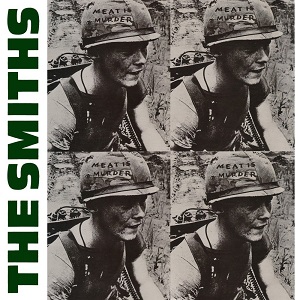
The only connection with Born In The U.S.A. is the Vietnam one, the cover photograph being a still from Emile de Antonio’s polemical 1968 documentary In The Year Of The Pig, the slogan on Marine Cpl Wynn’s helmet having been altered from “MAKE WAR NOT LOVE.” But where Springsteen’s music is dry, cracked and reserved, that of The Smiths is fluid, focused and explosive (the big difference is Springsteen and Morrissey’s respective attitudes to trains, as “I’m On Fire” and “Nowhere Fast” demonstrate; the freight train running through Springsteen’s head is urgent and painful, whereas Morrissey simply hears a distant train and finds it “sad”).

Meat Is Murder was the only one of The Smiths’ four studio albums, not counting compilations, to make number one in the group’s lifetime. The other three all peaked at number two, suggesting that Rough Trade did not have the resources or the will to push the records further. Discounting the Hollies’ Greatest compilation, this was also the first number one album achieved by any act from Manchester. It took that long?

The Smiths’ second album was not alone among 1985 number ones in standing in pronounced opposition to the overall trend, but its oppositional stance was by some distance the most violent and confrontational. It was largely recorded in what Morrissey describes in his Autobiography as being “a predictably cheap studio in Liverpool” (Amazon Studios) and produced by the group themselves, clearly relieved to be free of John Porter’s classroom, although the young Stephen Street was also present as engineer.

The record has remained somewhat undervalued, but the group wanted it to be far more representative than their debut of what they were able to achieve onstage, and as far as achievements – or records – go, Meat Is Murder might be their most remarkable one. Actually, it’s more than that; about midway through “What She Said,” even almost three decades on from when it was made, it becomes unavoidably evident that this is one of the great British rock ‘n’ roll albums, up there with The Sound Of Fury and A Hard Day’s Night, with a febrility not seen in this tale since Stupidity.

Nothing that has come before, not even the Pistols, is really anything like what The Smiths achieve here. I do not propose a detailed analysis of Morrissey’s lyrics, since there are more than enough of these to be found elsewhere, and, like Eminem, one has to be wary of paraphrasing entire sets of words. As a band, however, this album presents the performance of a group of musicians at their absolute and most confident peak. In “What She Said,” Johnny Marr and Mike Joyce in particular hang on to the rollercoaster with a singeing intensity, perhaps meaning to drag British rock back to 1963 and start again, but absorbing the lessons of everything that came after 1963. The drive and propulsion are terrifying and predicate Foo Fighters far more than they do Oasis.

All that really needs to be said is that the album’s principal, and very darkly expressed, themes are those of violence and death. Despite Morrissey’s use of words hardly glimpsed in pop discourse such as “ghouls” and “devout,” he is most emotionally direct when he uses no words at all; the extended yarragh on “Headmaster Ritual” (never forget The Smiths’ irreducible Anglo-Irishness), the wordless/indecipherable high voice alter ego that we glimpse on “That Joke” and “Well I Wonder,” the barks and yelps in “Barbarism” (which in itself puts me in mind of Rob Gretton at the end of “Everything’s Gone Green”). Although the “same old suit since 1962” jibe in “Headmaster Ritual” is smart – the implication being that the headmaster behaves as though the Beatles had never happened – much of the album sounds like pre-Beatles pop funnelled through a New York Dolls filter. “Well I Wonder,” for instance, could almost be Michael Cox (“Please keep me in mind” is a very pre-Beatles pop sentiment), although the accompanying music is far more reminiscent of Fleetwood Mac.

Likewise, “Rusholme Ruffians” is only half “His Latest Flame”; Marr’s descending half-tone sequences turn the song into something else. The more subtle nod to Elvis is the false fadeout of “That Joke” which puts me in mind of “Suspicious Minds”; the same endless, hellish cycle. “Barbarism Begins At Home” is a sort of missing link between Spandau Ballet (it’s in the same key as “Paint Me Down” and Marr’s chordalities are as inventive as Gary Kemp’s) and Graham Coxon’s Blur (see #316 for the precursor to Damon Albarn’s Blur). Andy Rourke’s bass is tirelessly creative throughout; note how the rockabilly jaunt of “Rusholme” is underscored by a funk bassline that could have come from Larry Graham.

But the home and school violence, the guilty second-hand fascination with violence or worse being done to others, all culminate in the grimly funereal procession of the closing title song (see Joy Division’s “The Eternal” for an unlikely comparison point). No real reason or logic can be attributed to statements like “Death for no reason is murder” – but you could say the same about “Do They Know It’s Christmas?” (perhaps the other end of this particular telescope); both are polemical statements designed to affect the gut and help change things, and there is no telling how many young Smash Hits readers set about altering their lives after reading Morrissey’s patient explanation of why he was a vegetarian. It is meant to be an unsettling coda in a year where “aid” was already being turned into an aesthetic and political blindfold, a huge monochrome NO to the primary-coloured YES which dominated its year. If things had been different, the next and much apter TPL entry would have been Songs From The Big Chair (the therapist responding to the patient). But that was kept off number one by entry #312, which demonstrated that the music business preferred to pretend that The Smiths hadn’t happened.

Tuesday, 24 June 2014

Bruce SPRINGSTEEN: Born In The U.S.A.


(#310: 16 February 1985, 1 week; 6 July 1985, 4 weeks)

Track listing:  Born In The U.S.A./Cover Me/Darlington County/Working On The Highway/Downbound Train/I'm On Fire/No Surrender/Bobby Jean/I'm Goin' Down/Glory Days/Dancing In The Dark/My Hometown


Sarah (Vowell) presents me with a hardbound copy of the United States Constitution and we head back to the station.  We have half an hour to kill before our train.  If I thought the lack of American-related decor in the main room of the citizenship facility was lousy public relations, it is as nothing compared with this port of entry;  the town of Hempstead itself.  Sarah and I attempt a walk around.  My first glimpse as a citizen of this golden land is not the Lady of the Harbor shining her beacon through the Atlantic mist but cracked pavement, cheap liquor stores with thick Plexiglas partitions in front of the cashiers, shuttered businesses, and used car lots.    
David Rakoff,  "Love It Or Leave It,"  Don't Get Too Comfortable


Lately I have been thinking a great deal about home and what home means; sure, it's where you live, but it's also where you come from and also where you find yourself, at any given time.  As any expatriate knows, you can feel more at home somewhere by bringing or having something that reminds you of home with you.  But what if you haven't left home, and yet feel...left out?

That is the great question that encircles and defines Born In The U.S.A; how to belong to a place, how to live in it, even if you don't fit in.  That Springsteen remains ambivalent about a lot of these songs (save for the title one) shows that even for him this is tricky territory, so to speak, and the huge success of the album in some way oddly muffled that ambivalence, or distracted from it.

If I seem to have lapsed into prim last-year-of-high-school writing, that's because that's where I am when this is huge; by the time this album is on to its...fifth single I am back in summer school one more time, to get one more credit so I can finally graduate.  (I have attended the graduation ceremony along with everyone else; passing Macroeconomics is seen as a formality.)  By this time hearing anything from this album on the radio is a given; you didn't need to own it to know it pretty well.  (Album tracks like "Bobby Jean" and "Darlington County" were played on rock stations anyway, just 'cause.)  Boys like Keith (perpetually upbeat, sporty, unambivalent about anything) in my class loved The Boss, whereas the more refined boys like Owen-I've-been-to-Germany wouldn't be caught dead lining up overnight for anybody, least of all Springsteen.  Owen knew about Propaganda, and thus the whole Regular Dudes vs. Effete Snobs situation presented itself to me for the first time.  Not that I was interested in either of these guys - how could I be? - but I knew that these preferences were set in stone for them, whereas they weren't for me.  And while I was more of a Propaganda girl myself, I knew that Springsteen was trying to say something, trying to come across, but in the general mix of radio - CFNY, in particular - it got kind of lost.  Big shiny songs, lots of 'em, videos too, and great success; it is no wonder that my favorite station considered him to be mainstream and by and large didn't play him that much.  It could well be that having moved back to Canada a few years previous, I was at one remove from the feelings in the songs; but really, this is a grown-up album, and I understand things in it much better now than I ever could have when it came out.  

Hometown Jam

"Born In The U.S.A." is the one song Springsteen feels stands on its own on the album; it's also the only song that Greil Marcus doesn't think is "cheese."  Martial in beat, defiant in spirit, this is a grown-up version of "Summertime Blues*" that sees one man vs. The Man in what voiceovers of movie trailers would describe as "a war he couldn't win."  That the Republicans in power thought it was a proud song by a patriot was...interesting, but the triumphal spirit that laced through '84 in the US put this song in a light that was...flattering, and unnecessary.  A much better reaction came from Stanley Clarke a year later and Cheech and Chong did "Born In East L.A." around the same time. 

The chorus of this song can mean several things; things that are too - yes that word again, ambivalent - to be used for a political campaign of any stripe.  It could mean that the narrator is, despite everything, proud to be an American; or angry that the American Dream hasn't happened to him, that from birth he's been hit hard time and again, a tool of US foreign policy and his brother (note how that word could mean an actual brother or a good friend) died for nothing, leaving a widow (not sure about that, but in effect...).  He has, like Martha and the Vandellas, nowhere to run to, nowhere to hide...

...and yet Max Weinberg's drum freakout at the end suggests that there is still some hope, if only that faint hope that being an American in and of itself is a kind of rough nobility.  This narrator doesn't demand respect - "I'm a cool rockin' daddy in the U.S.A.!" he proclaims at the end, meaning the exact opposite.  But he is Everyman, the Baby Boomer who would have agreed with "Fortunate Son" and whose plight and psychic pain would be the burden of a whole generation.  Springsteen's body language says as much here; his level look at the end asks if you can comprehend what has happened, and take it from him - a man who himself was rejected by the Army.  (I can well imagine some vets getting steamed up about that, but for Springsteen music was/is life and his dad, a WWII veteran, was surprisingly relieved when his son came back after three days, still a civilian.)

But still, I wonder - what could this "hometown jam" be that was so bad that going and joining the Army was the preferred thing to do?  Jail, I guess...

Wild Winds

In the previous song, there's a dog that has been beaten so much that he has to be covered up, and here is the narrator again - maybe not the same one - who longs to escape the world**.  He's looking for someone who will protect him from the rain and snow, someone who will in fact take him away from the world altogether - it's rough and ugly and exhausting and mean, the U.S.A.  Though this could apply to many places, of course.  Almost needless to say, this album was big in Scotland and northern England as a working class testimony right up there with Steeltown; but in the rest of England it was more Springsteen as ur-American, a middle-class phenomenon who isn't really one of them but speaks to them anyway.  Which isn't to say they don't feel those wild winds, either; but maybe not as roughly...

Two Big Spenders

Or, how do you write about, well, jerks sympathetically?  I mean, two guys from NYC who can't find a girl anywhere?  How awful are this pair?  They don't know, they are blissful in their lack of awareness, they just have an uncle - Wayne's - who can hook them up with some work, and off they go, in their car, blasting rock'n'roll and being unbothered by The Man.  First thing when they get there, there's a girl they pick up, convincing her that they are wealthy, so rich that "Our pa's each own one of the World Trade Centers."  That seems to work on her, poor girl, though I wonder how much of their bullshit she actually believes.  Wayne ends up being arrested by The Man, and the narrator rides off into the sunset with the girl - he has seen "the glory of the coming of the lord" and somehow I think Springsteen isn't just talking religion (Prince would understand).  Sha-la-la, la-la-la-LA-LA indeed, as the less awful of the two, I think, goes down the Dixie Highway to the Promised Land, I guess...(oh, and Clarence!)

She's Just A Little Girl
 
Move over, Meatloaf!  A working-class dude sees a girl (how young is she? She doesn't seem to be anywhere for long without her brothers) and works and works for her, courts her, tries to get her dad on his side...he answers that she "don't know nothing 'bout this cruel, cruel world."  The song is so rockabilly quick and brisk that the ugliness here is partly masked by the joy in his pursuit of this girl, a pursuit that leads to eloping overnight.  They go to Florida (in a moment of complete jerkdom, the narrator says "we got along all right") and sure enough the brothers are there and he ends up in jail, working again on the highway and unable to make eyes at any girls at all.  The American Dream so far here seems to be picking up girls and being either successful or not, depending on sheer luck.  Love makes you blind, careless, reckless and just plain stupid so far (how did her brothers know where she was, I wonder***)?  And oh, hello future TPL stars Arcade Fire....

Your Love Had Never Died

The next sympathetic man who has lost everything is here, and while their are virtually DNA-type links between this and Tom Waits' "Downtown Train" I am reminded even more forcibly of something else; a reverse of the Cupid and Psyche story, where Cupid runs to his house of love where he once knew Psyche, desperate, only to find she is not there.  His heartache is perpetual and profound, his loss terrible ("hung my head and cried").  The train has taken his baby away, as in "Mystery Train" and unlike that song there's no way she's coming back, though he is there working on the railroad at the end, in forlorn hope, once again another man without a woman, his loss tangible and bitter as unlike the jerk in the previous song, he really had something with her, or thought he did....

The Middle Of My Soul

And here is another train song, though this is the unrelenting train of lust and burning - though Springsteen plays this cool, quiet, as the song virtually smolders.  And yet that line about the soul suggests that this isn't just a physical thing, picking away at him like the guitar, the drums.  This fire is all-consuming, and he feels or thinks that he can take the girl higher, take her and perhaps change her, consume her and transform her.  This is damn primal stuff, and the ache here is for that Other who will thrive on this kind of attention and not be disturbed by his intensity.  This is an improvised song, done in the studio, a kind of mood piece that peels back a persona to reveal something darker, more interesting, "bad."  His feelings are making him sweat, his love/lust is stunning him, his need for the girl is almost the cry of a sick man.  His cries at the end are again like a train, as if he is tied to the tracks, effectively, with no way of escape....(And as Marcello says, "If only Elvis had lived to make this album.****")

Thus ends the first side; the songs Springsteen wrote in '81-'82.  The songs now shift to the more personal, the more revealing....

I'm Ready To Grow Young Again

The songs here came out of the same rush that produced the tough songs of Nebraska; Springsteen started with songs about Vietnam and went from there.  This happened along the way and its cheery message that surrender is not an option and musical redemption were not something he wanted on the album, but Little Steven convinced him otherwise.  "The romance of rock 'n' roll" is one thing, but in Reagan's America that grittiness was no longer really in fashion - rock as ideology to be corrupted and co-opted by The Man was more of what was happening (The US Festival of '83 being a fine example).  "We learned more from a three minute record than we ever did in school" gets to the heart of the matter, a heart that is perfectly understandable and worth fighting for, but part of me itches at the notion that Music Can Conquer All and music being a metaphor for a bigger fight, one that keeps people from really growing up.  But then I think of the music that means something to me and how it keeps me going - which is all this song is about - and I suddenly want Springsteeen to cover Stereolab (has he ever even heard of them)?  This is the first song to imply that there is a struggle between the past and present, but at least here there is a sense that the future is good and doesn't involve jail, running away or despair.

I Miss You Baby

"Bobby Jean" is a girl, the first girl here with an actual name, one that shares a past with the narrator - and suddenly she is gone, there is nothing he can do.  He remembers her with great fondness, not just as "pretty" or "little" but as his equal, who loved the same things he did, who shared his pain and joy, who told each other they were the "wildest"...indeed there is such affection here that she could have been his girlfriend, sure, but also just a close friend, period.  And she understood him better than anyone anywhere ever will, they were that close.  What has happened to her?  Her mom says there was nothing he could have done, she is in parts unknown, and he can only write this song to her (fourth wall broken!) and hope that she will hear it on the radio somewhere so he can get through to her that way, through music.  How two people who were so close once could be separated is never explained, but then the narrator doesn't really seem to care; he wants only to tell her that he misses her, in chords that show some knowledge of the Associates and the emotional exaltation that comes with them.

I'm Way Out Of Bounds

Or, welcome to the other side, the more realistic view, alas, in romance.  The girl sighs, bored, the boy feels low, unable to feel anything other than rejection and gloom, a toy that gets knocked around by the girl. He doesn't seem to know why she is like this, doesn't ask her questions, and even when they fight it's not worth the effort - nothing gets settled.  He is going down, all right, comparing their tense present with their eager and hot and bothered past - is this romance over?  The confusion and frustration here could relate just as much to a songwriter and his muse, now that I think of it.


But I Probably Will
 
If this album was huge and made people happy, despite the pain, it is mostly up to this song.  It is sung with a smile, a joy, even if it's about reminiscing and drinking (in a bar or at home) and realizing that the past is a shared thing, not a solitary one (contrasting sharply with the first song, where the narrator has no one to relate to, literally and figuratively).  The high school baseball pitcher who talks about nothing but high school; the high school beauty queen/divorcee who now drinks with the narrator at home after she's put her kids to bed (part of me can't help but think that the narrator may want to be her next husband, but then this isn't a romantic song).  The wink of a young girl's eye, indeed.  The past is wrestling the present to the ground and has its eye on the future.  But the narrator, once again hearing those baseball stories yet again, wonders if he too is going to succumb to the lure of the past - and is only stopped by the utter repetition he finds in them, the "boring stories" that have no oxygen or life in them anymore, just a lot of stale wistfulness and rank nostalgia that moves nothing forward.  This happiest-sounding of songs has the toughest message, ironically enough - that the beauty queen, miserable enough to cry, is saved by her remembering how things once were, is alive - though sad.  But the baseball pitcher just tries to "recapture" something that maybe wasn't all that great to begin with, and is dead but doesn't know it, as the Amish would say.  And then Springsteen ends it with a direct homage to "Roadrunner" as if to say he knows Jonathan Richman and Elvis Costello too, knows that when you look to the past it's one thing, but to age gracefully in the present is another thing altogether.

I Need A Love Reaction

When this album was nearly ready to go, Springsteen's manager asked him to write a song that was "contemporary" - which I guess means something danceable, upbeat, that would give the album oomph.  Certainly that's how Springsteen must have interpreted it, but what a direct autobiography of writing and disgruntled writing!  And yet the narrator here - I can't pretend it's not Springsteen himself - is reaching out for this Other, this girl who can liberate him from himself, get him out of his slump/dump, out of his relentless self awareness.  He needs just a spark, just a dance, a little something to give him some encouragement.  But there is one enemy that he at least has the grace to bow to - and these lyrics are key to the whole album.  "You sit around getting older/There's a joke here somewhere and it's on me."  Age and what comes of it haunts this album, from the hapless vet who's been around for ten years getting nowhere to the songwriter who feels he's the joke, but is old enough to know "there' something happening somewhere." (I always heard the next line as "I just want a kiss" instead of "I just know there is."  And in case you're wondering, I had no/have no crush-type feelings for Springsteen.)  He is tired and bored with himself***** - no need to hear high school buddy stories here - he just needs the Other, the Not Him, to get the world moving, not in the light but the dark, which he will happily settle for.  "Hey baby!" he yells at the end, like Bruce Channel, as the band does its best sophisticated boom-boom best and Clarence comes in, as he finally reaches out to her, a Hades in his dead world reaching out to the living girl, with a smile.

Take A Good Look Around

Or, where do you go when you can't be anywhere?

If the narrator we started with is stuck in a limbo of post-Vietnam nothingness, the narrator here looks back to a happy childhood, a troubled 60s and a recession in the present day, not as it hits just him but his town as well.  It is a calm song, the tension and agitation of all the previous songs washed out to a kind of acceptance.  And yes, that word again, ambivalence.  The boy is father to the man - he is taking him for a ride in his hometown, just as his father did with him, back in the 50s.  (There is a Harry Chapin feel to this, though in that song the boy grows up - this song is more about the parents.)  Is where you live an anchor?  Is it worth moving away, or is that pointless?  He and his wife Kate (the second woman with a name on the album) talk about packing up and moving south, and perhaps if they didn't have a child they would.  The textile mill has closed down, the town is going down, there seems to be no point in staying when there's work elsewhere.  It's hard to know if they do move or stay - the boy will lose a sense of where he is in the world if they move, but he will likely have better prospects if they do - as will his parents.  But the calm of the song is absolute; and Springsteen shifts the song to include you as well as his narrators, that this figurative hometown is your literal hometown, and another sort of wall gets broken down.  And thus the album ends, back and forth, asking the question of the listener, sympathizing with this difficult problem that a restless nation/world has to deal with, has had to deal with for a long time.  But being from the U.S.A. is one thing; being away from your hometown is another, and attachments are hard to break.  "This Land Is Your Land" and you don't just give up on your land, ever.   

In hindsight Springsteen was bound to have a hit with this slick and bright album, but under that slickness is a world of desperate men, men who are unable to hang on to things but are at least alive to their passions and in the best cases honest with themselves and others.

It's that honesty and no-bullshit forwardness that make this album vital; that would give both Steve Earle (and the whole New Country movement) and Chuck D instructions on how to structure songs and tell truth to power, to tell it like it is, plain and simple.  (Not that this was a big album in the world of hip-hop, necessarily, but it does have the one-two punch of realism and popularity that hip-hop has.)  It's the first US #1 album with the American flag on it since Sly and the Family Stone to address a national crisis - here the Baby Boom crises of Vietnam and their coming of age as thirtysomethings who are struggling against sitting around talking about the 60s, man, the rest of their lives.  (As it stood, Generation X as a term didn't exist in 1985 - that existential battle has yet to come.)

The impact of Springsteen in the UK was like a simmer that came to a boil - The River nearly got to #1 in 1980, and Nebraska the same in '82, but Born In The U.S.A. was so big and his tour in the UK so successful that it brought his first two albums into the chart for the first time, and the UK has had open ears to him ever since - this is the first of many times TPL will get to him.  But this is a whomping calling card that gave him a huge audience he has struggled sometimes to lead this way and that, but is doggedly loyal, as they sense he - along with Prince - are two Americans who are utterly themselves and thus trustworthy.  He gave money from his tour to the miners in Newcastle in early July; miners who had been on strike, who he identified with as they reminded him of his own father (his hometown is their hometown).  His tour was likely full of gestures like that - and his missing Live Aid was due to his relentless touring and the bubble he was in, had been in for a year by that time.  This was the #1 album when Live Aid happened, and that large event was somewhat at a loss without him, but then it was more that so many pop stars were doing for one day what he was standing for the whole while.  The outsider as insider; the person of no place everywhere; the hand and voice reaching out in the dark.  Springsteen understood all this, and still does.

Next up:  Northern Hometown Jams.


*I can imagine a young Springsteen listening to The Who's Live At Leeds and really liking their version.

**The "wrap your arms around me" harks back to "Born To Run" as does the first song, pretty much.  And do I hear an echo of The Smiths' "Pretty Girls Make Graves" here?

***I can only imagine that Stovell, where some of the narrator's coworkers go with "trouble on their shirts" is a way of saying that the whole crew here are kind of looking for trouble.

****And I definitely hear an echo of this song in the slow burn of Eric Church's "Springsteen."

*****This is the exact opposite of Jim Reeves' "Welcome To My World."  Springsteen wants, like the narrator of "Cover Me" to get out of his world and goes further - to become someone else altogether.

Thursday, 12 June 2014

FOREIGNER: Agent Provocateur


(#309: 26 January 1985, 3 weeks)

Track listing: Tooth And Nail/That Was Yesterday/I Want To Know What Love Is/Growing Up The Hard Way/Reaction To Action/Stranger In My Own House/A Love In Vain/Down On Love/Two Different Worlds/She’s Too Tough

With some pop records, it’s all about context. Taken alone as a single, “I Want To Know What Love Is” is an attempt at a wider statement of the same basic theme as “Waiting For A Girl Like You,” though its canvas is broader and coarser. The lyric’s climb-ev’ry-mountain metaphor is definitely shop-soiled, and the record sinks into regrettable bombast with the entrance of an entirely unnecessary mass choir, including among its curious number Jennifer Holliday and Tom Bailey.

In the context of displacing “Do They Know It’s Christmas?” from number one, however, the record felt as if the previous nine years of pop had never happened, as though nothing had moved a nanometre from “Bohemian Rhapsody.” Suddenly everything had to be a gigantic community singalong with no subtlety, everything explained, plodding and/or bleeping along to demonstrate that “we” were still human beings. The record foresees with some shivering accuracy the post-Band Aid trend for Big Statements sung by Lots Of Voices with Proper Passion.

How did Britain manage to get from “Two Tribes” to this in six months? Part of the answer, unfortunately, is to do with Trevor Horn, who was the original choice of producer for Agent Provocateur; however, after three fruitless months in New York, the band felt they wanted to play as a band, rather than be treated as dots on a computer screen, and so sent for Alex Sadkin.

If anything, “I Want To Know What Love Is” is diminished by the songs which surround it, all of which are either hoary old, tarted-up 1972 bar-band rock (“Tooth And Nail,” “She’s So Tough”) or dismal, insomnia-curing ballads (“Two Different Worlds,” “A Love In Vain,” which latter is neither Robert Johnson nor “Decades”). Listening to Lou Gramm’s generally prehistoric attitude towards women, it is a wonder that the object of “Stranger In My Own House” didn’t just change the locks. Worst of all is the pompous “That Was Yesterday” – Gramm really does remind me of Gary Barlow, then fourteen – whose crowning cry of “Yesterday will live ON!” and accompanying fanfare is scary, in a “tomorrow belongs to us” sense.

And you could have had Perhaps by the Associates, or even, if this was the sort of thing you wanted, Reckless by Bryan Adams, with its sharper songs, more adventurous production (Adams and Bob Clearmountain) and far more believable delivery. “Two Different Worlds” might share a lyrical theme with “Run To You” but, despite the occasional bit of decent acting (Gramm’s quiet, dread-filled hesitation on the line “I think she knows it”), is stodge set next to pasta Amartriciana.

Of course, there is another, highly credible explanation to why this and other number one albums of the time were so successful, and I will expand on that when we reach entry #315. If this really were only a case of the Old coming back in new, bigger clothes and suppressing the New forever, however, then the days to come would yield nothing but chill and horror.

Wednesday, 11 June 2014

Alison MOYET: "Alf"


(#308: 19 January 1985, 1 week)

Track listing: Love Resurrection/Honey For The Bees/For You Only/Invisible/Steal Me Blind/All Cried Out/Money Mile/Twisting The Knife/Where Hides Sleep

The watchword for 1985 was: put away childish things. We must all act like adults. Play pop responsibility, even if you wake up one morning and find that it’s not pop at all. Watch the Christmas 1985 edition of Top Of The Pops with its endless procession of lacquered, mulleted ballads and just two uptempo songs and wonder how any of it would have appealed to anybody under thirty. Childish things were discouraged and even kept out of the charts when possible.

And so were genuine art and emotion, or maybe they were just cleverly suppressed. I enjoyed listening to Alison Moyet’s recent Desert Island Discs, in which she was more than candid about her agoraphobia, her bipolar disorder and her near-complete lack of self-esteem. She is the greatest female white soul singer Britain has produced; anybody could listen to “Invisible,” the one true song on “Alf”, and know that – her roars and growls (“BOIL-ing mad!,” “It RINGS and RINGS!”) put her in the Brel/Joplin class and it is easy to see how the song’s composer, Lamont Dozier, could as easily have given it to Levi Stubbs.

But I also note that the solo Moyet chose to go with CBS because she liked how neat their offices were, and “Alf” is for most of the time too neat (those inverted commas are as soaked in meaning as “Heroes”). There is nothing wrong with her singing and lyrics, both of which are magnificent throughout, whether they deal with impotence (“Love Resurrection”), politics (“Steal Me Blind,” “Money Mile”) or emotional betrayal (everything else). They deserve far better, however, than the wall of plasticity that is Swain and Jolley’s music and producing. All too often we get rejected backing tracks for Bananarama (“Resurrection,” “Twisting The Knife”), Imagination (“Honey For The Bees”) and Spandau Ballet (most else); “For You Only” begins with promising darkness, but that soon dissipates into bland light.

There isn’t the symbiosis that Moyet had with Vince Clarke; she sounds as if she is fighting to be heard, wanting to be touched and believed but knowing that the only way that will happen is if her music sounds like everything else on the radio in 1984-5. “Steal Me Blind” is moderately appealing gospel – the phrase “my friends” has rarely sounded more sinister – but the closing “Where Hides Sleep” summarises the record’s central problem; a minor-key waltz in the same vein as 1982’s “Winter Kills” but with delicacy and poignancy replaced by boring, impact-free drums and keyboards. “You’re tormenting me,” she sings as the song and record fade out, but I suspect her main constituency was women, the female equivalent of the disillusioned Phil Collins fans, who sensed her own sense of inadequacy, felt her pain and could identify and empathise with her. So begins a rather glum Then Play Long year of mock sophistication and ingrained conservatism disguised as modest adventure. It was enough to make anybody want to act like a child and turn the feedback up to distortion point.