Sunday, 2 October 2011

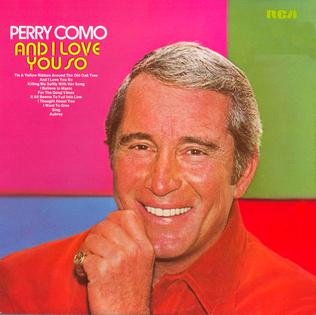
Perry COMO: And I Love You So


(#138: 26 January 1974, 1 week)

Track listing: And I Love You So/Killing Me Softly With Her Song/For The Good Times/Aubrey/Sing/I Want To Give (Ahora Que Soy Libre)/Tie A Yellow Ribbon Round The Ole Oak Tree/I Thought About You/It All Seems To Fall Into Line/I Believe In Music

Though recorded in Nashville and produced by Chet Atkins, who also provides excellent lead guitar throughout, this isn't really a country album, but there are indications that someone was trying to do something interesting with, or exploit otherwise hidden emotions in, Como. It isn't quite Perry Sings The Great Hits Of Today, although the song choices are for the most part not obvious or hackneyed, and I have to be careful not to claim this to be an MoR equivalent of Grievous Angel. However, the seeming lack of adventure and surfeit of contentment in Como are both superficial and misleading factors, and this collection for the most part finds him, of the surviving great Italian-American balladeers, far more comfortable with the then-present than Dean Martin (who by now had almost given up on recording, essaying a reticent collection of twenties and thirties songs which Reprise couldn't find it in themselves to put out until 1978), Sinatra (on the comeback trail with Ol' Blue Eyes Is Back, now with a sardonic and resentful roughness in his voice which often led to an unwholesome sense of superiority in his performance, the winning vulnerability now almost entirely absent) or Tony Bennett (who indeed in 1970 did record a collection entitled Tony Sings The Great Hits Of Today! under pressure from CBS, from which he almost immediately recoiled and returned to jazz).

Part of the clue as to why this should happen may lie with one of the two arrangers engaged on the record; respected Nashville veteran Cam Mullins orchestrated four of the selections (including the title track), but the remaining six were done under the direction of Bergen White. The latter was by this time well into an illustrious Nashville career, but had (also in 1970) recorded the extraordinary collection For Women Only (for contemporaneous developments in American avant-MoR, see also records such as Van Dyke Parks' Song Cycle, Richard Harris and Jimmy Webb's The Yard Went On Forever, Randy Newman's 12 Songs, Lou Christie's Paint America Love, early Nilsson passim, etc.) featuring elaborate internal dialogues between voice and orchestra such as "Let Me Stay Awhile" and "If It's Not Asking Too Much," even venturing into murder ballad territory with "The Bird Song." The experiment was not repeated, but much of its emotion must have stayed with White; compare, for instance, For Women Only's treatment of David Gates' song "Gone Again" with Como's reading of Gates' "Aubrey" here; in both performances, the strings (and in Como's case the flute) do not quite let the singer rest, rather compel the singer to dig deeper into his possibly self-inflicted grief. This Como does - with some inevitable reminders of Scott Walker - with subtle aplomb; note how each verse climaxes in a vaguely despondent, wordless hum. "Aubrey," first heard on Bread's Guitar Man album in 1972, is a complex song, worrying around the notion of a lost, or perhaps non-existent, love, and Como approaches its self-questioning with considerable emotional restraint; his resigned coupling of "moon" with "but where was June?," his slow emphasis on the "came" of "It never came around."

This was bold territory in which to place Como, and it is possible that his absolute, unshakable but relaxed command and self-confidence perhaps work against the record's effectiveness, but this should be placed against the attempts of White and Mullins to coax him gently out of his comfort zone. In this setting one has to imagine Como with suicidal ideations, or having just come out of prison, or engaging in one-night stands, or being a shit, and since none of these is imaginable in Como's case - you cannot even picture him stealing an apple from the grocer's box aged four - the record does sometimes lend itself towards hotel lobby blandness, and in one case worse; White's "Tie A Yellow Ribbon" is an exhausted miscalculation, as though both singer and arranger realised that nothing could be done with this song, thus the reversions to cliche (the Terry And June flute and muted trumpet unisons) and the absence of destination in a song about travelling back home; the crucial "whole damn bus is cheering" is rendered as merely another stop on the endless treadmill, there is no "I'm coming home" fadeout - the bus merely vanishes into the distance.

But most of the record deserves better attention. It bore two major hit singles in the UK - the title track remained in our charts for nine months, and "For The Good Times" for just over six - on the crest of a considerable revival of interest in Como's work, but neither performance is exactly reassuring. The Don McLean-penned title track, for instance, appears to purr contently on its bed of marimbas, but the song is about someone with a dark past, who has known hell and despondency, and is quietly liberated about having life and love returned to him. But Como needs to display no exhibitions of outward ecstasy; his central emphasis on the line "I'm happy that you do" expresses the hardest of won peaces. Likewise, the Kris Kristofferson song had previously been a US country number one in 1971 for Ray Price, who sings this sequel to "Help Me Make It Through The Night" with slightly bemused anxiety (he knows he's being a cad but is trying to cover it up), whereas Como approaches the extended, elegiac farewell to his temporary lover with the same rich exhaustion as the Nixon of Watergate ("...and make believe you love me one more time/For the good times") - a slow, awkwardly stately retreat from a gaze which may be from his lover, or from the uncomprehending world.

In between these twin peaks, one notes the ingenuity of following up a Don McLean song with a song written about Don McLean. White's one-note strings and backing vocals introduction begins promisingly enough, but Como cannot get comfortable with the song, and at many points one suspects that he is singing more of himself than of any muse (for instance, his "I felt all...embarrassed by the crowd"). In addition, his changes of emphasis in the choruses, where the "with her song" and "with her words" do not exist independently, and rhetorically, of the "killing me softly" but rather roll on regardless, dilutes the performance's emotion. Yet he remains capable of altering his mood with near-imperceptible subtleties, for example when he casually runs "...in all my dark despair" into the slight smile of "like I wasn't there." The cymbal which regularly and threateningly hisses, like a strayed snake, throughout the performance also suggests emotional imbalance. All in all, side one is a surprisingly turbulent (in its slowly burning manners) emotional ride, and by the time Como reaches the ebullient "Sing" with its encouragement of good over bad and happy over sad, he finds himself unable to shake off the residual sadness.

Emotions arguably magnify in the record's second half; "I Want To Give" (arranged by Mullins) may be the keynote performance. Here Como finally lets it come out (as far as he was diplomatically able to do so); his "I beg of you to listen to my heart," his plea "to make a world that cannot fall apart," complete with the Hollywood motion picture ending, suggests a tired God singing (his repeated, and increasingly desperate, "if you'd just let me"s). Thereafter he falls back into reserved mode; "I Thought About You" is not the song on Songs For Swingin' Lovers but moves Como into the unlikely arena of funk-lite, complete with a fuzzed guitar solo (possibly the closest Como ever came to rock), over which Como sings such thoughts as "Once I even thought of dyin'..."; his final "Most of alllll...IiiiiiiIII thought" is shaky and trembling; is he prepared to crack that mirror? Not quite, as it turns out; "It All Seems To Fall Into Line" is a middle-aged variant on "You've Lost That Lovin' Feelin'" and throughout the song Como patiently annotates the gradual stages of decline and collapse in the relationship with a suppressed sob which only really becomes palpable in his delivery of the song's final two lines.

Still, it is important to end each side on an attempted high, and it is significant that the album is programmed such that each side ends with a restatement of the transformative power of music in itself; Como approaches Mac Davis' "I Believe In Music" with genuine enthusiasm, over snappy electric guitar and strings (and eventually handclaps). He sings of something like salvation ("Find out what it really means to be young, rich and free!") and takes the record out on a relative high. And that is what must have appealed to its audience (the album stayed on our lists for over two years and, in a manner entirely compatible with Como's smart casual approach, slowly climbed up the chart for six months before topping it) - life then was tough and unhappy, and people were despairing, or simply bored, but the message was simple and far from plain; believe in music, agree that music is oxygen, and we'll all get by somehow. There are worse sentiments for a popular record to convey.

Thursday, 22 September 2011

YES: Tales From Topographic Oceans


(#137: 5 January 1974, 2 weeks)

Track listing: The Revealing Science Of God (Dance Of The Dawn)/The Remembering (High The Memory)/The Ancient (Giants Under The Sun)/Ritual (Nous Sommes Du Soleil)

It begins, as so many records of this period begin, with electronic howling winds ("Sounds like the Arctic!" remarked Lena). Eventually a lonesome guitar comes stumbling - or tripping? - into the picture, playing some lonesome single notes, like Hank Marvin stranded at the North Pole. This is an agreeable enough, if entirely unoriginal, beginning, but then the rest of the band comes in and I can't tear myself away from the knowledge that Jon Anderson's Accrington voice, possibly slightly speeded up for the record, bears an uncomfortable resemblance to that of George Formby. Then they start chanting...

It had been going well enough up until that point but then a young man in the audience raised his hand. and asked: "Are you going to be doing this with every bloody record?"

Baffled, I replied: "What do you mean?"

"Going through it minute by minute, word by word, note by note, gesture by gesture, until you've wrung all the surprise and beauty out of it? Three years we've been here now, and where have you got us? What have we learned? You're the sort who thinks that Concise is the capital of Nebraska. You're killing these records!"

Calmer, I responded: "It's killing something, but never the music. What you have to grasp is that this is, in great part, a detective story, a mystery; I'm trying to find something, and to do that I have to go through all the evidence that's available to me. Including, I might add, the ancient trick of conjuring up somebody in an imaginary (or is it?) audience - the Unreliable Listener, I could call you - in order to get things a bit, or a lot, further. The peril is the risk of missing something that might be the answer. Take your time; despite what the rest of the world tells you, it's there for the taking."

"But it's still killing something?"

"That in itself is the greater mystery, and unless you stay with me for the ride, you'll never see the solution. But rest assured that one aim is to get rid, or abolish, or force to abdicate, something that has been holding music down, and by extension us down, for far too long - so long that it has almost starved us. Patience, my twenty-one-year-old self, patience!"

With that he resignedly sat down, and drifted temporarily out of this story. But a deeper source of his pain and anxiety made itself apparent to me by re-listening to Tales From Topographic Oceans, namely that rarely - at least, so far - has a number one album been so anxious and meticulous to prove itself, and yet so shambolic in the proving. A double album, one track per side, which followed quickly on a triple live set, and would itself be succeeded later in the year by a three-song concept album (Relayer, which is cryptically alluded to within the misty midst of "The Remembering"). At their peak, they were as prolific and long-winded as any blogger!

Listening to it now, I feel variously boredom, frustration, annoyance and sympathy. Its eighty-one minutes drag by as slowly as the sixty minutes of Down Drury Lane To Memory Lane, yet contain so many minute moments of invention, coherence and foretelling that it is irritating that the group did not seek to expand them further. But finally I sympathise because hitting Yes is like punching a peanut which thinks it is a coconut; these are, or were, honest lads trying their best to (as they doubtless saw and still see it) push music forward.

But side one's "Revealing Science" lays out all the flaws. There's the chant, then a synth sea shanty ("Maid Of Orleans"! Who says that fifteen-year-old Andy McClusky and Paul Humphreys weren't devouring this in their bedrooms?), and then a random grab-bag of styles which could almost be termed postmodern or even prophetic, except that such an ingenious ploy is plainly outside the group's scope; they think they're writing Beethoven's Tenth. Thematically, it's the trusty old where-is-the-world-going meme, with several references to raping the forest, an unusual concentration on the word "moment" which seems to serve as a baton for changing musical gears, and reams of woolly semi-thinking about saving the world. They try their hand at folk-rock, space rock, even some pale fusion (but they most certainly are not Weather Report; see 1974's Mysterious Traveller by the latter for stark confirmation) and some old school sixties beat echoes; inevitably there are Peppery moments but ELP and especially the Moody Blues, with that damned mellotron, are recalled far more speedily. It cranks up for a rockout, then Rick Wakeman takes it down again with some cocktail Moog, and unlike the long Abbey Road medley, with which it shares a certain boue ("What happened to this song we once knew so well?"), there is no real sense of continuity or true cohesion.

The opening of "The Remembering" meanders forever - Chris Squire's bass is by far the most interesting thing going on here, and little wonder that the twenty-something Trevor Horn, then compelled to play "Tie A Yellow Ribbon" every night in a cabaret band, wanted to be him (and indeed sound like Anderson) - before settling again for mish-mash; there is a recurring synth leitmotif, meant to represent the topographic oceans but seemingly dropped into the piece at random. Again there is the ying and yang of loud bit followed by quiet bit, with essays in medieval lutism and touchy prog workouts, concluding in layered choirs and missed profundity. Lyrically it wanders around the plains of non-specific yeasaying, including a passing reference to Anderson's school days ("School gates remind us of our class"). But again there are touches of things greater; early in the lengthy instrumental introduction, Howe does something on his guitar, or touches the right pedal, which appears to suggest premonitions of the Cocteau Twins. Elsewhere there are echoes of the Beach Boys - "Sail On Sailor" as it might have been in abler hands - and more semi-random scrabblings building the path to Architecture And Morality. But all of these last but a few seconds apiece before being swept away in the next guitar solo, or Moog flourish. The album is half done, and that is not merely a statement about its duration.

"The Ancient" gives the group the chance for the obligatory percussive workout (I keep using the word "workout" in relation to this record, but it really does raise the same feelings as a listless day in the office). Despite Squire's valiant efforts to marry Jack Bruce with Stanley Clarke, this isn't exactly On The Corner in terms of world fusion as meltdown. In his sleevenote, Anderson talks about the piece being influenced by "lost civilisations, Indian, Chinese, Central American, Atlantean." Atlantean? Now hold on a minute; just because you call a track on your first solo album "Moon Ra" doesn't mean you are fit to wipe Sonny Blount's brow (especially if, so unlike Sun Ra, you are entirely lacking in humour), particularly in one of the many moments on this track when the band audibly feel as though they want to burst into "Atlantis" by the Shadows. We eventually encounter a beached whale of a rhythm track - puffing, bloated, oleaginous - over which Steve Howe does his best to get Robert Fripp chatting with Mike Oldfield (there is more than a fair scent of Tubular Bells throughout the record as a whole). And then there are more of these infuriating moments; two blink-and-miss-them upward harp-like flourishes that actually invent ZTT, a quietly probing guitar/echoplex/bass/drums interlude which foretells Bill Frisell's Power Tools a decade and a half later, even some Eno-with-a-Royal-College-of-Music-diploma Moog hisses from Wakeman. But then it's medieval time again, followed by a century-long Paco Pena tribute from Howe on his trusty acoustic. And then it rocks up again, and then it dies down. You could set your electricity meter by it.

"Ritual" is by far the best-structured of the four tracks, although everything is relative, since it begins with what could pass for a soundtrack to a BBC East Anglia documentary about sailing, presented by Cliff Michelmore, before moving into a melodic variant on "Gasoline Alley" for its main motif. Squire does a showoff bass solo. Then some more quiet. Then a dry run for the Police with some underlying evidence of 1964 Beatles still present (Squire's very McCartney-ish bass under the "at all" section). Then some Pet Sounds organ. Then a 5/4 rockout within which you can sense the band's collective urge just to say fuck it and move into "Louie Louie" (and it was largely Anderson and Howe's project; Wakeman spent most of his time in the studio hanging out with Black Sabbath next door, who were busy recording Sabbath Bloody Sabbath, before heading to the pub to play darts with Ozzy). Now Howe thinks he's Carlos Santana, but Caravanserai this is not (there's no joy). The music stops abruptly. Then a "Workshop" hammer n' tools percussive marathon, which I'm sure was great fun to play - actually it stops halfway between "Workshop" and "Antmusic." Then Wakeman revives his old "Space Oddity" tropes. Did I hear some scratching there? No, it's Rick trying to be Eno again. The mood now is one of an Anne Boleyn Secondary attempt at "Interstellar Overdrive" (you can smell the wood polish, see the teachers sitting with patient faces frozen in rictus smiles; Lena thought it was more like incidental music for The Six Million Dollar Man). Then we move back to unaccompanied, electric Howe. Anderson tries out for Jon and Vangelis - if I've studiously avoided analysing his lyrics here, it really is because I don't feel anything can be gleaned or learned from them; there are all the non-committal Moody Blues greetings card homilies about opening your eyes to see the sun, etc., some cod French, a confusing bit of business about whether he's going to call us or not, and finally lyrics which must have been threaded threefold through Babelfish (if only Babelfish had existed at the time, but really: "Look me my love sentences move dancing away"? "Hold me, around, lasting our"?), although the old calling still seeps through: "Hold me, my love, hold me," and, of course, "Flying home/Going home" (Anderson's multitracked harmonies do, admittedly, conjure up the Byrds). There is some liquidy piano, then a Tubular Bells-style build-up which wimps out at the last second and ends quietly, unresolved and unmoving.

So who bought this, apart from students and five-leaves-left stoners? Was it a quiet fortnight, or was its number one status the result of well-meaning Christmas gifts to teenage children? I can easily believe that the supposed epic nature of Oceans would look and sound big enough to beguile listeners just starting out, yet to learn about things like Future Days and Rock Bottom. Except that Yes had already, and repeatedly, proved that, when disciplining themselves, they were capable of superb songs: "Yours Is No Disgrace," "Roundabout" and "I've Seen All Good People" being only the three most obvious examples. Wakeman for one had had enough (but in truth he is hardly on there) and quit Yes after the record. But that distant pyramid, the lunar relics, the navy-blue sky - it was all an escape from grey, disappointing Britain. I still cannot work out what, if anything, the musicians on this record were striving to achieve, but after enduring its length we put on Aretha's Amazing Grace and it struck us that the title track achieved everything (and more) that Yes had been straining so hard to match; the effortless and natural move from one style to another, the unquenchable emotional openness, the happiness and laughter which comes from connecting with the world, even when it seems at its worst. So you see, the search, the ambition - both need to continue if a happy resolution, and perhaps even an ending, is to be reached.

Thursday, 15 September 2011

Elton JOHN: Goodbye Yellow Brick Road


(#136: 22 December 1973, 2 weeks)

Track listing: Funeral For A Friend (Love Lies Bleeding)/Candle In The Wind/Bennie And The Jets/Goodbye Yellow Brick Road/This Song Has No Title/Grey Seal/Jamaica Jerk-Off/I've Seen That Movie Too/Sweet Painted Lady/The Ballad Of Danny Bailey (1909-34)/Dirty Little Girl/All The Girls Love Alice/Your Sister Can't Twist (But She Can Rock 'N Roll)/Saturday Night's Alright For Fighting/Roy Rogers/Social Disease/Harmony

A double album wasn't really what he wanted, but he did it anyway in the hope that it might count as both of the two albums he was contractually obliged to supply to DJM each year. No dice, said Dick James, we need another one; the musician had been hoping for a rest, but his situation - that of becoming the most recognised and famous pop musician on the planet - was no longer allowing for such luxuries. On the other hand, you could view GYBR as a spilling repository of everything that Elton John knew in 1973, all that he was absorbing; work on the record began in Jamaica (following the Stones' trail) but heavy manners in Kingston (the Foreman/Frazier fight happened while he was there) compelled a return to France. Thence (via Taupin) came recollections and reconstructions of things and people he had known in his life, the old and new music coming at him like an unending stream of snowballs. Remember that the artist capable of sensitive character studies involving Marilyn Monroe and Roy Rogers also, at some point in 1973, pranced around in a 190-pound gorilla suit onstage with Iggy and the Stooges in Atlanta. Interviews of the period do not picture a particularly happy or satisfied Elton, but then the end of 1973 was not a particularly happy or satisfying time; a ruin of Nixon, oil shortages, strikes, power cuts, curtailed working weeks - a time when one wondered whether Britain wasn't really happier with ration books, that self-denial was a national pastime as well as this nation's fatal flaw. The title track of GYBE alone fit perfectly into such imperfection with its impossible yearning; if you can't imagine multimillionaire Elton forsaking penthouse for plough (and horny-backed toads in Britain?) then remember that everyone has their own version of the blues, and do not forget the Floydian poignancy of those long guitar arcs and anti-rainbow vocal harmonies. "When are you going to come down? When are you going to land?" - sometimes it seemed that everything in 1973 was a homage to Syd (and yet it was this song, of all songs, which moved the young Axl Rose to think about considering a career as a singer).

GYBE does a good job of summarising 1973's main trends; the movietoned nostalgia of David Cassidy, the glam of Bowie, the marooned mystery of Roxy, the general "where do we go from here"ness of That'll Be The Day, the politely stuck-out tongue of Alice Cooper, the inescapable shadow of the Moon. But while the record reminds us that John and Taupin remained, at least at this stage, petit maitres rather than large-scale conceptualists, the long stadium synth rock of its eleven-minute opener suggests that a grander notion had initially lodged in their minds. Done in collaboration with David Hentschel, "Funeral For A Friend" begins where Quadrophenia might have left off, complete with portentous wind howls, tolling bells and morose lead melody. The endless piano crescendos and intrusions of tympani and castanets, however, suggest a path forward, even if to (in equal parts) Bat Out Of Hell (Davey Johnstone went on to work in Meatloaf's backing band) and War Of The Worlds. Into this picture - perfect for building up anticipation for The Star's arrival on stage - John enters, whereupon the song immediately switches into a tough, fast rocker, Dee Murray and Johnstone in particularly stern form. His girl has left him, and the song careers somewhere between Sinatra's "Cottage For Sale" and "Wichita Lineman" ("You're a bluebird on a telegraph line"), running straight through "Ziggy Stardust" ("But my guitar couldn't hold you/So I split the band").

The sequence sets the tone for a long, varied and entertaining journey - but the latter is not necessarily what we get. The album's first third is more or less faultless; "Candle In The Wind" as a third-hand threnody to a fussy departed spirit works better, I think, as a candlelit bedsit meditation on youth and incipient sexuality than as an elegy of national lament; I was in Westminster Abbey, in a professional capacity, when he performed the rewrite a lifetime later, and although the emotion dormant in him was unquestionable and evident, the square-pegging felt awkward, like an old family snapshot blown up to cover the walls of a skyscraper. Here the intimacy and self-doubt are not sacrificed or exercised beyond their capacity. "Bennie And The Jets," an unexpected number one single in the USA ("We decided to put it out because it was the Number One black record in Detroit"), is the record's most defiantly futuristic and aggressive moment (but note the unusual aggression of drums, bass and piano throughout "Candle"); drawing on and expanding the Bowie/Ziggy template, the song is simultaneously all-inclusive and isolating - what are these curiously disconnected handclaps and whoops on what palpably isn't a live recording (as it turned out, the main handclap loop was sampled from Hendrix's 1970 Isle of Wight concert, with other effects from various recorded Elton gigs)? Moreover, those calls of "We'll kill the fatted calf tonight" and "Let us take ourselves along/Where we fight our parents out in the streets/To find who's right and who's wrong") go further down the path of insurrection than John or Taupin ever ventured, before or afterwards; it's a British cousin to/anticipator of Rundgren's "Just One Victory" (1973 also being the year of A Wizard/A True Star, that unparalleled unravelling and reconstructing of pop history); there is even the hint that this is really what John and Taupin wanted to do all along, kick down and get dirty. Note the odd, stinging outbursts of organ at song's end, the residual sense of futurism, and that Prince was, in 1973, fifteen. After the diversion of "This Song Has No Titles," all Mellotron melancholy with Beach Boy-ish backing vocals, "Grey Seal" is a terrific Procol Harum word-puzzle propeller with its artful, perspective-altering bridge between verse and chorus, although we still appear to be at the movies ("On the big screen they showed us a sun/But not as bright in life as the real one").

If the album had remained at this level and gone straight to "Your Sister Can't Twist," we would be looking at a pretty unassailable classic. Alas, the six songs which comprise the record's centre bring with them what I can only describe as a "Willem Dafoe moment," i.e. that point in a perfectly good film - Wild At Heart or The English Patient, say - when Dafoe arrives as a supporting character and immediately turns the movie into a glutinous mess. Worse, these songs expose John and especially Taupin's limitations. There is no need to go into any of them in detail, except to say in passing that "Jamaica Jerk-Off" was a bad idea even at the time, that "I've Seen That Movie" is an overblown overexposure of the movie motif complete with weepy guitar solo, would-be epic strings and "passionate" vocalising, notable only for being a partial musical precursor of "Sorry Seems To Be The Hardest Word," that the utterly stupid songs about prostitution and lesbianism rank among the worst and most misguided to have so far occurred in this tale (complete with unwarranted algae of pseudo-moral outrage), that I am not encouraged to find out anything more about Danny Bailey, and that Elton's vocals become angrier and less coherent with the lesser material with which he has to work. No vigilant record company boss would have spared the secateurs.

To prove what a great single album this would have been, John and Taupin rally round in the final third with noticeable regaining of quality; "Your Sister Can't Twist" is a wonderfully pseudo-dumb rocker, John's piano sounding particularly joyous, with its exhortations to "Throw away them records 'cause the blues is dead" and the Farfisa organ placing the song (essentially an "At The Hop" derivative) somewhere between Johnny and the Hurricanes, American Gladiators and Blondie. "Saturday Night," meanwhile, is Elton's most convincing straight rocker and comfortably outrocks anything on Goats Head Soup; note how the prog-rock organ is swiftly wiped out by Jerry Lee piano dips with the advent of every chorus, and Johnstone's rollercoaster guitar riff sliding perfectly into the shouty fadeout. "Social Disease" works where the albun's midriff doesn't, largely because of its effortless humour, its claps and whoops, and John's hysterical vocal, landing between Randy Newman and a particularly frisky Leo Sayer ("Dis-e-EEEEEE-eeeese!"). The closing "Harmony" unexpectedly finds John in the same place as Bryan Ferry at the end of Stranded; out there on the sea, blissfully landlocked, and not without its winks of escape ("In any case I set my own pace/By stealing the show - say hello, hello").

But "Roy Rogers" cuts the deepest, and proves that John and Taupin's talents lay in the immaculate miniature portrait rather than the sweeping gesture; in its contemporary reflections it is the mirror song to "Candle" and as an end-of-every-big-thing piece it ranks with Richard Thompson's contemporaneous "End Of The Rainbow." Here Taupin gets it absolutely right; the nine-to-five guy who knows that life has passed him by, who's too tired or insensate or trapped to change anything, who's wondering what all that promise of the sixties was for, whose only connection to life is watching the old cowboy films on TV. Weep with Johnstone's steel guitar as it drops off in agony after John sings the line "While the wife and the kids are in bed" - the hopeless Dividend Stamp greyness of late 1973 Britain is perfectly captured; this, let us not forget, is the world from which BS Johnson had just absented himself. Nothing for it but to bury oneself, in hiding from commitment, in the memories of when he wasn't required to be responsible or careful. But note the "let's shoot a hole in the moon" warning, and the "hit the hilltop" near the end, both of which lead to the nuclear siren drone which actually ends the song. The past is one thing, but the future has to live, too. In the meantime, there was another album to be recorded, another responsibility to be fulfilled. Wasn't he already nostalgic for a time when he didn't have to do so much work, when the yellow brick road was safely distant from him, up in that beckoning light?

Thursday, 1 September 2011

David CASSIDY: Dreams Are Nuthin' More Than Wishes...


 (#135: 15 December 1973, 1 week)

Track listing: Opening Music/Daydream/Sing Me/Bali Hai/Mae/Fever/Summer Days/The Puppy Song/Daydreamer/Some Old Woman/Can't Go Home Again/Preyin' On My Mind/Hold On Me

"I stand amid the roar
Of a surf-tormented shore,
And I hold within my hand
Grains of the golden sand"

(Edgar Allan Poe, "Dream Within A Dream")

"If you try you will find me
Where the sky meets the sea"

(Rodgers and Hammerstein, "Bali-Hai")

"Until we meet again kiddies it's all over now baby blue..."
(David Cassidy, from his sleevenote to Dreams Are Nuthin' More Than Wishes...)

Whatever did happen to Billy Bigelow Jnr. anyway? Well, he grew up like no one anticipated, even though it was his mother - that cautiously innocent voice which rings down from entries #2 and #4 (have we really only travelled seventeen years, or no distance at all?) - who led him into becoming famous. Famous, that is, to a point, one almost beyond bearability. By the end of 1973 The Partridge Family had been cancelled and the boy - if we can speak of this twenty-three-year-old as such - had already become half forgotten in his own home. He remarked that he felt as though he had been marketed like a packet of cornflakes. In Britain, however, he had never been more famous, and was never to be more famous; late 1973 caught him at both the peak and the end of his popularity, a situation which necessitated his being smuggled into studios in laundry baskets to do television, a live following which would end in fatality in only a few months. He wasn't, in short, happy, and the surface happiness of this record does little to conceal the abyss of despair lying beneath.

The record already seemed like a lost relic in its own time; there on the cover is David and his Dalmatian, on the rear David's head rising wetly out of the water as though already auditioning for the cover of Fourth Drawer Down, in the middle David's track-by-track sleevenote, in his own junior doctor's handwriting, complete with drawings. With the record also came a separate print, of Bruno Piglhein's 1925 painting Pals, a rather forlorn watercolour featuring a naked girl and a black Labrador, sitting side by side by a river with their backs to us. The only reason this doesn't qualify for a hauntology label is that it's difficult to see what messages the record is sending us two generations later, other than those to do with the singer's state of mind.

It is not an easy record, either, and one can only marvel at the loyalty of the fans which surely must have sent it to number one. Loosely structured as a song cycle (although it is neither Cassidy's Pepper nor his What's Going On?), the record begins with a snippet of the closing track, "Hold On Me," in which the singer makes the following observation:

"Although life is a serious game,
Was it I who played wrong?
Do I belong to the small few
Who get lost in the race
Who still seem to pretend
When their daydream ends?"

And before he can reflect any further, the record immediately sways into John Sebastian's "Daydream," the beginning of his time. Dominated by Michael Omartian's tack piano (and the musicians appearing throughout Dreams are the best Cassidy could buy; Larry Knetchel, James Burton, John Guerin, Kim Carnes, Michael McDonald, Victor Feldman and very many more besides. The music is downhome luxurious), Cassidy speaks (in his sleevenote) of first hearing the song in 1966, stuck on the Long Island Expressway in 105-degree heat - a situation more in keeping with the Lovin' Spoonful's follow-up, the pre-apocalyptic "Summer In The City"). He gets into a sort of swing but despite his deprecations (near the end he speaks "Makes. Me. Feel. So. Good") he is not quite in the realm of happy.

In "Sing Me" he goes even further back, citing Kitty Kallen's "Little Things Mean A Lot," musing about his mother "posin' like Marilyn Monroe" (thus Dreams becomes the first of two consecutive anguished number one albums to mention Monroe), his father holding him up at the beach, "Life was a joy, I never got old," followed by the crushing self-revelation that he is fated to get old, particularly when he turns four and a new baby brother arrives home (whereupon he promptly flees on his bicycle). Backing singers plead, "Take me away." Back to a life without responsibilities, without fear, without retrograde selective nostalgia.

And then it is back to "Bali-Hai" and he sounds as though he is being born; he materialises through the ocean wave effects and Feldman's ghostly vibraphone, tracing himself back to the source of his pain, that special island that once promised everything. It is an exceptional reading, and if it sounds as though we are nearing Surf's Up or even Pacific Ocean Blue territory, you wouldn't be far wrong. He snaps out of his reverie, however, as reeling bass and congas rope him into "Mae," another song about mother fixation. Here Cassidy really shows his versatility - normally his voice is breathy, microphone-close, accentuating the sibilants, not that far from, of all singers, Cliff Richard - and his rumbling "warm and tender," his repeated self-hypnotising mantras of "I need you, Mae" (waves, swimming, back to the womb, it's all here; there is even a Van-esque abrupt holler of "ALL RIGHT!" as emotional breaktime) leading into Michael Jackson-predicting mutters and gasps ("HI need! HIII need!!") which in turn wander into barking abstraction.

The improvised take on "Fever" is also extraordinary; with its Superfly bass/piano unisons, its floating vibes/percussion echoes, its use of echoes and spaces, Cassidy's own unmoored vocal ("HIIIIII LIIIIIIGHT up!" he gasps at one point) above melodramatic drums and piano, it plays like a hook-up between Isaac Hayes and George Crumb. Had it been a long-lost track by, say, Terry Callier, Norman Jay would have been on its case decades ago. A superb climax to side one, only slightly lowered by the re-reading of the old Partridge tune "Summer Days"; despite this apparently being closer to Cassidy's original vision of the song, it doesn't make the song itself anything more than mediocre (as the lumbering, mistimed key change about a third of the way in highlights).

Then, however, it's side two, and the hits: Nilsson's "The Puppy Song" is treated generously, with spring coil percussion, vaudeville washboard, the tack piano again, and hopeful (though alas uncredited) clarinet, but none of this hides the song's rather starkly alienated nature; after all, he has neither a puppy nor (to extend the dog metaphor westward, as the song does) friends, and he is merely wishing for one so that "we can stay away from crowds" and from "signs that said NO FRIENDS ALLOWED." Likewise, "Daydreamer" ruffles into view atop Michael McDonald's warm Fender Rhodes grill, and one can clearly see how the ten-year-old George Michael would have, so to speak, got it, but the unwanted oneness is still non-detachable from the singer, and just when you think the song is all over, there comes the most pregnant of pauses, followed by: "I'm...just...a..." and that "a" sounds as though he is pulling down the rest of the world with him, closing ocarina solo or no. He recovers some ground, however, on Shel Silverstein's characteristically goofy "Some Old Woman" with his soul brother parody vocal ("It's a shame...HM!...it's a PITY!," his comedy growling of "wicked and WILD!," his perfectly-timed throat-clearing). He ends up roaring "LIES!" and nowhere else on the record does he sound as though he is having such an unalloyed good time.

But then comes the closing trilogy, and Cassidy's neck bends towards tragedy. Not that you would necessarily know that from the good-time ambience of the playing - the then-unknown Kim Carnes is rightly applauded by Cassidy for her tennis-match piano on "Preyin' On My Mind" - or the determinedly lighthearted nature of the sleevenote, but "Can't Go Home Again" spells it out as dismally as The Last Picture Show; he's back, and doesn't really know why, his mama calling his name, and his mind drifts into imperfect memory (the song, composed by Cassidy with Carnes and Dave Ellingson, was originally planned as an unending list of memories, sightings and insights relating to "this boy's lost track"); the old dreams, the absences (Tom who ran the picture show is long gone), the fact that "a double-deck cone don't cost a dime no more," maybe the record's saddest reflection, the final encounter with a crying street bum (whom he remembers from boyhood) who could easily be himself - turn, turn, back into the car, back to the station, if you can, there's nothing for anyone here, and Cassidy wishes above all else that he could simply be "anyone" before the music fades into a Bob James groove of comfort. "Preyin'" continues the theme with its musings about "the lonely old man passing through your town" although, as mentioned, Carnes' piano and backing vocals do their damnedest to punch some life back into the boy.

Finally, however, there proves to be no exit, except the last one; "Hold On Me" finishes the record as it began, and its sentiments are the record's darkest with its "set myself free" and Cassidy's most emotional vocal performance - "Circle closing in on me 'til I can't seem to see," "We're alone and we're broken...now don't we need loving?" (is this still, despite everything, 1969?) - until the original refrain returns and is turned into a reluctant singalong. "Do I belong to that small few that got lost in the race..."? Fittingly, the record itself became an absence; although its only slightly less troubled predecessor Rock Me Baby is still readily available, Dreams has not survived, available only (to mirror the beginning of 1973) as an expensive and hard-to-find Japanese CD. It feels like a dream from which Cassidy is unable to escape; waking up, he finds that he is still dreaming, and that dream is stardom, nothing like he expected. But can't those sands of seconds be turned into gold? How good could his grip be - or does he gladly sink into responsibility-abolishing oblivion? Not quite, for he has survived and endured; nevertheless, this record reminds us of the pain waiting for everyone when the carousel opts to stop, or is stopped.

"Yet if hope has flown away
In a night, or in a day,
In a vision, or in none,
Is it therefore the less gone?
All that we see or seem
Is but a dream within a dream."

(Poe, op. cit.)

Wednesday, 24 August 2011

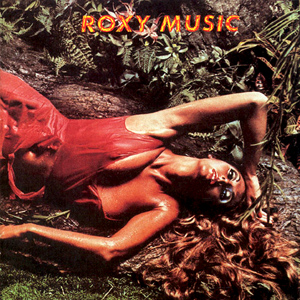
ROXY MUSIC: Stranded


(#134: 8 December 1973, 1 week)

Track listing: Street Life/Just Like You/Amazona/Psalm/Serenade/A Song For Europe/Mother Of Pearl/Sunset

"The Futurist Official dinner avoids the grave defects that pollute all official banquets:

FIRST: the embarrassed silence stemming from the fact that there is no pre-existing harmony between the table companions.
SECOND: the conversational reserve, owed to diplomatic etiquette.
THIRD: the moroseness produced by insoluble world problems.
FOURTH: the rancour of frontiers.
FIFTH: the low, wan, funereal and banal tone of the dishes."

(F T Marinetti, The Futurist Cookbook, 1932: trans. Suzanne Brill; San Francisco: Bedford Arts, 1989)

"I am for a life around the corner
That takes you by surprise"

(Roxy Music, "Manifesto," 1979)

There are recipes, and manifestos, and sometimes the division between the two is not as comprehensible as their shared unity. But think. Would it be worth it? It sounds revolting, potentially life-ending, too strange to look at, let alone try to eat. All these different, opposing ingredients. But take one bite, just the one. There will be such momentarily excruciating pain that you will briefly never want to come near it again, wish to run as far away from it as possible. But get past that wall of limitations, squeeze, push, burst beyond it, and you will experience delicacy and joy such as has barely been revealed to you in your years. The taste is catching, not really fatal; but there is a clear road, and two ways to travel - the past, and the future, the notions of nostalgia and consumerism, for your future lies in what you want, or are persuaded, to consume. Anything but to think about or stand in the present, with its awkward need for commitment and alternatives. Because sometimes the present is so unbearable that your feet might burn with the mere thought of living there.

But throwing it all together, and reorganising it into new and enriching shapes, is what it's all about. It? Or is it but a way to avoid thinking about the past, with all its torture disguised as retrospective candy? Or - and better - to look the past squarely in its reddening eye, laugh at it, or rather laugh with it (but why not both?) and nudge a future into existence? What if, like most of us, you're not at all sure where you want to go?

I think by the time of Stranded - and this is already The Third Roxy Music Album - Bryan Ferry had at least sketched out a draft of where he wanted to go. The mixing bowl has settled into a colour next door to concordance; Eno has already left and taken his flaming yellow with him. It's a wonder that either of the first two Roxy albums popped into pop; the eponymous debut laying out its agenda, then eating it into a symbiosis of King Crimson and Mike Westbrook's Solid Gold Cadillac that somehow cut deeper and worked warmer than either; side two of Roxy Music is like a photocopy of pop, muffed enough in the greys for unwary types to view it as "prog" (but didn't Ferry audition for the King Crimson singer job?). For Your Pleasure retains the dirty melancholy but gains more confidence; the vast Tara(ntula) plains of "Bogus Man" and the title track float with damaged Great Learning elegance (for Eddie Cochran was regarded as Cornelius Cardew's equal, and made better people's music into the bargain) while "Do The Strand" and "Editions Of You" spell out rock with a K for Kafka (and Kidd) and "In Every Dream Home" was coldly sweaty enough to christen the plasticity of prog anew.

But the end of 1973 was unjustly cold, dark and unforgiven. Here is where complete dissatisfaction with the present is made bare (if wired) in "Street Life," that least transparent of the season's Christmas hits with Paul Thompson's drums regularly tripping over themselves, finger snaps an oil scare away from The Addams Family and wavy line keyboards (stop feeling fascination?), Ferry growling, snapping, Little Richard wooooo-ing as though half a decade belting out "In The Midnight Hour" in toilets had to be paid back (and note the chewed-up "d"s and "l"s in the Billy Fury tradition). Anywhere - dreams of jet black angel fifties, Vassar debutante perfidity - is better than standing still ("You might be stranded if you stick around...and that's really something," concludes Ferry over a soundtrack that sounds like walking on hot coals).

There were other records around that related to Stranded, and ideally these should be heard in tandem: Ferry's solo These Foolish Things, a canny and canned exercise in emphasising the importance, majesty and continuity of popular song. Did anyone realise that "A Hard Rain's A-Gonna Fall" was such a great - and shocking - pop song before Ferry and David O'List got to work on their Spike Jones effects, and how naturally it fitted in next to Eric Maschwitz, or the whole Noel Coward thing? The comedy effects are put to subtler yet more ecstatic use on "Mother Of Pearl" - the single castanet which answers "flamenco," for instance. Then there is Eno's Here Come The Warm Jets. Much like Stranded, Warm Jets hovers lovingly over several differing variations of the same song and has no reserve or lack of wit about bashing different elements into each other, dodgem-style; thus the slo-mo poignancy of "On Some Faraway Beach" breaks straight into the punk sneer of "Blank Frank." "Baby's On Fire" sounds like rock trying to rescue itself from The Towering Inferno, whereas the tenderness of "Cindy Tells Me" meets its opposite, and match, in the determinedly ludicrous Ferry impressions on "Dead Finks Don't Talk."

What I'm trying to get at is that the Roxy Music of Stranded - and most of them were on both these records - walks a remarkable line in between the pop and popped extremes, even as its leader wrestles with his mind and Brylcreem. New keyboardist/violinist/electronicist Eddie Jobson was eighteen and fresh from Curved Air, and actually (or, at least, on this record) makes a better companion to Ferry, mainly because his lack of questions means greater concentration on how to soundtrack this mixture of woe and titillation. Some Roxy fans were disappointed by his work on "Amazona" and while it is true that the song's "weird" sections are clearly constructed with effort and skill, as opposed to the Connect 4 pot luck of Eno's anti-strategies, the interaction between Jobson and Phil Manzanera's guitar (albeit with Manzanera clearly taking the lead), coming out of the rapid 14/8 section, suggests the icy fallacy of the paradise to which Ferry is supposedly taking his partner, or hostage (although, with its references to "hollow sound" and "longings more profound," Ferry, as I think he is doing on "Serenade," may well be singing to, or about, Eno). Flashing blasts are finished by a serene Ferry hiccup and as they approach the drawbridge ("Journey's over - we're almost there!") the drums roll to a funereal stop and electrified bird whistles possess a false memory. "Serenade" flops along like a three-wheeled chariot with its fulminating Spector percussion - Fury doing Bowie's "Silly Boy Blue" sprung instantly to my mind - and Ferry (Ferry/Fury, and the two didn't look dissimilar) growls about G-plan gymnastics being of less meaning than the old mill stream in summer ("From courtly love to costly game"), even if, as any reader of George Eliot will know, the presence of an old mill stream does not preclude drowning. What does he want? "Will you swoon, as I croon your serenade?" he asks himself as much as, or more than, us.

Because this man is stranded; he is not quite undecided, but the tide is coming in, he can't make up his mind. Throughout Stranded he refers repeatedly to wasting time, and "wasting" can mean "in decay" here too (the latter is present in the "party-time-wasting" of "Mother Of Pearl," the more reflective meaning of decline in the "Do you disapprove how we've wasted my time?" of "Sunset"). At the beginning of "Amazona": "No more fall-out." As I said, anywhere and everywhere but here and now; and yet he can't live without it. Who could?

And yet Ferry can play tricks with time. If the transcontinental wanderings of "A Song For Europe" - which really play only in his head - will eventually become the falling-down buildings of "I Travel," if the ghosts of Sylvian are already making themselves feel in both "Song For Europe" and "Sunset," then the resemblance of the chord sequence of "Just Like You" to those of Blur's "Best Days" play like a blue prediction (those chords themselves being decidedly Kentish in the Robert Wyatt/Kevin Ayers sense), while the singer struggles not to fall in love, not to be overcome by it or to fall into it. Every time, fashion is pulled in as the culprit, just as it is on "Psalm," where it plays the role of a red herring. And yet, that sudden emotional eruption in the "How COULD..." section of "Just Like You" shows the momentary dropping of all masks.

Ferry is quite prepared to drop masks when needed (the snarl of "stepthroughthemirrorandSEE?" at the beginning of "Amazona") and to acknowledge that masks are not only needed a lot of the time but can also advance our case for living. "Mother Of Pearl" is a remarkable piece of music because he gruffly turns "pop" onto itself and forces it, and himself, to admit to real emotions, particularly happiness and joy, which the record had previously been doing its best to avoid. It begins waspish, the best Little Richard/New York Dolls jam session you never heard, with Ferry whooping, guitars, saxes and synths flying around his head like the artillery fire which will presently engulf Adam Fenwick-Symes at the close of Vile Bodies. But in comes a booming suburban James Earl Jones voice from nowhere: "HAVE YOU A FUTURE?" Shrieks Ferry in reply, "NO, NO, NO!" before the Voice corrects him with a firm and simple "YES."

And then he opens up, as the song slows to half-tempo, quoting "As Time Goes By," indulging in every sentimental gimcrack of a trope he can dredge up, knowing that this may yet be a dream of the firmest plastic...but he wants it, and her, as he allows awe to take over (Jobson's synth shiver which provokes Ferry's suddenly chloroformed "Steps right into-view"), as Andy Mackay's saxes honk like filled boots, and the Voice ("FU-TURE!") returns, before everything dips away towards Ferry's own voice, in a Newcastle club somewhere in 1964.

Newcastle - while Ferry was serving his art school/Gas Board apprenticeship, the thing was to be the Animals, but Roxy, though of similar instrumentation and talent distribution, appeared as a re-sexified Animals; sex thought of differently, and more colourfully, and more fervently - not that there's much talk of it here, but the breath of it is fetid enough to curtain any notions of overspent grief. As indeed is the spirit of Eno, hovering ambiently over the closing "Sunset," from the pre-ambient waterways which directly presage Another Green World to the unexpected poignancy of the Brian Wilson sleigh bells towards song's close, and the song is a hopeful and discreet closer, a record of a satisfied life closing down (Ferry's voice rises exultantly on "larks," glides effortlessly up and down an octave on the following "will sing"), the depth of his being underlined by Chris Laurence's magisterial bowed bass.

Perhaps the most palpable evidence of Eno's continuing grip on 1973 Roxy comes with "Psalm," which according to some sources was the first song Ferry wrote:

"'...On that occasion you told Bernard Stevens that you got no kick out of High Mass at some church or other in Patis because they went through the ceremonial and the music "as a formality" - those were your words. If you are religious it is your Protestantism, or if you aren't perhaps it's your British Way of Life that prevents understanding a faith which needs no exhibition of fervour.'"

(Constant Lambert, quoted in Arthur Hutchings' 1965 introduction to the former's Music Ho!)

Again he begins with fashion to trip up the unwary, and more importantly to prevent himself from believing, but as the song develops, with its straight piano and not quite straight-faced organ, his voice rises and chews on the second syllable of the word "sublime. A rhythm approximating broken-down R&B is introduced, Thompson drumming like Dannie Richmond, away from the centre. On the word "high," firecrackers explode as Ferry's voice dissembles into a single crystalline spark of electronics, violin, guitar and squealing alto. The drums steadily become more forceful, and even martial, as Ferry's surrender to faith grows more intense, and the London Welsh Male Choir quivers into being behind him. Ferry's "Op-EN-UP-your-EYES!" is simultaneously more exasperated and affectionate than Justin Hayward would have pitched it. At this point we notice how Manzanera, Mackay and Thompson have gradually turned the stately English background into a New Orleans gumbo shuffle, and also that the choir is singing in strange, unsettled tonalities (again there's something similar happening two years hence, namely Gavin Bryars' The Sinking Of The Titanic, which will appear on Eno's Obscure label). Everything boils forth, and Ferry is saved and convinced, or at least convincing us that he's been saved. An OMD drone awaits at journey's end.

Because the journey's beginning could scarcely have been more painful. Over thirty-eight years of familiarity with this record, "A Song For Europe" is always the one for which I reach first, and most fervently, because it spells out so many of the things I regard as essential to what can be understood as music, or even art (as though music weren't art); most tellingly because, if we view early Roxy Music as Al Bowlly trapped in a prog-rock band (the thirties trying to live within, and not merely with, the seventies), then we have to admit base emotion as being as profound as lofty speculation. Yes, it's a pisstake of Eurovision - some even say the song was anonymously submitted to the 1973 committee, although there is no real evidence that this ever happened - but it only uses pastiche as both shield and battering ram, to get through this stupid wall of plastic divisiveness, to admit that banal, crazy pop can quite a lot of the time get to the nub of things more handily than some higher art, but that a concept such as "A Song For Europe" could scarcely be imaginable without its high art carrot-masquerading-as-stick. He's sitting alone in an empty cafe - it could be in the shadow of Notre Dame, but then again it could be anywhere - thinking about someone who has gone, who isn't coming back (if there's any trace of the sixties in this record - potentially the first number one album of the eighties, never mind the seventies; the endless, futile search for "love" - the term "holy grail" even makes a climactic cameo in the midst of "Mother Of Pearl" - then it's in Jacques Brel filtered through Scott Walker) and, as a successor will do in a similarly climactic song of loss nine years hence, breaks down. "There's no more time for us" - a final response to West Side Story? - "There's no today for us," "My oyster [is] only a shell full of memories," "Now, only sorrow, no tomorrow." He closes down every escape route, but what else does the abandoned heart do when it has lost something central? And as mournful saxes, piano and guitar rise behind him, he intones the song's words, first in stentorian spoken Latin, and then in emotional French - his final cries of "Jamais! JAMAIS!" hardly offset or cancelled by his keep-us-guessing fading whistling. The point here is that sometimes you have to immerse yourself in "trash" to get to emotion, to express it directly, with candour and without cover, even if for half the span of a long-playing record you are playing hide and seek with emotion? Stranded, below and above all else, speaks for a future, one where high and low are revealed as two sides of the same, smiling coin, one where nothing is off limits or remote in terms of what can be reached or used; because, like Marinetti (but without his anti-Xenomania tirades), Ferry doesn't want to keep this an unruly mess; it is rather the basis for a new understanding of pop music, a different angle, a saltier taste. A style by which, against most odds, substance can be argued or sung into existence (the Futurism conceals, as it usually does, a Romanticism. Did somebody mention Keats?). The words here are as true as they would have been ten years ago, when I felt it necessary to begin writing in public, and five years ago, when Romanticism found, for me, a new purpose and a renewed meaning:

"never again, no, will I give up my heart
to gamble with fate is my crime
nevertheless love, it's all here in my book
I'd write it but don't have much time"

("Just Like You," Roxy Music)

Which then goes on to "I know it sounds crazy/But what can I do?/I've fallen head over heels over you," sung exactly as Adam Faith would have sung it. Faith, you can really see (all those "yes"es and "no"s in "Street Life"; "Mother Of Pearl" confirming that "yes" is the only final way to travel).

Sunday, 14 August 2011

David BOWIE: Pinups

Pin Ups - Wikipedia


(#133: 3 November 1973, 5 weeks)

Track listing: Rosalyn/Here Comes The Night/I Wish You Would/See Emily Play/Everything's Alright/I Can't Explain/Friday On My Mind/Sorrow/Don't Bring Me Down/Shapes Of Things/Anyway, Anyhow, Anywhere/Where Have All The Good Times Gone

On several occasions throughout Aladdin Sane one gets the feeling that Bowie is trying to rectify the sixties, the history which by 1973 was already setting into boots of concrete. A sixties where, already, Lou Reed and Iggy Pop counted for more than anyone cared to reckon, where a furious reclamation of the Stones as improper punks could be essayed. Perhaps he felt the need to underline this mission further (if not necessarily deeper) or perhaps he was momentarily stuck for something to do after the end of Ziggy, but the reclaiming exercise attempted on Pinups speaks for elements of that decade with which I don't think too many people have still come to terms. With perhaps two or three exceptions, none of these songs in their original versions is revived on oldies radio. This is the world of flat-jawed, thuggish, nascent British R&B, a world in which many of its inhabitants felt that they were still playing jazz, bypassing the roll altogether to rock into a fairly frightening idea of the future.

Moreover, Pinups is the work of someone shut out of the epicentre by virtue of being that crucial three or four years too young; Bowie worked the clubs to some extent fronting the Lower Third and the King Bees but was always overshadowed by his elders. So Pinups is also a love letter penned by an only slightly disillusioned fan. Somebody who can't remember whether the Ricky-Tick was spelt with a "y" or an "i" is as devout a follower of his chosen movement as Thatcher must have been of Larkin's, with her "mind full of knives" misquote.

Commercially it did the business but was largely mocked by the critics; Bowie was accused of lacking passion, of applying a pop voice to R&B material beyond his ken, of ludicrously camping everything up. Yes, Bowie at his peak was always a pop looter, stealing bits of everybody's records and outfits and running off with them as though it were always Christmas. But, particularly in the dark light of the past ten days or so, Pinups offers, I feel, some of the most passionate singing Bowie has ever tried, and some of his most troubled singing, too. Van Morrison shrugs off "Here Comes The Night"; what the hell, I lost on this one, I'm a bit grouchy but there will be more nights to come. But Bowie sings it as though being booted about by a gang of baddies; against the Palais band saxophones he sounds like a wounded Lotte Lenya, screaming his hiccups, becoming gradually more and more desperate as he slowly grasps the extent of his loss. Likewise, "Everything's Alright," a top ten hit for the Mojos in 1964 but done by everyone on the circuit, sounds anything but all right; he shrieks and gurgles as pianist Mike Garson detonates any plans to turn the track into a Zeppelin prototype.

The two Yardbirds covers Bowie uses more obviously as Zep templates; on "I Wish You Would," Ronson's guitar sounds like a parody of the Jimmy Page to come, there are drunken harmonica/guitar unisons and police siren noises (thus also post-predicating "Happenings Ten Years Time Ago"), syllables exaggerated like spotlit goldfish, and the inevitable atom bomb ending. "Shapes Of Things" is a clearer seventies heavy rock adaptation ("Maybe a soul-DIAH!") although the mood is clouded by the gradual intrusion of desolate high string tones.

The pair of Pretty Things songs - they were perhaps the most thuggish of the lot - works well because they are played more or less straight, so much so that we can still see how the attack of "Rosalyn," both in rhythm and vocals, foresees Dr Feelgood and the Clash with rare acuity. But he can't quite get a grasp on the Who. With "I Can't Explain" he tries to turn '65 Pro-Plus rush into '73 glam stomp, with some rasping, ghostly sax, before flattening the song into a midtempo hard boogie crunch. Meanwhile "Anyway, Anyhow, Anywhere," a song practically impossible to cover, if purely because of the inbuilt failure of any attempt to revive the scarlet shock of the original, is handled comparatively timidly, with phased drums and Ronson working on the feedback, but only as a competent student. At a time when the Who themselves were looking back on their own history with Quadrophenia, and wondering whether to bury or incinerate it, Bowie's nods don't seem quite adequate, or diverting, enough.

"Sorrow," the hit single, is effective because of its photo-negative inversion of the ebullient horror of the Merseys' original; it suggests huge banks of emotion, with its lonesome violin and lacrimal saxophone, rather than the full-frontal brass assualt of the source, and manages both to cover and amplify some of Bowie's most heartfelt emotions on the record (even with his over-enunciated "The OWNLEY thing I ever got from you"); his overlapping "I tried to find her 'cos I tried to find her" gets to the emotional nub (look at Twiggy, the cover suggests, see what the seventies have already done to her, how the mutating waves have hardened her, made her less approachable, more like...Bowie?). Its reverse is the brutal treatment handed out to "Friday On My Mind," in late '66 a handle for the Easybeats to work off some tension and drift out of office-dictated normality, but now a strange echo of the "rabbit" running in Dark Side Of The Moon becomes palpable as Bowie cries hysterically about how the working week, The Man, is crushing, squashing, strangling his life. His "even my old man is..." disappears into a murmur but he can barely hang onto the dead man's handle of the tube train; is this, his performance seems to suggest, all that we got from the sixties to take with us into the seventies (see also, needless to say, "5:15")? More of the same, but flashier-looking? Was it all...the silent cry of every concept album...for NOTHING?

"See Emily Play" takes that idea further. Bowie does everything to the already bent song except try to put it straight again. Already the Roger Waters undulating bassline at the end of the original - which announces quietly that this is the way the Floyd are going to go, with or without the guy at the front - has taken the song over. Bowie does it over in an oafish Cockney grunt as Ronson's synths hiss and Aynsley Dunbar (man of the match; superb throughout)'s drums collapse. A harpischord tries to nudge its way in without success before being drowned by Garson's tortured free piano. Drums stumble over the chorus as though unable to find their way home. Garson alternates between John Cale plink-plinks and Antonello Salis-style random assaults. Led by the drums, a vague Indian drone feel takes over momentarily. Then everything falls to pieces - like, it is implied, the mind of Syd Barrett - as string quartets, saxophones and other noises scrabble towards a scruffy fade. The song is viewed as a ruination, a sort of psychedelic Pompeii (and of course the Floyd would play Pompeii), a sternly playful warning.

But the heart is reserved for the closing, faithful reading of Ray Davies' "Where Have All The Good Times Gone," which is performed as good, lusty hard rock. The composer's rueful nod to McCartney ("Oh! Yesterday was such an easy game for you to play/But let's face it, things are so much easier today") is retained, Bowie's true voice finally emerges, and despite the obvious comparisons with the "depression" of its own time, the performance generates hope, confidence, the idea that, at the end of "Love Reign O'Er Me," Jimmy will survive the water, the crash, the sixties, and gladly carry on into a future. Still, Pinups remains one of Bowie's darkest corners, and the first step on the Low road. Maybe its sustained scream of mercy was something that the world of oil shortages, three-day weeks and strikes needed, just to get us through to a different world.

And then, with his next album, he encouraged the end of the world.

Thursday, 4 August 2011

STATUS QUO: Hello!

(#132: 27 October 1973, 1 week) Track listing: Roll Over Lay Down/Claudie/A Reason Of Living/Blue Eyed Lady/Caroline/Softer Ride/And It's Better Now/Forty Five Hundred Times Sir Clive Woodward, the former England rugby union coach, came up with the phrase, and it remains applicable, not least to the efforts of the current England cricket team. The phrase, or tactic, is "incremental accretion of marginal gains" and what it means is that a team hones itself in meticulous, microscopic detail, slowly working on improving every aspect of their practice and play, however seemingly irrelevant (hence, work on your palms because sweaty palms mean you don't bowl so well). The factors run into their hundreds, if not thousands, and the team is invariably the better for it. Likewise it is sometimes the case in rock music that the spoils go to those who don't set out to cause controversy, or make extravagant gestures, but rather work hard on honing the one thing they know they can do. As with sport, the prize quite often goes to the player who doesn't "want" it as much as their opponent, and throughout their remarkable four-and-a-half-decade career (which at the time of writing shows no signs of winding down), Status Quo have never presented themselves as the kind of band which "wants" something, other than to rock. There is no indulgence in their work, but instead fierce concentration (its fierceness amplified by the group's surface amiability). They may never have made a Sgt Pepper but neither are they liable to make a Goats Head Soup; they have simply carried on working on their thing with unflagging intensity and minute attention to their craft. Of course, none of this - particularly the word "craft" - is particularly sexy, and a music based on craft and effort alone would not be one to warrant major attention. It is probably true to say that Piledriver, this album's immediate predecessor, is the core Quo record; nothing but guitars, recorded practically as live, the purest vintage. But Hello! is seen by many as the definitive Quo album, and its many surprising variations on what might initially seem to be a monumental, one-string template suggest that it might be the ideal album with which to teach a new follower or listener how to play rock. What is offered here certainly isn't unwavering three-chord boogie, even though it might sound like that most of the time. For instance, "Roll Over Lay Down" is a surprisingly brutal (and possibly even brutalist futurist) opener with many touches of inspiration in its arrangement; the subdued and subsidiary role played by Alan Lancaster's bass, for example, which sets itself as part of a call-and-response routine which lasts for the song's first half. Similarly, John Coghlan's drums do not settle down, seem always poised for action. There is the group's trademark usage of silence as punctuation, as well as an effortless control of the loud-to-quiet-then-back-again procedural, such that it all ends in a furious, hammering climax, accompanied by an ironically desolate Moog wind roar. It is all about the group, however; it doesn't really matter whether Francis Rossi or Rick Parfitt is soloing at any given time (although as Rossi is credited with lead guitar I am assuming that most, if not all, of the solos are his work) - like Keith Richards and his various sparring partners in various editions of the Stones, they sound telepathic, ready to swap the lead/rhythm roles, and back again, at a mere second. And lyrically - though road manager Bob Young was responsible for most of their lyrics - there is a good deal more trouble being expressed than the music would superficially suggest. Both "A Reason For Living" and "And It's Better Now" explicitly speak of religion - the latter song owing a good deal in its construction and delivery to George Harrison (but, again, with ingenious stratagems deployed throughout, from the introductory Wilsonian vocal harmonies through the stop-and-start guitar/bass unisons to the final counterpart, gradually thickening in texture and spreading out before returning to the original setting and ending with a fast-drawing signoff) - and the protagonists of "Blue Eyed Lady" and "Caroline" are worse off due to an absence of faith, usually on the part of their respective cheating women ("To whom do you belong?," "How come you're all alone?," "When I'm thinking of you sleeping/I'm at home alone and weeping"), while the central emotional tenet of "Forty Five Hundred Times" - it comes down to the simple plea of "Be my friend," as basic and harrowing in its seemingly benign way as Richard Manuel's vocal on The Band's contemporaneous "Share My Love" - emphasises the record's theme of loneliness and detachment. When they stray from their patent, it doesn't always work - "Claudie" is a pleasant midtempo meditation, melodically slightly indebted to "Maggie May" but rescued by its astute harmonic variations at the end and its brush-off vaudeville finish; "Softer Ride," already available as the B-side of the single "Paper Plane," bases itself on a drone model, over which Rossi and Parfitt glumly intone "I ain't gonna work/I ain't gonna work no more," before bursting into focus. "Never no more will I have to be..." - cue three harsh guitar "DO DO DO!"s - then the most deadpan "down" you are likely to hear, prior to ending on a harmonic question mark - but their modest commitment to adventure does them credit. Note the compelling structure of "Blue Eyed Lady," which, following a harmonically adventurous duet between ascending guitars (we could almost, for a few seconds, be listening to Yes), goes into boogie mode, but with a colourful array of key variations and a central hook which is only played and heard once. Coghlan's emphatic cymbal and snare bashes build up the tension which we already half-know is never going to be released. "Caroline" and "Forty Five Hundred Times," however, are the record's main events; in its elementary tension-and-release palindromic structure, "Caroline" is one of the most natural rock hits of its, or indeed any, day; the group play with absolute assurance and deceptive lightness, Coghlan once again outstanding on drums, while Rossi sings his carefree lament in a what-me-worry (well-maybe-I-do) south London nasal tone which often creeps into the Kent backyards of Robert Wyatt. Piano (played largely by Parfitt) is added to the mix (as it is on other tracks), but does not overwhelm or impede the music's propulsion. Apart from a few keyboard and lead guitar overdubs, the feeling is live, and the attraction is instant. "Forty Five Hundred Times" is the group's magnum opus, clocking in at nine minutes and forty-five seconds - and if the long-playing record format had allowed, it could theoretically have gone on forever - and presenting a virtual handbook on the moods and dynamics of a rock band, not to mention an advertisement for Quo's entire repertoire of styles and gestures. It begins with a quiet, contemplative first verse (with Parfitt taking lead vocal), before the familiar midtempo stomp asserts itself. There is the hint of "Peter Gunn" in the bassline underpinning the song's main riff. Complex but canny guitar/bass unisons follow, then a guitar solo which could have sprung out of the happier pages of Aaron Copland. The song metamorphosises into a more familiar Quo tempo before accelerating with subtle speed; guest pianist Andy Bown essays minimalist high piano plink-plink notes straight out of John Cale's textbooks. The tempo grows faster still, asserting itself as the song's third palpable rhythm, before turning the volume down for another quiet interlude, guitars now scratchy fragments of notes (as with Mingus, Quo are experts at turning around when everything appears to be at the point of boiling over), but Rossi hits on a riff, both Bown's piano and Lancaster's bass pick up on it immediately...and then the group zones in on this motorik totality which reminds me how Quo have less to do with the history of rock than with what is to come, and in this case it is Kraftwerk (via, clearly, Neu!; the track is self-evidently Quo's "Hallogallo") - their assurance and community verge on ahuman, but at the same time they pull themselves back from the robot brink by their palpable enthusiasm for playing these riffs. The beauty of "Forty Five Hundred Times" is that it doesn't offer a solution, or a climax; the music gradually builds up again but just as it's about to climax it comes back down again and the song fades out, possibly to eternity. Seriously (because they're not taking it so seriously) outrocking the 1973 Stones, Quo sound as though they eat, live, breathe and sleep rock, and it is as untrammelled and welcoming as any rock of which I can think. All the detail, every single polish, or scrub, or tone-up, moves their music towards a greater good. They, for now, are British rock, and certainly capable of becoming a machine - until those winks and grins remind us that it's all for us, too.