Tuesday, 11 August 2015
TRANSVISION VAMP: Velveteen
(#391: 8 July 1989, 1 week)
Track listing: Baby I Don't Care/The Only One/Landslide Of Love/Falling For A Goldmine/Down On You/Song To The Stars/Kiss Their Sons/Born To Be Sold/Pay The Ghosts/Bad Valentine/Velveteen
Lately I have been studying the art of display - how to arrange things so they can all be seen to their best advantage. It is a tricky thing, though I enjoy doing it, and while learning I have once again come across the idea of "pulling focus." There should always be something to catch the eye, to give some (but not too much) glamor, so that the whole display can work around the focal point and not clash with it, or make it seem ridiculous or out of place by comparison. I am studying and arranging books this way, but album covers have to have their own internal logic as well, and just as with books you can actually learn a lot from an album cover...
...and are Transvision Vamp reflected badly by their cover? Well, yes and no. Is the focus of the group lead singer Wendy James? Oh yes. Are the other three in the background, looking a bit bored or distracted, as La James looks at the camera in her best sultry manner? Yep. Are they in a dressing room which happens to have a lot of signifiers around, like Marilyn Monroe, Bob Dylan, The Velvet Underground and, uh, Mudhoney? OH yeah. (There is even a book called Sex In Movies there, just in case you forgot they are trying to be sexy.) While this isn't as blatant as Rattle & Hum in its yearnings and idealizations of US culture, it does give me pause. As an American I am always a little disconcerted by the idolization of these people, as if Transvision Vamp would have no real purpose or inner substance of their own, beyond making music that somehow reflects all this love for these people.
Except it doesn't. I don't know if it's the fault of producers Duncan Bridgman or Zeus B. Held, but this is a very safe album. (Remember how generally conservative the album charts are, compared to the singles one.) The band are competent and put their songs (all written by Nick Sayer, more or less) through their paces, and James acts (more on this in a minute) the best she can. But you can't put such revolutionary figures as Dylan and the Velvets on the cover and just make regular pop/rock music, can you? Is just signifying enough to show that you are different from the other Chris Roberts Blondes* like Tracy Tracy from The Primitives or Andrea from The Darling Buds?
"Baby I Don't Care" is a declaration of pop love and the joys of things being "best left never said" and gets the full zoomy treatment, with James trying her best to get across her own insouciance, but the production from here on in is too timid, not willing to be rough or sexy enough, leaving James to carry, at almost all times, these qualities herself. But there is only so much even she can do, only so much focus she can pull, before the songs become "songs" and her voice is just a "voice." James had no hand in writing or playing any of these songs, and so it is her acting out the songs that distracts after a while; a lot of rock 'n' roll cliche is on hand here, and in her growl/whisper she tries to bring them to life. But how can you bring pastiches of ye olde rock love songs like "The Only One" or the seemingly endless title track** to life when there's no Other actually being addressed?
Other songs fare a bit better - the endless list of stars who were "Born To Be Sold" is an acceptance of the whole we're-only-in-it-for-the-money/fame vibe that so many bands would deny - Transvision Vamp marched right into a corporate label office and demanded a deal, man. There was no way they would go to an indie label, and this is them hooking their hopeful claim up to others who were also ambitious, as if mentioning "Little Richard and Lady Day" their successes would rub off on them. (She sounds, believe it or not, a bit like Lawrence from Denim, years before Back To Denim - the music is suitably retro, as you'd expect.) "Song To The Stars" is before this, where an ambitious man leaves his Other behind, with the requisite sadness in James' voice. "Kiss Their Sons" is a bit rougher, a bit better, with real disgust in James' voice - this is where Mudhoney come in, I think. (They are absent from the rest of the songs.) It's still a bit too neat, but at least they are trying....
"Falling For A Goldmine" is interesting - "there's flowers growing on the Berlin Wall" - but this song about Marlene Dietrich (at least that is who I think it's about) is all starry-eyed wonder, but it's a bit too one-dimensional, not pop enough to be kitsch (a beautiful word), not spaced-out enough to live up to the words. And what does the title mean? "Marlene On The Wall" by Suzanne Vega is a lot better using Dietrich as a presence, giving her a character and voice. With Transvision Vamp, she's an icon, and the song could just as well be set in Paris and refer to Edith Piaf...
"Down On You" is James growling away, but the music is slick, slicker than a water slide, when it should be very rough. (It has this awful squelchy synth in it, and of course a guitar solo. Sigh.) Compared to fellow Blonde Band The Primitives' "Sick Of It" this just sounds like a snobby Sloane Ranger dumping on her ex-boyfriend, and not a real purge. In the face of what is already happening and what is to come, Velveteen is dated, and I wonder how dated it even sounded at the time. In such a fast-moving and unpredictable time as this period of fractals and Tiananmen Square, making only a partial effort to be different (and not changing your producer) hardly counts.
"Pay The Ghosts" is yet another song where James is expected to bring the roughness as the song goes along sounding like...library music rock. Yes, that's what Transvision Vamp are doing here - making rock that sounds remarkably like the real thing, only...not. So James sings "Pay me what you owe me" while Rihanna is still in diapers, but again there's a snag - pay the ghosts? Who are the ghosts? Yep, James screams at the end, but there's comic books that have better plot than this. And so it goes, "rocking out" to the inevitable fade.
"Bad Valentine" is quiet, and sounds a bit like a try at Tom Waits/Bruce Springsteen, but even James can't really sell this one; she says she bad, sure, but do bad girls ever proclaim their badness? No, they don't. And I bet bad girls didn't buy Velveteen - Tiffany, Debbie Gibson, Paula Abdul even - that's what the bad girls like, pure pop without a hint of self-knowing or irony. They don't want near-ten-minute failed epics like "Velveteen" (it's got a string section and everything)!
So then, does the cover show what the contents reveal? It wants to be all pink and purple and velvety and so on, but that US glamor is forever just outside their reach, and their nodding towards Seattle to make up for this isn't quite enough. There's zero politics here, unless you count the awkward mention of the Berlin Wall, and James' acting is fine, but isn't enough to make up for everything else. She never seems to be singing to the listener but to the producer; I get no feelings jumping out at me, no shuddering drama, no trashy overacting, nothing. As much as they admire Americans, Transvision Vamp are British, and that reserve they have is doing nothing for them here.
Perhaps all these songs came off better live; I don't know. What I do know is that after their next album they broke up, James did a fine album of songs written for her by Elvis Costello and Cait O'Riordan called Now's Not The Time For Your Tears in '93, then went off to learn how to play guitar and write songs, first in London and then in NYC. I am pretty sure that she is much happier doing her own thing now than she was before - when all she wanted was to be famous, pure and simple. Velveteen marks the apex of the Blondes - the bands kept going, but sadly neither the more indie-identified The Darling Buds nor The Primitives got their own number one album.
Transvision Vamp meant well here, wanted to make a rough, bubblegum-girl group-garage classic, but the production diluted anything that was interesting, for the most part; and Wendy James got to see what fame was like, and enjoyed it while she could. But there are greater things than being a pop star...
Next: meanwhile, in north London...
*Chris Roberts had a whole obsession with Blondes in Melody Maker that was always over-the-top and yet also accurate in appreciating these three young women, all from bands that were pop and rock and indie and mainstream. I think he felt they were part of the apocalyptic feeling of the end of the 80s - these girls were good/bad but not evil, they had a kind of insouciance about things and were more "sincere" in a way than your actual U2s or Dire Straits. (I am sure one Courtney Love read all this and understood it immediately; in some ways she was the real Blonde of this time.) I don't know if Roberts had a crush on all these young women, though a lot of guys did, James in particular.
**I realize now that it's a Velvets/teenager thing, but at nearly 10 minutes it has no real climax and dissolution, no real sense of drama. (It thinks it does, like so much of this album, but it doesn't, and I remember at the time feeling let down by this.)
Sunday, 2 August 2015
PRINCE: Batman - Motion Picture Soundtrack
(#390: 1 July 1989,
1 week)
Track listing: The
Future/Electric Chair/The Arms Of Orion/Partyman/Vicki Waiting/Trust/Lemon
Crush/Scandalous/Batdance
First of all, Batman
was about the money. Warner Brothers owned and distributed the movie; Prince,
then a Warners recording artist with critical acclaim increasing in inverse
proportion to his record sales, owed them an album in his contract; and Warners
wanted hits for multimedia cross-promotion purposes. So Prince was prevailed
upon to provide a soundtrack of songs for the film, with the catch that he had
to sign over all publishing rights for these songs to Warners; if you’re idly
looking at a Prince best-of compilation and wondering why “Batdance” or “Partyman”
is absent, this is the reason. It was really only a step from this to all the
slave/symbol/emancipation business of the nineties.
Nevertheless Prince became quite interested in the project,
to the point of proposing the enlistment of Michael Jackson to sing the
ballads, while he himself would sing the fast, funky ones, although in the end
nothing came of this. Hence he voices the songs under the banner of different
characters; “Lemon Crush,” for instance, has him voicing Vicki Vale, whereas on
“Partyman” and “Trust” he is The Joker.
Recording sessions were relatively quick for him; six
weeks from early February to mid-March of 1989, with the use of three previously
existing songs, “Scandalous” (co-written with his father), “Electric Chair” and
“Vicki Waiting” (originally entitled “Anna Waiting” in honour of his then
partner Anna Garcia). But the album was a success - his first Billboard number one since Around The World In A Day – while in
both the States and Britain, “Batdance” became his biggest hit single in years.
To date, worldwide sales of the album exceed eleven million. It was like
another Purple Rain, which was
exactly what Warners had wanted.
Critically, however, the Batman soundtrack marks the point where many Prince diehards got off the bus. It received decent, if not
outstanding, reviews at the time but was perceived by some as a sellout, the
end of his imperial phase.
I actually wonder how many of these people blindly filed
the record away as a flop without really listening to it. For this ranks with The Black Album as Prince’s darkest and
most difficult work of the entire decade. Indeed, listening to the hyperactive-to-the-point-of-asthma
funk of “Partyman” or the desperate sensualities of “Lemon Crush,” it is clear
that Prince took the intentionally utilitarian funk and fury of The Black Album and brought them out
into – a new darkness. Time and again the record twists away from the listener
into the remotest of alcoves – in the case of the scary “Trust,” literally –
and avoids easy escape routes. It is as if, fenced in by contractual and
ownership requirements, Prince responded with some of his least compromising
music: “So they want a soundtrack, huh? Well, let’s see if they like this,” you can imagine him saying.
The only one of these songs which doesn’t work is the
boring ballad “The Arms Of Orion,” a Sheena Easton duet which is no “U Got The
Look” and takes a very long time to go nowhere interesting. But the opening “The
Future” slaps the listener right in the face with its nightmare scenario and
jittery, bitonal funk. “Systematic overthrow of the underclass,” he chants over
frantic sound effects and speech samples; somewhere in there are also the
typically derailing orchestrations of Clare Fischer (taken from a
then-unreleased 1986 song entitled “Crystal Ball”) and the voices of Sounds Of
Blackness. “It’s just that I’ve seen the future,” sings Prince, three years
ahead of Leonard Cohen, “and boy, it’s rough.”
It is as if Prince is already looking a quarter of a
century ahead, to a time where, as you all know, we are living in a world where
“The Joker” has essentially won, where someone who is prepared to murder a
child’s parents, deface a gallery full of paintings and poison the town with
toxic balloons is now in charge. In the forties Bruce Wayne and The Joker might
have been called George Bailey and Mr Potter.
It is not even as though this was countered by any
meaningful fighting back. Batman sends The Joker tumbling to his death at film’s
end because he has to, but there is the merest of acknowledgements in Nicholson’s
face that this is only the movies, that Gotham City has always been, and always
will be, Chinatown.
Not that Batman
is a great or even quite good movie. The soundtrack is so strong it virtually
demands a better film; “Electric Chair” is hard rock gone wrong, its increasing
guitar discordances (“It took my mind out like a G flat major with an E in the
bass”) paralleling the keyboard wanderings of “The Future,” while “Vicki
Waiting” plays like Bobby Rydell crouching at Pierrot Lunaire across the yard.
The trouble is that Burton knew the old zap-pow camp of
the sixties wouldn’t be enough in the late eighties, but hadn’t quite worked
out what to replace it with. So, in a direct contrast to Beetlejuice, Michael Keaton’s Wayne/Batman broods in dark corners,
mumbles his lines, sometimes makes you forget that he’s there. He’s like a
Michael Corleone who never gets out of the lakeside mansion at the end of Godfather 2, content to sit and ponder
in slow motion forever as his older brother goes fishing on Lake Tahoe.
Anton Furst’s huge, dark sets are suffocatingly
oppressive, in the same way as late-period Kubrick was prone to be – and I’m
sure that was the intention, to batter the viewer over the head with darkness.
There’s no light, not much humour; this is a Batman without a Robin, what
happens when you take the gags away and apply a different kind of gag.
Any light that does shine through the movie comes with
Nicholson’s Joker – he got top billing over Keaton and Basinger (functional but
no more as Vicki Vale), not to mention the $50 million plus he received in
payment and profit and merchandise cuts. Of course, he had been doing little
save playing an edition of Jack Nicholson for a decade – The Shining was a side-splitting dead end, he was reasonable if no
more in The Postman Always Rings Twice,
overrated in Reds, backing into
darkened corners in The Border, portraying
a brand in Endearment and Eastwick, a little too top-heavy in both
Prizzi’s Honor and Heartburn – but Batman is clearly his movie, and its indulgence of Nicholson was
fatal. The obvious solution would have been for Keaton to play both hero and
villain, but Nicholson was the bigger star and our old friend Jon Peters was
co-executive producer.
Nicholson’s Joker is lively but so hammy that it undoes
any credibility in relation to understanding how, and why, his character is
really a nasty little piece of work. Barzini was the chief villain – if such
terms can be used in a relativist sense – in the first Godfather movie but works so much better as an enemy because you
hardly see anything of him; he turns up as a guest at Connie’s wedding, then
coolly outdoes Vito at the peace summit, stares meaningfully at Michael during
Vito’s funeral, and before his operatic death on the courthouse steps we are
reminded that he is not quite the suave, urbane fellow he tries so hard to be –
he contemptuously flicks away a cigarette butt when leaving the courthouse
before carefully moving it to the side with his foot so that it won’t be
spotted, and when his men get shot, he turns and runs away in a doomed attempt to
save himself.
The character also works so well because he is played so
brilliantly by Richard Conte, that veteran of innumerable film noirs. He underplays
Barzini, and in his peace summit speech in particular, you do get the feeling
that he has a better and more astute grasp of the future than his colleagues,
that business (with maybe politics on the side) is the path towards tomorrow.
Nonetheless he is responsible for nearly everything bad that happens to the
Corleones (and others) during the movie, and he leaves little doubt that he
would have done the same to anybody else as is eventually done to him.
But Nicholson overacts, fills the screen even when he’s
not on it. It is as if he never really recovered from being Jack Torrance and
the film of Batman has a resultant
imbalance. Not so Prince’s soundtrack; “Scandalous” is the album’s hidden
jewel, one of his great soul ballad performances (up there with “Condition Of
The Heart” and “Adore”). Amidst cascading waterfalls of widely and violently
varying tonalities – frequently the song sounds on the verge of coming off the
rails altogether – Prince’s androgynous vocal (even more so than “If I Was Your
Girlfriend”) splinters the sky with its increasing craving for sexual and
sensual satisfaction (“2 hell with hesitations! 2 hell with the reasons why!”).
Readers would be well advised to seek the album out for this song alone. Such
penetrating deep soul is not in the past tense – as even a cursory listen to
Tyrese’s recent, and amazing, “Shame” will prove – but “Scandalous” reminds us
why we are supposed to think of Prince as a genius.
Thereafter there is nothing left but to tie up the loose
ends. I’d forgotten how “Batdance” is one of Prince’s most sheerly entertaining singles, not to mention one
of his most avant-garde ones; we begin with an “Uncertain Smile” loop, various
dialogue snatches, choruses and a Miles-ish organ ready to decamp to Dark Magus. Both “The Future” and “Electric
Chair” are referenced. Then everything slows to a strut for Vicki Vale before
speeding up again and culminating in balloon apocalypse. There is no end to the
record’s numerous diversions, wrong-footings and swift removal or reversal of
expectations. It is as if Prince has succeeded in reintroducing this most
solemn of Batmans to the vital
concept of camp, the “healing power of laughter” of which this film has
apparently not heard.
Thursday, 30 July 2015
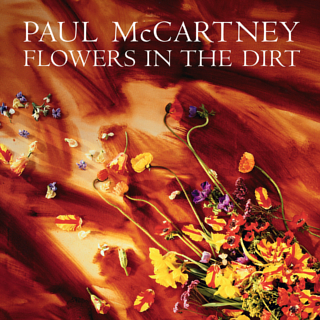
Paul McCARTNEY: Flowers In The Dirt
(#389: 24 June 1989, 1
week)
Track listing: My Brave
Face/Rough Ride/You Want Her Too/Distractions/We Got Married/Put It There/Où Est
Le Soleil?/Figure Of Eight/This One/Don’t Be Careless Love/That Day Is Done/How
Many People/Motor Of Love
(Author’s Note: “Où Est Le Soleil?” appeared on the CD and cassette
editions only.)
I cannot really remember when the phrase first came into
critical discourse, but it was around this time, as pop and rock slowly
ossified into “heritage,” something that had already happened, that the
expression “stunning return to form” started to be waved around like an
indiscriminate stick at any record by old-timers which wasn’t a disaster, or
for marketing and circulation results couldn’t be seen to be a disaster.
1989 was certainly a watermark year for Stunning Returns to
Form. In the case of records like Neil Young’s Freedom, Bob Dylan’s Oh Mercy
and Lou Reed’s New York it was certainly valid; these
were all by some distance the strongest and most focused records these
musicians had produced in years. But it was also used for things like Steel Wheels, from which I only ever
wanted to keep one song, although given time and a financial incentive, I think
I could argue in favour of Tin Machine
(their first album, anyway).
Where does Flowers In
The Dirt stand amidst all these stunning returns? It perhaps should be said
that, compared with the disaster that was Give My Regards To Broad Street and, to a lesser extent, Press To Play (half-decent songs overdubbed, mixed and remixed to
the point of stuffy, headachy inertia), any improvement could be seen as a
Stunning Return. I think McCartney knew that he was heading towards an
aesthetic and commercial brick wall and needed to pull some new tricks.
Much has been said about the mutual benefit derived from
McCartney collaborating with Elvis Costello – like Lennon, a thoroughly amiable
but decidedly independent-minded Scouser of Irish descent with no fear of
answering back, and in the late eighties, few can deny that musically McCartney
was in dire need of someone who’d answer him back. However, it has to be said
that only four of the thirteen songs on Flowers
In The Dirt represent McCartney/MacManus collaborations, so he was
obviously keen on continuing to hedge his bets.
A further four songs were done with the Trevor Horn/Steve
Lipson production machine, and McCartney in ZTT-land works rather better than
you’d imagine; no doubt for Horn and Lipson this represented some light relief
following the darkening intensity of Street Fighting Years. “Rough Ride,” “Figure Of Eight” and “How Many People” (the
latter dedicated to the then recently assassinated rainforest campaigner Chico
Mendes) all benefit from extra light and sparkle, while “Où Est Le Soleil?”
works the best; an unexpected Art of Noise-style exploration of electronica
with a minimalist French lyric which also points towards McCartney’s later “Fireman”
experiments in this field.
But the Costello collaborations cut the deepest. “My Brave
Face” ambles along like a familiar old Beatles song, but the lyric is a
deceptively unrelenting self-examination of post-breakup loneliness and
solitude, with the singer clearing away the uneaten TV dinner he’d prepared for
her, or throwing away dirty dishes. “You Want Her Too,” which McCartney does as
a duet with a rabidly snarling Costello, is a far less sentimental and
considerably more ambivalent take on “The Girl Is Mine” (featuring a bizarre
big band fadeout).
The other two Costello songs are among the darkest McCartney
has ever recorded; “Don’t Be Careless Love” finds him in bed, at night,
sleepless or dreaming the worst possible nightmares about his lover; it is the
other side of the coin of obsession that was “I Want You.” Meanwhile, “That Day
Is Done,” from which the expression “flowers in the dirt” is derived and in
which it is slowly revealed that the visiting lover is in fact attending the
singer’s own funeral, could act as a reverse scenario to Spike’s “Tramp The Dirt Down” (minus the politics but with a brass
band). And hence the double-edge of the cover design; it looks attractive from a distance, but come closer and its essential
morbidity is revealed. As with Lennon, Costello seemed able to access emotions
in McCartney that would otherwise have remained under the darkest of covers.
The rest, largely self-produced, is hit and miss. “Distractions”
is a lovely sequence of chords which perhaps meanders a little too much and
owes much of its impact to Clare Fischer’s orchestration. “Put It There” is a
very touching message of friendship to his son. “We Got Married” is a
straightforward yarn about, well, getting married and working on the marriage (“It's
not just a loving machine,” McCartney sings, “It doesn't work out/If you don't
work at it” – true enough words, and Linda is usually in audible attendance
throughout the album) but is Dave Gilmour’s long guitar solo really needed?
Likewise, “This Boy” again conjures up the old Beatles but is slightly detoured
by a closing veer into stadium rock. One imagines that a disciplined editor – a
Lennon or a George Martin (who nevertheless contributed a string chart for “Put
It There”) – would have halved these songs’ lengths and cut out the padding.
The closing “Motor Of Love” also goes on for a little longer
than it really ought but is not a bad soul-gospel ballad in which McCartney
shows us that he not only knows his Prince (“Adore” in particular) but also
that he is still channelling Brian Wilson somewhere in the ether. All in all I’d
call Flowers In The Dirt a reasonable
return to form, and one, moreover, I’d be pleased to listen to again. Away from
the jazz, McCartney proved that he could clearly still do anything at all.
Tuesday, 28 July 2015
QUEEN: The Miracle
(#388: 3 June 1989, 1
week)
Track listing:
Party/Khashoggi’s Ship/The Miracle/I Want It All/The Invisible Man/Breakthru’/Rain
Must Fall/Scandal/My Baby Does Me/Was It All Worth It
(Author’s Note: The CD edition included three additional tracks: “Hang
On In There,” the Brian May instrumental “Chinese Torture” and the 12-inch mix
of “The Invisible Man.”
I used the cassette.)
I don’t remember seeing this album being mentioned, let
alone reviewed, in Melody Maker or NME, although it got four stars in Q magazine, which by 1989 was where all
the readers had gone. One might have thought there was really nothing to say
about it, and moreover that saying anything about it wouldn’t make any
difference. Rich middle-aged men who’d done it all and had nothing better to do
with their time, or the disguised thoughts of one man who knew that he was
running out of time?
For Queen fans, The
Miracle was a considerable improvement on A Kind Of Magic, although such judgements are always relative; the
group seem far more comfortable when the “rock” button gets pushed, even
briefly – the epileptic interlude in the title song, the final song’s summoning
up of past triumphs – than when they are trying to be Culture Club covering “Young
Hearts Run Free” (“Rain Must Fall”) or Prince doing “Mony, Mony” (“Party”) or George
Michael (“My Baby Does Me”) or Bomb The Bass (“The Invisible Man”). One would
have thought that by 1989 they had done enough to body-swerve the need to sound
hip. Nor am I convinced that they needed to do songs about hanging out on the
yacht of a dodgy arms dealer or moaning about the tabloid press.
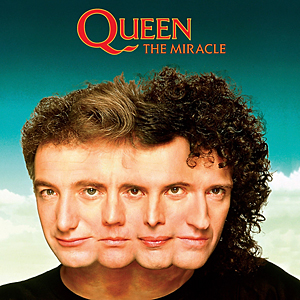
From the cover in, they take great pains to remind the
listener that they are a group, not
just Freddie and backing band, and it is rather sweet to hear the band namechecks
on “The Invisible Man” although, like the Beatles’ “The End,” such devices tend
to indicate an imminent finality. The video for “Breakthru’” saw them
performing the song on top of a train, speeding through the Cambridgeshire
countryside; apparently making the video was a lot of fun for everyone
involved, and it may represent the last public instance of all four having an
uncomplicatedly good time.
But I note that in that song Freddie sings “Breakthru’ these
barriers of pain,” and although he gives a fine, lusty (if somewhat hoarse)
vocal performance throughout the album, there are nevertheless clues here and
there which suggest that everything is not great; the exhausted downward stress
he gives to the last three syllables of the line “Everybody was hung-over” in “Party,”
the defiant “Who said that my party was over?/Huh, huh, I’m in pretty good
shape” in “Khashoggi’s Ship,” “Incredible how you can see right through me” in “The
Invisible Man,” and, most poignantly, “I’m a man with a one-track mind/So much
to do in one lifetime” in “I Want It All.”
“I Want It All” was one of the group's last great rockers,
although with the benefit of hindsight can be viewed less as a Thatcherite
money-grabbing anthem and more as the desperate wish of someone who might only
have a limited amount of time to experience it all (hence “I want it now”). The title track is the most
poignant because of what Freddie doesn’t
sing, but what he might have been thinking as he wanders amazed at this
wonderful world and wanting it not to be destroyed; yes, Hendrix, Sunday
morning cups of tea and Sahara rain are, or were, all miraculous but wouldn’t
it be a greater miracle if there were…just…a cure?
The album essentially ends with “Was It All Worth It,” a
last-ditch attempt to recapture the old Sheer
Heart Attack power – although not their last album, The Miracle certainly plays as though it were some kind of final
statement – which features Freddie looking back on this rock ‘n’ roll life that
he has led. “Am I a happy man,” he asks rhetorically, “or is this sinking sand?”
– and, he implies, why does it have to be either/or? There is a trace of Mott the Hoople’s “Saturday
Gigs” about these recollections, and if the song’s title sounds anticipatory of
the Pet Shop Boys, “Being Boring,” which is about much the same thing, will
follow just over a year later. But if the curtain is coming down, Freddie asks
himself (for peace?) whether it was all worth the price that ultimately had to
be paid, and concludes, smirking: “It was a WORTHWHILE EXPERIENCE!” with a
Holly Johnson-esque guffaw. Roger Taylor’s gong reappears from “Bohemian
Rhapsody,” while halfway through Freddie barks “We love you MADLY!” (John
Deacon via Miles Davis/Duke Ellington?) The final conclusion appears to be: it’s
worth hanging on in there. For now.
Monday, 27 July 2015
Jason DONOVAN: Ten Good Reasons

(#387: 20 May 1989, 2
weeks; 10 June 1989, 2 weeks)
Track listing: Too
Many Broken Hearts/Nothing Can Divide Us/Every Day (I Love You More)/You Can
Depend On Me/Time Heals/Sealed With A Kiss/Question Of Pride/If I Don’t Have
You/Change Your Mind/Too Late To Say Goodbye/Especially For You (duet with
Kylie Minogue)
The other side of a not terribly interesting story; while
Kylie sings about generally being a doormat, here’s the boy desperately trying
to persuade her, or us, that no, he means it, and yes, he loves her even though
he’s always away, and no, there’s nobody else, and…well, you can judge from the
respective album covers; Kylie smiling against a virginally white background,
and Jason, in front of a blood red wall, looking perturbed as though just
having been caught out.
The key may well lie in the first song: “Too Many Broken
Hearts” can be interpreted as a last-ditch don’t-leave plea or, if you look at
it from another angle, the first number one song about impotence since “Band Of
Gold” (“Last night I tried to reach you/But somehow it wasn’t enough,” “"So
I said, can't you wait a little longer?/I'll give you all that a lover should
give"). The song demonstrates, for all SAW's talk of nowness, a
surprisingly traditional gait; with only minor alterations in its arrangement,
"Too Many Broken Hearts" could have been a hit for the Fortunes in
1965, with its endemically catchy "You give me one good reason to leave
me/I'll give you ten good reasons to stay" tag. Shielded by layers of
protective double-tracking, speed slowing and backing vocalists, Donovan gives
a reasonably lusty reading...of a song which is supposed to be about
desperately holding on, in more than one sense.
The trouble is that when Donovan exclaims "I'll be
hurt, I'll be hurt, if you walk away" he appears to regard this
"hurt" as being on a par with bumping into an errant doorknob, and
given that the song may then venture
into "Band Of Gold" territory, he sounds more than ever like a
confused teenager who hasn't quite worked out which end to hold. The chorus
also lets the song down somewhat with its hackneyed "I won't give up the
fight for you" meme. The whole is like a gaudily coloured Commonwealth
jigsaw puzzle whose pieces never quite seem to fit.
Throughout the remainder of side one he protests his faith
perhaps a little too much; “Every Day” sees Donovan anticipating Bryan Adams (“’Cos
everything I do, I do it for you”) and its bathetic plea of “I may be working
overtime” recalls not only “Always On My Mind” but emphatically also Hot
Chocolate’s “Emma,” whose protagonist, you may recall, spends so much time
working overtime that he’s never there for Emma when she needs him. “Nothing
Can Divide Us,” the album’s best song, is sung with such an air of bafflement
that it hides how strange the song really is – “You can put your faith in me/I
will never set you free”; what kind of reassurance is that? Herein lies another
central problem; although Donovan is technically a reasonably competent singer,
so much so that you don’t notice that “Nothing Can Divide Us” covers some
three-and-a-half octaves, I have heard Rick Astley’s isolated guide vocal track
for the same song and his voice thunders
out its message; he knows how to project
a song, whereas Donovan sings the notes, so to speak.
Like other SAW albums, the music gets a little headachy
after a while with its benign hammer of repetition – although, with SAW, one
has to remember that they regard the comment “all the songs sound the same” as
the highest of compliments. There are no doomed adventures into daytime Jazz FM
land, but the music simply doesn’t let off, hasn’t given itself room to
breathe. By the time the side limps to its closer, “Sealed With A Kiss,” one is
reaching for the paracetamol.
Brian Hyland's 1962 recording of the song is a record of unalleviated
bleakness comparable with "Johnny Remember Me" and "Ghost
Town." While Carole King attempted to put a brave, jolly face on the same
issue in the same year's "It Might As Well Rain Until September," the
five-note dies irae of the opening
guitar figure, the distant harmonica and the unreachable wraiths of female
backing voices all contribute to the singer's sense of dazed dread that
September may never arrive, or that his love is already lost (the sequel to
"Sealed With A Kiss" did eventually arrive five years later in the
Velvet Underground's "The Gift," a warning that unilateral cherish
always has its inbuilt limits).
Hyland sings with the chill of death flowing within his
teenage veins, since of course to such teenagers even summer holidays from
school are a matter of life and death. Although there is no evidence in the
song that any of the singer's idolatry is reciprocated, the most charitable
remark I can make about Donovan’s version is that he sings it as Max Bygraves
might have sung it; the right notes - well, approximately - but with a complete
(verging on detached) lack of attachment to the emotions the song tries
meta-clumsily to articulate. It is all done on one, not even especially morose,
level. At the song's climax of "You won't be there," and "I
don't wanna say goodbye," which Hyland sings as though having just slashed
his wrists with fragments from his newly-broken mirror, Donovan can't even get
his timing or phrasing right.
His performance is therefore something of an innocent
insult. But naturally such concerns failed to register with his fans, most of
whom were not old enough to remember Donny Osmond, let alone Brian Hyland, and
who ensured that his "Sealed With A Kiss" became the first
non-charity single to debut at number one since "Two Tribes." But
even this achievement signals the beginning of the decline and devaluation of
the singles chart. In the same week there was also a new entry at number two -
"The Best Of Me," Cliff Richard's 100th single, and heavily promoted
as such, although it was an instantly forgettable routine ballad - and although
Cliff's hundredth single attained the same peak position as his first, thirty-one
years previously, both he and Donovan dropped down and out of the charts fairly
rapidly, and neither record has survived on oldies radio or endured in any
other noticeable way. The ground was therefore laid for the charts to becoming
yet another marketing tool as opposed to a genuine representation of the
public's musical likes at any given period (though some would believe, not
without reason, that 'twas ever thus); instant results became required, and by
the mid-nineties a first week number one entry would become more or less
obligatory for any would-be chart-topper. Thus the stage was set for the
rotating passing fancies of a few thousand people rather than for genuine
future classics; and thus the overall decline – in the singles chart rather
than in SAW’s work; that is yet to come - begins here.
Things get darker, but no better, on side two; now boy and
girl appear to be breaking up but the musical merriment is so remorseless and
one-dimensional that it’s hard to recognise emotions. Listening to this, its
year’s biggest-selling album in Britain,
is like being made to eat a dozen sugary chocolate éclairs in a row; it is not
long before nausea becomes dominant. While SAW took pride in comparing
themselves with Motown, the non-differential attitude is a fallacy; Motown may
have been a churn-‘em-out hits factory but its best records depended on a
matrix of musicians who not only play the notes they’re given but are also
given the freedom to play with them.
There is no James Jamerson or Paul Riser in SAW’s work, and drummer “A. Linn”
is far from being Benny Benjamin.
Actually, the further you listen to Ten Good Reasons, the crappier it becomes. One is hit over the
head, “Mule Train”-style, by song after interchangeable song, insubstantial
trifles which I forgot even as I was listening to them. Donovan’s “Change Your
Mind” is no Sharpe and Numan (nor is it even a cover of that song), while “Too
Late To Say Goodbye” is really a very nasty little song. As with Level 42’s “It’s
Over,” he’s gone, left her only a letter, but where Mark King is consumed by
the pain of his own guilt, Donovan, the staunch Gabriel Oak who has throughout
this record proclaimed his stalwart faith, suddenly announces that he’s found somebody else (“Who gives me all
that I need, not like you”). As he
merrily rolls away cheerfully singing “I won’t be there watching you cry,” it’s
perversity worthy of mid-seventies Lou Reed. It is also the album’s tenth song
and its natural closer; here the mask drops and Kylie was right – he really has been a shit all along.
But it’s not the end of the album. Tacked onto its end – and
it must have been tacked on – is the
big number one duet with Kylie, and suddenly they are together again and happy
again and in the context of this record it makes no sense whatsoever. The
photograph of the pair suggests a Dickie Valentine and Alma Cogan for their
age, but where Kylie is clearly A Star, Jason just resembles a grinning dork
(Dick van Dyke? Richard Chamberlain? Stan Laurel?).
With professional perfectionism SAW had put the two of them
together for a romantic duet to coincide with the broadcast of Scott and
Charlene's wedding in Neighbours,
watched by in excess of twenty million Britons. "Especially For You"
still had to wait a month at number two behind "Mistletoe And Wine"
before ascending to the top, but somehow that was seen as a polite gesture in
itself, since the song and performance are so unambiguously nice and wholesome,
and it was clear that SAW were setting Kylie and Jason up as the Donny and Marie
of their day, without the troublesome subtext of brother and sister singing
tender love songs at each other.
The song sees them reunited after an unspecified spell
apart, and it is handled with such delicacy; on TV they performed a courtly
little dance routine to accompany it, and the overall air is one of a Christmas
pantomime duet between the two romantic leads. Kylie clearly takes the lead;
her "mmm"s and "ooooh"s leading into the build-up to each
chorus are skilful and emotionally connective and there is an audible smile on
her face while she is singing. Double tracking and varispeeding disguise
Jason's rather lesser voice, but they drift agreeably enough through the song,
constructed as only “professionals” could construct it (twenty years previously
it might have been a hit for Jackie Trent and Tony Hatch, authors of the Neighbours theme tune) with that
question mark of an augmented minor underscoring the eighth bar of each chorus,
under "oh so true" as though questioning "how true is this,
really?” After all, “all the love I have is especially
for you” – what exactly does that mean? That it’s also distributed in lesser
quantities elsewhere?
Perhaps you had to watch the soap at the time to understand
the phenomenon fully, although I believe that Angry Anderson’s “Suddenly,” the
ballad which soundtracked the actual wedding scene, is far more upfront and
heartfelt in both intent and delivery, and other singing actors approached the
secondary art with far more adventure and enterprise – David Essex, for
example, was fully the equal of Kevin Coyne and Peter Hammill in the seventies,
David Cassidy’s voice cut through when needed – you believed him, and while Richard Harris admitted he was never the
world’s greatest singer, that worked to Jimmy Webb’s advantage enough to yield
two very fine albums. But other things in Australia were also ahead of this
jolly game; Midnight Oil’s Diesel And
Dust reminded us that there was more to that land than boy meets girl,
while Michael Hutchence’s Max Q
side-project was a considerably bolder take on electropop (imagine Donovan
having a go at “Way Of The World” or “Buckethead”).
The trouble with Ten
Good Reasons – well, one of them, anyway – lies, I think, in the overall
presentation and especially the presence of “Sealed With A Kiss”; as with Kylie, here is a cover of a pre-Beatles
pop song, and one is left with the impression that, given the singers were
brought into the studio, did their vocals double-quick under strict
supervision, and then emerged at the other end, what SAW wanted was a world
where rock ‘n’ roll had never happened; where popular music was a polite
procedural straight back to the days of 1953-4 with well-scrubbed, clean-minded
singers who never offended anybody but never stayed in anybody’s mind. No doubt
when faced with such a viewpoint, SAW would shrug their shoulders in genuine what’s-wrong-with-that?
Bafflement and furthermore say that their records were never for people like me
anyway. I wonder how many of the teenage girls who screamed at Jason and these
songs, and who are now in or approaching their forties, view this music now
other than with fond personal nostalgia.
It was a bit of an aesthetic quandary, but typically Lena
pointed out a comparison from left field which I had not even considered – and yes,
I have to be hard, up to a point, with SAW because once upon a time, and in not
dissimilar circumstances, there were…

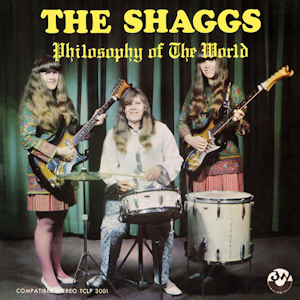
What we know about, and how we value, The Shaggs were down
to the stubborn perseverance of their father Austin Wiggin Jr. Taking one of his
mother’s palm readings as a prophecy, he took his daughters out of school,
bought them instruments and essentially pushed them into writing songs and
performing as a band. The girls were not sure that they were ready for making a
record, but their father was insistent; sure enough, twelve songs were taped and
the Philosophy Of The World album was
ready to run.
It may well be that pére
Wiggins was a tyrant with a temper. But he must have heard what few others,
including the group themselves, could hear. Listening to Philosophy is a little like listening to three musicians playing
three separate songs at the same time, or a jigsaw puzzle of a pop group whose
pieces are not quite in alignment. They sang of simple but resonant things, of
world love (the title song), the importance of parents (“Who Are Parents?”) and
God (“We Have A Savior”) and did it with such inconvertible honesty that
complaining that the drummer wasn’t quite doing what the two guitarists were
doing seemed petty.
This was the music of teenagers who weren’t allowed out of
the house to go to gigs, who were influenced purely by the pop they heard on
the radio – mainly Herman’s Hermits, Ricky Nelson and the Monkees. This worked
in their favour; if Philosophy had
been put together by some arthouse smart alecks, you would have seen right
through it on a first listen. But more importantly, what you hear is a group in
the throes of learning how to play together. Terry Adams’ Ornette comparisons
aren’t really fair (except that Coleman had his own unshakeable notion of
tonality and how to use it), although the late Helen Wiggin’s drumming, when
coaxed away from basic midtempo 4/4, occasionally rolls like the young Denardo,
for example on “My Pal Foot Foot.” Likewise, on songs such as “My Companion”
and “Things I Wonder,” Dorothy and Betty’s guitars shift regularly out of recognised
harmonic consonance. On “My Pal Foot Foot,” the three musicians even, if only
by accident, discover new ways of interacting.
Finally, the group slowly forms into something not yet quite
together, but approaching notions of coherence. “Why Do I Feel?,” the album’s
longest song, at just under four minutes, sees the musicians reaching some kind
of rapprochement; by the time we
reach “We Have A Savior,” they are playing as an almost recognisable group.
Crucially, these unforgiving hothouse conditions gave the Wiggin sisters a
chance to show the world what they were really like, lets us witness the
formation of something from what might initially seem like nothing. Whereas
with Ten Good Reasons, the system
appears to have been: get it clean and get it right and anyone can come in and
do what they like on top, as long as it’s what we like. I’m not sure that’s what
music was, or is, meant to be about.
Friday, 24 July 2015
SIMPLE MINDS: Street Fighting Years

(#386: 13 May 1989, 1 week)
Track Listing: Street Fighting Years/Soul Crying Out/Wall Of Love/This Is Your Land/Take A Step Back/Kick It In/Let It All Come Down/Mandela Day/Belfast Child/Biko/When Spirits Rise
"Students, we came too late. We are sorry. You talk about us, criticize us, it is all necessary. The reason that I came here is not to ask for your forgiveness. What I want to say is that you are all getting weak, it has been seven days since you went on a hunger strike, you can't continue like this. As time goes on, your body will be damaged beyond repair, it could be very life-threatening. Now the most important thing is to end this strike." - Zhao Ziyang, May 19th, 1989
It was an exhausting spring, the spring of '89; none of the signifiers of spring seemed to bring very much calm - not the green grass, the blue skies, flowers, the lilac tree blooming - it felt a bit like living in a picture book, where I was. Very calm, while outside in the world, it was anything but calm. It was fine that a spirit of change and freedom was in the air, but you have to have your health to enjoy it, or even fight for it. By now I was nearly done with Ryerson - as mentioned before I graduated, I had time to do nothing and nothing was about all I could do, recovering from anaemia as I was. I went out for groceries as my mom didn't feel like doing it (we also, for the first and last time ever, had groceries delivered to us - my mom couldn't drive*, so father's car was useless to us) and at some point I bought - while still having to go to Ryerson for exams - this album.
I remember listening to it on my father's old tape deck - it could record tape-to-tape and it also had a function where you could play a tape on repeat, which is just what I did one day with Street Fighting Years, laying on my bed and trying to gain some sense of things....
I press play and it starts...
A bass; a few notes, then a rhythm, not a fast one, more one that ambles along, with some drums and other percussion joining in; then some guitar and keyboards, and Jim arrives last...and like the rest of the music, his voice is quiet. This isn't like, say, Sparkle In The Rain at all...
"Chased you out of this world...suddenly you were gone.." The music gains strength, and his voice introduces the key line and idea - "here comes a hurricane." No amount of patient Trevor Horn production (for it is he, he who has waited so long to work with them) is going to mask what is going on here. "Will you look down this way...I need you 'round me." Charlie Burchill plays the blues, dammit. The song increases and is like a scene of amazing 360 degree completeness...and then, stops...
...I get a shiver from the new chords as Kerr sings "there's a multitude of candles in the windows of this world" and "we've got panic in the evening...I hear your sister call out (Sister Feelings Call)...don't you think that I don't care and don't you think that I don't know" And finally "I love you, I live for you..." as the song calms down and then resolves itself, eerily. Some of this is boomed out with that mid-80s voice of Kerr's but mostly it's been softened, hushed, and hidden somehow. The song is big, and Kerr meets its bigness, but he seems vulnerable, lost, unknown. The maelstrom is upon us and all his previous music has been powerless to stop it. The one phrase that sticks out for me here in this late tumult is "things won't be the same." "I hear big wheels turning" he says twice, as if it is him vs. the machine, and he is doing his best, darn it, to adjust. But it is tough; these are the "street fighting years" and there is indeed panic on the streets...
"Soul Crying Out" is less a mountain of a song but a documentary. This album was recorded in Scotland and has, even for Simple Minds, a profoundly Scottish outlook on things. The rhythms of the street are always what count here, and here is Scotland, facing the Poll Tax a year before England "the government says you have to pay pay pay." And then, without much warning, these lines: "I see the woman with tears in her eyes/I hear the baby, crying in the night/Something on the bed, was it something she said..." And remember this is a man who is married, who has a child of his own. The world is shrunk down to that trio, and the words of escape - everyone is crying out, crying for relief, for escape - points to domestic disintegration. (Disintegration by The Cure was #3 behind this album and entry #287.) He wants "peace of mind" but if you do not have it at home, you do not have it anywhere. All the chaos of the outside is reflected by the sorrow indoors; or vice versa. This is a tough thing to pull off, without sounding pathetic, but at the time I didn't know that there was such discord, it was not literal but figurative for me.
"Wall Of Love" is a booming tough song with delicate Horn touches; the Wall is of course in Berlin, and the wall Kerr wants is a new one, not just in Berlin but in "the townships of Soweto." The "devil with his chainsaw" wants to cut it down, but that wall is going to be built. "I believe one great day the rain will come and wash this mess away." Yes, Taxi Driver signifies here, as much as "the prisoner in the wagon while the children chase the dragon." "There's people making love tonight" he sings as the song ends, but that love, that reaching out, making the wall of love, is somehow still "not enough."
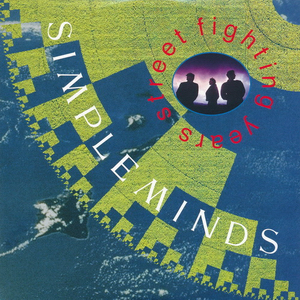
Quiet, then a sound like a gong; a simple line from Burchill, some percussion, and all is calm again. "This Is Your Land" is like getting out of a stuffy car and breathing in the sea air. It is also a call to Scottish nationalism, at a time when that was unfashionable. The rambling lyrics see old people, the sky, the city, the sea and the ancient places. Then look who shows up but...Lou Reed to say "Money can't buy me...money can't buy me...I've.got.time...time is on my side." "You don't know what you've got 'til the whole thing's gone, the days are dark, the road is long" says Kerr quietly, and then Reed replies "When you go away, when hope is gone, tell me what is right...what is wrong." And with that endorsement from a man who knows what it's like to stand for a place himself (hello, New York), Kerr comes back to say once again that you have to take where you live in your hand, to hold it, to possess it - to defend it. (How many places gain their freedom and independence during this time of uncertainty?) And yes Lisa Germano comes in at the end with her violin, the song becomes a march, a march to self-determination and independence. I can't say I knew that much about Scottish nationalism at the time, but the fractals of land on the cover and the multicolored view of a city - is it Glasgow? - inside point to a rethinking of things, of a taking account.
Bolstered by this, the last song on side one comes in with a drum roll, and who knows what goes on behind closed doors? Is he singing to the people of Scotland, or to the world or to...one person? There's the early line about "try to shake the deep foundations of this land" but then we are in that fancy hotel and I can see this through a haze of angry, tearful phone calls and "Take A Step Back" has a new meaning beyond getting a fresh perspective. Is the narrator - it's Kerr, that's clear - is he the "wanderer" who hears that "the rumors all around, said you're coming back to me"? Well yes, but it is clear from the music - unsettling, rattling like the train the narrator is on somehow - that it is too late. "Don't tell me it's a bad dream/"Don't tell me it's not what it seems" - there is an unease at the heart of this song of deceit and of rollercoasters of emotions and actions. Kerr is the needle in the haystack, elusive, not gracious or accepting, but cold and angry. The 80s are coming to an end, and a lot is coming to an end with them....
...the tape ch-chunks over to side two. My room feels a bit small by this point...
"Kick It In" starts with some organ, guitar, synth, sliding up to a beat that is big, ambitious. Never forget how ambitious this band in; Kerr steps in and sings of a city that is destroying itself, only to build itself up. Could it be Glasgow? The city wants you to "spread your love all over town" as he says, and the song is a sprint up a hill, a race down Montrose Street to the very center, a leap across the Clyde itself....and then this pulsing beat disappears for a moment as Kerr sings "Take off with me..." (This after closing the door so the demons - whatever and whoever they are - won't get in.) The song stops and pauses, hazy, as the city - not just Glasgow but any city, appears...then song picks up again, and that phrase "new gold dream" appears out of nowhere, as if that dream won't happen without some demolition, some adventure, some renewal. And the song ends on a heavy note, abruptly, as the work is there to be done and there's only so much that needs to be said....
As the decade ends, there is a sense that there are a few things left hanging that need to be tended to, old losses that are still niggling away that have to be addressed. The decade is collapsing, caving in on itself, it seems both big and hollow at the same time....
...and "Let It All Come Down" is one of the exit songs of the decade. If it seems like the sibling of The Korgis' "Everybody's Got To Learn Sometime" then that's due to Trevor Horn, who helped out the band with the song - but this is sung clearly to someone, from Kerr to Hynde (the "get close" is a direct pointer to her Get Close) and it is sung at night, anticipating a sunny but cold morning. She is crying, and he is encouraging her to cry, to keep crying. The music is big, ennobling, scary in a way. If you have ever been in a breakup, on either side, you know how awful it is, how much crying there is, how horrible it can be. "I cry and cry, and this isn't like the crying all the times before, not lusty and somehow pleasurable. This is the coldest, loneliest feeling in the world" as Julie Powell puts it in Cleaving. "All is in control (she's lost control again) love is on the open road...make me wanna live, make me wanna die" he sings as the piano picks up, then moans wordlessly, and comes back to the shining sun, the one spot of light possible. "So let it all....let all come down" he sings, and the song is quiet and then crashes in, collapses, as Burchill once again plays the blues. There is nothing left to say. Words are not meaningless, but this is beyond words. The main theme, the terrible truth, comes back, or rather looks over its shoulder at the ruins of the song, the end of the relationship. It is The Korgis' song from 1980 that acted as one of the first songs to mourn Ian Curtis (there are so many that unofficially do this, but the end of the song does refer to Joy Division) and here we are with that grief echoed yet again, circled back to, as if the decade cannot end with at least one more song about his loss. As bright and shiny as the 80s were, all that is rubbing off now, and it is ending where it began...
"Mandela Day" is, by contrast, a song that looks forwards - it is an act of magical thinking, and it has the light air of something that is confident, hopeful, warm. It sounds vaguely African without being Paul Simon about it, and was written specifically for the Mandela Day concert in June 1988. It is a song celebrating his release before he has been released - much as "New Gold Dream" looked to '83 and '84, to a Utopian future. It has been 25 years, and now he is free; free as he is now so well-known that his fame, even before release, is a kind of liberation. The sun rises too in this song, but its promise is not the cold one of the previous song, but the warm one of fresh air, no shackles, and liberation not just for him but for all his people...."what's goin' on" sings Kerr at the end, another link back to the past...
Sometimes a song has one meaning, no matter where you first hear it; songs can change in emphasis, however, if you are in a different place than most listeners, and I use the word “place” in more than one sense here…
As I've said at this time I was still living in Oakville - a quiet, modest, reasonably well off town full of people from the UK who had at some point decided to leave and try their luck in Canada. At least two of my father’s fellow teachers at Sheridan College were from the UK, and there were countless others across Canada who left for whatever reason and yet still felt a pull towards home, even if they could not return. To hear a song that explicitly calls for native sons and daughters to ‘come on home’ is perhaps one thing when heard on one side of the Atlantic, and quite another across the ocean. (My favorite Pogues song by far is “Thousands Are Sailing” which also came out around this time; and let’s not forget The Proclaimers’ “Letter From America” that lists the towns devastated as residents moved away, were forced out…)
What to do if your home and native land (to quote “O Canada”) is full of violence? What if you leave? How can you go back when you know very well awful things are continuing to happen? “Someday we’ll return here” he sings, “when the Belfast child sings again.” (Echoing, if a bit clunkily, of all things, “Someday We’ll Be Together.” Part of the confusion of the song is that Kerr sings the verses as someone leaving and then in the chorus as someone encouraging himself and others to return.) This is a song that tugs rather heavily on what is usually buried or not talked about, not without some diligent prodding, and that is the idea of home and where one’s actual ‘home’ is. It is an awkward subject for a song and yet when he cries out “The streets are EMPTY!” and then quietly resigned, nearly whispers “Life goes on…” – that is the punctum for me. Life goes on whether the person – indeed the people – return.
So the picture here is of a man talking to himself in a room, his own heart breaking and being vulnerable – overly-vulnerable you might say – to the quiet and semi-buried misery of others, their own losses and longings. It is as if the shiny yellow New Pop balloon has burst and here he is, seeing the world in a new (fractal and fragmented) way, full of separations. “But all’s not lost!” he sings at one point, however – he still has that “81-82-83-84″ optimism that something is going to change; not right now, but something is going to happen. And as any exile or expat knows, you are often in the odd position of feeling as if you are in two places at once, and having to make a decision, if you can, as to where you really want to be. "Belfast Child" is about wanting joy and return and renewal again, but the lumbering quality of the song shows just what a struggle this is. To miss someone is one thing, but to miss an entire culture and land is another....
And so back to 1980 and Peter Gabriel and "Biko" - Simple Minds toured as support for Gabriel back then, and this is their tribute to him as well as Steven Biko; this album has several of Gabriel's band members on it as well**, so another circle is neatly drawn together. Simple Minds' version is less stark than the original, but no less felt; if Gabriel introduced many to the horror of his death, then here the horror is known, famous, almost turned into a curse against his oppressors. There is the sense - all the way through - that something else is being referred to, via the synth/bagpipe skirls. The fire of nationalism is there, the wind will blow it higher, and indeed something already is happening. The world is going to change, in this year, in 1990, and in decades to come. Scotland - the other Other in so many of these songs - is evoked yet again, as Kerr reaches for the quiet in his voice - "gotta wake 'em up, gotta face up - I think you've gotta wake 'em up...never turn away." And the song ends, puuuuuuuussssssssssssooooooooossshhhhmmmmm, with the finality of a roll of thunder.
"When Spirits Rise" makes all this subtext, text. An instrumental that has all the bagpipe and drum corps strictness and passion you could want, it lures and ennobles again, as if that Utopian future really is possible if you are already there in spirit, that your energy and determination are always aimed for it. The calling to a higher consciousness - to a sense that the world is much bigger than your bedroom, and that it includes you, you there eating your defrosted breakfast early on a chilly morning, is one that is not always welcome. It can seem like a burden, but the promise of the burden is that you will be (paging Public Enemy) doing the right thing.
This album shows the struggle to get to that point, beyond the personal heartaches, or rather through them, to something bigger, something that you can put your heart and spirit into, if only it's a march, a signature on a petition, or an actual action like volunteering or changing a personal habit or method of doing things. The 80s have come crashing down, and there's a lot of building and refurbishing to do, and the chaos and uncertainty these times have lends itself to both tiny and sweeping gestures.
As it says on the inner sleeve, "Out there in the darkness, out there in the night, out there in the starlight, one soul burns brighter than a thousand suns." But you have to stay strong and healthy to keep your soul going, and your spirits up. This is yet another album that helped to make that possible (for me and others), and I am guessing was only too tangible for those living in Scotland, and other places where weary spirits needed it. A new decade beckons...
* My spatial relations are so bad that driving for me is pretty much an impossibility; if I could just walk everywhere I'd be happiest.
**Stewart Copeland plays drums on this song; Mel Gaynor and Manu Katche play them elsewhere.
Thursday, 16 July 2015
Holly JOHNSON: Blast
(#385: 6 May 1989, 1
week)
Track listing: Atomic
City/Heaven’s Here/Americanos/Deep In Love/S.U.C.C.E.S.S./Love Train/Got It
Made/Love Will Come/Perfume/Feel Good
“Beyond Action and
Reaction we would establish ourselves.”
In the spring of 1989, few pop stars commanded more sheer
goodwill than Holly Johnson. Having escaped from the wreckage of Frankie, and
emerged victorious from a lengthy court case against ZTT, which had sought to place
an injunction on him preventing him from recording as a solo artist for any
other record company – the presiding judge deemed it an unreasonable restraint
of trade, commenting that “Mr Johnson could be 70 years old and still be bound
to this contract” – he was ready to make himself heard, and people were ready
to listen.
It is difficult to consider his first solo album as not
being substantially rooted in personal experience; indeed there are subtle FGTH
references throughout – the escalating drum pattern midway through “Love Train,”
the way in which Johnson pronounces and elongates the word “war” in the line “You
want to end all war” in “S.U.C.C.E.S.S.” (and the nuclear explosion which ends
the same song). But, as he sings in “Got It Made,” he’s “escaped from the hands
of the Marquis de Sade,” and you can’t help but feel his innate sense of
deliverance from a deeply unpleasant recent past.
Certainly Johnson sounds much more at home with the likes of
Dan Hartman, Andy Richards, Steve Lovell and Stephen Hague than he ever did
with the ZTT team – far more of his self
is on display here – and for repeated listening I would much rather turn to Blast than Pleasuredome. There’s an inviolable optimism about his singing
which I always find reassuring, even when (as with most of this album) what he
sings about is deeply pessimistic. “Atomic
City” sees him emerging in
triumph from a wrecked landscape of metallic clangs and electronic bleeps over
a propulsive post-House beat. He co-wrote the song with Hartman (all nine other
songs were written solely by Johnson) and it does play like an odd subversion
of what Hartman did with James Brown on “Living In America.” Johnson’s apparent
enthusiasm is enough to make anybody want to go to Atomic City,
but listen carefully – “We’ve got no ozone/We’ve got radiation/See the air
pollution/From the power station.”
But Johnson is not deterred from proposing a happy ending. “If
time stood still on my windowsill,” he observes, “I’d squash it like a fly.” He
urges an uprising, and so the song is an unexpected reaction to the opulent nihilism of “Two Tribes,” suggesting that
there is a way out.
“We start from
opposite statements of a chosen world. Set up violent structure of adolescent
clearness between two extremes.”
Johnson wasn’t the first ex-Frankie to make a statement. In
the autumn of 1988 Paul Rutherford worked with ABC to produce the magnificent
and savage New Pop/Acid House hybrid that was “Get Real.” It should have been a
number one but the BBC, as usual, got canting cold feet and couldn’t deal with
it; consequently the highly inventive parent album Oh World did not gain a British release until 2011.
But Johnson, if superficially more cleancut, was scarcely
less candid; he just dressed his sex and politics up in politer clothing. Hence
“Heaven’s Here” is a catchy and upbeat late eighties pop song about the goodness
of love, until, once again, you listen more closely and catch such references
as “Blue skies, white lies and cherry pies” and then “Why waste your time in a
living hell?/You can live in cloudland just as well!”
“We discharge
ourselves on both sides.”
“Americanos” I interpret as part love letter to the USA, and part
deep scepticism. On “Atomic
City” he has a go at
crappy television gameshows, and in the video for “Americanos” he plays the
hugely camp host of a crappy television gameshow, the twist being that the
dirt-poor contestants clean up with the prizes rather than the rich ones. He
wistfully dreams about what you can build up from nothing in America, but
there is the fleeting reference to “low riding Chicanos” in one of the
choruses, as well as swipes at advertising, organised crime and the underlying
hypocrisy of free enterprise. The final verdict? America – he loves it really, but
wouldn’t want to live there.
“We fight first on one
side, then on the other, but always for the SAME cause, which is neither side
or both sides and ours.”
More upbeat positivity in “Deep In Love” or so you hope.
Actually, the deeper you delve into the song, the more you realise that it’s
not about a love affair but about the living death of consumerism (the chorus
in part goes “Your love consumes me”), and the nearest thing to organism that
capitalism can imagine is when “you’ve reached the limit on your credit card.”
Think of 1983’s “Key To The World” and we are not at all far from the world of
Heaven 17. Fairly frightening, once you get into the song’s depths.
“Mercenaries were
always the best troops.”
“S.U.C.C.E.S.S.” is a parody; well, it has to be, a Hi-NRG “Imagine” whose demands grow more and more
patently absurd and clearly impossible, from wanting fame to going into outer
space. Eventually, of course, you’re advised not to be satisfied with anything
less…than the world’s end.
“We are primitive
Mercenaries in the Modern World.”
“Love Train” was his big comeback single and a deserved top five hit, an absolutely immaculate, catchy and propulsive pop song (with a cameo guitar solo appearance by Brian May) – I remember Gene Pitney, of all hurt people, being particularly effusive about its merits on Radio 1’s Round Table record review show – but what is this? “I reached my peak,” “You’re just right to keep me up all night,” “Stoke it up,” “Keep the flames burning”; this is much more to the point than “Relax” and who noticed under its cheery topsoil?
“Our Cause is
NO-MAN'S.”
If “Got It Made” is an explosion of release from Frankie
hell, then “Love Will Come” is perhaps Johnson’s most heartfelt vocal on the
record; he frequently sounds close to tears in the choruses, as he wends his
way towards the ambiguous conclusion that life is not about consumerism; “Now
we know, love is the only thing that we get for free – or do we?” In both songs, guest guitarist Vini Reilly,
unmistakeable even when rocking, sounds positively exuberant, much gladder than
he had been a year earlier.
“We set Humour at
Humour's throat. Stir up Civil War among peaceful apes.”
Maybe “Perfume” was meant to be Johnson’s Prince moment, and
it’s certainly the record’s most sensual moment; perhaps the metaphor of
perfume as sex (“rub it in” etc.) was new, but it’s a timely reminder that “keeping
it clean” is not the primary point of Johnson’s fight.
“We only want Humour
if it has fought like Tragedy.”
If “Atomic City” is this record’s “Two Tribes” and “Love
Train” its “Relax,” then “Feel Good” is its “Power Of Love” equivalent, a
slowly unfolding but far more ambivalent ballad, where the singer appears to be
in emotional stasis, looking back at his past, missing it and now somewhat
marooned (“No tears left to cry/No mountains left to climb”). When he gets into
the closing seasonal metaphors, the penny, which has been drawn more and more
to the listener’s attention throughout the record, finally drops – Blast plays like a dry run for Robbie
Williams, that fellow Aquarian ex-boy band wild card with a past he’s keen to
bury and resurrect, frequently at the same time (and it’s hard to imagine that
fifteen-year-old Robbie wouldn’t have listened to, and learned from, this
record). And the art…the ZTT thing, if some must…has not been forgotten; in the
sleeve credits Johnson thanks, or rather BLESSES, “Percy Wyndham Lewis” and “God,”
and BLASTS “All the Believers and Deceivers…They know who they are.” The cover
resembles a recent explosion; the rear cover suggests reformation and
resurrection.
“We only want Tragedy
if it can clench its side-muscles like hands on its belly, and bring to the
surface a laugh like a bomb.”
But there was another project in which Johnson was invited
to participate at this time, one which put him back at number one in the
singles chart, and that, though not part of Blast,
deserves close attention.
The original Gerry and the Pacemakers recording of
"Ferry 'Cross The Mersey" drifted into the British charts like a
ghost ship in that excitable winter of 1964. It was used as the theme to a film
involving the group as well as Cilla Black and various other notable
Liverpudlians of the period; the film is rarely, if ever, revived, and this may
not be surprising since, watching it, Merseybeat seems as arcane and distant a
cult as Chartism. But the song prospered; although the Mersey Sound had by the
turn of '64/5 begun to implode to the point where it really was the Beatles and
everyone else, the clouded optimism of Gerry Marsden's song and George Martin's
string and French horn arrangement in the manner of "Wonderful Land"
still pointed to a time when Liverpool was a place of hope and riches,
somewhere everyone wanted to be...Liverpool's "moment."
That dissipated, as "moments" tend to do, and when
Frankie Goes To Hollywood revived the song for inclusion on the B-side of the
original 12-inch of "Relax" - thus providing a clear link between the
first and second acts to top the British charts with their first three singles
- they preceded it with a snatch of dole office dialogue from Boys From The Blackstuff; Liverpool in
1983 was on its knees, defeated by Thatcherism on one side and council leader
Derek Hatton's reckless careerism on the other. Against this backdrop Holly
Johnson sings the song with a strong element of defiance and a new kind of
hope; Horn's cavalcade of arpeggios at the end suggest Liverpool not to be
beaten, that the North would rise again despite everything.
Then came Saturday 15 April 1989, the afternoon of the FA
Cup semi-final between Liverpool and Nottingham
Forest, to be played in the neutral
grounds of the Hillsborough Stadium in Sheffield.
Traffic delays on the motorway meant that many Liverpool
fans did not arrive in time for the kick-off, and thousands crammed the
stadium's inadequate entrance turnstiles in an effort to get in. Concerned that
some of these fans might be attempting entry to the game without tickets, the
police and stewards were loath to let them in en masse, but eventually - and far too late - they opened another
gate, with the inevitable inward stampede.
In the wake of Heysel and other misdemeanours - not to
mention an underlying contempt for the working classes who, in 1989, still
constituted the majority of football crowds - Hillsborough, in line with other
stadia, had introduced steel fencing at the front of their crowd stands in
order to prevent hooligans from invading the pitch. In those days crowds were
still obliged to stand for matches; there was no seating for fear that seats
might similarly be ripped up and tossed into the pitch.
But this policy proved disastrous. The sudden influx of
spectators caused an immediate crush to those already in the stadium, at the
front of the stands, and they were likewise crushed from the other side by the
steel fencing. In desperation, some attempted to tear down the fencing and
escape onto the pitch, but police, under the impression that they were en route to attacking Nottingham Forest
fans at the opposite end, herded them back. The crushing continued; dead bodies
began to emerge from the walls of desperate flesh. 96 people were killed,
including a fourteen-year-old boy and a man who went into a coma before finally
dying in 1993, and nearly 800 others sustained injuries.
The disaster, much like Zeebrugge, was the inevitable
consequence of a culture of wilful incompetence and mismanagement. But then the
lies started to appear; in part generated by frightened vested interests, in
other part encouraged by certain Conservative MPs, under the headline "THE
TRUTH" in The Sun - the same
newspaper for which Pete Waterman had recorded the Ferry Aid “Let It Be” fundraiser
- there were stories of "drunken" Liverpool fans urinating on, or
copulating with, the bodies of the dead, pickpocketing their wallets, picking
fights with police. It was a PR disaster from which the newspaper has yet to
recover on Merseyside - in particular because it, or the editor of the time
responsible for it, has never issued an unconditional apology for running the
piece, or the headline - to this day many newsagents there continue to
blackball it from their shops, and its circulation figures there have remained
low.
So the 1989 "Ferry 'Cross The Mersey," recorded by
a quickly convened cross-section of Liverpool artists to raise funds for the
families of the dead, has to be considered as a protest record; in many ways it
is the angriest record SAW ever made - where "I'd Rather Jack" simply
has a jibe at out-of-touch radio programmers, the dignified but barely
suppressed fury of Waterman's "Ferry" is a direct, controlled attack
on the powers which would traduce Liverpool to a thug-crammed subhuman
wilderness. Marsden and Johnson were both brought back to recreate their
original performances, but there is a renewed intensity in their performances;
Marsden in particular sounds at times on the verge of tears in his solo
features, while Holly retains his original defiance but makes it somehow deeper
- in the "People around every corner" middle eight he stares daggers
at those who would doubt that Liverpudlians were happy to welcome and embrace
anyone, and his furious focus on the line "Hearts torn in every way"
needs no further underlining. Garry Christian, lead singer of the Christians,
provides the rich voice of moderation throughout.
But getting Paul McCartney to participate was a genuine
coup, and it is he who, at the end of the record, takes it to a further
dimension and slowly unleashes the rage which has been simmering beneath the
surface for the previous three minutes; as the harmonies modulate, and SAW
introduce an adroitly-disguised slow motion/16 rpm House piano line, McCartney
suddenly bursts loose: "This land's
the place we love!" he howls in terrible anger. "Ferry! Cross the Mersey!" he virtually
sobs - the subtext being: don't ever
fucking try to do us down, our culture, our way of living, our beliefs.
This "Ferry 'Cross The Mersey" is therefore a
profoundly anti-Thatcherite record - anyone lazily categorising Waterman as a
nouveau riche Tory missed his fortnightly columns in the teenpop magazine No 1, in which he regularly railed
against the poll tax and other manifestations of New Rightism, or his violent
decrying of Thatcher and Ian MacGregor apropos the 1984 miners' strike, which
he has done on both radio and TV more than once over the years - and in an era
when, as recently as May 2007, the likes of Matthew Parris (with regard to that
week's local government and Scottish Parliament elections) could still smugly
state that Liverpool "doesn't matter," it seems to me still the most
propitious, and certainly one of the most telling, of all charity records,
since its inherent current of political protest is as inescapable as the
original Pacemakers record is from the speakers on any Mersey ferry on which
you might happen to step.
* * * *
The surprise is that little seemed to happen with Johnson’s
subsequent career in music. There was Hallelujah,
a 1990 album of remixes, and then 1991’s Dreams
That Money Can’t Buy; unfortunately, disputes with MCA meant that the
record received no promotion and was given only a cursory release. For much of
its forty or so minutes it does sound like music written under contractual
compulsion, and Johnson has said as much, though is not entirely devoid of
merit; “Boyfriend ’65,” featuring a
near-inaudible Kirsty MacColl on backing vocals (for contractual reasons), is a
lost gem, and “Penny Arcade,” with its terrific Courtney Pine tenor solo, is
another.
But then health issues became a priority and necessitated a
long lay-off; Johnson re-emerged in 1994 with the funny and scabrous
autobiography A Bone In My Flute and
the one-off pro-LGBT single “Legendary Childen (All Of Them Queer)” (probably
his best and most euphoric work). But then he proceeded to make a name for
himself as a painter and that work now became predominant, with only 1999’s
self-released Soulstream to break the
musical silence. By Christmas 2012, however, he was back at number one with his
brief but telling contribution to The Justice Collective’s “He Ain’t Heavy, He’s
My Brother,” another Hillsborough fundraiser (also involving McCartney and
Marsden) and a record produced by Guy Chambers, who appears on Blast as contributing programming to “Feel
Good”; as Robbie Williams also sang on “He Ain’t Heavy,” the connection becomes
clearer. And then in 2014 he unexpectedly released the excellent Europa, and the old magic was
undiminished.
Next: Meanwhile, where was Trevor Horn in all of this?
Subscribe to:
Posts (Atom)

.jpg)


.jpg)