Tuesday, 8 July 2014

MADONNA: Like A Virgin


(#320: 21 September 1985, 1 week; 12 October 1985, 1 week)

Track listing: Material Girl/Angel/Like A Virgin/Over And Over/Love Don’t Live Here Anymore/Into The Groove/Dress You Up/Shoo-Bee-Doo/Pretender/Stay

(Author’s Note: Although this was, strictly speaking, the year’s fourth number one album to have been released in the previous year, “Into The Groove” was added at the beginning of side two of the UK edition in the summer of 1985 and was a major factor in the album reaching number one.)

More so than The Lexicon Of Love or Thriller, the advent of Madonna represents a very clear split in this story; you can readily break up the history into what happened before Madonna, and what happened after her. Once Ari Up complained, “We ain’t no material girls!” and a few years later, there was Madonna singing, or sneering, about how nice it was to be a material girl. I grant that the video does allow for the existence of irony, but there is absolutely none in Madonna’s smugly robotic vocal performance, and one has to ask whether the visuals – the Madonna brand equity, if you would – have taken irreversible precedence over the music.

The core of Like A Virgin – the title song, “Material Girl,” “Dress You Up” – could be interpreted as the elements of Ze Records taken to their non-ironic but logical conclusion. This, the record implies, is where New Pop has led us; the celebration of consumption, and more importantly, of image, and the ruthless jettisoning of any useful or compelling subtext.

This represents a key difference from what went before; however much Presley, the Beatles or even Bowie marketed themselves, however many times they changed their image, there was always the underlining codicil that these people had talent, something to say, and therefore there was something or somebody to sell. But with Madonna selling became the primary purpose, superseding content. She became anything you wanted her to be, without ever making the fatal error of letting you get too close to her.

All this is known, of course, and I don’t believe you are in urgent need of further painful semiotic analyses. What depresses me most, at this stage, is how anaemic and lacklustre a pop record Like A Virgin is, particularly as her debut album had actually been quite promising (and with songs like “Burning Up,” “Everybody,” “Lucky Star,” “Borderline” etc. I would argue that it is the superior record; up to date without needing to impose a date stamp on listeners’ foreheads). She wanted Nile Rodgers because of his work on Let’s Dance, and after Bowie, Rodgers was pleased to be working with somebody who knew exactly what she wanted (“I knew him before the butter dropped of (sic) his noodle,” quips Madonna in the album credits); it was she who had to persuade an extremely sceptical Rodgers that “Like A Virgin,” the song, was worth recording.

But his work here seems as mechanical and unrewarding as what he did with Bowie. The hits are more recognisably “Chic” than “China Girl” or “Modern Love” but if anything the production holds back. Despite the singer’s protestation on “Over And Over” that “You’re never gonna see me standing still,” Like A Virgin sounds like a backwards step.

Certainly the overall impression that the record gives is one of low-calorie bubblegum, utterly conventional and conservative, with a few outré elements to trap the unwary (her “legendary” TOTP performance of “Virgin” featured theatrical tropes that I recognised from the work of Lydia Lunch). Fillers like “Pretender” and “Stay” sped past my ears and vacated themselves from my mind even while they were still playing (it is a record of hits and B-sides). She obsesses about “eyes” like no singer in this tale since Justin Hayward. “Shoo-Bee-Doo” is Diana Ross at Blackpool Central Pier, complete with obligatory talkover and eighties saxophone “solo.” She is even for the most part lumbered with unhelpful Jordanaires-style backing singers (and the Simms boys from Let’s Dance are among them). The disastrous attempt at “Love Don’t Live Here Anymore” highlights her vocal and emotional limitations quite severely and pitilessly (even Jimmy Nail managed a better interpretation); she sounds mildly annoyed rather than heartbroken.

For Madonna really isn’t much of a singer, or a presence. Her voice is usually blaringly high and loud (possibly tweaked upwards mechanically), sometimes rising to a pertly rough shriek, with no real underlying personality. The songs sound like Fame rejects. Were it not for her façade of “modernity” we could be back in 1978 Tiger Beat land. As for “Into The Groove,” the bonus number one hit that had nothing to do with Chic, I am afraid that it has not aged well – try listening to it now, as opposed to what you remember feeling when you heard it twenty-nine years ago – and next to the still astounding Cubist electro of records like Shannon’s “Let The Music Play,” and despite its lyrical sentiments, it sounds, dare I say, a little square in 2014 (for a lot of the time on Like A Virgin, Madonna seems to want to reach back to pre-Beatles girl pop, specifically Brenda Lee, and to a lesser extent Connie Francis; the lyrical theme of “Material Girl” goes back decades, as its “Shop Around” paraphrase makes it abundantly clear that she understands that this is the case).

If you wanted dynamic and inventive female pop music in 1985, there was, and is, Teena Marie’s Emerald City. But poor Teena was never as good as selling herself as Madonna was, and so she is now gone and largely forgotten whereas Madonna is routinely hagiographised. The lesson was this: it’s always the pushy people who get to the front, the squeakiest wheels that get the lion’s share of the oil, regardless of what they might have to offer. Talent or even basic expression was no longer required. Make yourself into the biggest image you can find, and you will become that image. Is it just me who finds Madonna’s “Sing it to the WORLD! – Now I know you’re MINE!” two-thirds of the way through her Live Aid performance of “Into The Groove” one of the most terrifying spectacles of the eighties, and the clearest sign of the ruination to come? Was Madonna really everything “we” wanted?

Monday, 7 July 2014

VARIOUS ARTISTS: Now That's What I Call Music 5

NOW Thats What I Call Music! 5: Amazon.co.uk: Music


(#319: 17 August 1985, 5 weeks)

Track Listing:  A View To A Kill (Duran Duran)/The Word Girl (Scritti Politti)/Axel F (Harold Faltermeyer)/Johnny Come Home (Fine Young Cannibals)/In Too Deep (Dead Or Alive)/Icing On The Cake (Stephen "Tin Tin" Duffy)/Cherish (Kool and the Gang)/Every Time You Go Away (Paul Young)/Kayleigh (Marillion)/Slave To Love (Bryan Ferry)/This Is Not America (David Bowie and The Pat Metheny Group)/Don't You (Forget About Me) (Simple Minds)/Get It On (The Power Station)/Black Man Ray (China Crisis)/One More Night (Phil Collins)/Frankie (Sister Sledge)/History (Mai Tai)/Money's Too Tight To Mention (Simply Red)/Feel So Real (Steve Arrington)/Round And Around (Jaki Graham)/Turn It Up (The Conway Brothers)/Magic Touch (Loose Ends)/N-N-Nineteen Not Out (The Commentators)/The Unforgettable Fire (U2)/Walls Come Tumbling Down! (The Style Council)/Walking On Sunshine (Katrina and the Waves)/Out In The Fields (Gary Moore and Phil Lynott)/The Shadow Of Love (The Damned)/Life In One Day (Howard Jones)/Love Don't Live Here Anymore (Jimmy Nail)


"Language is a skin:  I rub my language against the other.  It is as if I had words instead of fingers, or fingers at the tip of my words.  My language trembles with desire...To speak amorously is to expend without an end in sight..." Talking, A Lover's Discourse, Roland Barthes


Oh, the uncertainty of this time!  I do not mean the near-perpetual worry of nuclear war (I think now that Live Aid was such a success because it was something people felt they could actually do something about, instead of just worry about at night) but the uncertainty that happens during the middle of any decade.  And few years were more uncertain than 1985, when there was enough going on underground to satisfy the restless and yet there was also this sense of ennui and vague post-Live Aid well-what-are-we-gonna-do-nowness that was in the heat of August kind of exhausting. 


And it was hot; I was a high school grad at last, having survived summer school one more time, and had nothing to do but wait to start at Sheridan College in September.  I must have listened to the radio quite a bit; gone to the mall; gone to the library across the street or downtown.  I wasn’t bored, per se – the music on the radio was too good for that.  But that was CFNY, whereas this is the UK, this is a big pig takin’ it easy by the pool, this is what compiler (he’s called “Co-Ordinator” on the back) Ashley Abram was able to put together on relatively short notice…  


Some of these songs – I count six – have already been dealt with on TPL elsewhere – if I was sitting in a booth with its own little jukebox I wouldn’t choose any of them, as I’d know them already, and who wants to eat onion rings to “The Unforgettable Fire” anyhow?  I know I don’t.  As for the rest…


1985:  I Didn’t See Any Movies, Darn It

As anyone who knows me knows, I am not a great moviegoer and since I had no one to go see movies, even bad ones, with in the summer I didn’t see a bunch of what are actually probably pretty good ones.  To wit – A View To A Kill.  I have seen about the last ten minutes of this and it is ridiculous and eyebrow-raising and camp as anything could be with Roger Moore and Grace Jones; if only Grace Jones had done the title song and not Duran Duran.  There is nothing wrong or bad with this song inherently, but once Simon Le Bon starts his battle with Princess Metaphor, yelping and trying to sound desperate/sexy, then it’s all “so you went to the top floor of the Eiffel Tower, do you want a medal?” time and Roger Taylor, always my favorite of the two Roger Taylors (we will get the other one, at the end – Abram’s got his ways, you see) left to start a wine bar for the yuppies of Birmingham.  God, can you blame him?

I also didn’t get to see Beverly Hills Cop, though at some point I think I saw some of Eddie Murphy’s stand-up movie Delirious, which was (and is) funny.  But I digress.  “Axel F” sounds like what it is – a simple ditty by a protégé of Giorgio Moroder, a kind of German response to “Planet Rock.”  Because it is simple and elegant and even spare (oh, to have Metronomy cover this live) it survives.

The Falcon and The Snowman wouldn’t have appealed to me at the time – though it might now; not sure.  But Bowie yelping “NOOOO!” on top of an almost-too calm Metheny groove is a rough predictor of Radiohead, and hey, where have we heard the America-Miracle word swap before?  Culture Club, that’s where.  Bowie was more than knee-deep in movies at this time (“This Is Not America” sound more acted than sung), and so Metheny takes this song emotionally to where it could go.

The one movie that I really should have seen at the time was The Breakfast Club – I feel at a loss when I read anything about the movies of John Hughes, and as a minor delinquent in high school I would identify with the characters, for sure.  “Don’t You Forget About Me” is a swoon of a song, Jim Kerr singing low and sweet, not loud and sweaty as he had sounded on Sparkle In The Rain; it’s a Keith Forsey song, produced by him as well, so it’s not on Once Upon A Time, but it went to #1 in the US long before it got anywhere in the UK other than as an import, and why is that?  It’s “Pretty Woman” without the growling and martial beat, more or less.  This is the high school romance song I sadly never got to participate in, the one where the sweethearts actually do stay in touch….

1985:  Chic, the Wilderness Years

Or, ow, my head.  How can you take something sexy and make it leering?  I mean, already there’s Duran Duran trying their best to be Chic (and apparently pissing off John Barry at the time); but then there’s this inexplicably awful cover version of T. Rex’s “Get It On.”  I don’t even want to talk about the physical functions it sounds like, there is something brutal and frankly non-sexual happening here, however the participants are convinced otherwise, and I blame drugs entirely.  The Power Station were produced by Bernard Edwards and Tony Thompson played the drums and yet there is nothing Chic about this whatsoever.  Andy Taylor and John Taylor play in a “manly” way that causes headaches and heading this Group of Death is Robert Palmer, who is always at his best when he is subtle, insinuating.  This is as come-hither as a wet towel and I’m just glad Marc Bolan never lived to hear this.  

I’m also not sure who Sister Sledge’s “Frankie” is supposed to be – Frank Sinatra?  Frankie Goes To Hollywood?   Nile Rodgers produced this and Denise Rich wrote it, having dreamt it up on a cross-Atlantic flight.  To his credit Rodgers didn’t like it at first, and yet it was an earworm for him, and then he insisted that Sister Sledge (who had brought it to his attention in the first place) record it.  Again, I can only blame drugs, and the times.  I mean, “I said to myself, we could have had twins”?

SIGH.

1985:  The Birth Of So(ul)cialism

These days it is a little bit forgotten, the So(ul)cialist movement, but if you were a conscientious objector to Thatcher and didn’t think New Pop was quite connecting with The People TM, then this was the thing.  Direct lyrics, danceable beats, Definite Attitude:  sharp dressing as well (paging The Style Council) was de rigueur as well, because, altogether now, there’s nothing wrong with being cool and going against the Live Aid hegemonic grain.  

Straight out of Birmingham, Fine Young Cannibals were the rhythm section of The (English) Beat and their old pal Roland Gift, and this sharp ska lament of a runaway son by his father echoes the lament that starts Our Favourite Shop – only he is missing, his father gets drunk every night, the world is turned upside down, and the cold Thatcher dawn is evoked as a place which has no place for runaway children.  No fingers are pointed, as such, but the ache in Gift’s voice is real, and the sparseness of this song is again very welcome, especially in the light of the all-too-produced likes of Bryan Ferry, Phil Collins, etc.

It is now that I should mention, in passing, that there was a riot in Handsworth, Birmingham when Now 5 was at #1; I can’t imagine that the good people of Handsworth really cared much for, oh, “Life In One Day” by Howard Jones (who isn’t part of the So(ul)cialist movement, though I’m sure he thought he was).  This flute-driven/don’t-worry-be-happy tune would be enough to make anyone feel like rioting, if only to run over to the radio/stereo, turn it off and put on Felt’s “Primitive Painters” or R.E.M.’s “Can’t Get There From Here” in order to restore some actual sense of human feeling.  How could anyone live their life in one day, anyhow?

My other favorite member of Duran Duran left before they became famous; Stephen “Tin Tin” Duffy made a joy of a single with “Kiss Me” and this is his So(ul)cialist response to class snobbism – “Icing On The Cake.”  Be part of those who live on council estates or housing and be proud, says Duffy; “They want to break you, they want to make you unhappy.”  I don’t think I need to underline how this could be a hit today, or how a young Robbie Williams probably bought it – again a warm hug of a song – with his pocket money.  Unlike the previous song this didn’t get played on CFNY as I recall, as no one in North America knows what a council estate is (if he’d used the US term “the projects” then it would’ve been understood).  

And now to Manchester, where Mick Hucknall has stopped being post-punk and is now a full-time So(ul)cialist, covering The Valentine Brothers’ hit from ’82 and all but willing Bobby Womack (R.I.P. Big Man) to come out and sing with him.  By now the Thatcher-Reagan love-in vibes were well known, so singing about “Reaganomics” is a transatlantic howl of righteousness that everybody could understand.  Simply Red may have, as I once read it somewhere, ended up making music “for stewardesses” but this is just as tough as it needs to be, with the question “Did the earth move for you Nancy?” at the end as “Huh, what, he said that?” as ever.  

1985:  Miscellaneous, Inc.

In any year where basically no one knows (or seems to care) exactly what is going on, where the flux of things is too strong to pull against and people end up in a kind of daze, all sorts of things can and do pop up in the chart, as harbingers or signs of life.

Dead Or Alive – led by the frightening, imperious Pete Burns – is kind of hard to believe in “In Too Deep” – how could anything be too much for him?  And yet it works as he says he could “steal a car” to get away from his ever-demanding Other, the sort of Other who could have “ten diamond rings” and still want more.  You could be straight and say this was a song about an impossible lover, or be Situationist and say it’s about capitalism.  No doubt about it, though, that Stock, Aitken and Waterman were revving up their collective gears here to take over the charts with hooks and shamelessness, and Dead Or Alive were the perfect band for that mission.

Also from Liverpool, China Crisis were everything Dead Or Alive was against – serious, quiet, studious, the sort of band that purportedly put the producer here, Walter Becker, to sleep.  This song, about Man Ray, is a dull pacifier of a tune, ambling along helplessly, questioning whether Art or Danger or Life are worth essentially giving a damn about, when “God only knows in the end.”  “We the people” vs. “the heavenly” – the doubt is always there, but with this there’s no actual sense that anything could ever change; this is audible static, a lament of those who cannot, as they say in the UK, be bothered.  UGH.

Kool and the Gang, blessedly, exist to remind us all that everything we have is precious, and if this is as smooth as silk and helps to invent Easy Rock type stations, I don’t care.  It’s always a good reminder to have, that the one you love may “receive” his/her calling in the night, and that what matters is here and now.  Not many songs refer openly to this intense and humble feeling in relationships, of sheer gratitude.  I’d better stop here before I get too emotional, folks.

On the definitely chirpier side of things is “Walking On Sunshine” – a personal fave of Johnny Carson, as I recall – and dammit why aren’t more power pop songs hits?  That this paraphrases “Roadrunner” is just perfect, that this song refers openly to letters might make it seem quaint nowadays but letters are still sexy, worth yelping and jumping around about, with the joy (that word again, but it is the right one) unbounded by anything, even itself.   
 
There is no way my limited knowledge of cricket could help me understand “N-N-Nineteen Not Out” by The Commentators (aka Rory Bremner) but it’s charming anyway – mention of a cucumber sandwich (I was hoping for cake, but, oh well, close enough), the 1984 tour of the West Indies and the priceless and still appropriate “none of them received a standing ovation” were enough to make me laugh.  Produced by Joe Quick, who must be Paul Hardcastle himself…

And what to make of The Damned sounding like a Goth Smiths?  “The Shadow of Love” has a bass and drums so much like them I got distracted and kept thinking of Rourke and Joyce, haplessly. “Nowhere Fast”?  “Still Ill”?  The drums come straight from “Ballroom Blitz” and I am not sure their take on Goth is always straight, but they’re the Damned, why should it be?  Again, not played on CFNY, as “Grimly Fiendish” suited the station better…

Also not played – “Out In The Fields” by Gary Moore and Phil Lynott, nor “Love Don’t Live Here Anymore” by Jimmy Nail.  The former is a rock lament to those who have to fight, sung by both men, the fight being maybe post-nuclear or pre-holocaust, hard to tell which.  But it’s done with more oomph than Dire Straits could imagine, and it’s likely one of the last things Lynott recorded before his death.  And it has “When Johnny Comes Marching Home” at the end, so it’s unequivocally against war, in its gruff way. 
 
I don’t know exactly why Roger Taylor of Queen worked with Nail to do this song, but it comes off fine, Nail’s voice sounding properly wounded and upset and the drums are bang-bang without being Collinsesque.  Now compilations often end with ballads, emotional ones, as if to say, that’s it, the party’s over…

…and as I understand it, this was at the time supposed to be the last of the Now compilations.  It was only supposed to be a fad, a teaser sampler for the albums, a way to get the singles and not have an awkward pile of singles around to organize.  There was, in the same week this was released, another compilation called Out Now! (not forthcoming on TPL) and I suspect the ever-expanding pig on the cover was due to explode, that his time was up.  But no…

1985:  Britfunk Lives!

Part of the underground movement I mentioned above was pirate or “unlicenced” radio, which certainly existed and played what I think wasn’t called “urban” music.  KISS FM was about to start and songs like “Round And Around” by Jaki Graham, “Turn It Up” by The Conway Brothers and “Magic Touch” by Loose Ends were just the sort of thing they would play; no doubt LWR (London Weekend Radio, where Tim Westwood got his start) were already playing them.  On the BBC only Tony Blackburn, a stalwart supporter of soul and funk and swinging pop played them.  This is a shame, and that these songs – all very fine – still don’t get played enough on, oh, R2 is a boggler; Jaki Graham shows she can get with the S.O.S. Band groove just as well as anyone, The Conway Brothers are asking for the song to be turned up before Public Enemy, and Loose Ends talk about magic, true love and tragedy in a way that is delicate and pure and of course it was a hit in the US as well as the UK.  

“History” by Mai Tai is at least heartfelt (“burn, burn, burn them up!”) and even if it’s basic stuff, it’s still based on – yep, again – that S.O.S. Band groove.  Still, as Marcello says, Control can’t arrive soon enough.  

This leaves us with the two supreme songs on this compilation…

…Steve Arrington’s gospel pop of “Feel So Real” is so fresh, so generous, so open-hearted…that Freddie Hubbard comes in for a solo seems like the most natural and inevitable of things.   “Freedom from the chains that hold us back” is what the song promises and delivers.  Was there really a prime time radio program once at this time that was nothing but gospel?  Why can’t something like that happen now?  

1985:  It Hits You, And Then It Hits You


There is no point in even my talking coherently here – Cupid & Psyche ’85 is by far my favorite album of the year*.  “The Word Girl” I probably didn’t even get at the time, but such a simple song carries such complex lyrics, lyrics that still look at the rest of pop music askance.  What are you doing?  What kind of language are you using?  The lightest of skanks had the biggest impact; and the whole album is one pulse and pull of language and what it may or may not be any use for.  The song halts itself, as if to say, wait a minute, this is a pop song too. And it sighs and continues, just as Green dou-dou-do-doo-doodle-doos; and the song is about Cupid in the dark, Psyche being realized, Cupid being realized…but you don’t need to know the story to get the song.  Just about every story that comes from this is known – Pride and Prejudice, Jane Eyre, Beauty and the Beast; but Cupid has the arrow, the punctum, and Psyche has the soul;  and this album takes those opposites and makes them whole.  The wink and confidence of “Perfect Way” caught Miles Davis’ ear; “Wood Beez”  (those tumbling down the stairs beats, that “including doing nothing” that leaps to prayer) did more for Aretha Franklin than the entire soulboy contingent at the NME and “The Word Girl” left me quietly wondering when, where could I find anyone who could do that,  who could like this, as much as me.  This is the album I didn't even know I needed so much manifest; hearing it was somehow as much a reward for graduating as my certificate, and even now it sounds ahead, or rather outside, of its time.  

I would walk in my plastic shoes on weekends back from the mall, the small pebbles on the rough way getting in my shoes, smelling of Essence Rare and oh that ORANGE, that deep intense orange after the already strong first whiff, and along with this album the nothingness of August 1985 was forgotten, irrelevant.  That it could exist in the first place was proof that someone would find me, or I’d find them (out of restlessness) and this album has more genuine understanding of love than Bryan Ferry could ever have; that love is something to enjoy, not suffer, and even in suffering there is hope – the astonishing “Hypnotize” – oh, that I could go back and play this for my father and say, see, it swings!  This is taking all those love lyrics and making them come to life; and that line…”it’s so hard to tell to you that I love you” which is the center of the whole album…revealed at the end, only to send you back to “The Word Girl” and how hard it is to understand the flesh and blood, the real, but necessary too…

Clearly, 1985 from the point of view of this album is something of a mess; but there are enough good things here to suggest that the underground, that So(ul)cialism, and that New Pop were going to win out, that the dullness and inertia and anesthetic qualities were not always going to hold.  Through the humid languid haze something was sustained, and the seed of something else was sprouting.  It is too easy, sometimes, to dislike 1985 because of the hegemony it represents; every time you hear something from it on the radio, it sounds so cut off from everything else, or it seems to.  

But beyond there was a push back, a defiance, a girl walking along eating wild raspberries and feeling like there is something beyond the washed-out pastels and florals of the day, something of phosphorescent and profound intensity.  Oh let me feel the pebbles in my shoes, the wind that bends the trees, that...OH...pause...between the notes, the vivid things that are beyond the reaches of the mall, the library, the home.  

 
*Yes, I know, I know.  Get it on cassette, to get the versions, including the divine one of "Absolute" that sparkles like my pink pearlescent shoes did.







Friday, 4 July 2014

MARILLION: Misplaced Childhood


(#318: 29 June 1985, 1 week)

Track listing: Pseudo Silk Kimono/Kayleigh/Lavender/Bitter Suite  (Brief Encounter/Lost Weekend/Blue Angel/Windswept Thumb)/Heart Of Lothian (Wide Boy/Curtain Call)/Waterhole (Expresso Bongo)/Lords Of The Backstage/Blind Curve (Vocal Under A Bloodlight/Passing Strangers/Mylo/Perimeter Walk/Threshold)/Childhoods End?/White Feather

Fish is exactly one month older than Paul Weller, and there are more similarities between the two than you would imagine; there is a point in “Lost Weekend” where he even sounds like Weller, and “Threshold” is a damn-you-modern-neoliberal-world outpouring of fury which would not be at all out of place in Our Favourite Shop. Sometimes – as in the affronted cry of “And they call us civilised?” which climaxes the latter song, he can even conjure up John Lydon, or at least Lydon channelling the spirit of Peter Hammill.

But Marillion in 1985 were also not that far removed from The Smiths, with the obsessive one-named frontman and the commitment to what, by mid-eighties standards, was deeply unfashionable music. How to define oneself against the Thatcher pool of bright, uniform promise? Go for progressive rock, or more properly in Marillion’s case, a simple resurrection of seventies art rock.

I’ve always thought that Fish sounds far more like Peter Hammill than he does Peter Gabriel – I am not saying that Misplaced Childhood is a Silent Corner And The Empty Stage for the monetarist eighties, but “A Plague Of Lighthouse Keepers,” from Van der Graaf Generator’s 1971 masterpiece Pawn Hearts, is cited in “Lords Of The Backstage” (“I’m so far out and I’m too far in”), and 1976’s Still Life climaxes with the song “Childlike Faith In Childhood’s End” (“Existence is a stage on which we pass/A sleepwalk trick for mind of heart”). Moreover, we are never allowed to forget that Fish is a Scotsman, since there’s an awful lot of Alex Harvey influence here, the same outraged tendency to showmanship, the febrile need to bare his soul, let us know everything about him.

For Misplaced Childhood – the above track listing is but a guideline; these are two sides of unbroken music, and I’m sure the band would have found a way to make it a continuous forty-one minute piece had the CD been slightly more established – is a self-damning evisceration of Fish’s own life. The former lover in “Kayleigh” is actually a compendium of various of Fish’s own girlfriends, and the implication is that he was the one doing the leaving; as he has himself admitted, his commitment to making it as a musician always took priority (Fish as prog’s Bill Shankly?). He jots down, sings breathlessly, everything he can remember, just to reassure himself that it all actually happened.

And so it is a trip – in more than one sense; Fish has attested that the record was conceived in the midst of a ten-hour acid trip – through the encroaching absence of love, with the increasingly bereft and confused protagonist going through all the anger/denial stuff and falling into all of the expected traps – drink, drugs, casual sex; it’s all here and none of it sounds joyous. It is only when he comes out the other side of the hell tunnel, after the explosion of “Threshold,” that he can stare out the window, see the magpie and the rainbow, and realise where he has been going wrong. He has to let go. He has to carry on – and so he does, into the closing song’s 1981, where Marillion have begun to become a serious proposition; a 1981 which actually, musically, does not sound that far removed from the 1981 of Simple Minds.

There is no “out there” stuff on Misplaced Childhood; if anything, the main musical influence here appears to be Rush (particularly evident on the tempo changes throughout “Heart Of Lothian”). But for most of its duration it is not at all comforting or guarded, and after the emotional Fort Knoxes of Dire Straits and Bryan Ferry (the couplet of “I’m happy to be lonely/Can’t you just leave me alone?” in “Vocal Under A Bloodlight” might be a fair pocket description of Boys And Girls) it is something of a relief to come to somebody prepared to let all of his emotions out, hold nothing back, and most importantly, not be ashamed about doing so.

It’s when Fish is at his most Scottish that the record comes especially alive; the simple but happy memories of the Royal Mile and Grassmarket “wide boys” in “Heart Of Lothian,” the Robert the Bruce analogies in the otherwise grim monologue “Brief Encounter,” and above all, the fuck-you celebratory ending of “White Feather” wherein the singer growls “I will swear I have no nation/’Cos I’m proud to wear my heart/THIS IS MY HEART!”

Of course, the latter song could also serve as a wider analogy for Scotland itself – Fish being a stalwart SNP supporter - but it’s a far more propulsive and confident call to self-determination than “Just A Shadow” and it reminds us that, once again, here is a record happy to be far away from so-cool-it-hurts London (despite the Belsize Park reference in “Kayleigh” to go with the mentions of Lyon and Toronto elsewhere on the record); theirs was a music appreciated in places like Berkhamstead, Bicester and Aylesbury, and certainly throughout Scotland. Towns away from the centre (perhaps even Milton Keynes would count) and where there might not be too much for an angry and bored person to do, but by God they still love their progressive rock, never stopped keeping the faith, were totally unswayed by trendy metropolitan goonery. To that not quite silent majority, Fish and Marillion turned to them and said, reassuringly and defiantly, “YES!” Misplaced Childhood was 1985’s least expected but perhaps most resonant gesture of musical defiance. And what is that Fish is singing in “White Feather”? Something about “barbed wire kisses”? You never know where some ringroads might lead.

Thursday, 3 July 2014

Bryan FERRY: Boys And Girls


(#317: 15 June 1985, 2 weeks)

Track listing: Sensation/Slave To Love/Don’t Stop The Dance/A Waste Land/Windswept/The Chosen One/Valentine/Stone Woman/Boys And Girls

I watched Bryan Ferry attempt dancing at Live Aid. The weather was not cool and neither was he. “Don’t Stop The Dance”? No! STOP the dance! I wanted to ring up Edwin Starr (then very much still alive and in action) and ask him to write, record and release a protest record entitled “Stop The Dance Now.” Thirteen years down the drain, and all that.

Whereas Boys And Girls is the portrait of a man gently and elegantly sliding down the drain to contented, cosseted oblivion. Ferry doesn’t quite succeed in eradicating himself – you have to wait until Bête Noire for that – but listening to this expensive-sounding record, made in some of the world’s best recording studios with some of the world’s best (or most reliable, or most expensive) musicians, you realise that the distance Ferry is putting between himself and the listener is getting further and further, so far to be unbridgeable. Indeed for practically all of the record, you cannot clearly hear what he is singing; his is an abstracted instrumental colour, as deliberately distant as Elizabeth Frazer – and both “Windswept” and its brief prologue “A Waste Land” suggest a Cocteau Twins influence.

The abstraction – in the old transitive sense of the word, of an artist stealing himself away from public view – is carried over to the music itself. No individual personnel credits are given for any of the nine songs, and the collective personnel consists of names with no instruments or voices appended. Thus “Sensation” begins like a Chic song turned into a jigsaw puzzle – complete with Nile Rodgers himself chugging away - which Ferry is trying to put back together. But who plays the other guitar(s) and when? Is it Mark Knopfler, or Keith Scott (from Bryan Adams’ band), or Neil Hubbard, or Chester Kamen, or…? Finally you realise that it really doesn’t matter who’s doing what or where; every contribution is secondary to the systematic darkening of the singer’s soul. That said, David Gilmour’s dramatic solo entry into “Windswept” sparkles like the kiss of an angel breaching a Harrods duty-free gift shop.

The record’s central subject matter is as it always was with Ferry; pop’s very own Silver Surfer, endlessly roaming international hotel and airport lounges, trying to find love. But as “Slave To Love” makes clear, Ferry is a slave to the concept of love, and flinches from its reality. Where have we heard that before here?

It is a very sad record, one which doesn’t quite lend itself to in-car stereo enjoyment as readily as Brothers In Arms – and many of the participants in the latter, including Knopfler himself, reappear here. David Sanborn’s pained alto adds considerable weight to the stately apocalypse of “Don’t Stop The Dance,” “Windswept” and the grimly bleak title song, but he might just as well be Andy Mackay. Many of these songs, with different musicians and arrangements, would have worked in the context of the original Roxy; set “In Every Dream Home, A Heartache” against “Stone Woman” and you wonder what emotional progress Ferry has made in twelve years.

Again and again Ferry refers to pop’s past – “Stormy Weather” here, “Heartbreak Hotel” there – in order to justify his not having a future for himself. “Windswept” is “Both Ends Burning” played backwards and re-orchestrated by Massive Attack. The curious “The Chosen One” with its bizarre mix of abacus funk and throaty gospellish chorus plays like Clannad jamming with A Certain Ratio. He can still push his voice when he chooses to; the shiver on the “river of no return” of “Valentine,” the “here today, gone tomorrow” section of “The Chosen One.” And note how whoever’s guitar suddenly rises up to screech at Ferry’s “The pain is gone” on “Stone Woman,” resolutely refusing to believe him and anything but “cool about it.” Meanwhile, Ferry repeatedly and slowly chants, “Ho-nes-ty.” Can we afford to believe him?

The closing title song opens with a dripping water faucet of a drum machine and a vaguely abstract single-high-note keyboard figure – Cocteaus? Aphex? – before Ferry wanders in to seal his own doom. The last palpable words of the record? “Death is the friend I’ve yet to meet.”

And then you realise that here is the Bryan Ferry of 1985, singing about death, aged thirty-nine. He goes on to wander the Prospero corridors forever and doesn’t care much whether you watch him or not. He tries, but he cannot find a way. Don't stop the dance? Why should we? And why should he care, when really he is only, as he always has been, dancing with, and for, himself?


Wednesday, 2 July 2014

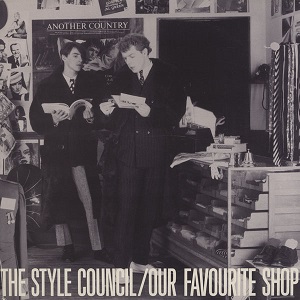
The STYLE COUNCIL: Our Favourite Shop


(#316: 8 June 1985, 1 week)

Track listing: Homebreakers/All Gone Away/Come To Milton Keynes/Internationalists/A Stone’s Throw Away/The Stand Up Comic’s Instructions/Boy Who Cried Wolf/A Man Of Great Promise/Down In The Seine/The Lodgers (or She Was Only A Shopkeeper’s Daughter)/Luck/With Everything To Lose/Our Favourite Shop/Walls Come Tumbling Down!

(Author’s Note: This was another album to which I listened in two formats. The LP is essential for the elaborately-designed photographic cover display and for the quotes from Jimmy Reid, Lenny Bruce, Oscar Wilde and Tony Benn. Side two of the cassette edition comprises “Gary Crowley Meets The Council,” wherein the chirpy disc jockey talks through the record – which plays quietly in the background throughout – with Weller and Talbot. I haven’t reminded myself of it yet because I don’t want their views to influence mine. It’s up on YouTube if you’re curious.)

In June 1985, David Peace was eighteen, or seventeen – he appears rather coy about revealing his date of birth. All I am saying is that some things stay with you for life, if they hit you at a certain time.

However old he was, there is no excuse for you not going off and reading Red Or Dead. The book is large, long and best read quickly; it works best if you see it as a Miltonian epic poem, and you will subsequently want to go back over key passages many times. Especially affecting is the book’s second half; Shankly retires from Liverpool, knowing almost immediately that he has made a mistake but too proud and/or stubborn to go back on his decision. His life busily winds down over its remaining seven years and he finds that, bit by bit, the world has no further need of him. The board of Liverpool Football Club are silently relieved by the retreat of someone whom they view as a faintly embarrassing anachronism. His testimonial match is under-attended and doesn’t raise that much money. The offers from clubs and chairmen slowly dwindle to nothing.

But he can’t let go, this Shankly; he’ll talk about the world and football as he knows them to anybody; sitting in a café, watching his tea go cold, waiting for someone else to come in and chat with, or ringing up fellow managers asking them what they thought of Match Of The Day, or reminiscing with any reporter, journalist or punter who turns up. Eventually he is prepared to talk to himself, sitting on the promenade in Blackpool. He can’t stop because he is aware that he may already have outlived his own legend; one of the book’s bleakest, shortest and most poignant chapters is the one where Thatcher wins the 1979 election and he sits silently in his chair, looks out of his window at the silent streets and locked doors, and feels himself, his time, to be passing. Is he really the last person alive who feels this way about football, and life?

Eventually the streets of Anfield turn into boarded-up, empty slums. The world has changed, and for the worse; everybody has gone away, and soon Bill Shankly will go away as well. Then what, or who, will be left? The heart attack comes during the riots, while his city is burning.

What I am asking you to do is to hold this picture in your mind as you listen to “All Gone Away,” a cheery Radio 2 samba, complete with a cheesy flute interlude straight from a mid-seventies BBC sitcom, over which Paul Weller sings about “how monetarism kills whole communities.” The first song in this tale to include the word “monetarism.” The Style Council were New Pop in the way Miles was free jazz; in other words, they weren’t really, but were carving out a parallel path.

Our Favourite Shop couldn’t be more different from Brothers In Arms if it tried – and it doesn’t need to try. I will leave the minutiae of the “shop” as displayed on the cover for you to discover but it is worth noting that very little, if anything, of what is in this shop is from the present (mid-eighties) time; it’s all from, or just before, or just after, the sixties, and this extends into the anything-you-like-as-long-as-it’s-not-rock approach to the Council’s music; its influences are mostly from the past (funk, soul-jazz, bossa nova, Beatles, psychedelia) but its intention is to deal with the (1985) present in order to enable a future.

Viewed in that context, the first six songs of Our Favourite Shop represent a dazzling index of pop possibilities; it is one of those rare records where every new song suggests a different, exciting (or imposing) world. And unlike Dire Straits, the record wastes no time pointing fingers and naming names. This is an anti-Thatcher, anti-Conservative polemic of fire, and perhaps the most depressing thing about it is that it could have been written and recorded last week.

The record begins, bravely, with “Homebreakers”; a railway platform announcer ushers in an odd vocal – how did Weller’s voice get so deep and gruff? – which is only odd until you realise that it is Mick Talbot singing; a brave introductory tactic for somebody as residually popular as Weller. The family can’t find work so are breaking up; the singer goes to the station and gets on the train with no real joy or hope. The accusation is that it is the Government who has done this, with their insistence on people getting on their bikes to find work. Anybody who came of age in eighties Scotland will recognise the pain instantly. The music is brooding, breakbeaty, organ-dominant; as Dee C Lee’s voice hangs on the last syllable of “responsible” like the mother clinging to the carriage door of the departing train, hindsight reconfigures what we hear; it actually sounds like Portishead.

“Come To Milton Keynes” is a neon nightmare of newness – the names of the great liberals John Milton and John Maynard Keynes misused to promote misleading, fallible brightness – mostly thanks to John Mealing’s astonishing orchestrations (Joe Loss meets “A Day In The Life”) but also to Weller’s deceivingly chirpy paean to drugs, violence and suicide and Talbot’s unhinged, Theremin-like keyboard which proposes a Home Counties Mercury Rev. “Internationalists” – performed at Live Aid, and the album’s title song in the States – is the kind of dynamic funk of which Wham! were once capable. “A Stone’s Throw Away” recasts “Eleanor Rigby” in a world drowning in state brutality, and depressingly it has not dated a jot. This is succeeded by a brief monologue by Lenny Henry, impersonating Bernard Manning over nightmare working man’s club organ, about how “light entertainment” is actually a malevolent, dark and gruesome death-ray  - and we now know that the reality was, if anything, much, much worse than that.

So far, this is a bold record, merrily displacing everybody’s preconceptions about Paul Weller’s art, if not his politics. The ride is thrilling. But about halfway through “Boy Who Cried Wolf” – better Culture Club than Culture Club had managed in eighteen months – you can sense some of the energy sapping, the urge to settle down and make a “Style Council record” becoming more apparent. The song itself is fine but far too long. And side two shrinks back from the musical challenge. Weller sings of frustrated suicides, French passion and, several times again, the dismal state of his nation but the music doesn’t keep pace, settling for a reasonable but none too exciting mix of Europop and American soul/funk styles (whereas the bossa nova of “All Gone Away” subtly reminds us that Tropicalia was primarily the expression of the desire for political and societal revolution via music; for the most exquisite blend of the two, see Tom Jobim’s matchless Matîta Pere). “The Lodgers,” with its undersold nod to the work of Jam and Lewis, works best in this respect, but the fact that “With Everything To Lose” was reworked, with entirely new lyrics, as “Have You Ever Had It Blue?” for the soundtrack of the following year’s Absolute Beginners, makes one wonder how closely people were listening to the words, or even bothering with them.

“Walls Come Tumbling Down!,” the album’s closer and big hit single, is like a supercharged and focused “Beat Surrender,” uplifting and hopeful. And this may be the first number one album actively to encourage its listeners to go out and do something to change things; hence the sleeve’s contact details for CND, International Youth Year and the Youth Trade Union Rights Campaign. In Like Punk Never Happened, Dave Rimmer refers to the Style Council as a kind of “loyal opposition.” This is streets ahead of The Gift – and the jury remains out as to whether the Style Council were really streets ahead of The Jam – but the fact remains that the album came out after the miners’ strike had drizzled into non-existence. Overlying all of these songs, like the heaviest and saddest of clouds, is the question which Charles Shaar Murray, in the NME, asked about the songs on Born In The U.S.A., namely “what do you do the morning after defeat?”

It is as if Weller knows that in the summer of 1985 “we” have already been beaten – and he remains careful to keep “pop” at a distance from him; the second line of the lyric to “Walls Come Tumbling Down!” is printed as saying: “You don’t have to sit back and Relax (capital “R” Weller’s, italics mine)” – and that what the Style Council are proposing, both philosophically and artistically, isn’t going to be enough to effect a change. So Our Favourite Shop is half a great album – although that was still half an album more than most other musicians managed in 1985 – whose inner dread is powered by the increasing knowledge that the shop is eventually going to go out of business, close down and be replaced by a tanning salon. As most of our favourite shops have now done.

Next: Pop’s Silver Surfer seeks solace but finds only self-willed solitude.