Sunday, 18 March 2012

Max BOYCE: We All Had Doctors' Papers


(#161: 15 November 1975, 1 week)

Track listing: Sospan Fach/I Am An Entertainer/I Wandered Lonely/I Gave My Love A Debenture/Rhondda Grey/Slow, Men At Work/Deck Of Cards/Swansea Town/The Devil’s Marking Me/A’r Lan Y Mör/The Pontypool Front Row/Sospan Fach

“When I see the eight I think of the great Mervyn Davies, the greatest ‘number eight’ in the world.”
(Max Boyce, “Deck Of Cards”)

The man always had a good sense of timing. Not only did “Merv the Swerve” check out the day before his number came up on Then Play Long, but he also died exactly thirty-six years after captaining the Welsh team who beat France comfortably at Cardiff towards their historic Grand Slam victory – and the day before it would happen again, 16-9 at the Millennium Stadium, by a side generally thought to be at least the equivalent of the great seventies teams. Only a few days after his victory, while playing for Swansea in the Welsh Cup final against Pontypool, again at Cardiff, he collapsed on the pitch with a brain haemorrhage. He was lucky to have come through that – he later admitted that had he collapsed on an “obscure golf course,” that would have been it – but as a result he never played again, although he did flourish in subsequent spells as rugby coach and journalist. Nobody who remembers his cunning and tough tackles, his brilliant passing – the term “defender” scarcely did him justice – could deny that he was one of the greatest players the game of rugby union had seen.

I stress the term “rugby union” because all of the rugby-related humour and music within We All Had Doctors’ Papers is to do with this variant of the game. The term “rugby league” is mentioned only two or three times, and on one of these occasions the words are bleeped out as though they were expletives. Those who don’t recognise the differences between the two sports are probably unaware of the turbulent history which produced them, a story of paid versus unpaid, cushioned southerners against needful northerners, between dilettantism and need. Rugby league is supposed to produce a more visually exciting and stimulating game than rugby union, and also requires two fewer players (thirteen rather than fifteen). This is, however, probably the first instance of sport selling itself out in order to appease fickle, floating audiences; the point of rugby union is that, under its cover of aggression, it is as artful and tricky a pursuit as cricket. It is about long-term results rather than flashes in a glamorous pan.

But then We All Had Doctors’ Papers isn’t really about rugby, even though four of its songs, and much of the patter, are devoted to the subject, and it was recorded live (to a point; the recordings were made from several different performances, as the fadeouts and splicings betray) at the Pontardulais Rugby Club. It’s true that a full appreciation of the record involves an intimate understanding of the geography of South Wales and the comings and goings of their mid-seventies rugby clubs. More importantly, though, it’s about life, and the necessity to hold on to and maintain it.

It’s not really a “comedy” album either, and certainly isn’t the only “comedy” album that will be considered here, although it is frequently very funny indeed. I thought initially to prepare for this record by undertaking a full-length survey of comedic trends in 1975, but after a thousand or so words realised that this would be sorely inadequate, and most likely irrelevant. Better to say that Max Boyce is this tale’s most visible example of one of the most prominent trends in British comedy of the period, namely the tendency of long-serving folk musicians to move towards telling jokes.

There was also Mike Harding from Rochdale and Jasper Carrott from Birmingham, but the man who got the whole craze going was unquestionably Billy Connolly, who the following week would attain a UK number one single with his literal shaggy dog story reading of Tammy Wynette’s “D.I.V.O.R.C.E.” Although 1974’s double Solo Concert, taped at a pub in Airdrie, was not Connolly’s first “comedy” album, it proved his breakthrough; it sold in such astronomical qualities in Scotland that I don’t think I’ve come across a household which didn’t have a copy. Formerly one half of the Humblebums, with Gerry Rafferty, Connolly gradually realised that his between-songs patter was getting a better reaction than his songs, and realigned his act accordingly. Hence Solo Concert is mostly Connolly, ranting, musing and amusing, with occasional proficient banjo/guitar outings; major setpieces like “The Jobbie Weecha!” and “The Crucifixion,” reconstructions of tired pop songs (“Nobody’s Child,” “Ten Guitars,” “Long Haired Lover From Liverpool” – all get a good kicking here) and long ponderous strands where nothing much happens at all; an overlong and unfunny reminiscence of fifties camping barely raises a titter. But there was nothing else like it happening in Britain, and so the Big Yin prospered.

Connolly bothers me, especially after listening to the man (mistakenly) labelled his Welsh equivalent. There’s a continued undercurrent of aggression and contempt in Connolly’s work; you’re never quite sure whether he’s going to step down into the audience and bash someone over the head with his banjo. There’s a hard threat about his posture, an air of menace. It’s almost as if he feels he’s too good for his (from his perspective) dumb cabaret audiences. And, this being seventies West Central Scotland, there are far too many jibes at Protestants – a reminder that Scotland remains divided by its own institutionalised religious apartheid, and it makes uncomfortable listening nearly four decades later. I imagine most Scots under the age of forty would find Solo Concert as hip and hilarious as Beowulf.

This was never a problem with Boyce. Although, like Connolly, he is apt to crack himself up with his own wit, he has a bashful, self-deprecating air about him that removes such barriers. Religion is not an issue here, and although he takes a few mild pot shots at England, he is not particularly anti-anything; more importantly, he’s pro-Welsh. His delivery is not gruff and cross like Connolly’s; his light tenor often gives his voice a plaintive, near androgynous air (“Tick-et-less!” he exclaims delightedly near the beginning of “I Wandered Lonely”), and if that self-deprecation sometimes leads towards bending his voice to mask the occasional punchline, this is all part of his personality, and his audiences certainly get it. And him.

For this record reminds us that Boyce is utterly at one with his audience; each treats the other like their equal, and there is love rather than spitting content. He had been working the Welsh club circuit for years, and in late 1973 tried out on Opportunity Knocks, without success. Still, his stage reputation grew big enough for EMI to take a chance on him; the resultant album, Live At Treorchy, was an immense hit in Wales, and a word-of-mouth success elsewhere in Britain; although the album never placed higher than #21 in the national charts, it stayed there for fully eight months. One of its songs, “9-3,” celebrating a celebrated rugby victory by Llanelli against a touring All Blacks team, contained the line “we all had doctors’ papers,” i.e. the entire working class population had been signed off work by their doctors so they could go and see the match. Subversive stuff for 1974, and the spirit carried over to its sequel.

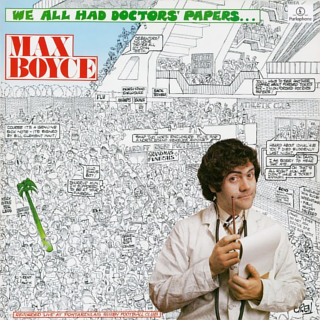
The cover is almost entirely a Where’s Wally?-type affair, drawn by “Gren” (“Cartoonist of the South Wales Echo"), and apart from a picture of Boyce himself, stern in his medical get-up and strongly resembling the young Danny Baker, it is all a cartoon of crowds swarming around and into the rugby ground, with numerous hidden celebrity cameos – mostly distinguished Welsh names of the period, but we also spotted Laurel and Hardy, Tommy Cooper, Batman and Robin, Harold Wilson and the Queen (and the fellow holding the giant leek is, I suspect, meant to be Boyce himself) – with humorous notices and banter, two speech bubbles indicating the first appearances in this tale of the future colloquialism “innit.” It’s all about getting one over on the powers that would be, in favour of the greater good.

Boyce clearly needs to prove nothing to this audience. His backing group – guitarist Neil Lewis, bassist John Luce and MD Jack Emblow on keyboards, accordion, etc. (with Boyce himself contributing guitar work) – set the scene with a furious sprint through “Sospan Fach,” Boyce’s adopted theme tune, which invites immediate clapping and sing-alongs. Then Boyce arrives on stage with his cheerful war cry of “Oggi oggi OGGI!” (Audience: “Oi! Oi! OI!”) and launches into a warm mixture of stand-up and songs.

Since the bulk of this album – or side one of it, anyway – is stand-up comedy, I will not attempt in-depth analysis or spoil any punchlines. As I say, if you have a working knowledge of mid-seventies South Wales life, you should be able to understand it all, but (as with the need with Billy Connolly to be familiar with the twists and turns of mid-seventies Glasgow) it’s not absolutely necessary. He does daft poems, bizarre narratives about himself and Wales and rugby, and it’s all great, infectious fun. His first song is the jokey “I Gave My Love A Debenture” (“Block A, Row 3!”), set to the tune of “The Twelfth Of Never” (complete with a little “1812 Overture” coda).

But – and this is quite unexpected, even given his then-recent past as a folk artist and poet – Boyce is also able to do serious songs. “Rhondda Grey” is his song, and a memory of a childhood in the mining community of South Wales. The boy is given an assignment by his art teacher at school and wants to paint what he sees around him. Excitedly he wonders aloud what colours he should use, and it is down to his father to show him:

“It’s a colour you can’t buy, lad
No matter what you pay.
But that’s the colour that we want –
They call it Rhondda grey.”

It’s a lesson in growing up, in rejecting superficial glamour in favour of the real; and as a song and performance it’s extremely moving. Boyce’s vocal is quiet but concentrated and clearly heartfelt – does anyone else hear, in Boyce’s singing, a marked resemblance to that other Welshman, John Cale? – and the listener can feel the audience empathising, although they do not erupt with approval until the end. In addition, the line “with your reds and greens and gold” brings to mind another live album recorded in 1975, this time in London, by and for another community on the brink of dispossession:

“One good thing about music,
When it hits you,
You feel no pain.”
(Bob Marley, “Trench Town Rock”)

It’s there, isn’t it, in the mass sing-alongs to “The Pontypool Front Row” and the ancient Welsh folk song (sung in defiant Welsh) “Ar Lan Y Mör.” “Everything’s gonna be alright,” as Marley sang to an ecstatic, if troubled, audience at the Lyceum. Anticipating this, Boyce launches into his satirical anthem to council road workers, “Slow, Men At Work” and everybody already seems to know the refrain “They keep their billycan brewing.” It is as if this contained community is fortifying itself against the outside world.

Side two concentrates on the songs. Although you’ll have to look up most of the references yourself (even though the mere thought of “Ray Williams training leaflets” makes me laugh uncontrollably), Boyce’s rugby union take on the old warhorse “Deck Of Cards” is funny and pertinent. “Swansea Town” is a pleasant country-folk lope towards nostalgia, again performed with great control and concern. “The Devil’s Marking Me” concerns rugby matches in the afterlife. Finally, “The Pontypool Front Row” – by which he means the renowned Welsh rugby front line of Graham Price, Bobby Windsor and Charlie Faulkner – is a quite exhilarating anthem, sung with gusto by everybody present, and incorporating topical references (Mary Whitehouse, Idi Amin, The Six Million Dollar Man) in a way which suggests Boyce could keep adding verses to the song forever. But there is no denying the power and commitment of the mass choruses – “And it’s up and under, here we go/Are you ready, here we go?” – and Boyce is clearly delighted and moved by the audience participation. He leaves the stage to a tumultuous reception, and “Sospan Fach” is played to fade.

In summary, then, Max Boyce is throughout a mirror to the audience (almost certainly 100% male); he sees them and they see him, one of theirs, and together they engage in building this subtle little dinghy of resistance to the outside world. Direct comparisons to other countries is hard, although Canada’s Stompin’ Tom Connors probably comes closest. This is a Wales which doesn’t particularly need anywhere else – and, as if we needed to be reminded, we are talking mid-seventies Wales, and a community long since rendered the opposite of “beautiful” by the remorseless but vital mining industry. In just under a year’s time there will come another live album of low budget but high energy; for now, though, listen to the more than evident love between Boyce and his audience, and think of Alan Cuthbert and Leigh Halfpenny today, both of whom made it possible for their country to repeat the greatness of Mervyn Jones’ days. The victory, the joy, made me feel just that little bit happier, that crucial little bit more human; and I think We All Had Doctors’ Papers does that too.

Sunday, 11 March 2012

Jim REEVES: 40 Golden Greats


(#160: 25 October 1975, 3 weeks)

Track listing: Distant Drums/Bimbo/Am I Losing You/Mexican Joe/The Blizzard/Gypsy Feet/I Fall To Pieces/But You Love Me Daddy/Guilty/Missing You/I Won’t Forget You/The Hawaiian Wedding Song/When You Are Gone/The Storm/One Dozen Roses/Not Until The Next Time/Penny Candy/Anna Marie/He’ll Have To Go/Four Walls/Welcome To My World/Scarlet Ribbons/According To My Heart/Make The World Go Away/Crying In My Sleep/Deep Dark Water/I Won’t Come In While He’s There/Golden Memories Silver Tears/Roses Are Red (My Love)/Memories Are Made Of This/You’re The Only Good Thing (That’s Happened To Me)/The Wreck Of The Number Nine/Yonder Comes A Sucker/How Can I Write On Paper (What I Feel In My Heart)/Have I Told You Lately That I Love You/Auf Wiederseh’n Sweetheart/Missing Angel/Is This Me?/Angels Don’t Lie/Is It Really Over

“The week that the Sex Pistols played their first performance, the six-year-old ‘Space Oddity’ by David Bowie took over the number one UK single slot from Art Garfunkel’s version of a sixteen-year-old song (sic), ‘I Only Have Eyes For You’. The number one album was the TV-advertised 40 Golden Greats by Jim Reeves, who had died in 1964. In returning, the 1960s showed up the poverty of the present.”
(Jon Savage, England’s Dreaming: Sex Pistols And Punk Rock, London: Faber and Faber, 2001 revised edition, Chapter 2: “August 1975 to December 1976,” p 130)

“[The Heartbreakers] had Christmas dinner with the Pistols, the Clash, and the Damned at the journalist Caroline Coon’s house, eating Christmas pudding and listening to old Jim Reeves records.”
(Will Hermes, Love Goes To Buildings On Fire: Five Years In New York That Changed Music Forever, NYC: Faber and Faber Inc., 2011, Chapter 4: “1976: These Are The Days, My Friends,” p 215)

In our preparations for this piece, Lena pointed me in the direction of “The Painted Door,” a short story by the Canadian writer Sinclair Ross. It is an extremely short story – it takes up barely seven pages – but I’d agree with Lena that it’s one of the best. Set, as was all of Ross’ work, in an unnamed Canadian prairie (Ross was a native of Saskatchewan, but it could just as easily be Alberta), it tells the story of a married farming couple, John and Ann. From the descriptions given – “slow,” “unambitious” and “dull-witted” are some of the more generous adjectives – John is a bit of a Gabriel Oak figure, solid, reliable and deadly boring and sexless. Without meaning to, he makes his wife feel less of a woman. In the meantime, she has been seeing another farmer, Steven, who awakens something dormant in her – desire? Femininity? Life? – but hasn’t dared take things any further. One day John decides to make a long trip to help out on his father’s farm; Ann doesn’t want him to go away and leave her alone but he is insistent. A grim blizzard is coming. He leaves, and while he is away Ann gets on with her current pastime of painting doors, specifically in this case the bedroom door. One has to do something. Steven is due to pay a visit; she is uncertain whether he can make it through the storm but he turns up. As things develop, they end up sleeping together; she awakens first, looks at his motionless, dozing face and suddenly realises the mistake she’s made. She imagines that she dreamt John came through the door, but of him there is no sign. The storm breaks, and John’s frozen body is found in a field not far from the farm. How could he have missed the farmhouse when he was so close? But Ann looks more closely at his palm, and with a gathering horror sees that it contains a scrap of paint. The painted bedroom door had not yet dried properly; he evidently came in, saw what was there and decided to turn away again, back towards his death.

I don’t want to undersell the continuing need for and influence of Celtic sentimentality in popular music, but there is more than something of John in the art of Jim Reeves. Forever gallant and dumbly faithful, forever cheated on and abandoned, the character of Reeves remains centred in a lot of ways; he is completely self-contained to the point of hermeticism, and not once in these forty songs does he make any attempt to understand the woman who keeps cheating on him, walking out on him. There is also a thin line between being self-contained and being motionless, as in stationary, as in bereft of life; in these songs he often seems perversely content to do little or nothing – without even trying, he acts as though the world revolves around him.

Ah, yes, understanding:

”I love you because you understand, dear…”

A cursory look at the track listing at the top of this page reveals that this is not quite the straightforward greatest hits collection it pretends to be. Yes, there is no typing error; the song most readily and famously associated with Reeves, though not his biggest hit, is absent. I can’t imagine a Jim Reeves collection without “I Love You Because,” but this is one; nor is there room for things like “Adios Amigo,” “There’s A Heartache Following Me,” “It Hurts So Much (To See You Go),” “When Two Worlds Collide” or even “Moonlight And Roses.”

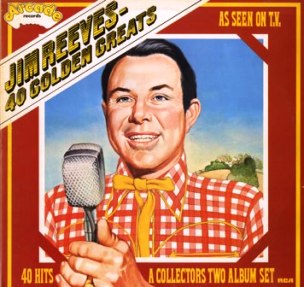
How did this happen? Why “A COLLECTORS TWO ALBUM SET” which bears no photographs of the artist, but rather a series of drawings of the man and an anonymous American Midwest whose landscape, despite the “Coca Cola” and “AMERICAN GAS” signs, bears more resemblance to the A40 Lewknor turn-off? Despite this being, ostensibly, an Arcade/RCA collaboration, it has to be said that extensive delving into the history has revealed no clearcut answers. Unlike Arcade’s contemporaneous and not dissimilar Elvis Presley 40 Greatest collection – and more about that in the fullness of time – this was not a handy collation of two previously existing anthologies. Was it a question of Arcade taking whatever RCA, or Mary Reeves, or whoever, was prepared to license out? Again, there is no clear answer except that in 1975 the Reeves copyright/licensing situation was in something of a mess; RCA were not at the time prepared to sort it out, feeling that the Reeves legend was a peculiar (i.e. non-American) phenomenon whose appeal was steadily diminishing (this being the era of major forward moves like Willie Nelson’s Red Headed Stranger). In 1992, Arcade did attempt to make amends by issuing a new 2CD collection, The Definitive Jim Reeves, which featured some of the omitted songs but was otherwise an almost completely different forty-song set. If RCA were holding back on some tracks in anticipation of a second 40 More Golden Greats set, they would be disappointed since no such record was ever released, despite the huge success of this one.

But to get back to “The Painted Door,” my referring to this story does have direct relevance to Reeves insofar as this album includes a song entitled “The Blizzard.” Against a backdrop of wind effects, the singer sets up the scenario; he has been caught up in a major storm (“The wind…seems mighty like a woman’s screams”) and is trying to get himself and his pony back to Mary Anne at the farm. They are only seven miles away but his hands are already frozen; still he knows “If we don’t get home, we’ll die.” He imagines Mary Anne cooking hot biscuits in the stove pan – the heat nicely contrasting with the cold – and they steadily get closer and closer to home. Before they can reach home, however, the pony gives up and drops on the ground. “Damn, get up, you ornery cuss,” mutters Reeves, perhaps already knowing his fate; the blizzard passes and they find his body, still tethered to the pony’s reins – they were only a hundred yards from home. I must admit that if I knew I was only a hundred yards from home – and throughout the song Reeves is always careful to let us know that he knows exactly where he is – I’d get in, eat and sleep, and bury the pony in the field next morning; but there is a fatal fatalism in Reeves’ voice that suggests a sacrifice as encyclopaedically pointless as that of John.

Another, earlier, song, “The Wreck Of The Number Nine,” similarly plays games with listeners’ expectations, but in both the abrupt jump cuts to the discovery of the dead protagonist are as swift and shocking as anything in the work of Cormac McCarthy. And when he’s not musing about death, Reeves is either preparing for his own (“Distant Drums”) or endlessly dreaming about the past. There is a will to extinction here which is present and active enough to be disturbing.

Not that Reeves was never anything less than imperturbable; he stands there, as solid, untouchable and mechanical as Ayers Rock or Rushmore. This is why his attempt to do Patsy Cline (“I Go To Pieces,” and other tributary works like “Guilty,” “Missing You” and the bamboozling “Is This Me?”) fails; marble statues don’t fall to pieces and Reeves’ practiced nonchalance provides an impermeable barrier to those who might otherwise empathise (although the palais band sax section on his “Pieces” doesn’t help either). Cline’s acting thing, her rhetorical genius, was to go to pieces – her “She’s Got You” is Ophelia in dungarees – but Reeves’ thing was to stay in one piece.

Broadly speaking, the album, though not chronologically arranged, traces a specific story of Reeves from his early fifties Louisiana Hayride days to virtually his last days (the closing “Is It Really Over” came from his final recording session in 1964). The early stuff is essentially hoedown hokum; “According To My Heart” makes a return appearance (the only overlap between this and the 1969 budget collection previously reviewed) and I’m still awaiting a Status Quo cover, but otherwise it’s mostly nonsense about kids with candy on their faces (the Junior Choice favourite “Bimbo” where the toddler already looks to be facing a better future with the opposite sex than Reeves will ever enjoy, the ludicrous “Penny Candy” with its Phil Harris-like talkovers – “She eats that messy kind!” – and its dubious association of blackface with happiness). Even at this stage, however, there are portents of the future; Reeves’ own song “Yonder Comes A Sucker” introduces his favourite subject, the Cheating Woman, fully formed. Other tracks – “Have I Told You Lately That I Love You” (Van Morrison must have been listening), “Crying In My Sleep,” “How Can I Write On Paper” – attempt to fuse the post-Hank fiddles with his later, smoother approach, but it wasn’t until “Four Walls,” another Reeves composition, that the formula was perfected – small group, vibes, electric bass, more echo on the voice. “Four Walls” is a foreboding piece of work, as he imagines his home “closing in on me” while desperately trying to convince himself that “my walls have nothing to say.” If it sounds as though this song is closing in on a 1977 RCA release, then it is; this is an embryonic “Sound And Vision” in subject matter, tone and delivery.

“He’ll Have To Go,” from 1960, was the big commercial breakthrough, of course, and what a crouched, wary shadow of a song it is; he pleads with her to whisper into the ‘phone, knowing full well she’s there with his successor, and he is most likely standing directly across the street. Yet the singer’s reserve, his reluctance to engage or argue, is what repeatedly does for him. Consider “I Won’t Come In While He’s There,” an unexpected Top 20 addition to the paranoias of 1967; about to leave town, he decides he’ll call in on his ex one last time, but as he approaches her house he notes “his” car in the driveway, the curtain drawn. He decides against a “Delilah” scenario (“I might do something I’d be sorry for later”) but is burning with resentment; “Does he know my whole world is in there with him/That he’s king while he sits there in my chair?” The whole thing takes just eight lines but is as beautifully and coldly drawn a portrait as anything by Raymond Carver; “he” has won, yet not once does Reeves face “him” in the eye, and you get the idea that this is exactly why women keep walking out on him; does the protagonist in “He’ll Have To Go” secretly ache for Reeves to come barging into the bar, seize the guy by his shirt collar, roar “Why I oughta…” and finish him off? Just to provide some excitement and life…just to prove that he’s a man?

But no. Reeves didn’t get to number one over a decade after his death on the Scottish and Irish votes alone; he was loved in England precisely because of his “Gentleman Jim” status, that he was indeed the personification of the “Keep Calm And Carry On” anti-ethos, that he didn’t resort to crude tactics, that he heroically stood there while all kinds of shit were heaped upon his head. His happiness, when it exists, is measured, never wild or wayward. One could easily imagine him being the last man on Earth, and not knowing it. It’s all about whispers (his UK follow-up hit to “He’ll Have To Go,” and not included here, was entitled “Whispering Hope”); whispers on the ‘phone, whispers in the walls, never raising one’s voice, always retaining…well, what? Dignity? Humanity?

A few songs go more happily than others. Well, there’s “The Hawaiian Wedding Song,” which is as bad as any of the cover versions here (the track listing alone should tell you the picture). There’s his first gold disc, “Mexican Joe,” which basically provides “Hey Joe” with a happy ending despite rhyming “peso” with “say so.” And there’s a certain proto-reggae jauntiness to tracks like “How Can I Write On Paper” and “Have I Told You Lately” which reminds us why Reeves was so idolised in Jamaica (apart from the clear signal they got from Nashville radio stations); pain and steadfastness are things universally empathised with (I hesitate to call them virtues, since this is the combination of failings which can only block humanity’s progress).

But so much of Reeves’ work is sealed off so assuredly from the listener that you sometimes wonder how he got to be so popular. “Welcome To My World” is all Mad Men string-driven lushness, but that old familiar knock on the door motif is back (“Knock and the door will open” – is this the Village?) and it’s not until we reach the song’s epicentre that we realise that it’s all a façade, built in the hope that one day “she” will stumble across it. Elsewhere, there is an extremely thin line to be drawn between heroicism and idiocy (always two closely associated foibles); “Not Until The Next Time” finds him minutely rearranging bits of furniture on a regular basis, knowing (despite the smouldering resentment of his delivery) that he’ll always take her back. The same with “Angels Don’t Lie”; no, she doesn’t cheat, yes, he believes her every time, and Brutus is an honourable man (other songs like “Missing Angel” suggest a worrying dependence on unconditional worship when it comes to human relationships). By the time his version of “Make The World Go Away” rolls around, he’s too tired to sing any more than half the chorus (not including the title).

Much of 40 Golden Greats is meretricious trash, neither golden nor great. The blame for this lies with his widow, Mary Reeves, who after his death authorised new backing tracks to be added to demos and throwaways in the archive, thereby giving the impression of Reeves as a kind of sixties Tupac Shakur, secretly hiding away in a bunker recording all of this “previously unreleased” stuff. “But You Love Me Daddy” is beyond bad. Repeated attempts are made to turn Reeves into a kind of Ben E King/Drifters/”Spanish Harlem” figure, as evinced by the mariachi trumpets on “Gypsy Feet” (“I can’t put an acre on your gypsy feet”), “Golden Memories Silver Tears” and “Missing Angel.” Worse, however, is a legion of backing singers who effortlessly drown out Reeves whenever they can and not afford him the space that his voice needs. It is no wonder that on “When You Are Gone” he is left feeling that “there’s nothing to live for”; those warblers will not shut up (and no wonder, come to think of it, that women keep leaving him – he has to drag this bloody choir around with him like a ball and chain!). “Memories Are Made Of This” is worse than you expect. “Auf Wiederseh’n Sweetheart,” complete with more blasted trumpets, is listenable only for Reeves’ commendably dignified vocal, and his unexpected yet poignant upwards octave leap in the song’s last syllable.

He does better on “Roses Are Red,” the Bobby Vinton weepie, because the arrangement is kept low-key (the harp from “I Love You Because” makes an appearance) and because the song’s subject matter suits Reeves’ stoic/stolid worldview; childhood sweethearts separated by time, desire and circumstance, with a visit to see her child and wish her all the best – it is like a neutered “Disco 2000” and agrees quite well with Reeves’ staunch impassivity. But “One Dozen Roses” spoils a perfectly good vocal by plunging it into a cocktail lounge musical nightmare; whoever thought Reeves merited the ring-a-ding-ding treatment? Then again, the song itself is dubious; buy one dozen roses and put my heart in the box? Isn’t that a rather gruesome thing to contemplate, let alone do?

This leaves the majority of Reeves’ own compositions, or co-compositions, and it is here where the central interest of 40 Golden Greats lies. Ignore the clichéd arrangement of “The Storm” and listen to an unusual deconstruction of a collapsing relationship, delivered in a style not a million miles from Richard Hawley (and on the latter subject, it might be worth noting that, as far as “Missing Angel” is concerned – if you can overlook the ghastly piano work – “a million miles” are in Reeves’ world no further or closer than the “100 yards” of “The Blizzard.” It’s all perspectival, and taken from an identical perspective). “Deep Dark Water” is an ambitious and verbose attempt to describe a failed life; here, for once, is Reeves the cheater, the drunkard, the player: “Alone and so lonesome/Bored and so blue,” he ventures into hell and now he is calmly awaiting his end. “They keep sawing louder on my limb and soon I’ll have to go,” he muses, before concluding, “Don’t be a would-be king and tumble from your throne.” The music is anything but reassuring (the honky tonk piano intro notwithstanding); for once, Reeves drops the mask and sees himself as others might still see him.

The concluding trio of songs comprise a harrowing sequence. “Is This Me?” finds an aghast Reeves, looking at himself crying, and then at his lover cheating, and refuses to believe his eyes; this is so not what we do. “Angels Don’t Lie” also deals with the gulf between illusion and truth. And, to cap or end it all, there’s Reeves’ “Is It Really Over” which he sings with the numbness of a man heading for the scaffold (on a similar matter, I should note here that the track “Guilty” is traditional country blues stuff, equating marriage with imprisonment – but he’s the one being dumped here, the one wearing the metaphorical noose), realising he has reached “the end of the line.” The parallels with “I Know It’s Over,” a work done by Mancunians of Irish descent, all of whom grew up with the music of Jim Reeves in their blood, need not be overstated.

At this point I ought to say that, having spent several hours in his posthumous company, and considerably more time researching his life and work (almost none of which has found its way into this piece, but it had to be done), this is almost all I intend to write about Jim Reeves; the fiftieth anniversary of his passing is only a couple of years away, and for all I know it may well be commemorated by yet another chart-topping compilation. But listening to these forty songs in succession produces a somewhat numbing effect, as in: there must be more to life than holding fast and keeping all emotion in check – look how it gets the singer nowhere (and I must also emphasise that, throughout this piece, whenever I refer to “Reeves” or “Jim Reeves,” I am clearly referring to the persona he projected on his records, rather than the man himself).

There is of course one cover version I haven’t yet mentioned, and in many ways it’s the most unexpected and astounding piece of music on these records. This is the second time I have had to write about “Scarlet Ribbons” – Val Doonican covered it, as he did “He’ll Have To Go,” on entry #50 – and Reeves does it as a completely solo performance, accompanying himself on guitar. At the start there’s a bit of chat about the song, that to his knowledge it is about 400 years old and comes from the United Kingdom, before he gets into singing the old standard. Knowing that Sinéad O’Connor was approaching her ninth birthday as this album became available, and that she must have listened to and known the performance, Reeves’ simple poignancy proves devastating. But as the song patiently winds towards its end, something strange begins to happen to Reeves’ voice; it becomes even deeper than his customary baritone (as a Texan, his style is almost the complete opposite of his compatriot Roy Orbison, for whom “Distant Drums” was originally intended, introspective as opposed to expressive. And a quick word about Reeves’ actual biggest UK single – his only number one here, in 1966, a year which proved that, despite unprecedented and unparalleled experimentation and adventure within the confines of the 45 rpm single, Celtic sentimentality would always win out – a song implicitly about Vietnam [“’cross the sea”] with tom-toms as threatening as those on Gaye’s “Grapevine” and a sudden realisation in the singer’s desperate mind that now is what matters, what has always mattered, and never mind the past, and that, given that he will probably die in action, he must marry Mary before the curtain falls); he comes closer to, breathes into, the microphone, and his vibrato becomes more and more drawn-out, exaggerated and actorly. In short, throughout “Scarlet Ribbons,” Reeves is gradually mutating – and at the song’s end, we realise that he has turned into Elvis. In pop terms it’s the equivalent of an Adams-Stokes heart murmur, but it is no less expected for that. And perhaps this is what caught the imagination of the nascent punks – for what did Reeves ever have to do with “The Sixties” anyway? He never had to live through them, grow his hair, write seven-minute concept singles...and so he is perfect, undamageable, unbreachable. He addressed matters in ways very familiar to the human heart, such that I was told separately by two members of the Blue Notes/Brotherhood of Breath how much they loved Jim Reeves’ work, because – it reminded them of home. The home John never really needed to leave, where he should have spent more time being loving and attentive towards Ann. Who knew, least of all him, that his life would have depended on it?

Sunday, 4 March 2012

PINK FLOYD: Wish You Were Here


 (#159: 4 October 1975, 1 week)

Track listing: Shine On You Crazy Diamond (Parts 1-5)/Welcome To The Machine/Have A Cigar/Wish You Were Here/Shine On You Crazy Diamond (Parts 6-9)

A drone. E minor. A Moog picking out a single note topline. An electric guitar doing the same before bending down to a heartbreaking move to B minor. Then back. E minor. The last chord of “A Day In The Life” – recorded in the same studio, the chord that is meant to stand for heaven – was E major.

Therefore it can be assumed that E minor is the precise reverse – the chord that represents hell.

But who is in hell, and whose hell?

Shaven headed. Eyebrows shaved also. Sports shirt. Nobody really knew who he was. He could be serving you a bagel in the Bronx. They had an album to do, and it was hard, wrenching work.

In the canteen. There he is, staring at them, maybe smiling. But who the hell is he? Nobody really knew.

Back into the studio, to work on this song, this damnable elegy, that seems to be taking forever.

The same guy pops his head around the door, has a look at some of the equipment.

Nobody knows who this is. One of the Abbey Road technicians – there are so many of them, it must be. Checking for health and safety and efficacy.

No doubt. But he keeps looking at them. And smiling.

Who
is he?

It took them a long time to work out who it was. Most hadn’t seen him for five, six years tops.

Slowly and shockingly they realised that it was the man to whom this song they were working on was dedicated.

Some of them took it better than others. But the other Roger took it worst. There were tears. There was shock. Most of all, there was a baffled numbness.

Who was this Syd anyway?


There’s no such thing as history beyond what each generation decides to make history. Figures of the past are never immobile tableaux. Every new generation discovers its own ghosts and venerates them with a view to recharging them. In the sixties it was Robert Johnson; by the mid-seventies it would have been Hendrix, Joplin, Morrison, the great untouchables.

But calling for ghosts, summoning them even, carries its own inbuilt risks. And in the rare event that the ghost you desire is still alive, don’t keep summoning the ghost and then act surprised when the ghost turns up.

Syd was there, that day in June 1975, and he may have been many things, or ended up as many things, but he was not yet a ghost.

Four clear clarion notes on the guitar. Wish. You. Were. Here. Gilmour stumbled upon the motif while idly doodling. The perfect mirror of the arched diver into the Mediterranean pool, so immaculate that you can neither see their shadow nor guess that their body had an upper half.

The sleeve. Hipgnosis, as ever. Businessmen shaking hands, one on fire; the idea being that we hide our burning passions under suits of sobriety, whatever society deems “appropriate.” A swimmer drowning in sand dunes. Huge wafts of cloth, red and white, blowing through a desert. A businessman with bowler and briefcase but no face.

If you tolerate this…but I am moving too fast.

Better to recall that the sleeve was in great part designed by junior Hipgnosis employee Peter Christopherson, about to start Throbbing Gristle, a band, or collective, whose work would poke into extremes even the Floyd would find uncomfortable but whose work, overall, would not be that out of place in the Floyd
oeuvre; one can look on their masterpiece, 1979’s 20 Jazz-Funk Greats, as an example of Floyd’s discoveries, and perhaps even Syd’s discoveries, taken to their logical conclusion. There was always so much of the sixties about TG.

Psychic TV, in which the late Mr Christopherson was also involved, do not have their groundbreaking 1982 work
Force The Hand Of Chance discussed here. That really is too bad..

The full band come in at 4:32 but Gilmour is already lost, mostly in his own history. One of the album’s key words is “shadow,” and although the word is exercised in its Peter Pan/Jungian sense, here it is hard not to think of the Shadows; the guitar wanders dolefully but dutifully through the history of sixties rock guitar, from Hank Marvin to Clapton and Harrison (there’s a fleeting reference to “While My Guitar Gently Weeps”), finally settling somewhere between Peter Green and Mike Oldfield. With its patient, submarine-like 6/8 tempo, the song stops just short of being a blues workout.

Then the voice of Roger Waters comes in, and we are very far from that meaning of the blues (although Gil Evans would have understood; see his astonishing resetting of the Bobby Troup number, featuring George Adams’ tortured tenor, on the same year’s There Comes A Time, if you can find it). It is a love song, there are no two ways about it, pining for the return of…the man in his mirror (if we carry on with the Jung analogy)? Black holes in the sky, threatening shadows at night, the rhetorical triplicates (“You stranger, you legend, you martyr, and SHINE!,” “You painter, you Piper (capital letter is mine), you Prisoner (ditto), and SHINE!” – Waters throws everything he can, mainly himself, at this living ghost, and with an undimmed and unambiguous passion. But why all the throwing? Is he lamenting Syd, wanting him back in his world – or does he envy Syd for having escaped this world?

Because if this album’s predecessor took in about every subject matter imaginable, then this one has just two subjects – Pink Floyd, and Syd Barrett.

Chelsea Cloisters is situated about halfway down Sloane Avenue, one of many anonymous roads linking the Sloane Square end of the King’s Road to the Michelin end of the Fulham Road; in other words, Chelsea to South Kensington. Like most of the buildings and aura in the backlands of South Kensington/Knightsbridge, it is apt to give me the creeps. It’s well advertised; apartments there are always available at knockdown bargain prices, given the area.

But there is something too perfect, too flawless, about the unending parade of Art Deco brownstones down this street, something too strident about their determined anonymity. The shops, too, are present, complete, too good to be true, too comprehensive. If you told me it was an M15 hideout/bugging post I wouldn’t be surprised.

Put it this way; I wouldn’t want to live there because living there wouldn’t feel like living. But if you wanted to hide from everybody, there are few better places to pitch up; nobody would even bother to penetrate the invisible, emotional web. So no wonder Syd decided to base himself at Chelsea Cloisters. From there he could wander the city and come back without any questions asked. Rather like Kenneth Williams’ dusty, and now demolished, Osnaburgh Street apartment, though, it’s not a place where you could imagine much, or anything, in the way of life going on.


After each utterance of “steel breeze,” the music shivers and comes to a considered halt before starting again. Then Waters temporarily leaves the song to saxophonist Dick Parry, first considered and ruminative on baritone, then piercing and tortured – that word again – on tenor (the switch is imperceptible). As the track slowly fades, the saxophone appears to scream.

John Surman had left the Mike Westbrook Concert Band, on less than good terms with its leader, in 1968 to concentrate on his work with Barre Phillips and the late Stu Martin in The Trio. He briefly returned in the spring of 1969 to help out with the recording of Westbrook’s Marching Song, but was not on speaking terms with the composer until 1974, when he was recalled to act as featured soloist on Westbrook’s Citadel/Room 315. Old grievances were laid to rest and the work was recorded in 1975. Undoubtedly its highlight is “View From The Drawbridge,” a slowly unfolding piece where Surman’s meditative bass clarinet is intercepted by the rest of the horns playing, in a different key, the old school song “Fishers Of Men,” as if he had just chanced by them by the riverside. The brass and woodwind figures thicken into impossible complexities before fading out and giving way to a second thematic statement by Kenny Wheeler’s flugelhorn. The harmonic textures become dense again before a calming influence – the trombones? – spreads across the picture like a revelatory sun. Then follows a romantic waltz ballad, a screaming trumpet crescendo – and finally Surman, never better on baritone, with only the rhythm section; one by one each player bows out until Surman is left with his old colleague, on electric piano, and finally on his own. Along with Stan Tracey’s “Starless And Bible Black,” it is one of the great masterpieces of post-war British jazz.

The Machine. Sung as though trapped in a mincer. Gilmour’s acoustic guitar provides the harmonic structure, but Richard Wright’s bank of electronic effects dominates; lyrically we are back in That’ll Be The Day territory (“You bought a guitar to punish your ma/And you didn’t like school”) – and yet, despite the door opening and slamming to bookend the song, the final mutation of speeding car into air raid siren (who said we left The War behind, and who is this record really about, anyway?), it has to be said that one could imagine a kid hearing this – let’s say, for argument’s sake, an eight-year-old boy somewhere in the backwoods of Washington State – and wanting that guitar, that Jaguar, that standing account at the Steak Bar. Which rational boy wouldn’t want that? And does Waters loathe himself for accepting the invitation so easily? Or is it, as he surely already realises, that some are able both to thrive and survive in such an environment, and others don’t make it – or worse, manage to escape it?

”We told you what to dream.” Robert Wyatt – there’s somebody whose dreams in and around 1975 I wouldn’t have minded analysing. His main release that year was the album Ruth Is Stranger Than Richard - the two sides are named thusly – and as a follow-up to the titanic Rock Bottom it didn’t meet with quite as good a reception. Side Richard is mostly based around the “Muddy Mouth” sequence of shaggy dog piano-and-voice tales, interrupted only by two contemplative instrumentals, one of which (“5 Black Notes And 1 White Note”) uses the same slice of Offenbach purloined for Donald Peers’ 1968 weepie “Please Don’t Go” rather more inventively; whereas Side Ruth is jazz-based – “Team Spirit,” where Wyatt sings from the perspective of an underloved football, is the peak; Brian Eno is credited with “direct inject anti-jazz ray gun” and does his best to disrupt both Gary Windo and George Khan’s tenor solos (Windo plays it straight but Khan and Eno go into simultaneous freakout orbit). The side, and according to the CD sequencing, the album, end with the group’s reading of Charlie Haden’s “Song For Che.” Again this is played straight, except for Laurie Allan, whose drums thrash and scream and roar (if drumkits can do such things) from start to finish, giving its own unmediated lament.

One track on Side Ruth was produced by Nick Mason; Mongezi Feza’s “Sonia” featuring the great South African pocket trumpeter himself. Before 1975 ended, Feza, a man of the same generation as Pink Floyd – and, perhaps more relevantly, Steve Biko – would be gone. Committed to a mental institution to the southwest of London, the people there took one look at his case notes and reason for admission, lazily concluded “Crazy Black Guy” and left him sedated. While under sedation he developed double pneumonia; fluid built up, unresolved, in his lungs and finally killed him. He was only thirty, and his passing tore a gaping hole in the South African/British improv/jazz community. Rather than being a documentary celebration of their group of musicians, the releases on Harry and Hazel Miller’s Ogun label soon became predominantly sombre affairs, heavy albums laden with tributes to Mongs. Listen to
Blue Notes For Mongezi, recorded by his erstwhile bandmates on the way home from Feza’s wake – preferably the full, unabridged 2CD version – and understand what a “tribute” is.

As for Wyatt and Mason, they worked again on Michael Mantler’s
The Hapless Child And Other Inscrutable Stories album, his adaptation of the creepily humorous amorality tales of Edward Gorey. The songs’ subject matters are mostly horrific – innocent children, or childlike figures, compelled to go through every imaginable and unimaginable humiliation – yet the band Mantler assembled was one of his best (and although I largely find Mantler’s work gloomy and impenetrable, it is a tribute to his skills and powers of persuasion that his albums have constantly featured musicians of the first order); Carla Bley on keyboards, mostly a Korg string synthesiser, which does bring a proto-New Romantic feel to the tracks, Terje Rypdal, passionate and heartfelt (and not unlike Dave Gilmour) on guitar, Steve Swallow on bass, and a positively demonic Jack DeJohnette at the drums (hear him particularly on “The Insect God”; it is as if at times his drums threaten to burst through the speakers and throttle you). Wyatt sings throughout, in increasingly disorientated and disturbing fashion; Mason helped out with the mixing and can be heard indulging in a little small talk with Alfreda Benge and Bertie Caulder at the beginning of “The Sinking Spell.” This music I will always identify with the dank, rain-swept, wind-blown post-industrial landscapes of northwest England and the Midlands which I passed through, on my way by train to my interview at Oxford University; its radiant bleakness tied in with things like the Specials’ 45 mix of “Do Nothing” (featuring the “Ice Rink String Sounds”), UB40’s “The Earth Dies Screaming” and even “Runaway Boys” by the Stray Cats. How apprehensive, yet how hopeful, I was, travelling to Oxford for the first time, on that cold Monday, 8 December, 1980.

Chatter and laughter, suddenly silenced, usher in “Have A Cigar.” Were it not for Wright’s keyboards, this could pass for swamp rock (Gilmour is in particularly maneating form on guitar). Waters tried out on vocals, but was dissatisfied – his best try can be heard amid the bonus tracks on the second CD of 2011’s “Experience” reissue, along with live Wembley tryouts of “Diamond” and the songs which didn’t make it to the final record, “Raving And Drooling” and “You’ve Got To Be Crazy,” a version of the title track featuring Stéphane Grappelli on violin (the band stumbled upon Grappelli in Abbey Road as he was recording one of his “jazz” albums with Yehudi Menuhin) which accents the craving for Rod Stewart to start singing, and the inconclusive “Wine Glasses” from the Household Objects album they originally planned to make (until Waters realised that it was pretty pointless twanging rubber bands to create a bass effect when an actual bass guitar was present). Dissatisfied, Waters turned to Roy Harper, busy recording his own album in the next studio, and asked him to sing the lead. Harper obliged and his two long verses are characteristic (again, this is a song about the badness of the music business); he seizes on the “Train” of the chorus’ “Gravy Train” and makes it unmistakeably his, and his squeal of “green” (“Everybody else is just GREEN!”) could only have come from him. It’s one of the record’s most human moments.

Harper had worked with Gilmour over the summer of ’75; the guitarist appeared on stage with Harper’s band and contributed considerably to Harper’s H.Q. album, a record containing some of the singer’s bluntest and yet most penetrating work – few records from any era burn with the immolating intensity of “Hallucinating Light” and the five-part “The Game.” And, ending the record (or its LP version anyway), its most eloquent moment, “When An Old Cricketer Leaves The Crease.” I’ve written about this song in detail elsewhere, and have no intention of doing so again here, yet it seems to me that this song is Wish You Were Here’s missing piece, a memorial to sportsmen of old, for sure, but also an elongating meditation on transience and legacy which could be applied to Syd as equally as to old Geoff Boycott. Harper is one of those spirits who tends to pop up on Then Play Long exactly when he’s needed, and he’ll be back again, helping out a girl who in 1975 is still an impressionable teenager, under Gilmour’s tutelage, and taking everybody’s lessons to her heart.

The thing is, with the title track, you do expect Rod to start singing any second; those “Gasoline Alley” guitar lines, the two lost souls swimming in a goldfish bowl, so it’s a little startling (even if it’s on a Pink Floyd album) when Waters begins to sing. But the title track, even above everything else on this album, is where this Roger stops beating about the bush and addresses his subject – his shadow - directly in the eye. It consists largely of a series of self-answering questions (“Can you tell a green field from a cold steel rail?,” “Did they get you to trade your heroes for ghosts?”), practically begging for an answer of any kind. “Year after year/Running over the same old ground/What have we found?/The same old fears/Wish you were here.” The track fades, gently – it never raises its voice above a whisper – with Waters doing some scat singing, and sounding not unlike a deeper Robert Wyatt. It is one of the most humane things he has ever recorded; and if the other Roger was indeed the mislaid “soul” of Pink Floyd, it is this same soul which lends belief and authority to the album as a whole – a belief and authority not always present in its predecessor.

People still ask me how it feels not to get to write about Dark Side Of The Moon directly. It’s true that there are, as the KLF once put it, great, unhealing gashes across the spine of Then Play Long, and DSOTM is one of them; it’s a ghost which has cast its own shadow across so much which surrounded it, and came after it, that it’s difficult even to attempt objectivity – as though the object of this blog were “objectivity”! I did write about it indirectly – I channelled its fugitive, lunatic spirit down the avenues and alleyways of the K-Tel sixties compilation which held it at number two, and – early warning – am not averse to doing so again with other worthy candidates. If, as Lena puts it, DSOTM is like one of these big, colourful children’s encyclopaedias which contains Everything, Wish You Were Here is a smaller, darker, more serious and more concentrated book, yet ultimately reaps the greater emotional reward. Certainly the music of Pink Floyd is so fundamentally part and parcel of my own history that I can’t tear myself away from what I know and feel about it. But one has to try. Whereas Waters was previously singing about “the lunatic” being “in my head” without any clear idea of who this lunatic might be, here he is able to identify and face the lunacy, which fits so neatly with his own (Robert Wyatt just gets everywhere).

But the thing is, if Waters is singing about Barrett, why the reference to The War (“Did you exchange a walk-on part in the war/For a lead role in a cage”)? Does he imagine Syd to be the Number 1 to his own Number 6?

Such things, alas, have to remain within the realms of conjecture, for here come the wind effects, and we are back to the blues workout section of “Diamond,” Wright this time taking the lead with an extended Moog solo. This slows down to a more blues-workable tempo, and Gilmour takes over with some of his most eloquent (and also most patient) playing on the record. Eventually this gives way to Waters’ last verse (“We’ll bask in the shadow of yesterday’s triumph,” he sings sardonically, and then, later, “Come on you boy-child, you winner and loser” – but who has won and who has lost? Who, indeed, is who?) and then a slow-burning funk groove with Wright mostly on clavinet. Soon this fades to reveal the original drone, and Wright’s Moog returns to centre stage, but this time the whole band are there; Wright solos thoughtfully over the emotionally moving chord changes, and the thing ends – as, deep down, we always knew it would – in the major key. E major, the chord of heaven. And, as the chord fades, Wright continues to play – and right before the music disappears, he begins to play the melody of “See Emily Play.” Farewell, you uncatchable ghost.

Syd listened to the playback of “Shine On You Crazy Diamond.” He liked the song but thought it “a bit old” and by all accounts had no idea of the song’s subject matter. He stayed around for Gilmour’s wedding reception and then wandered off into the night. None of the band members ever saw him again.

And, although Chelsea Cloisters was among the most reliable of hideaways, Syd’s continued residence there depended on the not insubstantial income he received from royalty cheques. But the seventies drew to a close, and times changed, as did allegiances, whims and tastes. His royalties diminished quite sharply, and he concluded that it was best to return home to Cambridge. This downturn was only temporary, however – from the eighties onward, the royalties again began to accumulate – and Syd briefly returned to Chelsea Cloisters a couple of years later. But the noise of London now disturbed him, and he hot-footed it – some say literally – back to Cambridge and stayed there for the rest of his days. Not yet a ghost.

Meanwhile, there are two ways in which I can order the curtain down. One is to consider a teenager, then living in a squat in Gunter Grove, a mere five-minute bus ride from Chelsea Cloisters, who one day wanders into his local fashion store with a partly self-written T-shirt which declares “I HATE PINK FLOYD.” I don’t believe he ever did, apart from the grounds that, if you hate something with a passion, you must love it with at least equal passion.

Secondly – and this is all Lena’s idea – it’s important to remember that
Wish You Were Here is a record which both laments and pokes fun at the notion of success. At many points it is like listening to a religious service (if not quite a requiem). But, if Roger Waters is above all singing to himself – doesn’t he himself more or less admit on the title track that he and Barrett, born Roger Barrett, are the same man staring at himself in the mirror? – then he must also be aware, as I said, that some people are better equipped to handle huge success than others. Think of that eight-year-old boy I mentioned in Washington State, who almost certainly heard and absorbed this record at a crucial time in his life, who went on to record an album – and it’s an album I get to write about in this tale, many years from now – where he talks about the exact same problems. Only he didn’t have the thick skin, the nous, to survive.

Wish you were here, Kurt, with all apologies.

Saturday, 25 February 2012

Rod STEWART: Atlantic Crossing


(#158: 30 August 1975, 5 weeks; 11 October 1975, 2 weeks)

Track listing: Three Time Loser/Alright For An Hour/All In The Name Of Rock ‘N’ Roll/Drift Away/Stone Cold Sober/I Don’t Want To Talk About It/It’s Not The Spotlight/This Old Heart Of Mine/Still Love You/Sailing

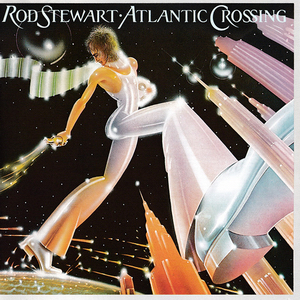
The thing most immediately noticeable when one looks at the inner sleeve of Atlantic Crossing is the huge, dark, blank space. At the foot, in some kind of Art Deco typography, are listed the credits; a long, impersonal list which doesn’t even bother to tell you who plays on what (a situation, I regret to report, not rectified by 2009’s 2CD deluxe reissue). There is, provocatively, no matiness whatsoever; no photos of Rod goofing around with the musicians, no self-deprecating, self-penned sleevenote…and certainly none of the musicians who had contributed to his British records. Make no mistake; Atlantic Crossing stands, or was made to stand, for a complete break with the past, the putting away of childish things and the assumption of a new seriousness.

This was understandable in the circumstances – Stewart’s solo contract with Mercury had expired and he was now fully signed to Warner Brothers; he had fallen in love with Britt Ekland; he didn’t fancy having to pay 83 per cent top rate income tax, so decamped from London to Los Angeles – but this did not stop, indeed may even have encouraged, some of the worst and most damning reviews of a rock album I can remember. Their gist was the same: Our Rod has sold out, he has ditched the Faces for anonymous, shiny sessionmen, he is a traitor to his own art, he has stopped being Our Rod and turned himself into Rod Stewart plc, an international brand for anonymous hotel lobbies and airport lounges the world over. He has become a decadent.

The facts, as usual, lie somewhere in between, and since it is not the job of this blog to recycle received wisdom but to assess fairly what is in front of it, the facts here may prove helpful. When Stewart left for the States and commenced preparatory work on his new album, he did not intend to abandon the Faces, indeed was contractually bound to do one more tour with them. But Stewart and producer Tom Dowd listened attentively to them in LA, at work in the studio, for an hour before regretfully agreeing that they could not provide a suitable backdrop to the kind of music he wanted to make. Moreover, Stewart did ask his old songwriting foil Martin Quittenton to make the journey with him and help write some of the new songs, but since this would have entailed being on the road with the Faces, the mild-mannered Quittenton settled for a quiet life.

Not unnaturally, this long-standing fan of Stax and Atlantic wanted to avail himself of the best musicians he could find. He met up with the MGs (if not Booker T) and got on well enough with them, although none of their initial collaborations made it to the final cut (they appear on the second CD of the 2009 reissue, including a scorching reading of the Bee Gees’ “To Love Somebody”) and there is no track where all the MGs appear together. Hence the sessions with Muscle Shoals’ finest, at the Hi studios in Memphis, and also in New York, LA and Miami, all with first division American session musicians (drummer Nigel Olsson, on loan from Elton John’s band, is the only other Brit to appear). The notion was not to make the album a series of soundalike tracks, but the central problem here had nothing to do with geographical disparities.

On the advice of his then manager Billy Gaff, Stewart divided Atlantic Crossing into two halves, a “Fast Side” and a “Slow Side,” and it is on the “Fast Side” that the album’s shortcomings become apparent. The symbolism of the cover was clear; Stewart has one platformed foot placed in the New World, but he is looking backwards at the Old Country, and more significantly has one foot still on British ground. True, he couldn’t have stayed with a formula which had outstayed its welcome; Smiler really had been the last hurrah for that method of working, and although it sold well enough to get to number one in the UK (and therefore into this tale), it only stayed on the album chart for twenty weeks, compared to the eighty-one weeks racked up by Every Picture Tells A Story.

But when “Three Time Loser” gets into its stride, you can’t help wondering whether Rod wants to have his cake and eat it. Yet another Jack-the-lad (or Rod-the-Mod) shaggy dog story (this time about venereal disease), it doesn’t take long for the casual listener to notice the disparities; the musical backing is a little too clean, the backing singers too efficient, the tenor sax soloist too smooth, and, above all, Rod, a little too desperate to impress with his whoops, trying his damnedest to convince us that he’s still the same old pub-rocking Rod Stewart despite his full knowledge that the goalposts have been moved. The problem is actually quite simple; he is obviously trying to find his feet in a new environment, and although the musicians are evidently more than keen to help him along with this material, he and they are not quite speaking the same language, and so there is a problem with aesthetic incompatibility.

The problem continues to manifest itself in “Alright For An Hour,” another would-be lad’s rave-up which guitarist and co-writer Jesse Ed Davis seems more determined to turn into pop reggae (although Davis’ unfailingly inventive guitar playing is a real benefit here, as is the bass playing, whoever is playing it). With “All In The Name Of Rock ‘N’ Roll,” Stewart makes his first lunge towards an all-out rocker, complete with police siren and horn section, but despite many inventive touches – for example, a drum intro which squarely predicates the Undertones’ “Teenage Kicks” followed by a minimalist John Cale top register one-note piano riff – he doesn’t quite pull it off, and here another problem becomes extremely noticeable; Stewart’s voice is too far back in the mix. He doesn’t impose himself upon a song like he used to be able to do. Hence, although the band works up a reasonable head of steam, and the central guitar riff is good and compelling, the track simply drags on for too long and has no choice but to come to a fairly abrupt halt, like a train having run out of fuel. Nor does Stewart’s cover of “Drift Away” help solve matters (this is not exactly a “fast” track); Dobie Gray’s original was almost by definition a record of the Watergate period, a reflection by a survivor on what had brought him to this state of resigned acceptance in the first place. Fatally, Stewart substitutes the “free” in the chorus of “Give me the beat, boys, to free my soul” for a second “soothe” and it just doesn’t carry emotional weight; the same can be said of Steve Cropper’s pointillistic and frankly over-fussy guitar lines – again, he seems to want to turn the track into reggae, and the overmiked wah-wahs on the choruses are uncalled for.

The side’s closer, “Stone Cold Sober,” a Stewart/Cropper collaboration, is also, however, the side’s saviour; if the “Fast Side” is a chronicle of two supposedly incompatible musical camps struggling to learn each other’s language, then “Stone Cold Sober” is the result of their finding a common ground. At last, voice and band seem to breathe in and out of each other, rather than being flashily superimposed; for the only time on this side, we get a picture of musicians pounding away in a studio. Furthermore, it is the latest entry in the “Out-Stone The Stones” contest – Ronnie Wood in particular must have heard this and growled his fury – and by some distance the record’s best rocker. Here everything – rhythm, horns, voices – blends together with a great naturalism, and it is from this point that the likes of Primal Scream derived their inspiration. The track fully merits the enthusiastic studio applause which ends it. Rapprochement has been reached.

Then, on the “Slow Side,” Stewart is given the pace and air for his interpretive voice to breathe and flourish – something which certainly wasn’t the case with the ballads on Smiler. His famous cover of Danny Whitton’s “I Don’t Want To Talk About It” brought out a sensitivity and compassion in his performance which had for some time been absent from his work. The 1971 Crazy Horse original falls apart while it is in the process of being performed; if I had not known better, I would have taken it for one of those Lou Barlow lo-fi Sebadoh tryouts on the early Dinosaur Jr albums. But here, Stewart is not rushed by the guitars or bass, or by Arif Mardin’s strings; they all appear to be in conversation with him, or at any rate listening to him. And Mardin’s final key change and huge question mark of an ending are touches of genius.

“It’s Not The Spotlight,” co-written by Gerry Goffin, is also a fine track, helped greatly by David Lindley’s excellent mandolin playing and some awe-inspiring bass work; my guess is Lee Sklar, but my apologies go to Donald “Duck” Dunn, Bob Glaud and David Hood, the other bassists listed in the credits, if one of them was responsible. More important than any of that, however, is Stewart’s magisterially reflective performance; this is an exhausted but happy love song for adults, performed by and for people who have lived through the unimaginable, and opened up an area hitherto largely ignored by rock; what happens when the rockers start to age?

Stewart’s slowed-down Al Green-style reading of the old Isley Brothers hit “This Old Heart Of Mine” – recorded in Hi studios with Green’s musicians, including the unmistakable (and, sadly, soon to be late) Al Jackson on drums – is also a nicely inventive touch, and well executed, the singer coaxing the song’s subtext of insatiable craving out into the open. But the key track here is “Still Love You,” the only song on this side bearing Stewart’s input as a composer. It comes across as a sort of “Maggie May: The Morning After” and has many recognisable elements, including the mandolin, celeste, organ and solo violin. But the “drugstore” reference places the song firmly in Stewart’s new home, and the music isn’t quite the same as it was in 1971 or 1972 (the despairing “Here I am again, writing this letter” is a direct reference to “You Wear It Well”) – once more it is a case of unfamiliar musicians slowly learning and assimilating the singer’s language, and once you get past that barrier, the performance, by singer and band alike, is deeply convincing. The drumming in particular is intelligently placed – if not Olsson or Jackson, it could have been Willie Correa, or Roger Hawkins – and in crucial sections, e.g. the “Two hearts gently pounding as that morning train…” sequence, the whole band appear to pause for breath and crouch down beside Stewart. Thus he is able to sing the “All I’m trying to say in this awful way” refrain with truthfulness, and the “I….I still love you” payoff, though probably rhetorical, and marred by inapt voice-echo, is suitably chilling. I also admire Stewart’s ingenuity as he signs off with a direct Isley Brothers paraphrase: “Guess I’ll always love you…”

All that remains is the venerated “Sailing.” The Sutherland Brothers Band’s 1972 original was not unknown to American audiences – here it flopped, though was included on K-Tel’s 22 Dynamic Hits Volume 2 - and perhaps as a result Stewart’s version didn’t do particularly well in the States as a single (although one has to correct the underselling of Atlantic Crossing’s success in the 2009 sleevenote; the album still made #9 on the Billboard chart and was certified gold). Elsewhere, however, and particularly in Britain, the single of “Sailing” went through the roof and was instrumental in introducing Stewart to a larger audience who wouldn’t necessarily have bothered with, or even heard of, Never A Dull Moment or Ooh La La - and it was certainly crucial in making Atlantic Crossing, for which the song stood as both finale and symbol, the staggering success it was here; reissues included, it stayed on our charts for a total of eighty-nine weeks.

How does Stewart’s “Sailing” stand up, however? Lena ventured the opinion that the song was a sort of compromise between Randy Newman’s “Sail Away” and Steam’s “Na Na Hey Hey Kiss Him Goodbye.” Myself, I note the involvement of Steve Cropper and the general theme of water and would label it the obverse of “Dock Of The Bay” – this is no aimless roam; Stewart sounds vulnerable at times but knows exactly where he is going and how to get there. He sounds regretful – as only he could – because he knows he’s leaving an entire life, a whole history, behind him. But, as with so many “classic” rock singles, “Sailing” makes far more sense in its original context; Mardin’s strings swell up as Stewart pulls away into the sunset, towards the darkness – the singer is saying his true farewell to “us” so long as he can remember who “we” are supposed to be. So the blank, dark space represents the unknown, and Atlantic Crossing, though fitful in finding its goals, deserves more than the history which it possibly gave to itself, as ready-made as the modest pun latent in its title.

Saturday, 18 February 2012

The CARPENTERS: Horizon


(#157: 5 July 1975, 2 weeks; 26 July 1975, 3 weeks)

Track listing: Aurora/Only Yesterday/Desperado/Please Mr Postman/I Can Dream Can’t I/Solitaire/Happy/(I’m Caught Between) Goodbye And I Love You/Love Me For What I Am/Eventide

“Some of them smile and it’s phony
Some of them smile and it’s okay
Some of them never tell you
Just how much love they’ll give away”
(American Music Club, “Last Harbor,” 1988)

“As we eye
The blue horizon’s bend
Earth and sky
Appear to meet and end
But it’s merely an illusion
Like your heart and mine
There is no sweet conclusion”
(Irving Kahal and Sammy Fain, “I Can Dream Can’t I,” 1937)

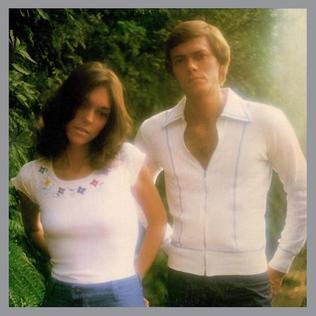
Neither of them appear especially happy on the deliberately over-exposed cover photo – Karen is doing her best to pretend the camera isn’t there - and despite the presence of a song entitled “Happy,” this is far from a happy record. In contrast to the Bay City Rollers, and the chirpy songs Paul McCartney wrote for his kids, this is also not an album for the young; “Please Mr Postman” was already fourteen years old, and it had been a quarter of a century since the Andrews Sisters had been at number one on Billboard with “I Can Dream Can’t I.”

One could therefore superficially dismiss Horizon as yet another symptom of the increasing shift in the albums market towards an older, more conservative demographic. But even if the Carpenters had made the record for no other reason than it was time to make a new album, there is something else going on here that the above does not quite explain. Put together as a concept album, mimicking the progress of a day from dawn to dusk (“Aurora” and “Eventide” are different versions of the same tune), there are songs about gambling (“Desperado,” “Solitaire,” “Happy”) but mostly songs about waiting for something - anything - to happen; waiting for the postman to deliver a letter, or dithering over whether to leave or stay with her lover, the ageing cowboy waiting for a miracle to come, the lonely man pretending no miracle will ever come.

With “Aurora” a new day dawns, and the echoes of sadness die away, or are hoped to die away (for this album never escapes the cloud of sadness which casts a huge, enveloping pall); “Only Yesterday” with its white bread Spectorisms (including surprisingly forceful drumming from Jim Gordon) tries its best to pretend it’s liberated (the opening line goes “After long enough of being alone” – already she is trying too hard), it never quite convinces; nor does the very similarly orchestrated Marvelettes cover, with Karen on drums and good solos from Bob Messenger’s tenor and Tony Peluso’s guitar. Both of these can be traced back to the oldies medley on Now And Then bookended by “Yesterday Once More” and share the foreknowledge that the past can never be reattained – on both, castanets rattle like buried snakes, and bells toll. “Desperado” doesn’t approach the barren poignancy of the Langley Schools Music Project reading and makes no more sense of the song’s confused poker analogy, but in the “hunger” of “Your pain and your hunger,” Karen’s voice cracks for the first time.

It cracks several more times throughout the epic reading of “I Can Dream Can’t I,” the record’s deliberate centrepiece; for instance, the “belong” of “You’ll never belong to me,” the “disillusion” of “There’s much disillusion there,” the penultimate “dream,” the second “sad affair” of “My heart is a sad affair.” Above all, Karen seizes and sits on the “conclusion” of the song’s prelude quoted at the top of this piece, and that prelude seems to me the cynosure of the record, the point where fantasy and reality meet to create a horizon. Billy May, then in his late fifties, was prevailed upon to provide an arrangement (here co-credited with Richard), and treats it as he would any Sinatra ballad; quiet rhythm rising to meet strings, a Dorsey-echoing trombone chorale, a wandering Pete Jolly piano solo, and a strings/harp coda to end. If only Richard had resisted the temptation to harmonise with Karen in the song’s closing ninety seconds – presumably intending an Andrews Sisters pastiche – this would have stood as one of Karen’s great solo performances; as it stands, it is one of the great Carpenters records, and also one of the most unnerving.

Side two commences with “Solitaire,” a song Karen didn’t particularly like, and despite its good moments – Joe Osborn’s initially inventive bass, Gordon’s increasingly rhetorical drumming, a particularly emotional and committed second verse vocal – it doesn’t quite work; the string arrangement is too slushy, and as a performance the song compares unfavourably with (in Britain at least) Andy Williams’ more famous reading (a top five hit here in early ’74) due to different verse lyrics but mostly to Karen’s obligation to sing the song in the third person (“And keeping to himself/He plays the game”), which necessarily places some emotional distance, as opposed to Williams’ first person delivery (his version works because he is able to convey his inner pain; you never doubt that he is singing about, and to, himself). Meanwhile, “Happy” isn’t a bad song per se but the listener remains unconvinced about any happiness, a feeling not dispelled by the strange Moog solo and the even stranger one hand clapping to fade.

By now the light of the afternoon is beginning to usher in the uncertainty of twilight, and the already dark mood grows even darker. John Bettis considers “(I’m Caught Between) Goodbye And I Love You” his best collaboration with Richard, but despite the moderately inventive, steel guitar-dominant arrangement and a fine vocal by Karen (including a very bleakly delivered second verse: “Then I may have to let you go/If only to survive”), the song suffers from a weak chorus and generally underpowered playing.

The song, however, does set the stage for the remarkable “Love Me For What I Am.” Ostensibly a variant on the old “You’ve Lost That Lovin’ Feelin’” template (“You’re always finding something/Is wrong in what I do”), albeit with the occasional phased guitar solo, the chorus sees Karen staring straight through the fourth wall, at her brother, at her record company – at her audience, especially – and so is worth quoting in full:

“You’ve got to love me for what I am/For simply being me/Don’t love me for what you intend or hope that I will be/And if you’re only using me to feed your fantasy/You’re really not in love/So let me go – I must be free.”

This is strong stuff, and although Bowie or Patti Smith could\have come up with these words, I doubt whether they could have poured as much conviction into their performance as Karen does; she is tearing down the cosy middle-of-the-road façade, demanding to be taken seriously – yet still caring enough to deliver that final, tender, pleading “free.” Walking a bridge between the Carly Simon of “That’s The Way I’ve Always Heard It Should Be” and the Aimee Mann of I’m With Stupid, this is one of the key feminist songs of its decade, and a palpable declaration of principles.

And so the day ends, with the ghostly chord changes of “Eventide”; whereas in the morning she walks down an alleyway, she returns walking up an avenue. And yet this is hardly catharsis: “Lying under barren skies,” “Weary to be home again”; these are not the warm words of a returned spirit, and somewhere, out beyond the realm of the palpable:

“Candles burning by the sea/Are waiting for me/Patiently/I wish the same/For you.”

She is aware of the existence of eternity and does not fully turn her back on it. If Horizon is one of the bleakest albums I have covered in some time, it is also one of the most satisfying of albums; it yearns to escape the known Carpenters straitjacket, and as a discrete whole makes perfect architectural and emotional sense. In the USA it proved too much to take, becoming their first album to miss the Top 10 after five straight hits, but here it stayed on the chart for fully six months, and in its combination of emotional limbo and subtle experimentation, perhaps a quote from another, not dissimilar, 1975 album might be in order:

“I’ve been down the road and I’ve come back
Lonesome whistle on the railroad track
Ain’t got nothing on those feelings that I had”
(Neil Young, “Mellow My Mind,” 1975)

Saturday, 11 February 2012

WINGS: Venus And Mars


(#156: 28 June 1975, 1 week; 19 July 1975, 1 week)

Track listing: Venus And Mars/Rock Show/Love In Song/You Gave Me The Answer/Magneto And Titanium Man/Letting Go/Venus And Mars – Reprise/Spirits Of Ancient Egypt/Medicine Jar/Call Me Back Again/Listen To What The Man Said/Treat Her Gently – Lonely Old People/Crossroads

“I mean, if this goes on like we’re saying it’s going on, it looks like that might be kind of the thing, y’know…”
(Paul McCartney interviewed by Charles Shaar Murray, NME, 26 July 1975)

“Rock on lovers everywhere, because that’s basically it”
(Wings, conclusion to sleevenote, Venus And Mars)

It occurred to me that Paul McCartney is the Jamie Oliver of pop, and not just because Jamie was born in May 1975, into (or about to go into) the world of Venus And Mars; both practise very hard at being chipper, can-do-anything chappies, irrepressible, imperturbable, Everymen loved by infant and grandmother alike, and it may be because that’s what they’re really like; conditioned not to be bowled over by anything life might throw at them. I doubt whether McCartney would have been particularly perturbed by the prospect of being interviewed by CSM, whose piece makes it plain what he thinks of Venus And Mars, namely, “not only one of the worst albums I’ve ever heard from a so-called ‘major artist’, but…also the most decadent.” McCartney, of course, sees him coming a mile off and puts up his steel ring of Fab Wacky Macca Thumbs Aloft, with plenty of non-committal “really”s and “y’know”s (and constant interruptions of whatever Linda might have to say) to conceal the fact that he doesn’t have very much to say about the record, or indeed about anything (the Common Market, taxation, politics – all disappear into a vacuum of “y’know”s), much to the chagrin of CSM, who is desperately trying to think of a diplomatic way of saying “Your album is so godawful I wouldn’t use it to line a budgie cage even if I had a budgie.”

Maybe Macca just wanted to lie back and have a good time. The album was recorded in New Orleans, a relative comfort following the toughness of Lagos, but where Band On The Run worked against the toughness and loneliness – the artist forced back onto his own resources - Venus And Mars frequently sounds too comfortable (i.e. drunk and/or doped), as though McCartney no longer has to try. And, in truth, he didn’t; if he wanted to make an album for his kids full of thirties pastiches and whimsical Marvel Comics homages, then didn’t (as he saw it) he have the right?

If this had been anybody in 1975 then I doubt a single word would have been expended on the record. But this was McCartney, from whom one expected a certain quality threshold – still, how do I define that “one” in the face of the ten million people who bought and loved the record? For them, McCartney still existing was enough, and from the American point of view I’m sure songs like “Rock Show” and “Magneto” sounded ideal on a sunny morning, cruising past the Wells Fargo Bank and the Biltmore Hotel.

But where Band On The Run benefited from its surrounding tension, such that every track sounds like a single, virtually nothing on Venus And Mars is still played today with the exception of “Listen To What The Man Said.” In addition, the argument for this being the first “Wings album” – i.e. the first one conceived and recorded as an integrated band – is rather undermined by the sleeve photos, which only show the members as distant figures. Paul and Linda can be seen grooving away at a Mardi Gras-type parade in New Orleans, but an attendee’s left shoulder blocks out Denny Laine. Nor was the record the work of an integrated band; drummer Geoff Britton left after completing only three tracks – he didn’t get on with Jimmy McCulloch – and his replacement Joe English was hurriedly hired and coached. Still, the McCartneys did their best; although Linda never gets to sing a Wings track, “Spirits Of Ancient Egypt” was largely given over to Laine to sing, while McCulloch both co-wrote (with one Colin Allen) and sang “Medicine Jar.”

This timid democracy, however, helped ensure the flimsiness and inconsistency of Venus And Mars. I don’t agree that McCartney simply slacked his way through the record; some care was obviously taken with the sequencing and segueing, and it is clear from the title track reprise, at least, that some concept took root in his mind. The trouble is that the good and clear moments are so distantly spaced as to be rendered meaningless, and the gaps are filled by largely irredeemable tosh.

The title track, for instance, is pretty and heartfelt enough, despite McCartney’s sometimes arch diction (“sports a-re-NAH”), and its bridge somewhat more than that (it later returns with more echo on McCartney’s voice, various Moog noises and an impressive, improvised choral line which put me in mind of Granddaddy’s The Sophtware Slump as well as the wheaty spirit of 1975 which the likes of Advisory Circle and Goldfrapp try so hard to recapture). But no further are our minds engaged than we are shoved into the limp “Rock Show.” Despite Allen Toussaint’s piano (taking “Lady Madonna” back to its rightful home at fadeout) and the song’s occasional moments of invention (e.g. the tuned clock chimes in the extended middle eight), the song is misguided in both conception and execution (it sounds like a half-hearted Kiss having a go at Elton’s “Love Lies Bleeding”) with its jibes at Jimmy Page and glam rock (the latter set against, I ask you, cod-reggae and spoken in McCartney’s comedy “posh” voice, crowned with deranged howls of “KIT-TAY!”) and stupid lyrics (“It’s Silly Willy with the Philly Band” – might I suggest that the line “The tension mounts, you score an ounce” contains more than its allotted modicum of truth?) making the 33-year-old Paul suddenly sound very old and reactionary indeed (having a go at glam in 1975?). It seems nothing more than an attempt to crowbar famous venues into one song, and the music hardly suggests a brighter tomorrow.

“Love In Song,” in contrast, is one of the simplest and most moving songs Paul ever wrote, a straightforward and clearly heartfelt dedication to Linda, delicately outlined by harpsichord and modest Moog with its refrain of “Happiness in the homeland,” together with subtle strings and McCartney’s most committed vocal performance on the record; hear how his voice falters at the end of the line “My eye cries out a te-ee-ear.” This song is so good I can imagine the Stylistics doing it justice.

When McCartney drops the pose and tells his truth, his music works; but “Love In Song” is quickly succeeded by the ridiculous “You Gave Me The Answer,” the latest of McCartney’s interminable line of straw boater/megaphone vaudeville period pieces, and by some distance the least convincing, not just because of the opening piano improvisation on “Maybe I’m Amazed,” but because as a pastiche the song sounds uncomfortable, ill-fitting; the melodic progression and McCartney’s at times over-passionate vocal both threaten derailment. “Magneto And Titanium Man” still carries a bit of thirties sauce about its seventies AoR strut – there’s a bit of Billy Swan’s “I Can Help” and quite a helping of Steely Dan’s “Reelin’ In The Years” – with some incongruous blasts of McCulloch guitar. McCulloch does better with his solo on “Letting Go” which again betrays McCartney’s familiarity with mid-seventies American FM radio (think Linda Ronstadt’s “You’re No Good” with extra horns and Moog). The latter song, another ode to Linda which might properly be retitled “If You Love Somebody, Set Them Free,” sees McCartney’s voice working back towards commitment without ever touching it; he drops out before any primal scream catharsis can be attained.

“Spirits Of Ancient Egypt” is just plain weird, and not in a good way (the track has, according to McCartney, “a couple of T. Rex touches” – what the hell was he thinking, or on?), coming across as an ungainly halfway house between Gene Vincent (Laine’s brave but desolate “You’re my baby”s, but then he has to cope with driving a Cadillac across the Irish Sea) and Midge Ure’s Ultravox (when Paul and Linda come back for the chorus and synths take centre stage). McCulloch’s “Medicine Jar,” meanwhile, sounds as a generic a 1975 rock track as one could find; it could literally be anyone or anything, and only McCulloch’s vague vocal resemblance to Ringo suggests why this was given the time of day anywhere, let alone points from a multimillion seller. This notion of “democracy” certainly doesn’t help with the record’s flow.

Nor does the tortuous “Call Me Back Again,” a forlorn, and unending, attempt to recapture the spirit of “Oh Darling.” McCartney admittedly doesn’t help matters with his vocal, which begins painfully out of tune, and despite some subsequent improvement his performance is quite overcooked, descending easily into pseudo-Plantisms (“When I-hi-hi-hi-hi-hi was a just a little baby boy”; look, McCartney, when you were a little baby boy you didn’t HAVE a telephone). The track, like too many tracks here, drags on and on under the impression that it’s “Hey Jude,” which it most definitely isn’t.

A moronic introduction of counterfeit jive talk notwithstanding, “Listen To What The Man Said” shows how good Wings could be when McCartney dropped the Fab Wacky nonsense and concentrated on writing pop songs. Here he finds confluence with the seventies AoR stream, helped I suspect to a major extent by guest guitarist Dave Mason and guest soprano saxophonist Tom Scott – the flow is irresistible, the Moog bass non-gratuitous and the lyrics erring on the side of simplistic rather than foolish. The build-up to the climax – “The wonder of it all, baby” – is exciting, the group sounds committed, and the transition from lead guitar to ‘cello (and thereupon the full string section, and the slow section) is both unexpected and wholly natural (rivalled only by the similar section near the end of Paul Simon’s Lennon tribute “The Late, Great Johnny Ace”).

The trouble here, again, is that, having created a variety of possible directions with that final section, McCartney settles for the most mundane. The “Treat Her Gently/Lonely Old People” sequence strives to emphasise with the plight of the old, but has nothing of the acrid poignancy of Scott Walker’s “Two Ragged Soldiers” or the basic good humour of Bob Hope’s many versions of “Thanks For The Memory”; instead we have a sagging waltz with the only inspired arrangemental touch being the sudden, stinging surge of string synthesiser – like an injection of sodium pentathol – succeeding the second statement of the phrase “old people’s home.” Finally, the old people being represented (“Nobody asked us to play”) presumably wander off camera to the strain of Tony Hatch’s theme from Crossroads, heading back to their televisions to watch the surreal interplay of actors and camera booms, improbable plot turns, ripe overacting and unscheduled Pinterisms which that singular soap opera encapsulated. McCulloch plays the tune as though it were still “Something In The Air” and the day fades to a Macca mutter and a cover which suggests not so much Botticelli’s painting of Venus And Mars as a couple of snooker balls in space. Wings went on to score more number one albums in the States, but not here; songs like “Let ‘Em In,” “Silly Love Songs,” “Mull Of Kintyre” and “With A Little Luck” proved them to be one of the great singles acts of the decades who never managed to make a good album (Band On The Run being largely a solo McCartney effort). I’m sure McCartney still isn’t bothered by that, really.

Saturday, 4 February 2012

The BAY CITY ROLLERS: Once Upon A Star

https://upload.wikimedia.org/wikipedia/en/e/ec/Once_Upon_a_Star_%28Bay_City_Rollers_album_-_cover_art%29.jpg

(#155: 3 May 1975, 3 weeks)

Track listing: Bye Bye Baby/The Disco Kid/La Belle Jeane/When Will You Be Mine?/Angel Baby/Keep On Dancing/Once Upon A Star/Let’s Go/Marlina/My Teenage Heart/Rock And Roll Honeymoon/Hey! Beautiful Dreamer

Back so soon, boys? Actually I do derive more than a shred of comfort from the fact that, had Twitter been going in 1975, it would have been overrun, not by Beliebers, but by their spiritual ancestors, the Rollermaniacs; and, like Our Justin, the appeal of the Rollers at their peak was practically sexless, or ignorant/blissfully unaware of sex – their blanket was one of comfort and security, and we shouldn’t forget that their second number one album, much like their first, is aimed at twelve-year-old girls rather than Steely Dan fans.

Whether the Rollers listened to Pretzel Logic in their own time and agonised is another question, but what is clear from Once Upon A Star is that they had been riled, badly, by the print about session musicians on their hits, about being Martin and Coulter’s puppets, and were determined to prove that they themselves were the attraction. Thus Martin and Coulter were shown the door (whereupon they immediately turned their attention to, amongst others, a promising Glasgow band called Slik) and replaced by former Sweet and Alex Harvey producer Phil Wainman, who, with Johnny Goodison, came up with three of the album’s dozen tracks. Two others were covers, leaving seven tracks written by Eric Faulkner and Woody Wood (with Les McKeown helping out on two of these).

The results are inevitably mixed and present a picture of a band in a tug of war with itself. Of the Wainman/Goodison songs, “When Will You Be Mine?” is a lame rewrite of “When Will I Be Loved?” clumsily superimposed on the standard rolling piano Rollers template, “Let’s Go” is the Archies doing the Glitter Band, strangely bloodless, even with its “Saturday Night’s Alright For Fighting” guitar line and key change (though, as Lena pointed out, speed the song up a bit and make it more antisocial, and you have the Ramones), and “Rock And Roll Honeymoon,” belted out by an enthusiastic Alan Longmuir, is perfectly serviceable power pop, complete with “Here Comes The Bride” Roy Wood-ish sax interlude, which would be venerated had it been Eric Carmen and the Raspberries.

Of the two covers, “Bye Bye Baby” was the biggest hit they ever had, McKeown sounding strangely elated about being torn between two lovers while the Roller formula met its apogee (one has only to listen to the flaccid “My Teenage Heart” to appreciate how difficult this formula was to reproduce), while “Keep On Dancing” was a mechanical retread of the 1971 original, deprived of Jonathan King’s production tricks and Johnny Arthey’s arrangemental genius – wah-wah guitar replaces organ and the false ending is substituted by McKeown bellowing over the least convincing crowd noises I have ever heard on any record; is that a baby squealing towards the end?

Left to Faulkner and Wood’s devices, one can sense how brave the struggle was for the group to assert themselves; the question being whether they had enough resources as a group to carry out their ambitions. On this listen my answer must be no, although it’s hardly for want of trying; if nothing else you are witnessing the sound of a band trying their damnedest. One’s heart does not warm up with expectation, for instance, at the prospect of a song entitled “The Disco Kid,” which if you were a Roller is about the last title, or idea for a song, you’d use. And McKeown’s introductory grunts of “Check it out!” and “UUHHH!!” do not exactly raise hopes. That being said, it’s a fair attempt, the wah-wah and clavinet work turning it into a sort of Junior Showtime “Trampled Under Foot,” with an interesting use of echo (“He’ll shake you DOWN!”), if an ultimately unconvincing one (“They call him Disco Kid!” announces McKeown at one point; presumably he doesn’t mean the guitarist who three years later appeared on Sun Ra’s Lanquidity). Similarly, “Angel Baby” isn’t much more than an attempt not to be “Be My Baby,” but I can’t think of any twelve-year-old 1975 girl who wouldn’t have melted at McKeown’s Morningside talkover.

It’s when they stretch their limbs in other directions that the Rollers really begin to engage my interest. “La Belle Jeane” thinks it’s The Band’s “When I Paint My Masterpiece,” with its ample mandolin and accordion deposits and tricky Franglais, but it’s not a bad thing to think, and the track gets truly interesting when the band try to cut the dummy loose, with Derek Longmuir’s minimalist drumming and its sections of dissolute harmonies, the chord structure at times reminiscent of Roy Harper’s “When An Old Cricketer Leaves The Crease.” The closing “Hey! Beautiful Dreamer” is a Beatles pastiche – Harrison guitar, verse and chorus, Lennon piano and middle eight (“How can you feel nothing is real?”) – which nearly pulls it off, its disjointed ethereal harmonies resolving in an angelic harmonic ascent towards fade, as though the band are fading from our grasp forever.

But the Faulkner/Wood Rollers work best, unsurprisingly, when dealing with the subject of fame and stardom (yes, this is classic, slightly self-conscious second album syndrome). The title track has ambitions beyond its grasp, looking for harmonic adventure and arrangemental imagination (well, there are a couple of clarinets) although stylistically it rather resembles Carl Wayne’s New Faces theme “You’re A Star” with perhaps a dash of CSN’s “Our House.” Still, it’s a sad but generous reflection on the transience of fame, etc. (“Your friends all drinking champagne from your hands”). And “Marlina,” one of the two tracks co-written with McKeown, cuts the deepest (although the sleeve is at pains to point out that the names “Marlina” and “Jeane” are “purely fictitious”); about a young girl seeking fame (and escaping from her “silver stallion” fantasies, although the song already knows that she won’t), Faulkner goes for the full Rod Stewart violin/mandolin deal, but the song is sung a lot more generously; McKeown’s voice is at times not a million miles from that of Roddy Frame, and overall the song structure, with only slight alterations, is that of Teenage Fanclub’s “What You Do To Me.” Here, though, is the impression that the group actually cares about what they’re saying.

Indeed three of the last four tracks on Once Upon A Star would not have been out of place on, say, Grand Prix or Songs From Northern Britain; and perhaps it’s a truism that the Rollers’ real legacy lies in their intended, and unintended, subsequent influence on pop. It’s also probably true that the average 1975 Rollermaniac wasn’t too bothered about self-authorship and just wanted to luxuriate in the sound and spectacle of the Rollers being themselves. But, at least here, the Rollers don’t get another chance; Wouldn’t You Like It?, which followed just a few months later, is overall a stronger album but only peaked at #3, and 1976’s Dedication was a dignified swansong (not that it was intended as such) but by its time sorely out of place. By that time the fleeting Stateside success had already fizzled out, and the real story of a decent but trapped group – nervous breakdowns, attempted overdoses, personnel changes, internecine band fights, court battles over unpaid royalties, not to mention the extremely thorny question of Tam Paton, the Walton Hop, and all that – had begun to leak out. For now, however, here stand the Rollers, a group who probably would have had a much better chance on Creation Records in 1995, if not an equivalent Twitter overload.