Friday, 11 January 2013

Paul McCARTNEY: McCartney II


(#229: 31 May 1980, 2 weeks)

Track listing: Coming Up/Temporary Secretary/On The Way/Waterfalls/Nobody Knows/Front Parlour/Summer’s Day Song/Frozen Jap/Bogey Music/Darkroom/One Of These Days

“Do I contradict myself?
Very well then I contradict myself.
(I am large, I contain multitudes.)”
(Walt Whitman, “Song Of Myself”)

“Story is for human as water is for fish,” says Jonathan Gottschall in his book The Storytelling Animal, and while some might sigh at that and prefer to wait another few million years for humanity to evolve, it has to be confessed that we, as human beings, need stories; need both to hear and to tell them.

And it’s one of the greatest stories ever told, isn’t it; the tale of how something or somebody apparently doomed gets rescued and saved at the eleventh hour and how everything can start again. About a day and a half ago I felt that Then Play Long had, for various reasons, gone about as far as it could go. The initial feeling of relief that I felt was rapidly superseded by a deeper sense of bereavement. Everywhere I looked, or listened, everybody was telling me no: we need you to tell us more stories, and, much more importantly, carry on telling the bigger tale until it reaches its ending.

Well, the Official Charts Company appears to have relented over Bowie, and enough people seem to want me to keep this blog going, in whatever form. And so it resumes, some 36 hours after I said it probably wouldn’t.

“You want a better kind of future…/Stick around, we’re nearly there.”
(Paul McCartney, “Coming Up”)

Likewise, just when 1980’s procession of number one albums appeared to be degenerating into a dismal parade of TV-advertised tinkly-bonk shit (to borrow Christgau’s priceless expression), and as Ian Curtis’ suicide looked to have drawn a very firm and thick line in the post-punk sand, other things spring up to replace them; New Pop for one, and on the other, the actually rather moving return of the old stars, those who could find no room at the late seventies inn of easy listening marathons and distressed retrospectives; the people who have largely been absent from this tale since the mid-seventies who have now returned, but with the knowledge that the old games won’t necessarily work any more; whatever they do now, they know, has to be “modern.” In touch with the new decade.

How fitting, then, that leading the charge was a performer who had faced a similar dilemma at the turn of the sixties and seventies, who under various guises has been a part of this tale since 1963 (or entry #33). A decade earlier, McCartney had reacted to the coming new age by retreating to his home studio, knocking some demos and odd whimsies into shape and producing the pretty reasonable McCartney album.

By 1980, however, something had changed in McCartney, even from his Venus And Mars days. A reunion with Lennon had not taken place; he had been a semi-regular visitor to the Dakota around 1976, sometimes bringing his guitar, but nothing transpired and eventually an exasperated Lennon had to tell him that it wasn’t 1956 any more, that he couldn’t just come round whenever he felt like it and expect to pick up from wherever “it” had (been) dropped. After that, McCartney never saw him again.

But it also has to be stated that had McCartney not been busted for marijuana at Tokyo airport, McCartney II probably would never have seen the light of day in such a clear sense; he had been invited to Japan to undertake a Wings tour, but his nine days in jail changed his mind about a lot of things, and by the time he returned to Britain, he felt that Wings had probably gone to their limit (there were more band rehearsals in August of that year but nobody’s heart was in it and Wings eventually fell into disuse rather than splitting as such). Hence his retreat to some homemade titbits he had knocked up in late 1979, and their eventual release as the third “solo” McCartney album. If readers protest at Ram being counted then it should be remembered that Paul was not entirely alone on McCartney or McCartney II; Linda is clearly audible on both, contributing reassuring middleground harmonies.

Moreover, on this occasion McCartney did have the benefit of an engineer to help push these eleven pieces into shape. But from the moment “Coming Up” starts it’s clear that he meant it as a manifesto; sounding livelier and more passionate than he had done in years, he offers a classic gritty rock lead vocal to something that isn’t really rock; his bass nods to Bernard Edwards but the whole feels slightly unreal, as though the tape had been slightly speeded up. Its rhythmic tropes owe much more to what would become pop’s effective lingua franca in the eighties, in particular 1985-period Scritti Politti, and are agreeably set against what sounds like a thirties dance band on amphetamines.

The song itself deals with the future being so bright not to need shades; “Coming up like a FLOWER!” he exclaims excitedly. “You want some peace and understanding/So everybody can be free,” he sings, but unlike Lennon on the 45 version of “Revolution” he offers unconditional agreement: “I know that we can get together/We can make it, stick with me.” Paul; always the sixties optimist – although it should be noted that in the States, the single was flipped, and the version that reached number one on Billboard was the live reading, done with full band at the Glasgow Apollo on 17 December 1979; a gig which was crowned by the appearance of the Campbeltown Pipe Band themselves during “Mull Of Kintyre” (the venue, to put it very mildly, went apeshit).

Even this, however, does not prepare us for the still shocking “Temporary Secretary.” Why “shocking”? Not for McCartney’s amiable, if inexplicable, Confederate drawl of a lead vocal, but because the song is constantly undermined, or strengthened, by the familiar atonal burps of a Roland 303 – over half a decade ahead of schedule, here comes Acieed House, and suddenly even Boney M’s (or Frank Farian’s) idea of disco seems as remote and distant as William Byrd. It is exciting, stupid, reckless and glorious.

The rest of the record is largely thrown together with a spirit of intentional lassitude that could from some angles be interpreted as lo-fi; “On The Way” and “Nobody Knows” are both good McCartney rockers, but distorted to such a degree that they are barely recognisable as such, McCartney’s voice being smeared in nebulae of echo, such that the slow-ish jam of “On The Way” reflects an awkwardly glimpsed Led Zeppelin, whereas the sprightlier “Nobody Knows” puts me in mind of that other one-man band of the period, Prince (it could have fitted perfectly on Dirty Mind). No wonder Lennon, who certainly heard the album, was moved sufficiently by these tracks (and in particular “Coming Up” which Lennon reckoned was the first time in ages that McCartney had shown some genuine effort) to consider returning to the recording studio himself.

In between these two tracks lies “Waterfalls,” one of McCartney’s loveliest and scariest ballads, soundtracked for the most part by floating electric piano and distant high-pitched Moog. It sounds like Val Doonican on Mars, all the more because it is evidently so heartfelt; written for his children – hence the increasingly sinister warnings about running away with strangers as the song progresses and methodically slows down – with his “go away” croak longer and more hurt on every return.

The song is especially affecting because – well, because of “Because”; that instant boué felt when listening to the Moog creeping into Abbey Road and the consequent sense of premature bereavement; where could the Beatles have gone with this if they had managed to survive? Perhaps McCartney II provides a partial answer, and “Waterfalls” still sounds like Robert Wyatt and nothing much on Earth.

Side two goes off into such deliberate, delicate tangents that if Jon Brooks had released it on Ghostbox last week we’d all be singing its praises; “Front Parlour” is a proto-electro melange peppered with indecipherable vocoder murmurings. “Summer’s Day Song,” with its minimalist five-line lyric and long instrumental passages, slows down the poignancy of “Waterfalls” almost to the point of stasis; McCartney murmurs about awakening from a bad dream to find they have woken up on a brilliant day, and the slowly majestic drift of the piece immediately puts me in mind of the work of those fellow, but much younger, Liverpudlians, Orchestral Manoeuvres In The Dark – play “Stanlow” from Organisation or “Sealand” from Architecture And Morality and see if I’m wrong – and the feeling develops that this might be McCartney’s Low, a semi-directionless wander through his own mind and its perception of the world (thus the “I need love” refrains of “Waterfalls” make that song the record’s “Be My Wife”).

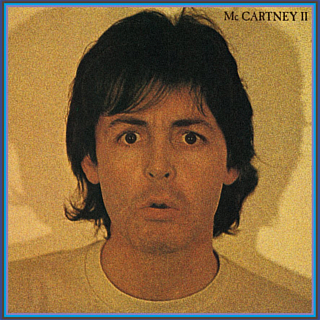
The feeling is strengthened with “Frozen Jap,” a New Romantic stomper (and the second instrumental on this side) paying very close attention to the work of the Yellow Magic Orchestra (the title, like much else about the album, including the startled mugshot-like cover and the various Oriental faces McCartney pulls on the inner sleeve, refers to his recent experiences in Tokyo). “Bogey Music” was written for a musical adaptation of Raymond Briggs’ Fungus The Bogeyman but still sounds two streets beyond strange, like Martians trying to understand rock ‘n’ roll (or Mud on very bad drugs). Throughout the song, the echo on McCartney’s voice deepens and becomes more disturbing. Likewise, “Darkroom” is McCartney’s idea of dub refracted through dreams of Gary Numan; it is frankly incredible that we are listening to a number one album.

The payoff, “One Of These Days,” has a simple acoustic guitar backing, with McCartney summing up the album’s themes, such as they have been, and offering his own, indistinct manifesto: “It’s there/It’s round/It’s to be found/By you, by me…/And breathe fresh air ever after.” As the song progresses his vocals become progressively more blurred by echo and Linda* until finally it is a smudged Xerox of a promise, a message sent out into the galaxy, still resonating, to anyone who cared or remembered what it meant. In this context I would like it to mean a new beginning, a way forward, a declaration of principles. What a story; and what stories still to come, including the next one, which is also illustrated by a picture of a man staring at the camera in some distress. When the darkness is turned inside out and made to illuminate the darkest of worlds.

*and wasn’t Linda VITAL to McCartney’s wellbeing, maybe even his intention to carry on pushing with his music? Sometimes it takes a loving American wife to show you the way you should be progressing…

Tuesday, 8 January 2013

BONEY M: The Magic of Boney M - 20 Golden Hits


(#228:  17 May 1980, 2 weeks)
Track listing: Rivers of Babylon/Daddy Cool/Sunny/Belfast/El Lute/No Woman No Cry/Rasputin/Painter Man/Ma Baker/Gotta Go Home/My Friend Jack/I See A Boat On The River/Brown Girl In The Ring/Mary’s Boy Child/Bahama Mama/I’m Born Again/Oceans Of Fantasy/Ribbons Of Blue/Still I’m Sad/Hooray Hooray, It’s a Holi-Holiday


“Vancouver! Vancouver!  This is it!” – David A. Johnston, May 18, 1980


There comes a time; there most certainly comes a time.  Observers knew something was going to happen, how big it was going to be was up to speculation.  When it happened, it was the biggest explosion ever. 

All spring the tension has been building here, in the album charts of 1980 and it is at this moment that tension is at its highest.  The faces on the cover are full of a kind of defiant knowing, a sort of blasé sense of having done everything they’ve been asked to do.  They peer through the large cut-out M within a shiny gold cover as if to defy anything or anyone to stop them.  They seem oblivious to the tension that has been building; or perhaps they sense it and don’t care, either way.  We entertain, they seem to say, and here in these 20 songs we are going to entertain you and you’ll like it.  The man seems to have a look of vague fear about him though; as if he can sense what the others can’t, that their days of huge singles and hit albums is about to end, in the UK at least.

Part of their defiance can be traced back to the fact they aren’t actually the band, as such.  Boney M is Frank Farian’s creation and his enterprise; they are singing with him, in the majority of these songs, not vice versa.  Performance shy, he retreated to the studio and gathered musicians and performers together to make Boney M something of a weird monstrous thing far more than an actual band*.  Under the cover of disco – a genre where performers and producers sometimes collaborated and sometimes didn’t – they had their second hit, “Sunny” – yes, that Bobby Hebb standard of thankfulness and redemption – and turned it into a European après-ski lounge party song, something harking back to 1969 and the thick veneer of sophistication and placelessness that makes the lyrics of the song seem so…incongruous.  Farian, though, clearly loves incongruity as that is what he, and hence Boney M, return to time and again.  

I have seen various words being used to describe Boney M – camp, kitsch, empty.  Those are fine words as far as they go, but as apt as they are, they somehow don’t seem right. In the face of what is to come, Boney M are more antiquated than anything else; “My Friend Jack” and “Painter Man” hark again back to the 60s and Freakbeat, to action and vivacity and a throwing away of niceness and conceits.  The Creation’s “How Does It Feel To Feel” is loud and questioning and sensational; Boney M answer, we are here to make you happy, our feelings do not matter.  And so in listening I feel nothing but a kind of puzzlement – who could like any of this?  Even if it’s pure showbiz, especially since the man (Bobby Farrell) doesn’t even sing on any of the recordings, well, are feelings required or necessary? 

I don’t mean to make a special case here; but from what I can tell Boney M’s lack of success in the US was due to that very emptiness and odd kind-of-but-not-really sophistication that in the hypermodern new-singles-every-week New York-to-LA may have seemed novel for the moment but then had to make way for everyone from the elegant and transporting Chic to the wonderfully over-the-top Village People to the awe-inspiring work of Giorgio Moroder and Donna Summer, not to mention fellow Germans Kraftwerk.  Boney M hit the disco market just as it was about to produce some of the best music of the decade, and once Saturday Night Fever hit, Boney M were all but forgotten in the US; their fame lay elsewhere, and so I never heard them at the time.  (“Rivers of Babylon” was something of a hit in the summer of ’78, but I don’t really remember it as Grease was the new craze of the moment.)

Thus I have no nostalgia for this music or band whatsoever, which I think tends to soften any opinions of them now; if a bunch of West Indians led by a German wanted to do songs about criminals (“Ma Baker” “Rasputin” – both of which I’ll get to at Music Sounds Better With Two - well then why not?  Especially when the lyrics are…well…strained:  Rasputin was loved by the “Moscow chicks” and he was “a cat who was really gone” and was “Russia’s greatest love machine”; Ma Baker “knew how to die.”  (“It was their last foray” when she died, of course.)  Both of these songs look backwards to another time, just as the Freakbeat songs harken back to Farian’s youth; there is a kind of gloopy quality here that I can’t define, but it makes me squirmy, even if I think of these songs as celebrations of anti-heroes. 

“Rivers of Babylon” and “Brown Girl In The Ring” strike me as songs from the Club Med for Newly Unindentured Employees, with all that implies.  There is a joy here – particularly in the latter song, but I can’t help but think that it’s a measured, rationed, limited happiness, even if lead singer Liz Mitchell seems to be actually engaged in the song, and not merely singing it.  The very neatness and tidiness of these songs makes them far more suitable for kids than adults but everyone bought them.  The first is an anti-slavery song, still done best I feel by The Melodians, and the latter is a traditional playground song about courting that Farian bought the rights to (it’s credited to him but he certainly didn’t write it – arranged it, more likely).  “Rivers of Babylon” has a kind of pathos of the exile to it, a kind of we’re-West-Indians-in-Germany-homesickness that makes me wonder if the band themselves suggested they do these songs, as opposed to Frank Farian telling them what to sing; I would get a bit itchy if I was told that I had to sing “When the wicked carried us away in captivity/Required from us a song/Now how shall we sing the lord’s song in a strange land” in a way that is hard to place but is nevertheless there.  With The Melodians, you know they know what they are singing about;  but in disco (not that this is a very danceable song) it becomes a nice sing-a-long that just happens to be about slavery, and about being asked to sing, and worrying about whether the words will “be acceptable” to more than one master.  It is a complex song to say the least, with all kinds of implications, and that it was such a huge hit in the UK probably says a lot, including how even slavery could be looked back upon as something from the past that could be put through the Boney M system and be…a hit. 

For those of you who think I may be taking all this a bit too seriously, well, I can’t back away from such an important song and say it’s just music to dance and get drunk to; that is done by Boney M far better in “Gotta Go Home” or “Daddy Cool” – both actual disco songs, neither of which has much meaning and are actually the better for that.  (“Gotta Go Home” is the basis for Duck Sauce’s immortal “Barbra Streisand” sans steel drums.)   “Daddy Cool” has Farian’s vaguely creepy voice interjecting as the band sing of their subject, and it’s barely a song, more a jam, something to exercise to in the morning – a blast of energy while your attentions are elsewhere, or maybe nowhere. 

When it comes to actual reggae, their version of “No Woman No Cry” is…uh, well as my father would say, it doesn’t swing.  In fact, that pretty much hits the head of why Boney M didn’t make it in the US – Americans like songs that swing, and Boney M don’t.  Putting in House-anticipating piano tinkles modernizes it somewhat, but again it comes off as something less than the original, not even that amusing or puzzling.  It’s just there, as are “Mary’s Boy Child” (also a huge hit in the UK, though I have noticed that it has fallen in popularity and in this past Christmas season I didn’t hear it anywhere, nor did it re-enter the chart as so many Christmas standards do) and “El Lute.”  Both are about heroes this time, not villains, but there is a dispassion here that reaches ABBA-making –Voulez-Vous levels of iciness.  “El Lute” is supposed to be a song about a Robin Hood-style escaped criminal but there’s no drama and it may as well be about a wandering minstrel who got lost; “Mary’s Boy Child” is done in a way that flattens the arrival of Jesus and makes it about as exciting as remembering to set the alarm or wind the clock.  “I See A Boat On The River” sets a new bar on a song not making any sense (“this song is shit” as Marcello said succinctly) and “I’m Born Again” is a “Mull of Kintyre” for those who wanted Boney M to branch into country music, complete with a guitar solo and fervent Moral Majority lyrics.  "Belfast" seems to think that city is a country and I honestly can't figure out what the point here is - surely not to make light of The Troubles, but to, um, make them danceable somehow?  (I will eventually get to an album with a much better song about Belfast at the end of this decade; for now let us ponder what, if anything, the citizens of Belfast thought of this song.) 

Which is to say, there really isn’t a lot of joy on this album; “Bahama Mama” is about a woman who mysteriously “has the biggest house in town” and lots of “honeycake” but can’t get no satisfaction;  “Still I’m Sad” (originally written and performed by The Yardbirds) is about a bottomless sorrow that sounds like an imminent psychotic breakdown and Boney M play it about as straight as possible**, but you wonder, where is the fun?  “Ribbons of Blue” is a country ballad complete with steel pedal guitar, but it’s not fun either – what, “Oceans of Fantasy”?  That is not fun, that is truly disturbing, especially once you realize it’s Frank Farian doing all the singing, including the falsetto – there in his underwater world of otherness, he is alone, in this fantastical place that perhaps only he really inhabits.  It is as inward-looking a song as any sensitive singer-songwriter could do, once you know it is him, that he is in his own ocean.  After all this, “Hooray Hooray It’s a Holi-holiday” is something of a relief, if only because Boney M are back at the playground, back to mischief and a sense, even if it is a little laboured, of fun.

The overall effect of this album was that it went on for too long (I wonder how many who bought it listened to it obediently and how many skipped the slow songs for the fast ones) and that Farian’s voice – always there in the background, if not the foreground – grated on my nerves and started to creep me out.  (Dieter Mier of Yello – who gained popularity in the UK just as Boney M’s disappeared – doesn’t bother me half as much, but that because the music is better and funnier.)  It got to be like looking at someone else’s interminable slide show of their vacation; meaningful for them (the UK public) but distant for me, me back in the US anticipating the explosion, the eruption.  It is manufactured nostalgia, a kind of production that maybe only could have happened at this time, when the best of disco could connect you to the past meaningfully (I Remember Yesterday by Donna Summer did this, as did Chic’s invocation of dance contests of the 30s) and look confidently to the future (“I Feel Love”; “Trans-Europe Express” and “Good Times”).  But Frank Farian wanted the sounds of today to apply to the world of yesterday that had no bearing on anything, or too much bearing to be held, or no point or plot.  I wasn’t moved by any of these songs for the most part; Joe Strummer looked in vain for his “roots rock rebel” at Hammersmith Palais, but I don’t even need that here – just a good record of songs that don’t sound so dictated, so alienated in a way from their roots.  Disco at its best was/is elevating, a force for breaking down barriers and uniting people on the dance floor.  But I don’t feel elevated by Boney M, or even very amused, as I guess people feel these days; I note these songs, but I can’t do much else with them.

At this time the tension is too great to be relieved by a look back at what was already passé (as Boney M were about to become in the UK – in Europe they continued to have hit singles and albums).

At this time, known to almost no one at first, one man dies – not in the supersonic din of the Mount St. Helen’s eruption, but at home, quietly, in England.  The reverberations of his death are felt throughout the rest of this blog, though not immediately.  Days after the eruption, scientists were allowed to go to the site and see what had happened, but had to be evacuated as their compasses spun this way and that; and so music in the UK will spin this way and that in the confusion of what has happened before settling back to normal. 

It is customary in a time of confusion to go back to what you know; and the UK public –whether they knew about Ian Curtis or not – went back to what they knew, or so they thought.  And for the next album, they turned to someone who was on his own, for the first time in quite a while.        

*Vince Aletti called them “bizarre.”  But he also found them reminiscent (in November 1976) of Silver Convention, not to mention Donna Summer.  They are only mentioned once in his fine anthology The Disco Files 1973-1978.

**I should note here that one of the crew of musicians Farian employed was one Michael Cretu, who went on later to form Enigma – “Still I’m Sad” sounds as much like Enigma as Boney M, really.

Tuesday, 1 January 2013

SKY: Sky 2


(#227: 3 May 1980, 2 weeks)

Track listing: Hotta/Dance Of The Little Fairies/Sahara/FIFO (Fifo/Adagio/Scherzo/Watching The Aeroplanes)/Tuba Smarties/Ballet – Volta/Gavotte & Variations/Andante/Tristan’s Magic Garden/El Cielo/Vivaldi/Scipio/Toccata

“Better pop music or a better society? The choice is yours!,” said Simon Reynolds, or something like that anyway, towards the end of 1986 in relation to the first Schoolly-D album. I myself don’t tend to make such a clear division, but it should be said that in the event of a perfect, model society, the perfect, model soundtrack for that kind of society would probably be the second Sky album, which I had forgotten was a double (79 minutes and 56 seconds – the album does exist on CD, but I’ve no idea whether they tried to cram all of it onto one disc; in any case, this is another album which makes better sense in the original LP format).

Gaze past the modified Roy Campbell painting (Octave) which graces the gatefold sleeve, with its five shadowy men standing on a ridge, contemplating what might be coming to get them, and this is scrupulous music that instantly knows its audience; conservatively eclectic, not deprived of humour (“Tuba Smarties”), welcoming and all-inclusive, probing enough to sound adventurous but not so avant-garde as to put anybody off listening, liberal-minded and reassuring. Sky’s was a tidy newness, a reliable present tense.

“Anglo-Australian jazz-rock fusion quintet with a progressive element” is how Guinness describes them. “Look, I’m a tolerant bloke, but Sky’s the limit,” ran the entirety of the late Richard Cook’s NME review of 1981’s top three album Sky 3. Somewhere in between, or beyond? Initially I thought of paraphrasing Jack Bruce and asking myself why I was spending an hour and 20 minutes listening to session musicians, preparing music to be used for stereo demonstrations and holiday programme soundtracks.

Despite the jazz connections of several members of Sky, there is no jazz element at work anywhere on Sky 2, although this is not to say that some moments don’t nudge the neighbourhoods of jazz; Tristan Fry’s abrupt eruption of free drums n’ electronica at the end of “Hotta” resembles moments on Tony Oxley’s Ichnos, and both Francis Monkman (on “Sahara”) and John Williams (on “Fifo”) introduce just enough harmonic ambiguity to let us know, even if we were unaware of these musicians’ fearsome collective pedigree, that if they wanted, they could go all free-form on our asses at any time (Monkman, after all, was an integral part of Manzanera and Eno’s 801 band; hear 801 Live for evidence of how scarily powerful that group could be at its most intense).

But this is not really what people like me and, I suspect, you would regard as jazz-orientated 1980 fusion. The nearest comparison point would be Weather Report’s Night Passage, but I think that would be unfair to both groups (no electronified “Rockin’ In Rhythm” here), and if your idea of fusion from this era is Pat Metheny’s brilliant ECM 80/81 double, or James “Blood” Ulmer, or anything involving Eugene Chadbourne or John Zorn, then Sky may disappoint you. But then, that’s exactly the sort of thing you’d expect me to say.

With the album there comes a blue insert with detailed histories of all five members and a meticulous breakdown of each track by each of the musicians in turn, the sort of definitive and self-deprecating analysis which makes detailed description here redundant (look, if you’re interested, head to your local charity shop and pick up a copy for a quid). Elaborately intimate, outgoing and flattering (to its listeners); Sky 2 is the “perfect” number one album. Then you remember that one of the many aims of the Sex Pistols was to destroy the charts, and that a “perfect” society, by benignly banishing imperfection, becomes de facto imperfect and needs to be undermined urgently in order to avoid universal beige drabness.

“Hotta” rather unexpectedly begins as a schaffel shuffle, somewhere between Goldfrapp’s “Ooh La La” and Brian Bennett’s “Chase Side Shoot Up” (if you think you don’t know the latter, think “BBC Golf theme”), before the guitars come in and turn it into a latter-day Shadows number. “Dance Of The Little Fairies” is a cross-breeding of Ravel’s Bolero and “Take Five” with the ghost of “If You’ve Gotta Make A Fool Of Somebody” skulking around at the back. “Sahara” isn’t bad at all, an improvisation on the second half of “Layla” bookended by what sounds like “Kashmir” lite, all introspective sand dunes.

Side two is devoted to an extended four-movement Monkman piece entitled “FIFO” (“…first in – first out, a data-handling procedure in computing,” as helpfully explained by the composer himself). It starts out as a Cliff Richard intro awaiting its singer (Australian co-lead guitarist Kevin Peek came to Britain in 1969 along with Alan Tarney and Trevor Spencer) and its numerous tempo and harmonic diversions are engaging enough to wonder how good a reputation this side would have had if it had come from a Paperbag album on SST. Indeed, the “Adagio” section is rather affecting, with delay pedals and echoes putting me in mind of Bill Frisell – it really is not very far away from what Frisell would do with the trio Power Tools at the other end of the eighties (one album, Strange Meeting, highly recommended). Then the music slowly picks itself up again with the “Scherzo” section (and, pace Monkman’s suggestion in his notes, I found I was easily able to scan the word “basically” into the melody line). Monkman pitched this piece as having a Question and Answer theme, and the climactic “Watching The Aeroplanes” section (“Turn this one up loud,” Monkman advises) initially plays as polite heavy rock, but its cumulative effect creeps up on you; on one hand, the cascades of drums and synthesisers anticipate Prince, while on the other, the slow, churning but determined build-up points us towards Simple Minds. A pretty effective seventeen minutes, and one that repays repeat listening.

Side three finds the group in moderate, but not displeasing, indulgence. “Tuba Smarties,” recorded live at the Dominion Theatre on Tottenham Court Road, is indeed a reminder that Flowers is apt to double on tuba every so often (“Grandad,” “Banner Man,” “Goodnight Ladies”). The piece is bookended by a soulful ballad performance which tries very hard not to be “Scarlet Ribbons” before breaking into a jaunty, audience-clapping-along Sousa march (with some shaky trumpet from another unnamed band member; Fry insists that it was not him). Then we encounter a long section of classical pieces, more or less played straight, and this is the album’s most satisfying passage; listening to John Williams (did I mention that he was involved?) and Peek delicately interacting on Preatorius’ “Terpsichore” or Vivaldi’s Concert in G, or Monkman skilfully working his way through Rameau’s sundry harpsichord variations, is to know what is truly good about the group. Fry has some fun with his xylophones and timpani on “Tristan’s Magic Garden,” and more besides; the motor-less vibraphone introduction looks forward to µ-ziq’s “Sick Porter” as much as it reminds us of Fry’s own similar work on John Martyn’s “Small Hours” less than three years previously, and the underlying beat again brings Massive Attack to mind (although the seven timpani bestow a touch of Captain Scarlet on the proceedings). The side ends with a heartfelt run-through of Williams’ favourite Spanish folk songs (or at least the two which comprise the essence of “El Cielo”).

“Vivaldi” is, as Monkman says, “Curved Air’s own barnstormer” and therefore works up a decent amount of sweat. Flowers’ lengthy “Scipio” sadly loses focus somewhere in the realm of its dozen or so minutes, beginning as a promising cross between gavotte and square dance before settling for a less than compelling compendium of pop single introductions and advertising jingles. The album ends with their busy bustle through Bach’s Toccata in D Minor, which thanks to Monkman’s Oberheim synthesiser sounds like War Of The Worlds; perhaps, in addition to their numerous television appearances of the period, that is why it did so well as a single (peaking at #5).

It didn’t, of course, last; Monkman left amicably towards the end of 1980 to concentrate on his own music, being replaced by Steve Gray, who you may remember did the string arrangements on the Shadows’ String Of Hits (Monkman himself had toured with the Shadows between 1977-8). This second line-up played what is, to my knowledge, still the only concert to be given at Westminster Abbey (the proceeds of which went to Amnesty International). But then Williams opted out in 1984, and without their major selling point (despite their insistence on being a democratic collective) their fortunes diminished comparatively speedily. All members remain active, to a greater or lesser extent, at the time of writing.

In their defence it must be said that Sky as a group demonstrate a very clear symbiosis; there is no doubt that they got together to play this sort of music because they loved it, rather than to make their own short cut to the bank – indeed the association of Williams, Fry and Flowers goes all the way back to Williams’ 1971 Changes album - and that they derived genuine pleasure from making and performing the music. There is no reason to be doubtful about them, but there is no reason to be particularly excited by them either. For many people in 1980 Britain, however, Sky gave them what they wanted – a slightly hipper Shadows - as opposed to what they didn’t know they might want. Do not dismiss the notion that behind Sky’s success there still lurks a huge change, just waiting for its opportunity to happen.

Monday, 31 December 2012

ROSE ROYCE: Rose Royce Greatest Hits


(#226: 19 April 1980, 2 weeks)

Track listing: Love Don’t Live Here Anymore/Wishing On A Star/I Wanna Get Next To You/Angel In The Sky/I’m In Love (And I Love The Feeling)/I Wonder Where You Are Tonight/You’re On My Mind/Is It Love You’re After/Car Wash/It Makes You Feel Like Dancin’/Do Your Dance/First Come, First Serve/Put Your Money Where Your Mouth Is/Ooh Boy

Why, of all the disco, funk and R&B acts which could have been in this space, did Rose Royce draw the long straw? Initially, it’s hard to understand; for the previous three-and-a-quarter years they had enjoyed a run of intermittently big hit singles but they were by no means chart regulars, and by April 1980 singer Gwen Dickey had left the band, which promptly (though only temporarily) disbanded, their hits now largely past them.

But then sometimes things depend on how you present yourself, or how you are presented, and whether it’s done at just the right time; for those still underestimating the group, I have to say that their Greatest Hits collection went platinum in the UK and was outsold in 1980 by only two other albums, neither of which I have yet reached. In other words, they represented the first major single-act R&B/album chart crossover since the Stylistics. And, like the Stylistics, they were far bigger in Britain than in the States, where they had enjoyed only four Top 40 hit singles, and where a similar Greatest Hits package was released at much the same time yet peaked at only #204.

But the two records differ. Cannily, the album was divided into a side of slow jams (the “Romancing” side) and another of uptempo dance cuts (the “Dancing” side). But the sleeves were different, the sides were reversed and there were several differences in track selections and listings. Overall, despite the omission of “I’m Going Down,” later to be brilliantly covered by Mary J Blige, I think the UK edition played more to the band’s strengths; there were enough familiar songs to reassure listeners, but also a sufficient variety of approaches to satisfy doubters.

How did Rose Royce happen anyway? It came down to where Norman Whitfield found himself in the mid-seventies – what do you do after, like stout Cortez, you have glimpsed, and maybe helped create, the future of soul music with the Temptations? But then, by 1976, the days of “Papa Was A Rolling Stone” were long behind him, as was his Temptations’ fairly swift descent into self-parody (by the time of 1973’s hopefully-titled Masterpiece, one commentator wrote that it was good of Whitfield to let the Temptations sing on their own record now and again). Tired of Motown and wanting to strike out on his own, he took with him a Los Angeles group – the musicians came in equal part from Inglewood and Watts – formerly known as Total Concept Unlimited. While backing Edwin Starr on tour in Europe and Japan, the singer introduced them to Whitfield, who used them as both the studio and stage band for middle-ranking Motown artists such as the Undisputed Truth and Yvonne Fair. By now they were called Magic Wand; but the Undisputed Truth’s frontman Joe Harris stumbled upon singer Gwen Dickey while in Miami. She was quickly added to the line-up and given the pseudonym Rose Norwalt.

While assembling this band’s debut album, Whitfield was approached by film director Michael Schultz, lately of Cooley High, with a view to providing the soundtrack to his next film Car Wash. Unusually, the music and the film shooting happened simultaneously, and so each element tended to comment on the other. Seeing his big chance, Whitfield changed Magic Wand’s name yet again to Rose Royce (to fit with Dickey’s “Rose” character, and also to get into line with the film’s automobile theme), and most people know what happened next.

But perhaps most people don’t know Rose Royce as well as they think, or only know parts of them. The wonder of this record – fourteen tracks, not one of which is a dud – is that it amplifies just how terrific and creative they, and their principal writer and producer, were.

Let’s start with the “Romancing” side, the finest of its kind since The Best Of The Stylistics, and two songs – their two biggest British hits – which still stagger with their patient invention and persevering power. With “Love Don’t Live Here Anymore” it is as if Whitfield took his Ball of Confusion and ran with it into the 21st century; the opening electronic pulse gradually pulls back its curtain to reveal a singer more bewildered than bereft – how strange a phrase “through the windows of my eyes” is, when you think about it – with regular laps by Paul Riser’s racing strings and an obstinately creative syndrum (this record probably represents the best extended use of the syndrum in pop). The loss is vast, our understanding of it becoming gradually less minute; I remember in the late summer of 1978, when this was climbing the charts, listening to Peter Clayton’s Sunday night Sounds of Jazz show on Radio 2, and in particular to a live session by the Mike Westbrook Brass Band – I think they were playing “Holy Thursday.” Anyway, the music was slow and mournful, and Paul Rutherford was the featured soloist on trombone; but his solo was in two parts. The first was straight balladry, but then halfway through, the trapdoor is suddenly pulled open from beneath and the whole group, led by Rutherford, retreat into grumbling free jazz atonality. It seemed fairly evident to me that this and “Love Don’t Live Here Anymore” were coming from the same Sargasso sea of tonality.

A few months earlier there had been “Wishing On A Star,” with oboe and strings doing their best to hold Dickey back from collapse, although the song seems more of a lament for times gone than a love forlorn – “I wish on all the people we might have been,” Dickey sings near the beginning, later on amending it to the more sinisterly poignant “…all the people we’ll never be.” At another point – it’s part of what is not quite a chorus – she sings, virtually in one breath, “Make the best of things oh baby when we’re together/Whether or never.” In other words, even if she got back what she was wishing for, it still wouldn’t be great. And whether or never what, exactly? The song’s arrangement emphasises the near-schizophrenic indecision at work here, seesawing between ascending Moog bubbles and put-back-in-their-place string balladry, never to be resolved, not even in the long fade, when Dickey quietly explodes. With both of these songs – the 1989 Fresh 4 cover of “Wishing” especially on my mind – there is a certain determined stealthiness which puts me in mind of Massive Attack; the very pronounced basslines, the crepuscular creeps.

Elsewhere Whitfield appears to have wondered what the Temptations might have been; “I Wanna Get Next To You,” sung by the very Eddie Kendricks-ish falsetto of guitarist Kenji Brown, is exactly the type of old school ballad for which the Temps may have yearned, but in fact it is a sequel to the not very reassuring “Just My Imagination” in that the singer has now summoned up enough nerve to at least try and speak to the girl. His patter, however, is not exactly persuasive; “Talkin’ ‘til I’m black and blue,” “You and I go sailin’ by,” “And girl, you make me feel so insecure”…who’s going to be captivated by this kind of paranoia? Certainly not the decidedly unimpressed girl to whom the song is sung (and danced!) in the film.

“Angel In The Sky,” however, is a glorious ballad worthy of Thom Bell, which seems to rotate around Dickey’s axis of simple faith; “You were so untrue…but now you’re true,” initially accompanied by only brushes and piano before the song opens out like so many February petals. “I’m In Love,” again sung by Brown, dazzles with displacement; his ecstatic, descending “Your ecstasy-y-y-y-y-y-y,” met by high strings swooping down, his bemused but elated rejoicing (“Wonderful! Marvellous!,” “I feel like a child on Christmas morning”). You may notice that there’s a little fill towards the end which later in the decade will form the basis of “I Wonder If I Take You Home” by Lisa Lisa and Cult Jam.

In “I Wonder Where You Are Tonight,” Dickey grieves eloquently; she is in a ‘plane (“Lookin’ down from Heavensville” as she puts it) searching for the guy (“And hope is my friend,” the obverse of “Goodbye To Love”) who years, or was it days, ago “jumped into your car/With your guitar”; she hears his songs on the radio but cannot find him. Midsong there is a vertiginous breakdown, with disturbing clashing cymbals and adder-like strings, but the overall feeling is that of “Wichita Lineman” crossed with “Country Boy” and exiled into seventies urbanism; at one point I imagine I hear Dickey crossly singing, “I wish you never saw a guitar!”

“You’re On My Mind,” once more I think lead-sung by Jones, is a satisfying side-closer. We are presented with brash Pearl and Dean brass and string fanfares which are silenced by the rattle of a conga. The singer is beyond himself with joy – at one point he exclaims, “I’d marry you NOW!” – and then the song moves suddenly but naturally into a Gaye-esque 3/4 with Fifth Dimension harmonies, before settling on a steadier 6/8 tempo with harp glissandi falling like showers of silver.

It’s back to the disco for the “Dancing” side, and “Is It Love You’re After,” their last significant UK hit, is the best of starts, with its insolently confident synth sequencing, its hyperactive brass, strings and percussion, all working against Dickey’s rather fear-filled vocal (“Do I, bay-bee?” she warily spells out) because she doesn’t know whether she’s going to be properly loved or whether this is just another one-hit wonder…

“Car Wash” itself is pretty much unassailable, I think, with its gradual build-up of handclaps, lead guitar, murmuring bass, etc., into Riser’s courtly Radio Clyde jingle strings, but it also lends clues as to how the film isn’t quite the carefree, laugh-a-minute experience you might imagine; yes, the boss doesn’t mind sometimes if you act the fool, but you don’t get rich (although it’s better than digging a ditch) and the assembly line chant of “WORK! And WORK!” suggests that it’s not a happy-go-lucky free-for-all, like Barney Miller but with cars (that show always reassured me in my younger days, going out as it did Thursday nights on STV, after News At Ten; no shoot-up epics or crises of faith going on, mostly humdrum but congenial day-to-day hustling along in the office). Similarly, the film climaxes with a sacked worker contemplating a robbery and only being talked out of it at the last moment; already everyone in the film knows that they’re going to keep clocking in, washing cars and clocking out for perhaps ever.

The rest of the side you probably won’t know so well, so “It Makes You Feel Like Dancin’,” with its gruffly confident spoken MC introduction – it is like David Ruffin doing Disco Tex – settles very nicely into a squishy Clinton-ish groove. “Do Your Dance,” with yet more booming syndrum, has its highlight when the band, a third of the way through the song, sing “Let’s get it on” and abruptly coalesce in a perfect Heatwave harmony. Dickey has great fun with “First Come, First Serve” – a faster “I Will Survive” with far more fuck-you-Jack content than melodrama – with its plump and funky bass, brass and percussion (“And I’m in desperate need YELP!!” – she does this a couple more times throughout the song, as though having just sat on an electric pin cushion) and insane random synth blasts.

“Put Your Money Where Your Mouth Is” sounds as though it stemmed from a jam; if that trumpet fanfare and the subsequent boom of “Talk is CHEAP!” (“That’s RIGHT, honey!,” Dickey replies immediately) sound familiar, it is because Starlight sampled both for their great 1989 dance hit “Numero Uno.” The number sounds like the Ohio Players during a round of poker (“25! 25? Nah, FIFTY!!”) with pronouncements of equal absurdity (“Right on!” “Put up or shut up!,” “Rock steady!”).

Finally, both romance and dance are united in 1978’s very fine “Ooh Boy” with more salty lashings of harp, although the lyric plays like the girl’s response to the protagonist of “I Wanna Get Next To You” (“I want to see you walking past my window/And I don’t even know your name” – plotwise, this is getting like Danny Wallace’s best-selling novel Charlotte Street).

What to make of it all, then? Side one is what might have happened had Whitfield been put in charge of operations at MoWest, with all that strange offshoot’s nocturnal rumblings. But side two makes me think of everyone who would have been listening to and absorbing this record, whether in its British or American form – not just the contemporaneous Solar music from LA (Shalamar, the Whispers), but the young Snoop Dogg and Warren G, and, over here, Martin Fry, George Michael, Mick Hucknall and Trevor Horn, among very many others, learning its lessons (so much of it, not least "Is It Love You're After," would reappear in altered format towards the end of this decade). The record is always approachable – Dickey pulls off the trick of sounding sweet, or hurt, without becoming cloying; her voice is masterfully understated, yet the approach as a whole works magnificently. Another bridge between one version of the seventies and another of the eighties; another building block for what will eventually happen. No wonder so many people loved the record; someone at Universal should think about reissuing this on CD.

Wednesday, 26 December 2012

GENESIS: Duke


(#225: 5 April 1980, 2 weeks)

Track listing: Behind The Lines/Duchess/Guide Vocal/Man Of Our Times/Misunderstanding/Heathaze/Turn It On Again/Alone Tonight/Cul-De-Sac/Please Don’t Ask/Duke’s Travels/Duke’s End

Duke was the fourth number one album in less than a year to be recorded at Polar Studios in Stockholm, and has more than a few things in common with Abba; the treated piano introduction to “Heathaze,” for example, not to mention the general lyrical theme of things and people coming apart and the possible emotional correspondence between “The King Has Lost His Crown” and “Cul-De-Sac.”

But where Abba were – for now – content to keep their countenance and pretend that everything was still holding together, Duke presents us with the uncomfortable picture of a band at war with itself. That may be a slight exaggeration in some aspects, but I recall that this was, after the Pretenders’ debut album, the first number one record to say explicitly “this is the eighties” from its sleeve design inward. It didn’t really feel like a seventies hangover – even though, delving into its fabric, that in part is exactly what it was – but my feeling is that, like so many artists around them in this tale, including Johnny Mathis, the group had come to the point where they realised that the Old Games just wouldn’t work anymore.

What Old Games? My understanding of Genesis in the seventies was based on the efforts of a close friend of mine at school who was mad about the band, in both Peter Gabriel and post-Gabriel incarnations, and was keen to get me interested in them. I remember borrowing quite a lot of albums from him (I gave them back), catching things like “The Knife” and “Supper’s Ready” on Alan Freeman’s Radio 1 Saturday Rock Show, and, I have to say, not really getting “it.” I grasped what Gabriel was trying to do and achieve, and that “I Know What I Like (In Your Wardrobe),” their first hit single, which featured both Gabriel and Phil Collins on lead vocals, was a disturbing thing indeed, like Traffic’s “Hole In My Shoe” having been fed a touch too much Mandrax.

That aside, however, I admired the musical ingenuity of the group’s work without finding much to engage me in their music. They seemed to me the most conservative of prog-rockers, lacking the sleight-of-hand shuffles of King Crimson or the numbing breakthroughs achieved by their older and smarter brothers Van Der Graaf Generator (Peter Hammill as a more forthright Peter Gabriel who didn’t need to hide behind any mask; see 1974’s exacting The Silent Corner And The Empty Stage for evidence). When external factors were allowed to comment, e.g. Brian Eno on The Lamb Lies Down On Broadway (easily the Gabriel Genesis’ best and most consistent work), the music became more urgent and driven, as much as it was more greatly tempted to hide itself away.

But put yourself in the shoes of late seventies Genesis; at the height of your initial acclaim, your frontman quits to go solo – and, as if to rub some sort of beneficent salt into the wound, becomes hugely successful almost immediately. You persist with two nice but directionless albums (A Trick Of The Tail, Wind And Wuthering) before your guitarist also decides to take himself elsewhere, having correctly assumed that there wasn’t much left for him to do in the band as it was. So there are three of you left, and you sense all this change happening around you, and probably you already know that the game might shortly be up if you don’t change it, drastically.

So you put out a not-quite-pop/not-quite-prog album bearing a glumly knowing title and somehow wangle a proper top ten hit single out of it, if little else – I never thought much of “Follow You, Follow Me” but the same album includes the great “Many Too Many,” a song encapsulating a time of adolescent sadness; I will always associate it with the train going from Uddingston into Glasgow after the end of the school year, me off to whatever Saturday or summer job I was doing, gazing at Kylepark retreating into nothing on the other side of whatever tributary of the Clyde crossed it, knowing that, somehow, something, a chapter of my life, had ended. It was also not a little fearful, and my fears turned out to be grounded; when I went back for the start of fourth year in August, the same people were there, but they weren’t the same people – what I mean is, other priorities had come to the fore, including the increasingly anxious question of how we were going to earn a living once we’d left school; what was going to become of us. In other words, the time for fun was over, the time for knuckling down to “O” Grades, etc., had begun.

But anyway, somehow you find yourself in late 1979, a year about to become “late”; two of you have put out well-crafted, reasonably-received solo albums and the third guy took time out of the group to try to save his first marriage (as well as to do other things; Collins, a veteran of Cale, Eno and Brand X sessions, double-drummed in an expanded edition of John Stevens’ SME at the 1979 Camden Jazz Festival alongside the missing link, John Martyn on guitar, and went on to produce and play on Martyn’s grimly frank divorce-themed 1980 album Grace And Danger, which could properly have been retitled The Dark Side Of The Duke).

You get back together and realise that, although you still have a hankering for the old regressive progressive days, you really have no choice but to sit down and come up with “songs” if you’re going to survive. And although I really have no idea why they decided to call the album Duke – or entitle one of its songs “Duchess” – the album, the group’s tenth in total, seems to have been specifically designed to resemble its nine predecessors as little as possible. Recorded in Sweden, produced by an American (David Hentschel) and with a comparatively minimalist, cartoon-like sleeve design by a Frenchman – Lionel Koechlin, whose “Albert” character is the large, enigmatic figure pursuing, or being pursued around, the sleeve – and third form handwritten lyrics, Duke was designed to look like a drastic break from the group’s ornate rococo-strewn past.

Whether it was a real break remains debatable. Like many others – and millions of people bought this record without necessarily knowing anything about Genesis or their previous form – I was drawn to Duke by its single, “Turn It On Again,” which sounded so unlike “Genesis” as to squash “Follow You, Follow Me” under an unceremonial steamroller. Brilliantly balancing residual prog tendencies – the 13/4, 4/4, 9/4 tempo leaps – with a genuine sense of The Modern (Collins’ midsong count-in suggesting at least some awareness of “Being Boiled”), “Turn It On Again,” though a group composition with lyrics by Mike Rutherford, demonstrates why Collins had been so keen to play (though didn’t actually play) on Bowie’s Low; it is the group’s “Sound And Vision,” bending the rules of AoR to present a strikingly similar picture of alienation. Like Bowie, Collins is alone in his room, and shut off from the world, with only a TV and radio for company; because he allows himself no distractions, he starts to regard the faces on his screen as “friends,” and even fancies that he falls in love with at least one of them. “Can’t you do anything for me?” asks Collins. “Can I touch you for a while?” Not only “Sound And Vision,” but also Scott Walker’s “Time Operator”; the snazzy prog operative, now arrived at a dead end, expiring in exile, trying out his chat-up lines on people who don’t respond. Had the song been written and recorded now, they could have substituted Facebook for TV without too much need for scene-shifting. And, in the middle of this submerging, subhuman whirlpool, is the “I” of Collins: “I…I…GET so lonely when she’s not there!”

(Compare with Brian Wilson’s “But I can’t help how I act when she’s not here with me” from “You Still Believe In Me” nearly a decade and a half earlier…)

All this having been said, though, “Turn It On Again” was part of a semi-disguised suite which runs, for the most part unassumingly, throughout the record; they had another “Supper’s Ready” ready and knew it, but also knew if anyone was going to take notice, they’d have to chop the sequences up and distribute them readily on the album. Actually, the first three parts, which are interlinked and segued, make up the record’s beginning; then, after “Turn It On Again,” the “suite,” as such, would conclude with the largely instrumental “Duke’s…” sections (and indeed this is how they performed the songs on stage for quite some time afterwards).

So the “changes” seen here may have been for the most part cosmetic ones only. But I don’t think Duke is an attempt by some old prog-rockers to sneak in some mouldy old seventies prog-rock through the back door; quite the reverse, in fact – they know they are dragging some of their past into the eighties with them but are fighting the temptation to cling to it. Hence “Behind The Lines” begins with all sorts of bright Rick Wakeman-ish keyboard fanfares and clattering drum figures; a keen ear can spot the skeleton of “Sussudio” struggling to get through, and when Collins begins to sing (“I held the book so tightly in my hands…”), the listener is thrust straight into what will become the eighties mainstream, with Collins as the decade’s Rod Stewart figure, a questionable constant which will hold out over the entire span.

If the song sounds and feels familiar it’s because Collins would go on to rework it for Face Value, and indeed lyrically it focuses on the stock Collins theme of two people being rendered apart, and how can we repair this, make it better again? Or, if you like, Save Our Marriage. Then the music goes, without a break, into “Duchess” and Collins’ gloomy Roland CR-78 drum machine patterns, interacting with live drumming thunderstorms, like shackles springing to fatal life, go on for nearly two-and-a-half minutes before the “song” begins. Like Scott Walker’s “Duchess” the song considers a lady who once was great and is now in hate-filled decline; unlike the Scott song, however, there’s not much in the way of empathy or identification (no “I’m lying, she’s crying” climax; Walker performs the song as a kind of identical twin to the Pretenders’ “Lovers Of Today,” and wouldn’t Chrissie and the guys have made a fine job of “Get Behind Me”?), much more in the way of self-flagellation masquerading as finger-pointing ticking-off; like several other songs on Duke, you get the inescapable feeling that Collins is singing about the possible fate of his own group, a sense amplified by the brief, morose “Guide Vocal” where a ghost intones “I am the one who guided you this far” before concluding “You’re on your own until the end…/Take what’s yours and be damned.” Is this a ghost, or an elephant in Genesis’ sitting room? Is it the “ghost” of Peter Gabriel?

After that, the seguing disappears (for awhile) and we get Rutherford’s obscurely-defined “Man Of Our Times” – skilful rock with some air of foreboding – and then Collins’ “Misunderstanding,” a mutated doo-wop ballad which, in form and subject matter, could rightly have been retitled “Hopelessly Devoted To You”; she doesn’t turn up to meet him, he goes crazy and ends up doing a bit of stalking, only to find, inevitably, that she’s with someone else (“I still don’t believe it!/He was just leaving!”). You get both the singer’s bewilderment and something of an understanding as to why she might have been uncomfortable staying with him. But oh no, it must be a misunderstanding, mustn’t grumble…and, again, the metaphor of an abandoned rock group, cast aside for a shinier and newer model, makes itself subtly apparent.

When not talking about men and women, Duke tends, awkwardly, to deal with Big Matters; awkwardly in that I have no usable idea what “Man Of Our Times” might be about. Tony Banks’ “Heathaze” is, as far as I know, the first song in this tale to deal with the subject of global warming, and although it builds up nicely and logically enough, there’s nothing in Collins’ vocal or the group’s performance to suggest that this might be the End of Everything; ozone depletion is treated as a mild irritant, and the lyrics, as with “Cul-De-Sac,” are so generalised and unwilling to pin any specific thing or person down that empathy just doesn’t come into it. “Cul-De-Sac” itself is a long, bombastic workout which may be about a tyrant waiting to be deposed, or a rebellious crowd who at the last moment may or may not have the tables turned on them – the deliberately obfuscatory lyrics do anything but help in this regard – or maybe it’s just another metaphor about Old Genesis limping towards extinction. Here, as generally on the album, Banks’ 1975 keyboard kit is a major irritant; instantly dated, getting in the way of whatever future the band, and specifically Collins, whose drumming cannot be faulted throughout, are trying to create for themselves (and, getting back to Walker, it is remarkable from recent listening how Scott 4 contains within its 32 minutes and 26 seconds the seeds of so many other things to succeed it; “The Old Man’s Back Again” could, as Lena pointed out, have been done by the Four Tops, with its throaty, staccato lead vocal and James Jamerson-like bass, most likely played by Walker himself, and we’re nowhere near “Loco In Acapulco” yet. Where Genesis on Duke do sometimes approach Scott’s doompit – “And now that the job is almost done/Maybe some escape? No. Not even ONE” – Walker’s crucial person-specific narratives make the leap Genesis can’t quite bring themselves to carry off. And, turning to Bish Bosch, what is “The Day The ‘Conducator’ Died” if not the belated sequel to “The Old Man’s Back Again,” the twisted “Get Behind Me” fuzzy lead guitar intact?).

“Alone Tonight” is written by Rutherford and “Please Don’t Ask” by Collins but the effect is the same; we already note how the songs, even the group compositions, appear to be based around Collins’ pivotal drumming (this was picked up by that eximious music critic, Patrick Bateman, in his peerless one-page summary of Duke from twenty or so years ago) but now Duke is essentially turning, or being turned, into a Collins solo record, full of divorce-centred moping. His own “Please Don’t Ask” at least acknowledges the existence of other people; she’s split and taken the kids with her, they meet up and he is prepared to take her back for the sake of “my boy” (“I hope he’s as good as gold”) but he’s not sure whether he still loves her; he makes some stupid throwaway comments which unsettle rather than reassure his ex (“Oh, you’ve lost weight, I can see, your hair looks nice…”). He’s willing to try again, but not particularly on behalf of her or him. But there is the incipient glint of the “Jesus, Phil, do you think you’re the only person on the planet with problems?” tendency.

After that, the album concludes with the long “Duke’s Travels/Duke’s End” sequence, which attempts to sum the record up. There is a lengthy and moderately startling opening section of free-form prepared piano and thunder-like percussion, almost as though the components of the introduction to “Wouldn’t It Be Nice?” (another Pet Sounds comparison point there) had been dissembled and nobody knew quite how to put it together again. Then, eventually, we get into a full-blooded 1971 prog workout, complete with multiple time changes and over-florid keyboard flurries, as though they had decided: shit, let’s go for it one last time before it’s wiped out forever.

Just as it’s about to turn into Chick Corea’s The Leprechaun, however, about six minutes in, a doomy, robotic, deep-throated Collins vocal steals back in, like the ghost of Gabriel, to reiterate the words of “Guide Vocal,” though this time with much more anger (“Take what’s YOURS and be DAMNED!”). Then, like a life flashing back before the eyes of the twentieth floor jumper, the original “Behind The Lines” theme returns, to be followed by what can only be described as a punk thrash through the “Turn It On Again” riff – straight 4/4, plenty of distortion. It sounds like the band are trying to destroy themselves, and at album’s end, they succeed in blowing themselves up. It’s the eighties; if you could feel our pain you’d be better able to glimpse the sun. Enough people said “Maybe we could work this time” to get them to number one, principally on mutual trust, for quite some time after 1980.

The “elephant”’s entrance – and, possibly, response - will not be far behind in coming. Is that him at the front, with his back to us, staring at what might yet become the sun?

Monday, 24 December 2012

Johnny MATHIS: Tears And Laughter


(#224: 22 March 1980, 2 weeks)

Track listing: Don’t Give Up On Us/Goodbye To Love/Gone, Gone, Gone/Midnight Blue/Solitaire/The Hungry Years/Alone Again (Naturally)/Too Much, Too Little, Too Late (with Deniece Williams)/Without You/It’s Too Late/Laughter In The Rain/You Are The Sunshine Of My Life/Everything Is Beautiful/The Most Beautiful Girl/Betcha, By Golly, Wow/Just The Way You Are (with Deniece Williams)/And I Love You So/Song Of Joy/Life Is A Song Worth Singing/You Light Up My Life

(Author’s Note: the above is the actual track listing as sequenced on the record itself. The listing on the rear sleeve transposes the positioning of “You Light Up My Life” and “Betcha, By Golly, Wow”)


When do the eighties begin, again? If it feels like 1977 once more, then that indicates that a lot of people weren’t ready to make any leap forward, great or even mediocre. There was still a lot of clinging to the past, a dread of letting go, and I suppose this album and its two predecessors directly addressed or reassured the frightened people who bought them; the Shadows doing “Cavatina” and “Bright Eyes” and suggesting to their listeners: don’t worry, we’re going into tomorrow with you, and we’re only fractionally less afraid than you are.

But whereas the Shadows only really sought to tell their audience what they already knew and believed, then Johnny Mathis’ second number one album is an altogether more complicated affair, grappling with “The Seventies” and wondering whether it was ever worth the struggle. The cover of Tears And Laughter speaks for itself, and I doubt whether anyone would get away with a cover like that now. I fully expected this “Collection of 20 Songs” to be more of the same; a Mathis Collection II, an update with cover versions so cosy you wouldn’t notice that “Betcha, By Golly, Wow” had been recycled from the first Collection. Listen to it, glumly tick it off, assuage the impatient wait for 1980’s more “serious” records to appear.

But I didn’t realise there would be so much music on the record. Although only a single disc, Tears And Laughter’s running time clocks in at over 73 minutes, only marginally shorter than Tusk. Presumably shoving all twenty tracks onto one record was done for economic reasons – there was a recession on at the time – but it is difficult to escape the idea that this really should have been another double album, divided as it is into two distinct sides, one of “Tears” and the other of “Laughter.”

In other words, grieve in sorrow and then find redemption in new love. This would have been a tall order for any singer to meet; the ideal would possibly have been a Sinatra double comprising No One Cares and Songs For Swingin’ Lovers, and if that’s a pretty high place to set the bar, then that still underplays how excoriating and intense, and at times unbearable, a listen No One Cares is – the album pointedly did not chart in Britain, indicating that Sinatra, with Gordon Jenkins, had on the record gone a little too far for comfort. Far from being a simple new volume of “saloon songs,” as much as the cover and Ralph J Gleason’s sleevenote try to persuade us otherwise, No One Cares plays like a prayer for the dying – in the middle of a brooding “Stormy Weather,” Sinatra suddenly cries out: “Can’t go ON! Everything I Had Is GONE!,” and few sequences of music are as harrowing as the closing one-two punch (on the original record; overlook the pointless and mood-busting bonus track tacked onto the end of the reissue) of “I’ll Never Smile Again” and “None But The Lonely Heart” where you can actually hear Sinatra cracking up – his “I’m so in love with you” on the former, the way his voice petrifies into bereaved numbness at the end of the latter.

In truth, Mathis does not really attain that level on Tears And Laughter. And before you rush off and declare this a Lost/Neglected Classic, it is my melancholy duty to point out that, with the scope of the ambition that I think is at work here – even though it is basically another compilation of album tracks encompassing the years 1970-79 – Mathis doesn’t always pull it off. This isn’t always his fault either, as he frequently has to struggle against insipid, Formica arrangements made to sound resonant on sophisticated seventies music centres.

But his “Goodbye To Love” compounds both angles of the problem. He doesn’t replicate the distressed continuity of Karen Carpenter’s long vocal lines; he takes breaths between syllables, strategically reorganises the lyric so that he can pause. In addition, there is no response to Tony Peluso’s two guitar solos, the underlying rage articulating the singer’s buried nihilism; instead we get a slushy choir, sub-Alpert trumpets and anaesthetising strings merely reproducing the song’s main melody. There is no real evidence here that this is a singer at the end of his tether. Likewise, compared to Nilsson, his “Without You” sounds as though sung by an army of robots.

Surprisingly, he makes quite a good fist of “Alone Again (Naturally)”; although he struggles (naturally) with such un-American lyrical tropes as “in the lurch,” he seems to recognise what the song is trying to say and actually brings out its real grief; by the last verse of serial parental bereavement he sounds in palpable pain. The trouble is not so much with the ridiculous alto flutes and (again) choir who drown his sorrows in magenta Crown paint, but that the song has far more emotional impact when heard in the composer’s own deadpan, matter-of-fact reading; a British sheen to cover a very Irish pain, the original’s magic lies in the picture of a fairly radical lyric dressed up as an amiable slice of early seventies easy listening.

He does better with Melissa Manchester’s “Midnight Blue” since the song’s post-Bacharach melodic and rhythmic twists do bolster up the underlying existence of some kind of hope (although, as done by Mathis, the Thom Bell influence is also very apparent). Of the two Neil Sedaka ballads on the “Tears” side – and indeed they are set side by side – Mathis’ “Solitaire” is slightly overplayed (his groan of “WHENT” in the phrase “that went unshared,” his mockingbird sustenato of “sleep” in the phrase “each sleepless night”), an approach not helped by the three ascending chord changes at the end, nor by the needlessly busy guitar heard throughout. “The Hungry Years” is more convincing (as is the electric guitar work, although the arrangement generally dies of surfeit of syrup); something in the bends of Mathis’ voice convinces you that this is not the sort of Things Were So Much Better When We Had Nowt indulgence written by someone who possesses the luxury of never having to worry about being poor again, but that the composer’s hungry years were actually not that far away; prior to his Carole King-esque reinvention and resurgence, Sedaka’s stock in the early seventies had sunk so low that he was compelled to go and live in Britain, as he couldn’t get any work in the States, and before being rediscovered by 10cc and others, he played the grim round of northern working men’s clubs, put up with the bingo calls, the raffle draws, the drunks who called out for “Take Good Care Of My Baby” or “Song Sung Blue.” Most importantly, Mathis’ impassioned plea of “Honey, take me home” takes us back to that state of mind we cannot escape.

“Too Much, Too Little, Too Late” gave Mathis his only US #1 single, in 1978, but it has to be said that Deniece Williams’ voice runs numerous embarrassing rings around his – does she really sing, at one point, “The kids are gone”? – and that, although Mathis has to work harder with his voice than he probably ever had to do previously, his lament can’t keep up with hers, and the incompatibility is clear; for this update of “Just To Keep You Satisfied,” Deniece really needed a Marvin Gaye to make us believe “his” side of the story. Still, it is instructive to hear this reluctant, yet agonising, acknowledgement that times have changed and passed away set against his own 1971 reading of “It’s Too Late”; the cumulative feeling that this sequence of music gives us is that we can’t go back, to the seventies or anywhere else; we have to move on, and by God does it hurt – hear how Mathis hangs onto his last “late” like a fingernail slowly scraping its way down the Grand Canyon.

If there is any scant hope left here, then it is with the record’s most recent song, and Mathis’ last significant UK hit single, 1979’s “Gone, Gone, Gone,” in which he tackles disco. Actually he does pretty well against the busy arrangement, particularly the extraordinary guitar which pans from channel to channel, offering skeletal/prototype glide-cum-Britfunk – it is like a cross between Stimulin and My Bloody Valentine, the giveaway lines of “Oooh yes, I tried to change her” and “I just cannot seem to face reality,” and Mathis’ anxiously sustained whimper of “Baaaaby!”

But the “Laughter” side doesn’t really resolve anything either – how could it, featuring as it does “The Most Beautiful Girl,” a song representing the very antithesis of happy (even though the “I lost my head and I said some things” line chimes with the belated admission of guilt in “Gone, Gone, Gone”)? There are attempts at happiness with the juxtaposition of rain (a third Sedaka song) and sunshine, but you never quite believe him.

Moreover, it is clear from this side, which really doesn’t contain much, if anything, in the way of “laughter,” that Mathis is looking towards a more universal definition of happiness. Hence the unfortunate appearance of Ray Stevens’ “Everything Is Beautiful,” where Salvation Army brass band and gospel choir replace the kids – and what a double-edged song it is, implying that the listener should look beyond the length of someone’s hair or the colour of their skin (the implication being that these things in themselves are somehow “bad” – good grief). It irritated me with its phony sententiousness when Stevens did it in 1970 and it still does.

But nothing after it is quite free of darkness, least of all “And I Love You So” with its references to shadows and night, or Mathis and Williams’ duet on Billy Joel’s rather sour “Just The Way You Are,” although the latter does improve on the original because (a) Deniece seems to be answering Mathis back on all that tiresome Archie Bunker stuff about not wanting Clever Conversation, and (b) Williams’ former employer Stevie Wonder, entirely uncredited, pops up on harmonica.

And then the record gets really strange.

First off, we get “Song Of Joy,” a full-blown adaptation of the closing section of Beethoven’s Ninth that I remember being originally done by a Spanish musician called Miguel Rios, though I don’t recall him going as far as Mathis’ nearly five-minute version, with its solemn ‘cello prelude, its overblown symphony orchestra and choir, its rhetorical pauses and the occasional reminder that Brian Wilson learned something about song construction and arrangement from old Ludwig. And, indeed, Mathis’ own stern cry for peace, understanding and a New Age. All rather too much for a side supposedly devoted to “laughter”; when do we get to “Anything Goes”?

But then, everything goes.

“Life Is A Song Worth Singing” is the same Thom Bell/Linda Creed song subsequently recorded by Teddy Pendergrass under the supervision of Gamble and Huff as the title track of his 1979 album. But this is the original, from 1973, arranged and produced by Bell himself, and presented here in its full, uncut, six-minute-plus length – and it is the reason why I urge you to run out after Christmas and track this album down, for it is the long-lost, if more proactive, twin of the Stylistics’ “People Make The World Go Round.”

It begins with a long, abstract introduction filled with howling winds and seemingly random synthesiser notes – what is this, “The Electrician”? – before the rest of the instruments make their separate entrances; low, Norman Whitfield-like strings, then electric piano, bass and vibes, followed by a surprisingly rockist guitar – what is this, the Doors playing “Papa Was A Rolling Stone”? – and, thereafter, clavinet and French horns, then the rest of the string section, and finally full brass, complete with trumpet fanfares. At last – nearly three minutes into the song – Mathis’ voice enters, and it is dour, accusatory, even, at times, mocking (“Too BAD!”). “Only you generate the power to change what you do with your life,” he intones, and although this may be a reflection of the late Ms Creed’s rather dreary proto-Reagan/Romney-isms (a dogged homily-like pseudo-righteousness that goes right through “People” and “The Greatest Love Of All”: nowhere, I think, did she author a song entitled “People Do Not Choose To Live Like This” or “It’s The System, Stupid”), the larger meaning in this context is clear – throughout the record, Mathis has been wallowing in something very near to self-pity, avoiding the consequences of his own actions, but now he realises that everything has to change, a challenge musically posed by the giant, hovering string section question mark which concludes the peace.

Finally, there is the modest catharsis of “You Light Up My Life” with its references to filling the singer’s nights with song – yes, it’s probably another Singer Addresses Their Audience Directly coda – and also including the entire album’s turnaround line, “Could it be, finally, I’m turning to home?” In some ways I find this closing sequence of songs quite moving; in tandem with the others, we are presented with a sort of early eighties easy listening precursor to A Grand Don’t Come For Free. Probably Mathis should have stayed on the Philly tip for longer; and the whole 1981 album that he cut with the Chic Organization, but which was never released, should have been made available. If the golf club didn’t understand, then the next generation surely would have done. But, with Tears And Laughter, we are presented with a picture of a performer who realises that what he has been doing all these years may never really have been enough; note his teeth-down emphasis on the word “gay” in “Alone Again (Naturally)” for possible proof of this.

Thursday, 20 December 2012

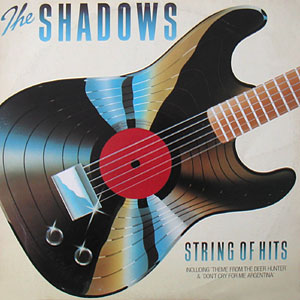
The SHADOWS: String Of Hits


(#223: 1 March 1980, 3 weeks)

Track listing: Riders In The Sky/Parisienne Walkways/Classical Gas/Theme From The Deer Hunter (Cavatina)/Bridge Over Troubled Water/You’re The One That I Want/Heart Of Glass/Don’t Cry For Me Argentina (Recorded live in concert)/Song For Duke/Bright Eyes/Rodrigo’s Guitar Concerto De Aranjuez (theme from 2nd movement)/Baker Street

In which former rock radicals opt for an easy life and churn out Hits 4U mood music for eighties Cannon Cinema auditoriums. Worst thing here is the hit, “Riders In The Sky,” wherein they disastrously push the button that says “modern,” with “Da Ya Think I’m Sexy?” bass sequencers, synthesised handclaps and whip cracks, and what sounds inexplicably like the “Silver Lady” riff superimposed.

The rest offers little improvement; perfectly good songs stripped of their harmonic richness and rhythmic impetus, such that it sometimes resembles an Anne Boleyn Secondary School prizegiving concert. Even on “You’re The One That I Want,” a song to which the Shadows are umbilically linked (as it was written by John Farrar, ex-of Marvin, Welch and Farrar), they mostly fail to shape up. Undercredited bassist Alan Jones does a very good job of holding it all together, while Dave Lawson’s synthesisers veer between tacky (“Classical Gas”) and quietly ingenious (the subtle “Strawberry Fields” paraphrasing on “Bright Eyes”).

Hank more or less sounds petrified throughout. I note how, on “Cavatina,” he sounds like the floating ghost of George Harrison and how, on “Baker Street,” he resembles Clapton. As “You’re The One That I Want” trudges toward fadeout, however, his frustrations abruptly explode and he breaks into a series of lightning Chet Atkins runs. I also have to applaud the manner in which Marvin and Welch turn “Heart Of Glass” into an unlikely country-rock workout. The sole group original, “Song For Duke,” presumably written in honour of the then recently departed John Wayne, also sees them do better as they are trying much less hard; an attractive “Wonderful Land” update for Spyro Gyra fans (and somebody should sample Lawson’s synth riff here too). Gerry Rafferty thought theirs the best of the many cover versions of “Baker Street”; although he might simply have felt flattered, the stripped-down arrangement does indicate the dusty lo-fi road movie to which Rafferty perhaps always wanted to soundtrack the song.

Otherwise, however, it’s sleepy MoR at its drowsiest; I reflect on how interesting “Aranjuez” might have turned out with Shadows disciple Neil Young as soloist and Jack Nitzsche arranging, but as it is, the Shads miss out the closing Picardy third (and therefore the movement’s entire point). Steve Gray’s string arrangements are, shall we say, unobtrusive (perhaps conscious that Norrie Paramor would die barely a month after the album’s initial release in August 1979). Then again, Marvin reckoned “Don’t Cry For Me Argentina” to be the best thing he ever recorded. I don’t know what that says about him or the Shadows at the turn of the eighties, but this record is yet another undernourishing biscuit tin of superficial comfort, and I’m not sure whether it was the record they wanted to make or the record they thought they ought to make.