Tuesday, 5 October 2010

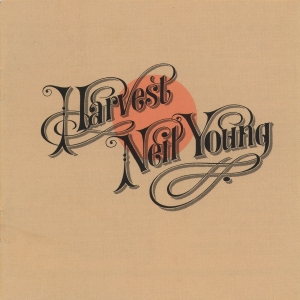
Neil YOUNG: Harvest


(#106: 11 March 1972, 1 week)

Track listing: Out On The Weekend/Harvest/A Man Needs A Maid/Heart Of Gold/Are You Ready For The Country/Old Man/There’s A World/Alabama/The Needle And The Damage Done/Words (Between The Lines Of Age)

It might be a cliché to speak of Canadian music in terms of its immense space, but then a cliché has to mean something in order to become a cliché, and regardless of whether it’s the jazz-rock of Lighthouse, or the powering pop of Sloan, or the blue neologisms of Joni Mitchell, or the rambling collectivist coherence of Broken Social Scene – or even the ostensibly heavier likes of The Guess Who or Rush, or the monolithically quiet likes of Glenn Gould – Canada’s music can be distinguished instantly from that of the United States. As with the country, there is less of a rush, less urban squeezing-in, more consideration, a fundamentally different hue; one thinks of dark pastoral roads, in places perhaps illuminated only by the snowed-in product of six-month winters. In those long winters there is little actively to do; one is left to ponder, to reconstruct a world.

Given the greater degree of consideration, it is possibly also true that Canadians are capable of seeing others in greater depth (because of the distance, and not just geographically) than they themselves are able to do. They also tend to be far more single-minded, albeit in a good way; less content to fall for hypes, to slot themselves into convenient categories, to do as they please, all the better to tell their stories. Their musicians have a pronounced tendency to turn from style to style, to alter their approach constantly, in order best to illustrate what they are trying to communicate. If Neil Young, for instance, wanted to record a New Pop/Vocoder album to speak with his son (Trans, 1982), then nobody, especially not record label bosses, was going to tell him otherwise. Contemplative country, feedback-laden improv, rock ‘n’ roll covers, multimedia dramas; he’s done them all, and while he might continue with political flip-flopping, it is all part of his inner being; what does this world mean for me, and to me, he continually asks himself, and us, where and how best can I construct a path through it?

And how come I can see through you with such alienating clarity? Only a Canadian could have conceived and performed the following words, from “Alabama”:

“I’m from a new land.
I come to you,
And see all this ruin.”

Everybody else was loving everybody else in early seventies Laurel Canyon, but Young, as always, kept his distance. If his only British number one album represented the closest he ever came to anything resembling a mainstream, that is not to assume that Harvest is, as too many have assumed over the decades, a sellout, a blanding out of his art, a nigglingly neutral commercial record. Bear in mind that Young had already offered us the groaning grinds of Everybody Knows This Is Nowhere with its ravenous setpieces (“Cinnamon Girl,” “Down By The River,” “Cowgirl In The Sand”) and Harvest’s predecessor, After The Gold Rush, a record almost unique for its period (almost? What’s Going On?) in that it was authentically angry but astute enough to disguise its rage in some of the prettiest tunes Young was capable of creating – the title track, gradually widening out from burned-out basement to spaceships, the Toronto coffeehouse Bacharach of “Only Love Can Break Your Heart,” the inescapable boil of “Southern Man” being its most celebrated. Many at the time felt Harvest an ironed-out replay of Gold Rush but the smoothness is not always visible and the patience needs to be understood; he is using the singer-songwriter format gently to hammer home profounder truths.

Consider that the album begins with a deliberate nod at the old teenage rock ‘n’ roll escape route before shutting it down – “Out On The Weekend”’s opening gambit of “Think I’ll pack it in and buy a pick-up/Take it down to L.A.” could in itself have come straight from Chuck Berry’s notebook, before the slow sadness kicks in – and, after wandering through just about every style Young could have wandered through in ’71-2, it culminates in the observation: “It’s just words, words.” Songs pause seemingly at random to allow sampled Richard Nixon speeches (“Alabama”) and studio chatter (“Words”), but it’s more indicative of a lack of inclination to rush through Young’s message than of art (although the latter is far from absent); he wants you to understand what he is trying to say (from “Weekend” again: “He tries to speak and can’t begin to say”) but you as his listener have to be prepared to understand him very slowly. The gatefold sleeve – and, once more, a well-weathered LP edition is the "truest" way to listen to this record – features on its cover what could be the sign on the side of a fruit truck; inside there is a huge close-up of a doorknob, to the barn in Nashville where much of the record was made, in which we see the indistinct reflection of Young, standing in the empty sunshine; and on the rear there is a shot of Young at work inside the same barn with his pick-up band the Stray Gators, but he is hiding from us, face away from the camera stage right, head down, concentrating on his guitar. He wants to tell you things but also wishes to remind you that you can’t pin him down; he’s there but he isn’t really there, or he might be in the studio in L.A., or on the stage of UCLA’s Royce Hall, or even encased in the improbable surroundings of Barking Town Hall (where the two tracks with the London Symphony Orchestra were recorded) – you think you’ve caught him? Why, he’s flown off again, and while his flight path might be straighter than that of a Dylan, you still have no hope of catching up with him.

What of the record itself? “Weekend” sets up the album’s central theme of habitual restlessness, of the impermanence of “home”; after its moderately hopeful introductory lines, we learn that there once was a woman, and that he loved her, but that she’s not there any more. “She got pictures on the wall/They make me look up/From my big brass bed” – a sombre reflection of “Lay Lady Lay” – puts this relationship into question, and when he’s “runnin’ down the road/Tryin’ to stay up,” is he fleeing her as desperately as the young boy who runs as far as he can from Madame George? The Stray Gators give nothing away; Kenny Buttrey’s drums are rhetorical (particularly succeeding Young’s “Can’t relate to joy”), Ben Keith’s pedal steel is simultaneously outer space, angel and foghorn (“I hear her callin’,” followed by five emphatic chimes from the whole band), Tim Drummond’s bass busily (but not in the way of a grasping panhandler) joining up the emotions. The band know enough to crouch down to virtual silence for the title track, where Young is addressing another girl, not knowing whether he wants to save her or vice versa; he sees her “walking with the boys,” his mother “screamin’ in the rain,” and maybe craves to take her out of this place altogether, but then he runs up against his own limitations (“Will I see you give more than I can take?/Will I only harvest some?”). When he repeatedly urges “let me fill your cup with the promise of a man,” it still sounds like a question, and not one to which the singer is expecting a prompt reply.

He is scratching around; there are people he knows, but does he want to be with any of them? Is he the one whose cup needs filling? Where does one place a song as deliberately immense as “A Man Needs A Maid”? Well, one could consider Carrie Snodgrass, the actress (“I was watching a movie with a friend/I fell in love with the actress”) who nursed Young after he sustained a back injury, but the pain expressed here runs far deeper and redder; he is lost, as lost as any rock musician of his time could expect to be, he is grasping at straws. To begin there is simply Young at the piano, singing about his life changing, the absence of trust, the lengthening shadows in which alms might be mistaken for arms; he slows down to allow the London Symphony Orchestra, under conductor David Meacham and playing Jack Nitzsche’s arrangement, to enter – first brass, then strings – for the lamenting Lear of the chorus. Bells and glockenspiel toll forebodingly – Nitzsche approaches the song like an autumnal Spector – as Young tries to work out what he wants, disguising his hurting three-in-the-morning plea. At “It’s hard to make that change” the orchestral storm gives way to a simple oboe, pursued by the first of two heart-shattering “When will I see you again?”s. With the first of these, Young is embraced by an enormous hug from the string-led orchestra, and I reflect on how the young Anne Dudley would have been affected by that puncturing moment, since she would replicate its gestures a decade later as the coda to ABC’s “All Of My Heart” – itself the coda of an extended pretence of searching for anything that isn’t love. What, whom, does he want? “Someone to keep my house clean/Fix my meals and go away.” He’s been hurt and unwilling to dip a toe into the pool of love once more – “To give a love, you gotta live a love/To live a love, you gotta be ‘part of,’” and woe betide those too hurt, too re-infantilised (because that’s what tragedy does to you, winds you right back again to being twelve, naïve and stupid); this is anything but an unreconstituted chauvinist song, rather an agonised cry to want to be a full human being again. At “Playing a part that I could understand,” the LSO rises to a climax of stalagmites and thunder – and then we’re back with the piano and his soul and that second, hanging-on-life-by-the-slenderest-of-threads, silently screaming to be held, to be cherished, “When will I see you again?” The coda is as quiet as deep art will allow.

“Heart Of Gold” was of course the album’s big hit, and sums up the record and its artist’s dilemma more succinctly and candidly: “I want to live/I want to give” and he’ll go wherever he can think he can find it (“I’ve been to Hollywood/I’ve been to Redwood” – where Young had just purchased some land – “I crossed the ocean for a heart of gold”) but (and remember, Young was still only twenty-six when he made this record) already aware of creeping mortality (“And I’m getting old”). When James Taylor and Linda Ronstadt’s harmonies enter the picture late in the song (all three turned up on the same edition of The Johnny Cash Show recorded in Nashville in mid-1971 and inspiring the notion of Harvest), the chordalities are thickened and made ambiguous; one marvels at how a song which in its determined quietude went so violently against the bleach-out-and-lay-back aura of its immediate surroundings managed to make number one on Billboard as a single. Buttrey’s drums again speak what Young can’t or won’t say, reinforcing the pronounced despair of the song’s final verse.

Side one ends with “Are You Ready For The Country?” – does he mean escape from the city, or face the nation? – introduced by Nitzsche’s staccato piano before unexpectedly settling into a McCartney-ish rural romp, although Buttrey’s reluctant parade-ground drumming suggests a deeper discontent. Crosby and Nash harmonise carefully (all three of CSN, plus the Y, turn up in different places throughout Harvest, never more than two at a time, and never the same two). Both Young and Keith’s guitars sound oddly detached, like leaves blowing around the abandoned town of The Last Picture Show. “Lefting and then Righting/It’s not a crime, you know!” says Young as he repeatedly tells us that “It’s time to go,” except when he encounters the hangman, who tells him “it’s time to DIEEE-EEEE!” Drummond’s subtly brilliant bass-playing reminds us why Harvest is one of Andy Rourke’s formative records; there is more than a premonition of the undertow of the Smiths in its chassis. But the message is delivered pretty clearly; get the fuck out of here, everyone.

Side two kicks off with “Old Man,” based on the man from whom Young had purchased the land in Redwood Park. Beginning with bass and acoustic guitar, before the entry of the drums, Young ponders about exactly how old anybody ought to be getting: “24 and there’s so much more.” Taylor and Ronstadt return on harmony vocals, and Taylor also contributes some uncredited banjo plucking, providing an anchor for Keith’s soaring pedal steel. The song shifts from its brooding minor key to a nearly triumphant major for its passionately harmonised chorus (“Old man, take a look at my life/I’m a lot like you”) before sinking down once more; and, once more, the message is expressed: “I need someone to love me the whole day through.” He is refusing to give up, to grow old, to die: “Old man, look at my life,” he states in his bitter coda, “I’m a lot like you were.” As with On The Beach, this is a sustained howl in favour of life, knowing that you have to slash through the stinging nettles of negativity before you can uncover and reclaim it.

The London Symphony Orchestra is back for “There’s A World” – at the same time, they were also occupied trying to work out, again under Meacham’s directions, the crossword Charles Ivesisms of Ornette’s Skies Of America, another patient unravelling of despair and its eclipse by initially cautious joy (the latter’s jolliest moment would later be revamped as “Theme From A Symphony,” the centrepiece of Coleman’s revolutionary Dancing In Your Head) – and, as with Ornette’s rainbows and churchy Sunday mornings, Young is trying to rise above the parapets, even over the roofs, to find somewhere and something better. Timpani, strings and bells usher him in; the darkness of the song’s brood (“Have you found it walking down the avenue?”) rising, via harp, to the airy lightness of “look around it.” That buoy marker of an oboe reappears before the song returns to Earth, just as Young is preparing to abandon it; “We are leaving, we are gone” (thus this becomes the true sequel to “Gold Rush,” the song). “We will leave you all alone,” he reassures, or threatens, us; a more gentle modulation back from lightness to dark ensues (“All God’s children in the wind/Take it in and blow hard”). The harp cuts the gravity dummy loose. “Will we lose our grasp/Or fuse it with the sun?” as Young had already asked on the song “Harvest.”

But “Alabama” – routinely dismissed as a pallid “Southern Man” rewrite – represents an advance on its predecessor. Young’s guitar is far angrier here, the fury which has been quietly boiling throughout the record, so incensed that it almost explodes the harmonies’ partial cosiness (Crosby and Stills contribute the harmonies here, and indeed the record does momentarily turn into a CSNY disc). Young howls, “See the old folks/Tied in white robes” (or “ropes”?). He turns the South on its side, citing “Swing Low Sweet Chariot” and offering a full chorus of “God Bless America” before cutting in with the Nixon tapes – this record came out only a few months ahead of Watergate – before demanding to know why this country, which he tries so hard to love, should want to destroy itself so completely. “Your Cadillac,” he accuses Alabama, “has got a wheel in the ditch/And a wheel on the track.../Banjos playing through the broken glass.” Nitzsche’s piano moves to the forefront of the music, followed by Young’s guitar. “You got the rest of the Union to help you along,” runs the song’s climactic couplet, “What’s going wrong?” – and it’s That Other War once more, the Civil War which redefined America so utterly, and under whose consequences we still live, or suffer, today. “Can I see you and shake your hand?” asks Young. He wants to love this nation, but it makes doing so the hardest thing ever – I thought of what sort of an impact Harvest might have made had Young brought in Elvis to sing the songs, and remember how America breathes the air generated by its own refractions. But thenYoung has to be singing these songs as well as writing and playing them; yes, by any dullard conventional theory his range in both voice and guitar are limited and clumsy, but didn’t most of the same people say the same thing about Elvis a lifetime previously?

The record’s sanest and chilliest two minutes ensue; “The Needle And The Damage Done” bases itself on the Donovan/”Dear Prudence” trick of climbing up the scale when it sounds as though it’s descending (it runs from D major via E major seventh to G major and a nearly unbearable ascension to B flat), and it’s just Young, onstage at Royce Hall, and on his own (“I know that some of you don’t understand”), singing the record’s most painful lament, for a man he loves who he knows, can see with his own eyes only a few feet away from him, is dying; by extension it becomes one of its time’s most eloquent epitaphs for the increasingly remote sixties - this is where escape has led us? To a gifted man destroying himself? The song’s motor is the pain which in comparison even “Maid” only partially fills in the spaces – and for the greater part of its duration there is nothing in it except space, space for thought, for lament, for earnestly-contained anger. “Every junkie’s like a settin’ sun” he finishes, and he makes that “settin’ sun” sound like a “skeleton,” shaking and shivering in a manner more profound than that heard on “Cold Turkey” – how much emotion do you have to summon up to silence those screams, to turn all of those “oh no”s into “Ono”s? The sudden, roughly-edited burst of applause sounds like the last joke being played before entering the first five minutes of death.

The applause cuts straight into the closing “Words” (this time featuring Stills and Nash). The song meanders, but Young, I think, wants it to stand as an escape route, a relatively happy ending; he (and of course, being Canadian, he was always going to play the part of the Worried Man – the arteries of The Band run semi-wild throughout the record) is settled on his new land, tossing philosophies in his mind like pancakes, wondering what this is going to bring to him; but musically the song is restless; Nitzsche’s piano offers a grinding cyclical 11/4 riff out of which Young’s guitar climbs gingerly before becoming markedly more strident. Drummond’s bass begins to walk. Then the band cuts back to a funereal 4/4 tempo as Young’s voice re-enters. But after the last chorus, the song rears its stuck wheels as the piano riff will simply not disappear; the effect is one of a sonically lighter “I Want You/She’s So Heavy.” Young’s guitar becomes steadily more frenzied and acidic and appears finally ready to break free, but, as elsewhere on the album, his own storm abates, and Young lets Keith’s pedal steel drift gently back into the foreground before the song and album fade.

The mood would grow darker – or supposedly so, as Young, apparently horrified by Harvest’s overwhelming success, moved deliberately out of mainstream focus; but even something like Tonight’s The Night finally winds up on the side of life (how could it not when it details its deaths in such lurid detail?). And he has prevailed; he recognised Johnny Rotten when the rest of America hadn’t remotely worked out how, or whether, to deal with him, the immaculate sequence of records from Eldorado to Sleeps With Angels represents the greatest sustained Indian summer of any rock musician’s career (though it’s tempting to cast fellow Canadian Leonard Cohen as Young’s secret alter ego; at this period he’ll sing about slashing one’s wrists as though he were Allen Sherman, but with infinitely greater wit and fright), and even as the critical wind drifted away again he has continued to find new ways to illuminate the old ways, right up to the simple but radiant Lanois/Le Noise pun. Why? Because, as with Scott Walker and John Cale and Dylan and Cohen and you fill in the rest, he has kept moving because nobody told those pioneering sixties people that they ever had to stop. Think of The Suburbs - as this tale will do in the long term – and the green wood between the spaces, and what humanity you’d see fit to place somewhere in between them, or, if you’re lucky, beyond them.

Tuesday, 28 September 2010

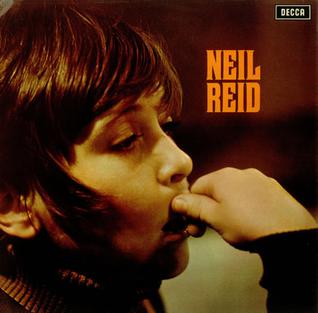
Neil REID: Neil Reid


(#105: 19 February 1972, 3 weeks)

Track listing: You’re The Cream In My Coffee/On The Sunny Side Of The Street/Peg O’ My Heart/Ye Banks And Braes/Happy Heart/When I’m Sixty Four/Look For The Silver Lining/If I Could Write A Song/When I Take My Sugar To Tea/My Mother’s Eyes/I’m Gonna Knock On Your Door/The Sweetheart Tree/One Little Word Called Love/How Small We Are, How Little We Know/Ten Guitars/Mother Of Mine

It’s an unusual cover photograph; he is not eagerly grinning at us, as you might expect from a performer of his age, but rather looking away from us, pensive, and with that pronounced upper lip, looking not unlike the younger Gordon Brown. The inevitable question is: what is he thinking? How did I end up here? Am I excited or scared? How long is this thing going to last? I wonder what my mother’s making for tea tonight. What is this West Hampstead, this big recording studio? How far away am I from home, exactly, and will I be able to find it again?

The Motherwell lad, sometimes billed as “Wee Neil Reid,” is still the youngest artist to top the British album chart, at 12 years and 9 months, but the child prodigy factor is only one element at work here. The record is the first augur of one of the key trends to dictate this tale in the future, namely success fuelled, and in many cases created, by the power of television. Throughout the seventies in particular, as we shall see, there were innumerable attempts to deny that this was the seventies, a craving to escape to any other time – the fifties, the sixties, nineteenth-century Vienna, even that abstract spider known as “the future” – than now, and music channelled through television helped to feed that hunger. A glance at the singles charts at the beginning of 1972 gives it away; as well as Neil Reid, we find Benny Hill, Cilla Black and Val Doonican, theme tunes from action series (The Persuaders - John Barry’s artful marriage of medieval cimbalom and future shock Moog remains unrivalled) and soap operas (“Sleepy Shores,” the theme from medical drama Owen M.D., starring Nigel Stock, the man who once pretended to be Number 6 – or was he the real One?), advertising jingles (“I’d Like To Teach The World To Sing”) and even a nod to the big screen (“Theme From Shaft”). Shortly thereafter, thanks to the dubious but unarguable power of Hughie Green’s Opportunity Knocks, Neil Reid’s debut album made it into this story. Why the sudden eruption? It should be remembered, amongst other things, that the period 1971-2 marked the point where colour televisions became affordable, when Grundig, Ferguson and others manufactured sets which anyone could buy.

But it should also be remembered that as 1972 dawned there were only three television channels – BBC1, BBC2 and ITV. The choice was less, external options were fewer, and so viewers had to tune in, essentially, to the same things. Thus audiences of 20-25 million for soaps and variety and comedy shows – then, almost half the population of Britain - were relatively commonplace. A common language was agreed and spoken. Shows such as Opportunity Knocks took full advantage of this; having moved to television from radio in 1966, the weekly you-the-people decide talent contest quickly caught on. Broadly similar in format to today’s Britain’s Got Talent, the avuncular Montreal-born Green presided over a bill of half a dozen or so acts, some singers and musicians, others comedians, yet others what were then known as “specialty acts” – magicians, jugglers, bodybuilders, plate spinners, even singing dogs – out of which viewers had to cast a postal vote on a weekly basis to determine which of these acts would return in the next episode. It was an enticing façade of popular democracy (“I mean that most sincerely, folks – it’s YOUR vote that counts!”) whereby the public could feel as though they were helping to make an ordinary person a star, but of course few of the acts who made it to the show were green, in any sense; nearly all of them had put in time on the club circuit, and Neil Reid was no exception.

The boy was apparently discovered singing at a Christmas party for pensioners in 1968, and over the next few years he appeared on various club bills during his school holidays. Eventually he came to the attention of the Opportunity Knocks producers, appeared on the show, and was a sensation; not since fellow Scotsman Jackie Dennis in the late fifties had a homegrown child star risen to such prominence, and that turned out to be a harbinger in itself (but more of that later). He was signed to Decca, the single (and featured song on the show) “Mother Of Mine” was rush-released at the end of 1971, and quickly climbed to number two (only prevented from topping the chart by the aforementioned Coke dynamo “I’d Like To Teach The World”). The local papers in Lanarkshire adored him, as did mothers and grandmothers everywhere.

An album of sixteen songs was put together by Dick Rowe (the man who a decade previously had turned down the Beatles; the fact that he was also the man who signed the Rolling Stones, the Moody Blues, the Small Faces, the Zombies, Van Morrison’s Them, John Mayall’s Bluesbreakers, Tom Jones and Engelbert Humperdinck among others has been conveniently forgotten) and producer/arranger Ivor Raymonde, and unusually a degree of thought and modest adventure appears to have gone into its making. The songs were a mixture of old pre-war and inter-war favourites (for the grannies) and more contemporary material, and never is the selection or approach predictable, even if the approach doesn’t always work.

“You’re The Cream In My Coffee” begins with discrete ukulele and bass plucking, and what immediately strikes the listener is the unalloyed confidence of Neil’s voice – he occasionally misses his target in terms of phrasing and pitching, but the misses are always narrow and there is a latent power in his grain which somehow exceeds the material he’s been given to sing. He negotiates the tightrope trickery of the song’s complex middle eight, composed of successive trapdoors of modulations, very skilfully indeed. Unfortunately the intrusion of the teatime variety choir and vaudeville trombones rather spoils the track’s atmosphere, but the song soon cuts back to its original setting; there is something of a wink in Reid’s quick “You!” signoff.

The arrangement given to “On The Sunny Side Of The Street” is rather bewildering; the song is taken comparatively slowly, and the striptease mood (complete with nightclub bongos) strikes me as less than apt. Again the choir steals in to spoil things, and the North Pier organ solo midway through loads the track with excessive cheese, but the nice lyric change (“I’ll be as rich as Elvis Presley”) is carried off with good humour. Still, there is as yet nothing to suggest anything other than a fairly standard early seventies MoR album, and this feeling doesn’t radically change with “Peg O’ My Heart” – later used, in its original arrangement, as the theme for The Singing Detective - which here is treated in the manner of a Co-Op commercial. The song’s bridge is somewhat scrambled, and there is a bizarre interlude where the strings make a half-hearted attempt at a Highland reel (“Yip!” barks Neil) – wait a minute; is there something else going on here?

His version of the traditional Scots song “Ye Braes And Banks,” however, is a different matter. Raymonde’s arrangement becomes liquid and iridescent, and there is something in the tone of Neil’s voice which now suggests possible futures; the song is taken patiently and rather opaquely, but there are long stretches where, even as a Scot, it is impossible to discern exactly what he is singing – instead, there is an almost alien purity about his voice as an instrument in itself, and I have to remind myself that, not only was Elizabeth Frazer about a year Neil’s senior, but also Ivor Raymonde’s son Simon would eventually become a Cocteau Twin; I wonder if the two boys ever met, and what influences from this Simon would carry over with him a dozen or so years hence. Again, with “Happy Heart,” Neil is stretching out his vowels and consonants in a way I’ve only known one other singer to do – his near contemporary in Dundee, Billy MacKenzie. Now he is really settling into the record, and even essays a bit of scat singing with some success. His “When I’m Sixty Four” involves a children’s choir (and, if the photographs on the rear of the album are anything to go by, Neil himself at the piano); it’s a pleasant little conceit, a knowing in-joke.

But “Look For The Silver Lining,” a Jerome Kern ballad from 1919, provides the record’s most heartstopping moment, and Raymonde’s most creative production and arrangement work; Neil’s voice is pitched as a distant echo, not quite graspable...and then the song, quite unexpectedly, goes “out”; cymbals fade into processed hisses, there are meandering meadows of guitars electric and acoustic (and one of the guitarists is, to cloud matters further, Derek Bailey, not a million miles from his other-galaxy work on Tony Oxley’s “Stone Garden”), rumbling bass and tinkling electric piano, and then the song fades out of focus and even audibility, eventually returning on a crest of Free Design harmonies (“Look for the silver lining, silver lining”); the atmosphere is somewhere between early Boards of Canada, Belbury Poly and Saint Etienne’s “Avenue.” The track not only cries out to be sampled, but also works as a portrait of genuine hauntology; that is, the piece is haunted by the ghosts of the music which will, intentionally or not, follow it. Side one then winds to its agreeable end with Howard Greenfield and Neil Sedaka’s “If I Could Write A Song,” and Neil’s general phrasing here is highly reminiscent of that other former child star, Scott Walker.

“Take My Sugar To Tea” conceptually balances out “Cream In My Coffee” and is similarly arranged, with more ukulele and the occasional blast of trombone (possibly from Paul Rutherford – I am not sure how this album is affected by having two-thirds of Iskra 1903 playing on it), but the arrangement is rather stilted and bumpy (the generous tympani solos do not help) and Neil again sounds a little out of his element. Then again, towards the song’s end, ukulele, electric guitar and tympani engage in a three-way summit of pointillism which hovers delicately atop the border of abstraction. “My Mother’s Eyes” is more successful; Raymonde remembers his Dusty Springfield and Walker Brothers days and lets out the Spector floods in his orchestration (complete with echoing pianos, etc.). Once more, the choir is strictly not needed, but the approach by both arranger and singer is epic, stentorian, rhetorical, and Neil works up to a satisfyingly chilly high note finish.

“I’m Gonna Knock On Your Door,” however, is tackled as neither Eddie Hodges or Little Jimmy Osmond could have imagined it; fuzz guitar and furious Hammond organ lead us, via some handclaps, into a netherworld somewhere between “Hang On Sloopy” and the not-yet-recorded “Children Of The Revolution”; the approach is defiantly bump and grind (but he’s only twelve!) and amidst the thunderstorms of rhythm and descending (into hell?) organ riffs, Neil sounds a bit lost.

However, we then move into a meditative state-of-the-world interlude. “The Sweetheart Tree,” composed by Henry Mancini and Johnny Mercer, was commissioned for Blake Edwards’ movie The Great Race; when I was eight or nine, I thought the latter my favourite film, uproariously funny, and I haven’t revisited it since for fear of disappointment (since it was another in the long post-Around The World In Eighty Days/It’s A Mad, Mad, Mad, Mad World series of throwing lots of famous names together and making them have hilarious scrapes in all sorts of different places; I suspect that I would now be bored rigid by Lemmon’s hamming, by Natalie Wood’s blankness, by the overlong Prisoner Of Zenda skit which climaxes the film). It’s an odd choice for a slapstick comedy, but note the guitar (and/or clavichord) work here which gives the number an ethereality which, again, would find its true home with Robin Guthrie and (via Neil’s admirably controlled vocal) Elizabeth Frazer; one almost forgets the return of the kids’ choir. “One Little World Called Love” leads us back to the main 1971-2 milieu, that of where the world is going, that love could still save us all, although note the deadpan guitar comping throughout, and also the occasional breakout of a disturbing shard of lyric (“A peal of thunder when God sounds his gun”). This sequence concludes with the plaintive waltz (but composed by the radical composer Earl Wilson Jr, although this version seems to take its cue from Josef Locke’s 1969 reading) “How Small We Are,” bookended by an astutely solemn brass chorale.

“Ten Guitars” is the Humperdinck standard, and both Neil and Raymonde do their best to make it sound as unlike Engelbert as possible. Flute flutters, drums are busy in a hip-shaking way, but the message persists (“Through the eyes of love, you’ll see a thousand stars”), even as Reid manfully (or boyfully) takes the song out with some exhortations (“Come on everybody!,” “All together now!”).

“Mother Of Mine” itself is left until last. Composed by the guitarist Bill Parkinson (formerly of Screaming Lord Sutch’s backing band the Savages, and an unwitting contributor to the key song on entry #109), the song’s simple poignancy works in its favour and Neil’s performance is faultless, even through the lush choirs and final key change. But there remains something oddly otherworldly about it; it doesn’t really fit into any timespan (is it 1952 or 2022?), and he is singing such lines as “When I was young” when he is still only twelve. And there is, of course, something which moves me about the record which maybe exceeds the record itself; listening to Neil’s singing here (especially his five-note “way”s), I cannot help but think of the fourteen-year-old Billy – a man who would eventually end his own life out of unreachable grief for his mother’s death – and how, or if, he would have sung this; the similarities are unavoidable. And that's not even to mention the record's role as a bookend of premature maternal lament for its decade, the other being Lydon's beyond-articulation howls of grief on "Death Disco."

But Neil’s life continued to a much more successful issue. His initial success was not sustained – a follow-up single, “That’s What I Want To Be,” and follow-up album, Smile, both released later in 1972, both barely scraped into their respective Top 50s. Of course, the Osmonds had arrived in the interim, and suddenly they seemed much hipper, much more in tune with the times; the final irony came when Little Jimmy covered “Mother Of Mine” for the B-side of his Christmas chart-topper “Long Haired Lover From Liverpool.” Neil couldn’t have competed with that, and nor, I suspect, would he have wished to do so. He returned to the clubs for a further year or so and then his voice broke. He continued to record for a time, including with Roy Wood – notably his more than decent 1974 single “Hazel Eyes” – but to little avail, and he moved into the touring musical circuit for a few years before opting out of the music business altogether. Eventually he became a practising Christian, and today he lives happily in Blackpool, works as a management consultant and runs what he calls a progressive, 21st century church named Oasis Blackpool. His initial success did open the floodgates for a host of wannabe child stars, most (but by no means all) of whom similarly came up via the Opportunity Knocks route. Of that flock only Ricky Wilde (as co-producer, co-writer and guitarist for his younger sister Kim) and Bonnie Langford have continued to prosper; other stories are necessarily more tragic or routine. I doubt that there will be much, if any, call for Neil Reid to be upgraded to CD status, but as a modest stew of differing time periods in popular music it does what it set out to achieve, and the astonishing “Look For The Silver Lining” in particular demands rediscovery.

Tuesday, 21 September 2010

VARIOUS ARTISTS: The Concert For Bangla Desh


(#104: 29 January 1972, 1 week)

Track listing: George Harrison – Ravi Shankar Introduction/Bangla Dhun/Wah-Wah/My Sweet Lord/Awaiting On You All/That’s The Way God Planned It/It Don’t Come Easy/Beware Of Darkness/While My Guitar Gently Weeps/Medley: Jumpin’ Jack Flash-Youngblood/Here Comes The Sun/A Hard Rain’s Gonna Fall/It Takes A Lot To Laugh, It Takes A Train To Cry/Blowin’ In The Wind/Mr Tambourine Man/Just Like A Woman/Something/Bangla Desh

Although Bolan cried, “It’s a rip-off!,” some sixties survivors evidently felt the need to prove that rock music needn’t be a rip-off. In 1980 John Lennon opined, apropos the Concert for Bangladesh and the controversy regarding the whereabouts of the eight million dollars that the concerts and associated records and film had raised, “But it’s all a rip-off.” Then again, George Harrison had invited Lennon to participate, provided that Yoko didn’t, but an argument between John and Yoko took place and Lennon pulled out.

However, if the 105 or so minutes of the triple box set prove anything, it’s that they stand as a marker of rock’s attempt to grow up, to prove that, as had been promised in the sixties, this music could make a difference to the world, and in particular to the lives of people who had nothing to do with rock. Bangladesh had been born, painfully, out of the ashes of East Pakistan, but West Pakistan, under the iron rule of Yahya Khan, did not wish to relinquish its control over the country; there had already been a disastrous cyclone in 1970, but in March 1971, refusing to acknowledge the results of the democratic Bangladeshi election three months previously, Khan sent his troops into the country and undertook Operation Searchlight, a genocide programme comparable to that which would be unleashed by Pol Pot in Camodia four years later. The original album sleevenote refers to a million Bengalis murdered, although subsequent statistics have put that figure up to three million; this led to the beginning of the Bangladesh Liberation War. In addition, ten million Bengalis fled the country, seeking refuge in neighbouring India, and were susceptible to cholera and other diseases, not to mention the continued threat of monsoons.

The concerts had been the original idea of Ravi Shankar; himself a Bengali, and horrified by the massacres, he wanted to put on an event to raise both funds and awareness, and asked his friend George Harrison for advice with the hope that he might be willing to produce the concerts, if not participate in them. He gave Harrison extensive literature and newspaper cuttings concerning the history and then-current state of Bangladesh; similarly horrified, Harrison immediately offered to take part and get as many other musicians as possible to do so. Liaising with Allen Klein, the final line-up was agreed in some 4-5 weeks; as Harrison comments on the album, many of his colleagues had cancelled other gigs or commitments in order to participate. One, Eric Clapton, was in the middle of his heroin phase, and only turned up for rehearsals the day before the concerts. For Harrison himself, this would be his first stage appearance since the break-up of the Beatles, and – the ultimate coup – Bob Dylan agreed to take part, marking his first gig since the 1969 Isle of Wight set.

The organisation took place on the turn of a dime – as did the quick writing and recording of Harrison’s fundraising “Bangla Desh” single – and two concerts were given on 1 August 1971, one at noon and the other at seven in the evening; the album collects the best performances from both. As a feat of management, the event was something of a miracle; as a listening experience, it raises some peculiar issues.

The album begins with Harrison wandering onstage to a wall of whoops and cheers from the audience; he asks them to “settle down” for Shankar’s opening set, attempting to convey to them the complexity of Indian music (“a little bit more serious than our music”), and then Shankar comes on. He too asks for patience and open-mindedness from the audience, and also requests silence and non-smoking. Evidently both men were being cautious, and Shankar takes pains to explain that “your favourite stars” will appear in the concert’s second half and that this is the music, the culture, of the nation for whom they are here to raise funds; to understand the cause, one must understand the culture. The four musicians – Shankar on sitar, Ali Akbar Khan on sarod, Alla Rakha on tabla and Kamala Chakravarty on tamboura – tune up for around a minute and a half, only to be met by a round of applause. Shankar smiles and indulges the audience before launching into the two-part “Bangla Dhun,” a pair of improvisations based on a Bangladesh folk tune. A relatively light run for these masters, the piece is divided into a dadra sequence (six beats) and a teental sequence (sixteen beats). In the meditative first half, Shankar and Khan intertwine beautifully, Khan’s sliding quarter-tones in particular reminding us how this music had so beguiled and entranced the likes of Coltrane a decade earlier; there are of course reminders of the other musics which this music would go on to influence, including both English and Scottish folk music, country and bluegrass, and (of course) psychedelic rock – in the teental section, the patiently escalating dazzle of the four musicians’ interactions (plaintive sitar, flowing sarod, dramatic tabla-tamboura call and response sequences) is enough to send one into hypnosis; as the music speeds faster and faster, psychedelia suddenly seems the plaything of children – and it is all based on a subtly rephrased (with every recurrence) four-note sequence. As with Dylan’s later set, this seems a league above everything else that would go on that day, and the audience’s thunderous reception proves that they were ready.

Harrison then returns to the stage, running through some All Things Must Pass material; “Wah-Wah” benefits from Leon Russell’s piano swipes, “My Sweet Lord” is done as though from the lounge, with some rather sour guitar commentary from Clapton, “Awaiting On You All” turns on the almost inaudible axis of Billy Preston’s organ. But, despite the phalanx of musicians onstage (including all four members of Badfinger, inaudibly strumming away on acoustic guitars), the original album’s sound wall isn’t quite recaptured, and moreover – and particularly halfway through “Awaiting” – the feeling comes through that we are at church, attending to a sermon. A long way away from the rabid rave-ups of Get Yer Ya-Ya’s Out!, Harrison is keen to remind his audience that they are there for a Specific Reason. The retrospective listener, however, feels as though he is being lectured to, and hence the protestations of both Harrison and Shankar that they deal in music and that politics have nothing to do with why they’re there are, charitably stated, disingenuous; if rock is supposed to change the world, shouldn’t it be taking a less fence-friendly stand?

Billy Preston gets his solo spot, and his “That’s The Way God Planned It” wipes the floor with the 1969 studio version; his idea of gospel is more florid and lively than Harrison’s, with fine call and responses with the multiple backing singers, a storming organ solo from Preston himself, and a real holy roller of a crescendo with doubling tempi and ecstatic tambourine. But Ringo then sings his hit “It Don’t Come Easy” and gets the second biggest round of applause of the day; even though he fluffs his words in the final chorus, the audience forgives and blesses him. The original single has much of the offhand joie de vivre about faith which Harrison wasn’t quite ready to unleash, and although his strained voice takes a firm second place to his and Jim Keltner’s drumming, he seems to be the concert’s most welcomed presence.

Harrison takes over again for a couple more songs; the gloomy “Beware Of Darkness” bears some extra light thanks to Leon Russell’s agreeably gruff co-lead vocal and Liberace piano, while following extended band introductions by Harrison (Ringo is acknowledged by a quick gallop through “Yellow Submarine”), Clapton – still wanting to be “Derek,” just another guy in the band – has his moment in “When My Guitar Gently Weeps,” his and Harrison’s guitars sobbing at each other, even if the backing is a little over-emphatic, a tad too pub-rock (amazingly, it was only at this point that most people realised that Clapton had played on the original recording).

Then comes the album’s unexpected highlight, Leon Russell’s solo spot. The least known of the featured musicians, and therefore probably the one with the most to gain in terms of reputation, he tucks into the Stones and Coasters with such volcanic force and ribald humour that he makes me want to re-evaluate his entire back catalogue; finally, here is the spark, the duende for which the concert has been crying out. “Jumpin’ Jack Flash” was a brave one to essay in this context, and the most astonishing thing about it is perhaps Russell’s vocal – with his repeated, ragged “WHOOO!” screams, he sounds like, of all people, Iggy Pop; and Don Preston’s guitar and Carl Radle’s bass respond with a deadpan thwack straight out of “TV Eye.” Halfway through, Russell modulates into an extended improvisation on the Coasters’ “Youngblood,” framing the song with long out-of-tempo half-scat half-rants about faithlessness and childishness, eventually dovetailing back immaculately (he’s been cheating, sneaks back in the early hours, his baby wonders what he’s been doing but after a considered pause decides that it’s ALLLLLL-RIIIIIIIGGGGGHHHTTTTT) into “Flash,” and then back towards a Merrie Melodies “Youngblood” signoff. Chaotic, rambling, rash – Russell pretty well steals the show, wraps it up and takes it under his arm to the pawnbroker’s.

Harrison comes back on, with Pete Ham of Badfinger in acoustic tow, and runs through a briskly-taken and rather superficial take on “Here Comes The Sun,” even if the twin acoustics’ interplay immediately recalls Shankar and Khan (it is a real shame that Badfinger didn’t get a set of their own; still the most undervalued pop group, power or otherwise, of the seventies, especially by those who ripped them off and drove half of them to suicide; their story makes that of their oddly logical twin Big Star appear like a walk in the park in comparison).

But then Harrison asks us to welcome “a friend of us all – Bob Dylan,” and the audience goes apeshit. Much horsetrading between Apple and Columbia was required to ensure Dylan’s presence on the record (and indeed the 1991 2CD version on which I am basing this piece appeared on Columbia/Sony) but it was more than worth it; the pictures alone indicate that this was something other than what had previously been going on, and Dylan wisely opts to stick to the folk; his is a deceptively understated and nonchalant set, and all five songs have a relevance, however indirect (from “Just Like A Woman”: “I was dying there of thirst”), to what was actually happening in Bangladesh (earlier on in the show, the audience clapped along to Harrison’s “Bangla Desh” record as it played under documentary footage of atrocities – did they really only come to see lots of famous people on the same stage together, with the cause trailing a very distant second?); “A Hard Rain” is treated almost playfully, the lines coming at almost random divisions (though the scratch band assembled for Dylan’s set – Harrison on electric, Russell on bass, Ringo on sturdy blisters-on-fingers tambourine – do a fine job of second guessing the great man), but the song is never treated as a throwaway. “It Takes A Lot To Laugh…” dices with death, ownership and commitment but here it’s Dylan’s pivotal “BOSS,” un-resolving into a spreading helter-skelter of ululations, which commands the song’s regretful flow. “Blowin’ In The Wind” is treated with careful solemnity but that too is almost completely overwhelmed by an unexpectedly passionate vocal – my God, he still CARES about this at this late stage – from Dylan, an octave above his normal range, stretching like James Carr, howling like Pickett. On this night it could scarcely have sounded less relevant. This “Tambourine” teems with pain, almost losing itself before Russell’s walking 4/4 bass strolls with us back to reality. “Just Like A Woman” is taken at a funereal 4/4 pace; at first it sounds as though Dylan is taking the piss out of Jagger (this “she begs” is gnarled up to sound like “she BAKES”), but then the hurt steals into his timbre, and that last extraordinary “guuurrrlllll” he holds like an unstable Colt .45, turns it into a Shepp wobble, then a terrifying growl, hurling its shards, its atoms, into Harrison’s guitar (the only live version to beat it is the one Bridget St John did, somewhere in the middle of England, in late 2007, where she sings it quietly, from the perspective of the woman – and you are numbed, truly shocked; now, she quietly hisses, you think you know about pain?).

There’s no real way to follow that, but Harrison has to come back on and finish the concert somehow; his “Something” is somewhat gruff and the attendant irony of Clapton’s querulous slides need not be over-underlined. Still, it rocks up to an entirely inapposite finale, and then the cheers and the inevitable wait for the encore. Amazingly, “Bangla Desh” the song is a tougher little cookie than I had remembered; the words still sound as though tossed together in twenty seconds (which was probably not far from the truth) but Spector’s production (and he is on the unobtrusive mix for this set) takes full advantage of the wrong-footing chord changes and there is a cloud of numbed rage which somehow lifts it out of the bob-a-job league. Here Harrison gives his most ferocious – and life-filled – performance on the record, with everyone – Jim Horn’s tenor, Clapton’s anguished, breaking-out-of-himself guitar solos – elevating towards a double tempo rampage, as though failure to resolve things in Bangladesh could drag the rest of the world down with it. After that, there is really nowhere else to go.

And, for the all-star benefit concert, there were surprisingly few other places for it to go throughout the seventies; unlike Live Aid, etc., this was an integrated group of famous people on stage pretty much throughout the whole event, rather than a slideshow of famous people doing their individual turns. Perhaps those nasty, inconvenient politics might have had something to do with it, but there is also the fact that the proceeds from the event, in all its manifestations, languished in limbo for several years due to the simple omission by its producers to apply for tax-exempt status. It does seem that the money eventually did get through; it wasn’t nearly enough to make any practical difference, but awareness was raised, and Bangladesh struggled slowly and painfully towards a full democracy in the early nineties. I myself was pleased to come across my copy in a branch of Oxfam, since the money raised from my purchase will go – with any luck – towards relieving the current flooding crises in Pakistan. But if rock wanted to grow up, it seems to me that it had to acknowledge things like politics as well as accidents of nature, and it’s possible that the only such events which still attract mass audiences and funds are those which strive to be as apolitical as possible. It’s not until the turn of the eighties, with the likes of Secret Policeman’s Ball, the Concerts for the People of Kampuchea and No Nukes, that the crossover all-star fundraisers began to pick up real steam. Still, as fumbling and messy as their approach was, Shankar and Harrison were ahead of their time, and ripping anyone or anything off was, I’d wager, the last thing on either of their minds.

Tuesday, 14 September 2010

T. REX: Electric Warrior


(#103: 18 December 1971, 6 weeks; 5 February 1972, 2 weeks)

Track listing: Mambo Sun/Cosmic Dancer/Jeepster/Monolith/Lean Woman Blues/Get It On/Planet Queen/Girl/The Motivator/Life’s A Gas/Rip Off

(Special thanks to the indefatigable David Belbin for kindly sending me a CD-R of this album’s second CD issue, and to the Camden branch of Music & Video Exchange for supplying me with an original LP edition, complete with the crucial inner sleeve and label designs)


The first question has to be: why the title? What are they – or, more accurately, he, or, even more accurately, s/he – fighting against? The cover, as with the record itself, is quite unlike any other number one album of this year, indeed seems diametrically opposed to all the rest of them, even though Hipgnosis designed it; the elf almost dwarfed by his amps, thrashing away at his guitar, bathed in a halo of deliberate gold. The future beckoning us with unplaceable lips and radical pixie boots. This is a new kind of electricity, and the war is being waged against certain things which have come before it, or were standing in its way.

Electric Warrior marks the point – more so than the soundalike compilations – where the British album chart caught up with pop. It provides a definitive and cocksure ending to a decidedly unsure year, while also unmasking the road shortly to be followed. However, it doesn’t quite shake its head at all of the past; in presumably purposeful contrast to the futuristic black and gold of the cover, the inner sleeve presents us with misty, pastoral, angels-in-their-hair sketches of Marc Bolan and Mickey Finn, as though it were still 1967 and the countryside; meanwhile, on one of the labels (the one not occupied by Fly Records’ sixties calligraphy), the duo appear in a field, ready to be snapped for Fabulous 208, or Look-In, or any of the teen magazines ready to take them, and Bolan in particular. Yet the record drips with words uncommon; “doth,” “perchance,” “whence” and “stars in my beard” (the latter a deliberate, door-closing reference to the Tyrannosaurus Rex days), as well as Bolan’s hair and hips, suggest a spirit whom Keats would have understood instantly. An old Romantic ready to embark on a true New Romanticism, a full decade before that term was to be traduced by some of the children and teenagers who listened to and devoured Electric Warrior (other wiser ones would subsequently remember him as the fulcrum of what would come to be known as New Pop) – but the cloudy pastoralism is balanced out, almost flattened, by the Jaguars and Cadillacs which rear and roar their carburettors throughout the record; look, Romantics, at how all the world has changed!

Of all the artists featured in TPL 1971, Bolan seemed to have the greatest urge to free himself from the sixties (although he was of course one of its most integral components); he didn’t possess autumnal regret or tints of rose for times spent and chances missed – on the contrary, he was the keenest to get on with “now,” to drag the rusty body of sixties rock and pop into something which would look like a future to those who didn’t need or want to remember the sixties (as with the teen audience who made up the broadest base of T. Rex’s fan demographic).

Certainly of all the albums featured in TPL 1971, Electric Warrior is the most sheerly playable; as with all great pop albums, one requires to play it repeatedly, in partially stunned disbelief that this is actually happening (or did happen almost forty years ago) – its swing is easy, its come-ons bursting with come. Bolan’s was a more youthful take on sex and rock than, say, Zeppelin – it is easy to forget that in fact Bolan was almost one year Plant’s senior – and one more acutely programmed to what the hips, the nascent stimuli, in his fans desired. His is a more aqueous seduction, slower, more persuasive, and ultimately far more comprehensive.

But where did that voice of his come from? “Mambo Sun” opens the record – and as a record, Warrior’s success is largely down to the studio ingenuity of producer Tony Visconti (together with his team of engineers, including future key figures such as Malcolm Cecil, Roy Thomas Baker and Martin Rushent) – with what is essentially a breakbeat; percussion, electric guitar, ‘cellos, violins and, finally, Bolan’s voice all enter separately and combine in connected universes. What is immediately remarkable is the use of space and patience – here, space is the pace. But that voice! Was there any real precedent for it? There are some clues in “Mambo Sun”; the song begins like a Kevin Ayers wet dream (“Beneath the bebop moon/I wanna croon with you”) but Bolan’s Received Pronunciation vowels conjure up the spirit of one of the original New Pop forebears, Noel Coward, even as his corn-stirring vibrato reminds us (and some in 1971 needed to be reminded) of Buddy Holly. But this is far from a straightforward seduction; he is trying to get to us (“My life’s a shadowless horse/If I can’t get across to you”), wanting to manufacture his own oceans, even referencing Marvel Comics (“On a mountain range/I’m Dr Strange for you,” with a rhetorical chord augmentation). The pining turns to panting (“Upon a savage lake,” “My wig’s all pooped for you”), and eventually Bolan breaks out of the poetry, draws a careless breath and cries “TAKE ME!” – and no one could resist or refuse as he turns on the tantric scat lantern, full of “ow!”s, “uh-uh!”s and “baby”s, Visconti’s strings rising up wistfully at the end in the manner of prototype synthesisers.

And there was also, lest we forget, Syd Barrett, who could so easily have dreamed up half the songs on the album, particularly the regenerating reincarnation cycle of “Cosmic Dancer,” wherein, ahead of acoustic guitar and lowering strings, Bolan patiently, but very unplainly, dances from womb to tomb and back again, apparently free of gravity and care (“I was dancing when I was AAAHH!”). Is twelve too late, is eight too early. There is a trace of disturbance in his “wrong to understand,” as he asks us to recognise “the fear that dwells inside a man…OHHH!” Visconti’s strings alternate between barbed wire swipes and Mantovani soothers. “Here I go again, once more…” he sings, preparing yet again to be reborn, and his “OW OWWW!” heralds a three-way dialogue between backwards guitar (that 1967 river again), backing vocals and drums, eventually resolving in trading of fours between Bolan and Bill Legend – the latter’s work is exemplary throughout the album. He can live forever if he so desires, but can he ever negate the past, least of all his own?

“Jeepster” solves that problem by joyfully lining up three decades of pop tactics and jumbling them all up into one of the greatest of all pop come-ons. Released as an unofficial single at the end of 1971, it was kept off the Christmas number one slot only by Benny Hill’s novelty hit “Ernie,” but the milkman’s strawberry yoghurts couldn’t hope to produce nearly as much cream as Bolan generates here. Immediately the stony (or Stones-y) backbeat is offset and lightened by Finn’s congas – the double-drum approach inevitably leading to thoughts of Glitterbeat and, eventually, Antmusic – and although the song is based on a mongrelisation of Howlin’ Wolf (“You’ll Be Mine”) and Roy Orbison (“You’re My Baby”), it sounds nothing like either. We are in the land of the blues but this is a different, if related, urge to that of the Wolf or Muddy, not the least because the song is repeatedly slung into a minor key by Visconti’s “I Am The Walrus” ‘cellos in each chorus. Meanwhile, Bolan merrily mixes psychedelic abstraction (“You’ve got the universe reclining in your hair”) with upfront fuck-me-nowisms (“I’ll call you Jaguar/If I may be so bold”), although he eventually hardly requires the words to spell out his intent. His gasp before the percussion/guitar break (complete with Slade-anticipating boot-stomping and sandpaper handclaps), his climactic “OWWW!,” his “Uh, uh, UHH!!”s – did Michael Jackson or Prince ever get to listen to his work at the time? Or maybe they all got the same notion from different perspectives of James Brown. Either way, note how Bolan’s guitar steadily ups the sexual ante – it’s hardly present in the early part of the song, but pours all over the latter half, and how “upon your frozen cheeks” eventually explodes into vampirism – “I’m gonna SSSSSSUCK YA!” Bolan grins, twisting the key consonant just enough to make it suggest an “F” rather than an “S” (although Greil Marcus may yet be alone in hearing “One-two-three-FUCK!” in the intro to “I Saw Her Standing There”), and abruptly one wonders why the rest of 1971 pop couldn’t harbour this kind of sensual good humour. The song thrashes orgiastically towards fadeout.

Darker clouds decorate the halls of “Monolith”; there’s a hi-hat hiss, then a guitar snarl, then – suddenly – a stately ballad, Bolan’s treated guitar striding in and out of its woods – and what is it about? Amidst all the “kingly”s and “whence”s Bolan delivers a warning that this cannot last forever: “And dressed as you are girl/In your fashions of fate/Baby it’s too late.” Part Dylan, part “Out Of Time,” part Zappa satire, even (“Lost like a lion/In the canyons of smoke – girl it’s no joke”). Flo and Eddie’s backing vocals and Visconti’s strings sound haunted; handclaps stutter out a messy ending. Don’t start creating new gods this early in the new age.

And then Bolan does Elvis, hilariously and splenetically (that “One an’ two an’ BUCKLE MAH SHOE!” intro); “Lean Woman Blues” is a great mash-up which imagines Presley kidnapped by Ken Kesey to participate in The Basement Tapes. The song is a trainee cobra bluesy crawl, slightly redolent of Zeppelin, although here Bolan is both gorged by a knife and compares himself to “a child in the sand on the beach of the land of you.” Multiple Marc guitars move out of tonality and rhythm towards the song’s end; shit, guys, when does this peyote wear off?

“Get It On” priaptically opens side two. It was their only American hit, and even there it had to be retitled, with quite magnificent meaninglessness (or anti-meaning) "Bang A Gong." But magnificent it is; the song is Bolan’s fullest realisation of a carnal pop-rock synthesis which demands (or requests) elegance rather than crude groin-thrusting. The groin does thrust and throb all the way through the song, but with so much righteous style; the 45-degree bend between the snare drum and the downward piano roll (played by an uncredited Rick Wakeman) which introduces each verse; the superb interaction between strings and baritone sax (at the record's end there's a lovely little unison line between violin and Ian McDonald’s alto and baritone saxes), the second set of drums which slink just a quarter of a beat behind the main set.

Unlike the hapless, hopeless likes of Mungo Jerry, Bolan makes sex sound sexy. I thought for several decades he was singing "cat in black, don't look back and I love you" but actually it's "clad in black." No matter; the entire song is full of these sublime hiccups of irrationality - "You got the teeth of the hydra upon you," "You've got a cloak full of eagles," "You gotta hubcap diamond star halo." Well, what words can frame deliriously wild love? "You've got the blues in your shoes and your stockings," could have come straight out of Gene Vincent, who died that year; in a not-at-all odd way, Bolan makes him live again. Not to mention the wonderful Brideshead Revisited "a"s of his pronunciations of "dance" and "chance,” or the fulsome, genuinely androgynous backing vocals of Flo and Eddie.

With this song one knew that Bolan owned 1971 and he knew it; no one else that year seems to have had the confidence to assert themselves kindly on the public by announcing "You're dirty sweet and you're my girl" other than in odious, previously noted macho ways (1971 was also the year of "She's A Lady," penned by Paul Anka and gruffed ignobly by our old friend Tom Jones; you can prod the padlocks of his zip and his distressed lady's mouth). And, at fadeout, he gives it all away; a slurred reference to Chuck Berry’s “Little Queenie” and it all becomes clear; the staccato, spacious rhythms derive from Eddie Cochran, the nonchalant self-confidence from Berry himself (“Jeepster” is also a souped-up and slightly slowed-down “Maybelline”); this is rock ‘n’ roll reborn, retooled and flashing hydras of punctum everywhere it shone.

“Planet Queen,” meanwhile, could have strolled out of the Elysian fields of four summers past, particularly the sky-cracking ascending choruses (“Love is what you want/Flying saucer take me away”), although Flo and Eddie, late of the Turtles (with their own subtly undermining take on the pop song – “Elenore” for instance deconstructing itself as it goes on, and don’t underestimate the Chinese Opera strings of “You Showed Me” - still fresh in discerning minds) give their best performance on the record; as Charles Shaar Murray commented at the time, who else but members of the Mothers of Invention could deliver the line “Give me your daughter” straight-faced and mean it? In addition the “flying saucer” collides with the “Cadillac King”; the song moves up an octave for its final verse with yearning, practically starving strings, and finally Bolan cannot help but hiccup, breathe and sigh his immense sigh of cosmic relief at the song’s end.

“Girl” likewise could have come from the Tyrannosaurus songbook; a relatively straightforward acoustic ballad (at least until Bolan’s electric starts randomly cutting in) in which the singer surveys God, Boy and Girl and finds them all wanting, in different ways (“Mentally weak,” “You’re mentally dying,” “Come and be real for us” – indeed, Bolan’s electric hisses up towards fury at the climactic “OH GOD!”), although the lovely double-tracked flügelhorn improvisations of Burt Collins provide a Milesian cushion of comfort.

“The Motivator” proceeds much along the same lines as “Get It On,” albeit with a Syd Barrett remix; it bangs against currents of tambourine-driven stomp and perilous descending-string minor modulations, the orchestration highlighting the battle between the song’s two halves; on one hand, he loves fashion – no previous TPL entry has made such a fetish out of clothes – but is aware of its deadly limitations. “I love the velvet hat/You know, the one that caused a revolution” – in other words, the one Marie-Antoinette used to wear; and then there is the King’s broken crown, the golden cat in the bedroom – where does it all end (“I love the clothes you wear/They’re so mean, they’re so fine”)? The repeated descents of “Love the way you walk,” etc. appear to demand a question mark, but Bolan eventually settles for an appreciative “Walk on!” Steve Currie’s bass provides its own dubious, inventive commentary. Bolan’s guitar erupts like a coil spring (in the song’s climactic refrain), bookended by two different guitar solos, one minor and modal, the other engaged in a debate with Visconti’s pizzicato strings. Eventually a Moog and string unison take the song to its uncertain finish.

“Life’s A Gas” is the album’s simplest, shortest and most moving song, and as regretful but realistic a farewell to the sixties as Lennon’s “God.” Bolan muses about what could have been (“I could have chained your heart to a star,” “I could have built a house on the ocean,” “I could have turned you into a priestess”) but realises that dreams are just those, and what counts is the reality: “But it really doesn’t matter at all (cymbal hiss) – life’s a gas!” with that gulp which may signal either release or grief, the retrospective poignancy of Bolan’s “I hope it’s gonna last” notwithstanding. As was the message of Vaughan Williams’ Tallis Fantasia, celebrate what we are as human beings, and be happy with that…

…because if we’re not (and the agitated guitar and string figures at the end of “Life’s A Gas” give us fair warning) we get “Rip Off,” the album’s completely unexpected climax wherein Bolan upturns all our notions about T. Rex and throws them into a cauldron of shock. An autodestruct button of spleen? It starts with a breakbeat – and then Bolan raps, in an ugly, monstrous roar of a voice, over Ian McDonald’s greasy saxes. He grunts, he moans, tearing down every effigy of the past, as well as some of the present, including his own (“Terraplane Tommy wants to bang your gong it’s a RIP OFF!! Such a RIP OFF!!”). Again, more indebted to the Lennon of “Walrus” than it might wish to admit, this performance seems to subvert everything we have heard on the record, thrashing like a beaten turtle between keys C, F, G and A, between exultation and despair, nude dancing dudes or moon with a spoon – it’s all fake, you’ve been had. “Ooh my GOODNESS baby!!” Bolan squeals as the song boils over – and McDonald, formerly of King Crimson and then a member of Keith Tippett’s Centipede, breaks over a C major string drone for a free alto sax cadenza (compare with his work on the second half of side three of Centipede’s Septober Energy). Guitar feedback bubbles into the picture but both strings and McDonald then unexpectedly resolve into a troubled, extended E major – the “Day In The Life” chord, hanging there like a glittering sword; do you dare to touch it?

Yes, there was the precedent of Donovan and the singles Mickie Most and John Cameron produced for him in the folkie-discovers-sexy stakes, but as with The Queen Is Dead, Electric Warrior casts such a shadow over the peers of its time that one briefly wonders why anyone else wanted to make records. Like the Smiths’ masterpiece, it sums up its time, places pointers to a better future. On the cover Bolan looks as though he is radiating rock. His beats are slippery and deceptive, breathe along with him. The relationship of voice to string section was the best since Astral Weeks. And yes, Oscar Wilde, with that damned underworld dandyism, and the Sebastian Horsley to come – and everybody else who got turned on in 1971, at the right or sometimes the wrong age (he sings so much about clothes!), to whom Bolan was, more or less, the new Beatles, who wanted to create a future as glamorous as his promised to be – and never let the Mod factor be forgotten; Bolan was a very early heavy hit on the London Mod scene, even as a model – but think of that slow bubbling up and turnaround at the end of “Rip Off” (how many other futures did he invent with that one track? Roxy Music? Heavy metal? David Bowie – who was making similar, if subtler, moves with Hunky Dory at the time, although that record didn’t break big until post-Ziggy stardom; “The Bewley Brothers” plays like the saddest flipside “Rip Off” could ever have; but hell, doesn’t this invent Ziggy? Turning kids onto John Coltrane? Or, on a wider level, at least allowing Green Gartside or Neil Tennant to think about how they should sing, if at all?), and think of Jason Bourne rising out of that river at the end of The Bourne Ultimatum; he’s given birth to something that can’t be killed, and the glam steps to follow were built by his uniquely carnal baptism.

Tuesday, 24 August 2010

LED ZEPPELIN: Led Zeppelin IV (Four Symbols)

Led Zeppelin IV - Wikipedia


(#102: 4 December 1971, 2 weeks)

Track listing: Black Dog/Rock And Roll/The Battle Of Evermore/Stairway To Heaven/Misty Mountain Hop/Four Sticks/Going To California/When The Levee Breaks

Place yourself in a bizarre position, as bizarre as some of these symbols: it is America in the late seventies, and a boy, no more than eleven or twelve, is listening, rapt and spellbound, to a voice the like of which he has only heard once before, and even then it was at a distance. It is not entirely clear whether he is aware that the singer is essentially imitating the boy’s father; he hears the last, Sisyphean “roll” at the end of “Stairway To Heaven,” the escalating abstract voice interplay of “Battle Of Evermore,” or the fourth quarter of “Four Sticks,” and something of that smiling despair stays with him and sticks to him, such that when he eventually turns to making music a decade and a half hence, everyone will compare him to this singer, perhaps more so than the inevitable comparisons with the long-gone father whom he never really knew in the first place. Eventually, and prematurely, he will die, slightly inebriated, up to his waist in an unpredictable river, the destruction wrought by which will be described in the record’s final, climactic song; and in almost his last conscious act on Earth he will be singing one of this man’s songs.

The Buckley stories are two things, or two sides of one miraculously tragic thing, but the fourth Zeppelin album is above all else about hearing things rather than seeing things, and the impossibility of believing anything that you see, or in the continued existence of something which might once have been known as “home.” The ancient portrait of a labourer of the soil is tacked to moderately florid, terminally peeling wallpaper, and on the reverse sleeve the camera pans out to reveal, not a rural idyll, but a house in the process of being demolished, giving way to an unspectacular view of a row of similar terraced houses in the process of being knocked down, somewhere in Dudley, in the West Midlands, but dominated by a new, if already grey, tower block. The future will come and swallow you up as mercilessly as the Mississippi if you’re not careful.

For most, as 1971 drew to its end, Led Zeppelin were still the most vital present and the most promising future. The group was pressurised by the expectations raised by these promises, but also spurred to become as detached, if still connected, a satellite to the rest of rock as the Beatles had been before them. With the partial exception of Who’s Next, I can’t think of any other number one album from this year which sounds as though it could have been recorded in the eighties – and that isn’t simply down to Bonham’s stairwell beats on “Levee,” later to become one of the foundation stones of hip hop. The production is as free of mud as the musicians’ minds are full of it; everything is crystal clear, even the variegated channel-swapping activities of “Levee”’s climax. They were all around us, yet they also strove to be as absent from us as possible; Jimmy Page had been stung by the muted critical reaction to Led Zeppelin III and was determined to present the blankest of templates; no group credits, no easily graspable title (Led Zeppelin IV and Four Symbols became the most popular aliases) – here is some music, and it doesn’t really matter who made it, even though you know damn well who it is (that having been said, the determined anonymity may have wrongfooted some initial buyers in the States, and the record sat at number two for a month without ever reaching the top, although it has since comfortably become the best-selling album in the US never to make number one).

But what is the record saying? Quite a lot of things, and not every one of them is compatible with others. “Black Dog,” for instance, is a most defiant album opener, sounding so relaxed in its post-Hendrix priaptic swoon that it’s easy to overlook just how tricky the song is to play, both harmonically and rhythmically; in its own way, it’s a glove thrust down at the gym-shoed feet of any lousy bar band who think they can do Zep. Its confidence is absolute – Bonham’s cowbell chiming in at precisely the right hip-urging moment, the circuitous dervishes of multiple Plants (with his repeated quatrains of “uh!”s), until the song reaches its turnaround and neither guitar nor rhythm sound remotely grounded; the spectre is almost that of what would twenty or so years hence come to be known as shoegazing, guitars playing virtually by themselves, everything ascending into weightlessness rather than being ground down by gravity (even with the gravest of rock drummers at the helm).

This urge, however, isn’t quite spent or fully expectant in its thrust. “Rock And Roll” is the greatest tribute anyone could have expected in 1971; from Bonham’s “Keep A-Knocking” drum rushes – he sounds as though bashing the biggest drum kit in the world - through Page’s Berry recitations (and subtle if speeded and pitched-up quotations from Link Wray’s “Rumble”) to Plant’s righteous holler – so reminiscent of his Wolverhampton contemporary Noddy Holder – demanding to be carried back home, to the world of “The Stroll” and “Book Of Love,” although he knows that recapturing such a world is as forlornly foolish as expecting that ancient hop-gatherer to hop again, his echoing “Been a long lonely, lonely, lonely, lonely time”s joining the hurting dots between 1956 Presley and 1970 Lennon – and of course Elvis should have broken down the studio door and demanded to sing this song, but was that ever going to happen? Jones’ piano in the meantime references Little Richard, Jerry Lee, and even (in the final verse) John Cale (see the Stooges’ “I Wanna Be Your Dog”). Finally Bonham proffers one final explosion on his kit – enough to demand that the 2I’s bar be immediately quadrupled in size – and the song ends on a vaguely triumphant A major.

Many first-time listeners must have felt excessive relief; here they are, back and doing what they’re best at doing. But then their ears get tripped up again with “Battle Of Evermore,” an almost impenetrable song lyrically, if not emotionally; those with only a casual knowledge of Sandy Denny’s work, with or without Fairport Convention or Fotheringay, would not necessarily be aware of the fervent fountain of passion which she summoned at deceptively regular intervals – her symbiotic musical relationship with the younger Richard Thompson, as demonstrated on Liege And Lief and Unhalfbricking, was as natural a fusion as that of Gilberto and Jobim, or Keith and Julie Tippetts; indeed her performance on “Evermore,” as the stern “Queen Of Light” setting herself against Plant’s “Prince Of Peace” (a Pharaoh Sanders reference in the middle of a Led Zeppelin album!), conjures up Julie as much as it does the perhaps more immediately relevant reference point of Shirley Collins. They debate about peace and war, about dragon’s flames and sunlight, and their conversation gets more and more animated; the way both Plant and Denny hold and twist their notes is remarkable – Al Cohn and Zoot Sims lost in Hobbitland – and as Denny disappears into the sky, Plant’s “BRING IT BACK!” cries become less and less anchored; electric guitar finally makes its appearance – Page mostly contributing excellent first-time mandolin (used very differently from Every Picture Tells A Story) – and Plant’s voice rams into a processed, unbearable series of screams (remarkably, the Seattle/Vancouver female-powered rock band Heart tackled both “Rock And Roll” and “Evermore” in their early days).

The torrent of ungraspable pain at the climax of “Evermore” surely justifies the call for forests echoing with laughter in “Stairway,” yet the latter is the first of two extended sermons – and explanations of the album’s intent – ending each side. Those who bewail its failure to appear as a single – the band rightly refused to edit it – would do well to remember that the song did not become celebrated and worshipped overnight; its influence, or perhaps its pull-and-push, grew slowly and organically over a period of maybe eighteen months until it was recognised as a classic. Now it is so hallowed that it is a simple thing to forget or fail to comprehend its central message, which is not that far from something like “Imagine.”

Set in a solemn A minor – in explicit contrast to the triumphant A major of “Rock And Roll” – “Stairway” was designed to illustrate just how completely the group could develop the dynamics of a song from missable quietude to inescapable wall of noise. Its procession is admirably patient; the doleful school recorders of John Paul Jones herald a near-tearful vocal from Plant; imagine a Del Shannon gradually being brought to his senses. There’s this lady – well, it was 1971 – busy buying things, all things she will most likely use once or never at all, and thinking that consumerism will make her unlike all the rest, a shallow notion of “special” which will render her happier than the humblest uncomplaining ploughman. Plant’s voice is full of compassion rather than sarcastic blasts – picture how, for instance, Jagger would have addressed a similar subject matter – and the music systematically moves up and amplifies with him as he urges the return to nature, albeit with caution; his repeated “it makes me wonder” – eventually upgrading to “really makes me wonder” – suggests a root bafflement; why would she not look to the “eastern glow” and glean the opposite of what the singer sees when he looks “to the west”; are those rings of smoke visible through the trees the warning or the aftermath of the battle implied in “Evermore” (“The pain of war cannot exceed the woe of aftermath”)? The new day, however, is anticipated rather than dreaded; the question is, will she follow or misunderstand the “sign on the wall” (that picture, that worker, as the house collapses) – “sometimes words have two meanings”? The music, meanwhile, is brimming upward, Jones’ subtle electric piano blending with Page’s treated guitars to create a Traffic-type rustic groove.

As Bonham’s drums enter the picture, Plant sings of “two paths” and, rather more ominously, of “a bustle in your hedgerow” which could be the May Queen or the first sign of an impending disaster, hitting the middle of complacent suburbia (Bonham increases the intensity of his drumming at the signal “stand long”). “There’s still time to change the road you’re on” – and I am reminded of Mingus’ “The Chill Of Death” recitative (from his large-scale 1971 project Let My Children Hear Music) where he picks the wrong road and can’t get back. “Your head is humming and it won’t go – in case you don’t know,” continues Plant. “The piper’s calling you to join him.” Get out of that locked tower and join the real world, which isn’t this one in which we are all marooned. “Oh-hum-hum,” he croons, more agitatedly, and as he points out the true path – that of, or on, the “whispering wind” – his voice hangs on that “wind,” blows it out and stirs it up until it becomes the catalyst for a hurricane; the song’s implicit rage breaks loose, even if it’s not really rage but rather revelation: “There walks a lady we all know” – not the same lady who’s been buying from the stores – “who shines white light and wants to show…” and Plant gives us the signal: “The tune will come to you at last/When all is one and one is all/To be a rock and not to roll,” with that last “roll” being held, caressed, in its place; realise what you really want and need, stay here, the song stops, Plant sings the key line, once more, alone, now smiling. It’s not too late for you, or the environment (this is 1971). Not just yet.

Side two lightens the load, or at least pretends that it does; “Misty Mountain Hop” is a funky frolic, mostly driven by Jones’ steadfast Fender Rhodes and an amiably insistent three-note riff. We are back to the blues, or at least Plant is back in 1967, hanging out with the hippies, getting high, the policeman as useless as Dixon Of Dock Green, and it all looks fine, until he turns to his sceptical partner and exclaims: “There you sit, sitting spare like a book on a shelf rustin’,” going on to demand, “You better open your eyes,” his subsequent “WOAH WOAH YEAH” demonstrating that his request is rather more urgent than that of similar entreaties from fellow Midlanders the Moodies. As a delicately strident strut its latent power is only really approached by peak period Faces, and Supertramp built an entire career out of the bridge alone. Still, Plant reveals himself as not bereft of scepticism (the mocking “really don’t care, really don’t care” roundelay playground chant); he eventually takes off for “Misty Mountain” but confesses, “I really don’t know.” Isn’t he just going to run straight into a mirror? He disappears, via Bonham’s huge riverruns of drums, into echoed oblivion.

“Four Sticks” is a surprisingly, or not so surprisingly, agonised incineration of a torch song, mainly built to feature the titular accessories of Bonham, stoking a 5/4 hurricane; again there is that recurrent theme of red (“Eyes that shine burning red” from “Black Dog”), but now it’s the river that’s red, and the golden oldies recollections (“It’s cryin’ time,” “When the pines begin to cry”) are far more forlorn than those of “Rock And Roll.” Plant explodes, sometimes like Janis Joplin, at others like Little Jimmy Scott, about rivers running dry and the rainbow’s end (see also Richard Thompson’s not entirely unrelated “End Of The Rainbow” from 1974). Finally (“Who hide their love to depths of life and ruin dreams that we all knew so – BABE!”) Plant has to resort to Starsailor ululations.

Plant does “Going To California” as a Joni Mitchell tribute – complete with Joni-impersonating vocals – and once more (alongside the band, playing acoustically in White Album fashion - we find him attempting to escape both the sixties (“flowers in her hair”) and find something deeper, elsewhere than where he is. So he goes to California, and presumably to Joni (who at this time has released the burnished, bruised Blue), but then is this really the paradise that he wants? No sooner has he got there than the earthquake happens – and it did happen, in Los Angeles in February 1971; the band were there at the time, as was my wife, then aged four, and the event is referenced to, sonically, near the beginning of Escalator Over The Hill - and Plant reels back, as outraged as Kenneth Williams: “Seems that the wrath of the Gods got a PUNCH on the NOSE!” He ends the song standing on the Hollywood Hills, as far removed from “home” as ever – “Telling myself it’s not as hard, hard, hard as it seems.” Even in “ideal places” there is trouble in store.

But trouble? It’s been storing up the whole album long, and “When The Levee Breaks” – revealing itself, as it does, as the intended partner of “Stairway” – lets it all flood out, summing up the record’s themes of displacement and restlessness (what does the world mean if it’s nothing, and what do we dare do in it, or to it?). It feels like the most cleansing of rains, and a notable step-up, in both intensity and intent, from the Kansas Joe McCoy and Memphis Minnie 1929 original, performed very briskly with McCoy’s no-nonsense vocal trembles, blended with Minnie’s agile single-note runs, about all the disasters which might befall him were the Mississippi to burst, although it had already done that two years previously, thus engineering the mass migration of chiefly black workers to the Midwest and contributing directly to the urbanisation and eventual electrification of the blues. Zeppelin’s take is best heard in combination with Randy Newman’s terminally placid thoughts on “1927” which conclude his Good Old Boys album (well, didn’t the South ask for it, he wonders?). Through its bursting brooks – every hole of the sound picture drenched in phased guitars, Bonham’s dambusting/building drum track, Jones’ furious undertow, Plant’s howls – the song offers no hope of escape or even home (“Don’t it make you feel bad/When you’re tryin’ to find your way home/You don’t know which way to go?”). The riff tumbles and bangs into itself like an Atomic Age pinball machine; even the rhetorical pauses harbour no lifeboat or saviour. Worlds weep and moan and even God appears to have vanished (“Cryin’ won’t help you, prayin’ won’t do you no good”). More even than “Baba O’Riley” or anything else in the 1971 portion of this tale, “Levee” sounds like the end of everything, and the underscoring message is indeed that: forget the sixties, there’s no way back “home,” you have to keep moving or drown, but what if the flood engulfs the whole world? It is ruthless but justified – a lifetime before the Welsh waters, the song demands that everything must go, all the useless baggage, all the store-bought trash, everything that is not you and me and humanity. “Going down, going down now,” Plant wails, sounding as though he is indeed drowning, as the music whirls around him into imperceptibility and abstraction. Drums bark like Zeus’ vilest thunder. Page’s guitar pleads but to no avail. Everything goes out of focus. The last sound we hear is the group, and the planet, vanishing down the plughole of the bath newly bereft of both babies and water.

In the gatefold sleeve there is a dark portrait of the Hermit, high on a hill overlooking, by some distance, a city, and civilisation, in darkness, with only his own lamp to lead the way towards – what? His Tarot card identifies the Hermit as a mentor, a guide, someone whose wisdom is likely to lead everyone else who wants it out of darkness. By casting themselves as four separate but connected hermits, Zeppelin set themselves up as guides. In two entries’ time we will see what happened when a levee actually did break, for real, in this age rather than that of the twenties of the rural Southern States. But for now, and for tomorrow if we’re that fortunate, we would do well to remember the name of Plant’s first band, and listen. You never know what the slightest rustle might mean.

Wednesday, 18 August 2010

VARIOUS ARTISTS: Top Of The Pops Volume 20


(#101: 27 November 1971, 1 week)

Track listing: Mamy Blue/Butterfly/The Night They Drove Old Dixie Down/Another Time Another Place/Sultana/The Witch Queen Of New Orleans/Maggie May/Tweedle Dee Tweedle Dum/I’m Leavin’/Spanish Harlem/Keep On Dancing/Simple Game

If society wants songs to sing, does it matter if they happen to be as dark as the cover of this record? There are other volumes of Top Of The Pops whose covers bear a black background but this one seems to me by far the darkest, and also the most sinister, a solemn twin to the lime green gaiety of Volume 18. And yet the sleevenote strives to be as sparkly as ever, with its references to “pocketful of smash topliners” (is the record intended to be a comforting drug?) and its exhortation to “rocket yourself to your digs, and settle down for a trip to the Stars through this Superb Hallmark disc” – those conjoined “digs,” the gutter aiming at the stars. A means of escape from a world not worth inhabiting.

This is not the most cheerful group of twelve songs encountered on these collections, but then Top Of The Pops, like its namesake programme or anything else, could only be a mirror to its time; examining the hits of November 1971, the tendency did seem to be for doomy, downbeat songs. Did the times justify so bleak an outlook, or, much as is the case these days, was Britain still incapable of hauling itself out of the wreckage of the Second World War? The present Government’s live-by-your-means blitzkrieg policy is little more than a continuation of the sixty-year-old make-do-and-mend mantra, or mindset; even in times when logically and rationally we do not need to make do and mend, the mentality has not left us, or been evacuated from us. And although the make-do-and-mend mentality is as inescapable as ever throughout this volume, there is, along with the gloomy outlook, a sense of late pregnancy, the slowly clearing knowledge that new light is about to shine and wipe out the darkness. Although only two of these songs explicitly concern themselves with war, the overall mood is one of bunkering down in the air raid shelter or on the swiftly-converted tube platform, lighting careful matches and singing songs, to ourselves as much as anyone.

“Mamy Blue” is the gloomiest opening to any of these recent entries that I can recall; essentially a piece of slick Euroschlock, a Continental hit (written by a Frenchman, Hubert Giraud) for Madrid soft rock group Los Pop Tops (although a Roger Whittaker cover version managed to cancel both records out commercially in the UK), distant choirs echo around the turbulent mind of the errant son, who has come back home after far too long to discover that no one, least of all his mother, is there. “I’m lost – how will I survive?” ponders the wretched singer before his lamentations turn into grainy howls, as the choir, and eventually sonorous tympani, overwhelm him. It’s the grimmest of any early seventies homecomings; at least with the Stanley Brothers’ “Rank Strangers,” there are other people who try to reassure the too late returnee, but there is no one to be felt or touched in “Mamy Blue”; merely impalpable ghosts.

The calm apocalypse-preparing French singalong mode continues with Danyl Gerard’s “Butterfly” which the singer here disastrously attempts to sing in a cod-French accent, as wavering as the pitch and accompanying percussion. A Boy Scout guitar encourages the waving of hands, but the Last Post bugle which materialises at song’s end (along with some perfunctory whistling) appears to underline the high possibility that we are all going down together as we go; it might have been sung by the passengers of one of the Titanic lifeboats.

But what to make of “The Night They Drove Old Dixie Down,” performed in the manner of what Greil Marcus termed Joan Baez’s “massacre” of the song? The Band’s original, written specially for the one true Southerner in its ranks to sing (and drum), is one of the profoundest American songs of the last century; Levon’s narrator simply tells us what we need to hear, before we even think of the conjunction of Aeneas and Orson Welles (and therefore America’s tragedy?) implicit in the name “Virgil Kane.” The song gently thrusts in its intended audience’s faces the impossibility of escape from what the Civil War involved, the germs and emotions it still carries in every American’s head; this is what the war did to me, he is saying, and if you don’t believe that a drummer can make you cry, hear what happens during the patiently but firmly rolling choruses; this is the genesis of the path which leads to the likes of Arcade Fire, the notion that this group is speaking for and to all of us.

In a not-so-rare lapse of taste, however – she did also subsequently tackle Tears For Fears’ “Shout” – Baez turned the song into a jaunty singalong, and disastrously, Robert E Lee is turned from a general into a boat (“the Robert E Lee”; Virgil Kane’s brother did not die such that he might snatch a glimpse of a boat). In a further twist, the hapless session singer’s task here is to translate Baez’s voice into mock-American and she is easily drowned out by the overarching choir which surfaces in each chorus; still, this is probably no better a treatment than the Baez record merited. And the campfire singalong continues.

All that can be said for “Another Time Another Place,” co-written by Mike Leander, is that the singer does a fairly decent Engelbert, and that the song’s strange Miss World-musical-interlude jubilation at the prospect of release, complete with Ski Sunday strings, strikes a markedly different angle on the prospect of freedom than any of the other songs under consideration here (even though the singer appears to remark, at one point, “I locked up my whore”).

Sultana’s “Titanic,” a surprise “club banger” instrumental hit of the period, which essentially involves a Norwegian band attempting to impersonate Santana, is given a fair and reasonably dynamic reading, residing somewhere between the Studio 2/KPM Sound Gallery mood pieces and the house band in Peter Kay’s Phoenix Nights. But Redbone’s “Witch Queen Of New Orleans” is made no less strange in this reading; also something of a surprise hit here (#2, as opposed to #21 in the States) with a funk-rock group of Red Indian extraction drawing some lines between psychedelia and Norman Whitfield paranoia – the whining guitar and question-mark strings attempt to outfox each other throughout the record – this version renders the song even more astray; the singers sound as though socks have been lodged in their mouths, which somehow makes the song’s aura even more threatening.

Side two begins with what I hope is a nod to one of their own who did manage to find a way out; over the five minutes and fourteen seconds of this “Maggie May” – undoubtedly the strangest single piece of music I have yet come across in this tale – it can charitably be said that the players do their best, in addition to remarking how the best musicians can make something complex sound so simple (as Rod’s band does on the original). The singer, if anything, sounds like David Clayton-Thomas of Blood, Sweat and Tears – hoarse, throaty – and, more pertinently, like Stewart’s mentor Long John Baldry. Despite the multiple mistakes and miscues to be expected from a session where the musicians were expected to learn and reproduce the record in one hour, It’s arguable that a workable alternative perspective on the song can be found here; he sings “wear me out” rather than “wore me out” with some eagerness, and is notably more excited by the “mother/lover” conundrum than the already world-weary Stewart. In other words, this singer sounds as though he actually has been kicked in the head, and a much more likely lad to have had the song happen to him. The guitarist plays on the beat, as opposed to Ronnie Wood’s beyond-inspiring beat-anticipating, but seems to settle for playing his own solos rather than reproducing Wood’s. The “mandolins,” however, sound more like balalaikas, or even prepared bedstrings, and provide quite an atonal punch to the track; Lena invoked Joe Meek and his decade-old Blue Men, while to me it sounds as though the mid-seventies manifestation of John Stevens’ Spontaneous Music Ensemble gatecrashed the session and covered it in microtonal slides. One momentarily forgets the complete absence of ebb and flow between musicians, or of dynamics of any kind.

“Tweedle Dee, Tweedle Dum,” Middle of the Road’s wan, clan name-changing meditation on the eve of the Glencoe Massacre, gets a slightly better deal than “Chirpy Chirpy Cheep Cheep” did on 18; the singer here is taking the song more seriously (or as seriously as it deserves to be taken) although she gets over-excited with both “shouting” and “fighting” and the handclaps and singalong at the end are a little forced, in a five-minutes-to-lunch sense.

But then comes the record’s most mysterious and unsettling song. “I’m Leavin’,” written by Michael Jarrett and ex-Checkmates Ltd frontman Sonny Charles, wasn’t much of a hit for Elvis (US #36, UK #23), but in his hands is one of his quietest and most affecting, and draining, recordings. “How will I know if I arrive in time to know you, if you had taken the time to show me that I wouldn’t be lonely?” reads the philosophical gambit disguised as a first verse; things are not happening at all, and he’s leaving as slowly and as reluctantly as he possibly can. Presley sounds as worried a man as he ever did sound – it’s not accidental that his four/five-step “I-I-I-I-I’m” falsettos recall Roy Orbison – and the tune is as final a lament as he ever performed; drained of life, hope and reason, this is the singer of “Mamy Blue” without even a lifeless house on the hill (if you discount Gracelands, and the hill). No longer possessing the entrapped rage of “Suspicious Minds,” he finally sees that he can actually walk out…but walk out into where? And with whom? “Where will I go, and who will I have to lay beside me, to ease this emptiness inside me?” he ponders, and then comes a completely unexpected about-turn to “Heartbreak Hotel” – “I’m so lonely,” this time sung as though he is literally about to die, the wearied resignation of the descending semitone harmonies of the song’s leitmotif. It is a staggering performance, in its ruined, dignified restraint and its withheld emotional collapse, and all that the Top of the Poppers can do is intone it as a ghost; the Elvis impersonator is drastically off-mike, almost buried behind his backing singers. The delivery is opaque to the point of impenetrable, and all that remains are these scant, browned traces of grief and resigned hopelessness.

“Spanish Harlem” is done as per Aretha Franklin’s reading, apparently by the same singer who “did” Joan Baez on “Dixie,” and although its rose represents a rebirth from the ashes of forced humiliation, this version can simply be labelled as a “good try”; the singer forces herself to something better and beyond herself and doesn’t always hit the mark but at least makes an attempt. “Keep On Dancing,” the first hit for the prototype 1971 version of the Bay City Rollers, was ingeniously orchestrated by producer Jonathan King and arranger Johnny Arthey, with the first verse performed by lead singer and solo ‘cello, several rhetorical drum rolls and a false fadeout (which latter may have inspired in part “Overnight Sensation (Hit Record)” by the Raspberries). This reading keeps the arrangement but loses all the punctum, although the singer sounds more like a younger Les McKeown than the Nobby Clark who actually was the Rollers’ lead singer at the time, and the jagged, fuzzed, over-miked Farfisa makes the track amusingly disproportionate.

This slightly confused programme, and Top Of The Pops’ presence in this tale, end with “Simple Game,” an old Moody Blues B-side (to “Ride My See-Saw”) revived and retooled as a call to arms by the Four Tops. Lacking the sophisticated studios of Motown (or anywhere else of note, for that matter), this version obviously misses the dynamics, particularly when the treble is turned up in the mix for the choruses, such that the semi-darkness of the democratically-shared four-way lead vocal is put into contrast (if not eclipse) by tambourine-led forcefulness. Nevertheless, even though “Levi Stubbs” is clearly also “Rod Stewart,” this isn’t a bad attempt, and the general unbadness, or at least the purposeful waywardness, explains in part why I have devoted considerably more words to these performances than those on entries #94 and #96.

But the whys and wherefores, and more importantly my conclusion about this whole phenomenon, have to be examined and resolved. If nothing else – and I don’t necessarily believe that there is nothing else – these collections managed to distil the charts of their time, provide a summation of what was going on and what record-buyers and music-lovers were wanting out of pop as 1971 eased into its fall, and thence unto winter. The British Market Research Bureau listened to protests from Proper Record Companies and, as 1972 began, the Top Of The Pops and Hot Hits series, as well as their myriad imitators, were returned to the safe anonymity of the budget charts. But the question lingers: the communality of many of these songs, their uniquely tender desperation, suggests music for a nation under siege, and that need on the part of what some writers still refer to as “plain people” for the song above and beyond whoever happens to be singing it, even if they are singing it themselves – how does this all contribute to the nature and purpose of music? If I’d been thirteen or fourteen in 1971, starting a school band, I imagine we’d have played “Maggie May” something like the way the Top Of The Poppers play it; and thus the partly fallacious key whose tag bears the legend “anyone can do it.” Add to this the fact that, her 1971 hair excepted, the Volume 20 cover girl, with her bullet belt and red star T-shirt and short skirt, almost seems to prophesy punk, and we can scrabble an entrance into the tunnel which masks a yet-to-be-discovered solar system.

Perhaps the notion of the Top Of The Pops series as harbinger of punk is too far-fetched, even for this tale. But eventually the soundalike records themselves would be superseded; first by the telemarketing of Original Hits by Original Artists – prepare yourself at this early stage for a deluge – and then by the slow realisation on the part of major record companies that they could make more money out of their recent back catalogue than they’d thought possible. But people who love, or even like, music first and foremost want a song to sing, to work the magical task of simultaneously making them feel special as individuals, and making them feel secure as a member of a mutually trusting society. The togetherness, as well as the gosh-am-I-really-up-here-on-this-stage-singing-this electricity – all this would eventually lead to the true heirs of the soundalike albums; firstly, the PopIdol/X-Factor era, whose records were conceived and manufactured on a very similar basis, and, of course, to the ultimate democratiser of music, karaoke, where finally we all become the singer, and hence the song, and thus the world. There are weaker ambitions to harbour.