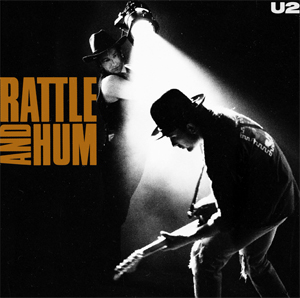
(#374: 22 October 1988, 1 week)
Track Listing: Helter Skelter/Van Diemen's Land/Desire/Hawkmoon 269/All Along The Watchtower/I Still Haven't Found What I'm Looking For/Freedom For My People/Silver And Gold/Pride (In The Name Of Love)/Angel Of Harlem/Love Rescue Me/When Love Comes To Town/Heartland/God Part II/The Star Spangled Banner/Bullet The Blue Sky/All I Want Is You
(Author's Note: Italicized songs are performed by artists other than U2.)
Bono recalled the section in
Luke 9 when Jesus told a man not to wait and bury his father but to follow Jesus immediately. Daly responded to Bono’s summary, “Seems cold-hearted.”
Bono replied, “No, seems punk rock to me. He could see right into that fellow’s heart. He knew he wasn’t coming and he was just, it was pretense. We’ve gotta be a bit more cutting edge, not look to the signs of righteousness. Look to the actions.” - "Bono on Jesus, C.S. Lewis and King David as a bluesman" 2013
It is hard to know just where to start here; at this juncture it is best to reach the summit gradually, and I must set the scene first.
Late October 1988 saw me in as bad a state as ever, though I was still functioning enough to go to Ryerson, read the
Village Voice and other music weeklies, write poetry, and once again wonder if I had a writing voice and if anyone would ever care for it. But mostly I was carrying grief with me, waking up to it as a seemingly permanent state like someone with the sniffles wakes up with a fully-blown headcold. My mom couldn't sleep in the bedroom, but slept on the couch instead. Lots of suddenly superfluous things neither of us needed or wanted crowded up the house, and we were too numb to do anything about it just yet. Music kept both of us going, I think - me on my Walkman, and she listening to the CBC late into the night.
In this state my listening was alternately intense and casual; habitual and random. So of course I got this album on vinyl and thanks to a free ticket given to the
Ryersonian (the paper I would be working on in the next semester) I got to see the accompanying movie
Rattle And Hum for free. It was the thing to do, and liking U2 was quite hip at this time, as was the whole rock-with-a-conscience effort - I saw the Amnesty International concert at Maple Leaf Gardens, after all, and hadn't I seen U2 back in April of '87 in Pontiac, Michigan? Yes, I did. But even then I felt a bit weary and hollow, and the only time I felt
good in conjunction with AI was when I actually helped get someone out of jail. (He even wrote and thanked me, which was very kind of him, but tragically I couldn't write him back.) I appreciated all the eager conciousness-raising, but wondered just how much people would be
motivated to do something besides buy an album or maybe go see the band/performer in question again on their next tour. I enjoyed all the concerts, of course; and now I think of it, I even went to one in April or May of '88 in Toronto, and that was a direct benefit concert for the Toronto branch of AI, which was cool.
Maybe it was my grief that made everything turn from a tint to a shade; maybe it was the approaching winter, the cold air seeping in, the end of summer. But I remember being distinctly underwhelmed by
Rattle And Hum and by the movie too - without any real ability to point to anything at the time, just a vague sense that something about it was wrong.
Little did I know, but across the Atlantic in the
NME offices, things were starting to get complicated. Now, as a Ryerson student the mantra was - and God knows this was drilled into us in our last year in the Newspaper section* - that the advertisers should not dictate the editorial or investigative parts of the paper, that if they don't like something that's run they can take their ads elsewhere. Idealistic stuff we knew, but the point was that integrity was
all in journalism, especially the harder stuff. At the
NME however, the editor Alan Lewis was doing the shameful censorship himself,
sans advertisers. And so a perfectly fine review of this album was canned in favor of one that was all praise, and all because the editor wanted to put U2 on the cover. One review, the more truthful one, gave it a 4; the make-nice one was an 8, and sure enough, U2 did make the cover, denim, cowboy hats and leather vest in service to their current American phase.
Because I didn't know - in my almost daily round of errands, notes, jolting poetry ideas, etc. I could be distracted very easily - I had no idea that the writer of the first review, Mark Sinker, was sufficiently demoralized by this action that he left the
NME just what Journalism Head John Miller would have told him to do, if he felt the editor was bound to do this kind of thing again for the same purposes (I have no idea if this happened again, by the way). If I had known about this, then The Journalist's warning about writing for the
NME in particular would have made a lot more sense.
Now, normally I don't approve of numerical ratings for things, but in the spirit of this last review (now since disappeared - maybe it's in the
NME archives somewhere?) I will rate everything on the album out of 10, and more besides.
"Helter Skelter" - "This is a song that Charles Manson stole from The Beatles. We're stealing it back." Okay, first off I must say that as an American I feel a certain...
authority about these four Dubliners coming over and paying, uh, "tribute" to my nation. God knows Americans are not subtle people, but there's heavy-handed and there's feeling like you're being pelted by small potatoes. U2 do
not get going on the right foot here - the song is not scary enough, the gesture is clumsy and as a resident at the time in Los Angeles not all
that far away from the killings, U2 cannot
possibly understand how weird and tense and paranoid late 60s Los Angeles was. Already I feel sorry for the audience here, because back in Pontiac U2 were not trying to ingratiate themselves with us Americans - yet. (1/10 for reminding me how batshit the original song is.)
"Van Diemen's Land" - Do you think Billy Bragg (
Worker's Playtime, late '88, "Waiting For The Great Leap Forward") heard this and laughed? How am I, suddenly immersed in poetry, supposed to react when I read in the notes that this is a song for Fenian John Boyle O'Reilly who was deported to Australia because he was an apparently not very good poet but caused trouble anyway? This is sung by The Edge, nasally, and I doubt if it's any better than O'Reilly's poetry, really. It is the first hint of the largely political subject matter at hand, but Billy Bragg is funny and this is just...dull. (1/10 for reminding me of Billy Bragg, who I saw around this time at the Concert Hall, alongside Australian band Weddings, Parties, Anything.)
"Desire" - This was the big #1 hit song in the UK and probably why a lot of people bought the album. I cannot hear it without cringing, though, as it is full of...sigh...signifiers and
business and yet feels so secondhand. And then there's the harmonica. Now, the harmonica is one of those ur-American instruments that signifies a lot and has to be played very very well or else it sounds awful, and yeah, Bono can't play harmonica. Robert Plant wails away on "When The Levee Breaks" and Chrissie Hynde sounds pissed off at the end of "Middle Of The Road" and Johnny Marr sounds like Johnny Marr on Smiths songs and elsewhere, and they can all
play (so could Brian Jones and John Lennon, for that matter). Alongside the ughtastic "AAwwRiIIIIGHT?" Bono makes it worse by sounding like a busker, though I feel I am insulting buskers by this comparison. Playing something badly does not equal "authenticity" but someone seeking said quality and not understanding that it's mostly about actual experience and
skills, fella. (0/10 as it's also got the line "She's the promise in the year of election" which has always,
always made me cringe.)
"Hawkmoon 269" - This is a love song of endless similes and proceeds to slowly crush anything that love actually is out of existence. "I Need You" by America is more succinct, and the only other song I can think of that is as inane about the sun is Cliff Richard's "Power To All Our Friends." "Power to the sun" he sings brightly, not thinking that maybe the sun is actually a source of massive power
itself? (I must haplessly digress here to Brunching Shuttlecocks' survey of sources of
light.) "Like heat needs the sun" Bono sings, and there's Bob Dylan yes everyone American Musician Of Importance #1 has turned up here and is playing organ, let's give him a big hand, everyone! Actually this makes me want to read Brunching Shuttlecocks and then listen to "Agua De Beber" by Astrud Gilberto, but to each their own, you know? (1/10 for helping to introduce Dylan, eventually, to Daniel Lanois, who helped him out of his 80s slump.)
"All Along The Watchtower" - Oh, did someone say
Dylan? Well, here's U2 attempting this song after hearing it on the radio a few times. To say it's not as good as Jimi Hendrix is obvious, but it's not even very good for U2, who at this stage in their US tour are in San Francisco trying to be The Beatles (again) by playing on a rooftop and spraying graffiti and calling it their "Save The Yuppie" gig. OMG U2 are like, so punk rock! They have a sense of humor about the recent Wall Street crash and are stopping traffic and not caring if they can't really play! Meanwhile, the real spirit of punk is whittled away some more, and genuine subversion is trying to rid rock of the
Rock 'n' Roll Hall Of Fame special episode 1968 The Year That Changed Rock Forever sludge that clogs up this album like the aforementioned head cold. I mean, this is
Tops Pops Hits level of badness, and saying it's "Three chords and the truth" doesn't change the fact, Bono, that this song has
four chords. What next - "Eloise"? "People Got To Be Free"? "This Wheel's On Fire"? "Dance To The Music"? "Tighten Up"? "When The Music's Over"? "Honey"? (0/10)
"I Still Haven't Found What I'm Looking For" - It may have seemed like a good idea at the time (really that could be the subtitle to this entire album) for U2 to perform this song with a gospel choir, what with it being a religious song and everything, but note how completely outperformed and outclassed they are by the New Voices of Freedom here at Madison Square Gardens, in particular by George Pendergrass and Dorothy Terrell, who make the song sound vital, as if it is about something, and that's because they aren't on autopilot, as the band seems to be after so many, many shows. Eventually U2 have the good sense (for once) to just stop playing and let the choir take over, and it's one of the highlights here. The thorny question of whether they have the choir here to make all this soul-searching more "authentic" is atill a good one, though, especially since it has become commonplace/cliche in so many songs to have such a choir come in at the end to make a rather ordinary song more "meaningful" and "uplifting." Whereas gospel music is literally about enthusiasm, but is also profound and political and so on. Maybe U2 are trying to signify here? As Christians their understanding of music is different from, say, The Housemartins, whose song "I'll Be Your Shelter" is overtly gospel and political and darn it feels a lot more heartfelt, somehow. (6/10 for the New Voices of Freedom)
"Freedom For My People" - The
story of Sterling "Satan" Magee and Adam Gussow is so remarkable I'm sure Hollywood will make a movie about it one day. They kept right on playing on the streets in the 80s, only getting a record deal in the 90s, on the back of their own efforts, nothing to do with U2. Very much a touristy moment on Rattle And Hum, a sort of moment where the real United States once again subtly trumps whatever the tourists are doing. Satan and Adam are still out there, God bless them. And Adam plays better harmonica than Bono. (8/10 for being too brief.)
"Silver And Gold" -Well there I was in my room, sitting on my bed or the floor or my chair (all so close to each other, didn't matter where) and I remember hearing this and feeling certainly
moved by the sentiment - I mean who doesn't want to raise arms against their oppressors sometimes? - but weighed down by the rhetoric. This is about a man who wants to be free, but here are U2, putting him in chains, chains that sound like Ry Cooder or Bruce Springsteen or David Gilmour. Oh, and this song (as Bono explains to the audience in his odd neither-Irish-nor-American accent- "Am I bugging you? I don't mean to
bug you") is about taking up
arms? About
violence? (Taps index finger to side of head, tries to remember, oh yeah) aren't you
also the guy who said "Fuck The Revolution" about the actions of the IRA in late '87? COME ON ALREADY dude, you can't have it both ways. Also, when requested by Bono to play the blues, The Edge
can't play them. I wish I could say I was making that up, but I'm not. Will Sergeant knows more about the blues than you do, son. (0/10, made worse because I think Bob Dylan or Keith Richards or some such rock "legend" encouraged him to write this song.)
"Pride (In The Name Of Love)" - Yes we are back to this song again, and yes, it's live and oh yes Bono has something to say here. It's "PRIIIIIIIIIIIIIIIIIIIIIIIIIIIIIIDE" in the name of love, as annoying as Rihanna is these days. It's not played very well (a bit too fast for me) and there's lots of back-and-forth whooah-ooohaaa-oooohs between Bono and the audience, but it's all a little self-congratulatory, coming at the end of tape one (or side two on the record) (0/10 for the audible smugness.)
Pause...
"Angel Of Harlem" - If there was ever a song where the bingo cliche card would be filled, it's this one. Again, to someone with more than a passing interest in jazz, is this just plain embarrassing, wrong on so so many levels it's hard to know where to begin.
But I will say that doing a song in Sun Studios about the New York jazz scene is, well, a little odd - mainly they are trying to be all Stax here, but Bono is no Otis or Sam nor indeed Dave. He is YELLING this song about a woman whose very technique was
subtle; he is glorying in being in New York and yet wearing a stupid hat (there, I've said it) like a yokel in Memphis. Again, I'm not expecting a work of art here - after having suffered through the first part, nothing can really surprise me now - but this is horrendous. That he throws in Miles (yes, just Miles, the masses of U2 fans are supposed to know who he is)** is one thing, but OH NO he's mentioning John Coltrane and
A Love Supreme.
As I have already
explained, this album is both very good but is also a kind of stereotypical album that someone like Bono
would champion, not just because it's a religious album but because it's practically a part of the rock canon at this point (jazz division obvs.) and that's all to be expected at this time...but still it's incongruous. John Coltrane has nothing
at all to do with Billie Holiday, he never worked with her, so again this is just Bono signifying that he has an
incredible grasp on jazz because he knows about
THREE people in it and is going to go on about one in a way that would have just
irritated her, I'm guessing. And of course she's portrayed as a tragic figure (you know, a bit punk rock, like Jesus) is also awful. But the near-penultimate line, again yelled out as if he was a pig farmer - "SALVATION IN THE BLUES!" - is enough for me to ring the invisible bell and bring this album to an end. Nope, nowhere near that yet. (0/10 and if I could make it a minus, I would; also we haven't heard the last on
A Love Supreme, oh no.)
"Love Rescue Me" - In which American Musician Of Importance #1 comes by for a song he co-wrote and it's so meh I can't tell who wrote what parts - except for the part that quotes the Bible. This is so bad that when he sings "the future is here at last" I am only happy because that means the song is ending, a song that mentions "the purple of her eyes" without ever explaining how her eyes got to be purple. I'm sure this love is coming to rescue you, Bono, but I'd take her to the doctor, first. (0/10, for quoting the Bible awkwardly.)
"When Love Comes To Town" - And here is American Musician Of Importance #2, the now late Mr. B.B. King. To say that this man shows up U2 for the hopeless rubes they are is a gross understatement - and yet they treat, as Mark Sinker wrote, Mr. King as if he was their "butler." There's no way I can put it better. Mr. King himself called Bono a "young man" and that also just about sums it up. Oh and SHUT UP BONO. (9/10 for King, 0/10 for U2.)
"Heartland" - And suddenly a song that was recorded during
The Joshua Tree sessions shows up and is remarkably better as it has Eno and Lanois, who do a much better job producing U2 than Jimmy Iovine does. That it isn't that great by
Joshua Tree standards but is a moment of calm and reflection here shows how frantic and unpleasantly loose
Rattle And Hum is. Somewhere a few young men in Abingdon are listening carefully - this is what to aim for, not all this other stuff around it. (5/10 for reminding me how good
The Joshua Tree is - easily forgotten at this point.)
"God Part II" - So far Bono has taken up the cause of the anti-apartheid movement, asked and failed to hear the blues, been shown up by B.B. King, a choir
and Bob Dylan and has attempted songs by Dylan and the Beatles. Well, now he's all about John Lennon, and this is where I got off the figurative bus with U2, never to ride it again. Lennon's songs can and will be remembered, in part because they are so direct and plain; and the many memorials to him in music were varied and successful.
This, on the other hand, is Bono seeming to take up the mantle of Lennon (a mantle his last
album was trying to shake off). It makes me feel queasy to hear this song - supposedly a sequel to Lennon's own "God" - and there in the second verse..."Don't believe in forced entry, don't believe in rape/But every time she passes by wild thoughts escape"- and this is followed by "I don't believe in death row, skid row or the gangs/Don't believe in the Uzi it just went off in my hand" and I scratch my head and think just what wild thoughts he (the narrator, though there is no reason not to think it's Bono) has and how violent he could be. And this is the crux of the whole album - Bono always seems to be going on about what a
terrible person he is (in one song he's living in the palace of sin) but what has he actually done that is so bad? Is it just thinking about doing wrong things? There are actions and there are words - hey, he says so himself up there - and part of me thinks that you actually have to
do something wrong in order to know just how bad it is. (Nick Cave could tell Bono a thing or two about this.) Then he sings about how "I don't believe that rock and roll can really change the world" and then "I don't believe in the 60s in the golden age of pop/You glorify the past when the future dries up" and then the whole album collapses in on itself.
And yet did I notice this at the time? Gina and I were too stoked by the fact that he quotes Canada's own Bruce Cockburn next, from his song "Lovers In A Dangerous Time" from 1984's
Stealing Fire. That we would be so excited shows how modest and unthinking we were about Canadian music - gosh, someone
noticed him! And he's mentioned in the lyric sheet and everything! This I remember clearly, but my exhaustion with this album came with it. Did I think, hmm, maybe one day there will be Canadian music to look forward to expectantly as much as I did with this
Rattle And Hum? Maybe. That Bono professes to believe in love more than the past is, well, to be expected, but then what is the point of this selective look back at US music? Is he saying that U2 has no real future, that this whole thing has been a dead end?
The 80s have been threatening to end for some time now - early '87 I'd guess - but here the 80s are truly coming to an end. (Perhaps this inspired Fukuyama in thinking we'd come to the end of history itself.) You can't be political and make a difference? You can't look back without somehow being able to look forward as well? U2 have effectively painted themselves into a corner here, and we have reached the divide - there are those who can engage with the present and future and have the capacity to learn and change, and there are those who are content to stick with what they know, who are suspicious of anything new, who revere tradition, who claim they don't believe in a "golden age of pop" when in fact they do.*** Reaching back to do a sequel to a song by John Lennon is hubris. Is it what Roxy Music or The Human League or Mike Oldfield did? No, but they aren't U2 now, are they? (2/10 for quoting from a much better song, by a much better guitarist, for that matter.)
Digression: Wouldn't John Lennon have been happier just listening and re-listening to The Chameleons' version of his "Tomorrow Never Knows" from
Strange Times? Wouldn't the world have been a better place had The Chameleons had some of U2's popularity and fame? As I listen I hear Mark Burgess & Co. not just covering the song but relishing it, revelling in it, wrestling with it, trying their best to bring this 20-year-old song into the present, giving it a
life, a second life. This is not sloppy genuflection but an actual audible
thinking about what the song is saying. There is big difference between what you
want and what you
need. Surely with songs like "Tears" and "Swamp Thing" are far more Lennon than anything on
Rattle And Hum.****
"The Star Spangled Banner" - Yes, this is Jimi Hendrix at Woodstock and even if you hate hippies and think Woodstock was overrated, to hear the whole thing is still a
revelation - this was used by U2 before they performed the next song, and to say it makes them sound dull and ordinary is an understatement. (10/10 for Hendrix, 2/10 for U2's thinking here.)
"Bullet The Blue Sky" - OH NO not this again.
"So I'm back in my hotel room with John Coltrane and
A Love Supreme
...in the next room I hear some woman scream out
that her lover's turning off, turning on the television...and I can't tell the difference between ABC News,
Hill Street Blues
and a preacher on the old time gospel hour..."
Based on this, do you think:
He's listening to Coltrane but not very loudly;
He's "with" Coltrane on some spiritual level but not actually listening to him;
He listening to Coltrane loudly all right, because if he can't tell the difference between those shows then that's the only answer that makes sense;
He needs to get a different room.
(1/10 for mentioning Coltrane again and giving the listeners a logic problem to solve; the song around it is just as you'd expect, and since when does God need cash?)
"All I Want Is You" -Or, when in doubt, why not pretend you're Echo And The Bunnymen?
U2 were not a band who worked in isolation; they knew very well there were other groups - like the Bunnymen and The Smiths - who were just as good (if not better) and they had to keep the hell up. Maybe part of the reason this whole thing is so bad is that they don't feel that sense of healthy competition any more, that they really are the biggest/best band in the world and can do what they like. A big ballad that has strings arranged by one Van Dyke Parks (it is a total relief when they come in) is a way to close this...thing...but notice how the strings are a little...
dubious, a little questioning? At least U2 aren't trying to sound like The Beach Boys here (thank goodness for small mercies) and, um, well
Ocean Rain is about twenty times better (song and album) but the lyrics and singing are kept in check, before the strings hmm and haw along into infinity.
As you have already figured out, I don't think much of this album and its success is a saddening and discouraging affair. I mean, if you wanted to listen to The New in US music there was always rap or go-go; or if you wanted something old and something new at the same time, well, where better to look than country music? There was Dwight Yoakam bringing the Buck Owens feel back with
Guitars, Cadillacs, Etc. and
Hillbilly Deluxe and showed that a young man from Kentucky could make in the punk rock bars of L.A.; straight out of Texas came the supremely inimitable Lyle Lovett with his self-titled debut and
Pontiac; shit-kicking motormouth rebel Steve Earle - born in Virginia, raised in Texas, he's bad, he's nationwide - came out with
Guitar Town in '86 and certainly caught the ears and eyes of many U2 fans, in my experience. For those who want something a little more smooth, there was North Carolinian Randy Travis - his
Always & Forever and
Old 8x10 were huge, and helped to launch a whole movement called
neotraditionalist. And let's not forget Lucinda Williams, who if there was any justice would be the main subject of this piece with her 1988 self-titled album, and not U2*****.
But U2 were in a touring bubble, turning and turning in on themselves, and did not heed the wisdom of another man from Texas:
"Ornette says, "The kind of music we play, no one player has the lead. Anyone can come out with it at any time. Rather than be a success myself, I want the music to be successful." In other words, there aren't any stars on this record, or in Ornette's world; just people who play, and people who listen." - Bob Palmer, liner notes to
Science Fiction by Ornette Coleman.
In the ambition of U2 lay their demise; they want to be
big, and at this point are becoming the biggest band in the world - but they are losing sight of Coleman's view, if they ever had it in the first place. Their antipathy towards "indie" rock shows this; their complete inability to understand American music despite having toured there for years is proof as well. I can well imagine Brian Eno listening to this and wondering what went wrong, and it will be years before U2 return to
TPL. The US is a big, varied and blunt place; there is something fierce and lonely and profound about it that is too easily reduced to symbols, slogans, cliches - in part because they are true. But there is a world of difference between someone wearing a Sun Studios t-shirt while recording there and someone who has a profound respect for Memphis and for the South in general. (And as we shall see, the South itself is a varied region.)
But what do you say about
Rattle And Hum, Mr Tennant?
"Rock critics liked
RAH because they want a return to the traditional rock values. What they basically want is for it to be like 1969 again. It's this thing where British - or in U2's case Irish - groups discover the roots of American music. U2 are doing this and they're just doing pastiches (his voice rises) and it's reviewed as a serious thing because 'Dylan plays organ' on some song and B.B. King plays on some throwaway pop song. "When Love Comes To Town" that could have been written by Andrew Lloyd Webber. It could be in
Starlight Express if you ask me."
"The fact is that PSB stand against all of this, so it's quite right that people like that should slag us off. Because we hate everything that they are and stand for. We hate it because it's stultifying, it says nothing, it is big and pompous and ugly. We hate it for exactly the same reasons Johnny Rotten said he hated dinosaur groups in 1976."
Ladies and gentlemen, I give you the opposition:
Now, compare the Bono-shining-a-spotlight-on-The Edge (you can just sense Ornette Coleman's amused distaste at that) to this pleasing and reverberating set of colors. You just know and feel that this is different; that they didn't want to have a photo of themselves on the cover, as they - the Pet Shop Boys - have a plan.
Why do regular singles and then mix longer versions when you can just do longer versions and then edit them? Why not prolong the feelings and emotions and dig into them right away? To immerse yourself in the song, to immerse yourself in the music itself. The op-art cover stands against the cult of personality that U2 stood for (yes, hello Living Colour, hello
Vivid, hello Black Rock Coalition.)
It begins with a swirl of strings, a woman's voice giving us drama, the curtain pulls back....
...and we are in the past. This is not the past of U2 however, a generalized past, but a specific one, set to a house track that clatters and speeds along An ordinary day is sketched out - getting up, watching tv, talking with a friend, maybe going out to shop or staying in to eat. "I didn't want to compete or play out on the street" - this album isn't called
Introspective for nothing. We are going back into a specific past, one of the imagination. "Che Guevara and Debussy to a disco beat." The past is remembered in the present, zooming ahead, and "left to my own devices" - those backyard devices of politics and music - are introduced, and the world of dreams and reality mix, and imagination and longing come into the mix as well. This is a secret symphony, a moment when dreams are revealed, when the world and all its mundanity and ordinariness are redeemed by this long-held feeling. "I could love you if I try." Could the narrator try? Once he had "no strength, no joy" and was lonely, but here he is, able to get all the news from the "party animal" (Jon Savage, as it turns out) and is coming out of his shell, where once he was a "roundhead general." The music turns and swirls again and again, the everyday given drama and crispness. This world is
interior, and far away from the 'soul, passion and honesty' of U2. The future is on the line - will he love? "I probably would." There are no certainties, no rote answers.
A man goes home; he is on the way home. He knows no one will be there when he gets there, so he thinks that he wants a dog. He wants a Chihuahua, a little yappy dog. But not a cat (this song is mean about cats, I feel). A dog that will bark and bark and distract him from his loneliness. "Oh, you can get lonely..." Whether there ever is a dog at his place remains to be seen. In all likelihood he walks through the dark, deep house song through the dark street and into the dark "small flat"...silent and with no dog around. A friend of mine said this was one of the saddest songs she'd ever heard. A dog to keep you safe from others? A dog to keep you company at home? Is the narrator capable of love? Because that's what a dog, even a little jumping dog, really wants. As anyone knows, you have to be ready for an animal, it's a full-on experience. No miserable person can just go and get a dog. There's a bigger problem here...
Remember when I said the South is a big area, quite varied? Well, here the PSB are in Miami, working with the producer Lewis Martinee, who did songs for Expose and all of the players on it are Cuban - there's another America for you, U2! But the song is about romance, deceit, jealousy, heat, and humidity, "all day all day." The Other flirts and flirts, winning over others when she should be with the narrator - the thrill of the chase exhausting and causing doubt and a thunderstorm, on the inside. It sounds like a tango, like a mambo, like the fragile heart being tossed this way and that by the forces of the Other, her dancing with danger wearing him out. She is relentless and as tough and fierce as the sun.
And from sunny Miami we go to Paris...
Now, this is the 1968 that the PSB are about; this is the past they are recalling. Not the Beatles, but the regular people of
Paris - students, but others as well - protesting, on strike. Not a rock song, but a movement from the people, those people including the Situationists. It was on the wall:
Cela nous concerne tous. ("This concerns everyone.") The police had books thrown at them as well as paving stones; this was an intellectual, social event, and a violent one. Suddenly we are with a young woman - Tennant is singing it from her point of view - and she is surrounded, but courageous, just as the people of Paris were. (Eighth Wonder had already had a hit with their version of this earlier in the year.) This is a film though; the opening band playing at a counter-revolutionary rally. Her boyfriend is a hooligan, he's The Man - but she has had enough of him. "Take these dogs away from me" (scarier dogs than Chihuahuas I bet). The song beeps and looms in the best French tradition, and the fascist speech is there in the break, the clapping, the marching - but she is resolute. She is not scared. She is not one for poses, for pretending. She is going to fight for her equality and rights. "If I was you, I wouldn't treat me the way you do." The music rises and rises, she puts on her Chanel sunglasses and goes out into the daylight, after a night and morning of fighting. There is nothing left to lose. The future marches on; the workers march on. Again, the music is utterly modern, bringing the past into the future...
"Always On My Mind/In My House" is one of those crushing ironies that U2 could not hope to compete with. This is, as I have to remind myself at times, a
country song by Willie Nelson, a song about that interior feeling of guilt and longing and hope being expressed to the Other, no doubt a woman, who is there at home feeling lonely and neglected. Thus the PSB are quite able to pay tribute to the roots of US music while still taking this to a different place altogether. That Tennant raps in the acid house part - his voice going up and down, the music pulsing, the ambiguity in their original version still there - makes this a more intense (85% cocoa in effect) version. He loves and thinks of his other, but can she read his mind? No, she can't because what he feels he won't show, or cannot show. And yet the song warps and weaves back to that Christmas '87 #1 and the gliding, explosive and giddy style is still the multicolored light show above a mournful, solitary figure talking to her in his mind, his maybes being crushed by his love...but maybe he didn't love her? Didn't love her enough? More explosions at the end, to match the breaking glass as "In My House" begins, the house after all being not just the music but the social interior. What does his Other have to say? Still no idea, but suspect that a look between the two will say more than words; that he did everything for her, and was too busy to tell her so. Do the PSB understand the US more based on this and "Domino Dancing"? OH YEAH.
But now we go to Chicago, the home of house music, for something rather moving. "It's Alright" is originally by Sterling Void and Marshall Jefferson, and is socially conscious and celebratory all at once. It is also prophetic...
...and there's a choir, saying the title of the song, dropping out for Tennant, who is far away, possibly in the future? And then the piano and beat of house, the "alright" being chanted...Afghanistan, South Africa, Eurasia - all in trouble, but hope is the solution. What proof is there of goodness? The music. "Generations will come and go, but there's one thing for sure/Music is our life's foundation" and OH DAMMIT I'm crying, this is too moving "The year three thousand may still come to pass/but the music shall last/I can hear it on a timeless wavelength/never dissipating but giving us strength..." And indeed the song goes on, then suddenly stops for those amazing chords on the piano and the morse-code beats in the back; this is is the future, the future is here NOW and there is no useless looking back as there is with U2. Trevor Horn (for he produced this) does his usual magical job. "It's gonna be alright!" sings Tennant, throwing his hope to the wind. He knows it's going to be alright, that the music - this kind of music and its descendants - will indeed go on. This faith in music goes against Bono's doubt, and the song ends with Chris (yes, Chris) saying that he too thinks it's going to be alright. The choir ascends, the music lifts...
....and somewhere in London just a few days after
Introspective is released, a little boy is born...and grows up to do this
song, a kind of combination of answer record to "Always On My Mind" and an affirmation of the ecstasy of music itself. Will the music go on and on? Will the music last? Could heaven ever be like this? In all their sweaty evocations of the past, could U2 reach this joy and intensity? Look at the cover of
Introspective and then
In Colour and the indebtedness couldn't be any clearer, but we are truly on the inside here, in the
depths...(more on
In Colour when the time is right).
There is another album which could be considered the "opposition" to U2 although the band itself didn't consider them to be as such; they didn't really compete with anyone. They spoke to those who maybe felt a bit left out, a bit alone. That they were now on a major label just meant more people could participate in that great aloneness, and I will get to who those people are in a moment. The band I am thinking of is of course R.E.M. and this is the album:

It starts with a stumble-and-fall, and confusion: "Hello, I saw you, I know you, I knew you, I think I can remember your name." There is a blithe eyebrow raising with Buck's guitar, but deadpan from everyone else. "Pop Song '89" is not about being certain or sure about anything. "Hi Hi..Hi" repeats Stipe, as if he keeps trying to talk and then not knowing what to say. "I think I thought you were someone else." There goes the 80s, poof, done. It's over. It is so strange; no one knows who they are or what to talk about. "I lost myself." The music grasps and grasps but cannot hold on to anything - everything keeps slipping away, and HI HI HI
AND
"AAAAAAAAAAAAAAAAAAAAAAHHHIIIIIIIIIIIIIIIIIIIIIIIIIIIIIIIIIIIII" begins the PERFECT segue into "Get Up" and sleep is the subject or is it? AAAAAAAAAAAAAAAHHHHHHHHHHHHHHH "dreams they complicate my life/dreams they compliment my life." It is as if the decade is just one long dream that people are trying to get out of, or trying to dream their way out of. AND music boxes tinkle and the inexorable pull backward as Stipe sings "this time there's no escape from dreams" as the song AAAHs once again and ends, pausing, ending as if the singer wakes up...
...already we are one hell of a place away from U2. We are in the interior again, but this is a song of observation - Stipe telling Mills (who is in the background) to get up. But dreams are powerful things and give life a certain dimension...
...and suddenly there's the sound of crickets (already I am homesick) and it's night and there's a mandolin and "Sometimes I feel like I can't even sing/I'm very scared" and automatically the narrator guides us back to childhood, falling into sleep in the backseat as you look outside and see the stars. "I am in this kitchen, everything is beautiful, she is so young and old"..."You are here with me, you are here with me, you
have been here with me..." I don't think this is much of an exaggeration, but this is, of all 1988 albums, the one that helped me with my grief. There is little distance between myself and these songs; I can't even call it my favorite of theirs, as it is more
imprinted on me than any others. "You Are The Everything" (and the whole album) brings it all back, too much to write about it objectively. But I will try..
"Stand" is simply genius; a demented hymn, an orienteering anthem, funny and yet solid. "If wishes were trees, the trees would be falling." Nothing is permanent; "think about direction, wonder why you haven't before." Be careful, look, notice, think about where you are and why you are there. Are you where you thought you were?
And then Peter Buck does the WORST guitar solo ever, as if in answer to Bono telling The Edge to play the blues. STAAAAAAAAAAAAAAAAAAAAANNNNNNNND.
And then they do such a riposte to all of Bono's grandstanding (and perhaps their own?) that it's chilling. Part one of this: "World Leader Pretend" is the song of a dictator, a paranoid, remembering and ruling and "it's amazing what devices you can sympathize, empathize" and the wall here is coming down, right alongside a steel guitar and he is alone, far more alone than the narrator of "I Want A Dog." "This is my world and I am world leader pretend." The leader gets up, admits his mistake, takes full blame, knocks down his wall...YOU FILL IN THE HARMONY. YOU FILL IN THE MORTAR. I am not sure who the you is - the audience? The Other? A burden like this cannot be carried by one person alone.
Oh man I don't know how I can write about this next song. It makes me cry; I cry the whole way through it. I don't like that a crying response to a song is seen as "girly" when it is only human. Okay, here goes...it has two voices - Stipe sings background here, not Mills. "Swingset hands," "I will try to sing a happy song." "Come play with me..." This is the interior. This is the hopeless interior. "I'm not supposed to be like this but IT'S OKAAAAAAAAAAAAAAAAAAAAAAAAAAAAAAYYYYY."
"Hey those kids are looking at me...I told my friend myself...they're LAUGHING and they're running
over here...what do I do? What can I do? What do I say? What can I say?"
In case you hadn't figured it out, the wrong child is in a literal sense one who is disabled, but this song stands for anyone who feels isolated, left out...and there's a whole generation who have grown up listening to R.E.M. and who feel this way. I don't know if they all hear this and cry as I do, but there is such poignancy here - is it an exaggeration to say that the soon-to-be-named Generation X were all made to feel this way by others? I don't know. But this says a lot more about frailty and courage and loneliness than U2 could ever do, and Stipe's near-angry last "OOOOKKKKAAAAAAAAAAAAAY??" is as sharp as ever. It cuts any sentimentality right out.
As does "Orange Crush" - their own evocation of the Vietnam War. "Follow me, don't follow me" says history, as if to say this is worth remembering, but not repeating. Stipe's an Army brat; for him to do such a song, such an overt song about what happened must have been liberating. Even if the song is about a high schooler going into war, it is about "time to serve your conscience overseas" and how a nation was brainwashed into thinking that was true....
And now the grandstanding song #2 - "Turn You Inside-Out" When I saw R.E.M. do this, the background image was a school of fish, swimming this way and that. The pounding, whipping noise, the beat, the absolute rules; this is about power and the manipulation of power, of crowds. "II-IIII--IIII could turn you inside-OOWWWWWWWWWWWUUT." "I believe in what you do!! I believe in watching you!!" Here Stipe is of course looking at himself, at his effect, at his manners, and admitting that he has
power. That the situation of being a lead singer of a popular band gives him choices. All the bossy asides of Bono are pushed to the max, as people used to say. The madness of a crowd, the charismatic leader, the power - there is a kind of
madness here that R.E.M. are recognizing and it was damn strange to see this power brought to life onstage and then destroyed by Stipe. This is
not the future, he is saying, what is coming next will
not be like this.
"Hairshirt" is once again about being an outcast, about being shunned, about being "soooooooooo alone." But it is about giving up that guilt, casting it away, burying it, no longer feeling bad. "Here I am...HEERE I AM." Do I hear "Creep" by Radiohead coming out of this? Maybe. Do I hear someone else, 21 just like me, listening and nodding? Oh yeah.
"I Remember California" is not how I remember California, but the traffic jams, citrus fruits, smoggy skies, going up to or from Fresno...I know what they are talking about. "History is made to seem unfair." My father being buried beside his parents there in the San Joaquin Valley. "I guess it's just a gesture." Suddenly R.E.M. mean what? Are like who? My Bloody Valentine? Talk about the opposition to U2! "The lowest ebb and highest tide...the edge of the continent"...the end of the decade...the music here is exhausted, doomed, but it captures that finality of reaching the Pacific and what can seem like the end very well...
And now, the last unlisted song, one where everyone is playing a different instrument than usual and it's "It's Alright" again..."This world is big, and so are we/I stayed up late to hear your voice...this song is here to keep you strong." Wonderfully amateurish playing, but that is the spirit here -
"hold her and keep her strong while I'm away from here." Bells! Overlapping, dazed voices, a recognition of how much love there is in the world, how much love is needed. A benediction, after so much turmoil.
Green was not meant to be a normal, regular album, and it still has a freshness and profundity that...well, you know...
I cannot tell you, due to my extreme subjectivity with
Green, how important it was for anyone else, though time seems to have shown that it has had one hell of an impact. How I grasped on to it for help at the time; how I felt understood by it, even if a little awed, and what a bulwark it was for me, as my grief grew and took hold. It is as palpable as a hug, and in the fall of '88, with four more years of Republican rule (and in Canada five more years of Mulroney) the political lines were there, but my loss was not public. The interior and exterior meet here, and just as they step up to major label fame, R.E.M. show they are not about to show false consciousness. This is a rough album, and in time I would buy it again and associate it with another death; but there is life here, and a reminder that life is about love and support, and not power and influence...
And so the divide stands; U2 look backwards and implode, right there onstage, while the Pet Shop Boys and R.E.M. both have ways forward that include everything from genuine empathy and sympathy to a kind of bravura and profound faith in music that can actually sustain hope and the future itself.
My grief would follow me; sometimes it would carry me, paradoxically. I would resist any call from the outside for now; the words of Jesus above couldn't really apply to me, as my father was still very much alive to me in so many ways; it would take a very long time to work through this, and I had no real guide or map. The divide I mention is not just a musical one but increasingly a political one; this is a period of transition, though none of that has happened yet, and both in music and politics the old orders are stultifyingly there, but with some kind of other
noise in the background. If I tell you that on their future singles the KLF will use crowd noises from Rattle And Hum, well, that shows what subversion there is, and how immense the divide is between the two.
Next: the old order, reasserting itself.
* The
Ryersonian was the twice-weekly paper produced by the Newspaper section - those deemed not good enough to write for the Magazine section but hapless at the Television section as we were not, for whatever reason, photogenic or technically adept enough for it. We worked out of the modest (now demolished) Journalism building and watched a lot of MuchMusic, but that is for later on...
**I was asked earnestly once by my friend Gina's also-U2-fanatical-friend who Billie Holiday was, as she had no idea and had
never heard of her before. She most certainly wouldn't know who Miles was, nor John Coltrane, either. The last I heard of her she became a nun, and for all I know still doesn't know much about these musicians.
***It is about this time that
Q magazine gets started.
****A man on youtube compared The Chameleons directly to Debussy. A post-punk Debussy maybe, but I think the point stands. The acoustic version of "Tears" is tough and yet delicate, and listening to it in '86 unwittingly prepared me for my father's death.
*****Or if U2 were more attentive to their own Irish roots, they might have noted Van Morrison and The Chieftains' excellent
Irish Heartbeat or The Waterboys'
Fisherman's Blues. Granted these only came out in 1988, but they both show better ways of dealing with the past directly, with a kind of seriousness and joy that U2 are distinctly lacking.


.jpg)


 Posts
Posts

