Tuesday, 19 January 2010

The BEATLES: Abbey Road

 
(#72: 4 October 1969, 11 weeks; 27 December 1969, 6 weeks)  
 
Track listing: Come Together/Something/Maxwell’s Silver Hammer/Oh! Darling/Octopus’s Garden/I Want You (She’s So Heavy)/Here Comes The Sun/Because/You Never Give Me Your Money/Sun King/Mean Mr Mustard/Polythene Pam/She Came In Through The Bathroom Window/Golden Slumbers/Carry That Weight/The End/Her Majesty
 
“Once there was a way to get back homeward.”
  
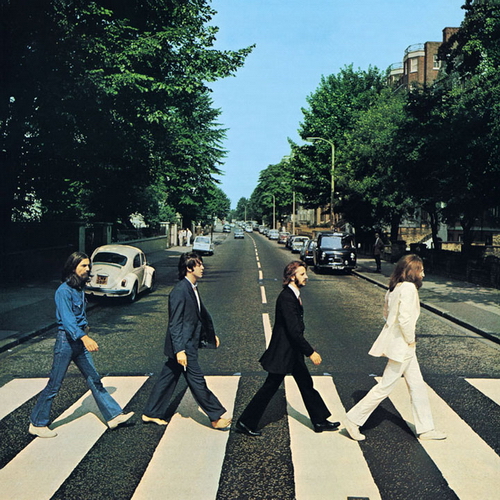
It is a scathingly hot day somewhere in the middle of a summer, some way towards the end of an age. Once these four young men smiled winningly at us from a balcony and now they cannot bear, or bother, to look at us. The grinning balcony is still only a ten-minute bus ride from where they are now walking and their home then was the same as it is now but so much, too much, has changed; three of them have a beard and three – not the same three – are wearing Tommy Nutter suits. They resemble not so much a gravedigger, body, undertaker and priest as three young businessmen leading their lackadaisical rock star charge towards a meeting. What do you mean, who are we? You ought to know by now. The era of PR sleevenotes long gone, the necessity for names or even titles vanished. In any case we’ll be off soon; you won’t need to be concerned by or about us. A journey from left to right, from the past to the future, from one decade to the next, from one stage of existence to another, and they’re not looking especially pleased or particularly distressed about it.
 
The original idea for a title was Everest. Their engineer liked to smoke Everest cigarettes. It was suggested that they fly out to the Himalayas for a cover shot. They gave the suggester a Paddington Bear-like meaningful stare and returned to their separate but still connected bits of business. Abbey Road? Well, that’s where we’ve been these last seven years; the home has become a brand, and we’re stopping just short of becoming a brand ourselves. That was probably just as well. Apple had proved that they weren’t really suited to the branding business, nor indeed to the business of business. There was always money to flow out of the tap towards anyone who wanted it. Wasn’t there? (One of the unsuccessful applicants for Apple funding was the writer and then hopeful filmmaker BS Johnson, who addressed a gruffily disgruntled letter to “Paul MacCartney.”)
 
The business was draining them, or at least their joint business account, and before long, no longer having an Epstein to join the dots for them (or at least make a good fist of dot-uniting), business split them, but then so did encroaching adulthood. McCartney was the romantic, the only one who didn’t want Klein the Stoney cold rationalist managing their affairs, the only one who wanted the Beatles to continue to exist as “The Beatles.” He couldn’t let go of the teenage notion of the Toxteth gang of four, hanging out forever, delaying responsibility and finiteness. He felt safe, warm, within their womb and feared the immediate strike of a hammer, silver or otherwise, if suddenly he had to fend for himself.
 
The other three were, above all resentful, sniping other things, bored. John already had one foot outside the door, his conceptual sexworks with Yoko and Plastic Ono Band activities now taking precedence; George wanted nothing more than to be the second or preferably third guitarist in an easy-going, semi-anonymous jamming band (or, with any luck, The Band); Ringo was just fed up. So Paul took the role of slightly over-ebullient scoutmaster; they stumbled through the recording of an entire album (see entry #77) and attendant documentary film as though they could still cut it, there and then, like they had done in the old, irretrievable days, only to find that, two-and-a-half years off the stage, they really couldn’t. So they pulled together, sat apologetic before stern schoolmaster George Martin, and resolved to make the best possible finale to their time together (their career, if not their individual careers), a marker which would modestly attest: This Is What We Were And What We Did. (Why would they have wanted to stand on top of Everest anyway? Their principal ambition after 1967 had been to get down from the top.) The sun is shining and there are two songs on the record devoted to the sun, but how strong or penetrating were its rays?
 
If you play the cassette edition of Abbey Road you will notice an odd change in sequencing: “Here Comes The Sun” now starts side one and “Come Together” side two. Perhaps it wasn’t so odd a reordering; indeed, despite the initial momentary imbalance from having the album begin with two George songs, it renders a queer logic. In all senses Abbey Road was a collection of individual Beatle songs (rather than “Beatles”) and having two Georges followed by two Pauls, then one Ringo and finally (before the collaborative Long Medley) the three Johns gives an air of the album being a trailer; look, they are saying, this is what we have to offer individually. It is rather like four slices of solo album samples before the group reluctantly reunite and take themselves out of, or into, history.
 
But on reflection, and in keeping with the LP edition which I have known for the last forty years, “Come Together,” the quietest beginning to any Beatles album, remains the better starter. After the rather chillingly carnal introductory whisper of “Shoot me,” answered by rat-a-tat rimshots and snares and underscored by a questioning bass and warm electric piano blanket, Lennon immediately reaches for his Chuck Berry security blanket (“Here come old flat-top,” for which he subsequently had to do an expensive royalty deal) but more subtly is reaching back towards the scattered shots of “I Am The Walrus”; the track is like “Walrus” come into focus, or fruition, or adulthood. There is no longer any particular need for rage or exhibitionism; his targets still sound relatively random but he seems to know exactly where to aim in order to hit them, and as the mist clears he proclaims:
 
”One thing I can tell you is you got to be free.”
 
The guitar prowls in for the central proclamation before the song dives back into post-Dr John ju-ju sensuality; the Beatles have never sounded so relaxed, nor so damned sexy. There is, as with much that is concealed within the belly of this album, more of a debt to The Band than is commonly acknowledged, but the intertextuality is subtler than “Glass Onion” (“Got to be good looking ‘cause he’s so hard to see” is a nifty riposte to the “I can’t tell you but I know it’s mine” of “A Little Help From My Friends”) and the soft cries of “Right!,” “revolution” and “come” which decorate the song’s outward journey not only declare satisfaction with unmasking of the song’s various false prophets – this is nearly the seventies, you can trust no one except yourself, be duly warned – but also a rapprochement with the notion of “Revolution”; it will now come from the head, and therefore the mind. McCartney’s bass turns messy at fade, Lennon’s lead guitar plaintive and inquisitive throughout his call to deny all sense and order, to face the approaching decade with what we hopefully have learned from the previous one.
 
Then George finally gets to have his substantial say. At last, with “Something,” he appears to have found the peace which had been eluding him, or around which he had been skating smartly. Remember how when he emerged he did so with the sullen fuck-you likes of “Don’t Bother Me”; but he has gradually learned how to reach out towards the world and become part of its flow, and maybe has a better grip on the world of 1969 than his “senior partners” in the group. In retrospect the dying fall and rebirth of “Long, Long, Long” was his turning point and in “Something” – a song about the nature and manifestations of love – he understands what it has all been, and should be, about. The song still wanders as dazed as “Strawberry Fields” with Ringo’s ghostly cymbal sustenati and Martin’s strings, Billy Preston’s staccato organ and Harrison’s own wah-wah providing a bed of appositely soft flowers. His Scouse “no other lover” in the second verse – and of George Harrison verses there is none better or profounder – tells us that he is reeling with this new discovery. But is this happiness complete, unspoilt, free of insecurity? The middle eight suggests that it is not, with Starr’s thundering tom-toms, Harrison’s suddenly shocked cries of “I don’t KNOW!” and McCartney’s deep piano which rumbles down a staircase to the resumed piece of Harrison’s central guitar solo. Throughout McCartney’s bass sneaks in and out of the song’s contoured curvature as though giving a warning “Psst!” to George, but “Something” is more complete and, finally, happier than anything else on the record – and also wiser; consider the philosophical certainty of Harrison’s “You know I believe – and how.”
 
Then we come to McCartney’s perplexing pair. “Maxwell’s Silver Hammer” is for the unwary the album’s most shocking moment (and the moment Lennon most hated); a jolly romp about a serial killer which plays like an unwieldy cross between “When I’m 64” and “Mack The Knife.” The “pataphysical” reference may be a nod to Robert Wyatt and Soft Machine (who were busy recording their second album, including the track “Pataphysical Introduction,” at Olympic Studios in Barnes at the same time that the Beatles were doing preparatory work for Abbey Road) but the blend of clanging “bang bang” anvil clunks, Harrison’s incongruous Chet Atkins fills and some highly disturbing clusters from an instrument we hadn’t heard on Beatles records before, the Moog synthesiser (not to mention the Monty Python lumberjack chorus at the end), remains uncomfortable listening; McCartney has subsequently justified the song as a metaphor for unexpected bad things happening when you think all has been sorted out (see “Ghosts” by Japan a dozen years later!) but it is as disturbing as the sequence in the original Willy Wonka film when Gene Wilder takes the kids and their parents through a high-speed tunnel decorated with images of sharks, blood and horror; they are aghast, terrified and destabilised but he happily continues to smile regardless, with those huge gobstopper eyes eager to devour the planet.
 
“Oh! Darling,” a slightly overwrought exercise in fifties R&B/doowop revivalism (which in turn inspired 10cc’s “Donna”) is on slightly firmer ground but it is still jarring to hear McCartney holler, “Please believe me when I tell you, I’ll never do you no harm,” directly after narrating the adventures of Maxwell. A more disciplined approach to the template Lennon used for “Yer Blues,” the track offers an equally committed group performance – note the rumbling collective rattle of drums and piano which herald each middle eight, in which latter McCartney screams more potently (“Hey you-WOOOO!” “WOOOOOOHHHH!!,” “Cry-y-yyyy-y-y”) than anything he’d done since “I’m Down,” Harrison wisely restraining himself to join-the-dots single-note guitar arpeggios. Echoes illuminate the final verse, McCartney’s throat palpably going but still capable of bloodcurling “DOO YOO!”s before floating ghosts of piano and guitar strokes bring the song to its end. Was McCartney going slightly stir crazy in the studio?
 
Ringo’s “Octopus’s Garden” offers some slightly less complicated cheer, George’s Chet nods far more at home with Starr’s good nature. But the song is still about escape – note Harrison’s sympathetic triplet of single line guitar notes in response to Starr’s moderately melancholy “sea bed” – and the various lyrical references to refuge (“Knowing they’re happy and they’re safe,” “No one there to tell us what to do”) are rather anxious for light. Ringo’s “near a cave” is especially wistful – virtually on the point of tears – although the sadness is temporarily extinguished, or obscured, by a thumping, on-the-beat instrumental break. The backing voices swoon as they swim through their Leslie cabinet fishtanks, and in its own undemonstrative, remorseful way, the song demonstrates more than any other on the album why the Beatles had to end.
 
Then Lennon returns, noticeably more wracked and distressed than he was at the beginning of side one; an ungainly 12/8 arpeggio of guitars, almost run into the ground by its own weight, crashes into the hitherto sunny picture – and inventing Siouxsie and the Banshees in the process – before the music settles into a troubled A minor variant on Mel Tormé’s “Comin’ Home Baby,” Lennon having nothing to say other than “I want you…I want you so bad…it’s driving me mad” but then there is no need for him to say anything more; the Ocean Child has taken over his life, his world, and one year on from the rueful acceptance of “Julia” he is in danger of being overpowered by his new muse; the love, the need for sexual tactility, overruns reason (“Come together, RIGHT NOW, over me”), and the music lumbers between E7, B flat 7, augmented A before the fearful arpeggio returns to trample over the trees (although interestingly the most piercing scream of “HEAVYYYYYY!!” appears to come from Paul!), McCartney’s fretful bass scraping its fingers up and down the singer’s shattering spine. The bossa nova model is as far a cry as imaginable from “A Taste Of Honey” and Billy Preston’s Hammond even conjures up the unlikely reminder of “Mr Moonlight.” Lennon’s final “MAAAAD…YEEAAAAAHHHH!!” signals the primal screams up ahead, and realising that there is no way out of this trap (is this song an unexpected parallel to “Suspicious Minds”?), the arpeggio of death, of hubris leading to inevitable and inescapable nemesis, is repeated, over and over, grinding the Beatles and their decade down with the promise of a less promising decade to come – there is more than a hint of the nascent Black Sabbath, not to mention clues to the later My Bloody Valentine.
 
Ultimately the song is gradually wiped out by storms of white noise from Lennon’s Moog, Preston’s atonal rumblings and subtle guitar feedback. It seems unable, not simply unwilling, to stop, even as it stops the world all around and within it. As an ending it is infinitely scarier than the climax of “A Day In The Life”; at least the latter offered hope, but the D minor grind persists, fifteen times in all before somebody finally flicks the off switch and the music, the group, the life, the sixties, are abruptly extinguished forever. And virtually until the last possible moment, the album side orders were reversed, with “I Want You (She’s So Heavy)” being the closer – effectively the Beatles’ last word - before Lennon was finally persuaded to relent. Here are the demons of “Help!” finally matured; there is a sudden, scarifying realisation that there is now no way back. But is there still a way forward? Side two opens, delicately and gradually, with acoustic guitars fading in, a patient Moog hovering in the middleground.
 
After a dying fall in the latter – echoing the final moments of “Long, Long, Long” – Harrison reappears, revitalised and reborn, welcoming the end of winter, the cessation of pain, the new beginning. There are comforting strings, a smiling Leslie-fed guitar, and a deft multitempo focus to the song – odd bar lines, unexpected handclaps – which imply a new and unshakable confidence. The piccolos and flutes which decorate the top line of the final chorus even manage to hark back to the Four Tops. The Quiet One’s reassuring message: “it’s all right” – don’t worry about the new age to come, the sun’s come out again, we will be happy, safe. But will we be together? It remains unclear. “Because,” which isn’t quite “Moonlight Sonata” played backwards (since that would again imply sunshine), is perhaps the saddest and most affecting track on Abbey Road, the shadows it casts the longest and possibly the most grievous. Perhaps inspired – some sources suggest written – by Spike Milligan, Lennon’s modest wordplay transcends its punnery to suggest a reflective dismay, a prematurely autumnal hopelessness.
 
More so than anything in the Long Medley, “Because” represents a life cut off before its time, not only because it suggests new avenues which the Beatles hadn’t really explored – how many of their songs owe such a direct stylistic debt to the Beach Boys (“Our Prayer”)? – but because it tells us where they might have gone; the Moog which materialises halfway through the song almost places it in an unlived seventies. Would they, as Lennon later dreaded, have ended up sounding like, or inventing, the Electric Light Orchestra had they gone on? Still, it’s impossible not to be at least minimally tearful – at least, for personal reasons, for this writer – at the prospect of what might have been had lives, and perhaps people, been different. The track was, chronologically, the last recording to feature all four Beatles, and it sounds different to and distinct from everything else they did in this year; like “I Want You,” it appears (albeit far more subtly) to finish midway. Then come the constructed long shadows of the extended goodbye. First Paul, the man who felt he had most to lose from not being a Beatle, drops the pretence and laments what has become of his old friends and comrades, as well as himself; six years on from “Money (That’s What I Want)” there is now only “You Never Give Me Your Money.” Back in A minor, the commonest key on the record, McCartney’s compressed sadness does indeed sound on the verge of breaking down.
 
But then again, McCartney has never been the man to mope for long, or stand still; with a brutal tough-love swipe (in its way as startling as Hendrix at Woodstock, quickly obliterating the deceased feedback of “Star Spangled Banner” with a sod-everything, lumpen thrust into “Purple Haze”) the song speeds up, transforms into C major, and McCartney gets down to business. The leitmotif “nowhere to go” revolves around his partially intentional determination as he realises that the silver hammer has split his life into shards. But he will make damned sure he does have somewhere to go when the time comes and by the time he reaches the giggly sweep of “Oh, that magic feeling,” accompanied by Starr’s grumbling tom-toms and robot boogie-woogie figures from guitar and piano, he feels a greater sense of relieved release, captured in a proudly pealing Harrison guitar solo, which continues to scale the scalar heights before culminating in a squeal of reborn ecstasy (for an improbable current parallel, see the last 90 seconds of Plan B’s “Stay Too Long”). “Wipe that tear away!” commands McCartney, now slightly irritated. “Came true…today…YES IT DID MY MY MY MY!” he suddenly realises as he attains his new self. Lennon, with a characteristic sardonicism, underscores McCartney’s liberation with his “all good children go to heaven” nursery chant. Climaxing with the same Harrison arpeggio that appeared on “Here Comes The Sun” – and in only slightly altered form on Cream’s “Badge” – the song disappears into tape loops of toads and crickets and McCartney’s live wind chimes which eventually resolve into “Sun King,” an affectionate nod to Fleetwood Mac’s “Albatross” whose gentle E major drift unexpectedly but delightfully shift into a C major vocal choir (all voices by Lennon). The Watney’s Bontempi organ from “Mr Moonlight” makes yet another reappearance while the multiple Lennons croon a succession of mixed Italian/Spanish/Scouse gibberish. From “Here Comes The Sun” to a mere “Sun King” (Louis XIV) – were appearances that deceptive? 
 
The track putters to a natural end before Lennon hurls the group into “Mean Mr Mustard,” a jagged, colourful return to the character studies of Sgt Pepper. This too – via the line “Her sister Pam…” and Lennon’s joyous “He’s a DIRTY OLD MAN!” – segues into the terrific acousto-indie thrash of “Polythene Pam” with Lennon’s best and broadest Scouse on any Beatles record, its close-miked 12-string stabs clearly inspired by “Pinball Wizard.” “Yeah, yeah, yeah!” he chants knowingly. “OH LOOK OUT!” he yells as he makes way for McCartney and “Bathroom Window,” slightly slower in pace and indicative of the comic book tales in which McCartney would subsequently indulge, though still using the same chords as “You Never Give Me Your Money” and owing a good deal to the previous year’s “Lady Madonna” (“Sunday’s on the ‘phone to Monday”). Gravitas returns, however, and with a quietly terrifying finality, as McCartney reaches “Golden Slumbers” with its ineffable lament of “Once there was a way to get back homeward”; at least Winwood still carried the implication or hope of there still being a home, but McCartney knows in his bones that such a place no longer exist; they’ve travelled too far, seen too much, been too many people. 
 
The spirit of Elizabethan playwright Thomas Dekker – whose plays included one entitled The Sun’s Darling – is summoned from the piano exercise book of McCartney’s sister (and, as with “Walrus,” there is the police siren piano). Then the music toughens up and a raucous, accusatory unison football chant of “BOY, you’re gonna CARRY THAT WEIGHT! CARRY THAT WEIGHT A LONG TIME!” – the antithesis of the reassuring mass togetherness of “Hey Jude” – comes into focus, complete with (Maxwell’s silver?) hammering piano. Strings signal a return to the original “Money” – where McCartney himself finally admits to breaking down – and then the “Carry That Weight” chant returns; the new, realistic Beatles, walking into their separate futures, knowing that what they’ve done can never be reproduced and certainly never equalled, and that this burden will remain with them for the remainder of their lives.
 
But rock guitars pick up on that last A minor and McCartney swerves into a possibly Led Zeppelin-inspired shriek before Ringo gets his one and only drum solo. In contrast to Ginger Baker’s workout on “Do What You Like,” I have rarely heard a drum solo which tries so manfully not to be a drum solo, and Ringo had to be pretty thoroughly persuaded to do it. He sticks to the beat and the point, and then – provoking more knowing tears of farewell – we realise, with the grinning, self-referential chant of “Love you! Love you!,” that the Beatles are saying goodbye to us, in turn. First Ringo takes a bow, then Paul, George and John get three rotating three-bar guitar solos apiece, Paul lively, George being more Clapton than Clapton and John snarling as though impatient to invent punk before the staccato piano and regretful Harrison guitar usher McCartney’s final, brief and ruefully wise statement – essentially, you reap what you sow, we get the ending you deserve – before the screen widens out, the strings sweep in and the song, and the Beatles’ career, ends on a wistful but still optimistic C major.
 
But not so fast – after twenty seconds of silence (the first twenty seconds after death?), the last chord of “Mean Mr Mustard” shocks the listener awake to leave a winking McCartney postscript, roving, like the Queen herself, from left to right channel, like the men on the cover, before that too is cut off. A sly “bye!” if ever there were one. That last smile of a farewell is, as it was always intended to be, immensely reassuring; although the Beatles know that they have no future as a group – as opposed to their legacy, their brand – the concept of a future still exists. Who, at the end of 1969, knows where these young men are heading, walking towards, least of all the young men themselves?
 
They are, as I suggested at the beginning of this piece, walking away from one life towards the second (and third and fourth and fifth), but they know they will be tethered to this leafy street, this history that they will never be able to shed, this idealisation of a time which suggested everything but took its time to deliver anything (most of the results of sixties radicalism would bear fruit, for better and worse, in the seventies), particularly since they, together with their receptive audience, were chiefly responsible for creating it. Time to build new homes, time for the seventies. Well, almost. But there remains one, not entirely unexpected, coda to come before this tale too crosses over. Who in fact will end up being in people’s dreams tonight?

Monday, 11 January 2010

BLIND FAITH: Blind Faith


(#71: 20 September 1969, 2 weeks) 


Track listing: Had To Cry Today/Can’t Find My Way Home/Well All Right/Presence Of The Lord/Sea Of Joy/Do What You Like 


There are three more albums to go in this tale before the sixties end and as well as the sense of curtains being pulled down, there is also the sensation of new curtains being pulled open, or at least the desire, the craving, for a future, even if no one yet knew what that future was going to look like. In many senses there was the feeling that few of the survivors wanted to continue being what they had been, who they were, in the sixties. The Plastic Ono Band, for instance, had already begun to record and gig, and throughout the latter half of 1969 Eric Clapton was its guitarist. Did Clapton really know what he wanted to be in the seventies? He had tired of Cream and their epic jams, had succumbed to the influence of Big Pink and wanted to return to the (superficially) simpler process of playing well-written, thought-through songs as a member of an integrated and infinitely less pressured band; in his case, as with many others’, we can take “less pressured” to be synonymous with “less famous” or even “anonymous.” Why else would the first and only Blind Faith album appear without any indication of the group’s name on its cover? You bought the word of God blind and expected revelations. There were still enough believers to send the album to number one in both Britain and the States on trust alone, and although a vague frost of disappointment settled once the mist of belief had cleared, the record has proved to be surprisingly revelatory in other senses.


In truth Blind Faith were practically over by the time the album came out, but the experiment was perhaps always meant to be shortlived. In 1968 Clapton had unsuccessfully lobbied for Steve Winwood to join Cream, and after that group broke up, and Winwood had put Traffic into temporary cold storage, he was keen for the pair to continue working together. Winwood suggested involving Ginger Baker in any new group; Clapton was dubious since the last thing he wanted was Cream 2 (or The New Cream) but Winwood prevailed, insisting that Baker would be amenable to their new ideas. Bassist and violinist Rick (or Ric) Grech was recruited from Family to complete the line-up. They made their live debut as support act at the famous Rolling Stones Hyde Park concert on 7 June and were well received, although Clapton was disappointed with the group’s performance. They then did some touring abroad but, as what was essentially a jamming band, the lack of new songs required the resuscitation of old Cream and Traffic favourites. Hence both Clapton and Winwood found themselves in exactly the same situation from which they had attempted to escape; a “SuperCream” blowing idly to unquestioning thousands. One of their support acts in the States was Delaney and Bonnie, a far less complicated and considerably more enjoyable affair for the guitarist; Clapton began to hang out with them, eventually “joined” them and their backing band would subsequently mutate into the basis of Derek and the Dominos. Wanting nothing more at this stage than to be “Derek,” Clapton left the running of Blind Faith more or less to Winwood, and the band soon folded, the other three members teaming up with Denny Laine and many of the great and good of British jazz-rock in Ginger Baker’s big band Airforce before Winwood reconvened Traffic (with Grech on bass) in 1970.


So the Blind Faith album stands as a singular statement, necessarily inconclusive but a fascinating document of the various strands which British rock and jazz (and, via the transatlantic work of Jack Bruce, John McLaughlin, Dave Holland and others, also involving American jazz and rock) were busy interweaving at the time. Its opening track, “Had To Cry Today,” proceeds along a standard, Cream-like mid-tempo blues lope, but Winwood’s anguished lead vocal is clearly coming from a different place altogether, as indeed are the more complex harmonies into which the song quickly devolves. Despite Baker’s emphatic tom-tom work, the overall feeling is that of a more relaxed, less rushed Cream, and since the song (as with three others on the album) is Winwood’s it is clear that his is going to be the dominant voice here; he already seems to be getting ready for the adventures of John Barleycorn Must Die. Nevertheless Clapton opens out the song with his first solo; anxious, concerned, tonally very Hubert Sumlin (see the six head shakes of bending A notes halfway through). Winwood returns to see the song out, or so he thinks; his swooningly distant vocal on the penultimate chorus (“But you want every ONE to be free”) seems to lean back into a 1967 which hasn’t quite been left behind. The song resembles a more considered take on the riot-craving angst of “Something In The Air” (“The feeling’s the same as being outside of the law”) but Clapton buzzes moderately angrily under the final chorus and after a brief backwards loop begins to solo again, this time in duplicate; one guitar continuing the previous hurt, the other offering snappier, sharper Buddy Guy lines (if we take BB King’s Lucille as the template for the former, then this represents a masculine/feminine struggle). The song then stumbles into non-being with ambiguous closing harmonies, a resigned drum roll and a pondering bass wandering into the fog.


“Can’t Find My Way Home” is the record’s, and 1969’s, key song. Many of the hit songs which found their way into the charts towards the end of that year captured the awkward struggle of survivors from an unspecified disaster, trying to feel their way towards anything or anyone that might represent a home; think of “Reflections Of My Life” or “He Ain’t Heavy, He’s My Brother” or even “Two Little Boys.” There will be more crucial songs in the year’s two subsequent remaining number one albums but none quite captured that quietly shocked dissolution which Winwood articulated with such perfect imperfection. The quietest and briefest song on the record, it circles around its uncertain D major centre, rotating to C major, then to a heartbreaking B flat minor and finally back to D. “Come down off your throne,” pleads Winwood, his voice shaking on the phrase “You are the reason” as he clutches at the most visible straw in the clouded desert. A far cry from the confident trainee duende we heard two years previously in “I’m A Man” – confident enough to duet/duel with himself, and sharing the same producer, Jimmy Miller – Winwood has returned to a premature second childishness, desperate to stave off the merest oblivion. His exhausted traveller’s whimper – “And I’m wasted and I can’t find my way home,” the “can’t” very carefully pronounced with an estuarian “a” – is the most affecting and chilling moment in any 1969 music. Behind him, and around him, the band busk like a broken-down beat group, Baker’s supplementary commentary on (toy?) cymbal and rumbling tom toms particularly and subtly pertinent. Winwood turns his lament into the sustained, wordless howl of a bereft wolf, the noble warrior who has forgotten how to walk, perhaps even how or why to dream. He too sees the bad moon rising and realises that the only way to survive may not be to go back, but to press forward.


But then, when all seems lost, it is useful to remember where one started from in the first place. If Baker’s terminal steam train hiss of cymbals at the end of “Can’t Find My Way Home” signified that “rock” had run out of power and ideas, the group take that as a signal to go back to the beginning – to Buddy Holly (and interestingly Grech did some time in the Crickets in the early-mid seventies). They tackle “Well All Right” as a benign Southern fried boogie with a slight reggae lilt, although the stroll is framed by two agonised passages of Canterbury-type guitar/rhythm unisons more in keeping with Caravan (or perhaps Peter Green’s Fleetwood Mac) than Cream. In between these troughs, Winwood is clearly leading the way, his phased piano and Hammond organ giving way to a couple of fine piano solos, the second (following the second unison statement and the false amiable ending) notably freer and more joyous, before Clapton finally adds comments of his own.


“Presence Of The Lord,” however, though sung by Winwood, is the only Clapton song on the record, and it is his moment. Beginning with solemn organ and processional rhythm, the influence of the Band is evident in every pore of the track; Baker’s gravely stentorian drums bearing a marked resemblance to those of Levon Helm, with patiently rolling ripples of Richard Manuel piano (over further tapestried layers of organ, piano and guitar). Throughout Winwood sings Clapton’s words of rebirth (“I have finally found a way to live”) with great, if precarious, authority. The unusual harmonies which underscore the second half of the second line of the second verse pave the way for a gradual loosening of the music. Winwood intones the pivotal, climactic “Lord” in a strangely uncertain (as though undecided, having second thoughts) pitch before Clapton and Baker blast off at double speed, Clapton issuing one of the most furious solos he has ever recorded, as though he had been waiting throughout the rest of side one to unleash what he felt, thought and wanted. He eventually retreats, wounded and angry, back into the fabric of the song but the pitch is eventually raised again with Winwood’s shrieking voice and Clapton’s icepick of guitar maintaining a mutual scream of release before Clapton appears to splinter into a million pieces at the song’s end, akin to a broken crystal ball displaying an unwanted future.


“Sea Of Joy”’s hard, clenched-teeth intro is abruptly succeeded by a return to a pensive acoustic folk mood, Winwood still in the pastoral fields of 1967 (“Following the fragments of the skies”). But then he suddenly explodes with a rare fury, shouting the line “AND I’M FEELING CLOSE TO WHEN THE RACE IS RUN!” as though to remind everyone that he is still approaching the end, or an end. He is questioning everything – the line “Once the door swings open into space,” is an accidental reminder of that other 1969 “Can’t Find My Way Home” variant, “Space Oddity” – and then an additional toughness is called in with Clapton’s dramatic entry. In his rhetorical intoning of key words such as “CONCRETE” and “ALL BECAUSE” (the latter phrased, possibly unintentionally, to sound like “OVERDOSE”) Winwood can even seem peculiarly reminiscent (or prophetic) of Peter Gabriel-era Genesis; his voice is piercing in its pain.


But then the song relaxes its tension, settles down to a nucleus of organ, electric guitar and Grech’s very Rick Danko-like violin, gradually multiplying like rose petals. We catch the bid “set sail” from Winwood and as Baker’s tom toms become more intense are also put in mind of that other 1969 nautical idyll (albeit in reverse), Procol Harum’s “A Salty Dog.” The song eventually disappears into ribbons and laces of quietening violin.


Baker’s “Do What You Like” at almost fifteen-and-a-half minutes is the album’s big jamming setpiece, but unlike countless subsequent examples does not sound forced or ponderous. Proceeding at a relatively brisk 5/4 – exactly like “Living In The Past” but with astral multitracked vocal harmonics taking the place of the flute – Winwood with a bright longing sings Baker’s very 1969 advice to open our eyes, take a look, get together etc.


Then the group settles into a groove; Winwood’s opening, hymnal Lowery organ solo rather unexpectedly takes us to the land of the Mike Ratledge/Robert Wyatt Soft Machine (while the song’s sentiments also correspond with those described throughout Kevin Ayers’ contemporaneous Joy Of A Toy, and the music’s sense of space provides a signpost to Miles’ also contemporaneous Bitches’ Brew). Clapton then comes in with a relatively restrained solo (actually sounding remarkably like the John McLaughlin of Extrapolation, and even more remarkably, if less surprisingly, like the young Carlos Santana); he is effectively a support player on this record, content to provide due service to the songs, but unafraid to express himself precisely as and when needed. Grech then gets his bass solo, which finds him in a Jimmy Garrison mood – pensive out-of-tempo meditations, double strumming – while Baker carefully traces his progress with nautical bells of cymbal chimes followed by slightly more pronounced snare rolls.


Meanwhile, odd, disjointed titular vocal chants fade in and out of the background. Finally Baker takes over for his long solo, patiently building up from quiet brush strokes via Cozy Cole/Big Sid Catlett paradiddles through Elvin Jones snare fusillades to the expected Max Roach/Tony Williams explosion of interdependent tom toms, cymbals and bar line divisions. It’s a great pocket history of jazz drumming, which was no doubt its intent. The background vocal chants meanwhile reach their climax and Winwood’s blossoming, ripening organ springs out of the ground and guides the band back to the song.


After a fulsome rally of “Get together!”s the “YOU LIKE” voices turn unexpectedly harsh and fuzzed and the song dissolves into a glorious, atonal free ensemble which atomises over the course of an elongated fade, together with enthusiastic ad libs from (mostly) Baker (“What a run!,” “Get down!,” “Big story!”) into pointillistic pricks of stars, a sudden, reversing Mellotron chord and assorted dots of random.


The overwhelming impression of Blind Faith is of a Cream and a Traffic on holiday, stretching their limbs and minds, free of pressure to be anyone or anything. In its own way (doing as it likes) it indicates a purple patch of musical freedom and cross-genre fusion to come; whatever any of the participants thought of it subsequently, they sound as though they are having an absolute ball, while Miller’s subtly less-than-documentary production precludes mere jam session status – the record feels structured and genuinely adventurous. Most subsequent “supergroups” would miss this essential interactive quality, based on the always erroneous assumption (as any cricket or football coach would tell you) that putting the “best” players together would create the best band. Despite the anguish of its central song, Blind Faith displays a certain degree of optimism about the new times to come as they prepare to reopen the curtain. The remaining two curtain callers would, as we will see, come to drastically different conclusions, even if ultimately they were both looking at the same thing.

Tuesday, 5 January 2010

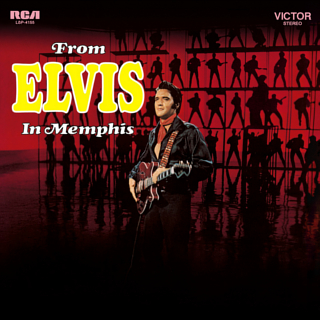
Elvis PRESLEY: From Elvis In Memphis


(#70: 30 August 1969, 1 week)

Track listing: Wearin’ That Loved On Look/Only The Strong Survive/I’ll Hold You In My Heart/Long Black Limousine/It Keeps Right On A-Hurtin’/I’m Movin’ On/Power Of My Love/Gentle On My Mind/After Loving You/True Love Travels On A Gravel Road/Any Day Now/In The Ghetto

In truth he wasn’t enjoying the sixties as much as he had the fifties. The decade didn’t seem as open to him as the previous one had been. Whereas once he’d fearlessly kick down doors, now they all appeared to be spontaneously reassembling and systematically closing on him.

It had started well enough, or as well as could have been expected; he’d done his time in the Army, had seen things, lost others, been introduced by his commanding sergeant to amphetamines, fallen in love with a fourteen-year-old girl (but, unlike his old pal Jerry Lee, waited seven years before marrying her), and came back a not entirely unwilling convert to the notion of All-Round Entertainer. There was that dormant electricity which had suddenly reawakened – see entry #19 for fervent proof – but once he had got being back out of his system he quickly settled down to what everyone else around him wanted (or so he was given to think); the Neapolitan ballads, the rapid turnover movies, the tuxedo. There were heartfelt gospel performances, private solo recordings, but gradually the brand took over the being.

Did he even want to think about the Beatles? Oh, they’d met and got on reasonably/diplomatically well, but he didn’t feel any direct connection, was slightly suspicious and increasingly resentful of their takeover – how much easier it was for him to break bread with his jukebox favourite Tom Jones; now there was a man as he knew him – and overall felt what must have resembled a gradual and not particularly painless descent into an airy nothingness. Pot Luck – see entry #29 – had been his last non-soundtrack, non-gospel, non-random bits and pieces album and perhaps the effort thereafter became too great. Far easier to drift agreeably and lunkheadedly into a world populated by the less complicated likes of Bill Bixby and Stella Stevens. It relieved him of the pressure of having to think.

But pressure was getting to him in different ways – well, maybe not as much as some people liked to think, since his priorities eventually changed. Nevertheless, where exactly did he stand in the world of 1967? He married Priscilla that year, and she gave birth to Lisa Marie in early 1968; as with Dylan, he was now a husband and father, but unlike Dylan, his new contentment – surely there must have been immense contentment – was not initially reflected in his music of the period. A look at his singles schedule for 1967 reveals, among numerous interchangeable others, such items as “Indescribably Blue,” the double A-side “You Gotta Stop/The Love Machine” and “Long Legged Girl (With The Short Dress On).” None did very much commercially, and hardly any of them were even noticed; no one was mad about them, but then again they drove no one mad. Did these records even exist, in any meaningful sense? Was he simply sick of the endlessly rotating hamster’s wheel which he thought himself compelled to tread?

Something had to give, and after his daughter’s birth, and following a few words with a record company concerned about his now minimal sales, he slowly strove to reform, if not remake, himself. The Jerry Reed songs “US Male” and “Guitar Man” got him back on the lists; they didn’t quite convince of a new tungsten toughness but they were certainly more than creditable attempts. Then NBC producer Steve Binder came through with an offer of a Christmas TV special. Col Parker wanted the tuxedo, Bing Crosby sentiments, fluff around the Christmas tree, a Santa Claus outfit (and attached beard?), “Jailhouse Rock” with a flute solo.

But finally, and ultimately, Presley said no. He wanted to reclaim, not just his leathery roots, but rock itself. The Beatles had had it all to themselves while he had been roboting his way through Hollywood, reduced to making films about “Swinging London” which had about as much to do with London as Antarctica. He felt humiliated and enraged. These Limey schoolboy fuckers, he thought to himself, still scrubbing behind their ears and sniffing the classroom inkwells while he was busy inventing their future – the jibes he aims at the group in his TV show have a bitterness which takes them above Dean Martin’s Celebrity Roast level. Christ, even Dean, the man he had once – perhaps, deep down, still – wanted to be, had come through the sixties infinitely hipper than him, by means of doing little more than slouching on his stool on TV every week, sending up crooning and essaying gags of antique corn. Dino had a much securer grasp on his own journey to blissful nothingness. Elvis was apt to become a little confused about what was and wasn’t there, or here.

Well, enough was enough. The white tuxedo, the showbiz, the tinsel, were kept in their place, but he wanted Scotty and DJ back, he wanted to get back to the 1954 urge that had kicked him into tactility in the first place. And he burst, and did it with brilliant radiance. Few items of televisual pop have smouldered with such red rage and unapologised-for transcendence (as well as such unexpected, sun-raising exuberance) as the Sun Studios in a boxing ring experiential part of Presley’s ’68 Special. He goes back over Jimmy Reed and Smiley Lewis again and again, will not let go of songs, dips in and out of numbers as will and desire direct, can’t find a damned strap for that guitar of his but dammit, he stands up anyway, like an Atlas intent on preventing his disc from slipping. Then, after half an hour or so, he returns to the tuxedo, and to “Memories,” but something has not been extinguished, and right at the end he erupts into “If I Can Dream” – a clumsy song, but delivered with more balls and fervour than anything he’d done in nigh on nine years. There is a frightening certainty about his hoarse shriek of a betrayed voice, watching 1968 and the future dissolve in bullets before he could get to them and stop them – and suddenly he counted once more.

In early 1969 he went back to the studios in Memphis for the first time in nearly fourteen years. The musicians were respectful but wary, and if truth be told not exactly bowled over by the prospect of working with someone who – whisper it soft – they perhaps considered to be past it, over the hill. Not like that dynamic Neil Diamond guy who’d come by a couple of months before; now there was someone evidently happy to see a future unfold before him. But Elvis…it wasn’t a question of whether he still had it, but whether he was ready to recognise what “it” was? There was scepticism, not all of it unjustified.

That doubt evaporated the moment he got down to work. The album opens with his enraged voice over a rubato introduction. “I had to leave town for a little while,” he roars in the manner of a Ulysses newly returned to find the palace trashed, “You said you’d be good while I’m gone!” Prompted by a circus organ, the band strike up a furious undertow of beat while Presley laments about the wreckage of the decade upon which he has belatedly stumbled. He exclaims his bafflement over “a man downstairs with long, bushy hair.” She – if “she” can mean a decade, or a movement, rather than a specific, would-be lover – has been untrue to him, betrayed his dream, and he will spend most of the rest of the record coming to terms with this loss.

Jerry Butler’s “Only The Strong Survive,” then a relatively new song (co-written by future Philly Sound lords Gamble and Huff), is attacked by both singer and band with a strut and snap which, like many of these tracks, demonstrates a surprising attachment to Motown. It had been just over a decade since he’d lost his mother, and the grief is still sorely palpable in his performance of the song; his cry of “Don’t leave me!” after the first chorus, for instance. The choruses are noticeably faster than the verses but the singer’s pain is veering towards the extra-articulate; his “IwouldntletherKNOW!” scream heralds an abyss of strings as he stands on the precipice of non-existence. His climactic “YOU’D BETTER HOLD ON!” sounds like a self-projecting plea to be allowed to cling to the cliff edge.

But maybe the most startling of these dozen performances is the old Eddy Arnold chestnut “I’ll Hold You In My Heart.” Following a triple false start, Presley, seated at the piano, hurls himself into the song’s sentiments and hardens them up (“LOOOOOOKING for…”). On the first of several middle eights he proffers an octet of self in his “IIIIIII feel so blue” before hurtling into a hiccupping “Please-A wait-A for meeeee.” In the second middle eight he switches to a squealing falsetto (“You KNOW!”). The drums then accelerate into an unexpected third middle eight where he whines an extended “Why?” followed by four “I’m sorry”s, two “I said”s, an uncanny seven-syllable “heart,” and a resolving, James Brown-ish “UH!” But in the fourth middle eight, his grip on the song as tenacious as any dachshund’s jaw, he produces a sextet of “I”s – five hiccups and one resolving vibrato – before racing into “I’m away, I’M AWAY,” an orgasmic “YES!,” a recovering “Oh, oh, oh” and a final, devastating “Pulllleeeeaaaaasssse-AHHH!” Here he is as capable of deconstructing the language of sung song as effectively as Tim Buckley or Elizabeth Frazer.

“Long Black Limousine” reverses the scenario of the opening track, though its bells are far more threatening; now she is coming back, in a fancy car as she had always promised, but she is not alive; the car crashed after a party, perhaps the same party about which the singer was initially so suspicious. After a solemn beginning the song speeds up to a mid-tempo lope from the second verse (and the drums make their belated entry, followed by a Last Post trumpet). He has been preaching, possibly only to himself, but again the hurt seeps out in his markedly hoarser delivery of the second middle eight. The contempt which he only suggested in his opening “rich friends who knew you in the scene” blossoms into unclenched hatred; “A CHAUFFEUR!” he exclaims, as baffled and insulted as Lady Bracknell, before an upward key change heralds three defiant cries of “YEAH!,” each higher than the last as backing singers, guitars and drums interlock in the manner of coffin nails. A decade down the road from “Old Shep,” this is as disturbing a death disc as Presley ever created; he appears to be sounding the toll for something far greater than one misguided individual having passed away. It is a lament for somebody whom he deeply wanted to have stayed, but also somebody with whom he had even more deeply wanted to escape. Or perhaps a stark projection of his future self onto a passion beyond reconsideration. The Worried Man has many guises.

His relatively restrained take on Johnny Tillotson’s 1962 country hit “It Keeps Right On A-Hurtin’” almost comes as light relief after the draining anti-catharsis of its two predecessors, even though he sings it as a song intended for the bereaved, having been left with nothing but a pillow and his million tears. There is little time to dwell on this mourning, however, as he is quick to proceed to “I’m Movin’ On,” the old Canadian country song by Hank Snow which had provided the model for Ray Charles’ “What’d I Say?” Beginning quietly with acoustic guitar, the band launches into a Tennessee Three triple beat wagon ride but this rhythm is soon overtaken by an amazing, pre-emptive conference between country and funk, Reggie Young’s wah-wah guitar anticipating “Theme From ‘Shaft’” by two years. The picture blossoms to full intensity before retreating back to piano and Gene Chrisman’s needle-sharp drums. But Presley won’t let it rest (since that would mean his having to rest, or be like the rest) and he forces the power to be built up again (“Move on, baby, move ON!”). Chrisman bears down on his ride cymbal, at times as abstract and overpowering as Sunny Murray’s, before the song breaks open and everybody cuts the dummies loose.

“Power Of My Love” is the album’s most unexpected track, far more surprising in its way than “Ghetto”; although the song was written in 1962, we are firmly in the land of 1969 blues rock, with hard-biting guitar and harmonica. But with one swipe Presley puts the winsome wannabes back in their humbled place. “CRUSH it! KICK it!” he roars. “And no baby you can’t LICK IT!” he sneers. He is now winning, and knows it. “You’ll never get away,” he hisses in the first middle eight as Ed Hollis’ harmonica erupts into screaming multiphonics worthy of Pharaoh Sanders before giving way to Young’s guitar. Brass enter into the song’s final, sturdy 6/8 straits and Presley grins as though having violently wiped the last eight years of compromise and smiles off the desk and into the incinerator.

Did he still want to be Dean? “Gentle On My Mind” had also been done by the lontano maestro in 1969, and to everyone’s surprise nearly made number one as a single in Britain that spring. But Presley hardly seems to notice Dean’s preceding presence, let alone those of John Hartford, Glen Campbell or even Aretha Franklin. In contrast to Martin’s throwaway, heck-I’m-a-wino-so-what lax loucheness, Presley reapplies the Motown touch and toughens the song up. The rhythm is taut R&B and the bass (Tommy Cogbill and/or Mike Leech) neatly echoes James Jamerson. Young’s guitar commentary, however, is pure Steve Cropper, and so the worlds of Motown and (the more obviously local) Stax unite. Presley, however, audibly crumbles with the prospect of no home, as evinced by his stifled sobs at “stain my face” and “’til I’m blind.” Chrisman drives his snare accents diagonally, and unlike Dino, you can visualise the junkyards through which Elvis is wandering, perhaps of his own making.

Then it’s back to Eddy Arnold (yet again from 1962; was Elvis trying to reverse history to free it of the Beatles?), although Presley’s take on “After Loving You” owes much more to Della Reese’s later version. There are handclaps, a marked dissonance of emotion between Presley’s “now” and “after,” and then, as with “I’ll Hold You In My Heart,” he moves beyond words, language. “That’s ‘cause I’m no good I’m NO GOOD TO ANYONE!” he curses. At one point he can be heard to roar what sounds remarkably like “I feel DERANGED!” Then he presses down on his heart-driven eraser with his “Era-a-a-a-a-ased.” He treats the ballad as though it were an unclenched “One Night” (sung on the TV Special as he had always wanted to sing it, in its uncleaned form). “IMNOGOODIMNOGOODIMNOGOOD!!!” he exclaims, followed by a balancing triple “to anyone”s. His voice descends in intensity, grows steadily quieter and, as we reach the fade, gradually more garbled; the mouth music in which he indulges in the song’s final moments resembles no one so much as Phil Minton (see the latter’s 1981 album A Doughnut In One Hand for corroboration).

We then reach the closing trilogy of understated, damaged but elegant ballads. “True Love Travels On A Gravel Road” is delivered initially stately, patiently. But, perhaps triggered by “and stand by her man” (remembering the then recent Tammy Wynette song), Presley blasts off again. “HOW MANY HEARTS?” he howls. The second verse is delivered loudly and forcefully. Once again the horns, strings and rhythm draw us back to Motown. In the third verse Presley’s lamenting is soundtracked by a tambourine, followed by handclaps and Chrisman’s bouldering drums. His “MMMMMMMMMMM” is extended to lands approximating infinity.

“Any Day Now” is possibly the only moment on the record where Presley is at real peace. Written by Burt Bacharach and a hit for Chuck Jackson in – you guessed it – 1962, the mood is fast, brassy, a more streamlined version of Motown. But again, after trying to keep his countenance (“You’ll be on your way”), Presley collapses and yells (“THEN MY WILD BEAUTIFUL BIRD!”). Behind him Young’s guitar is anxious and restless before strings take the centre stage and are in turn superseded in the middle eight by tambourine. His hoarse whimper of “I’ll be hoooooooolding on” is a terrible moment of self-realisation (since he’s holding on “for dear life”); she’s there with him, palpable and tactile, but already – and ahead of the apocalyptic “Suspicious Minds” – he’s anticipating her betrayal, her departure, knowing that if she comes back it will be in a long black limousine. “Love will let me down,” he confesses towards the end, in a perilously quiet last verse, as starkly as though he knew that the world was always going to let him down. “You’ll be aro-ound” he finally sobs before the dam bursts and he weeps. “DON’T FLY AWAY, MY BEAUTIFUL BIRD!” he screams, twice. Don’t let me bleed my life to nothing. Marcus called it “naked piety” but the sins are already in their, and possibly his, place. One eventually realises how close Presley’s hoarse cry is to that of Levi Stubbs, and how infinitely less settled it is.

But, in the end, Presley steps outside himself, remembering that his woes are purely his, and peers out into this strange 1969 world to find something he either can’t recognise, or something he knows only too well. Mac Davis – the author of “Memories” – came to him with the song; Presley was initially dubious about taking it on and meaning it but was eventually persuaded. He looks out onto a world already planned to be wrecked for some at the moment of conception…and the music is as hushed and reverent and wary as everything else on this album isn’t. The song keeps pausing and restarting, as though he is pacing the sidewalk, thinking, turning around and retracing his steps. There is a distant, martial snare drum and behind it an even more distant cymbal. The strings are “Ode To Billie Joe” woozy, the backing singers now carrying the song’s superficial emotional dynamic. Presley himself, however, remains utterly calm, though this calm may be but a mask for numbness; he tells the story and watches it spin around to the beginning of the same bloodied cycle, and he thinks of Tupelo in the thirties and forties, wonders if that could have been him, might still be him. “In The Ghetto” sees him move out, perhaps for the final time, into the larger world, and its imprint, its singer now a distant chimera, is the final impression which this record leaves.

On the cover there are multiple shadows behind him, as there once were in Jailhouse Rock; they may well be his own shadow multiplied to refill an emptying universe. It is telling that earlier in the summer of 1969, when budget-priced albums were incorporated into the main chart, he nearly reappeared in this tale with the long-delayed release of the soundtrack to Flaming Star, his best and least musical and certainly least glamorous film. And, as with Flaming Star, From Elvis In Memphis constitutes Presley’s most direct statement to his audience; in the Sun days he was still working out what he wanted to say and how he wanted to say it, but now he knew exactly what and how. Yes, this was a King in exile, back to reclaim his rightful place (“You’ve GOT to be a man, you’ve GOT to take a stand!”), back to demonstrate that, damn you, he still counted (the key factor of the album is how nakedly physical it sounds). Some of his vibrati in “I’ll Hold You In My Heart” even – had he known it – anticipate Bryan Ferry. But he was temporarily back, back with his people, back with the songwriters, few of whom came from anything that could be described as a glamorous background. The door opened, just for a second, just a glimpse of light as yellow as the cardigan he wears on the album’s back cover – but it was enough for him, for anyone who still cared to listen (and, astonishingly, everyone still cared). The seventies were going to become a different kind of playground for him, and this tale will not revisit him until, for him, it is too late. For one brief but vital moment, the treadmill yielded.

Monday, 21 December 2009

JETHRO TULL: Stand Up


 (#69: 9 August 1969, 3 weeks; 6 September 1969, 2 weeks)

Track listing: A New Day Yesterday/Jeffrey Goes To Leicester Square/Bourée/Back To The Family/Look Into The Sun/Nothing Is Easy/Fat Man/We Used To Know/Reasons For Waiting/For A Thousand Mothers

A slice of typical 1969 blues-rock lumbers into view; apparently weighed down by its own history, it stumbles over itself like a worried spider, scuttled in a Soho cellar. It owes something to Cream and the singer’s voice is not unlike that of Jack Bruce’s but there is a deeper, perhaps harsher, possibly more cunning tone to his timbre. He is singing a song of abject dejection; he found someone, or something (“Spent a long time looking for a game to play”) yesterday, but only got the chance to kiss her once, and now he has to be somewhere, or something, else (“My luck should be so bad now to turn out this way”). “It was a new day yesterday,” he ruefully observes, “but it’s an old day now.” Cue a flute, an instrument not generally seen in blues-rock; moaning about its player’s rotten luck, a tone and attack which were always much closer to Harold McNair than to Roland Kirk.

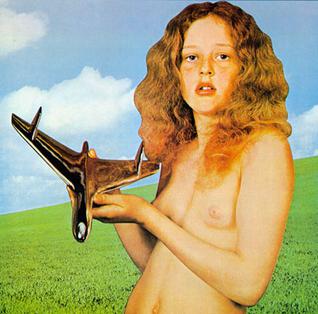
This moment – and a useful counteract, two generations ahead, to Elbow’s equally stumbling but far less surefooted “One Day Like This” – may mark the opening parry of the second wave of the British invasion in this tale, Cream having provided the bridge back to the first influx. But the song also indicates a farewell to what Jethro Tull had hitherto been; its leader wished to express the blues in somewhat different forms, and its original guitarist, wishing to stay firmly within the blues as he knew them, had decamped to form Blodwyn Pig.

Hence “A New Day Yesterday” is a markedly pronounced goodbye to Tull’s recent past, and with the second track on their second album the lightness of being makes itself visible, at least musically; the mood is now delicate, acoustic (with some Leslie cabinet-filtered electric lead guitar comments), waltzy. New guitarist Martin Lancelot Barre handles flute duties on “Jeffrey” although Ian Anderson’s lyric and growl (“Bright city woman…/Gonna get a piece of my mind,” the rhetorical quatrain of “me”s on “you don’t fool me”) still seem blues-derived. He views the urban wannabe with some distaste, but his is a radically different viewpoint from the Woodstock August 1969 that the States knew; the wan flute, Clive Bunker’s brushes, place the record firmly in a slightly gloomy end-of-the-trip 1969 Britain; downbeat, introspective, looking for a quieter way out. Tull’s rurality– and let us not forget that they were named after the eighteenth-century pioneer of modern British agriculture – did not really resemble the loping wagons of Canned Heat’s “Going Up The Country.”

“Bourée,” an instrumental adaptation of the fifth movement of Bach’s Bourrée in E Minor, is perhaps the record’s most telling articulation of this mood. Moving steadily through jazz, folk and light blues styles, there is a loneness to Anderson’s flute – and again one thinks of McNair’s work with Donovan, for instance on “Sunny Goodge Street” – which almost defies rescue. I think of those ruminative Nick Drake instrumentals – since this was also, had he only known it, Drake’s time – and in particular the heartbreaking “Sunday” with its already doomed rolling hills of strings.

Glen Cornick’s bass solo on “Bourée” also reminds us that Stand Up might be the first number one album to derive purely from the hippy era; after all, its original, woodcut-based gatefold sleeve opened up like a children’s book to reveal pop-up figures of the quartet, defying us to imagine what they are thinking, coupled with the deliberately charming credits (“Some songs for you,” “and…er, well yes! It really has turned out nicely”). If the Moody Blues represented the mainstream of progressive British rock, then Tull are a very different prospect; in place of the Moodies’ intricately and immaculately arranged setpieces, Tull provide an intuitive degree of interaction and spontaneity more in keeping with the prime folk and jazz movers of the period (see Pentangle’s contemporaneous Basket Of Light for confirmation). There were of course the shaggily dogged stories and cautiously euphoric discontinuities of the Incredible String Band, but of course there was also Traffic – and we’ll be getting back to the latter very soon, albeit at one remove – and the general air of getting collective heads together in the electricity-free country cottage. And inevitably there was Led Zeppelin, to whom Anderson dedicated the 2001 CD remaster of Stand Up; they invited Tull to support them on their 1969-70 arena tour of the States and it was there that the group learned about large-scale dynamics and also worked up the stage act for which the likes of Lester Bangs, not knowing much about British art or music hall traditions, would gloomily berate them – but theirs is a story which will have to wait a few more entries before taking up.

Back in the city, Bunker’s tick tock drums rudely awaken Anderson, who provides a frustrated yawn of a vocal. “So I think I’ll go back to the family,” he muses, “where no one can ring me at all.” Here is a reluctant urbanite who really has had enough; indeed he sings “I’ve had about all I can take” before the group pauses and effects a heavier re-entry into the song. His flute sounds positively exasperated but the overall mood, as well as the smiling bookend guitar arpeggios, put me in mind of Ogden’s Nut Gone Flake a year later; the craving for space and air now becoming a desperate gasp for oxygen. The song speeds up and Barre’s extremely 1969 lead guitar sweeps in for a modestly extended jam (since this is also the age of stretching out your songs, much as the arriviste would stretch out their weary legs atop a hopefully green pasture). But Anderson keeps changing his mind: “Doing nothing is bothering me/I’ll get a train back to the city/That soft life is getting me down,” he now declares, only for the weary urbanite to return almost immediately: “Every day has the same old way of giving me too much to do.” The crisis of 1969’s young Britain; can’t do with it, won’t do without it.

Side one ends with “Look Into The Sun” – does that imprecation sound familiar? – and we are back in mournful acousticland, a more formalised ISB template into which Barre’s wah-wah pedal eventually wanders. Anderson very effectively contrasts the notion of “sad songs” with the word “glad”; again he is pining for the mythical girl he once knew and now has lost, and although he sounds as though he is advising, “To walk is better than to run,” he ceaselessly questions his own decisional path (“Or was it better then to run?”). He ends the song, chilled out but hopeful. It would seem that everyone in 1969 Britain felt the need to slow down, or maybe stop altogether.

“Nothing Is Easy” fades in with a brisk, back-to-work gallop, and Anderson roars beautifully about “one white duck on your wall” before taking the song’s basic life on the road/in a group model and developing it into a frighteningly convincing declaration of principles: “Isn’t it just too damn real?” he hisses at one point. “Fly away…from the fingertip ledge of contentment,” he warns at another point. “My zero to your power of ten equals nothing at all,” he confesses at yet another stage. But he goes on to compare himself to a “Black Ace dog handler,” a “waiter on skates,” and the lurid allegories of the song’s concluding laps – “Love’s four-letter word is no compensation,” “foreskin conclusion,” “cold breakfast trays” – give a terrifying sense of conviction, especially as a mask for total uncertainty. Meanwhile the song itself makes, via Bunker’s drum solo, with the Mingus accelerando (see Black Saint And The Sinner Lady) towards a free-form pile-up.

With “Fat Man” Anderson retreats a little in volume, if not in confidence; rather than anything resembling a rock band, the song is driven by auxiliary percussion (slightly reminiscent of Pharaoh Sanders’ Karma) and Anderson’s balalaika (when he’s not singing or blowing his flute, he lends himself to all sorts of stringed and keyboard instruments throughout the record). Both are possibly speeded up, and over this unlikely bed Anderson rants about his happiness in being a thin man again; observe his orgiastic “Too-hoo-WHOO!” at the end of the phrase “and all the night time too.” There is more than a hint of Zeppelin’s subsequent adventures into acoustic, folky franticity.

“We Used To Know” in contrast is a patiently measured ballad in which Anderson returns to what I perceive to be the album’s – and possibly 1969 British rock’s – central theme. “Nights of winter turn me cold,” he sings. “Fears of dying, getting old” – and yet Anderson was only twenty-two. Nonetheless, he sings from the observed perspective of a character who feels that things are perhaps already doomed, peering remorselessly into the chasms of modern “living” before coming to the conclusion that “The race was won by running slowly,” with the strong suggestion that it still could be. He departs mournfully with the warning “But for your own sake – remember times we used to know” before Barre’s guitar weeps slightly less gently than before.

“Reasons For Waiting” is, however, the record’s big balladic setpiece, Once again there is an acoustic beginning before the music picks up, though not to an overbearing degree. Anderson is standing or sitting up, watching his (once?) lover sleeping, wondering again about that day which he so venerates, the day when everything and everyone simply seemed to click, be in tune, in tandem with each other’s needs. Like Gabriel at the climax of Joyce’s The Dead, he observes in the dreading knowledge that he can no longer – or could ever – touch the sleeping woman, and so his mind wanders to the skies, his wishes, which he already knows are foredoomed, fall upon her sleeping, once-weeping face like petals rescued from the newly-laid moon. David Palmer’s strings – a light far from damning – make their discreet entrance, and somehow I think ahead towards Seal, and Anne Dudley, and Trevor Horn, and have to pinch myself to remind myself that we are still in the sixties, albeit almost at their end.

Then, for the finale, Anderson reverts to one of the oldest tales in the rock ‘n’ roll book; “For A Thousand Mothers” is a cackling song of imperious revenge on the parents who just didn’t understand. Bunker’s 6/8 drums are harsh, martial, with multiple cymbal crashes. The melodic procedural is medieval but the tambourine which makes itself apparent in the final verse hisses like a snake, and Anderson seizes his opportunity, his moment, to damn and decry they who would have fucked him up. Words like “Did it surprise you to be picked up at eight in a limousine?” could in a different time have come from Eminem. His is a terrible rage, and the machine of the music carries his still-smouldering anger to its justified destination.

Anderson would come back to this issue at least once more, with the late 1969 stand-alone single “Sweet Dream,” still one of the most extraordinary top ten hits of any age, standing as it does somewhere between Ravel’s Bolero and Love’s Forever Changes as Anderson prepares to elope, to escape her parents, to get away from the past and embrace the future – in stark and deliberate contrast to the deliberate and oft-missed irony of “Living In The Past.” Coming after Ray Conniff and Jim Reeves, Stand Up returns to draw a line under the generation gap - it is worth noting that the young Nick Cave was a major fan of Tull and in particular this album – but its message is a familiar one, albeit more savagely delivered; we’ve got to get out of this place.

(Author’s Note: And, for that matter, I’m getting out of this place for the next couple of weeks; this is the last TPL post before I take a long-delayed and much-deserved break for the holidays. Thanks to everyone who’s come here, found the blog, read it and/or commented on it, either here or elsewhere. Entry #70 – where a recent past comes back to haunt us – will appear early in the New Year. All good wishes for 2010 and see you all again soon – M.C.)

Monday, 14 December 2009

Jim REEVES: According To My Heart


(#68: 12 July 1969, 4 weeks)


Track listing: According To My Heart/Don’t You Want To Be My Girl/Don’t Tell Me/You’ll Never Be Mine Again/I’ve Lived A Lot In My Time/If You Were Mine/Don’t Ask Me Why/Stand At Your Window/What Would You Do/I Can’t Fly


We hear bold fiddles and steel guitar with an unexpectedly bold, youthful and high-pitched voice confidently riding the crests of this song of hope (“The future will be bright”), already knowing enough about the emotional and rhetorical structures of pop singing to coast along his three-note, trisyllabic ascents to the words “love” and “heart.” Musically this is Bob Wills/Hank Williams liveliness, but the voice at this stage is still lending itself more towards the likes of Jimmie Rodgers and Vernon Dalhart – what annotator Charles Weaver rather sniffily refers to as purveying a “pseudo-popular singing style” – full of anxious life and partially fulfilled optimism.

This is Jim Reeves, in 1955, singing “According To My Heart,” and it’s a startlingly raw Jim Reeves to those who know only his later, more velvety work. Fresh off his stint as the singing host of the radio show Louisiana Hayride and newly signed to RCA, here is someone still in the process of forging his own style, finding his way out of his influences and adding a few more askew influences on his way to a smoother individuality.

The album to which that song lent its title was a budget-priced reissue of a 1960 compilation of odds and sods – B-sides, previously unreleased tracks, etc. – issued in the immediate wake of his big crossover hit “He’ll Have To Go.” In the wake of Nashville Skyline, and in light of the fact that as man landed on the Moon this was the most popular album in Britain, it is tempting to regard According To My Heart as a backwards glance towards the beginning of its remarkable decade, in order to assess how far anyone, or anything, had come.

It was, of course, also the second posthumous UK number one album, and as with JFK there is a case for saying that Reeves represented a lost idol for many people – particularly those of Irish Catholic descent – who would have preferred a sixties with rather than without him. In entry #50 I touched upon the popularity of country-derived music in the community of Irish immigrants who settled in the north of England and in Scotland after the war and particularly throughout the sixties and seventies; since I grew up in west central Scotland I can attest that country was the dominant music, the music most heard and loved, where I lived, to a far greater extent than rock or pop. This is unsurprising given that much of the architecture of country music owes its being to the music which the Scots and Irish had already brought over with them to the States in the nineteenth century. And the Jim Reeves constituency in Britain, though not exclusively northern based, was certainly weighed in great favour towards the north and the Celtic contingent in particular. The works of James Kelman, for instance, certainly underline what a crucial, and perhaps life-preserving, tonic country music could be to the downtrodden working classes of Glasgow; see the tenement shebeen which climaxes A Disaffection, or its use as Sammy’s main guide back into the world in How Late It Was, How Late.

This compilation serves several useful purposes, not the least of which is providing a fuller formative picture of the younger Reeves, although, as with Nashville Skyline, its ten tracks collectively clock in at around the 27-minute mark. The title track is by far the record’s most optimistic, but the mostly major key-biased, midtempo Western swing-mutating-into-C&W template holds firm throughout. “Don’t You Want To Be My Girl” introduces the record’s first degree of emotional ambiguity. Recorded in 1960, the track demonstrates how Reeves had already begun to assimilate the influences of Crosby and Sinatra into his technique; now he is assuming his more familiar guise, crooning closely and softly into the microphone, although his more fortissimo moments, as Weaver asserts, owe a good deal to what Weaver calls “those fence-busting innovators,” and in particular Eddy Arnold.

If Reeves is smoother here, however, he is also more afraid, and more elusive. He is expressing sympathy towards a woman whose man doesn’t – we are asked to presume – treat her as she ought to be treated and prematurely offering his replacement hand; the pedal steel raises a quizzical eyebrow at his “He’s gonna drop you…he told me himself.” His three-note descent to contrabass on the “love” of “nobody hides a love” is not absent of threat or menace. In “Don’t Tell Me,” conversely, he is the one who has been cuckolded. Sharply picked out lead guitar notes do a more explicit job of emphasising Reeves’ concealed (by regret) rage; his “Don’t you realise” is agonised, high, and he can barely conceal the hatred underpinning the phrase “snuggles closer and laughs at every silly little line.”

“You’ll Never Be Mine Again,” structurally not dissimilar to Don Gibson’s “I Can’t Stop Loving You,” complete with call and response backing singers, has Reeves in a superficially more resigned mood, but again he is in tatters over this “someone else” who keeps materialising like an unwelcome pursuer from an unspecified past. He trembles palpably on the “pretend” of “pretend that your world is mine,” and by the time we reach “Then my world will come to an end” we realise we are dealing with a spirit as troubled, and perhaps as paranoid, as that of Roy Orbison.

“I’ve Lived A Lot In My Time” is the album’s keynote song, and the only one not specifically concerned with love (apart from a crucial couplet – “I had a sweetheart/But I was unfaithful”); here Reeves is Everyman, down from a mansion to his last dime, fighting with the Grim Reaper and walking with the Master in the same Dark Valley, but peacefully impatient to taste “Eden’s green pastures”; here is the aged wanderer of “A Hard Rain’s A-Gonna Fall,” the scarred Harding, who has endured everything and is not entirely sure whether he has learned anything. The approaching end of the Worried Man’s road, and the “Woo-ooh” of the female backing singers are the sirens luring him to the final field which might yet turn out to become an ocean.

“If You Were Mine” sees us back with the exuberant mid-fifties Reeves, promising the world to his as yet uncommitted hopeful Other; his “before” in “you’ve ever been loved before” is positively lascivious, and his hyperactive “Mine MINE mine!” remarkably virile. But in “Don’t Ask Me Why” he’s won her, and she’s playing around, and there’s nothing he can do about it; he struggles to preserve his countenance but the high, gasping “MIGHT” of “You might as well ask me why I breathe” and its counterpoint, low register, clenched “breathe” in the same line document a mind in turmoil. “…or why I live at all,” he continues; and the “calls” in the second middle eight (“answer when she calls”) is sustained beyond tolerable length and vividly despondent.

“Stand At Your Window,” despite or because of its enthusiastic boys together harmonies on the title, is more disturbing still. She is in her mansion – another mansion, you may note – and he is standing beneath it, making a sinister deal of the contrast between the light in her window and the darkness of his soul in the gutter underneath. Despite the slightly incongruous rolling piano, this is an uneasy portrait of what is essentially a stalker – but I am also reminded of a Canadian who began his career in the fifties with the Buckskin Boys, who a lifetime later would write an astonishing song-cum-epitaph apologising to his would-be Other for ignoring her while she stood beneath his window, with her bugle and her drum, while he was waiting for the miracle to come. Leonard Cohen narrowly escapes direct inclusion in this tale since Songs From A Room had been kept off number one two months earlier by, successively, the Seekers and the Moody Blues, but the streams have to be taken into full account.

In “What Would You Do,” Reeves finally owns up. “You call me a cheater,” he sings, humbly (Weaver refers to these “humble true-love ballads” as being the polar opposite of the “beat-dominated charts of today”), caught out, before continuing, slightly more bravely, “Well, maybe that’s true.” “But…” he explains, “…with heaven at your fingertips – what would you do?” He has surrendered to his baser instincts, and perhaps located his greater ecstasy in doing so, and all he can now do is fumble with reasoning and excuses, the underlying subtext being: really, you’re no better, are you?

Lena points out that the subject matter of these songs – losing love from nearly every possible angle – and the song titles themselves would have been entirely fitting for a group like the Wedding Present; again, David Gedge, growing up in the Leeds of the sixties and seventies, could hardly have failed to absorb Reeves’ music in his youth (and we think also of Morrissey and Marr’s parents on the other side of the Pennines, not to mention Richard Hawley in Sheffield, and many, many others, John Lydon and Shane MacGowan included). But Reeves never deals in self-pity or explicit grief; his final word on this record is a resigned, regretful shrug of his shoulders (even though he is clearly reddening with fury underneath). In “I Can’t Fly” he accuses his soon-to-be-forsaken partner of wanting him to be “perfect,” and as the honky tonk rolls under the third verse he apologises, in a manner not entirely bereft of anger, “You’re looking for an angel, and I’m sorry I can’t fly.” He bids a sardonic farewell as she goes on looking for “that perfect guy” and comments “I hope his wings are pretty.”
What strikes me most about According To My Heart as a record is the complete lack of a barrier between Reeves and the listener. Lena reckons his voice and timbre are not dissimilar to Kermit the Frog (emphatically not intended to be an insult) and maybe his manner was the same; someone, like Kermit, who is perfectly comfortable with who and what he is. As far as his wider impact as an artist and general influence is concerned, we will be returning to his work in due course, but I should point out at this juncture that it would be a mistake to put Reeves under the same cut-price MoR banner as Ray Conniff; indeed, this album and its predecessor are polar opposites in virtually every way. Conniff, the urbanite from Massachusetts, fashioning meticulous, distant, polished music that breathes aspirational, white collar, conservative; whereas Reeves, the country boy from Texas, is distinctly blue collar, working class, Democrat-voting, communal music (unsurprisingly Reeves was a JFK voter). We think of ruminative figures at the bar; lonesome long-distance truck drivers, men with plenty of time to think and to drink. Music to enable commensality, the communal breaking of bread, and sipping of wine, at the common table. And this music spoke more directly to them than many others that could be nominated.

Tuesday, 8 December 2009

Ray CONNIFF: His Orchestra, His Chorus, His Singers, His Sound


 (#67: 21 June 1969, 3 weeks)

Track listing: Memories Are Made Of This/I’ve Got You Under My Skin/Volare/They Can’t Take That Away From Me/Greenfields/Melodie d’Amour/Days Of Wine And Roses/Spanish Eyes/Somewhere My Love/Mrs Robinson/Up Up And Away

“Terminal addicts don’t notice how alienated they have become from old life, old friends, old ways, old interests. One day you realise you’d rather stay right here in this warm and comfortable drug chair, here, in the cool un-cruel shade, this the only place my mind don’t ache, this the only place my soul feels ripe, this the one place my body don’t itch and yelp and hurry, I like it here, what’s the problem, here I don’t need to DO anything, don’t need to meet anyone else’s demands, don’t need to stress or argue or bargain or barter or seduce or shine…I can just be me. And dream. Endlessly dream.”
(Ian Penman, “Notes Toward A Ritual Exorcism Of The Dead King,” from the anthology The Resistible Demise Of Michael Jackson: Ropley, 0 Books, 2009)

“But I’ll keep on waiting ‘til you return,
I’ll keep on waiting until the day you learn
You can’t be happy while your heart’s on the roam,
You can’t be happy until you bring it home,
Home to the green fields and me once again,
Home to the green fields and me once again.”
(“Greenfields” by Terry Gilkyson, Rich Dehr and Frank Miller)

It is January, 1972, three days past my eighth birthday. In the White House President Richard Nixon is hosting a dinner to commemorate the fiftieth anniversary of Reader’s Digest magazine. The guest list has been carefully drawn up by his trusted adviser, Irving Kristol; the Reverend Billy Graham, Lionel Hampton, Bob Hope – guaranteed non-boat rockers, guaranteed non-rockers, full stop (even if in another life Hampton might have held one of the strongest claims for precipitating rock).

The onstage entertainment is to be provided by the Ray Conniff Singers. Conniff doesn’t have his usual band of crack West Coast session players to hand; he is using a small pick-up group of musicians from the Marine Corps and has had to hire in singers specially for the occasion, on the recommendation of his then contractor Jay Meyer. One of these is a Canadian, Carole Feraci, originally from Toronto but resettled in southern California. Initially when she gets the call from Meyer she’s sceptical but later calls back to accept the engagement. Unknown to anyone else, she and her boyfriend have meanwhile thought up a plan.

The singers make their way onto the makeshift stage. As Feraci approaches the microphone, she suddenly produces a banner. “STOP THE KILLING,” it states. She then begins a short speech, directed directly at Nixon, who keeps his countenance. The speech culminates in this sequence, which was shortly to become world famous:

“If Jesus Christ were here tonight, you would not dare to drop another bomb.”

Conniff reaches for the banner and tries to grab it but Feraci is too quick for him and holds onto it confidently. “Bless the Berrigans,” she concludes, “and bless Daniel Ellsberg.”

In a room filled with the thickest and iciest of silences, Conniff strikes up the band. The song is “Ma, He’s Makin’ Eyes At Me,” a number which, in its Johnny Otis Show manifestation, had started a revolution fifteen years previously. She sings it dead straight, eyes unblinking. After the song has ended, voices in the audience yell for her to be thrown out. Conniff apologises to Nixon for the unexpected disturbance and then politely asks Feraci to leave; she politely does so. Immediately she is surrounded by reporters and cameramen; Secret Service agents are lurking but have been told to play it cool. Eventually she leaves the White House and disappears into history.

If anything got Nixon elected in 1968 – Sirhan Sirhan and Mayor Daley notwithstanding – it was his promise to end the Vietnam war. His beloved “great silent majority” core of supporters were weary of war and of the post-Kennedy promise which they felt had been squandered; they were afraid of Eugene McCarthy, weren’t much inspired by Hubert Humphrey. As things turned out, of course, the war laboured on for several more years; but that “silent majority” (and we should recall that the original meaning of that term relates to “the dead”) craved stability, some semblance of a return to the America they thought they once knew. In any case, many felt Nixon had been cheated out of the job by JFK back in 1960, and were increasingly baffled and intimidated by their free-thinking offspring with their new fangled ways of doing things and living life. They, in short, were scared, and thus the parallel refuge to music which sounded like the music they used to know; clear tunes, definable words, smart singers and musicians, the haze of memory wafting in from those ancient breezes. Life before younger life came to spoil everything.

Once upon a time, Ray Conniff too was scared; in the late forties he had relocated his family to Hollywood after the big band scene had fizzled out for partly economic and partly fashion-related reasons. He had previously made something of a name for himself as a relatively imaginative trombonist, composer and arranger for bandleaders including Bunny Berigan, Glenn Miller and Harry James, having (it should be noted) learned the basics of composition and arrangement via a mail order correspondence course in the thirties. But inventive solos and charts didn’t pay the bills, and after a couple of years in Hollywood Conniff was feeling the pinch, having to take on manual labouring to keep his children’s heads above water, always facing the imminence of bankruptcy and foreclosure.

Out of his fear he formulated a plan. He sat down and carefully studied and analysed every number one Billboard hit record of the preceding ten years, in tandem with the leading advertising jingles over the same period. He studied the commercial virtue of repetition, the relationship of rhythms to hooks, the most palatable ways in which voices and instruments could be combined to produce the best value result. The strategy paid off, and he was soon hired by Columbia producer Mitch Miller as a staff arranger. Miller’s story and relationship to pop – a story which, amazingly, has not yet ended at the time of writing – will be looked at more fully at a later stage as, equally amazingly, he will crop up again in this tale (as a contributor to entry #116).

But Conniff’s big break came with his score for “Band Of Gold,” a 1956 ballad hit for the crooner Don Cherry (needless to say, not the same Don Cherry who in 1956 was rehearsing with Ornette Coleman in L.A. in preparation of overthrowing other notions of order). His tactic here was to substitute a chorus of voices for a string section; they were wordless, purely instrumental, smooth, and an instant success. He went on to arrange many hits for the likes of Guy Mitchell, Marty Robbins and Rosemary Clooney before Columbia gave him the chance to record with his own orchestra. Assembling a band of stalwart West Coast studio reliables, many of whom had known Conniff from the big band days (for instance, guitarist Al Hendrickson, formerly a staple of the Artie Shaw Orchestra), and an eight-strong team of singers (four male, four female), Conniff’s albums found great and immediate favour. Covers of albums such as The Hi-Fi Companion, The Happy Beat and It’s The Talk Of The Town set the tone; this music was hip, swinging and urban without being especially threatening.

As the fifties ironed themselves into the sixties Conniff’s album covers leaned towards featuring pretty girls with beaming (if rarely smiling) faces filling the (hopefully) welcoming space, the only striking exception being 1964’s Invisible Tears, an album of country-flavoured ballads whose cover featured no faces but simply the title and Conniff’s name in large, black, forbidding type; there was, as we shall see, more than a hint of recividist melancholy underlying Conniff’s work.

His Orchestra, His Chorus, His Singers, His Sound was a budget-priced sampler of key tracks from the 1960-8 period released especially for the European market and to publicise Conniff’s then current European tour and owes its inclusion in this tale (as does its successor, entry #68) to a brief experiment undertaken by chart compilers the British Market Research Bureau where all albums – both full-priced and budget-priced – were included in the same chart rather than (as had previously been the case) separate ones. The gold and black label (“THIS LABEL IS REMOVABLE”) on my copy indicates that in Britain it retailed for fifteen shillings, but does that mean that the music sounds cheap, and if so, whether Conniff’s career is a long term study of the impotency of cheap music?

I am not so sure. The album devotes a side apiece to his “Chorus” work and his “Singers” work, and the difference – or, if it can be counted as such, the evolution – is quite remarkable. As soon as Conniff’s 1960 band breaks into “Memories Are Made Of This” – which, along with “Volare,” ushers in that most insecure of holders of fleeting memory, Dean Martin, a man for whom, in 1969, life was already becoming a memory, he having become his own legend, and therefore, strictly speaking, outside himself – his debt to his big band schooling is obvious. Despite the occasional harp glissandi and the decently distant, wordless chorus echoing in the middleground, “Memories” gives us a useful beginner’s class in big band arranging. With every verse Conniff varies the voicings; in the first, the trumpets carry the main melody while the saxophones do the calling and responding, in the second the trombones work against the trumpets, and that latter scenario is reversed in the final verse. In addition, the surprisingly brash and bold trumpets throughout – a direct legacy from Conniff’s Harry James days – indicate that, while this music clearly aimed to please, it was not a lazy music.

Conniff had worked out his “Sound” with geometrical precision, and despite the progressive modifications he applied to it, the basic precepts never changed; discreet rhythm, set back in the mix, with the accent on echoing rhythm guitar and click bass, with enough space to allow brass, reeds and voices to come through in meticulously-determined proportions. In addition, he was very much in favour of large unison brass/reed lines, as can be demonstrated by his arrangement of “I’ve Got You Under My Skin” which, if dutifully and scrupulously stripped of all the sex, dirt and longing both Cole Porter and Frank Sinatra had applied to the song – as with many other tracks here, it could have served as the backing track to courtly Home Counties formation dance teams, cha-cha rhythm and all – its horn voicings look curiously forward to the work of Medeski, Martin & Wood (and it should not be forgotten that no less a personage than Gil Evans adapted not dissimilar voicings for his own bands from the late sixties onwards) and there is genuine inspiration in the way Conniff finally but gracefully and patiently makes the tune recede towards a central point of silence.

Conniff takes “Volare” to the airy penthouse, Hendrickson’s guitar and echoplexed rhythm astonishingly reminiscent of (or anticipating) dub. The loungey swing is confident, robust, although I note the use of the xylophone rather than the vibraharp; there is a certain residual martial stiffness still present in his work, but certainly this is the kind of thing that Jack Lemmon would have slapped on the deck in his apartment in preparation for Shirley MacLaine to come round (although we forget at our peril that MacLaine’s character in The Apartment does eventually attempt suicide).

But then that aforementioned melancholy begins to creep in, creating shades of wintry dusk. Introduced by a prematurely fatigued bass trombone and celeste unison, “They Can’t Take That Away From Me” is perhaps one of this record’s key tracks; the title alone speaks volumes about its intended audience. There is cleverly descending counterpoint between voices male and female and the voice-as-instrument schemata, though notably less flexible than subsequent developments inspired by it – particularly in Britain, where John Dankworth was undertaking more adventurous experiments in the same mode, using Cleo Laine’s voice as an additional horn, and those in turn inspired one-time Dankworth trumpeter Kenny Wheeler (like Feraci, an expatriate Torontonian) to utilise Norma Winstone’s voice in the same way in his own big band – is a more substantial innovation than Conniff is usually given credit for (indeed, Esquivel’s habitual use of “zu-zu-zu” in his work may be regarded as a direct commentary, possibly satirical, on Conniff’s trademark “do-do-do”s). The overall feeling, however, is muted, hesitant, although at one point the stately piano (either Pete Jolly or Jimmy Rowles) is abruptly intercepted by a blast of screeching cha-cha brass before quietude resumes.

Side one concludes with the album’s deepest and most resonant track. “Greenfields” (recently revived by Michael Stipe as part of Faultline’s Your Love Means Everything project) was a melancholy hit ballad for the Brothers Four in 1960 and Conniff (six years later, by which time everything had changed) approaches the song with real, perceptible emotion. He takes the number very patiently, with a slow, harp-driven 6/8 tempo. The piano picks at the memory like a widowed scavenger polishing lilacs at the grave. Again, however, two-thirds of the way into the track an unexpected wave of danceband brass and quavering reeds briefly engulfs the song – those memories of Miller, the ghosts of forgotten winds. It resembles a tug of war; look, I know our world is vanishing, it seems to be saying, but remember how it used to be – and maybe, if we try really hard, and that includes screwing our eyes up as firmly as possible, it will happen again? This knowing sadness infiltrates the sometimes forced jollity of the rest of the record.

With side two we are suddenly in a different, and not necessarily a better, world. “Melodie d’Amour” commences, unexpectedly, like a Shadows B-side, all twangy, tremolo guitars; but now the voices have found and learned a language – two languages in fact, since they sing the song in both French and English, but at this stage (still 1966) the Singers – by now expanded to 25 in number, 12 females and 13 males) seem to know what they’re singing and why they’re singing it. Conniff makes ingenious use of stop-start and silence tropes in the middle eight, although the fade is rather abrupt.

Thereafter, however, a strange, eerie jauntiness appears to dominate. “Days Of Wine And Roses” is anything but a jaunty song, and moreover contains in Mercer’s lyric one of the greatest opening lyrical tropes in all of popular song, a sentence as endless as the tracking sequence that commences Touch Of Evil and which also paraphrases Gauguin (“…a door marked ‘Nevermore’ that wasn’t there before”). The voices – and suddenly there is nothing to hear except voices; the big band trappings have subtly vanished and we gradually realise that the voices have effectively replaced the (obsolete?) instruments – treat the song, however, like an amiable night at the bridge club.

Conniff’s “Spanish Eyes” (a.k.a. “Moon Over Naples”), a song co-written by his curious German counterpart Bert Kaempfert, is taken at a brisker pace than Al Martino’s famous version (and Engelbert Humperdinck’s only marginally less famous reading). The yearning buried not so deeply within the song, however, is almost entirely ignored – the singers are reciting the words almost passively, and the inevitable mandolin which ushers in the would-be climactic key change displays unwelcome signs of slipshod laxity, or worse, indifference.

The new problem is compressed with Conniff’s reading of “Somewhere My Love,” which also brings into play the contemporaneous recording of the song by another German counterpart – and, in the end, perhaps Conniff’s better – James Last. Far more successful in Europe than Conniff, Last has since 1967 built a career on unashamedly giving the public what it wants, but exhibits a certain élan which the later work of Conniff frequently lacked. Last’s concerts are party events, the equivalent of hen parties and bingo nights, the audience’s unabashed celebration of itself; it is deceptively democratic. Whereas I picture a solemn, dutifully seated audience passively absorbing the “quality music” of Conniff onstage, even though Conniff himself appears to have been extremely passionate about both his music and its live delivery. Last’s version of Lara’s theme – as heard on his 1967 album Love, This Is My Song – is artful, seductive and finally heartfelt. But Conniff’s version is so damned foursquare – with the emphasis on “square” – that one is reminded of Melina Mercouri relating her fairy tales in Never On Sunday, all of which end with “they all go to the seashore,” a cheerful allegory for death (since that is the only way all stories can end). His “Somewhere My Love” seems fully equipped for that terminal beach journey.

With “Mrs Robinson” this placidity becomes offensive, and downright disturbing. The crucial “about you for our files” sequence is recited exactly as one would expect a call centre employee to recite it – was this a deliberate commentary on Conniff’s part? – and the banally jaunty brass and incongruous Basie piano fills are exceeded in missing the point by the voices’ scary, mechanical “hey hey hey”s which sound as though punched into a computer, stripped of all emotion and indeed all humanity.

It is here that I have to bring in the concept of Muzak. It is not my intention to reiterate Joseph Lanza’s admirably full – if, I fear, fully misguided – history of this genre in his indispensable Elevator Music, but I note that elsewhere Conniff’s style has been described as more attuned to supermarkets than elevators, and this may well be the case – growing up, I heard this sort of thing lurking through the speakers while my parents were doing the Saturday shop, and it was the effective lingua franca of Radio 2 over the same period (its final, fitting destination being the David Jacobs Collection, which airs last thing on a Sunday night, the last remaining refuge for what its 83-year-old presenter describes as “our kind of music”). The history of Muzak as a tool for increasing productivity at work – and subsequently for increasing consumer output in shops and shopping malls – is fully documented but the early vitality of Conniff’s approach seemed to dissolve as the sixties resolved and reformed, replaced by a numb anaesthesia, a panacea, a placebo to a disaffected but resolutely silent “majority” of an audience.

This becomes most evident in the album’s closing track, a 1968 take on “Up Up And Away.” Ironically, while Jimmy Webb was at this time busy redefining and reshaping what came to be known as “easy listening” – as though “MacArthur Park” or “Wichita Lineman” could remotely be described thusly – Conniff sounds intent on neutralising his experiments. He applies the same, click track formula to this most ill-fitting of songs to which to apply it; there is virtually no rhythmic vitality at work at all, and the album’s nadir comes with the Singers’ “Wheeeeeeee!!!!,” an expression of compulsory gaiety if ever I heard one (and which, along with the aforementioned xylophony, takes us unpleasantly back to the days of the Mitchell Minstrels).

But the album was a huge success, in the confused “other” Britain of 1969 – the Britain which didn’t quite get the long hair stuff, which quite liked the Beatles before they went all strange, the Britain of depressed, Valium/cooking sherry-dependent housewives – a prematurely bereaved nation looking for the cheapest of painkillers (even though the cheapest painkillers only help create and intensify the pain so that you have to keep taking them). “All passion spent” as the phrase goes. Side one proves that with Conniff there was some early passion – and, as later records like 1972’s I’d Like To Teach The World To Sing confirm, invention and imagination were not entirely lost from his music – but it is worth remembering why he made this music in the first place, and what, if everything, had been lost along the way. This was a music, remember, that was originally fashioned out of fear – the not-so-modern disease of fear of the bailiffs superseding the fear of death – rather than love, whose formula was arrived at and determined scientifically. I also sense a parallel with another album (from the next decade) where the artist gradually vanishes from his own record – the two sides of Bowie’s Low. In addition, Conniff was born in November 1916, the same month as Walter Cronkite; but where Uncle Walt turned against the Vietnam war at a crucial moment and played no small part in its eventual end, Conniff, natural conservative that he was, could only watch in bafflement and horror as one of his singers did it for him. That speech of Carole Feraci’s was eventually sampled on “America No More” the shattering B-side of 1992’s “America: What Time Is Love?” by the KLF – and if you thought that format of Conniff’s sounded familiar, read the KLF’s Manual and marvel at how the same approach could lead to two diametrically opposed roads.

When we listened to this album at the weekend, however, we followed it with “Bliss” a 2005 track by Alan Braxe and Fred Falke under the pseudonym of Defender, and wondered how a piece of music constructed under exactly the same construct as Conniff’s – mechanical repetition, practically no “human” involvement – could be so warm and alive as opposed to the deadness of Conniff’s “Up Up And Away.” There are reasons architectural and aesthetic for this, of course – the hymnal organ which provides the undertow for “Bliss” and eventually comes to the fore as a natural coda – but it really is a matter of life versus death, of ambient (Eno’s Music For Airports made passengers feel twitchy and nervous when tried out in an actual airport) versus ambience; the active reception of sound rather than the passive acceptance of “Sound.” Conniff survived; he continued to record and tour until only a few months before his death in 2002, one month short of his 86th birthday. But look at the girl on the cover of this record, and wonder at how many people were glad not to smile. She too is lost in an endless dream – and how can we tell that it’s not a nightmare?