Monday, 15 June 2009

ORIGINAL MOTION PICTURE SOUNDTRACK: The Sound Of Music


(#42: 5 June 1965, 10 weeks; 16 October 1965, 10 weeks; 19 February 1966, 10 weeks; 25 June 1966, 7 weeks; 1 October 1966, 18 weeks; 25 March 1967, 7 weeks; 20 May 1967, 1 week; 3 June 1967, 1 week; 18 November 1967, 1 week; 2 December 1967, 3 weeks; 27 January 1968, 1 week; 23 November 1968, 1 week)

Track listing: Prelude and The Sound Of Music/Overture and Preludium (Dixit Dominus)/Morning Hymn and Alleluia/Maria/I Have Confidence In Me/Sixteen Going On Seventeen/My Favourite Things/Climb Ev’ry Mountain/The Lonely Goatherd/The Sound Of Music/Do-Re-Mi/Something Good/Processional and Maria/Edelweiss/So Long, Farewell/Climb Ev’ry Mountain (Reprise)

Sometime in 2002 or possibly even early 2003 – the times were hard enough still to blur exactness - I watched the film Last Night on late night television; it was one of those films I only intended to half-watch before turning into bed but something compelled me to stay with it. Briefly, the world is coming to an end, possibly about to be swallowed by the sun, and we see a not too disparate group of people in this city patiently going about preparations for their final hours, mostly without panic or evident distress; not scuttling into bunkers, for that would be fruitless, but trying to have as nice a final time as possible.

But there is this man, Patrick, sitting on the roof of this building, and who significantly is played by Don McKellar, the film’s director, who is simply waiting to die, and off whom the viewer’s eyes or minds cannot be taken; he is a recently and prematurely bereaved widower living in an open air tomb, surrounded by purposeless memories of his former life, drinking himself into earnest oblivion. And there is this woman, Sandra, who has agreed a suicide pact with her husband (David Cronenberg) but for various reasons cannot get in touch with him. Ultimately Sandra and Patrick end up on the same roof; lacking any better alternative, they sip wine, place “Guantanamera” on the stereo, aim revolvers at each other’s temples and wait. But they can’t go through with it; something is pulling them back, perhaps the music, or more probably the slow realisation that they are attracted to each other. So instead of the modified suicide pact they kiss; the sun, which has steadily been growing brighter throughout the film (even though most of it takes place at night), fills the screen with white brilliance and the film ends.

But does the world end? Some years later I am inclined to believe that it doesn’t, but back then I wasn’t in a position to judge. It now seems to me the clearest of metaphors; it is Patrick’s world which is ending, which he wants to end, until the final resolution delivers him (and her) from the darkness and back into the light of a new and brighter dawn. Certainly in those darker days I was in no fit state even to realise that the city in which this rebirth was being played out was Toronto; prophecies don’t always come blaring and waving.

Some of this may go towards understanding why for me the most touching moments on The Sound Of Music soundtrack are those where Christopher Plummer – an actor born in Toronto – sings. This happens only three times; first, and most touchingly, on the reprise of the title song, after his children have found their collective voice and he takes a tentative lead at the end. His is the singing voice of an actor but thankfully – and possibly having learned some lessons from West Side Story - Robert Wise thought better than to dub him; he sings like a child learning to speak for the first time, hesitant and nervous, but when he reaches the crucial lines “I know I will hear what I heard before” and “and I’ll sing once more” and the widower is returned it is impossible for me not to be moved. Here is another of Rodgers and Hammerstein’s post-Rochester superficial beasts whose inner beauty only needs to be coaxed out by the right Jane. Then, in the duet “Something Good,” we reach the equivalent of Rochester ’s marriage proposal. “Nothing comes from nothing…nothing ever could,” Andrews and Plummer reassure each other as their voices slowly stretch out the syllables to the point of quietly euphoric non-/co-existence. Finally, in the defiant reversal (melodically, harmonically and thematically) of the Horst Wessel Song that is “Edelweiss,” he finds his truer and nobler self.

Never mind the implausibility of an Austrian Navy admiral, since this is a fairytale (albeit one grounded in historical reality, but this is Cupid and Psyche, complete with mountain top); Plummer’s Baron is no realer an admiral than the ancient madman firing cannonballs over the roofs of Kensington in Mary Poppins, but is Andrews’ Maria any more substantial a figure than Poppins? So many of the show’s songs are list songs, but most of them come to the same conclusion; after spending three minutes unsuccessfully trying to pin down the character of Maria in “Maria,” the nuns come to the moderately aghast revelation: “She’s a girl!,” and the Cupid and Psyche comparisons run deeper, since this Maria, much more so (if necessarily more fantastic) than the one of West Side Story, is a signifier, a channel of subtexts, a personification of the word “girl,” just ahead of Lennon’s remarkably similar musings on the same subject (see entry #44) and a generation ahead of Green Gartside’s (#319).

But more than that, this Maria appears to be the personification of music. Although the show, Rodgers and Hammerstein’s final one, plays as a pocket summary of their work to date, since the Rochester-Eyre analogy also appears, with varying success, in The King And I and South Pacific, the plot is essentially that of South Pacific seen from the other, darker end of the telescope (Emile goes off to sea to fight, the Baron goes off to avoid fighting at sea, and both do the right thing), the climactic anthem of “Climb Ev’ry Mountain” is a more formalised variant on “You’ll Never Walk Alone” and the jaunty bounce of “The Lonely Goatherd” and “Do-Re-Mi” both still unavoidably conjure up the plains of Oklahoma! (both are basically bierkeller hoedowns), I cannot recall another preceding major stage musical so concerned with the nature of music itself; certainly Sondheim and others would go on to develop that template but there are no clear precedents (The Music Man does not count but it was fitting that Robert Preston and Julie Andrews should finally meet up in the 1982 environs of Victor/Victoria). The sprite of Maria can only come to life with music, and uses music to bring others back to life. She is lost in music but finds the world again through music.

Is Maria Music? The first sound we hear on the record is birdsong, and slowly the disparate elements of a song build up to reveal her butterfly at its brilliant centre. On “Do-Re-Mi” the modal acoustic guitar introduction sounds strikingly 1965 but MetaMaria is analysing her own elements, explaining how every single one of her aorta work and function together to power a human life, how each individual element of the song she is singing blends and unites to form the song she is singing; not so much deconstruction of music, but more reconstruction. With swift happiness (or with the happiness of a swift?) she brings the children into her orbit.

Even as a spirit, however, Maria is not infallible or insensitive; “My Favourite Things” – another song of lists attempting to make a sense of life out of disparate factors and also a song not forgetting that the first four letters of the word “listen” make “list” – is a song of defiance aimed at her own underlying fear (in a different Sound Of Music it might have been sung by Anne Frank), and it is worth noting that the diatonic point where A minor reluctantly blinks its way into F major seventh (the “bad” of “then I don’t feel so bad”) was the basis of Coltrane’s famous improvisation on the song.

(And for many Coltrane was the embodiment of music as sprite/spirit, living and breathing music to the exclusion of all else, including, finally, his own life; as Frank Lowe has remarked, how hard is it to visualise Coltrane at home on a Saturday afternoon, beer in hand, watching the football? But in 1965, as with so much else seemingly diametrically opposed to The Sound Of Music – from Godard to Ballard, from Berio to Reich – Coltrane’s art was pushing furiously towards a future, coming out of A Love Supreme and stretching its post-Monk modes towards the troubled semi-freedoms of Ascension and Kulu Se Mama)

Stretching another barely stretchable point, there is even congruence between Coltrane’s modal hymnologies – the literal declamation of Part Four of A Love Supreme – and the opening nuns’ choruses which seem to be occurring in a Salzburg which never knew a Mozart (but Maria as Mozart and Baron von Trapp as Salieri, only a couple of centuries out of place?). Perhaps as an in joke, one of these nuns is Marni Nixon, the singer who voiced the part in the film of My Fair Lady which most felt should have gone to Andrews rather than Hepburn (but Andrews got the Oscar for Poppins anyway). There is a hint of “devil’s music” exasperation about their initial reading of “Maria” and perhaps this is what has led misleading commentators throughout the ages to declare the supposedly crushing success of The Sound Of Music as a decisive, populist reaction; the yes vote for continuation of the old faced with the uncertainty of the new (Civil Rights, Beatles, it was all understandable and you knew where you were, etc.; not a feeling unknown either in a Britain which had recently lost its Churchill and whose citizens didn’t necessarily all know or like where they were heading).

That the soundtrack album spent a total of 70 weeks at number one between mid-1965 and late 1968, a total bettered only by South Pacific – for comparison purposes, the single at number one during its first week at the top was Sandie Shaw’s never-chirpier “Long Live Love” while its last week was echoed, tellingly, by Hugo Montenegro’s recording of Morricone’s theme from The Good, The Bad And The Ugly – cannot be denied or avoided. This would not have happened without a general craving for stability, but given that my mother took me to see the film in the local cinema (the George in Bellshill, long gone) at least three times in my extreme youth its renewable appeal was eminently understandable (and if, like my mother, you had lived in the horrific middle of World War II, you would doubly understand it) – and this does not even take into account its subsequent, camper life as a dressing up karaoke repertory cinema perennial.

But stability and conservatism do not always imply maltreated horses or Margaret Thatcher. As we will go on to see, The Sound Of Music tended to keep the number one seat warm when the big boys (and they were always boys at this stage) didn’t have something new out, so this very feminine stability helped balance the testosterone rush developing elsewhere. In addition, it is wrong to deride it for imagined stuffed shirtness. Consider that the musical is about a free spirit who repeatedly finds joy and revelation in natural things rather than man-made ones – listen to those lists in “My Favourite Things” again and compare and contrast with the all too human ones in “Subterranean Homesick Blues” – who comes brandishing an acoustic guitar and singing of flowers and birds in order to shake up a complacent and confused middle-aged man; and consider how remarkable this was coming from the pen of a lyricist who essentially did not live to see the sixties. As with the less-than-subtle central anti-materialist subtext of Mary Poppins, we are faced with something which appears to offer reassurance at a time when much, for many, was drifting apart but in fact predicates what would eventually usurp them as the decade proceeded onwards.

And, as with Mary Poppins, Andrews’ protagonist isn’t quite as uncomplicated as she appears. Her “I Have Confidence In Me” seems to me the record’s key performance; she is in fact paralysed by the newly granted uncertainty that comes with problematic freedom but does her best to square herself with a round world. Her bountiful delivery progressively becomes more unhinged in its forced joy, and the music bounces off rubber walls of rhetorical triplets of high notes and rhythm in a way that is more disturbing than merely overcompensating for an essential lack of confidence. By the time Andrews screams out “WAKE UP – IT’S HEALTHY!” she almost sounds as though she’s proclaiming “Wake up – it’s Hell.” Lena perceives some kinship with Kate Bush in this performance; these steeply sprinting bounds which would in time rematerialise in songs like “Hounds Of Love” balanced with the petrified near-silence of Andrews’ quiet, paused “Oh, help!” See also her bafflement throughout “Something Good”; although it is impossible to imagine Andrews doing so much as steal an apple off a greengrocer’s cart, the song does impose the question of how and why Maria came to the abbey in the first place (although the rest of the show does not really address this issue).

But Music alone cannot shut out the wider and darker world. Though it comes early on in the song sequence, Dan Truhitte and Charmian Carr’s “Sixteen Going On Seventeen” is decidedly creepy in a proto-jackboot manner; here girls are but empty pages for men to write upon, and note the mild dissonance and less mild sense of dread which accompany the “face” and “world” of the line “face a world of men” as well as the second syllables of “I’ll” and “care” in the chorus line “I’ll take care of you.” Given that the only logical sequel to this song would be the rueful self-realisation of Cooke’s “Only Sixteen,” it is scarcely surprising that Rolf, the boy singing the song, goes on to join the Nazis and only helps the von Trapps escape at film’s end with some marked reluctance (a less complex struggle with the evil other than represented in Carousel).

Still, the show’s ending, as represented on this album, is one of the grimmest of any Rodgers and Hammerstein show, despite being a “happy” ending. The perky marionettism of “So Long, Farewell” gradually resolves into a dirge of ineffable loss (“I’m glad to go”), underlining that by fleeing they are losing everything, though in a different, less fatal way than if they had stayed, and the closing choral reprise of “Mountain” sees them fled, somewhere (as Rodgers implies in one of his sleevenote quotes) between Parsifal and My Fair Lady. Dylan may wander, but he literally brings all of his stories back home; whereas the von Trapps are left with no home. There is never any doubt that they will find a new one, but it will not be quite the same home, not really the same life. And, of course, it is impossible to detach the subtext from “So Long, Farewell” of this being Hammerstein’s, and maybe Rodgers’, last throw of the dice. Despite strong individual songs, none of Rodgers’ post-Hammerstein musicals (No Strings, Two By Two, I Remember Mama etc.) made any lasting splash; Cabaret turned out to be a better and more truthful, if less ostensibly placatory, sequel to The Sound Of Music; and the sixties carried on as they would always have done. Think of The Sound Of Music as a generous, if rueful, handshake, a passing of a hard won torch, from one world to its successor, a warm guardian standing at the gate of the sixties, testing commitment and maybe even humanity. Think also that Jane Eyre was indeed spoken of as a fairy, a sprite (and a salamander, but all Rochesters have their wall of protection ready to be gently broken down); but above all, think of “Guantanamera” on that early morning roof in Toronto, how something changed in that air and how long I would have to wait until I realised that the air was not excluding me from its moonbeam song.

Monday, 8 June 2009

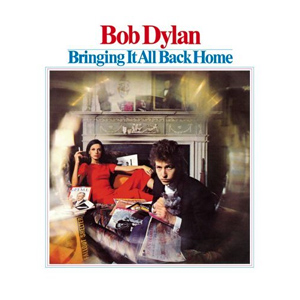
Bob DYLAN: Bringing It All Back Home


(#41: 29 May 1965, 1 week)

Track listing: Subterranean Homesick Blues/She Belongs To Me/Maggie’s Farm/Love Minus Zero/Outlaw Blues/On The Road Again/Bob Dylan’s 115th Dream/Mr Tambourine Man/Gates Of Eden /It’s Alright, Ma (I’m Only Bleeding)/It’s All Over Now, Baby Blue
 
(Author’s Note #1: Although I mention her regularly and acknowledge her thoughts and perspectives where indicated, I do feel it incumbent upon myself to acknowledge the vast help offered to me in the course of compiling this tale by my dear wife, Lena Friesen. Listening to these albums anew as a couple has elicited and provoked insights which otherwise would have been inaccessible to me. In particular I must highlight the immense contribution that Lena has made to the analysis of the Dylan albums, records which have been in her family all her life and with which she familiarised herself thoroughly as a child growing up in California; practically all of the following thoughts, and most of the thoughts expressed in entry #40, come from her and it has largely and merely been my job to document them and incorporate them accordingly.)

(Author’s Note #2: I have been a stickler for listing track titles as they appear on whatever edition of the album I happen to be using. For this essay I used the standard CD edition of
Bringing It All Back Home where only the first half, or top half, of “Love Minus Zero/No Limit” is listed as a title.)

If, according to Hemingway, American literature starts (and perhaps finishes) with The Adventures Of Huckleberry Finn, then it is right that Bringing It All Back Home, a record with which for many an entire culture starts, should essentially document its author as a Finn for his time; a dissatisfied, mischievous and fundamentally melancholy renegade fleeing his previous cultural/familial bonds, running into increasingly unlikely adventures but always surviving and sometimes thriving. It’s easy enough to accept chaos if you are its deliberate creator.

But let us talk briefly of Kanye West, and not merely – or at all - because of “Subterranean Homesick Blues,” whose provenance, part Berry’s “Too Much Monkey Business,” part Guthrie and Seeger’s “Taking It Easy” and part Kerouac passim, is far more interesting for the ways in which its various elements are mixed and remixed than for being any supposed precedent to rap; in fact the song, as with several others on the album’s “electric” side, though musically inspired by the example set (and reset) by the Beatles, has far more in common with the Stones and the angle at which they were coming towards Chuck Berry’s history. Likewise the unperched swoops which Dylan’s scarred scarlet vulture of an “I” makes towards “Maggie’s Farm” and its underpinning swing seem directly inspired by the Stones’ “It’s All Over Now.”

But back to Kanye, a musician who has recently aroused some controversy by not being what he is expected to be, someone whose art and expression cannot necessarily be contained within the milieu in which his art became formed. As electricity was to Dylan so is the Autotune to Kanye; a tool with which to further his art (and, by hopeful extension, all art), to articulate things which protest folk and hip hop could not allow. More to the point, Dylan’s more than menacing and essentially one note baritone vocal line on “It’s Alright, Ma” presages some of the passages on 808s And Heartbreak to a surprising degree.

Yet – just as Kanye’s rediscovery of his “real” voice on Estelle’s “American Boy” and Keri Hilson’s “Knock You Down” provides a liberating conduit out of doom – Dylan’s natural good humour gets him out of sundry scrapes; his post-Moby Dick wanderings through an America which doesn’t quite want or know how to accommodate him on “Bob Dylan’s 115th Dream” have the reckless rumbustiousness of a Stephen Malkmus (whose remark “Between here and there is better than anything over there!” on Pavement’s “Conduit For Sale” is particularly relevant here); he’s repeatedly arrested, beaten up, thrown out of windows but gets back to his ship in good time to wish good luck to the hapless, incoming Columbus.

Musically, too, the electric arrangements are horizontally active rather than vertically deep; the crosstown traffic of interweaving guitar commentaries across “Maggie’s Farm” or “115th Dream” never freezes up into a cluster while there is a modestly exultant rhythmic bounce throughout side one which derives from Presley far more than Lennon and McCartney, and Dylan responds acutely to this when required, for instance in “On The Road Again,” when he exclaims “There’s a HOLE! WHERE! MY STOMACH DISAPPEARS!!” in mock outrage and genuine astonishment that some people still choose to remain in a place which he himself has long decamped, and again at song’s end where his anguished yet defiant “HOW COME YOU DON’T MO-OVE?” streaks the skies of complacency like an unanswerable comet. And yet the musicians are capable of exquisite tenderness where needed, so that “She Belongs To Me” and “Love Minus Zero,” two would-be love songs whose subjects appear slightly ungraspable, as though he is singing more of an ideal than an actual person, are supported by a reliably resonant but profound backdrop.

If this piece has shied away somewhat from discussing the album’s lyrics in greater detail it is only because almost half a century of deafening deconstruction on the parts of hundreds, or indeed thousands, has gone into doing so. Similarly the above remarks offer little clue as to exactly how shocking and, in some cases, insulting an impact this album had in 1965, and in particular the Britain of 1965. It is sobering to remember that Dylan’s initial commercial impact in this country came in something of a collective rush; “The Times They Are A-Changin’” did not chart as a single in the UK until the spring of 1965, and its run overlapped with that of “Subterranean Homesick Blues.” Likewise, all of Dylan’s back catalogue appeared or reappeared, largely together, in the album chart throughout April and May. We were getting the back story and the advance all at once, and the impact was disorientating; no sooner had he become fixed as a protest singer for our age of convenience than he was running away from solutions and slogans towards a dextrous mix of emotional/symbolic ambiguity and sheer glee. Unlike the Beatles he could and would not be pinned down (and the Beatles were already learning from his example how to unpin themselves). From earnest Hentoff sleevenotes to semi-abstract self-penned essays, part ee cummings and part Mingus, from answers blowing in the wind to…well, there was the rub; where had he ever offered answers? And the division of demolition on Bringing It All Back Home is not so securely fixed. Side one may sound like Dylan trashing Seeger’s front porch – and the obvious allegory of “Maggie’s Farm” and the less obvious one of “Outlaw Blues” also point to this – but the balance between physical volume and writerly sharpness is not lost; “Subterranean Homesick Blues” sounds and feels random but its observations are as deftly and delicately pitched as “Masters Of War” albeit delivered a couple of dozen times faster.

It may well be, however, that side two – the “reassuring” acoustic side – houses, both emotionally and structurally, the more radical music. The original “Mr Tambourine Man,” for example, calls up the Beatles (and specifically Lennon) far more readily than anything on side one (although both perspective and delivery of “Love Minus Zero” perhaps point sideways or backwards to “She’s A Woman”) and in terms of its patient, itemised demanding of the infinite looks forward to “Imagine” as surely as it looks back to “A Hard Rain’s A-Gonna Fall” (the song is the post-apocalypse positive to “Hard Rain”’s negative). So it was only natural for the Byrds to take the song’s chorus and second verse alone (again, Dylan had set the precedent with his reconstruction of “Honey, Just Allow Me One More Chance”) and turn it into luminous, chiming, era-inventing pop; perhaps the first pop music that could truly be termed “post-Beatle.” “Gates Of Eden” in contrast is a paradise achieved, or at least dreamed, with the knowledge of its own mortality bordering upon non-existence (or anti-existence), but musically is most remarkable for Dylan’s snarling octave leaps; above all else, his more exposed voice on side two reminds us just how instrumental he was in deconstructing the accepted norm of popular singing. The timbre and grain of his voice are as alien yet as finally natural as the saxophones of Coleman or Ayler, though aesthetically he is far closer to Ornette in the sense of establishing a complete, self-contained new world within music. Note, too, the rhetorical rumblings of his bottom two guitar strings at certain key strategic points in the song (for instance, when following the couplet “The savage soldier sticks his head in sand/And then complains”). Here is a clear possible genesis for the humorously imagined lands of ideal which would subsequently best be articulated by Leonard Cohen, whether in the positive (“Tower Of Song”) or the negative (“Waiting For A Miracle”).

“It’s Alright, Ma” meanwhile sounds like nothing else that has preceded it in this story. Its acres of quotes which have succumbed to the common parlance need not be reproduced or further delineated here, but there is a striking, sinister darkness about its alleged confidence, Dylan’s low voice stalking rather than conspiratorial, that takes it into a non-light which neither the Beatles nor the Stones had yet reached or penetrated at this time. Its insistently mordant modality looks forward to both Led Zeppelin and Fleetwood Mac, and yet the traveller himself is not (yet?) Marcus’ Worried Man; this is rather his farewell to the past and the culture which have spawned him and which he now needs to abandon in order to live. His eye on the world is not shorn of its necessary wink, however; we need not worry about him, he reassures us, his running distance is unlimited. Finally, a rueful goodbye; “It’s All Over Now, Baby Blue” sees him shutting the door firmly on the lobby marked The Future Of Civilisation. He’ll run forever if he has to, and live an enjoyable and provocative life into the bargain – indeed it’s the central part of Dylan’s bargain – but don’t look to him any more than you’d look at LBJ on the cover of Time, or Curtis Mayfield or Eric von Schmidt or Robert Johnson or Joan Baez or any of the other adornments screwed into that keyhole of an album sleeve design for a solution; even before the sixties are halfway through, he is warning us that we are already on our own even as he is, as Malkmus would go on to say, taking a rotten old tree and making it bear fruit.

But then how was he to know of the trembling distant voice ready to startle his sleeping ears in the belief that she has found him?

Tuesday, 2 June 2009

Bob DYLAN: The Freewheelin’ Bob Dylan


The Freewheelin' Bob Dylan - Wikipedia

(#40: 17 April 1965, 1 week; 22 May 1965, 1 week)

Track listing: Blowin’ In The Wind/Girl From The North Country/Masters Of War/Down The Highway/Bob Dylan’s Blues/A Hard Rain’s A-Gonna Fall/Don’t Think Twice, It’s All Right/Bob Dylan’s Dream/Oxford Town/Talkin’ World War III Blues/Corrina, Corrina/Honey, Just Allow Me One More Chance/I Shall Be Free

How apt that the most singular album in this tale to date should begin with a song whose origins stretch back to Canada. “Blowin’ In The Wind” was inspired by the spiritual “No More Auction Block,” a song popular among the former black slaves who had fled to Canada following Britain’s abolition of slavery in 1833. Dylan’s delivery is straight, earnest, dedicated and direct, his steadfast-verging-on-stubborn low tenor slightly reminiscent of Johnny Cash. Already, however, there are signs that what we are hearing does not quite match up with what we get; it was to become a typical characteristic of Dylan’s evasive genius that a song which would go on to have an incalculable impact on both popular culture and the wider world should be so determinedly non-committal and ambiguous; foreshadowing Lennon’s patiently subversive list of demands in “Imagine,” Dylan asks a series of rhetorical questions (in Homeric/Ciceronian triplicate) and leaves us to come up with the answers, or indeed the single answer which may answer all of his questions. The song offers no bouquets of reassurance; it is protesting at us, rather than for us.

A similar process of patience works its way through Dylan’s second album and it is indicative of the presence of true genius that its impact was to be so gradual and osmotic. The thirteen songs collected here were recorded (along with many unreleased others such as “Talkin’ John Birch ‘Paranoid’ Blues”) over a 12-month period between April 1962 and April 1963, a period which incorporated the Cuban missile crisis (and Dylan is keen not to let us forget its existence) and trips by Dylan himself to London and Rome. The record was issued in May 1963, did not enter the British charts until May 1964 and took nearly a year to climb to number one. During that time his influence had already seeped its way into the work of the Beatles and others, and it is instructive to go back to the source in light of its subsequent adaptations (see entries #37-8) and Dylan’s own reaction to the latter (see entry #41).

It is also a pleasure to read Nat Hentoff’s detailed and informed, if characteristically slightly sentimental, sleevenote as a respite from the tower of PR babble with which this tale has become all too familiar. Looking at the monochrome shots of Dylan, at work in the studio, there radiates a single-minded (yet community-earthed) intensity highly reminiscent of Coltrane (as a glance at the sleeve photos on the latter’s Ascension will demonstrate). This was serious stuff; yet the joy of Freewheelin’ lies in how Dylan systematically subverts the seriousness through its passage.

“Girl From The North Country” was derived from the arrangement of “Scarborough Fair” which Martin Carthy variously showed to both Dylan and Paul Simon when they visited Britain but Dylan’s adaptation is far subtler and slyer. His delivery is not quite as straight as it was on “Blowin’ In The Wind”; he is already offering startling intervallic octave leaps – a kind of halfway house between post-Yoruba field chants and Hank Williams yodel – and introducing his idiosyncratic sliding scale of phrasing (not to mention the “A” pronounced as in the letter of “A true love of mine”). Note also the contrast of “In the darkness of my night/In the brightness of my day” in light of McCartney’s subsequent “And I Love Her.”

“Masters Of War” brings out the shadows of “Blowin’” into a public light. Any ambiguity is abandoned here and the directness and harshness of both words and performance – over a modal waltz figure which Lennon would later adapt as the basis of “Norwegian Wood” – are as shocking today as they must have been forty-five years ago. Dylan’s voice has now little to do with coffee house politesse – hear the “Hide behind WALLS!” that he howls at an early point – and via the ingenious double metaphor of water running down the drain and blood running through the masters’ veins we attain a despair which belies the singer’s insistence on his youth; so young yet so exhausted, wishing the would-be destroyers an early and swift death. Some theatricalism is evident but its unabated and unassuaged fury has no real precedent in this tale, although its musical roots lie in the English Civil War lay “ Nottamun Town,” and recordings of the latter by Bert Jansch and Fairport Convention later in the sixties have Dylan’s setting coursing with moderate but clear wildness through their veins.

On a musical level “Down The Highway” is perhaps more radical still. It follows the classic twelve-bar blues structure but Dylan’s comments in the notes about the fundamental mistake of interpreters of the blues being that they try to get inside the blues rather than get outside their troubles remain pertinent. At several points he mentions Big Joe Williams’ drolly sombre style as a major influence, but everything about “Down The Highway” points to unexpected futures. The opening, wriggling out of tempo guitar figures, as well as the strikingly distended aspect Dylan’s voice lends to the couplet “Well, meet me in the middle of the ocean/And we’ll leave this ol’ highway behind,” directly anticipate Hendrix. The giggling and yodelling accompanying the line “Ain’t got much more to lose” are more in keeping with Stan Freberg than Hank Williams. The tag line descents (“Lord, she took it away to Italy – Italy!” he repeats, astounded at his own echo as well as co-cover star Suze Rotolo’s decision to move there for a prolonged period) have a pleasing gruff dismissiveness which would subsequently be developed and mutated by Beefheart. There may even be a hint of 50 Cent through Dylan’s occasional monotonal moroseness, but in general his vocal performance, moving through hiccups and octave vaults, might rightly be said to presage Tim Buckley. And he leaves us in no doubt that he means to capture and represent the entire spirit of his country: “Yes, I'm a-walkin' down your highway/Just as far as my eyes can see/From the Golden Gate Bridge/All the way to the Statue of Liberty.”

“Bob Dylan’s Blues,” meanwhile, invents the indie slacker template which would only properly germinate three decades later with Daniel Johnston, Beck et al. "Unlike most of the songs nowadays've been written uptown in Tin Pan Alley - that's where most of the folk songs come from now days,” Dylan drawls at the beginning, “this is a song, this wasn't written up there - this was written somewhere down in the United States!” before launching into a hilarious fuck off litany ranging from the Lone Ranger and Tonto to six shooters and judges, with impeccable comic timing, the final, climactic “Yes!” being but the funniest example. Let the whole of society be blown in the wind.

Then, without warning, we proceed directly to “A Hard Rain’s A-Gonna Fall” and realise that we are in the presence of a vivid visionary. Again, perhaps the most remarkable facet of Dylan’s performance here is his patience; he does not rush through his forest of mirrored metaphors but gives us time to consider each increasingly horrific sight as he proceeds. The immediate inspiration – the Cuban missile crisis and the medieval Anglo-Scots ballad “Lord Randall” notwithstanding - would seem to be Ginsberg’s Howl, the underlying model inescapably Whitman’s Leaves Of Grass if we are speaking of the containment of all multitudes. But if, as Lester Bangs noted, the optimal musical accompaniment to Howl (pace the Kronos Quartet) would be Coltrane’s “ Africa ,” “A Hard Rain” needs only Dylan’s unavoidable, intimately global presence to work, since the focus has firmly to be on the words. As a song of personalised (as in internal, encrypted) protest its only real sixties parallel is “I Am The Walrus.” And yet, despite the song’s introduction of the rain metaphor which would become dominant as history progressed – Fogerty’s “Who’ll Stop The Rain?” being only one subsequent example – it still carries hope, however battered; Dylan’s reporter will continue to wander and report and walk through the valleys of not yet pacified pain, possibly beyond the world’s end. The song’s ramifications are vast, its procession of alternately condensed and expanded metaphors deftly handled, its implications ranging far beyond the scope of the thirty-nine albums previously discussed in this study, perhaps even beyond music.

If side one is the album’s “dark” side, side two lets in the light, even with the darkest of subjects. “Don’t Think Twice” is taken very carefully for one of the most acidic and defeated of Dylan’s long line of end-of-the-affair dissection songs, though its fleet guitar topline work may suggest the assistance of studio guitarist Bruce Langhorne with the recording. Inspired by and borrowing liberally from Paul Clayton’s 1960 song “Who’s Goin’ To Buy You Ribbons When I’m Gone?” (although Clayton did teach the song to Dylan), “Don’t Think Twice” goes some way beyond its inspiration; here Dylan is clearly clutching at useless consolations, talking far more to himself than to his departed Other, though note the Droopy whine of “I never KNOWED!” and the general misleading lightness of touch, both of which were to have an immediate effect on the lyrics of Lennon and the guitar work of Harrison.

“Bob Dylan’s Dream” was inspired by the Victorian song “Lady Franklin’s Lament,” another song taught to him by Carthy during his winter 1962 visit to London, but Dylan transfers the latter’s Arctic mourning into perhaps the record’s most touching moment, a reminiscence of hanging out with the artist shortly to be known as Wavy Gravy in New York in 1961, his eyes already half damp in remembrance of better and more innocent times, a life never to be recaptured – and yet Dylan was still only twenty-two; still, would a new and uninformed listener earmark Astral Weeks as the work of a 23-year-old? How long does it take for some lives to be lived? Ask the 13/14-year-old Springsteen of 1963 that question, and then listen to Nebraska.

“ Oxford Town ” swiftly deals with the James Meredith/Mississippi campus riots affair; Dylan’s delivery is half jokey but the undertow deadly serious; this is the album’s only directly “topical” number (“Somebody better investigate soon!”) and suggests that Dylan was wise to move towards a more encompassing approach. “Talkin’ World War III Blues” in contrast is “A Hard Rain” in reverse image and the album’s most remarkable track as well as its funniest; here Dylan realises that the only way to confront the destructive nonsense of the world is to counterbalance with creative anti-sense. Finally he emerges from his chrysalis to form the Dylan of Highway 61 and Blonde On Blonde as he reports his post-apocalypse dream, a crumbling slapstick backdrop of reluctant partners, other sole survivors who think he’s a Communist, unpaid radio bills, Cadillacs (“Good car to drive…after a war”) and speaking clocks. Again his timing is immaculate and hilarious (regularly punctuated by some especially droll harmonica blasts). Those who imagine that Dizzee Rascal’s “Bonkers” has no precedent would do well to re-examine this song, with its extended, deliberate confusion between waking and dreaming, and even unto its song-within-a-song irruption; whereas on “Bonkers” the cheery post-2 Step song which drifts onto the radio (“Go with the flow” etc.) is abruptly interrupted by Dizzee’s impetuous “Back in, back IN!,” the equivalent moment on “Talkin’” comes when Dylan turns on his record player to listen to “Rock-A-Day, Johnny singin’, tell your ma, tell your pa, our loves are gonna grow ooh-wah ooh-wah,” the last five syllables blending into a descending murmur of informed disinterest. Unlike “Bonkers,” however, there are other people present; the psychiatrist to whom Dylan is narrating the dream exclaims that he has had the same dream but that only he was in it, and Dylan extends the anti-Spartacus metaphor to mourn all the people walking around in the 1962 world recognising only their own dreams. He cites Lincoln before offering “I’ll let you be in my dreams if I can be in yours” and then, almost offhand, adding “I said that.”

“Corrina, Corrina” is the only track on the album to use a band – so varied and startling have Dylan’s approaches been that we frequently forget that this is largely a solo recording – and perhaps suffers from over-familiarity (as it seems that every American musician in the early sixties was obliged to record the song) and a sense of padding (the band includes such unlikely rockers as pianist/jazz historian Dick Wellstood and the recently departed Condon bassist Leonard Gaskin); although Dylan is appositely grieving – his accent on “I just can’t keeeeeep from cryin’” for instance – there is a slight sense of detachment about his performance. This is not something that can be said of “Honey, Just Allow Me One More Chance”; unlike previous misreaders of the minstrel show tradition, here is an example of something entirely new being created from existing material. Composed and recorded by Henry Thomas in 1927 – the original can currently be found on the Document compilation Ragtime Texas: Complete Recorded Works In Chronological Order 1927-1929 – Dylan does not precisely cover Thomas’ original; rather, he largely discards Thomas’ verses, doubles the song’s tempo and uses the chorus as a jump-off for his own fanciful flights. This is Dylan’s most remarkable vocal performance on the album, full of snaps, cackles and whirled whoops – some highly reminiscent of the Coasters on tracks like “Young Blood” - almost turning the blues into an abstract untruth and worlds away from the conscientious student singing “Blowin’ In The Wind” some forty-five minutes previously.

The closing “I Shall Be Free” sees the future Dylan fully formed, and happy with it; here is the hipster, relaxing and slacking out shaggy dog stories like overwarm Bazooka Joe bubblegum, secure in the knowledge that faced with the prospect of imminent apocalypse, shouting nonsense in the face of authority, or at least drawling it, is the best protection and attack; JFK rings him up (how did that sound in the Britain of 1965?) asking for advice and Dylan recommends bringing in Brigitte Bardot, Anita Ekberg and Sophia Loren and then putting them in the same room as Ernest Borgnine (“Country will grow!” he gruffly reassures the President). Here the rhetorical poetical quattrain makes itself known (honeymooner, June crooner, spoon feeder, natural leader; bagels, pizza, chit’lins, a muttered “bullshit”). A man comes on the television two years ahead of “Satisfaction” and Dylan considers Yul Brynner, Willie Mays, Charles de Gaulle and Robert Louis Stevenson as reasonable alternatives to hair oil. Attending to his delivery here, while one recognises the Guthrie/Elliott precedents (though Ida Cox may be a more fitting, if more surprising, comparison point vocally), I do wonder whether the influence of Lonnie Donegan may perhaps have travelled in reverse (try Dylan’s “Well, I gotta woman, sleeps on the cot” next to Donegan’s “Well, I gotta gal, six feet tall” on “Cumberland Gap,” even though both have the same uncommon antecedent). His final words to a world waiting for protest and revelation? “I catch dinosaurs! I make love to Elizabeth Taylor! Catch hell from Richard Burton!” As with everything else about this, the most significant and unique album to be discussed in this tale thus far, it gives the impression of elemental earth converting gladly into electricity, and the future, permanent blocking of all undue auctions.

Tuesday, 26 May 2009

The ROLLING STONES: The Rolling Stones No 2


(#39: 6 February 1965, 3 weeks; 6 March 1965, 6 weeks; 24 April 1965, 1 week)

Track listing: Everybody Needs Somebody To Love/Down Home Girl/You Can’t Catch Me/Time Is On My Side/What A Shame/Grown Up Wrong/Down The Road Apiece/Under The Boardwalk/I Can’t Be Satisfied/Pain In My Heart/Off The Hook/Suzie-Q

“Well, my groobies, what about Richmond ? With its grass green and hippy scene from which the Stones untaned…”

Looking at TW9 from that perspective – the endlessly rolling lushness of Richmond Park, the easy purchase to neighbouring Bushy Park and Hampton Court, the ideal of Arcadia – rather than from the workaday suburban bus route viewpoint it is easy to see why newness could emerge from its glistened woods in more than one form. I can only say that, as with Virginia Woolf, five minutes in this golden mean make me thirsty for the grey city; but more than one Rolling Stone still keeps a house in Richmond , so it’s no good applying Bloomsbury or Dennistoun principles here.

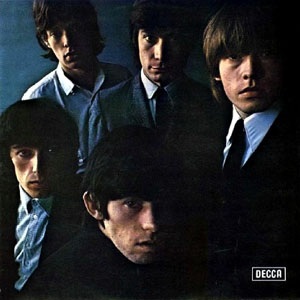
Still, it’s hard to listen to the second Stones album and not think of Lena ’s mythical Anne Boleyn Secondary School Battle Of The Bands Semi-Final. In David Bailey’s cover shot they appear more apprehensive than menacing (and two of them are staring with some dread at something unspecified to the right of the camera) and their trainee businesslike remote approach streaks through to the back cover shots, where they appear to be doing their best to ignore the camera as much as possible (except for a dubious-looking Watts). And while Oldham’s sleevenote, with its cheerful, systematic pilfering of A Clockwork Orange, may seem to represent a decisive break from the likes of Derek Johnson and Tony Barrow – including the famous blind man-distressing parenthesis – he still manages to fit in a reference to “groupdom” in between curiously Lytton Strachey-esque shaggy dog stories about the wit and wisdom of Keith Richards and sundry Boswellesque jaunts. Nonetheless this is certainly the first album in the tale to mention the concept of the hippy (see also “Their music is Berry-chuck and all the Chicago hippies”) even though the promise of the ultimate answer to Wagner, Stravinsky “and Paramour” is not quite fulfilled by the record’s contents.

The Rolling Stones No 2 is currently not an easy record to find or collate; in terms of CD availability, its twelve tracks are currently divided between four different albums, and of these the version of “Everybody Needs Somebody To Love” – a moderately daring five-minute would-be showstopping album opener - is a good two minutes shorter than the original. As an integral album, however, it feels unfinished, and the blind man may be an apt analogy for this stage in the Stones’ development; here the five are feeling their way around different sorts of pop, rock, soul and blues, sometimes coming up with a collective answer, at other times failing rather badly. It is hard, for instance, to speak up in favour of their “Under The Boardwalk” which, as with several other covers here, is performed in too low a key with inevitable, problematic vocal consequences; despite a heavily-miked acoustic guitar solo dashed off by Jones, the football mob chant of backing vocals on the last “boardwalk” of each chorus betrays a misunderstanding of pop. The same problems occur in their reading of Otis Redding’s “Pain In My Heart” where the crucial “Come back” and “Love me” triples and the climactic “baby” at the end of each are groaned in a manner more suitable for Bernie Winters than the Stax studios (though inspire a moderately furious dual guitar roustabout).

With their version of Solomon Burke’s unassailable “Everybody Needs Somebody” it is clear that Jagger is still a boy when set against Burke’s authoritative (but never tyrannical) man. “I’m so glad to be here tonight!” he announces at the beginning as though walking onstage at Blackpool Winter Gardens, and his imprecations to “save the world” are buried a little too distantly in echo to work, either rhetorically or emotionally. The arrangement, however, is inventive; Jones’ and Richards’ rhythmic placements are far more suggestive of Motown and ska than Stax, the gradual build-up is well timed and executed (with the catalyst of Watts ’ cymbals) and Jones’ final agitated comments deserve more space than the premature (even after five minutes and five seconds) fadeout allows them.

Side one thereafter is largely strong. Leiber and Stoller’s near-demonic “Down Home Girl” is handled well as a slow shuffle with each new startling declamation (“I’m-a gonna take you to the burning river and push you in”) answered by Richards’ querulous three note descending wolf whistle figure, varying in intensity and space with each fresh appearance (Jack Nitzsche contributes piano to this track, and one cannot rule out his expert manipulation of space in terms of its production). With Jagger’s equally wolfish harmonica playing, we get yet more early notification of the grip which Dylan was already exerting on British music, and this soon-to-be-overpowering influence is also evident on their reading of Berry’s “You Can’t Catch Me.” Recorded in the Chess Studios in Chicago , and apparently with the composer on hand to yell encouragement throughout, the song bounces defiantly against the trampoline of Jones’ nervy elastic band slide.

“Time Is On My Side” shows that the Stones were rather more capable of addressing Arthur Alexander as peers than the early Beatles; Jones’ opening three note coyote cry descends into a ball and chains rhythm (with Jagger’s tambourine acting as manacle) and along with the two preceding tracks we are reminded of how, among countless others, the young Polly Harvey would have grown up with this music in her blood. Here Jagger’s timing is perfect; the slow one-two approach of “You…came…” splintered apart by a raging bark of “RUNNINBACK!” and supplementary eruptions (“Spendtherestofmylifewithyoubaby!”). Over Jones’ solo Jagger retreats to the back of the studio, shrieking “GO AHEAD! I’m runnin’ outta time!” and the great triplicate climaxes of “TIME! TIME! TIME!” display a mastery at which their “Pain In My Heart” only fumbled to reach.

The side ends, slightly anticlimactically, with two of the record’s three Jagger/Richards compositions. “What A Shame” is chiefly notable for its gambolling guitar intro, periodically interrupted by Jones’ shivering slide, which predates Bolan’s “Hot Love” by some six years. “Grown Up Wrong,” meanwhile, sees them attempting the Howlin’ Wolf template with mixed results; its (surprisingly) stumbling drums and handclaps are out of synchronisation but agreeably rather than offputtingly messy, though the strident mass vocal near track’s end is misplaced and the production echoes seemingly random. In addition, the song audibly runs out of steam about halfway through and the group have to fall back on stock responses to maintain any momentum; still, Jagger’s comments “Growing up too fast, don’t forget about the past” are worth noting.

“Down The Road Apiece,” an old boogie number which was originally a hit for Will Bradley’s band in 1940, was recorded at the same Chess sessions as “You Can’t Catch Me” and finds the band incendiary and inspired. A brisk roadhouse boogie with more than a hint of Elvis about its beaming bounce (though clearly the Stones derived inspiration from Berry’s subsequent reading), the track features scarring guitar breaks from Richards which get immediate responses from Wyman’s vaulting bass, Watts’ ride cymbal (the latter especially during the third break) and Jones’ increasingly dissonant piano. Thereafter, however, the pace slackens; as well as the above misreadings of “Boardwalk” and Otis, we get a surprisingly muted take on Muddy Waters’ “I Can’t Be Satisfied” in which Jagger is more sullen than despondent (and, again, pitched far too low). There is also some misunderstanding between Jones’ and Richards’ lines in the introduction and overall Jones pushes the Hubert Sumlin button a little too often. And yet at the same time the Stones were capable of producing an incandescent version of Wolf’s “Little Red Rooster,” a deserved number one just before Christmas 1964 (it was succeeded for the season by “I Feel Fine”) whose subtle slyness made even the Animals’ “House Of The Rising Sun” seem somewhat jejune.

“Off The Hook” is the record’s third Jagger/Richards number and again offers no indication that anything of the quality of “The Last Time” or “Satisfaction” was just around the corner; to return to Lena’s Anne Boleyn Secondary model for a moment, much of side two resembles an enterprising school band doing their best with material which they cannot really grasp, and “Off The Hook” sees them attempting the girl group formula with considerably less success or mischief than Lennon; an elementary construction driven by a crisp, jangly rhythm, it too runs out of inspiration relatively early and the subsequent padding out to fade is embarrassing.

And yet the Stones’ incipient duende abruptly veers into focus with the closing track, their version of Dale Hawkins’ “Suzie-Q” (and a decisive influence on the younger John Fogerty, in 1965 still leading the Golliwogs), which offers a handclap-strewn punk thrash. The momentum is exciting, the goal achieved and Jones offers a fiercely fuzzed-up guitar solo; but, as with so many of this album’s tracks, it is unceremoniously faded out, and at a mere 1:50 offers only a soupçon of the storm of hip malchicks about to overpower the dirgiest of countenances. When next we meet the Stones in this tale, however, the school stage would have been exchanged for at the very least a greener and more authoritative quadrangle.

Monday, 18 May 2009

The BEATLES: Beatles For Sale

A photo of the Beatles – George, John, Ringo, and Paul


(#38: 19 December 1964, 7 weeks; 27 February 1965, 1 week; 1 May 1965, 3 weeks) 


Track listing: No Reply/I’m A Loser/Baby’s In Black/Rock And Roll Music/I’ll Follow The Sun/Mr Moonlight/Medley: a) Kansas City; b) Hey, Hey, Hey, Hey/Eight Days A Week/Words Of Love/Honey Don’t/Every Little Thing/I Don’t Want To Spoil The Party/What You’re Doing/Everybody’s Trying To Be My Baby 


The fourth Beatles album has tended to remain under a critical cloud, having been variously described as hard to grasp, makeshift, and, in particular, weary. Most assessments of the record have focused upon the group’s assumed tiredness at the time they recorded it. It was forged in the immediate aftermath of a gruelling world tour (during which the famous Hollywood Bowl concert was recorded – see entry #183), and essentially recorded (and mostly written) on their days off (including a marathon eight hour session in mid-October 1964), and despite Tony Barrow’s previous assurances of a dozen-year stockpile of new songs, only eight new Lennon/McCartney songs appear on the album, the rest of the space being occupied by six covers of old rock rep reliables.


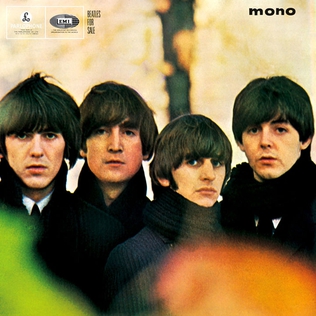
Certainly, as can be seen from the above statistics, the album did less well than its predecessors (but then, unlike its predecessors, it was faced with markedly stronger competition – see entries #39-41). And the autumnal cover shots of the group taken in Hyde Park, all black mufflers, polo necks and moods, do suggest four young men in need of a serious rest (in contrast, the monochrome gatefold snap of the group in full grinning blast onstage – with George resembling, of all people, Slade’s Dave Hill – already seems taken from an irretrievably antique archive).


None of this, however, explains how in the middle of the marathon 18 October recording session the Beatles were able to come up with their most adventurous and experimental songs to date – Lennon’s “I Feel Fine” and McCartney’s “She’s A Woman,” both kept back for the next single – nor how at the end of those eight hours Lennon was able to give such a convincing and passionate performance of “Rock And Roll Music.”


Nor, indeed, does it explain the more subtle reinventions going on throughout the album as a whole. That the autumn shades stealing into the closing scenes of side two of A Hard Day’s Night continue to darken the sky is unavoidable, especially given the opening Lennon triptych of bleak. “No Reply” veers disturbingly between polite bossa nova rustle, as Lennon explores his betrayed bafflement, and outright aggression – the violent block harmonies of “I SAW THE LIGHT” and “I NEARLY DIED” – the bipolarity unresolved by the energised, one-step-up-at-a-time drive of the middle eight. The final C minor – not even ruefully smiling, simply resigned to eternal dark – suggests that his cries will never be answered.


“I’m A Loser,” the first fully-formed “Dylan” song of Lennon’s, demonstrates how Lennon took Dylan’s model as a thing in himself. At this stage not particularly interested in politics, Lennon recognises Dylan’s diagonally slack swagger, his industrious indolence, likes the jump of his cut, the drooled mouth organ multiphonics, and switches down side streets like a Mini Moke on rainbow-coloured heat. The casualness is a necessary disguise for his pre-emptive self-deploration – the grinning, slightly too deep “crossed,” his sunny “I have left it too late” and “Pride comes before a fall,” both of which misleading rays are answered and comforted by Harrison’s shoulder cry guitar figures. In his own solo on this track, Harrison offers the first of the album’s several tributes to Carl Perkins, and the initial signpost towards the thing which would eventually be known as country rock.


“Baby’s In Black” derives its harmonic sense and air of newly-bereaved listlessness from the Everlys but its sea shanty setting and Mercer-esque deadpan rhyming/punning clunks which appear to make casual light of terminal grief (“And although it’s only a whim…she thinks of him,” “Baby’s in black…and I’m feeling blue”) are new and disturbing, as is Harrison’s solo, which resembles a sinking ship’s creaking deck.


Out of this airless trilogy, Lennon’s never more ecstatic roar through Berry’s “Rock And Roll Music” – a song that was effectively Lennon’s Bible – comes as the most euphoric of escapes. Singing and screaming with all the audible liberation of a recently freed deep sea hostage, Lennon tears through his self-imposed regrets, gets back to the seed which inspired him – and everyone comes with him. His “tango” gets an immediate cymballic reaction from Ringo, and even George Martin’s piano verges on the edge of besotted unreason. One of their best recordings – and by extension one of the greatest of British rock recordings - “Rock And Roll Music” still stands as the definitive defence case against the cynical prosecution of future misapprehensions of their magic.


The turn-on-a-dime nature of the album’s genesis is perhaps illustrated by the fact that the fourth of its eight originals, McCartney’s “I’ll Follow The Sun,” was one of the group’s earliest songs, dating back to 1960. Using the same ascending harmonic stepladder as “No Reply” but to strategically different ends (even if the song’s lyrics are necessarily as callow as any written by an eighteen-year-old), the browning (not yet quite Browning, even though its writer was living on Wimpole Street at the time) rays of sunshine steal through four years ahead of similar, slightly less self-conscious endeavours on the White Album, Starr gently tapping his suitcase in time with Paul’s optimistic melancholy.


All of this makes the immediate subsequent shrieking of “Mr Moonlight” that more shocking. Originally done by Piano Red (the original Dr Feelgood) in 1962, this is perhaps one of the most disturbing of all Beatles recordings. Lennon more or less screams the song throughout and the Mike Sammes Singers-in-aspic oppressive block of mass harmonies lends to the general aura of Lynchian grotesquerie. The odd percussion section – George whacking an African drum, Ringo banging his suitcase – is disorientating enough in itself (and, in itself, points the way to Dave Dee, Dozy, Beaky, Mick and Tich) but the macabre cherry comes with McCartney’s chintzy-verging-on-Hammer-horror Hammond organ interlude; as though the group are taking revenge on all those Minstrels, the casual besmirching of Presley by his arrangers.


As with many of the album’s tracks, the almost random fadeout suggests a reluctant weightlessness. Much more assured is the McCartney-led Little Richard tribute. Goaded by Lennon in the studio to “Really throw it!,” McCartney scars his throat to provide one of his most ravenous vocal leads; the band’s swing is comfortable yet propulsive, Starr’s wink of a link from Leiber and Stoller to Penniman is a conspiratorial carpet slipper and again demonstrates how, when the band relaxed themselves, they were able to rock and swing as precious few others of their peers could achieve. The Lennon-led backing vocals as the sequence reaches its climax is cheeky but in full concordance with the lead singer’s cocky cheer.


“Eight Days A Week” remains the album’s most celebrated song; its then unprecedented fade-in intro confirms that the group had not lost its sense of adventure (and its fire engine ice cream chimes foretell the Move; see “Flowers In The Rain”), and Lennon’s confident joy locks in beautifully with McCartney’s strolling-up-and-down-the-D-major-High-Street bass. Yet another derivé of girl group pop – most marked in its insistence upon foregrounding the handclaps – the song becomes the parade down which these ideals of sixties swing promote themselves; the “Hold me, love me” bridge (with the marvellous confirmatory consummation of that diminished G sharp under the second “love me”) confirm that Lennon’s previous pleas have now been pleased. As per Derek Taylor’s hopeful sleevenote – “Just play the child a few tracks…and he’ll probably understand what it was all about. The kids of AD 2000 (sic) will draw from the music much the same sense of well being and warmth as we do today” – if you wanted to know why it should have been so good to be properly alive in 1964, “Eight Days A Week” would sum it up with perfect imperfection.


The group’s take on Holly’s “Words Of Love” is, after the foregoing storm, curiously shadowed (again, it’s how the Shadows might have done it, as they surely must have done in their early days), as though the group are singing it to and for themselves, slightly turned away from the listener, turning into each other. The performance’s casualness is underlined by the initially slight rhythmic stiffness; the singing is low, internalised. But suddenly, towards the fadeout, Harrison’s Gretsch Tennessean begins to open up in terms of chordality, again opening an unexpected door into a Byrdsian future.


Following this, Ringo gets his turn on the Carl Perkins/Cavern Club warhorse “Honey Don’t” and chirpily sends all the bleakness up. “Doggone!” he exclaims in pure Scouse. “Ah, rock on George, one time for me!” he grins to the guitarist. “I feel fine!” he self-refers. He even offers an Oliver Hardy “Mmmm-HMMMM!!” But then Starr – quite unexpectedly – leads the way into the Beatles not quite sounding like the Beatles. Structurally “Every Little Thing” seems to be an exercise in Bacharach pastiche with its displaced thirds and deliberate anywhere-but-the-centre bar line constructs – see also “It’s For You,” written by Lennon and McCartney as a single for Cilla Black that year - but Martin’s piano and especially Starr’s timpani open out the sonic picture to an extent not hitherto heard on Beatles records.


On top of this, however, and leading yet more credence to this being the Beatles’ definitive proto-folk rock/country rock record, we have interweaving guitar lines and harmonics which (as Lena says) prepare the way for early R.E.M. (Reckoning in particular) – Harrison here is virtually inventing Peter Buck. “I Don’t Want To Spoil The Party” brings back some of the album’s initial bitterness and acts as a sort of coda to the opening Lennon trilogy. Still exercising its country influences, a slightly blotto Lennon (“I’ve had a drink or two and I don’t care”) has had enough (“There is nothing for me here, so I think I’ll disappear”). Again the song offers a surprisingly aggressive bridge but here Lennon realises more quickly that it’s time to wander (leaving Harrison to work out his Perkins infatuation yet further). “I think I’ll take a walk and look for her,” he gloomily concludes – and this time there’s no indication that he’ll be back.


Slightly more surprisingly, “What You’re Doing” offers a bitter McCartney – as with other such songs of this period, it seems to have been directly inspired by the downside of his relationship with Jane Asher. His emotion overlaps the slightly clumsy schemata (“got me runnin’” rhyming with “there’s no fun in…”); the “me” of his central “It’s ME” stretches hoarsely over a dozen syllables. Martin’s saloon bar piano interlude rumbles like terminal thunder. Once more, Harrison predicates the Byrds in his guitar lines but the Spector drums/bass/piano pattern reimposes the notion of not quite reproducible in real time (“There is little or nothing on the album which cannot be reproduced on stage,” says Taylor, after he has spent a long paragraph detailing the opposite).


In light of all of this unusually angled intensity it is right that Harrison ’s cheery take on Perkins’ “Everybody’s Trying To Be My Baby” should have closed the record as a sparkling glass of liver salts cures incipient indigestion. “Well, they took some honey down from a tree,” sings George, “Dressed it up and called it me.” Light of foot and emotion, but not lacking a certain, confined confidence, the track’s easy swing and charm takes us down (or up) while also belying the postmodernist considerations of the album’s title; are we simply becoming a commodity, a brand? Not if we can help it, grin back the four smiling suits sitting afront a montage of silent movie stars – and that photograph too would prove a precedent of things yet to be made to happen. The critical cloud duly rolls on by.

Monday, 11 May 2009

The BEATLES: A Hard Day's Night


(#37: 25 July 1964, 21 weeks)

Track listing: A Hard Day’s Night/I Should Have Known Better/If I Fell/I’m Happy Just To Dance With You/And I Love Her/Tell Me Why/Can’t Buy Me Love/Any Time At All/I’ll Cry Instead/Things We Said Today/When I Get Home/You Can’t Do That/I’ll Be Back

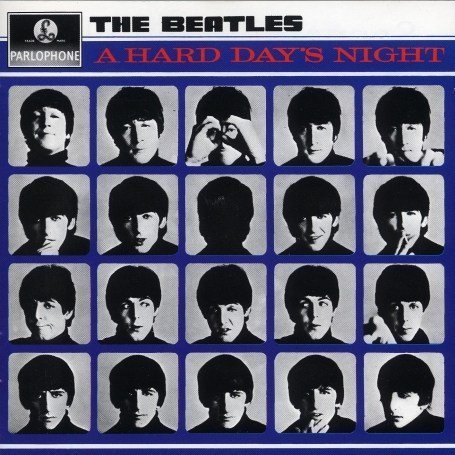
They have multiplied. There are now five times as many of them as there used to be; twenty faces being pulled at or pushing the camera – except for Ringo, who patiently sits it out – gazing at us from within a constellation of assumed film reel, wondering: why are there so many of us and so few of you?

It is hard not to imagine their peers hearing - witnessing - the opening chord of “A Hard Day’s Night” for the first time and not asking themselves the same question, in immediate and abject despair. It is still the nearest thing to pop’s equivalent of the Big Bang, the godly gesture which forever separated the Beatles from the quarried men who hoped to walk beside them on their towpath. MacDonald calls it a G eleven suspended fourth, Harrison referred to it as an F major chord with a G on top (played on his new 12-string Rickenbacker) but advised asking Paul about his bass note – and although the former description is, technically, the more accurate, there remains the knowledge that the chord – the fist of rampant creation – can never really be pinned down. If its intent were to begin time, then it can be excused for having no identifiable precedent.

The irony of it all is that, apart from its beginning and ending, “A Hard Day’s Night”’s explosion has little to do with guitars. Within the song’s main body Ringo’s drums, bongos and cowbells and Lennon and McCartney’s voices more or less predominate; the principal guitar here is Lennon’s acoustic rhythm, suggesting a skiffle group waking up in a spaceship (the latter confirmed by the mid-song Harrison/Martin guitar/piano break, taped at half-speed and then speeded up to resemble a suitably frantic harpsichord). The melody line scales and descends sundry tonal snakes and ladders and the division of lead vocal duties – John on the verses, Paul on the middle eight – cannily disguises the song’s complex, two-and-a-half octave range. There’s a lovely moment when Paul, palpably straining – virtually shrieking – to grasp the double “TIEEEEEGHT” at the end of the second middle eight, threatens to go off the scale and lose his voice altogether but doesn’t; coming back into the final verse, Lennon responds to his exhausted but exultant “YEAH”! with an approving grin of “Mmmmmmm!” And if that weren’t enough – but entirely fittingly, given the song’s impatient pelvic thrust – Harrison’s Rickenbacker returns triumphantly at the end, chiming between A minor seventh (without a fifth, flattened or otherwise) and F major and fading out on that opened-out promise; here’s the future, what are you going to do with it?

The answer – any answer – proved to be beyond the ken or scope of any of their fellow Merseybeat travellers (though, as it turned out, not beyond that of some of their Mancunian counterparts) and so the Beatles, having separated British pop from its stifling previous history, now detached themselves from the family entertainment flow, or at least were determined to do so. It is noticeable how in Lester’s film the four seem to be the relatively calm centre of an established British universe busily going mad; their capers in the Isleworth field and elsewhere, derived from Lester’s previous The Running, Jumping And Standing Still Film short improvised with Milligan, Sellers, McKern and others four years previously, still delight with their instant freshness, but the showbiz great and good surrounding them are otherwise fussing and cussing like overheated kettles. Norman Rossington’s Carry On Sergeant manager was nobody’s idea of Brian Epstein but lent the film its defining opposing element – whereas John Junkin’s jittery but adoring roadie was far closer to Epstein in terms of personality.

Yet the real rebels in the film are – if we’re talking alternating between loud and soft – Wilfrid Brambell as Paul’s grandad and Ringo himself. The former has seen it all and lived through more, long and hard enough to realise the gleeful futility of existence; we won two world wars to allow glumness? By some accounts Brambell’s performance gave a truer picture of the man himself – a Dublin dandy, a closeted gay alcoholic – than could have been gleaned from his dozen years of Albert Steptoe in Galton and Simpson’s brilliant extended extemporisation of Beckett’s Endgame (though note should be made of his touching and truthful final appearance in Terence Davies’ 1983 film Death And Transfiguration, not to mention the fact that on the back of his performance in A Hard Day’s Night he was subsequently engaged to play the Mothers’ bassist in Zappa’s 200 Motels, though quit the production after about a week of shooting).

The part of the film which I most frequently revisit, however, is the long, slightly disconnected section midway through where Ringo wanders off on his own, availing himself of pleasantly innocent psychogeographics through a West London riverside still rubbing its sores from the war. Barnes, Kew, Twickenham, the Ealing Studios child on the riverbank who understands Ringo as no one else could, the bitterly warm loneliness of the Twickenham pub where he unsuccessfully tries to get served; a world from which he was already thoroughly separated, even before he became famous (interesting also that Ringo is essentially ranging through the Stones/Yardbirds’ southwest stamping grounds). He returns safely to the TV studio and the theatre, of course, and even in the controlled and clearly mimed environment we do get an inkling of the Beatles’ conversion-friendly power; a world which includes, among others, the nascent Phil Collins and Charlotte Rampling.

The album’s songs are in equal parts futuristic and ambiguous. Futuristic if, for no other reason, this was the first Beatles album to consist entirely of their own compositions (and the only Beatles album to consist entirely of Lennon and McCartney songs), but also because of a fervent freshness and consequent newness stronger than had been suggested on either of their first two albums. This gained strength was crucial; coupled with the energy and irreverence (particularly on Lennon’s part with regard to conventional song structures), I often think side one of A Hard Day’s Night – which incorporates all of the songs used in the film – to be the best and most thrilling side of music on any Beatles album; here is a group totally in control of itself and happy with it.

Lennon’s crazed mono/polytonal walrus of a harmonica on “I Should Have Known Better” is a punk step forward from “Love Me Do”; here is where the Dylan influence starts to seep audibly into the Beatles’ work. Lennon’s vocal is so carefree and Harrison’s super-miked 12-string growls (combined with, again, acoustic guitar in the rhythmic forefront) that its good humour makes nonsense of assuming that its words are nonsense. Lennon is bending the rules like William Brown squatting in the back row of the lecture theatre in the Guildhall School of Music and just as happy to catapult convention.

Still, even happiness has its limits here; by the second line of “If I Fell,” Lennon is already pleading for help (“Help MEEEE understand”) and the song gently meanders around unorthodox bar line/modulatory tropes (though most clearly continue to be derived from Smokey’s Miracles). Moreover, the line “I found that love is more than just holding hands,” though representing a belated and rather touching rise out of adolescence into maturity, is the first instance of Beatle intertextuality (self-referring to “I Want To Hold Your Hand”), though nowhere near as self conscious and suffocating as the tendency would eventually become. Less of a declaration of love than a rather nervous fumble around the notion of love – the “look of love” if we must – Lennon wanders between second person at one remove (“I would love to love you”) and third person (he suddenly begins to talk about her as “she”), this is a song about a hypothesis of love which its author and singer hasn’t yet finally worked out.

George gets his nervous choirboy-at-the-end-of-term-school-dance solo feature on “I’m Happy Just To Dance With You,” although his somewhat morose vocal suggests the surface to belie the reality (I love his Scouse “Every-think!” in the second verse); though a relatively minor song, it still works because of all its subtle and not so subtle arrangemental touches; the now characteristic Beatle trope of beginning a song with the second half of its middle eight, Ringo’s hearty African drum slaps to echo Harrison’s chronically insecure heartbeat, and the group’s very deviously deployed Bo Diddley guitar lines (recorded a couple of days after “Not Fade Away” debuted in the singles chart, was this the first instance of the Stones influencing the Beatles?).

McCartney’s “And I Love Her,” though seemingly this album’s parent-pleasing representative, is actually a far more disturbing song than its reputation suggests. Here is a song of unalloyed but rather confined love almost wholly in a minor key, as though this is a love which has to be hidden, that can only come alive at night. Thus, instead of any sunshine, the song’s central metaphor bases itself upon the bright stars shining and set against the dark sky; McCartney’s unusual emphasis on “dark is the sky” injects a tinge of unrest into the song’s apparently becalmed waters. The simple emotional tropes used in the song’s harmonic construction – the gentle semitonal lift to allow Harrison’s Spanish guitar solo, the closing Picardy third major – have such a devastating emotional impact that they do more than remind us that the genius of the Beatles as writers was not to introduce or innovate a new musical language but to examine the existing language from a different and hitherto untried perspective. In “And I Love Her” they tell us that this song’s love, the singer’s secluded joy, has been hard won, that there is a pregnant pleading for relief which is only answered by the song’s final but (in retrospect) inevitable concordance of ascent into the major key.

Before we can dwell on this too long (and too dangerously), however, Lennon sweeps back into the picture with the thrilling “Tell Me Why” to remind us that few groups ever expressed unhappiness as happily as the Beatles did. Another of his Shirelles-derived girl group tributes, the song races along with exceptional power, McCartney’s comping jazz bass effortlessly complementing Starr’s cymbal triplets, and the band roaring over both and having great fun doing so, as proven by the hilarious John/Paul/George asthmatic falsetto take off section in the middle eight. “All I do is hang my head and moan,” grins Lennon as the song rises to a comforting climax.

The side concludes (it could be taken no further) with the lap of honour of “Can’t Buy Me Love,” a song which ushers in the new age as forcefully as “A Hard Day’s Night” but more subtly; throughout McCartney refers to his Other as “my friend,” suggesting not merely sexual ambiguity but (more powerfully and truthfully) a Harold Wilson casualness which spelled the end of moons shining in June, spooning, turtle doving, and so forth, but especially undue deference; everyone is now equal so let’s swing into tomorrow. As with the Stones’ “It’s All Over Now,” there’s a definite country tang to the song’s swagger (though Ringo’s flooring tom toms place it firmly and finally in the rock camp) and George plays his best solo on the album; slightly distorted and nervously nudging but thoroughly relevant and thrilling.

The six songs on side two were composed, mostly on the turn of a dime, to flesh out the rest of the album (it was, as Tony Barrow’s sleevenote points out in its own, inimitable way, “one of the greatest challenges of their pop-penning career” – and, as Norman Rossington does throughout the film, Barrow is still referring to the four as “the boys” as though National Service were still a thriving issue), and as McCartney was at the time preoccupied with/besotted by Jane Asher, it fell to Lennon to write most of them. The net result – apart from McCartney’s “Things We Said Today” – is effectively the first Lennon solo record and the album takes on a tone simultaneously more aggressive and more uncertain. “Any Time At All” is a good rocker which takes the hopefulness of “It Won’t Be Long” a slight step further though Paul and George manfully succeed in covering the gap left by the absence of a middle eight – the sudden gleam of guitar and piano arising over ten bars like Poseidon emerging from a swimming pool in New Brighton, and George’s hello-The-Byrds coda.

The country pastiche “I’ll Cry Instead,” however, is so buoyant musically that it nearly masks an extremely confused Lennon, both lyrically and vocally. “I got a chip on my shoulder that’s bigger than my feet,” he exclaims before bemoaning his shyness in the face of crowds and an embryo of desperation: “I’m gonna hide myself away (in the second middle eight this is answered by a bizarre yell of “WAHEY!”)/But I’ll come back again someday,” the extraordinary line “I’m gonna break me too,” and a narrowing down to walking bass and tambourine to emphasise Lennon’s vaguely sinister “show you what your loving man can do.”

McCartney’s “Things We Said Today,” meanwhile, vacillates between doleful A minor verse and chorus and spirited, striving A major middle eight (this really was their Aeolian cadences album); another would-be love song sung in the shadows (imagine the Shadows as a folk group, even) with a very definite sense of impermanent foreboding. The vocal harmonies come from the Everlys but Lennon’s acidic semi-acoustic strikes throughout (and Ringo’s tambourine, entering on the cusp of the second middle eight) point towards a less secure, smiley future; there are already elements of Pete Townshend in Lennon’s attack but the song’s general Duchess of Malfi lost on the Mersey Ferry air of leyline dreaminess also signposts, as Lena pointed out, the work of future Liverpool groups, not least Echo and the Bunnymen.

This is followed by an astonishing two-fisted roar of bipolar betrayal from Lennon. Significantly, the tougher rhythms of “When I Get Home” and “You Can’t Do That,” though still Motown-derived, now lean far more towards the Marvin Gaye of “Hitch Hike” (i.e. more into the Stones’ Motown orbital) than to Smokey. On “When I Get Home,” Lennon is preparing for hysteria. “I gotta whole lotta things to tell her!” he roars. “I’m gonna love her ‘til the cows come home…/’Til I walk out that door…AGAIN!” He’s two-timing, and limboised by it; hear Starr’s contemptuous cymbal splashing impotently against a brick wall of block harmonies and multitracked guitar rhythmatics. “I’ve got no business being here with you…THIS WAY!” Lennon trembles.

But on “You Can’t Do That” he finds that she’s been two-timing too, and he doesn’t like it one bit. One of the most furious rockers anywhere in the Beatle catalogue (and looking forward in part to the Stax/James Brown/second stage Motown fusions to be formed throughout Rubber Soul and Revolver). Lennon’s exasperated “OHH!!” sirens like a mortal sword wound. “I’m gonna let you down and leave you flat!” he hisses (to a deadpan ditto response from the others on backing harmonies) “BE! CAUSE! I! TOLD! YOU! BE! FORE!!” as guitars and drums threaten to bring the studio walls down. Especially fevered is the song’s groaning guitar duel, John’s hammerheaded thrashing contrasting with George’s marginally more plaintive responses.

The side and the album end on another low key A major/minor meditation. Six or twelve months earlier “You Can’t Do That” would have been the album’s natural closer, but shades of autumn are dawning even in this springtime as Lennon resigns himself to the fact that he’ll continue fucking himself up by keeping his options open; bear in mind that he was still 23, unconvinced about Cynthia and the father of a recently born son. He can’t decide whether to torch it all and start something new or miserably put up with things as they stand, even though he knows that he’ll keep coming back to the treadmill, or to heaven (those Picardy thirds on “come/came back again” tell their own resolving story). Instead of a bring-the-ceiling-down climax, the record fades out, or rather wanders out of the studio much as Ringo does in the film, with a raised Harrison eyebrow of tonal ambiguity. No wonder so many of their contemporaries settled for the easier and perhaps happier life of the scampi-and-chips circuit. But the harder second wave of beat groups were beginning to come to the fore over the second half of 1964, and the Beatles knew they were in for less deferential competition. Any big bang, after all, is liable to create a universe in which even its creators are obliged to exist.

Tuesday, 5 May 2009

The ROLLING STONES: The Rolling Stones


(#36: 2 May 1964, 12 weeks)

Track listing: Route 66/I Just Want To Make Love To You/Honest I Do/Mona (I Need You Baby)/Now I’ve Got A Witness (Like Uncle Phil And Uncle Gene)/Little By Little/I’m A King Bee/Carol/Tell Me (You’re Coming Back)/Can I Get A Witness/You Can Make It If You Try/Walking The Dog

Over the weekend we were passing through Kingston, looking for various things (all of which we found). On the way back we took a slow bus which went around most of the houses between Kingston and Richmond, and there is nothing much between Kingston and Richmond except houses (and carefully shielded greenery). Although rows of houses are a de facto feature of suburbs, these houses seemed more oppressive than anything one might spot in Harrow , or along Western Avenue ; identical mockeries of Tudor, securely oblong, large in diameter but still bearing the scent of suffocation. The road name Anne Boleyn Way gave it away; this was Reggie Perrin country, a place for those who had made their peace with the racket of the city and wanted nothing else in their lives save peace even as their inner pieces disintegrated.

Perhaps it’s unfair to damn places like Ham and Petersham; these are, after all, perfectly good places to bring up children – lots of parks (including Richmond Park), relatively easy access to town (so long as you have a car, and if you don’t then what are you doing here?), minimal crime rates, nothing remotely simulating a fuss – and yet gazing at these dappled, quiescent boxes on a glorious Sunday lunchtime, I knew that were I growing up somewhere like this, I would look for the quickest and brightest escape route as quickly as possible.

The opening blast of “Route 66,” where some young men who certainly knew Kingston flee to another Kingston , still sounds like a ramrod exploding its way out of this pacific trap. Rhythmically more compressed than the Beatles – Charlie Watts keeps the beat linear while everyone else does his best to make it as jagged as possible, guitars like razor-strewn tyres cutting up the road behind them to ensure that the past is securely and firmly burned – this bears a determination still in the process of being articulated but breathes escape from its innermost pores. Jagger is still a little dazed by it all, hasn’t quite evaded the future London orbital ring – “Barst-OW, SANE Bernardino!” (and Barstow , as Lena pointed out, is not a big place, but crucially it is a different place) – but Watts’ concluding crash of ride cymbal demolishes the gate of polite and sets the sixties (or Britain ’s sixties) free.

A journey very different from Cliff’s jolly Number 9 bus – we are still only three entries away from Summer Holiday but that world seems to have been eclipsed forever – “Route 66” offers a rawness different in kind and background from the Beatles. Overall the first Stones album is a logical step from Barber and Donegan’s world, via the key bridge erected by Alexis Korner and Cyril Davies; there is a furious purism at work here as well as an anxiety to batter down purism’s restricting bonds. If the Beatles basically approach rock ‘n’ roll from its pop angle, the Stones come at it from a metamorphosing angle which was in time to be known as rock. The Beatles are anarchic alchemists, the Stones stern reformists.

This difference is immediately apparent on the album sleeve of The Rolling Stones. Notice that, apart from the requisite Decca logo, Nicholas Wright’s cover shot – not so much Out Of The Shadows as forming new ones – has the cover all to itself; for b(r)and identification you have to turn to the rear sleeve where huge black blocks of logo almost blot out the rest of the allotted space. Similarly, the Stones do not exactly glare out at us from the cover and if anything look slightly nervous, as though preparing for a trainee business seminar speech. Still, the individual photos on the rear bring nothing so much to mind as the cover of Heaven 17’s Penthouse And Pavement; Jagger & Co. look like nominees for Young Businessman Of The Year; studious, industrious, getting down to dealing with profit margins. It is difficult to take the Home Counties out of any would-be rebels, but note the decidedly Home Counties premature arrogance of the absence of name(s) from the cover which slightly overrides the collective fear; what, you don’t know who we are already? Well, you should.

Andrew Loog Oldham’s sleevenote is very brief and of its time (the Stones inhabit “Beatdom” as opposed to the Beatles’ “discdom”) but already pointing towards a magic beyond articulation. “The Rolling Stones are more than just a group – they are a way of life,” he proclaims, and in an extremely telling passage he comments: “…its public buys sound…a raw, exciting basic approach to Rhythm and Blues…”

The key word here is “sound” since, much more so than the Beatles, the Stones were (at this stage) necessarily a group at one remove. They learned everything they knew through records – records, I must again stress, that were hard to find, that you had to know about or sneakily rip off an uncle or cousin or neighbour – and from the off they were acutely aware of the differentials between live performance and studio recordings, that the album had to exist as a distinct thing in itself. Keith Richards has recently spoken of the group’s keenness on working the studio, distancing or clustering their instruments and voices to create something that retained the spontaneity of live performance but was subtly incapable of being reproduced on stage.

Nowhere on the album is this better demonstrated than on their reading of Bo Diddley’s “Mona,” the reason why you’ll need to hunt this album down in its original form (thanks to the idiosyncratic inclinations of Allen Klein, only the US versions of the sixties Stones albums are currently available on CD; the equivalent here, retitled England’s Newest Hitmakers, substitutes “Not Fade Away” for “Mona”). This achieves a weightless anti-existence uncanny by 1964 Britpop standards; the famous “hands off” guitar motif was inescapably heard and absorbed by Johnny Marr, of course, but Jagger’s voice seems to be roaming the room like an impatient moth awaiting butterfly upgrade; now it’s up close, now it’s 20 feet away and nearly buried in Chislehurst caverns of echo. “Gonna build a house next door to you,” he announces like the tannoy at Richmond station, before darting down a purple river to quiver about his heart going “bumpity bump.” Meanwhile, Jones, Richards and Wyman collectively give ecstatic shivers up and down the pentatonic scale, slithering like Mingus’ rogue snake. The performance – almost a landscape – could go on forever; the minimalist hypnosis a strange (but entirely logical) forebear of both Barry White and Phuture.

Generally at this stage the Stones do better with R&B. Willie Dixon’s “I Just Wanna Make Love To You” is a grinding punk cluster when compared to Etta James’ patiently panting rendition. Guitars and drums cut mercilessly through verse/chorus lines; Jones’ harmonica is acidly multiphonic (reminding us that Ayler paid his dues backing Little Walter), a tambourine adds itself to the melee somewhere along the line and there are truly startling bitonal guitar grinds/squeals from both Brian and Keith. Jagger hasn’t quite got the knack of grittily sensual yet; his repeated simian hiccups of “love to you baby” are more akin to Bernie Winters than Muddy Waters, but he’s undoubtedly getting there. Jimmy Reed’s “Honest I Do” is treated with an almost ska-like arrangement with snarling commentary from both guitars and a Sunny Murray bookending of cymbal sizzles from Watts . Slim Harpo’s “I’m A King Bee” depends almost entirely on Wyman’s rumbling, jittering bass; Jagger booms “Bus awhile!” and gives the nod to Jones to come in with abrupt eruptions of barks, farts and blimps while Wyman slithers up and down his octave of pelvic thrust.

Their approach to Chuck Berry, as demonstrated on “Carol,” is markedly different from the Beatles’; the unison snare/guitar hammering and the epileptic high speed handclaps throughout give a sensual underline to the Beatles’ happiness simply to rock. But when they approach pop they run into some problems. It’s interesting how the Stones approach Motown from the Marvin (male) end rather than the Beatles’ Smokey (female) end but their take on “Can I Get A Witness” is still too jejune to convince. Keyboardist Ian Stewart – possibly still the real unsung hero of the Stones – pushes the music along with determined aplomb but Jagger’s Gaye impersonations are not up to scratch. “OHYEHYEHearlyupinthemornin,” he stutters. “I believe a WOMAN’S! A MAN’S! BEST!! FRIEND!!!!” And when he reaches the point of Gaye’s unquenchable climax of a high note, he ducks it altogether with a shrill dentist’s drill drone of “WEEEEET-NISSSSSS!!!”

“Now I’ve Got A Witness” – one of two band compositions (possibly improvised) credited to “Nanker Phelge” – is a straightforward 12-bar organ-driven instrumental variation on the tune. Both Phil Spector and Gene Pitney were in town at the time of the recording sessions, and Spector copped a composer co-credit on “Little By Little” in which he energetically shakes (and shivers in admirable unison) his maracas. Pitney may or may not be the pianist – he is credited as such on the sleeve, but Roy Carr insists in his An Illustrated Record that Stewart played on the track – but it’s not a bad effort with future signifiers such as “But I was afraid/Of what I was looking for” and chants of “Yeah, little bit, little bit…”

Pitney was also the first performer to have a UK hit with a Jagger/Richards composition – “That Girl Belongs To Yesterday,” top ten in the spring of 1964 – but “Tell Me” is the first Glimmer Twins composition to be recorded by the group themselves. Oddly, for a band so seemingly steeped in R&B, many of their early compositional efforts tended to be yearning ballads, clearly influenced by the great girl groups of the period (chiefly, as with the Beatles, the Shirelles). “Tell Me” is as hesitant a first attempt as you’d expect. Starting with some reasonably delicate acoustic guitar, Jagger intones “I want you back…again” in a very hesitant delivery before the group make a sudden, bold leap. There is some crisp tambourine and an enterprising attempt at a group chorus (Keith’s harmony vocals are unstable but enthusiastic). “I tried to tell you,” begs Jagger, “but you…didn’twannaknow.” As he skis involuntarily down that emotional slope Jones cushions him with a ruefully mirthful shake-of-head guitar figure. Then, suddenly, with the instrumental break, we are back in the land of The Shadows . “I hear the knock on my door” (cue Watts ’ dutiful tom toms) “that never comes,” moans Jagger, before he and the rest of the band work up towards a messy climax (“I’m comin’…HEY!...OWWW!!”). The glorious fracas that ensues sees the song disintegrate altogether into random giggles, yelps and out-of-tune harmonies as Jagger barks “Come OWN! Come OWN!” before the engineer abruptly fades both him and the track out.

“You Can Make It If You Try,” originally a US R&B hit for Nashville soulman Ted Jarrett, is handled almost as a Salvation Army recitation with stately tambourine and church organ; again the result is awkwardly enterprising if not remotely near country going soul (Jagger addresses the subject of the song as though at a board meeting, already anticipating “Let’s Work”). But their closing romp through Rufus Thomas’ “Walking The Dog” demonstrates that when they didn’t try so hard, they worked better (the occasional cluster of wolf whistles notwithstanding). Again, Jagger is manfully (or boyfully) striving with his drawls of “dressed in BLAAACK” and “silver BELLLLLLS” (and invents Lou Reed in the process). Brian tosses off a good, purposeful solo and the general thrust is one towards garage rock (albeit underscored by bubblegum handclaps). The final frenetic flourish opens the magic carpet up rather than nailing it down; The Rolling Stones is a hugely sloppy album which probably took fractionally less time to record than it did to play, but in the middle of 1964 that simply didn’t matter – they are clearly going somewhere, if still groping clumsily, and the sense that any of its hundreds of thousands of listeners could have done just as well in their own bedroom was an absolutely vital one. Escape from the relapsing suburbs is achieved; they open up the road to rock by unzipping it and daring you to mock the redness of their tongues.