Tuesday, 15 April 2014

Howard JONES: Human's Lib


(#297: 17 March 1984, 2 weeks)

Track listing: Conditioning/What Is Love?/Pearl In The Shell/Hide And Seek/Hunt The Self/New Song/Don’t Always Look At The Rain/Equality/Natural/Human’s Lib

(Author’s Note: My CD edition of this album includes the rather unnecessary “Extended Version” of “What Is Love?” and an additional track, “China Dance,” an instrumental which originally appeared as a B-side to the single of “Hide And Seek.” I’m sure that you’ll agree, however, that the title song is really the only way to end this record.)

“Oh – what’s the bloody point?”
(The last sentence entered in the diary of Kenneth Williams, 14 April 1988)

The first point to consider is – who is this Bill Bryant?

He grew up in Rayners Lane, that strange stretch of no man’s land between Harrow and Pinner which today is best known for the Art Deco building with its elephant’s trunk-like appendage which is currently under the management of the Zoroastrian Trust Funds of Europe, and his life was unremarkable until he met and fell under the spell of the guru Sree Sree Mentu Maharaj, founder of the Universal Peace Mission, in 1971. Following a “spiritual experience” of his own a year later, he began to spread Mentu’s word himself, speaking and writing about spirituality, love and peace. Eventually he gathered a small band of devoted followers, who would regularly convene to listen to him speak at his home, in High Wycombe. Among these followers was his temporary co-worker in an instrument factory, one Martin Jones, who was on his summer break from university. Soon Martin’s brother Roy became acquainted with the man and his faith, and eventually a third brother – Howard – was drawn into this circle.

Some have spoken of Bryant exercising a strong and powerful influence over Howard. It is a matter of record that Bryant was, more or less, Howard’s best friend (they were best men at each other’s weddings) and, if you will, his main spiritual adviser. Together they – along with Martin and Roy Jones – worked on writing or reworking some songs, a great deal of which ended up on Howard’s first album (six of its ten songs feature lyrics written or co-written by Bryant). This influence was not necessarily a negative one; on the contrary, Bryant knew that Howard had talent and worked intensely with the musician to ensure that his – or their – songs could come through and be heard. This situation continued until the point in 1983 when Jones was evidently set to break big – his break came with a session that he did for Kid Jensen’s evening Radio 1 show – and he attracted another, more experienced manager and promoter, Dave Stopps, who was able to take, or sell, his work further.

Bryant and Jones then went their separate ways, and it does not appear to have been amicable; the relationship became strained and in one blog devoted to Bryant’s work, the following gnomic and rather sinister sentence appears: “What developed was later described by Bill as improper and should not have happened.” Whatever the truth of this assertion, listening to Human’s Lib remains an uncomfortable experience, insofar as we are hearing, more or less, one person – apart from the incongruous appearance and playing of Davey Payne, the saxophonist with Ian Dury and the Blockheads, on “Pearl In The Shell,” Jones really is on his own throughout (although producer Rupert Hine’s touch is clearly evident) – singing and performing what essentially comes across as being a lonely and slightly claustrophobic work; and yet on the majority of these songs he is singing words which in part are somebody else's. Now, if we based our appreciation of a record on the influence wielded by the musician’s guru, then that would rule out, amongst others, Who’s Next and All Things Must Pass from this tale.
But listening to this record is often akin to being doorstepped by travelling Jehovah’s Witnesses salesmen. The song titles read like the chapter headings of what Christgau correctly termed a “revolving self-help manual.” But it is perhaps important to note that Howard Jones, though commonly thought to have come from High Wycombe, was actually born in Southampton before moving, with his Welsh parents, back to Cardiff, near where he was raised. He continued his (grammar school) education at Stokenchurch, just down the A40 from High Wycombe. As a teenager his family relocated to Canada. He then returned to Manchester to study at the Royal Northern College of Music before moving back to High Wycombe and encountering Bryant. His Welshness manifests itself in his occasional tendency towards pulpit preaching, for instance in the out-of-tempo outro to “Equality” (which was issued as a single in South Africa as an anti-apartheid statement) or the “anyway/anyway” rhetoric of “What Is Love?” It is very significant that his first band was not, as some sources suggested in the past, the Desperate Bicycles (“It was easy, it was cheap, go and DO IT!”), but a progressive rock group called Warrior.

I do not think that progressive rock tendencies had deserted Jones by the time Human’s Lib came along; indeed, they are highly palpable, and not just in the “New Song”/”Solsbury Hill” sense; “Conditioning” sounds highly influenced by Peter Gabriel 4 (and to a lesser extent by Bill Nelson), with its systematic closing down of hope and individuality, via increased discordance and even a “Peter Gunn” quote. The Hammond organ on “New Song” already sounded dated (as did the presence, at the time, of mime artist and fellow Bryant disciple Jed Hoile). “Natural” could have been performed by the eighties Genesis.

Elsewhere his songs run between brooding balladry and polite uptempo not-quite-pop. But it is clear that he felt that he had something that he wanted to communicate to as wide and non-generalised an audience as possible. “I’ve been waiting for so long” he sings in “New Song” – he was twenty-eight by the time that became a hit (four years older than Morrissey). There is the sense of emotions and feelings that had been held back for too many years, now making themselves apparent.

These factors in themselves, however, do not make Human’s Lib compelling listening. “What Is Love?” made me wish at the time that Thomas Leer’s “All About You” had been a number two hit instead. “Pearl In The Shell” is humdrum Lego Motown, though if its backing track had included a “Funky Drummer” loop and it had been released in 1990, it could almost have passed for baggy (“And the fear goes on”). He specialises in sermons – there are no love songs as such on the record. “Hide And Seek,” which I saw him perform live and unaccompanied, on voice and grand piano, at Live Aid, is a better song and benefits from not being over-emphasised, but unfortunately Jones’ strained Vick’s Sinex vocal makes me think of how avidly the thirteen-year-old Gary Barlow must have listened to it. “Hunt The Self” suggests a failed Footloose soundtrack bid which is derailed by an avalanche of percussion which in turn is abruptly switched off, even though its lyric suggests some impatience on the singer’s part (“Well it’s time for a change,” “Having deep talks with scholars who sound so fine/Hearing this sham is like getting drunk on cheap wine”). Then again, these lyrics were co-written with Bryant.

“Don’t Always Look At The Rain” has a nice chord change, even if it’s late seventies Genesis feeding back to Brian Wilson, but like Genesis and the Moody Blues, the message is annoyingly non-specific. Jones doesn’t ask us to open our eyes and look at the sun: “And tell me,” he pleads, “is it a crime to have an ideal or two?” But there’s having an ideal or two, and being able to express and communicate it. Sometimes his lectures verge on hectoring: “I love you even though you think that I don’t” (“What Is Love?”), “Everybody wants to feel happy even if you think that you don’t” (“Equality”). The latter song has a hook which immediately made me think of a-Ha’s “Take On Me,” but as already noted, by its end we are already back at Speaker’s Corner, Jones proclaiming through his megaphone (“Don’t you know, we’re just the same” – the same as what?). The overriding philosophy here can best be summed up by “Natural”; “And if they were not meant to be/Well, don’t you think they wouldn’t be?” And if you could glean any practical sense or meaning from that, then Jones was speaking to you.

But then the album turns around on itself. The closing title track initially conjures up the spirit of Ultravox, but this is a far more restless and worrisome song. Jones sings about what he’d really like to do, as if to say, well, all of what you’ve been listening to here is a sham, or, well, you never knew the half of it, and it is disturbing, like Squeeze performing the theme to Hallowe’en. He knows what he wants to do, but in the face of freedom, finally waves a white flag: “But you just try being free my friend/Everyone will hate your guts.” Make do and carry on. Keep calm and mend. But the song ends with another percussive avalanche, as if the entire contents of the recording studio had been pushed over; and then one looks at the cover painting, done by one “Steg,” where four ungainly figures stand in front of an unspecified coastline in the darkness. The one on the left, whose face is only half-visible, is Jones, and there is something in his left eye which suggests what he would TRULY want to do to the world – and you maybe don’t want to know what that is. But look at the song’s lyrics, listen to its propulsion, keep Jones’ Welshness in mind, and think of it performed a decade later, with guitars and drums, and a vocal that’s an octave higher.

You surely can’t be suggesting…?

They’d never admit to it, those early eighties teenagers growing up in Blackwood. Not in a billion years. They were probably listening to Declaration by The Alarm. But it’s there. I can feel it. I can sense the leyline that can be drawn from this song to something like “If You Tolerate This…”

Provocative. But there’s nobody else on this record. He sounds so utterly alone. And in one way it’s slightly alienating.

Nobody else except the people who contributed to the songs that he is recording. It is a dark record, but it’s not Hergest Ridge, that number one album that was so nearly Welsh. Music For A New Society by John Cale is this album’s angry uncle. There was McCartney II, of course, and so many of the songs on Human’s Lib sound like they still belong to an uncertain 1980.

But who else was doing this at the time? Themselves and themselves only and alone?

There was Billy Bragg; in Germany there was Holger Hiller; from Australia there was Scraping Foetus Off The Wheel; and, speaking of which, Trent Reznor is a couple of months away from turning nineteen and learning how to work a recording studio. The Downward Spiral is only a decade away.

But you still feel under-nourished by the experience?

I think that Jones was trying to reintroduce progressive rock through a shiny yellow back door. I find much of his debut album benignly indigestible. How can a better life, a better world, be achieved without any element of conflict?

But he kept the first Style Council album off number one.

Have you listened to Café Bleu recently? The business of thought and expression, and the gap in between.

The elephant in the spring 1984 pop sitting room.

We’ll get to that sooner than you think. But nothing else seems to be measuring up.

What’s the bloody point?

Staying alive because you don’t know what’s coming next, that’s what.

And what if we ARE all the same?

Now what would be the bloody point of that?

Monday, 14 April 2014

The THOMPSON TWINS: Into The Gap


(#296: 25 February 1984, 3 weeks)

Track listing: Doctor! Doctor!/You Take Me Up/Day After Day/Sister Of Mercy/No Peace For The Wicked/The Gap/Hold Me Now/Storm On The Sea/Who Can Stop The Rain

“No peace for the wicked/We’re dancing ‘til we drop/No rest for the wicked/And we’re all too scared to stop.”

As unlikely as it would seem, as recently as 1984 it was still something of a shock to some audiences to be faced with a pop group consisting of a white man, a woman and a black man. The three-piece Thompson Twins were not unprecedented in this respect and have always denied any conscious intent of ending up as they did. However, by being as they were, their success allowed for a dual perspective; jaded observers – mainly in Britain - dismissed them as pretentious cartoon bubblegum, while others – particularly in the States – regarded them as improbable avatars.

Thanks to “Hold Me Now” they had achieved the crossover; youngsters were attracted by the cartoon imagery and symbols, while adults, reassured by their ability to fashion a Proper Song – in some ways, “Hold Me Now” was to them what the Beatles’ “And I Love Her” had been to doubtful 1963 mothers – paid the group closer attention. Up until then, any attention paid to the Thompson Twins had gradually increased from sparse to reasonable. Arising out of the late seventies post-punk London squat culture – the band as it was at the time were originally based in Chesterfield, although Tom Bailey actually hails from Halifax – the early Thompson Twins were usually seven or so in number and operated as a reasonably democratic collective. Their stage performances were much admired, particularly as they usually culminated in percussive free-for-alls, involving the audience. However, there were several groups operating in the same territory, and it proved hard for the Thompson Twins to stand out; their 1981 debut album A Product Of…(Participation) was shrugged aside as not living up to their onstage impact. 1982’s Set, though a little streamlined and involving input from Thomas Dolby, proved similarly underwhelming, although its lead single “In The Name Of Love” unexpectedly topped the American dance charts. This led the group’s manager John Hade to ponder whether the unwieldy and unprofitable septet should downsize to a trio and their aim re-focus on pop.

So it was that the Thompson Twins became Bailey, New Zealander Alannah Currie and Anglo-Nigerian Joe Leeway, and started to have hits at home. I saw them at York University in March 1983, a performance that was recorded for transmission on Radio 1, and they were largely magnificent, although the accompanying album Quick Step And Side Kick again did not really capture their stage power; the production was a little too smothered, and questions arose in my mind about how good its songs really were. Nevertheless, to a starved post-New Pop audience, it seemed to fill a gap (as it were) – one NME writer compared hearing “Love On Your Side” in Radio 1’s Top 40 countdown show to listening to the Stranglers or the Clash amidst an ocean of gloopy dreck from Dr Hook and Brotherhood of Man – and the record was only kept out of this tale by Thriller.

They had some way still to go, but they toured with the Police later that year and travelled the world, including Egypt, where they picked up some ideas and instruments with a mind to using them. Eventually they ended up at Compass Point Studios in Nassau under the watchful production eye of Alex Sadkin and recorded their fourth album there (with mixdowns back home in RAK Studios). Few major eighties records received as comprehensively hostile a press reaction in Britain as Into The Gap. Smash Hits aside, it was roundly berated, with the accusations of their offering comfort music for thrusting young Thatcherkids, of adopting Thatcherite techniques in laying off more than half of their workforce and, that least eighties of concepts, “selling out.” The NME described the record as “1984's most instantly kitsch mass programme of monosodium glutamation of the brain” (whatever that might mean), while City Limits dismissed the group as “candy-floss art capitalists” (which, given that Alannah Currie later married the KLF’s Jimmy Cauty, could be considered a backhanded compliment). The final straw for many came at the beginning of March, when Into The Gap stayed at number one for a second week, holding the eponymous debut album by The Smiths at number two. This, it was felt, was what The Man wanted Britain to listen to, and The Smiths were The People’s Choice.

Like Into The Gap itself, the reality of that situation was rather more complicated, and more to do with Rough Trade’s inefficient and inconsistent marketing and distribution strategies and the realisation that The Smiths was not quite what that group’s reputation had promised it might be, than with the Thompson Twins. But there will come the opportunity for me to speak about The Smiths in greater detail as this tale progresses.

In essence, Into The Gap – and I returned to this record after an absence of three decades with some suspicion, my mind dulled by the endless recycling of its hit singles on oldies radio and my very dim recollection that the song “The Gap” was actually pretty good – is a record of two halves, or, if you bought it on LP, two sides (in fact most of the album’s 600,000 UK sales were on Walkman-friendly cassette – side one featured the album itself, and side two a host of extended 12-inch versions and remixes, and all of this material, plus stray B-sides, is now available on the standard 2CD reissue. Coupled with Sadkin’s innate understanding of space and echo, this was definitely an album to listen to on headphones while walking around in the hot sunshine). The album itself remains in some obscurity and no little disrepute; I bought the 2CD edition in, of all sedate places, the Selfridge’s branch of HMV, where one copy had been sitting for upwards of half a year, patiently waiting for me to buy it. As I picked it up, I could see to my left a big display devoted to…The Smiths, on CD and on doubtless pristine 180 g remastered LP which retailed for almost six times what I had paid for it as a new release in my then-local Virgin Megastore thirty years previously.

So it could be argued that the Thompson Twins won the battle, but that The Smiths won the war. But I think that leads to a misunderstanding of what Into The Gap is trying to achieve. Side one is, mostly, terrible. You can see exactly what they’re aiming at and how they’re doing it but it just doesn’t work. As a statement of incrementally rising sexual frustration, “Doctor! Doctor!” doesn’t seem to me to have advanced an inch from “Goodness Gracious Me,” apart from having jettisoned all of the latter’s good humour. “You Take Me Up” may be, in Bailey’s words, an “industrial gospel song,” with the old cotton fields of slavery replaced by factories, but the words and sentiments don’t quite join up. I note how the classically trained Bailey – always in charge of the music – does his best to introduce subtle harmonic confrontation into both songs (there is a cloudy minor key undertow perpetually lurking to bring down the jollity of “You Take Me Up” while sad fifths and sevenths adumbrate the instrumental break of “Doctor! Doctor!,” and in both songs there is a definite harmonic push towards the East) but his singing sounds whiney and entitled and the songs drag and plod rather than soar. “Day After Day” – not the Badfinger song – tries for David Byrne jitteriness but ends up resembling China Crisis. Even “No Peace For The Wicked,” the album’s Big Political Statement, is rather uninvolving, like a below par Duran Duran B-side. The overriding impression is one of seventeen-year-old David Cameron playing at pop, and if the rest of the album had proceeded like its first side it would deserve no further words here, and The Smiths a good deal more words.

But side two is a rather different proposition. “The Gap” remains the album’s best song, an attempt at East-West crossover which isn’t embarrassing, and with plenty of harmonic and rhythmic interest. Contrary to side one, Bailey seems to have realised that under-singing is the key here – and there seems a definite and palpable exuberance as the three musicians sing their way through the choruses (even if one suspects that when singing “chew the fat,” they really wanted to sing “cut the crap”). Suddenly the music becomes three-dimensional. You also get the feeling that finally Bailey is singing what he feels inside him, and not what he is expected to sing.

“Hold Me Now” may still prove to be the Thompson Twins’ “legacy” song, the record for which they will finally be remembered, and like “Be My Wife” and “All Of My Heart,” it’s the moment when they stop masking themselves with deliberate obfuscation, come clean and say what they believe. As a fairly straight love song – the couple are breaking up but the singer doesn’t want their love to end – it benefits from a very welcome lightness of touch and approach, together with an ingenious arrangement, incorporating the castanets from “Then He Kissed Me,” the subtle and omnipresent xylophone and an ingenious use of keyboards – they flow out like the Ganges or the mutinous Shannon in the instrumental break and dissolve into indeterminate ripples at Bailey’s “please don’t cry anymore.” They are very careful not to make the record’s closing moments overblown – Currie’s deadpan but hearfelt backing vocal is a much-needed contrast to overweening Soul, Passion and Honesty – and you end up thinking that, when they want to write a pop song, they are perfectly capable of doing so (although Bailey and Currie both strenuously deny that there was any active intent to make “Hold Me Now” as such). Re-placed in its original album context, the song makes a whole new set of sense.

The two concluding songs are relatively downbeat (like New Gold Dream, it’s the spectre of summer slowly mutating into winter). But “Storm On The Sea” in particular is a substantial song, and finally a very moving one, with a wonderful descending chord sequence and a lyric which, while never making it obvious, acts as a sequel to “The Long And Winding Road” (“Carry me home/Lead me to your door”), even while it is surrounded by a genuinely epic arrangement which sounds like the world slowly winding down to dust. I don’t know how familiar the sixteen-year-old Albarn was with this record, but the song points fairly squarely to a decade forward, and in particular to “This Is A Low.” Listening to it yesterday, on a watery sunny Sunday spring afternoon in a city which I am no longer sure wants people like me living in it, was an experience of frankly quite tremendous poignancy, as if squaring some kind of life circle. The record ends with “Who Can Stop The Rain” with its inventive, Andy Summers-ish guitar line which reminds me of how little guitar there is on this record (had you noticed?). The love affair is over and the protagonist conflates it with dread of things to come (“I’m haunted by a dream of giant human beings”), and with every “It’s drowning me,” the music gently halts as though the singer has indeed been drowned.

But there is one factor about the Thompson Twins, and in particular Into The Gap, that is never remarked upon, except by the musicians themselves, and this is highlighted by “Sister Of Mercy,” the song you all thought I’d forgotten to mention. If we are now indeed in a time after the initial wave of New Pop – if there is now some kind of second wave on the way – then we have to recognise that its manifestations can be manifold, and that Into The Gap might have more in common with The Smiths than is usually admitted, not just in the strategic deployment of harmonica (compare “You Take Me Up” with “Hand In Glove”), but also in the characteristic New Pop manner of saying the unsayable while charming the listener into thinking that it’s about something else. On The Smiths that moment comes with “Suffer Little Children,” a song written and performed by people who two decades earlier could themselves have been victims, and a song which is performed as though coming from another planet (it has nothing to do with what people acknowledge as being “rock music”), and although that obviously goes a lot further than “Sister Of Mercy,” the latter’s quiet and easily missable power cannot be passed over. Like “Numbers” or “Rent” it was an audience-testing single, and in that context performed significantly less well than its three predecessors.

But as Bailey sings about the placid, ignored housewife who after a quarter of a century suddenly and violently turns, we cannot ignore the fact that the lyrics to this song – like its eight companions – were written by Alannah Currie. Where the division of labour in Eurythmics was clearcut – Annie writing and singing the words, Dave taking care of the music – this is, I think, the first – and possibly the only – occasion on Then Play Long where we are faced, throughout the entirety of an album, with a man singing the words of a woman. Currie has made no secret of her strong feminist beliefs, and indeed has said that she toned “Sister Of Mercy” down a little to make it work from the male (i.e. Bailey’s) viewpoint. This context, however, means that much of the record has to be re-evaluated, and although, as I said, side one is largely dispensable – the piano figure at the beginning and end of “Sister Of Mercy” will eventually mutate into the opening of “Opportunities (Let’s Make Lots Of Money)” and much of the first side can be seen as prototypes for songs and ideas which the Pet Shop Boys would take a lot further - the unexpectedly high quality of side two demands a new listening. Perhaps this chemistry could only have worked at one point in history, in its own time – and Into The Gap stayed on the charts for just under one year – since later efforts by the Thompson Twins, beset by physical and creative exhaustion and possibly record company pressure, did markedly less well; if anybody in Britain bar diehard fans remembered them at the end of 1985, it was as Madonna’s backing band at Live Aid. But a strong half-album was still a lot better than some of their contemporaries managed, and due attention to side two of Into The Gap – that’s “due” as in “long overdue” – should convince you that they deserve better than being pushed to the bottom of anybody’s embarrassing eighties box.

Sunday, 13 April 2014

SIMPLE MINDS: Sparkle In The Rain


(#295: 18 February 1984, 1 week)

Track listing:  Up On The Catwalk/Book Of Brilliant Things/Speed Your Love To Me/Waterfront/East At Easter/Street Hassle/White Hot Day/"C" Moon Cry Like A Baby/The Kick Inside Of Me/Shake Off The Ghosts


“This is where the staring angels go through.
This is where all the stars bow down.”
“Pibroch” Ted Hughes


As I sit here and write there are decisions to be made; and some of those decisions are ones that are national.  Will Scotland stay within the Union, the centuries-old now Union, or will it go, finding itself increasingly alienated from a nation – England – that does so little to truly understand it?  Will there be, as the new phrase suggests, a “conscious uncoupling” of the two come this autumn?

I exaggerate here; of course I do.  Sparkle In The Rain, though, is just one proof amongst many to suggest that those to the south had no real understanding of the album and hence Scotland – aside from Melody Maker, it was panned – and, I would add, it is probably still being misunderstood to this day.  Yes, Scotland – this album couldn’t have been thought up and thence expressed by people from anywhere else.  It is a strange thing to consider in the abstract, but geography is destiny not just in war or agriculture but in that most invisible of things, music, as well.  It is as if the noise, being intangible and weightless, was seeking to tie itself down to something substantial; something equally of spirit and vitality. 

And it is something to try to equal the experience of being in Scotland.  For instance:  by rail, from London, the train passes through the picturesque south with its farms and canal, then through the industrial dense heartland of potteries and heavy metal, and then somehow goes up to the North, stopping first at Warrington, then to Wigan, Preston, Lancaster, Oxenholme (the Lake District), Penrith, Carlisle…and once the train leaves Cumbria, a funny thing happens.  It’s easier to see on the highway, but suddenly Scotland appears.  The air changes.  The emptiness/presence of the land is truer, clearer.  If you can sense it, the change is subtle but very distinct.  (The same change happens when you leave the US, say via Niagara Falls, and go into Canada – straight into the fruit farm section, rural and utterly quiet compared to the bustle of the border.)  In places like this you need to be loud to be heard; you need to be direct.  The huge hills appear, with sheep impossibly high up on them, sheep on hills no farmer would go up, and the words SPACE and PHYSICAL jump up, demanding to be used.  And then eventually the train stops in Glasgow, after going through the eastern towns of Cambuslang and Motherwell, homes to Midge Ure and Neil Reid, homes to so many who would scoff at the word “bombastic” and would rather you used the word “swagger” to describe this album.  Glasgow itself – what I know of it – would agree. 

The Big Music

"The Big Music," according to Mike Scott of The Waterboys, is "about perceiving spirit in the world, about being touched by a sense of the sacred."  While their A Pagan Place hasn't appeared just yet (it will in June) it is remarkable that in this year of years Celtic music should stand for what rock is supposed to be - already we've had the half-Scottish Eurythmics, and now Simple Minds, and Big Country and U2 to come; all of them chasing their own versions of The Big Music, music you can, for lack of a better word, have faith in.  Apart from Echo and the Bunnymen I don't think any English bands were really searching for The Big Music, in that Bill-Drummond-ley-line-tour-there's-more-to-this-world-than-meets-the-eye way.  The Big Music implies risk, a willingness to go beyond, an eagerness to reach out.  Simple Minds already had the sacred in New Gold Dream; Sparkle In The Rain had to become The Big Music in order for that sense of the sacred to come across to a large, huge amount of people.  Hence the cover with its shield with S and M intertwined, as if the band was now off in the world to advance their cause and fight if they needed to.  That might strike some as pompous, but how on earth could Assorted Images design it as a "normal" or "regular" album cover?

And so the album starts with a count-in (when's the last time we've had that?) and the sense that this is indeed a battle.  Drums, piano, bass flood in as if that sacred fount has just been turned on; each repeat sounds like an elevation, a fresh start, a whack on the head.  This is Simple Minds as unified force, marshaled into position by Steve Lillywhite to knock the listener out, in more ways than one.  It is as intense as any Associates song, "Up On the Catwalk" - and really just as coherent, if not angular.  He wants to see the world, to be on stage, to be someone -

--and gaze into the world, to be possessed, to be a part, to have the world of glamour ("Natassja Kinski!") rub off on him.  He wants his Other - his Angel - to be with him, to accompany him.  It is a delirious song, going from Bombay to Brixton, able to see the problems of the world and still have a sense of...not joy, joy is almost too modest a word here.  It's more awe and ambition: "I will be there, I will be there, I will be there" he sings, as if just sheer will and magical repetition is enough.  There is nothing swoony or subtle going on here, it is more as if Jim is in the throes of something much bigger than himself, as if the 2D has become 3D - a feeling that came across to some fans as going over-the-top, of being too...masculine, too hit'-'em-with-a-brick to be sacred, still.  The Big Music implies change though, and ambition, and a need to go beyond the normal.  This is, in case you don't know it already, a LOUD album and it's a disservice to listen to it quietly.  It is also restless, which to some ears can sound too punchy, too exhausting....

...but to someone living in a place where approximately nothing is happening - and yes, I did get this when it came out - it was practically a necessity.  In March of 1984 my French class - minus me - went to Paris for March break.  By the time I got this album I already knew I wasn't going to Paris, I who read French Elle and longed to be French...and was of course pretty good speaking the language, too.  I stayed home and watched the rain - it later turned out it had rained a lot in Paris as well, which was some consolation - and listened to Sparkle In The Rain.  Much later my mom would make up for this near-tragic event (I can just imagine myself walking around in Paris and not being able to shut up about the food - who knows, I may have just had an epiphany there & then and become a patissier or something) but I had this album in the meantime.

And yes, "Book of Brilliant Things" - a song of gratitude for memories, pictures, the glories of the natural world...was it around this time that I saw lightning strike a power pole, producing a shower of pale pink iridescent sparks?  I so wanted that to happen, metaphorically, to me; to be struck by something, elevated, in a town where very little, if anything, had anything vital about it.  Jim Kerr's "bright and shiny" book is the next level up from waking up on those sensuous "brilliant days" - a record, a scrapbook, of everything that really matters.  "Our hearts beat like the wheels of a fast train" that goes "all around the world."  Note there is no limit to the hearts here, or whose hearts they are.  Brilliance belongs to all...

"Speed Your Love To Me" (with Kirsty MacColl on backing vocals) is a leaping song, tireless, as if time itself was of the essence, Jim's vocals once again on the edge of something...scary?  The narrator is out there, sleepless, willing that love to come to him, that incendiary force that is too good, too much, to be believed.  This is love as near madness - "You go to my head!" he sings, stunned, helpless.  This is what happens when The Big Music just takes over.  The song lunges ahead, like a runaway horse, and Jim does all he can just to keep up...

Now, anyone who didn't like this album when it came out was served notice in late 1983 when "Waterfront," the album's first single, was released.  Again the words SPACE and PHYSICAL have to be used in all caps.  I remember hearing this while in my high school library, not far from the cafetorium* where music was played during lunch periods.  I wasn't the only one who turned my head to the door as if to say "what...the...hell????"  The steady, unrelenting bass of Derek Forbes; the larger-than-life-y'all drumming of Mel Gaynor; the sly winking guitar of Charlie Burchill; the total effect, with Jim Kerr sounding like a Glaswegian God, was to feel the wind, the rain, the rough waves crashing, right there.  Yes it's about Glasgow, about the shipyards, about a feeling of loss and need ("so close yet still SO - so FAAAR")...about the ships and the men and the need to get out of the metaphorical rain.  But the waterfront remains, the memories of what it all once meant (Scotland was, as I understand it, already beginning to feel the effects of Thatcher's policies).  "One million years from TODAY!" "Come in, come out of the rain!"  Simple Minds may no longer be New Pop - with this album they are far more New Rock - but these songs of defiance are about something, not just words that go with the rhythms of the songs.

"East at Easter" puzzled me at the time; a delicate song, anticipatory, as if something is about to happen, something not particularly good.  "There's going to lighten up the sky" sounded as if fireworks were going off...and there's the ships moving south, ships from Glasgow perhaps?...but no, this is war.  Thus the anguish, the constant rocking of the child as a protest against war, the two figures walking hand in hand (lovers? parents? soldiers?).  "AAAUGH they're going to lighten up the sky!" Jim cries out, with the even more "And we will go walking HAND IN HAND" as if that walking itself was the last walk ever, a promise of future togetherness, the delicacy of love being tested and toughened up by war (not just in the Falklands but in Lebanon).  The narrator knows what is going to happen, but seems powerless to stop it - that is the source of the real angst.  And, lest we forget, the ultimate and unthinkable lightening up of the sky, which will be one of the main topics of music this year...

And where there's death, there's sex.  "Street Hassle" is a rarity (for now) - a cover that omits most of the NYC Lou Reed talk for the flirty gentle sensuality that is shameless and regrets not a damn thing.  "We need your loving so badly - come on, slip away!" - he skips to the end of the song, with the rings being stolen off his fingers as he sleeps, but not caring about that, the loving being so great that theft doesn't matter.  (Or to be mushy, she totally stole his heart, even though he claims there's "nothing left to say.")  The song is sha-la-la satiny cool, Kirsty MacColl standing in as the voice of the woman.  The song hovers, dips, and focuses on the need for love, even the purchased kind, the love that is real enough but leaves you wanting something more substantial....

"White Hot Day" is a reflection, a remembrance, of the sort of thing that Simple Minds were into before they were the first punks in Glasgow - Gabriel-era Genesis, something majestic and overblown and yet oddly intimate as well, with lyrics such as "In time only time speak for time in time!" Derek Forbes' bass playing is particularly amazing here (Marcello compares him to McCartney) and the whole song is a swirling psychedelic experience of time during a "quiet night of a white hot day."  "A pretty nation sleeps in time" - I cannot help but think of this nation as Scotland, and certainly the bigness and sense of destiny in this song sound Scottish to me.  "Whisper the things that will come our way."  Sun-dazed and bold, this is the kind of song that must have won over one Chrissie Hynde as she saw Simple Minds perform in Australia (during a package tour in early '84 along with Talking Heads and Eurythmics), where she was amazed by them and subsequently met and married Kerr.

After this song, a triumphant and world-wrapping-up one, in comes the doubt.  "'C' Moon Cry Like A Baby" seems to take place before and after the previous song.  A woman is crying, on "the first day of July" (I smile; that's Canada Day, of course) because "something is missing."  All the fine words have been declared and sung and yet, and yet...there is something that cannot be understood at the heart of all this.  Angels sing about the "fast pace" of things, "earth children" sing about how "love will conquer anything" - shouldn't it be the other way around?  No wonder the girl is crying.  The song stops and starts, no longer triumphant, the moon hanging over the whole scene like a symbol of something new (a waxing moon) that is emerging out of the old.  The girl is left alone by the narrator; with a pointed "we" maybe not being the ones who understand what is going on, as opposed to the girl...

...and now one more push, one more try - or is it a confession?  "The Kick Inside Of Me" again leaps out toward the listener, but who is really being addressed?  "You put the storm out that's up in my head" and damn right the song sounds stormy, restless, like being caught in a high wind with rain coming at you from all directions**.  Jim sounds possessed here, something "deep, deeper" inside of him is alive, full of fear, running for its life.  The music crashes around him like that storm, as if the pretty sparkles in the rain are now dangerous, lethal.  Then, the clue:  "And we steal the world and live to survive/shake out the ghosts and turn around/in spite of ME, shake up the ghosts inside of me!"  This whole album has been but a brave whistling by a graveyard, a glorying in a world that is so intense because it has to be; not just to say this is Glasgow or this is Scotland, but this is the end of a moment.

"Shake Off The Ghosts" is the last song, and in its slow, military lament it is as if we are looking at a vast field of monuments, moments, markers.  By February 1984 (this album could've been released earlier, but they held back to avoid the Christmas rush/January lull) the first era of New Pop was done.  Not that all of the bands were gone, not that all the voices were silent, but so much of the promise of the time wasn't fulfilled, second albums were too forward and awkward to fit into the shiny strangeness that New Pop seemed to represent to most listeners and music fans.  Jim runs and runs to escape the ghosts, but they will not go away...not just Curtis and Lennon, but whole scenes that are going, about to go; Altered Images had broken up, Orange Juice had another year or so left, Alan Rankine had left Associates and thus Billy Mackenzie was somewhat adrift...ABC, OMD and Soft Cell had all released albums that didn't strike the public's fancy as much as their previous ones had; Japan had broken up...a great deal of punctum had been produced by these musicians it had not always been understood; hence the more obvious (if I can put it that way) songs of Frankie Goes To Hollywood, with "Relax" being as visceral and engulfing as anything on this album.  But that delicacy of the first wave of New Pop is gone and "Shake Off The Ghosts" shows how impossible it is to get away from them.  The song builds to a terrible climax, as if the sheer multitude of losses and laments is the cause for the overwhelming and urgent songs the rest of the way through the album.  (I expect this is an album best listened to not just loudly but repeatedly.)  

That lament is in short also a lament for the general reception of Scotland in the union, a place that is separate and misunderstood the further south you go in England, a place that gets addressed in this way in 2014 (note the disparaging mark on Simple Minds' actual rivals in Scotland now, Big Country).  To be in Scotland is to see the UK in a very different light, literally and figuratively; it is incredibly spacious and physical in one way, but utterly isolating and profound in another.  Even taking the bus from outside Glasgow, bumping along through Tollcross, seeing Parkhead Cross where Celtic play, passing by the Gallowgate and the Barrowlands where Simple Minds rule, there is nothing inherently grand or pretentious.  There is that feeling in the air of violence, sure (No Mean City is a phrase that has described Glasgow and its secret sister city Toronto as well) but of a kindness and frankness as well.

Sparkle In The Rain is a mirror held up to the city - that swagger of "Waterfront" and haunting exhaustion of "Shake Off The Ghosts" are there even now.  The battle of the album ends with the wounded everywhere, the band seemingly over a cliff, overcome by its own momentum, Jim's "take me away!" desperation to get OUT an ironic comment on the many Scots who had to get out - yet again - as there was no place for them anymore in their native country.  We will go walking hand in hand; the girl cries, she doesn't understand; is it just my imagination; I want to move on up to the front.  Some say we will be together - some say, for a very long time.  Maybe this was only a number one album for a week because it was made by Scots for Scots, and the "we" is Scotland itself, a Scotland that would go on to produce everyone from The Jesus and Mary Chain to Calvin Harris, who at their best also reflect the ineffable qualities of Scotland which aren't that ineffable here, not when Simple Minds are practically throwing them in your face this whole album through.  And still the folks down south don't really understand.  Can it be they could understand?  With the current strategy of Kate Moss speaking for David Bowie at the Brits - when has Bowie even been in Scotland lately? - and the Cameron (for shame, for shame) government's admonishing the Scots as if they are England's children.***

So yes, maybe if more had listened to and understood this album when it came out, things would not be in the lamentable and unnecessary situation they are in today.  1984 is a year pre-programmed to make everything politicized whether that fits or not, and Simple Minds' sometimes vague lyrics are anchored in such force and anger that it is hard not to hear it as a political album.  That it is a white hot album, an album seemingly made in a place that is as elemental as that Hughes poem, still makes it hard going, I'd guess, for anyone who wants something more polite, subtle, modest.  But 1984 is a BIG year and this is the second one to say, from Scotland, that something is happening and there is no point in pretending that it isn't.  Hearing this now is like hearing the distant early warning of a place that is still allied with The Big Music, a place that looks eager to be free of the constraints and pretensions sent to them by the south.  Free from the sort of thing that is coming next...


*Combination cafeteria and auditorium, depending on the school's needs.  The seating patterns at lunch were as unbending as those in the actual classes.  Music was played during the lunch periods, a nice touch in a time when no one had any 'personal listening devices.'     

**For anyone who thinks this album was made to sound more like U2, keep in mind that this song prefigures "Vertigo" by a good 20 years and is a better song, to boot.  Sparkle In The Rain isn't Simple Minds' War, in other words. 

***No praise or encouragement for the coalition; just endless threats of "you can't use our pound" to which I'd like to say "some places in London won't take Scottish pounds already you doughnut." 

Sunday, 30 March 2014

EURYTHMICS: Touch


(#294: 4 February 1984, 2 weeks)

Track listing: Here Comes The Rain Again/Regrets/Right By Your Side/Cool Blue/Who’s That Girl?/The First Cut/Aqua/No Fear, No Hate, No Pain (No Broken Hearts)/Paint A Rumour

“I believe you only experience love with strangers, so it doesn’t last long. You’re usually just in love with the idea of somebody. Many of my own love affairs were projecting my own ideas onto others. Like the relationship between the junkie and the drug, what destroys the person is what they crave most.”
(Annie Lennox, October 1983)

The idea of the mask came from Blade Runner, or possibly an article she read about Blade Runner in The FACE, but it was enough to send out its own signals. There was a woman, and there was a man, and the woman is on the cover, in the centre of pure white light, raising her fists as if to make both embrace, her right eye looking warily at the camera; am I being brave enough? Can you believe me? And there was a man, not on the cover but on the inside, dressed in black before a background of grey, looking full on at the camera, and looking slightly fearful. Were it not for the beard you could believe he was Bowie.

So there are these two separate people, working together but being strictly professional about it, and yet you would know by just looking at them, without knowing anything about their history, that once they had something going. But neither seems particularly comfortable about being in close proximity to the other, even if they are not, as such, together. Nor are they really together in their music, other than the woman’s voice is the clear centre around which all of the man’s music revolves, or orbits. There are periodic encounters with the elements on their songs; the rain, the sun (“No Fear, No Hate, No Pain”), water (“Aqua”) – the woman could almost be singing from the centre of the world, preventing the rest of it from falling apart. The music swirls and circumnavigates around her.

But this is their third record together, these Eurythmics, and the mutual discomfort is starting to become a little jarring. The title itself – Touch – could be deadly ironic, given that one of its songs (“Aqua”) repeatedly warns “Don’t touch me.” Nothing on the record is settled or welcoming. Even its most outwardly jolly song, “Right By Your Side,” is performed as though it were an extended exercise in self-denial; she craves love, protection and warmth, extols the ability of love to solve all pain and uncertainty, but she overplays the song – her performance is a little too happy, like Julie Andrews as your geography teacher doing the Twist to EinstĂĽrzende Neubauten; so exuberant that it becomes restless. You wonder how much she really believes what she is celebrating.

For much of the rest of the record, Lennox’s voice – and there is less of her voice on Touch than you might imagine – carries a hardness, even at times a severity, which creates an immediate emotional barrier, as though erecting its own “TRESPASSERS WILL BE PROSECUTED” signs. Even when it is superficially softer – “Here Comes The Rain Again,” “Regrets,” wherein she sings of her fist colliding against “your furniture” – it continues to act as a veiled threat. This in itself does not make Lennox a great singer; too often on “Who’s That Girl?” and elsewhere, she seems slightly scared of silence, so must fill the space with worn pub-soul tropes – which is a shame since “Who’s That Girl?” is otherwise a finely tuned performance, her restrained exasperation only coming to the boil at key rhetorical moments (“But there’s JUST ONE THING!”).

Otherwise, “Who’s That Girl?”, with its Gartside-like hanging on the question of “the language of love” and the paradoxes that it is likely to create in reality – who, in truth, would desire anything “cooler than ice cream” or “warmer than the Sun” or both? It is the old (by early 1984 standards) New Pop theme of “love” being different from, and perhaps more desirable than, love as a real and existing thing, since Lennox seems doomed to be eternally disappointed by the latter. On “Here Comes The Rain Again,” where she is palpably unhappy, she even encourages her lover to use the language of love –  “Talk to me like lovers do,” “I want to kiss like lovers do” – with, again, the elements, the “open wind,” the metaphorical “ocean” – while speaking, or singing, of the way things are as being “like a tragedy/Tearing me apart, like a new emotion” (and this imagery is echoed in “No Fear, No Hate, No Pain”: “And when the sun comes up/It’s like a new commotion”).

Hence “Regrets,” if it’s not about Thatcher, which it might be (“I’m an electric wire/And I’m stuck inside your head”), it is about somebody protecting herself against hurt and harm, to the point of hurting and harming anybody who approaches her, and this could apply to Lennox in terms of protecting her image against the world; in the FACE interview I quoted at the top of this piece, Lennox goes on to mention that: “I went to a Music Therapy luncheon last year, the kind of ‘do’ where they invite record business bosses and if you’re very unlucky you’ll sit next to a Radio One producer like I did and have him fondle your knee all through the main course.” Who wouldn’t want to defend themselves against this kind of world? “I’ve got a delicate mind,” she hisses, “I’ve got a dangerous nature.” Likewise, the lyric of “Cool Blue” could exist on the same level of allegory as Fine Young Cannibals’ “Blue” (“Blue again, it’s a lasting chill/To keep you cold as winter”), though could also, of course, refer to death; the ruminative vocal is broken up by mock-exasperated cries of “How could she fall for a boy like that?”

Whereas “Aqua,” which Lennox has said is about a junkie (“I saw you put the needle in”), could almost be a cold rationalist sequel to the Shangri-Las’ “Past, Present And Future” – “Don’t touch me/Don’t talk to me EVER AGAIN” – except that this protagonist will slowly sink under the metaphorical water of oblivion. “No Fear, No Hate, No Pain” could be set in the protagonist’s afterlife – Lennox’s voice now reduced, in the choruses, to Fairlight siren triggers, while in the verses she sings of sex and death as though they were the same thing. “The First Cut” could be a prequel to all of this, with its references to “the cold, cold ground,” while “Paint A Rumour” is a most disquieting album closer, Lennox repeatedly whispering “I could tell you something” without ever telling us what it is, other than stray lyrical sparks which may or may not have a political undertow (“See the place go red,” “Promise not to sell”).

Much of the record concerns itself with its singer not really wanting to be “here,” and one has to ask what, or who, has caused this willingness to be absent. Musically, Touch is less straightforward than its singles might suggest; it is as if the wary pop of Sweet Dreams is now being made to cohabit with the experimentation of In The Garden. “Rain” and “Girl” proceed like a more measured Depeche Mode, while the opening onomatopoeic synthesiser line of “Rain” itself helped pave the way to Acid House, as it will later recur as one of two underlying cyclical figures in Frankie Knuckles’ “Your Love.” Michael Kamen’s strings are present on “Rain” and “No Fear, No Hate” but are unobtrusive enough to make the listener forget that they are there.

“Regrets” is terrific counterfeit Grace Jones, with some unhinged cornet work from Dick Cuthell at its fadeout (Cuthell was also a regular associate member of the Specials/Special AKA, and I wonder whether Rhoda Dakar’s 1982 collaboration “The Boiler” was on anyone’s mind at the time of recording this album – Cuthell’s playing is nearly as troubled on the latter, which is too upsetting a record to be listened to more than once, but must be listened to once – for repeat playing, there is an instrumental B-side) and indeed points the way to two groups of future importance who both benefited from Dave Stewart’s patronage. One is Underworld – their anxious yet patient techno paradigm is also very evident on “The First Cut” and especially the long “Paint A Rumour” (which latter also presages Belgian New Beat) – and the other is Curve, which is hardly surprising since half of that duo, Dean Garcia, plays bass throughout Touch, and is especially prominent and creative on “Cool Blue.”

“No Fear, No Hate, No Pain,” on the other hand, musically sounds like the end of everything, more The Final Cut than “The First Cut,” slow and declining and circular. And so one can usefully listen to Touch and trace a line of influence which would eventually lead us to Goldfrapp, and to a lesser extent Portishead, and perhaps even SinĂ©ad O’Connor and Polly Harvey, both of whom would have been young enough in the early eighties to take Annie Lennox’s pain to their hearts. But that is the final problem with the record; here we have this woman, and this man, and once they were, and now they are, but what they are isn’t what they once were, so love can never be readmitted, but there is so much protectionism and abstraction busily at work that it’s hard to detect a heart.

Thursday, 27 March 2014

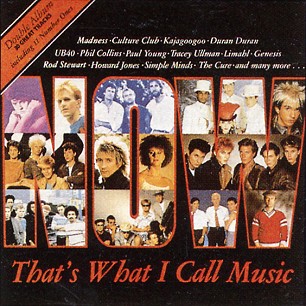
VARIOUS ARTISTS: Now That's What I Call Music


(#293: 17 December 1983, 4 weeks; 21 January 1984, 1 week)

Track listing: You Can’t Hurry Love (Phil Collins)/Is There Something I Should Know (Duran Duran)/Red, Red Wine (UB40)/Only For Love (Limahl)/Temptation (Heaven 17)/Give It Up (KC & The Sunshine Band)/Double Dutch (Malcolm McLaren)/Total Eclipse Of The Heart (Bonnie Tyler)/Karma Chameleon (Culture Club)/The Safety Dance (Men Without Hats)/Too Shy (Kajagoogoo)/Moonlight Shadow (Mike Oldfield)/Down Under (Men At Work)/Hey You (The Rock Steady Crew) (Rock Steady Crew)/Baby Jane (Rod Stewart)/Wherever I Lay My Hat (That’s My Home) (Paul Young)/Candy Girl (New Edition)/Big Apple (Kajagoogoo)/Let’s Stay Together (Tina Turner)/(Keep Feeling) Fascination (Human League)/New Song (Howard Jones)/Please Don’t Make Me Cry (UB40)/Tonight I Celebrate My Love (Peabo Bryson & Roberta Flack)/They Don’t Know (Tracey Ullman)/Kissing With Confidence (Will Powers)/That’s All (Genesis)/The Love Cats (The Cure)/Waterfront (Simple Minds)/The Sun And The Rain (Madness)/Victims (Culture Club)

Looking at the track listing for the forthcoming Now 87, I note with some dismay that all of the hitherto unknown songs included have entered yesterday’s midweek singles chart. This is not a new phenomenon with Now compilations and its continuation indeed supplants my dismay with disquiet. It is as if the charts have been meticulously plotted so that all of the untried and untested singles will debut at precisely the right moment and hence make next week’s compilation look fresher than fresh. It is as if pop music has been planned to death.

Listening to the first Now volume of all, I also note that we have not really completed the circle begun by Raiders Of The Pop Charts. Instead of finishing where 1983 started, with a thirty-track, TV-advertised double compilation album, it is quite apparent that we have ended up somewhere entirely different; somewhere not quite so shambolically comfortable, and somewhere a lot more disturbing and possibly fatal.

Is that last sentence an overstatement? The overall priority of the Starship Enterprise, you may remember, was to observe history rather than try to change or influence history. With the many TV-advertised compilations featured in this tale between 1972 and 1983, the overall picture is one of a slightly inchoate assemblage of cottage industries and an agreeably sloppy attitude to compiling these collections; it really was a case of working with what you could lease from whatever record companies would be prepared to lease to you, finding unexpected connections and more than occasionally throwing a very welcome curveball. Ronco, K-Tel and Arcade compilations – not to mention things like Don’t Walk – Boogie (a true ancestor of the Now series) - were, broadly speaking, a mess, occasionally a hugely irritating mess, but generally a rather surprisingly fertile one.

My suspicion is, however, that with the dawning of the Now franchise, we witness the beginning of a direct attempt to influence the course of pop music, and maybe even how pop music is made or consumed. The first volume was advertised with a painstakingly irreverent voiceover by one of its featured artists, Tracey Ullman; the subtext was that this was not bargain basement, available at Woolworths and Rumbelows K-Tel time.

The overall aim – or one of them – seems to have been to put the house of the compilation album in order. Although essentially a joint venture between EMI and Virgin, it was Virgin Records who came up with the initial idea (and negotiations for the concept involved Richard Branson himself). The album was advertised by a curious logo; a beaming pig listening over a garden fence to a chicken singing, and proclaiming “Now that’s what I call music!” In fact this was originally a 1920s advertisement for Danish bacon, but Branson bought a poster of it as a present for Virgin Records’ then managing director (and Branson’s cousin): “He was notoriously grumpy before breakfast and loved his eggs in the morning,” observed Branson, “so I bought him the poster, framed it and had it hung behind his desk!"

Following negotiations, Virgin managed to persuade EMI to come on board with the venture – this was the first time major labels had collaborated on such a large project. Some hits were then leased from CBS, WEA, Polydor, Island and Stiff, but none from Arista, RCA, MCA, Chrysalis, A&M or Phonogram. There was still quite a lot of scepticism as to whether the Now project would work, and some unrest about whether, if popular, the album would hinder the sales of artists’ own albums – one may view the delayed entrance of several major acts on Now II as having waited for the waters to be tested before becoming involved.

But the first Now album was an immediate success; it sold 900,000 copies over the Christmas/New Year period and more or less rendered the TV-dependent labels redundant overnight. Packaged immaculately – some might say suffocatingly – Now 1 seemed to promise proper quality; no sloppy covers pasted together in five minutes, no filler, full, unedited 45 versions. It appeared to legitimise the enterprise of multi-artist compilations, push them into growing up.

And yet listening to it is such a cold, deadening experience. Overwhelmingly, despite the presence of eleven of the eighteen singles to make number one during 1983, it is far too safe a selection of hits, and the absentees imply that we are dealing with the second tier of pop stars, or possibly tier 1a. For the record, neither 1983’s first number one nor its last is included. The first was a hangover from 1982, “Save Your Love” by RenĂ©e and Renato, a calamitous confirmation of what happens when camp is taken too seriously, or not seriously enough (it is the missing link between “Welcome Home” and “Barcelona”), and it says something about the nascent Now brand that this would have seemed out of place on any Now album (though would have fitted without complaint onto any K-Tel or Ronco record). The last – another unanticipated novelty – was released too late for inclusion (and wrongfooted certain grave assumptions about Now 1) and appears on Now II. Of the remaining five missing chart-toppers, “Billie Jean,” “Let’s Dance,” “True” and “Every Breath You Take” have already been written about in the context of their parent albums (and their absence here implies that they are just too big to go on Now, since Bowie was, at the time, an EMI act). This means that the one remaining absent number one, Billy Joel’s “Uptown Girl,” will simply not be written about here directly. That, I am sure you will agree, is a tragedy beyond comprehension.

But how can you have a 1983 greatest hits album without “Blue Monday” or anything by Michael Jackson? How much better would any of the C90 cassettes you and I would have filled with our versions of 1983 music have been? And why so safe a track listing – get past Simple Minds, plus atypical songs by Genesis and The Cure, and there is no rock as such – Big Country, U2, Echo and the Bunnymen, even EMI recording artists Iron Maiden – all for the boys, all absent. In fact the record seems to have been scrupulously assembled so as not to frighten or disturb, or even momentarily stir, anyone who buys it or listens to it; “This Is Not A Love Song” by Public Image Ltd, released on Virgin and beyond dispute one of 1983’s greatest singles, was a much bigger hit than many of the songs included here, but you will search for it on this record in vain.

Actually the TV-advertised labels were not quite down the dumper; the late 1983 charts also included three BOGOF compilations; The Hit Squad (Chart-Tracking & Nightclubbing) (Ronco), Superchart ’83 (Telstar) and, a revisit from 1981, Chart Hits ’83 (K-Tel). There is necessarily some overlap between this trio, but they do provide a fuller and less predictable picture of the year’s hit music; if you’re looking at the Now 1 track listing and wondering where such and such a song is, odds are that they are on at least one of these three. But it was a losing battle; in the following year, 1984, Ronco filed for bankruptcy.

In other words, Now 1 was the future. But what kind of future was it trying to create? Remember what I said about the series trying to influence history. At the time of this record’s release, several of its tracks were climbing the chart as singles, and it’s possible that the surprising underperformance of hits like “Waterfront” (peak position #13; not remotely indicative of the song’s true popularity) and “That’s All” (#16) is directly ascribable to their inclusion here. But the record’s attempted coup de theatre was to conclude with “Victims”; the assumption being that, having begun with the year’s first “new” number one, the record would close with the final one. It didn’t work, partly because of Now 1 itself and partly because Colour By Numbers was still a hugely popular, big-selling album, but also in part because, as a single, “Victims” was too complex and involving a song to cross over as effortlessly as the knowing bubblegum of “Karma Chameleon”; there are no real hooks, no easy emotional compromise. It is just too disturbing for that (it peaked in third place in the Christmas singles chart).

And, if pop can sometimes, at its best, prove really disturbing, I also have to say that I cannot imagine a similar enterprise being undertaken even twelve months previously. Leasing problems notwithstanding, what would a Now That’s What I Call 1982 have looked like (and before any smart alecks come on board to point it out, I am fully aware that ten year-specific Now Eighties collections were released many years later, and no, I don’t think the 1982 album would have looked like that at the time)? My feeling is that the pop of 1982 was overall too radical, too disturbing, to act as a comfort blanket for casual supermarket consumers, and that in itself may tell us how things had perhaps lowered slightly in terms of the horizons of the following year’s pop. Did the pig really represent the lazy, sated consumer fully prepared to pay money to buy a new packaging of what was already available; indeed, when some of its content was still new? Or did the pig represent the bloated, indulgent music industry who’d be perfectly happy to sell the public records of a chicken clucking if they took off?

Phil Collins/Genesis

An early indicator of how readily "adventurous" musicians from the seventies were prepared to dress up and dumb down for the unforgiven eighties. The song's imperious beat and encouraging catchy tune, as demonstrated in the Supremes' 1966 top three original, hide a near-suicidal lyric: "But how many heartaches must I stand/Before I find a love to let me live again?" These are words crying out for Orbison at his most tormented, yet Diana Ross at her perkiest is strangely but equally convincing at conveying the song's underlying desperation.

Collins' cover, which in itself is faithfully facsimilied in the mode of a reproduction antique – his vocals aside, the recording might as well have been taken from one of those Hot Hits make-do-and-mend albums - was the only substantial hit single from his second solo album, Hello, I Must Be Going!, by some distance the weakest-selling of his '80s tetralogy, full of interchangeable whining ballads about his first divorce. They do not include songs entitled “You Can’t Take My TV” or “Why I Pay You To Go Out With Fancyman (Why I Not Break His Jaw)?,” despite what the eximious Comstock Carabinieri claimed, but it’s a close call. It's also telling that virtually all of his cover versions come from an idealised 1966 - "Tomorrow Never Knows" on Face Value, "A Groovy Kind Of Love" from Buster - but unfortunately whatever minor merit his "You Can't Hurry Love" might have possessed is utterly nullified by its rather creepy video featuring multiple besuited Collinses, unflatteringly filmed on VT, performing a Blues Brothers tribute, as if the song were just a piece of laughable fluff from his schoolboy years to be sent up. As for “That’s All,” The Cure do a better Beatles on “The Love Cats.”

Duran Duran

“PLEASE PLEASE TELL ME NOW!” they demand, in the manner of anxiously psychotic hostage takers. The “Look Of Love”-derived intro heralded an attempt at adding a harder, tougher edge to Duran Duran’s pop – le Bon’s “I KNOW you’re watching me” and “DON’T SAY you’re easy on me” warned listeners that he really was not to be messed around with (actually he sounds not a million miles away from that other renegade Brumrocker Ozzy Osbourne). Hence when le Bon tells of “jungle drums” we receive booming “Poison Arrow” echoes of drum. It’s pretty clear that this is a transitional record and also why it didn’t get included on Seven And The Ragged Tiger; musically the most interesting ingredient is John Taylor’s bass (particularly in the fadeout, under le Bon’s “Every time it passes by”), and while producer Alex Sadkin is always aware of the value of space and silence, and a harmonica strays in from an old career in an old town during the instrumental break (are we really as big as the Beatles?), this is a relatively disappointing piece of work; the ingredients to enable development of their music are all present, but are, at this point, still only perhaps three-quarters baked.

UB40/Bonnie Tyler/Paul Young

One central problem with the Now series, apart from making great pop sound dull, is that sometimes 45 edits are no longer enough. Some songs are now benefiting from their full album length, such that any single edit is like looking at just one corner of a painting rather than the whole thing; otherwise they run the danger of sounding emotionally constipated. The edit of “Total Eclipse” here is (pace what I said above) different from the edit on the original 45 and still unsatisfactory. Then again, “Please Don’t Make Me Cry” is unedited, if a wholly unnecessary inclusion. A very long way indeed from “So Here I Am.”

But those sleigh bells on “Total Eclipse.” One is never too far away from the Beach Boys, or indeed from Dennis Wilson, who slipped into the blue Pacific Ocean, never to resurface, on 28 December 1983.

As regards Paul Young’s “Wherever I Lay My Hat,” see also Scott Walker’s “Orpheus” from 1966.

Kajagoogoo/Limahl

“Johnnie Ray!” exclaimed Lena as we endured “Only For Love” (“And! Ew-YOU! RrrrrrRECOGNISE!”). Or perhaps a glossier variant on Chris Andrews, whose “Yesterday Man” was re-covered by Robert Wyatt on a very different Virgin Records compilation album in 1975. But one of the major failings of Now 1 is the inclusion of three songs by Kajagoogoo and/or Limahl. Some might say that was five more than was absolutely necessary.

Kajagoogoo were EMI's "priority new act" for 1983. They achieved some useful publicity touring as support to Duran Duran, and Nick Rhodes even co-produced their first single. Their profile was heightened further by an appearance on the Channel 4 series The Other Side Of The Tracks, presented by an expatriate American broadcaster who is currently under a legal cloud, and who was then the partner of lead singer Limahl - just before the Christmas of 1982.

Everything about "Too Shy" betrays the slide rule. It is a ghastly melange of absolute misunderstanding of New Pop; as if the swooning entrance of the keyboards allied to a burbling, harmonically ambiguous bassline could in itself conjure up Level 42, or Japan. When Limahl enters for the first verse, it becomes worse; a tortuous Lexicon Of Love parody ("Try a little harder" with sub-sub-sub-Anne Dudley piano) swiftly followed by dangling Tin Drum/New Gold Dream angles of warbling synth over which Limahl coos "Move a little closer" in the manner of Cheggers Plays Pop host Keith Chegwin, before we reach the chorus which fully reveals Kajagoogoo as the dull, Jamiroquai-presaging jazz-funk drones they secretly always wanted to be - and when Limahl huffily walked out, or was pushed (depending on whom you ask), some six months later, they indulged their sub-Shakatak fantasies freely (“Big Apple,” which set new standards in flaccidity, both musically and lyrically, is perhaps the worst song about New York ever written, from the perspective of people who sound as though they had travelled no further west than Hounslow). The song seems to be about sexual timidity, but faced with Limahl, one is scarcely surprised by his Other's reluctance to "dilate." "Too Shy," however, dilates New Pop to the point of nullity.

There was an album – White Feathers, which peaked at #5 at the end of April, and which, despite including songs entitled “Ergonomics” and “This Car Is Fast” – and two other hit singles that are rather more disturbing than “Too Shy” (“Ooh To Be Ah” might still be one of the most abstract things ever to make our top ten; play against, say, Gabi Delgado’s “History Of A Kiss” and see the connections, while “Hang On Now” is a downbeat ballad sung as though its singer were hanging onto the edge of the world with a turquoise fingernail) – is ultimately no more than placid jazz-funk, even if in Icelandic terms it might be a missing link between Mezzoforte and Björk. I mean, “Magician Man.” Whereas Limahl’s first solo effort (which peaked at an unsurprisingly low #16) is not even interestingly random, like a Dadaist jigsaw puzzle, but merely a ghastly cut-and-paste of 1983 pop elements, none of which fits with each other. As well as equally ghastly and obligatory soulful, passionate and honest backing singers. Honest about what?

Heaven 17/Human League/Tina Turner

From the first second of “Temptation,” you are never in doubt that, unlike Limahl, Heaven 17 know how to structure a great pop record, and they also know that without conflict and pain, there really wouldn’t be much pop music, of any stripe, left. If “Let Me Go” had given notice that the dream wasn’t working, or even coming true, then The Luxury Gap from its cover inwards set about demolishing illusion. The knowledge that it’s all bullshit, that you can travel the world, go crazy with plastic and before day is done you still have to get back, get home, to desolate, semi-derelict Sheffield – such things power the polite screams of “Key To The World “(“I’m Mister Obsolete – DELETE!,” complete with the ironically opulent Earth, Wind and Fire horn section) or “Crushed By The Wheels Of Industry,” or the quietened tragedies of “Come Live With Me” (the song Rod Stewart never sang, but should have done) or the closing “The Best Kept Secret” which sees Glenn Gregory staring out onto an ocean of nothingness which will evidently take forever to fade.

“Temptation” is angry, righteous, arranged with maximal ingenuity by BEF and sometime AMM accomplice John Barker, with a continued, upward, creeping angle of progress between topline chords and underscore rhythm which anticipates what Calvin Harris would do on 18 Months. It is sinister yet ultimately liberating, thanks to the explosive co-lead vocal of NYJO graduate Carol Kenyon.

Both Heaven 17 and the Human League peaked at #2 behind “True” in consecutive weeks; Top Of The Pops proved a challenge. But “Fascination,” Melody Maker’s single of the year for 1983, was the last thing that Phil Oakey’s League did with Martin Rushent, and overall – although there was no telling at the time – the record (still credited to “Human League Red”) serves as a fond farewell to the association, with everybody in the group taking a vocal turn, and Jo Callis’ wobbly guitar-processed-via-synth riff sounds like the missing link between “Magical Mystery Tour” and “Only Shallow.” Meanwhile, Oakey’s deep “hey, hey, hey, HEY” is reminiscent of Larry Graham with Sly and the Family Stone.

But then there is Tina Turner, returned like the grown-up co-protagonist of “Temptation,” and these days she had seen, and how they bled their way slowly into how she sang “Let’s Stay Together” – is my memory fallible, or was the original single credited to “B.E.F. Presents Tina Turner” (it might have been “Ball Of Confusion” from 1982)? In any event, it was the Heaven 17 fanbase who got it into the Top 40, but then perhaps an older demographic helped elevate it into the Top Ten; absent from the charts for a decade, and perhaps from the world from as nearly as long a time, here she was; alive, and in pain, and euphoric, the B.E.F. voices gently ushering her into centre stage, and for once the old times were justified.

KC & The Sunshine Band

Lena commented that “Give It Up” might well have been the “Get Lucky” of its age and I would agree with this. Long, hot summer – no, Weller’s nowhere to be seen here – and a number one song inhabiting that nice middle place where everything just works. Also “Give It Up” was the year’s only number one single without an accompanying video (N.B.: there was a VHS companion to this album which included the otherwise Now-avoiding “I.O.U.” by Freeez and “Never Never” by the Assembly).

The record was an unexpected and brief but highly welcome resurgence of the Miami Sound. Only its discreet synth marks out “Give It Up” as having been recorded in 1982 rather than 1974, and that’s no bad thing. While “That’s The Way (I Like It)” remains KC’s best record because of its underlying sense of approaching menace, “Give It Up” is busily arranged but basically straightforward three-chord bubblegum disco with a terrific good humour which is admirably happy to remain as such. An anachronism in the land of “Just Be Good To Me” and “Hey You (The Rock Steady Crew),” perhaps, but a contented one.

Malcolm McLaren

Worthiness is not the same thing as worth. To seize a music, take it to pieces, expose it to its aesthetic polar opposite and thereby (hopefully) refresh it is not a task to which the adjective "worthy" should be applied. There are places for reverence and respect as long as you don't let them block your future. I could spend the rest of my life revering Spencer's Resurrection at Cookham but simultaneously realise and adore the pelvis-driven imaginings which give that masterpiece its multiple puncta.

As with World Music. If music is truly to be of the world then it must by definition be exposed to "impure" things, it must be acknowledged that the music itself is probably "impure" to begin with. It cannot be adopted or handled with dainty fingers, nervously examining their adrenalin reserves to ensure that they contain adequate nullifying agents of respect. Otherwise any World Music is all middle-distance, respectful, designed never to derange. More of a lead should have been taken from Malcolm McLaren and Trevor Horn.

It is deliberate that, with the Duck Rock project, McLaren set out to combat and nullify what he viewed to be the sterile blandness of New Pop. And how better to attack than to employ its chief architect, Trevor Horn, to arrange and produce? McLaren said he wanted Horn to obtain some "bollocks" in his work, get "a bit of the rough, the spontaneous" into his meticulous productions. It is therefore doubly ironic that Duck Rock is one of the most seamlessly, microscopically put-together things which Horn ever did.

How did they approach this? It was McLaren's ceaseless strivings for a new punk, and his moderately keen ear for developments. He was in America while hip-hop and electro went overground with Flash and Bambaataa, witnessed with amazement kids breakdancing to a modified "Trans-Europe Express," scratching up records like John Cage with a good drummer (a disciple of Karel Appel's COBRA group/philosophy as well as of Debord, McLaren instinctively knew how to insert the art into this sort of thing). His ears wandered vaguely in the direction of Africa, specifically in view of Bambaataa's Zulu Nation and any connections which McLaren could discern (Nigeria's King Sunny Ade and Senegal's Youssou N'Dour had yet to break overground, though the former's Synchro System was, usefully, a minor UK hit at around the time of Duck Rock's release, while the fatally less mischievous Laswell got to N'Dour first). His wits further led him to discern a vague (probably imagined) link between the square dances of the white South and the hip hop culture of the black North - apart from their both being ritual occasions to allow participants to somehow become more "themselves" - the same idea which, of course, prompted Punk into existence. How to marry all of this up?

McLaren and Horn did some field trips to NYC, Tennessee and the South African townships, made some recordings and then returned to London to knock them into shape with what was eventually to become the Art of Noise (indeed, the latter's epoch-beginning Into Battle EP largely originated from Duck Rock outtakes) with some help from Thomas Dolby. Significantly, from NYC, they employed the DJ duo The World's Famous Supreme Team to act as a kind of Greek chorus for the album, turning it into one of their then legendary late night/early morning radio shows.

It's hard to visualise just how radical the first single from the album "Buffalo Gals" seemed when it came right at the death of 1982, right when certain careerist ambulance chasers seemed determined to strip New Pop of all its mischief and sensuality. And how appropriate that both McLaren and Horn should signify a way out. Radio One played it; and their DJs sounded completely baffled but, to their credit, they knew that this was something new and correctly predicted that it would be a gigantic hit. True, to those long familiar with things like Grandmaster Flash's "Adventures on the Wheels of Steel" (which just missed the UK Top 75 about a year previously), this was not exactly something unprecedented, although one could argue that what McLaren and Horn did with it was unprecedented. Certainly square dance cut-ups were not yet on the Zululand template, although downtown Double Dee and Steinski were simultaneously busy preparing their likewise groundbreaking "Lessons." For the other big hit off the album, "Double Dutch," McLaren reversed the template, getting Zulu singers to exalt the praises of NYC skipping contests.

The album itself remains eminently playable. Though the Supreme Team's patter is now a stock template for Radio 1/Kiss DJs, it sounded fresh and spontaneous at the time, sounded like an injection of (s)punk into the barrenness in which post-New Pop pop had marooned itself. And McLaren let no stones lie in his "world tour." From the near-holy murmurings of the introduction "Obatala" effortlessly into the welcoming Supreme Team ("leave your guns at home! Tell me Shirl, how do you manage to stay up until four o'clock in the morning to listen to our show??!?") and the killer opening sequence of "Buffalo Gals," "Double Dutch" and "Merengue," this is a grin-inducing record. On the latter, six clear years before the Lambada came to public prominence, McLaren gleefully romps through the salsa-meets-kwela-meets-Charlie Haden's Liberation Music Orchestra like a postmodern Bruce Forsyth, excitedly intoning lines like "nice little cemetarios will be waiting for you!" Even the fact that McLaren's delivery (especially on "Double Dutch") recalls no one so much as the late Harry Corbett of Sooty the Bear fame somehow lends even more humanity and mischief to this record.

And what about "Punk It Up"? In his sleevenotes, McLaren recalls the glee and enthusiasm with which the Zulus entertained his stories about the Sex Pistols, and how enlivening and joyous it is to hear the Zulus singing, "I'm a Sex Pistol man" to top-notch Afrobeat. This seeming disrespect for "other musics" (sics) actually betrays a greater and deeper respect for them than mere Xeroxing and blanding out. The whole thing continues in similar (if slightly more contemplative and ritualistic) mood on side two before bowing out with "Duck For The Oyster," a straightfaced square dance for fiddles and scratch DJs where McLaren manfully fuses both mutually hating though ultimately alike extremes together. Note the parting cry of "Promenade you know where/AND I DON'T CARE" where he performs the final bonding ceremony with Punk and thereby regenerates it.

A shame that no room could be found on the CD for perhaps McLaren and the Supreme Team's greatest moment, "D'Ya Like Scratchin'?" (the B-side of the 12-inch of "Soweto") where the Team's especially demented scratching interacts with proto-Art of Noise beats to almost hysterical levels until McLaren strides in with a straight hoedown version of "Red River Valley" (cf. Scooter's "Fuck the Millennium" to see how this spirit remains propagated even into the present century). But this is a joyous record which superficially doesn't give a fuck but deep down its fuck is much more sincerely given than any "worthy" or "respectful" people I could mention could really offer. Liz Phair quoted “Double Dutch” in her song “Whip-Smart,” while Paul Simon, with whose “The Late Great Johnny Ace” we could close down 1983, was sufficiently intrigued by the record to begin a controversial adventure of his own.

Culture Club/Men At Work

Say something once, why say it again?

Men Without Hats

A classic example of an act wrongfooting its audience with its videos – although the medieval undertow of “The Safety Dance” was really always evident. They were from Montreal, they came, they impacted and they went back into the rest of the world.

Mike Oldfield

A decade after Tubular Bells set the whole thing going, was it deliberate, or a nice accident, that Virgin’s original star should reappear on this record? On TOTP he looked ecstatic, clean-shaven and grinning, perhaps relieved at no longer having to share a chart with Paul Nicholas or David Soul, accompanying Maggie Reilly, erstwhile singer with Glasgow white soul band Cado Belle, with guitars which at times border on the hysterical. All in keeping with a song whose subject matter is the assassination of John Lennon, that other 1980 ghost whom New Pop can’t quite forget.

The Rock Steady Crew

“DIGITAL” beeped the voice, repeatedly, and top B-boy producer Stephen Hague, presumably with Duck Rock on his mind, set about recording this fantastic piece of avant-bubblegum (although it is really “Hang On Sloopy” plus “Looking For The Perfect Beat”). Like “I Can See For Miles,” there is continued build-up (the live turntable scratching = Keith Moon’s cymbals) but no climax or release. Pop, this is your smiling future. At least until you see the video and watch with an increasing rictus grin as the second half turns into a display of American military weaponry. World, this must not be your unsmiling future. But the song was sampled by De La Soul (on “Cool Breeze On The Rocks”) and the nod to Numan at fadeout suggests that somebody else will have the last laugh.

Rod Stewart

All this new-looking design; all these old-looking names. If someone had time-travelled from 1976 to 1983 they’d still recognise Genesis, Mike Oldfield, Tina Turner, Roberta Flack, Bonnie Tyler, KC & The Sunshine Band. If they were really hip they’d remember that Malcolm McLaren was the Pistols’ manager.

And of course Rod, always bloody Rod, haven’t seen you since the seventies Rod. "The situation ain't all that new," croaks Rod, and indeed it isn't; the brought-you-up-from-nothing plot is borrowed from "Don't You Want Me?," the rhythm from Eddy Grant and the resignedly exasperated tone from "Maggie May." A dozen years on from the latter and now it's Rod's turn to tell his ungrateful paramour to sling her hook, though the line "I've said goodbye so many times" indicates that the problem is not one of the semi-hapless Jane's making.

Soaring to number one on the back of a bizarre WEA promotional campaign which included a free beach ball with every copy of the single - oddly this offer was only available at chart return shops - "Baby Jane" is Rod's sixth, and to date last, number one single, and it is the most airless. Revisiting this most purposely forlorn of 1983 hit singles, the overwhelming sensation is one of nullification; despite the presence of Tom Dowd as co-producer (with Rod), this is yet another "big" and seamless production, treble-heavy and metronomically precise, such that no art can hope to breathe or thrive within its consumer-flattering/suffocating bubble-packed surface. However, the bluff "When I Fall In Love" citation does provide an early indication of Rod's eventual (though not permanent) mutation into a hoarse-faced granny-pleasing MoR crooner. Cheryl Cole’s birth song; it’s enough to make me feel sorry for her.

New Edition

The pre-eminent pop producer in 1983 was not Trevor Horn - at least, not the pre-ZTT Horn - but the team of Arthur Baker and John Robie. In striking contrast to the maximalism of ABC and Dollar records, and with a keener ear to the urban ground, Baker and Robie stripped their productions of anything approaching lushness in favour of skittish, deeper beats with a staccato rather than ambulatory perspective applied. There is evidence that the noticeably tougher Horn who emerged with things like Duck Rock, Art of Noise and "Owner Of A Lonely Heart" from mid-1983 onwards was provoked into substantial rethought after experiencing the impact of Baker and Robie's steely futurism. Bambaataa's immensely important "Looking For The Perfect Beat" was the first single to feature digital rather than manual sampling. Records like Freeez's "I.O.U." and Robie's astonishing double whammy of C-Bank's "One More Shot" and Jenny Burton's "Remember What You Like" are beyond-Futurist cut-ups of notions of "song" and "voice"; it is a wonder how, on the latter two singles, Burton manages to retain her elegance and grace while being assaulted from all sides by smashing glass, gunfire, car horns and Corbusier-proportioned beats. And of course there was "Blue Monday," the point where all pop music meets, simultaneously the beginning, suspension and end of time, the supreme seven-and-a-half minute denial of 1983's ruination (because the song is about a ruination) and a record whose importance casts a yellowing shadow on the subsequent quarter-century of pop, a record so vital yet accidental that Baker left his name off the label credits but later owned up to having produced it (Robie is credited with the mix).

But there were also minor ambitions to do a Motown; see the Andromeda Strain Four Tops of Planet Patrol's "Play At Your Own Risk" and "Cheap Thrills" (although Planet Patrol’s eponymous album remains a marvel), and most clearly and depressingly evident in "Candy Girl," strictly speaking a Maurice Starr and Michael Jonzun conception, but produced by Baker and Robie. The song is little more than an electro update of "ABC," Ralph Tresvant was never going to be another Michael Jackson, Bobby Brown's rapping was annoying even at that early stage, and next to the unforced naturalness of Musical Youth it all still seems more than a little contrived, and probably in an unpleasant sense. This underlines the ultimate failure of Now 1; so we couldn’t get Michael Jackson, the biggest pop star on the planet, but here’s somebody who sounds like he USED to sound. And somebody else in the background who will grow up to be somebody extremely unpleasant. What was that about a Georgian market square, and hell?

Howard Jones/Simple Minds

To be written about in the near future, but not here. For now there is Bob Marley’s “Emancipate yourself from mental slavery” and there is “Throw off your mental chains.”

Peabo Bryson & Roberta Flack

Side three was evidently meant to be the “adult” side, as it closes with UB40’s “Please Don’t Make Me Sleep” followed by this 1975 snooze of a Mathis Collection duet. But the sequencing is beyond awry and the hoped-for demographic much too hopelessly wide. Did anybody like Peabo Bryson AND The Cure? And yet for one week this outsold “Karma Chameleon.” Where’s “Islands In The Stream” when you need it?

Tracey Ullman

The Kirsty MacColl-ness. The punctum pause: “Ba-a-by-y!” He’s bad, but I love him: see “Papa Don’t Preach.” Potential sequel to this song: “Fairytale Of New York.” Did Amy Winehouse hear this record as an infant? It plays like a happy Amy song, complete with the he’s-bad-BUT trademark. More ahead of its time than you imagine. The only woman on the cover, in the centre of a field of men, two of whom appear twice.

Will Powers

It doesn’t say very much about any newness relating to Now 1 that its most outrĂ© moment is provided by, of all people, Lynn Goldsmith, with her musical chums, nearly all of whom were around before punk. Terrific in a Tom Tom Club kind of way – it could so easily have fallen over into the Meri Wilson side of that particular fence – and Carly Simon might not have sounded better or more alive than here.

The Cure

I wish I could provide Cap’n Bob with a more positive welcome to TPL but The Cure essentially mucking around with jazz and psychedelia has been so eroded by three decades of radio overplay that it’s completely lost its mischief. No, Pornography was as far as “that” Cure could ever have gone without exploding. But “Let’s Go To Bed” was better pop and none of the Banshees hits or spinoffs (“Dear Prudence,” The Creatures, The Glove) bothers to put in an appearance here. To the record’s loss.

Madness

Their last top ten hit in their original lifetime, and hardly heard now; it plays like a miserablist dilution of 1982’s “Primrose Hill,” and only David Bedford’s strings lift the song out of the morass. Suggs sings like Robert Wyatt hidden behind a muffler, “Wings Of A Dove,” though incongruously jaunty (it made number two but sounded as though the band were beginning to make records to please NME writers), was a bigger hit, no useful sense of liberation or catharsis is communicated, and ultimately we are left with a…

…Hall Of Mirrors

A sense of no risk being taken. A sense of the record not being ambitious, or brave, enough. A “grazing experience” as Lena put it.

But there is more, and it is sinister; I think that the arrival and success of the Now brand constituted the first nail in the coffin of what is generally regarded as the pop single. Think, even, about that “I” in “Now That’s What I Call Music”; who is this “I”? Who’s doing the deciding, the dictating? It might not be as threatening as the “we” of today – “Why we all love Breaking Bad” when one has not even SEEN Breaking Bad – but it was a way for the old, conservative music industry to get back in, having worked New Pop out, and nipping any genuine newness in the bud. It would affect the way people regarded the single – if they are all handily collected, why bother with singles? – and, worse, alter the way in which pop was conceived, listened to, watched and sold. Soon (in 1983 terms) there will come the time when worried record companies will begin to make records in the hope that they will end up on a Now compilation, and a generation before the internet makes its full impact, the consumers will gradually disengage themselves from the form. Before long, TPL will consist of little other than these records, these treated logs, these doctored journals, and solidification and morbidity will set in.

NOW, the British music industry knows exactly what the hell is going on in their own world, and will be damned if they will give it somebody else, somebody new and untested, or an established artist whose career plan won’t particularly be advanced by inclusion on these records. Thatcher had won again in July 1983. Everything, and everybody, was happy. Don’t complain. Don’t DARE complain. Be the worst you can be.

Like I said, Now is the end of something, and this is the fulsome picture of the hell that has now arrived; people pretending to be happy when their souls and their homes have been stolen away, the school choir unity of too many charity records to come, the desecration of gospel that will culminate in Cowell, the central assembly point for people who don’t want subtext, excitement or outrage – or even mild difference – but shiny conveyor belt shite that will fit in the checkout with the Brillo pads and Johnson’s air fresheners.

This music was better when I was nineteen.

But, these days we can no longer see.