(#110: 6 May 1972, 1 week)
Track listings:
Prophets, Seers & Sages...: Deboraarobed/Stacey Grove/Wind Quartets/Conesuala/Trelawney Lawn/Aznageel The Mage/Salamanda Palaganda/Our Wonderful Brownskin Man/O Harley (The Saltimbaques)/Eastern Spell/The Travelling Tragition/Juniper Suction/Scenescof Dynasty
My People Were Fair And Had Sky In Their Hair...But Now They're Content To Wear Stars On Their Brows (to give the record's full title; the combined total must constitute the longest title of any number one album): Hot Rod Mama/Scenescof/Child Star/Strange Orchestras/Chateau In Virginia Waters/Dwarfish Trumpet Blues/Mustang Ford/Afghan Woman/Knight/Graceful Fat Sheba/Weilder Of Words/Frowning Atahuallpa (My Inca Love)
(Author’s Note: The estimable marketing people present at Fly Records in 1972 appear to have packaged this budget double reissue in such a rudimentary fashion that the two albums are listed and sleeved in reverse chronological order; for the sake of my and your sanity, I am addressing the records in the order in which they were conceived, recorded and released, even though only three months separate the two)
By 1972 Marc Bolan had decamped to EMI, complete with his own label, The T Rex Wax Co, and his former record company, Fly, were determined to milk his back catalogue as shamelessly as anyone did that side of Silvertone Records and the Stone Roses, and incidentally remind Bolan’s new, younger army of fans that he didn’t spring from nowhere. Thus the first two Tyrannosaurus Rex albums – originally released in July and October of 1968 respectively – reappeared in the spring of 1972 as a two-for-the-price-of-one package and sprang straight to the top. Even given that the proverbial telephone directory recitation would probably have got Bolan to number one at that stage, the reissue’s utilitarian packaging does lend a soupçon of nostalgia for a time when (as previously mentioned in this tale) reissued records were simply reissued records, without re-contextualising in the form of learned sleevenotes, retrospective hindsight-aided commentary from surviving parties involved and/or rare photographs (as per the admittedly excellent Universal 2004 CD repackagings). You were expected to take returning records at face value and make your own decision about them.
And what must Marc’s screaming fourteen-year-old female fans have made of this artefact from a past which, although only half a decade ago, already seemed to some as remote as Beowulf? Well, after listening to it, I can immediately think of one fourteen-year-old girl in Kent who would have absorbed the music and poetry, and understood (see, for starters, entry #237). But the questions which both records raise overrun any antique curiosity approach.
For instance, the blueprint for what Tyrannosaurus Rex would eventually become is loud and present on the opening track of each side of their debut; “Hot Rod Mama” and “Mustang Ford.” Both rockers, and rocking as feverishly as anyone or anything without ready resort to an electricity supply could have managed in early ’68, “Hot Rod Mama” in particular is a brain-boggling opener, beginning with guitar, bongos and Chinese gong hammered as though the junior Sonic Youth were busy warming up and moving straight into a frantic 12-bar blues-folk strum. Bolan’s wall of acoustic guitars, careering in and out of tonality, creates its own feedback, while Steve Peregrine Took’s Chinese gong effectively gives the go-ahead to the Jesus and Mary Chain. Through all of this Bolan is singing, screeching, hiccuping...what? It doesn’t particularly matter; at this early stage he was already talking about the sound (and the grain) of his voice exceeding whatever flung-together bits of Tolkien, Hindu, Inca and Aztec mythology, Lear, Ginsberg, Dylan, Anthony Burgess and Spike Milligan were emanating from it. John Peel, then his great friend and most fervent promoter, once (fondly) spoke of Bolan’s lyrical approach as “a ratatouille of notions” and that seems a fair enough summary to excuse any in-depth examination of the lyrics to these twenty-six songs; again and again, I was drawn to the entrancing power and mischief of Bolan’s voice above and beyond what vowels it was garbling up, although I note the return of the Old English good manners here and there – the purring “it was grand” which materialises in the middle of “Scenescof,” for example; this latter track being more considered than “Hot Rod” but still diverted into unexpected directions with the duo’s multitracked wordless frat backing vocals (sounding exactly like Flo and Eddie).
And so it proceeds. “Child Star” speaks wistfully of Mozart, Beethoven and waste as it slows down and speeds up pretty much at will, Bolan’s single-note Robert Johnson guitar quivers unresolving into drenching noise. The Eastern drift of the duo’s approach begins to become really apparent here – it makes perfect sense that the disillusioned Mod that was late sixties Bolan should be recharged by seeing Ravi Shankar perform. “Strange Orchestras” is more of the same, albeit more frantic, sounding like a hobbit jug band with Took’s mysterious “Pixiephone” belches and Bolan’s boozy roar of “Ya-HEY!” upending any notion of comforting tofu cushions.
Finally, on “Chateau,” we get the first real template for Bolan’s later ballad approach, although its chord changes are reassuringly unpredictable; but then the texture thickens and as the instruments (and remember, this is an essentially acoustic recording) multiply out of rational recognition and the tonalities waver like the mutinous Shannon, we are presented with nothing less than yet another signpost to My Bloody Valentine; words here are a mere sheer of ecstatic sighs, Ray Bradbury’s A Sound Of Thunder being caressed to glide.
Would a later musical reincarnation of William Blake have made music like this (George Underwood’s very Blakean cover design appears to agree)? “Dwarfish Trumpet Blues” potters along nicely enough until Took’s gong signals a toughening up of sonics, until the two men’s vocals end up stumbling over each other and degenerating (delightfully) into incoherent yelling. A Citizen Kane cockatoo screech from Bolan drives the song, and side one, towards an abrupt end.
With “Mustang Ford,” it’s all there, everything that was to become familiar two or three years hence; the Berry/Vincent/Cochran homages fed through a traceable beaker of Narnia/Rings/assorted otherworldly stuff, all scooched together by this remarkable twenty-year-old Jewish lad from Hackney (thanks, Lena) and a great personal friend of Syd Barrett (which Took was, well into the seventies). But Barrett’s approach to limericky nonsense or anti-sense is utterly opposed to Bolan’s; for a start, despite the admirably shambolic approach adopted throughout Children - imagine what a stir the record might have caused if it had appeared on SST or Homestead or K Records in the mid-eighties – Bolan never sounds like anyone less than someone who knows exactly what he’s doing; he was the Mod acting as a hippy, whereas Took was unquestionably the real deal. The combination was acidic enough to work (although inevitably contained within it the seeds of its own rapid destruction), and it would be disingenuous to ignore or underrate Took’s contributions to their work. “Mustang” certainly rocks like the cat which Bolan would eventually become, but what about those Looney Tunes/Goon Show voices in which Took indulges from midsong onwards? Once more the song veers into unintended atonality until it reaches a plateau of rhythm and riff which continues to chug upwards in intensity, like a hyped-up Flying Scotsman train deciding to take on the Lake District at its own game.
“Afghan Woman” is another Bolan ballad paradigm and drifts along agreeably, although Took is careful to maintain tension by unpredictably subdividing the tempo and his bongos’ accents from the beginning of verse three; Bolan brings the song to a natural end with a soothing Japanese koto-impersonating coda. “Got to get it together, yeah,” Bolan sings early on in “Knight” – and where does that voice come from, and will I ever cease to wonder where? The song scutters along as gladly as its natural masters, the Incredible String Band, but the chord changes are straight out of Chuck Berry, and Bolan does a good Muddy Waters anguished howl tribute in his brief but quite, quite gorgeous guitar solo before resorting to barking like Howlin’ Wolf on meths; the song nevertheless resumes its gentle canter before being kissed off to bed by two delicate curlicues of guitar and voice.
Ah yes, the voice, and the homing waltz “Graceful Fat Sheba,” with its repeated leitmotif of “meat cleaver,” Took’s bongos growling like Weybridge thunder. Donovan of course, and probably Buffy Sainte-Marie, and maybe even Bessie Smith...but who else? We’ll have to give this some thought. Again, “Weilder Of Words” gives fair warning of what will be coming in the long term, from its “na na na na” chorus upwards; the chorus then develops into a new riff before descending into a semi-singalong howling coda and thence (or is it ascending, like Ascension?) into lovely chaos.
“My Inca Love” sets off at a midtempo pace, and melodically points in part towards “Life’s A Gas” before speeding up slightly. The melody is a wandering slalom, or hall of mirrors, daring the listener to wish its resolution. Eventually the song settles for a hoarse “Hare Krishna!” mantra which continues to increase in intensity and distortion before breaking off to allow John Peel to narrate a children’s story (written by Bolan) which seems to take the lead from Wind In The Willows with its “mole-ish” protagonist and his “yellow Rupert trousers,” albeit on some decidedly strange medication; Peel also manages to sneak in a reference to “bluebeat rhythms” although musically this is much closer to David Peel and the Lower East Side than the Skatalites. The duo then return for a brief closing sprint through the unlisted title track, perhaps foreseeing the decline of their era – were the children of 1967 really prepared to settle for the morsels which 1968 was offering to them?
Producer Tony Visconti – Children was his first job in this capacity – has admitted that the chaos was the thing and that he was learning on the job. Hence, Prophets is ostensibly a much better “produced” record (although perhaps released too soon; the debut made a very respectable Top 20 showing in the UK but its follow-up failed to trouble the scorers) – if maybe not quite as fun – and giving us a clearer picture of where Bolan (if not necessarily Took) was going. “Deboraabored” was a purposely sloppy re-recording of their surprise hit single “Debora” (which preceded both albums, and duly returned to the Top 10 as a double-header with its follow-up “One Inch Rock” around the time of this reissue). Bolan shrieks and scats and halfway through the song reverses, plays backwards and Bolan and Took improvise atop; given the bongo attack in particular, this is a clear influence on Robert Wyatt’s “Little Red Riding Hood Hit The Road” six years later. “Stacey Grove” takes us back to the jug band workout with Bolan’s grinning refrain of “He’s a nice cat!” “Wind Quartets” comes on like George Crumb’s Makrokosmos III for meditation fans with its atonal saucepan strokes and the Silver Surfer reference reminds us exactly what year we’re in (even if, in this context, it’s four years ago), not to mention the awestruck “aahh”s from both Bolan and Took (a recurrent feature through both records) – we are not too far away from Ogden’s Nut Gone Flake second childhood (because where did the first one go?) nirvana. “Conesuala” sounds exactly like “Debora” except that it’s about a woman who makes clothes for animals (remember how popular T Rex would prove with children in particular; Bolan always had that Jackanory thing about him, as well as everything – or anything - else). “Trelawney Lawn” is a pleasant acoustic stroll through the orchard rudely gravelled by Took’s freeform bongo irruptions, leading to a passage of tritonal whistling and an odd, Pauline Oliveros deep frequency coda. “Aznageel” sounds exactly like “Conesuala” except with higher pitches, more pastoral and more staccato. “The Friends” is a breathy fragment which passes almost under the listener’s door before escaping quickly through the window. “Salamanda Palaganda” introduces new textures in the form of Chinese temple bells and rudimentary flutes, not to mention Bolan’s stopping making sense refrain of “Zoo-zhoo-zhue-zu-zhoo” and the assorted “Tu whit tu WHOO!”s and climactic “MEOW!” “Brownskin” (you just wouldn’t get away with that title now) sees Bolan still experimenting with song forms, here constructing the song in a conversational manner, accompanied by Took’s chattering teeth.
Catching the Village Green Preservation Society strut which subtly walks through “O Harley,” I wonder how many managed to miss out the Ray Davies influence on Bolan’s voice. With its confident pace and determined finger-snapping, both of which eventually combine to resolve into a rather catchy hook, we are clearly moving towards the more familiar T Rex model, although Took’s oddly distant, off-mike backing vocal at song’s end reminds us that we’re not quite there yet.
And with “Eastern Spell,” from its handclaps inwards, we could almost be listening to a surviving 1968 Buddy Holly – again, how could anyone miss that influence on the voice? – and if that sounds unlikely, think of the slapped knee on “Everyday” or the packing case on “Peggy Sue” (which we will be doing in the fullness of time). “The Travelling Tragition” introduces yet more unfamiliar textures – in this case, what sounds like the distant cry of a celeste, although any maudlin tendency is ruthlessly stamped upon by Bolan’s “Rat-a-tat-tat”s and “de-boom, de-BOOOM”s; eventually the song turns into a hobbled country stroll out of a never-realised Ladbroke Grove equivalent to Harvest. “Juniper Suction,” a barely disguised sex-pant (Bolan being married to June at the time), takes the form of an ungainly, gnawing-on-itself waltz, with express tritonality and that MBV preview scenario again; guitar unstable, bongos rattling, megaphone whispers.
But, with its “one-two-free-FOAH!” intro, the closing track, “Scenescof Dynasty” (a reworking and upgrading of track two of Children) gives the most overt indication of Bolan’s soon-come future. Bolan carries the melody entirely in his vocal, his only accompaniment being handclaps and assorted comedy-cum-horror backing vocals. I note the uncommon emphasis given on the word “machétè” and the deep breathing gasps which go on behind, and around, Bolan. As if he’s already about to bring this manifestation to an end and move forward.
There would be one further album by the duo, Unicorn, following which Took was replaced by Mickey Finn; on a fourth record, A Beard Of Stars, Bolan plugged in his amplifier for the first time since his John’s Children days (were they really only two years ago?) and the stealthy move towards abbreviation and stardom continued. Took saw out the seventies at the helm of innumerable bands, principally various manifestations of the Pink Fairies, and remained a true Ladbroke Grove hippy until his premature death in the autumn of 1980; where Bolan went after the times and the moods changed, this tale will assess sooner than you might think. In the meantime, the renewed success of this work - as with other contemporaneous manifestations such as the delayed success of the Moody Blues' Days Of Future Passed in the States - serves to remind us that, even though we are treading fairly deeply into the seventies, we cannot yet leave the sixties behind; and also it should be noted the quintessentially British character of Tyrannosaurus Rex's work cannot be undervalued - apart from the possibility of an urban London equivalent to the kind of country-blues-rock brew people like Taj Mahal, and to a lesser extent Country Joe and The Fish, were cooking up, there really is no meaningful transatlantic comparison point, which may in part explain the otherwise baffling failure of Bolan to export his seventies success to the USA.Tuesday, 30 November 2010
TYRANNOSAURUS REX: Prophets, Seers & Sages The Angels Of The Ages/My People Were Fair And Had Sky In Their Hair...But Now They’re Content To Wear...
(#110: 6 May 1972, 1 week)
Track listings:
Prophets, Seers & Sages...: Deboraarobed/Stacey Grove/Wind Quartets/Conesuala/Trelawney Lawn/Aznageel The Mage/Salamanda Palaganda/Our Wonderful Brownskin Man/O Harley (The Saltimbaques)/Eastern Spell/The Travelling Tragition/Juniper Suction/Scenescof Dynasty
My People Were Fair And Had Sky In Their Hair...But Now They're Content To Wear Stars On Their Brows (to give the record's full title; the combined total must constitute the longest title of any number one album): Hot Rod Mama/Scenescof/Child Star/Strange Orchestras/Chateau In Virginia Waters/Dwarfish Trumpet Blues/Mustang Ford/Afghan Woman/Knight/Graceful Fat Sheba/Weilder Of Words/Frowning Atahuallpa (My Inca Love)
(Author’s Note: The estimable marketing people present at Fly Records in 1972 appear to have packaged this budget double reissue in such a rudimentary fashion that the two albums are listed and sleeved in reverse chronological order; for the sake of my and your sanity, I am addressing the records in the order in which they were conceived, recorded and released, even though only three months separate the two)
By 1972 Marc Bolan had decamped to EMI, complete with his own label, The T Rex Wax Co, and his former record company, Fly, were determined to milk his back catalogue as shamelessly as anyone did that side of Silvertone Records and the Stone Roses, and incidentally remind Bolan’s new, younger army of fans that he didn’t spring from nowhere. Thus the first two Tyrannosaurus Rex albums – originally released in July and October of 1968 respectively – reappeared in the spring of 1972 as a two-for-the-price-of-one package and sprang straight to the top. Even given that the proverbial telephone directory recitation would probably have got Bolan to number one at that stage, the reissue’s utilitarian packaging does lend a soupçon of nostalgia for a time when (as previously mentioned in this tale) reissued records were simply reissued records, without re-contextualising in the form of learned sleevenotes, retrospective hindsight-aided commentary from surviving parties involved and/or rare photographs (as per the admittedly excellent Universal 2004 CD repackagings). You were expected to take returning records at face value and make your own decision about them.
And what must Marc’s screaming fourteen-year-old female fans have made of this artefact from a past which, although only half a decade ago, already seemed to some as remote as Beowulf? Well, after listening to it, I can immediately think of one fourteen-year-old girl in Kent who would have absorbed the music and poetry, and understood (see, for starters, entry #237). But the questions which both records raise overrun any antique curiosity approach.
For instance, the blueprint for what Tyrannosaurus Rex would eventually become is loud and present on the opening track of each side of their debut; “Hot Rod Mama” and “Mustang Ford.” Both rockers, and rocking as feverishly as anyone or anything without ready resort to an electricity supply could have managed in early ’68, “Hot Rod Mama” in particular is a brain-boggling opener, beginning with guitar, bongos and Chinese gong hammered as though the junior Sonic Youth were busy warming up and moving straight into a frantic 12-bar blues-folk strum. Bolan’s wall of acoustic guitars, careering in and out of tonality, creates its own feedback, while Steve Peregrine Took’s Chinese gong effectively gives the go-ahead to the Jesus and Mary Chain. Through all of this Bolan is singing, screeching, hiccuping...what? It doesn’t particularly matter; at this early stage he was already talking about the sound (and the grain) of his voice exceeding whatever flung-together bits of Tolkien, Hindu, Inca and Aztec mythology, Lear, Ginsberg, Dylan, Anthony Burgess and Spike Milligan were emanating from it. John Peel, then his great friend and most fervent promoter, once (fondly) spoke of Bolan’s lyrical approach as “a ratatouille of notions” and that seems a fair enough summary to excuse any in-depth examination of the lyrics to these twenty-six songs; again and again, I was drawn to the entrancing power and mischief of Bolan’s voice above and beyond what vowels it was garbling up, although I note the return of the Old English good manners here and there – the purring “it was grand” which materialises in the middle of “Scenescof,” for example; this latter track being more considered than “Hot Rod” but still diverted into unexpected directions with the duo’s multitracked wordless frat backing vocals (sounding exactly like Flo and Eddie).
And so it proceeds. “Child Star” speaks wistfully of Mozart, Beethoven and waste as it slows down and speeds up pretty much at will, Bolan’s single-note Robert Johnson guitar quivers unresolving into drenching noise. The Eastern drift of the duo’s approach begins to become really apparent here – it makes perfect sense that the disillusioned Mod that was late sixties Bolan should be recharged by seeing Ravi Shankar perform. “Strange Orchestras” is more of the same, albeit more frantic, sounding like a hobbit jug band with Took’s mysterious “Pixiephone” belches and Bolan’s boozy roar of “Ya-HEY!” upending any notion of comforting tofu cushions.
Finally, on “Chateau,” we get the first real template for Bolan’s later ballad approach, although its chord changes are reassuringly unpredictable; but then the texture thickens and as the instruments (and remember, this is an essentially acoustic recording) multiply out of rational recognition and the tonalities waver like the mutinous Shannon, we are presented with nothing less than yet another signpost to My Bloody Valentine; words here are a mere sheer of ecstatic sighs, Ray Bradbury’s A Sound Of Thunder being caressed to glide.
Would a later musical reincarnation of William Blake have made music like this (George Underwood’s very Blakean cover design appears to agree)? “Dwarfish Trumpet Blues” potters along nicely enough until Took’s gong signals a toughening up of sonics, until the two men’s vocals end up stumbling over each other and degenerating (delightfully) into incoherent yelling. A Citizen Kane cockatoo screech from Bolan drives the song, and side one, towards an abrupt end.
With “Mustang Ford,” it’s all there, everything that was to become familiar two or three years hence; the Berry/Vincent/Cochran homages fed through a traceable beaker of Narnia/Rings/assorted otherworldly stuff, all scooched together by this remarkable twenty-year-old Jewish lad from Hackney (thanks, Lena) and a great personal friend of Syd Barrett (which Took was, well into the seventies). But Barrett’s approach to limericky nonsense or anti-sense is utterly opposed to Bolan’s; for a start, despite the admirably shambolic approach adopted throughout Children - imagine what a stir the record might have caused if it had appeared on SST or Homestead or K Records in the mid-eighties – Bolan never sounds like anyone less than someone who knows exactly what he’s doing; he was the Mod acting as a hippy, whereas Took was unquestionably the real deal. The combination was acidic enough to work (although inevitably contained within it the seeds of its own rapid destruction), and it would be disingenuous to ignore or underrate Took’s contributions to their work. “Mustang” certainly rocks like the cat which Bolan would eventually become, but what about those Looney Tunes/Goon Show voices in which Took indulges from midsong onwards? Once more the song veers into unintended atonality until it reaches a plateau of rhythm and riff which continues to chug upwards in intensity, like a hyped-up Flying Scotsman train deciding to take on the Lake District at its own game.
“Afghan Woman” is another Bolan ballad paradigm and drifts along agreeably, although Took is careful to maintain tension by unpredictably subdividing the tempo and his bongos’ accents from the beginning of verse three; Bolan brings the song to a natural end with a soothing Japanese koto-impersonating coda. “Got to get it together, yeah,” Bolan sings early on in “Knight” – and where does that voice come from, and will I ever cease to wonder where? The song scutters along as gladly as its natural masters, the Incredible String Band, but the chord changes are straight out of Chuck Berry, and Bolan does a good Muddy Waters anguished howl tribute in his brief but quite, quite gorgeous guitar solo before resorting to barking like Howlin’ Wolf on meths; the song nevertheless resumes its gentle canter before being kissed off to bed by two delicate curlicues of guitar and voice.
Ah yes, the voice, and the homing waltz “Graceful Fat Sheba,” with its repeated leitmotif of “meat cleaver,” Took’s bongos growling like Weybridge thunder. Donovan of course, and probably Buffy Sainte-Marie, and maybe even Bessie Smith...but who else? We’ll have to give this some thought. Again, “Weilder Of Words” gives fair warning of what will be coming in the long term, from its “na na na na” chorus upwards; the chorus then develops into a new riff before descending into a semi-singalong howling coda and thence (or is it ascending, like Ascension?) into lovely chaos.
“My Inca Love” sets off at a midtempo pace, and melodically points in part towards “Life’s A Gas” before speeding up slightly. The melody is a wandering slalom, or hall of mirrors, daring the listener to wish its resolution. Eventually the song settles for a hoarse “Hare Krishna!” mantra which continues to increase in intensity and distortion before breaking off to allow John Peel to narrate a children’s story (written by Bolan) which seems to take the lead from Wind In The Willows with its “mole-ish” protagonist and his “yellow Rupert trousers,” albeit on some decidedly strange medication; Peel also manages to sneak in a reference to “bluebeat rhythms” although musically this is much closer to David Peel and the Lower East Side than the Skatalites. The duo then return for a brief closing sprint through the unlisted title track, perhaps foreseeing the decline of their era – were the children of 1967 really prepared to settle for the morsels which 1968 was offering to them?
Producer Tony Visconti – Children was his first job in this capacity – has admitted that the chaos was the thing and that he was learning on the job. Hence, Prophets is ostensibly a much better “produced” record (although perhaps released too soon; the debut made a very respectable Top 20 showing in the UK but its follow-up failed to trouble the scorers) – if maybe not quite as fun – and giving us a clearer picture of where Bolan (if not necessarily Took) was going. “Deboraabored” was a purposely sloppy re-recording of their surprise hit single “Debora” (which preceded both albums, and duly returned to the Top 10 as a double-header with its follow-up “One Inch Rock” around the time of this reissue). Bolan shrieks and scats and halfway through the song reverses, plays backwards and Bolan and Took improvise atop; given the bongo attack in particular, this is a clear influence on Robert Wyatt’s “Little Red Riding Hood Hit The Road” six years later. “Stacey Grove” takes us back to the jug band workout with Bolan’s grinning refrain of “He’s a nice cat!” “Wind Quartets” comes on like George Crumb’s Makrokosmos III for meditation fans with its atonal saucepan strokes and the Silver Surfer reference reminds us exactly what year we’re in (even if, in this context, it’s four years ago), not to mention the awestruck “aahh”s from both Bolan and Took (a recurrent feature through both records) – we are not too far away from Ogden’s Nut Gone Flake second childhood (because where did the first one go?) nirvana. “Conesuala” sounds exactly like “Debora” except that it’s about a woman who makes clothes for animals (remember how popular T Rex would prove with children in particular; Bolan always had that Jackanory thing about him, as well as everything – or anything - else). “Trelawney Lawn” is a pleasant acoustic stroll through the orchard rudely gravelled by Took’s freeform bongo irruptions, leading to a passage of tritonal whistling and an odd, Pauline Oliveros deep frequency coda. “Aznageel” sounds exactly like “Conesuala” except with higher pitches, more pastoral and more staccato. “The Friends” is a breathy fragment which passes almost under the listener’s door before escaping quickly through the window. “Salamanda Palaganda” introduces new textures in the form of Chinese temple bells and rudimentary flutes, not to mention Bolan’s stopping making sense refrain of “Zoo-zhoo-zhue-zu-zhoo” and the assorted “Tu whit tu WHOO!”s and climactic “MEOW!” “Brownskin” (you just wouldn’t get away with that title now) sees Bolan still experimenting with song forms, here constructing the song in a conversational manner, accompanied by Took’s chattering teeth.
Catching the Village Green Preservation Society strut which subtly walks through “O Harley,” I wonder how many managed to miss out the Ray Davies influence on Bolan’s voice. With its confident pace and determined finger-snapping, both of which eventually combine to resolve into a rather catchy hook, we are clearly moving towards the more familiar T Rex model, although Took’s oddly distant, off-mike backing vocal at song’s end reminds us that we’re not quite there yet.
And with “Eastern Spell,” from its handclaps inwards, we could almost be listening to a surviving 1968 Buddy Holly – again, how could anyone miss that influence on the voice? – and if that sounds unlikely, think of the slapped knee on “Everyday” or the packing case on “Peggy Sue” (which we will be doing in the fullness of time). “The Travelling Tragition” introduces yet more unfamiliar textures – in this case, what sounds like the distant cry of a celeste, although any maudlin tendency is ruthlessly stamped upon by Bolan’s “Rat-a-tat-tat”s and “de-boom, de-BOOOM”s; eventually the song turns into a hobbled country stroll out of a never-realised Ladbroke Grove equivalent to Harvest. “Juniper Suction,” a barely disguised sex-pant (Bolan being married to June at the time), takes the form of an ungainly, gnawing-on-itself waltz, with express tritonality and that MBV preview scenario again; guitar unstable, bongos rattling, megaphone whispers.
But, with its “one-two-free-FOAH!” intro, the closing track, “Scenescof Dynasty” (a reworking and upgrading of track two of Children) gives the most overt indication of Bolan’s soon-come future. Bolan carries the melody entirely in his vocal, his only accompaniment being handclaps and assorted comedy-cum-horror backing vocals. I note the uncommon emphasis given on the word “machétè” and the deep breathing gasps which go on behind, and around, Bolan. As if he’s already about to bring this manifestation to an end and move forward.
There would be one further album by the duo, Unicorn, following which Took was replaced by Mickey Finn; on a fourth record, A Beard Of Stars, Bolan plugged in his amplifier for the first time since his John’s Children days (were they really only two years ago?) and the stealthy move towards abbreviation and stardom continued. Took saw out the seventies at the helm of innumerable bands, principally various manifestations of the Pink Fairies, and remained a true Ladbroke Grove hippy until his premature death in the autumn of 1980; where Bolan went after the times and the moods changed, this tale will assess sooner than you might think. In the meantime, the renewed success of this work - as with other contemporaneous manifestations such as the delayed success of the Moody Blues' Days Of Future Passed in the States - serves to remind us that, even though we are treading fairly deeply into the seventies, we cannot yet leave the sixties behind; and also it should be noted the quintessentially British character of Tyrannosaurus Rex's work cannot be undervalued - apart from the possibility of an urban London equivalent to the kind of country-blues-rock brew people like Taj Mahal, and to a lesser extent Country Joe and The Fish, were cooking up, there really is no meaningful transatlantic comparison point, which may in part explain the otherwise baffling failure of Bolan to export his seventies success to the USA.Sunday, 14 November 2010
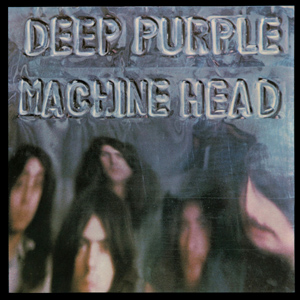
DEEP PURPLE: Machine Head
(#109: 22 April 1972, 2 weeks; 13 May 1972, 1 week
Track listing: Highway Star/Maybe I’m A Leo/Pictures Of Stone/Never Before/Smoke On The Water/Lazy/Space Truckin’
Accidents can make great records happen as much as, or perhaps more than, meticulous preplanning. In late 1971 Deep Purple were looking for a suitable place abroad to record their next album, mainly to escape the clutches of the Inland Revenue but also to refresh themselves in a new environment. Montreux seemed as decent and quiet a place as any to wake up, and so the band, accompanied by the Rolling Stones Mobile Studio, travelled there with the intention of recording the album “as live” in the Casino, home of the Golden Rose Awards and the jazz festival. Frank Zappa and the Mothers of Invention (then still including Flo and Eddie) were scheduled to play the last gig in the Casino before it was turned over to Purple, and it went well enough until “some stupid with a flare gun” (and it works so much better, on a “stoopeed” level as well as a scansion level, without the expletive) shot sparks into the roof halfway through Don Preston’s Moog solo on “King Kong” and the place slowly caught fire. Mark Volman solemnly announced to the audience, “Arthur Brown in person – FIRE!” and Zappa asked that the premises be vacated. Everyone, including Deep Purple and their crew who were seated in the front row, left the building but there wasn’t much evidence of anything except stray smoke, so much so that Roger Glover re-entered the empty auditorium shortly afterwards to inspect and drool over the Mothers’ equipment (two synthesisers!). Not long thereafter, however, the fire took firm and immediate hold and the place was gutted. Seated on the terrace of their hotel on the other side of Lake Geneva, the musicians watched the wind blow the flames and smoke across the expanse of water; the venue’s owner, promoter Claude Nobs, was more concerned about what the band were going to do than the destruction of his own property and living, and quickly sought alternative arrangements. Inevitably, in the midst of all this, the germination of a song entered some of the band’s heads.
The song, based loosely on the group’s perennial closing stage jam “Mandrake Root,” a riff developed by Ritchie Blackmore from his time in Screaming Lord Sutch and the Savages. However, another Savages guitarist, Bill Parkinson, claimed that “Mandrake Root” had been ripped off fullscale from his own composition “Lost Soul.” Thus it is possible that the man responsible for “Mother Of Mine” was also indirectly responsible for “Smoke On The Water” although legal niceties remain opaque (Parkinson did get a modest settlement for “Mandrake,” but as he himself has admitted, pursuing a claim for “Smoke” would “open up a whole new can of worms”).
Nevertheless, Nobs earmarked the Pavilion Theatre as a replacement recording venue, although only the backing track for “Smoke” was completed there; while recording it, the police were attempting to gain entry into the building – there had been complaints from elderly residents about the noise. Marooned for the next week, Nobs finally found somewhere handily out of town; the Grand Hotel. I am unsure whether Machine Head is the only number one album principally recorded in a hotel but the group made the best of it and came out with what many still feel is their best album; not quite as in-your-face as In Rock or as experimental as Fireball, but the definitive portrait of what the group was capable of at their peak.
Amazingly, nobody in the group thought of “Smoke” as anything but another track; it appears at the beginning of side two, was the last of the album’s songs to be added to their stage act and was not considered as a possible single; “Never Before” was the surprising choice for the latter. It’s a decent enough example of the group at work, starting off with a patient would-be Meters strut before rhythmically becoming more familiarly Purple, with subtle “Day Tripper” references from Jon Lord’s organ at the end of each chorus (Lord’s own solo on the song tickles like a seldom-disturbed duster before moving into a sequence that is remarkably prescient of the work of Dave Greenfield in the Stranglers) and standard woman-done-we-wrong wails from Gillan with a descending escalator of a chorus (“Never-felt-so-bad”). Earmarked as a surefire hit, it does its business but doesn’t quite grip in the manner of “Black Night” or “Strange Kind Of Woman”; the single poked its nose briefly into the top forty and most fans preferred to wait for the album.
But “Smoke” is the middle of the album’s three peaks, as towering in their ways as the distant Alps which the band would espy as they made their precarious way from studio to balcony to guest room to mixing desk several dozen times a day. Beginning with Blackmore playing that riff – so simple, so Sky Saxon – and joined systematically by (unison) organ, then drums, then (crucially) bass, the song’s dynamics stem from an understanding of funk as opposed to rock; Ian Paice is quite the funky drummer here (galloping up the pace for Blackmore’s solo, firing up the ride cymbals towards song’s end), and the whole suggests not crushing, abscess-filling rock, but (again) an almost New Orleans approach to the business of rhythm and space. Lord’s organ emits some onomatopoeic ’67 squeals as the song fades. Gillan’s vocal is careful, generous and quietly powerful. The production allows the performance and song to breathe, such that – and this is the secret of its continuing success and influence – you feel you are in their living room, and that you could play along with them. Wisely resisting the temptation to turn the fire into a symbol of sixties idealism burning to cinders, they recount, as though writing a diary, and tell their tale as any folk musician would, and it has correspondingly endured for far longer than more apparently “meaningful” and “profound” pronouncements.
The great thing about Machine Head is the joy of listening to the group just playing, and/or playing around, and the unexpected signs its road flags up. “Highway Star,” for instance, starts like Stereolab (specifically “John Cage Bubblegum”), with Lord’s jolly clockwork Bontempi and a rushing but not rushed rhythm before Glover’s bass and Gillan’s shriek rise like Man-Thing as played by The Odd Couple. Organ/guitar unisons take root while Gillan roars “Nobody gonna have my girl!” Riding over the descending chords of the middle eight, Gillan does indeed conjure the spirit of Arthur Brown, gleefully comparing the sex drive of cars and girls (“I LOVE her!”). Lord offers an energetic bouillabase of an organ solo, incorporating baroque bends and Eastern/Klezmer hiccups, while Blackmore quotes both Bach and Johnny Burnette in triple time. This Apollo Age rockabilly (with, again, Beatle nods, specifically “Drive My Car” in the “and everything” bridges) ends atomised, splintered.
“Maybe I’m A Leo” (it’s Gillan’s sign) goes on a trip-up “Black Dog” ride with a “Come Together” overlay (Lord’s Leslie cabinet-filtered Fender Rhodes) and is yet another woke-up-this-morning grievance, although this loneliness is set down more deeply in “Pictures Of Stone,” Gillan’s best vocal performance on the record. Paice knocks over several cases of cutlery in his introduction and Blackmore’s Leslied-up guitar meditates at half tempo over the busy “Black Night” backdrop – Blackmore really is a sample machine here; after the half-tempo main riff he makes with James Burton licks for the next two bars before wobbling back into the song. His own solo makes judicious use of the tremelo arm, high-pitched and unstable, before settling on one concentrated note of grief which he rapidly cuts off with a brusque wave of the tremelo arm. Meanwhile, Gillan could almost be predicting Ian Curtis or even David Sylvian here – “A prison of my own making,” “Where have they hidden my throne?,” “I don’t belong here” (Radiohead already?). Lord essays a one-man organ/Fender Rhodes duel, all up and down flurries over a Status Quo backbeat. Even Glover gets a bass solo; Lord then embarks upon a upward atonal organ cluster, and the song stops before everyone goes over the edge. After a meaningful pause, the song restarts, Lord’s organ now barking like a distressed Irish setter beneath Blackmore’s guitar, “whispering pictures of home.”
“Lazy,” based on an old Oscar Brown Jr riff (with a touch of Jimmy McGriff in Lord’s Hammond), begins misleadingly with a drone phaser box/organ fade-in before Lord and Paice’s cymbals set up an “Eye Of The Tiger” punch bowl. Blackmore then creeps into the picture and before you know it we’re back in Klook’s Kleek with some old-school grits n’ chitlins via Wardour Street boogie. Finally, Ian Gillan makes his belated entry (whereupon Paice immediately settles down) and berates his slacker subject for not getting out of bed, wanting bread, &c., even resorting to harmonica when words fail him. Then the group steps up the pace with furious organ blasts. Blackmore plays a more aggressive solo before all falls back down on a stock bar band ending.
The album ends with the superb “Space Truckin’,” which begins as though it were “Annalisa” by Public Image Ltd, Paice’s cheerleading stomp being the exact midpoint between “Dance To The Music” and PiL. The triplicate “Come on!”s recall the Troggs, the descending guitar/organ unisons in the choruses even suggest Joe Meek (as, inevitably, do Gillan’s deliberately silly lyrics, which despite or because of their silliness resonate in relation to the past as lovingly as Plant’s in “Rock ‘N’ Roll”: “Remember when we did the Moonshot?”). The overall effect is one of what Jefferson Airplane’s Blows Against The Empire might have sounded like if Sly Stone had still been producing them (and yes, Blackmore “samples” some Paul Kantner lines in his solo here). Paice’s solo revs up the Sly subtext as abstract keyboards float and flutter in the background (including I Hear A New World-esque beats). Then Gillan returns with a mighty shriek as Paice bangs and hiccups his way out of the song and into the fade.
As far as influence goes I would suggest that Machine Head’s is twofold; the cleanness of the riffs, together with their plentiful suggestions of what has gone before them, points the way towards the clinical-but-still-powerful likes of Boston and the legions of stadium pop-rockers who would follow in both their and Purple’s wake; whereas the childish naughtiness of the record’s multiple musical borrowings, tinted by a friendly dammit-let’s-just-dig-it aesthetic view, leads in part to the Jesus and Mary Chain. These fellows love their music; the love is unmissable. And yet, less than a year later, both Blackmore and Gillan would be looking for a way out. Never mind (and did you spot the other path there?); Machine Head remains definitive, not because it was more militant or further out there (where?) than any of their other albums of the period, but because it simply presents its audience with a group doing something better than anyone else at the time was doing it. Many times, that’s enough; the happy accident of getting it right.
Thursday, 21 October 2010
LINDISFARNE: Fog On The Tyne
(#108: 25 March 1972, 4 weeks)
Track listing: Meet Me On The Corner/Alright On The Night/Uncle Sam/Together Forever/January Song/Peter Brophy Don’t Care/City Song/Passing Ghosts/Train In G Major/Fog On The Tyne
Many of you will recall the seventies British situation comedy Whatever Happened To The Likely Lads. In their original sixties incarnations Rodney Bewes’ Bob Ferris and James Bolam’s Terry Collier were appropriately laddish swingers of the Men Behaving Badly variety, but when they returned in a different decade they found that their world had changed. Bob had moved steadily upward into the white-collared middle classes of Newcastle, but Terry had been away in the Army and comprehended almost nothing about the city and the people to which he had returned. Things hadn’t really worked out for Terry, but he seemed infinitely more assured (and resigned) about his current station in life than his ostensibly better-off mate.
Much of the comedic content of the series has not endured; it is largely typical fear-of-mother slapstick which has dated badly. But the elements which have remained with me are the lengthy, non-comedic interludes where Bob and Terry walk around their city, watching the haunts of their younger days, the buildings and things they assumed would always be there, being demolished and destroyed, with nothing much (as yet) to rise in their place. The feeling would be familiar to almost any British city dweller of the period but the remembrances are auburn and rueful; where are our roots now, where exactly do we go from here? The British economy was in almost as bad a state as now, and familiar mutterings about cuts to public services were in effect. Is anything, you wonder while watching these virtual documentaries, going to survive?
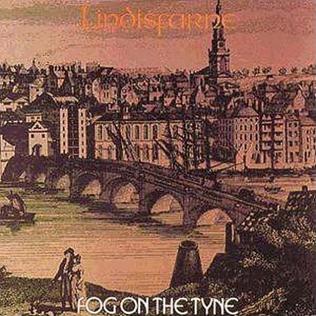
I say this because it may go some way towards understanding why Lindisfarne – on the face of it, an unpretentious, good-time folk-rock group from Newcastle – became so popular during this period. Folk music is about the most difficult of musics to categorise, since there is a different strain of folk which applies to every different village, and in some cases every different street. But something about Lindisfarne seemed to brush the rawest of nerves in many British people of this time. I’m not sure who might qualify for the present day title of “people’s band” in Britain – the Arctic Monkeys briefly came nearest to qualifying, and Mumford and Sons most certainly do not qualify (do you hear their songs being hummed on the bus, or in the pub?) – but Lindisfarne assumed the role of people’s band over the period 1971-2; Fog On The Tyne was one of the largest-selling albums by any British act released in 1971, and took its time climbing to the top (reviving its previously uncharted predecessor Slightly Out Of Tune in the process). The sepia-pink cover struck its own chord; an engraving – real or fake, it doesn’t matter – of Newcastle as its inhabitants might have known it in the days of Jane Austen, a peaceful but defiantly working-class city, and there is that same air of quiet defiance about the group’s music.
“Meet Me On The Corner” was the album’s big hit single, set in a square bass drum and harmonica dance pattern, and musically slightly reminiscent of “Mrs Robinson.” Singer and mandolinist Ray Jackson – you may remember his vital contributions to entry #99 – speaks to us about dream sellers (because “dreams are all I believe”), ways not of escaping but ways of examining his own reality far more happily (“Lay down your bundles of rags and reminders/And spread your wares on the ground”). The harmonies on the choruses, as elsewhere, are strongly predicative of the Electric Light Orchestra, but Alan Hull’s staccato Gilbert O’Sullivan piano intensifying the song’s harmonies on its first chorus takes us decidedly back down to earth, Jackson’s harmonica puffing ceaselessly like the most determined of trains.
“Alright On The Night” is far more intense, however, as one would expect from its writer, Alan Hull (generally, Hull writes the album’s darker songs and Rod Clements the lighter ones); he shares vocal duties with Jackson and Si Cowe and is palpably angry: “Can you tell me exactly what it is about me that’s so unclean?” he protests over a deceptively laidback “Maggie May” setting. “Take that stupid look off your face,” he continues, “Everything I say I mean.” He is not trying to repel his accuser, but instead inviting him to join him in his world (“Come and live with me in a cave”) – drummer Ray Laidlaw’s triple cowbells after the first chorus are like golden hammers striking an unknowing head. The choruses promise a straightforward good time, come out for a drink on Friday, that’s all we ask of you. The song’s subtle rhetoric persists – the guitar/mandolin interlude after the second chorus, Clements’ bass roving around the periphery of the men. The mood is almost one of a pastoral, provincial Stones, but there is another unexpected comparison which comes to mind (and with which Lena came up) – to which I will return shortly.
“Uncle Sam” is Cowe’s song – his first – which Jackson sings in muted breath over quiet guitar, mandolin and organ. Words such as volunteers, uniform, frail, jail, hang and blacklist make it abundantly clear what world we’re in – the war is still going on – and Laidlaw’s drums circle the song briefly before landing, together with harmonica and piano, to set up a Band-like midtempo mourn. “Well, I’m goin’ across the border,” Jackson tells us – to Canada? Or is he in 1746, in his own doomed-to-be-repeated history? – and after his “Watch what happens to me,” there is a short pause before Laidlaw’s drums rain down on his head; he’ll be on the road if anyone wants him, and one reflects on how huge and inescapable a shadow The Band are continuing to cast over unexpected regions of music at this point; the multi-vocal/instrumental approach, the deliberate archaism (masking an unanticipated newness) – but even this anti-Vietnam song could only have stemmed from the docks of the North-East.
With “Together Forever” – written by the great St Andrews folk musician Rab Noakes – the group moves back towards good-time mode, but there is a deeper tinge of true happiness; they’re sitting on top of the bus, in the front (“watchin’ the people who don’t look like us”), they have no money, but what do they care? Jackson sings the song truthfully and moderately lustily, and the band cruises along behind him like the most becalmed yet confident passengers, even offering an ascending music hall guitar signoff; they are perfectly happy being who they are and what they are, where they are, and are keen to let you know this.
Hull’s “January Song” leaks back into wistfulness with its acoustic guitar and roving bass, or at least pretends to do so; yet Hull’s own voice veers between several strips of agonised – there is an unavoidable Dylan tinge to his tone but the guitar appears to turn to acid behind him; The Modern Man, losing his way, unable to reach out and touch anyone or anything, and Hull’s blanching beg for him to rediscover what he’s supposed to be here for (“I sometimes feel the fear/That the reason for the meaning/Will even disappear”). The song drifts into an extended chant of “You need me need you need him need everyone” – should that “him” be spelt with a capital “H”? – as Laidlaw’s drums finally kick in and Jackson’s mandolin strums its vivid way into the picture. It is immensely moving.
But Hull’s gloom scarcely lifts. I have been unable to find out exactly who Peter Brophy was (or still is) but again it hardly matters; he could be singing about T Dan Smith or John Poulson – central and crooked figures in the demolition of old Newcastle – or simply The Man; but Hull puts every shade and nuance of emotion, disbelief, grief and hurt into his multiple “You don’t care”s. His voice becomes steadily more animated and dissolute, crescending into rage before falling back into simple regret; the lyrics are post-“I Am The Walrus” cod-surrealism but the anger does not fade (unlike the near-sibilant harmonica which cushions Hull’s quieting fury at fadeout); is this what we came through the sixties for?
With “City Song,” Hull finally cracks; he has had it with “the city” as he is compelled to know it (“I’ve been too long travelling on your train”) and sends modernity (as he thinks it) towards damnation; “Your tatty tricks to me/Are now really rather lame,” he sings, and later adds, “Your music doesn’t speak – it swears.” From most other people this would come across as crass reactionism but he is clearly attempting to grasp for something deeper, a slipped loss he is trying to regain. “Back to the garden,” “country lady,” “magic children” – it remains so hard, so impossible, to run from the sixties. The harmonies come in on the second chorus and fill up the song like semi-distilled nectar. In “Passing Ghosts” – the ghosts get thicker with every song; this is supposed to be a good-time band? – Hull’s voice and melodic construct are strikingly similar to those of his contemporary Bill Fay (his “sleep with we,” for instance) and he ends by resorting to the phrase/incantation “Come together” (upon which drums and bass make a very belated entry), Jackson’s rivulet of mandolin tinkling behind his despair. His grave might be ready (and still), but in the meantime he wants to pass the time, like a pewter mug of beer, between himself and his fellow human beings. That might be all he ever wanted.
“Train In G Major,” another Clements tune, is sprightlier. If the Dylan comparisons are inescapable (Bob Johnston produced the record), with the train indeed coming slowly, the record’s central message is as red as its boiler; “Take me to some better place to be...Awwww, wow, tell me baby!” Hull essays a brief “Ballad Of Bonnie And Clyde” piano quotation. The harmonica provides the engine, the walking bass lays down the tracks, and electric guitar offers rays of sunshine shivers towards song’s end. We’re finally getting out of “here” – and it might not be a geographical “here.”
No, because the title track, which closes the album, says strongly and proudly that they’re staying right where they are, Hull’s spirit finally satisfied and approaching modest euphoria (he shares vocals with Jackson and Cowe). “Think I’ll sign off the dole!” he exclaims (with two wake-up cowbells in response). The verse/chorus sequences work on tension and release; is this the first song in this tale to deploy the word “presently”? But again they tell us that this is what they want – the crappy sausage rolls, the pub, themselves and their own kind; it’s what they know and clearly what much of their audience knew and craved. Harmonica, fiddle, piano and mandolin patiently work the song up towards a satisfying, mantra-like climax. Understand us, they are saying, and you might understand yourselves. And indeed, turning back to “Alright On The Night,” its lyrics and general melodic structure, if set to a different tempo and different instrumentation – not to mention a different decade – remind us of a Newcastle teenager who at the time was playing in a folk group called Dust. His name was Neil Tennant. “Everything I say I mean”? Whatever was going to happen to the likelier lads of Tyneside in times to come, this record, entirely lacking in side or irony, tells the people who needed to hear and know it: we are still all in this together, and in a much more touchable and workable sense.
Tuesday, 12 October 2010
Paul SIMON: Paul Simon

(#107: 18 March 1972, 1 week)
Track listing: Mother And Child Reunion/Duncan/Everything Put Together Falls Apart/Run That Body Down/Armistice Day/Me And Julio Down By The Schoolyard/Peace Like A River/Papa Hobo/Hobo’s Blues/Paranoia Blues/Congratulations
”Reality but reality grimly seen/And spoken in paradisical parlance new.”
(Wallace Stevens, “An Ordinary Evening In New Haven,” Section XII)
Or: Spiro Agnew Stole My Chinese Food.
Paul Simon’s first solo album is the ideal, mechanical twin to Harvest. He may be scooting and quietly howling around the encased claustrophobia of Manhattan rather than blowing down wildly open roads, but the story is the same. More than anything else on the record, “Paranoia Blues” gives his game away, and in it he’s on the brink of giving his city away. It helps that musically (as elsewhere on the record) he is in the same place as the recent Stones, with Stefan Grossman’s unquestionably authentic bottleneck and Hal Blaine and Simon’s deadpan Sonny Boy Williamson beats. You can love a city as much as you like, but when you turn around and someone’s run off with your Chinese food then you know it’s time to go. The dreading of the interrogations in the little room at JFK Airport assumes an equal force to the Lin’s Chow Fun abstracter. “Whose side are you on?” he keeps asking, and the overall mood (“I got some so-called friends/They’ll smile right to my face/But when my back is turned/They’d like to stick it to me”) anticipates the O’Jays’ ostensibly scarier “Backstabbers.” Simon’s “oh no”s sound like sobs, the horn section resembles an incontinent kazoo convention; there’s a quick, wriggling pause – should he stay or should he go? – before the thump picks up again and Simon wails with the forlorn brow of a man who knows, just like the protagonist of “The Boxer,” that he may never get out of here.
Most of the emotions on Paul Simon centre around the idea of things coming to an end – “Everything Put Together Falls Apart” being but the most explicit expression and aptest summation of the notion - and if the record comes over as a sophomore-level tour of New York then it speeds through its streets in the knowledge that the city as it stands in 1972 is reaching something of a nadir, as proved to be the case, and that either the city needs to get out of itself or the author does. Or at least do something else; Simon spent most of 1971 teaching songwriting (his students included the Roches and Melissa Manchester) and if the record stands as a final, queerly euphoric sneak out of the need for Art Garfunkel - without the requirement for two-part harmonies, Simon's songs manifestly speed up in both construction and delivery - there is a sense of loss and discontent that his supposed new freedom cannot quite mask.
For instance, the record begins with a death and another Chinese meal, which is what a Mother and Child Reunion actually is (fittingly, it is a combination of chicken and egg), with a song recorded in Jamaica under the supervision of the great producer Leslie Kong (who, like Paul Simon's family dog, would not live to see 1972). "No, I would not give you false hope/On this strange and mournful day," Simon immediately warns us, although the warm spirit of the music - he is accompanied by most of the Maytals (including the staccato, single-note lead guitar work of Huks Brown which makes the song sound like a mutation of early sixties Drifters), as well as the subtly indispensable piano of Larry Knetchel (he tumbles, like the singer's soul, down from the second verse towards the chorus) and a quartet of backing singers which includes Cissy Houston - gives the misleading impression of happiness. In fact the mourning was due, as intimated above, to the death of the Simon family dog (he is seen on the sleeve sitting, alternately solemnly and laughingly, with what presumably was the new dog).
Still, the song isn't just about the death of a dog and the eating of a Chinese meal to cheer up the mourner; one always has to watch out for Simon's symbols. "I know they say let it be," he mentions in a direct reference to the Beatles, but adds that "the course of a lifetime runs over and over again," and all of a sudden the song reveals itself as a quiet snub to death and impermanence, as seemingly carefree as Bolan's "Cosmic Dancer" with its unending womb/tomb cycles. "The mother and child reunion/Is only a motion away," may be in part a reference to "Hey Jude" but fundamentally the symbolism is to do with regeneration, rebirth, returning to the original source - peace like a river indeed.
But if you want to get out of New York, where else is there to go? "Duncan" is a lighter fusion of "The Boxer" (in its Band-influenced storytelling) and "El Condor Pasa" (Los Incas are back with their charango and flutes) and thus lightens up the darkish road of its tale; Lincoln Duncan is a fisherman's son in Nova Scotia, gets bored and decides to up and move down to New England. He describes being penniless and rootless, stuck in a thin-walled motel while his neighbours fuck for the Olympics ("Bound to win a prize/They've been going at it all night long"), losing his innocence to a street preacher in a tent in the woods and relishing the memory (his "oo-wee"s and "oh-oh"s) - "Just thanking the Lord/For my fingers," and he doesn't just mean the ability to play his guitar. Behind Simon's unusually expressive voice (although the rest of the record will prove that it's not that unusual), the Andeans hover in the middle distance like the suspended lights of Interstate 95.
Contrast this with "Papa Hobo," where Simon's protagonist is sufficiently desperate to quit New York that he dreams of Detroit ("It's carbon and monoxide/That ol' Detroit perfume.../Detroit, Detroit/Got a hell of a hockey team") and working on the motor assembly line. Charlie McCoy's raspberry bass harmonica is back from "The Boxer" (blowing a particularly ripe one in response to Simon's "Sweep up!"). Knetchel offers a careful continuo on harmonium and the song moves into a McCartney daydream - "And the weatherman lied" - before Simon scats out to fade; is he singing "Never go to heaven"? This leads into one of the record's few escape hatches, or perhaps it's just his ripest daydream; "Hobo's Blues" is a quick, snappy instrumental jaunt for Simon's coffeehouse guitar and Stephane Grappelli's immediately recognisable violin, almost heartbreaking in its brief revelation of the wider world concealed beneath the shell of urban stress - and we remember that the term "hobo" was originally an abbreviation of "homeward bound."
Elsewhere it's about misadventures and mishaps and what the hell is this day supposed to look like; "Run That Body Down" is a lateral meditation on the legacy, if any, of the sixties - his doctor tells him to stop the abuse, he in turn tells his then-wife Peg to do the same. At the title there are four rapid smashes of acoustic guitar chords (played by Simon and David Spinozza); Simon's "Who you foolin'?" falsetto and his "IIIIIIIIIII" sustenati go almost into the airy abstract. Jerry Hahn's seagull-like wah-wah electric moves the song into a more contemplative quarter but the message is unabated; how long can any of us go on pretending that it's still as it was five years ago - the war's still on, people we know have died; how much longer?
Ah, yes, the war that was still on, and the ineffable weariness of a nation which Simon articulates so perfectly on "Armistice Day"; he's down in Washington DC looking to speak to his Congressman but he's still waiting and getting tired. The symbolism here is clear and abject, but note the unorthodox chords which greet the revelation "She was there," backed by Airto Moreira's tick-tock percussion. Simon and the group hold on that last chord and turn the song into a modal drone, featuring the horns and Hahn's energetic electric guitar which steadily gets funkier and more inventive. Again there is an unexpected feeling of the Delta about the piece; where does that "When I needed a friend she was there/Just like an easy chair" come in? He's tired but he's also playing away ("Oh Congresswoman/Won't you tell that Congressman?") - you do what you have to do in order to live, as well as exist, while you're waiting; look, he says, how far down I have been dragged.
"Peace Like A River," however, is the closest that Simon has ever got to an explicit protest song, or as explicit as he wishes it to be; the mood is bluesy, patrolled by Joe Osborn's strolling bass, and as the song progresses the work of the three musicians (Simon on guitar, Osborn, and drummer Victor Montanez) moves more towards Timbuktu; at times we could almost be listening to Ali Farka Touré. But then Simon's guitar fills out into a background chorale for the choruses; they have been waiting, this crowd, for something to happen, or to be delivered - they are not quite free yet and expect more pain before the final freedom happens, but they will not be deterred; "You can beat us with wires/You can beat us with chains/You can run out your rules," sings Simon in the most atypical chorus he ever wrote, "But you know you can't outrun the history train." Once more, the grain of Simon's improvising voice is remarkable; his breathing "Aaaaaaah"s, his fluttering "Oh-oh, oh-oh, oh-oh"s, his no longer weary "four in the morning." Christgau has referred to this song as Walter Carlos Williams after the repression but to me Wallace Stevens (despite being markedly more of a political conservative than Williams, or for that matter Simon) is a more fitting comparison point; Stevens understood that reality had to form itself out of dreams before it could become real and that perspective and emotion, and the poet and reader's relationship to both, were what counted. Over and over in his work Stevens questions himself, his art, his tools of imagination, but it is all put in the service of a successful and revelatory consummation of desire and action.
Thus it doesn't really matter what the (imprisoned? About to be released?) audience of "Peace Like A River" are waiting for, just as it doesn't matter what misdemeanours have caused him and Julio to make a run for it; Airto's whooping percussion on "Schoolyard" remains a delight, but this song (even with its whistling) is not free of grenades; the "radical priest" who gets the kids out of jail and onto the cover of Newsweek has to be one of the Berrigans, two of the most vocal opposers of Vietnam and of Nixon (remember Daniel Ellsberg and that Ray Conniff concert?). "Well I'm on my way," sings Simon. "I don't know where I'm going.../I'm taking my time." Are we all ready for the country, in either sense?
But then there is "Everything Put Together Falls Apart," the record's equivalent to "The Needle And The Damage Done" and musically as stark, even if Knetchel's harmonium and Fender Rhodes express alienation in a language that the Manhattan wine bar would understand; the song strolls cautiously through myriad chambers of unexpected chord changes as Simon effortlessly repositions Young's howls in the city. "Taking downs to get off to sleep/And ups to start you on your way/After a while they'll change your ways," he warns, before breaking into an inexpressible falsetto ("Ooo-oo-oo-ooh") on the heels of the starkest last couplet of any songs upon which this tale has thus far stumbled: "But when it's done and the police come, and they lay you down for dead/Just remember what I said," following which Simon's acoustic stings and Knetchel takes the song out on a horrifically ironic barrelhouse of keyboards. This is not the reason why we did and believed all that stuff, you remember...or do you?
The record itself closes with "Congratulations"; Knetchel's electric piano shivers like a trapped eel through the centre of the song's bridge (all those bridges, all this trouble) before switching to stately, spiritual organ. Hal Blaine's drums are a literal heartbeat, meeting Osborn's rising bass. Meanwhile Simon has had enough; he takes his world and the immediate past to pieces ("Ohhhhhhh, and I don't know when" - the exhausted cry of a defeated urbanite); what did those sixties, that supposed love, get for us, or where did it get us? "I notice so many people/Slipping away" - their numbers get fewer by the day - "And many more waiting in the lines/In the courthouse today...in the courthouse today"; the unions divorcing, the splits rendered. "Love is not a game, love is not a toy," he says, exasperated, and finally, as all of the lights go out, Simon concludes, alone and utterly apart, with a final, exhausted question: "Can a man and woman/Live together in peace?" before issuing a last plea, the simplest of all pleas - "Oh, live together in peace." Knechtel's piano escorts us from the scene.
There were of course other accounts of collapsing society to account for at the time - not least, There's A Riot Goin' On - and although Simon is less obviously in pain than Sly Stone, the aura of imminent extinction remains high, and this album sets Simon's lines against as unapologetically real a background and environment as they ever found; it is hardly surprising that Simon never quite managed to stare reality this starkly in its face again - the following year's There Goes Rhymin' Simon was necessarily a happier affair, but his attitude towards what was real and not became more equivocal ("Kodachrome"); and despite many fine records of variable popularity in the interim, it isn't until the rueful maturity of 1983's Hearts And Bones that Simon really gets back to this territory and speak to it as directly as he does here ("The Late Great Johnny Ace" remains the wisest and calmest response to Lennon's passing expressed by anyone in popular music). As 1972 moved into its uncertain spring, Simon tells it as he thinks it is - and the world was as near to his thoughts as it dared, or could bear, to get.
Tuesday, 5 October 2010
Neil YOUNG: Harvest

(#106: 11 March 1972, 1 week)
Track listing: Out On The Weekend/Harvest/A Man Needs A Maid/Heart Of Gold/Are You Ready For The Country/Old Man/There’s A World/Alabama/The Needle And The Damage Done/Words (Between The Lines Of Age)
It might be a cliché to speak of Canadian music in terms of its immense space, but then a cliché has to mean something in order to become a cliché, and regardless of whether it’s the jazz-rock of Lighthouse, or the powering pop of Sloan, or the blue neologisms of Joni Mitchell, or the rambling collectivist coherence of Broken Social Scene – or even the ostensibly heavier likes of The Guess Who or Rush, or the monolithically quiet likes of Glenn Gould – Canada’s music can be distinguished instantly from that of the United States. As with the country, there is less of a rush, less urban squeezing-in, more consideration, a fundamentally different hue; one thinks of dark pastoral roads, in places perhaps illuminated only by the snowed-in product of six-month winters. In those long winters there is little actively to do; one is left to ponder, to reconstruct a world.
Given the greater degree of consideration, it is possibly also true that Canadians are capable of seeing others in greater depth (because of the distance, and not just geographically) than they themselves are able to do. They also tend to be far more single-minded, albeit in a good way; less content to fall for hypes, to slot themselves into convenient categories, to do as they please, all the better to tell their stories. Their musicians have a pronounced tendency to turn from style to style, to alter their approach constantly, in order best to illustrate what they are trying to communicate. If Neil Young, for instance, wanted to record a New Pop/Vocoder album to speak with his son (Trans, 1982), then nobody, especially not record label bosses, was going to tell him otherwise. Contemplative country, feedback-laden improv, rock ‘n’ roll covers, multimedia dramas; he’s done them all, and while he might continue with political flip-flopping, it is all part of his inner being; what does this world mean for me, and to me, he continually asks himself, and us, where and how best can I construct a path through it?
And how come I can see through you with such alienating clarity? Only a Canadian could have conceived and performed the following words, from “Alabama”:
“I’m from a new land.
I come to you,
And see all this ruin.”
Everybody else was loving everybody else in early seventies Laurel Canyon, but Young, as always, kept his distance. If his only British number one album represented the closest he ever came to anything resembling a mainstream, that is not to assume that Harvest is, as too many have assumed over the decades, a sellout, a blanding out of his art, a nigglingly neutral commercial record. Bear in mind that Young had already offered us the groaning grinds of Everybody Knows This Is Nowhere with its ravenous setpieces (“Cinnamon Girl,” “Down By The River,” “Cowgirl In The Sand”) and Harvest’s predecessor, After The Gold Rush, a record almost unique for its period (almost? What’s Going On?) in that it was authentically angry but astute enough to disguise its rage in some of the prettiest tunes Young was capable of creating – the title track, gradually widening out from burned-out basement to spaceships, the Toronto coffeehouse Bacharach of “Only Love Can Break Your Heart,” the inescapable boil of “Southern Man” being its most celebrated. Many at the time felt Harvest an ironed-out replay of Gold Rush but the smoothness is not always visible and the patience needs to be understood; he is using the singer-songwriter format gently to hammer home profounder truths.
Consider that the album begins with a deliberate nod at the old teenage rock ‘n’ roll escape route before shutting it down – “Out On The Weekend”’s opening gambit of “Think I’ll pack it in and buy a pick-up/Take it down to L.A.” could in itself have come straight from Chuck Berry’s notebook, before the slow sadness kicks in – and, after wandering through just about every style Young could have wandered through in ’71-2, it culminates in the observation: “It’s just words, words.” Songs pause seemingly at random to allow sampled Richard Nixon speeches (“Alabama”) and studio chatter (“Words”), but it’s more indicative of a lack of inclination to rush through Young’s message than of art (although the latter is far from absent); he wants you to understand what he is trying to say (from “Weekend” again: “He tries to speak and can’t begin to say”) but you as his listener have to be prepared to understand him very slowly. The gatefold sleeve – and, once more, a well-weathered LP edition is the "truest" way to listen to this record – features on its cover what could be the sign on the side of a fruit truck; inside there is a huge close-up of a doorknob, to the barn in Nashville where much of the record was made, in which we see the indistinct reflection of Young, standing in the empty sunshine; and on the rear there is a shot of Young at work inside the same barn with his pick-up band the Stray Gators, but he is hiding from us, face away from the camera stage right, head down, concentrating on his guitar. He wants to tell you things but also wishes to remind you that you can’t pin him down; he’s there but he isn’t really there, or he might be in the studio in L.A., or on the stage of UCLA’s Royce Hall, or even encased in the improbable surroundings of Barking Town Hall (where the two tracks with the London Symphony Orchestra were recorded) – you think you’ve caught him? Why, he’s flown off again, and while his flight path might be straighter than that of a Dylan, you still have no hope of catching up with him.
What of the record itself? “Weekend” sets up the album’s central theme of habitual restlessness, of the impermanence of “home”; after its moderately hopeful introductory lines, we learn that there once was a woman, and that he loved her, but that she’s not there any more. “She got pictures on the wall/They make me look up/From my big brass bed” – a sombre reflection of “Lay Lady Lay” – puts this relationship into question, and when he’s “runnin’ down the road/Tryin’ to stay up,” is he fleeing her as desperately as the young boy who runs as far as he can from Madame George? The Stray Gators give nothing away; Kenny Buttrey’s drums are rhetorical (particularly succeeding Young’s “Can’t relate to joy”), Ben Keith’s pedal steel is simultaneously outer space, angel and foghorn (“I hear her callin’,” followed by five emphatic chimes from the whole band), Tim Drummond’s bass busily (but not in the way of a grasping panhandler) joining up the emotions. The band know enough to crouch down to virtual silence for the title track, where Young is addressing another girl, not knowing whether he wants to save her or vice versa; he sees her “walking with the boys,” his mother “screamin’ in the rain,” and maybe craves to take her out of this place altogether, but then he runs up against his own limitations (“Will I see you give more than I can take?/Will I only harvest some?”). When he repeatedly urges “let me fill your cup with the promise of a man,” it still sounds like a question, and not one to which the singer is expecting a prompt reply.
He is scratching around; there are people he knows, but does he want to be with any of them? Is he the one whose cup needs filling? Where does one place a song as deliberately immense as “A Man Needs A Maid”? Well, one could consider Carrie Snodgrass, the actress (“I was watching a movie with a friend/I fell in love with the actress”) who nursed Young after he sustained a back injury, but the pain expressed here runs far deeper and redder; he is lost, as lost as any rock musician of his time could expect to be, he is grasping at straws. To begin there is simply Young at the piano, singing about his life changing, the absence of trust, the lengthening shadows in which alms might be mistaken for arms; he slows down to allow the London Symphony Orchestra, under conductor David Meacham and playing Jack Nitzsche’s arrangement, to enter – first brass, then strings – for the lamenting Lear of the chorus. Bells and glockenspiel toll forebodingly – Nitzsche approaches the song like an autumnal Spector – as Young tries to work out what he wants, disguising his hurting three-in-the-morning plea. At “It’s hard to make that change” the orchestral storm gives way to a simple oboe, pursued by the first of two heart-shattering “When will I see you again?”s. With the first of these, Young is embraced by an enormous hug from the string-led orchestra, and I reflect on how the young Anne Dudley would have been affected by that puncturing moment, since she would replicate its gestures a decade later as the coda to ABC’s “All Of My Heart” – itself the coda of an extended pretence of searching for anything that isn’t love. What, whom, does he want? “Someone to keep my house clean/Fix my meals and go away.” He’s been hurt and unwilling to dip a toe into the pool of love once more – “To give a love, you gotta live a love/To live a love, you gotta be ‘part of,’” and woe betide those too hurt, too re-infantilised (because that’s what tragedy does to you, winds you right back again to being twelve, naïve and stupid); this is anything but an unreconstituted chauvinist song, rather an agonised cry to want to be a full human being again. At “Playing a part that I could understand,” the LSO rises to a climax of stalagmites and thunder – and then we’re back with the piano and his soul and that second, hanging-on-life-by-the-slenderest-of-threads, silently screaming to be held, to be cherished, “When will I see you again?” The coda is as quiet as deep art will allow.
“Heart Of Gold” was of course the album’s big hit, and sums up the record and its artist’s dilemma more succinctly and candidly: “I want to live/I want to give” and he’ll go wherever he can think he can find it (“I’ve been to Hollywood/I’ve been to Redwood” – where Young had just purchased some land – “I crossed the ocean for a heart of gold”) but (and remember, Young was still only twenty-six when he made this record) already aware of creeping mortality (“And I’m getting old”). When James Taylor and Linda Ronstadt’s harmonies enter the picture late in the song (all three turned up on the same edition of The Johnny Cash Show recorded in Nashville in mid-1971 and inspiring the notion of Harvest), the chordalities are thickened and made ambiguous; one marvels at how a song which in its determined quietude went so violently against the bleach-out-and-lay-back aura of its immediate surroundings managed to make number one on Billboard as a single. Buttrey’s drums again speak what Young can’t or won’t say, reinforcing the pronounced despair of the song’s final verse.
Side one ends with “Are You Ready For The Country?” – does he mean escape from the city, or face the nation? – introduced by Nitzsche’s staccato piano before unexpectedly settling into a McCartney-ish rural romp, although Buttrey’s reluctant parade-ground drumming suggests a deeper discontent. Crosby and Nash harmonise carefully (all three of CSN, plus the Y, turn up in different places throughout Harvest, never more than two at a time, and never the same two). Both Young and Keith’s guitars sound oddly detached, like leaves blowing around the abandoned town of The Last Picture Show. “Lefting and then Righting/It’s not a crime, you know!” says Young as he repeatedly tells us that “It’s time to go,” except when he encounters the hangman, who tells him “it’s time to DIEEE-EEEE!” Drummond’s subtly brilliant bass-playing reminds us why Harvest is one of Andy Rourke’s formative records; there is more than a premonition of the undertow of the Smiths in its chassis. But the message is delivered pretty clearly; get the fuck out of here, everyone.
Side two kicks off with “Old Man,” based on the man from whom Young had purchased the land in Redwood Park. Beginning with bass and acoustic guitar, before the entry of the drums, Young ponders about exactly how old anybody ought to be getting: “24 and there’s so much more.” Taylor and Ronstadt return on harmony vocals, and Taylor also contributes some uncredited banjo plucking, providing an anchor for Keith’s soaring pedal steel. The song shifts from its brooding minor key to a nearly triumphant major for its passionately harmonised chorus (“Old man, take a look at my life/I’m a lot like you”) before sinking down once more; and, once more, the message is expressed: “I need someone to love me the whole day through.” He is refusing to give up, to grow old, to die: “Old man, look at my life,” he states in his bitter coda, “I’m a lot like you were.” As with On The Beach, this is a sustained howl in favour of life, knowing that you have to slash through the stinging nettles of negativity before you can uncover and reclaim it.
The London Symphony Orchestra is back for “There’s A World” – at the same time, they were also occupied trying to work out, again under Meacham’s directions, the crossword Charles Ivesisms of Ornette’s Skies Of America, another patient unravelling of despair and its eclipse by initially cautious joy (the latter’s jolliest moment would later be revamped as “Theme From A Symphony,” the centrepiece of Coleman’s revolutionary Dancing In Your Head) – and, as with Ornette’s rainbows and churchy Sunday mornings, Young is trying to rise above the parapets, even over the roofs, to find somewhere and something better. Timpani, strings and bells usher him in; the darkness of the song’s brood (“Have you found it walking down the avenue?”) rising, via harp, to the airy lightness of “look around it.” That buoy marker of an oboe reappears before the song returns to Earth, just as Young is preparing to abandon it; “We are leaving, we are gone” (thus this becomes the true sequel to “Gold Rush,” the song). “We will leave you all alone,” he reassures, or threatens, us; a more gentle modulation back from lightness to dark ensues (“All God’s children in the wind/Take it in and blow hard”). The harp cuts the gravity dummy loose. “Will we lose our grasp/Or fuse it with the sun?” as Young had already asked on the song “Harvest.”
But “Alabama” – routinely dismissed as a pallid “Southern Man” rewrite – represents an advance on its predecessor. Young’s guitar is far angrier here, the fury which has been quietly boiling throughout the record, so incensed that it almost explodes the harmonies’ partial cosiness (Crosby and Stills contribute the harmonies here, and indeed the record does momentarily turn into a CSNY disc). Young howls, “See the old folks/Tied in white robes” (or “ropes”?). He turns the South on its side, citing “Swing Low Sweet Chariot” and offering a full chorus of “God Bless America” before cutting in with the Nixon tapes – this record came out only a few months ahead of Watergate – before demanding to know why this country, which he tries so hard to love, should want to destroy itself so completely. “Your Cadillac,” he accuses Alabama, “has got a wheel in the ditch/And a wheel on the track.../Banjos playing through the broken glass.” Nitzsche’s piano moves to the forefront of the music, followed by Young’s guitar. “You got the rest of the Union to help you along,” runs the song’s climactic couplet, “What’s going wrong?” – and it’s That Other War once more, the Civil War which redefined America so utterly, and under whose consequences we still live, or suffer, today. “Can I see you and shake your hand?” asks Young. He wants to love this nation, but it makes doing so the hardest thing ever – I thought of what sort of an impact Harvest might have made had Young brought in Elvis to sing the songs, and remember how America breathes the air generated by its own refractions. But thenYoung has to be singing these songs as well as writing and playing them; yes, by any dullard conventional theory his range in both voice and guitar are limited and clumsy, but didn’t most of the same people say the same thing about Elvis a lifetime previously?
The record’s sanest and chilliest two minutes ensue; “The Needle And The Damage Done” bases itself on the Donovan/”Dear Prudence” trick of climbing up the scale when it sounds as though it’s descending (it runs from D major via E major seventh to G major and a nearly unbearable ascension to B flat), and it’s just Young, onstage at Royce Hall, and on his own (“I know that some of you don’t understand”), singing the record’s most painful lament, for a man he loves who he knows, can see with his own eyes only a few feet away from him, is dying; by extension it becomes one of its time’s most eloquent epitaphs for the increasingly remote sixties - this is where escape has led us? To a gifted man destroying himself? The song’s motor is the pain which in comparison even “Maid” only partially fills in the spaces – and for the greater part of its duration there is nothing in it except space, space for thought, for lament, for earnestly-contained anger. “Every junkie’s like a settin’ sun” he finishes, and he makes that “settin’ sun” sound like a “skeleton,” shaking and shivering in a manner more profound than that heard on “Cold Turkey” – how much emotion do you have to summon up to silence those screams, to turn all of those “oh no”s into “Ono”s? The sudden, roughly-edited burst of applause sounds like the last joke being played before entering the first five minutes of death.
The applause cuts straight into the closing “Words” (this time featuring Stills and Nash). The song meanders, but Young, I think, wants it to stand as an escape route, a relatively happy ending; he (and of course, being Canadian, he was always going to play the part of the Worried Man – the arteries of The Band run semi-wild throughout the record) is settled on his new land, tossing philosophies in his mind like pancakes, wondering what this is going to bring to him; but musically the song is restless; Nitzsche’s piano offers a grinding cyclical 11/4 riff out of which Young’s guitar climbs gingerly before becoming markedly more strident. Drummond’s bass begins to walk. Then the band cuts back to a funereal 4/4 tempo as Young’s voice re-enters. But after the last chorus, the song rears its stuck wheels as the piano riff will simply not disappear; the effect is one of a sonically lighter “I Want You/She’s So Heavy.” Young’s guitar becomes steadily more frenzied and acidic and appears finally ready to break free, but, as elsewhere on the album, his own storm abates, and Young lets Keith’s pedal steel drift gently back into the foreground before the song and album fade.
The mood would grow darker – or supposedly so, as Young, apparently horrified by Harvest’s overwhelming success, moved deliberately out of mainstream focus; but even something like Tonight’s The Night finally winds up on the side of life (how could it not when it details its deaths in such lurid detail?). And he has prevailed; he recognised Johnny Rotten when the rest of America hadn’t remotely worked out how, or whether, to deal with him, the immaculate sequence of records from Eldorado to Sleeps With Angels represents the greatest sustained Indian summer of any rock musician’s career (though it’s tempting to cast fellow Canadian Leonard Cohen as Young’s secret alter ego; at this period he’ll sing about slashing one’s wrists as though he were Allen Sherman, but with infinitely greater wit and fright), and even as the critical wind drifted away again he has continued to find new ways to illuminate the old ways, right up to the simple but radiant Lanois/Le Noise pun. Why? Because, as with Scott Walker and John Cale and Dylan and Cohen and you fill in the rest, he has kept moving because nobody told those pioneering sixties people that they ever had to stop. Think of The Suburbs - as this tale will do in the long term – and the green wood between the spaces, and what humanity you’d see fit to place somewhere in between them, or, if you’re lucky, beyond them.
Tuesday, 28 September 2010
Neil REID: Neil Reid
(#105: 19 February 1972, 3 weeks)
Track listing: You’re The Cream In My Coffee/On The Sunny Side Of The Street/Peg O’ My Heart/Ye Banks And Braes/Happy Heart/When I’m Sixty Four/Look For The Silver Lining/If I Could Write A Song/When I Take My Sugar To Tea/My Mother’s Eyes/I’m Gonna Knock On Your Door/The Sweetheart Tree/One Little Word Called Love/How Small We Are, How Little We Know/Ten Guitars/Mother Of Mine
It’s an unusual cover photograph; he is not eagerly grinning at us, as you might expect from a performer of his age, but rather looking away from us, pensive, and with that pronounced upper lip, looking not unlike the younger Gordon Brown. The inevitable question is: what is he thinking? How did I end up here? Am I excited or scared? How long is this thing going to last? I wonder what my mother’s making for tea tonight. What is this West Hampstead, this big recording studio? How far away am I from home, exactly, and will I be able to find it again?
The Motherwell lad, sometimes billed as “Wee Neil Reid,” is still the youngest artist to top the British album chart, at 12 years and 9 months, but the child prodigy factor is only one element at work here. The record is the first augur of one of the key trends to dictate this tale in the future, namely success fuelled, and in many cases created, by the power of television. Throughout the seventies in particular, as we shall see, there were innumerable attempts to deny that this was the seventies, a craving to escape to any other time – the fifties, the sixties, nineteenth-century Vienna, even that abstract spider known as “the future” – than now, and music channelled through television helped to feed that hunger. A glance at the singles charts at the beginning of 1972 gives it away; as well as Neil Reid, we find Benny Hill, Cilla Black and Val Doonican, theme tunes from action series (The Persuaders - John Barry’s artful marriage of medieval cimbalom and future shock Moog remains unrivalled) and soap operas (“Sleepy Shores,” the theme from medical drama Owen M.D., starring Nigel Stock, the man who once pretended to be Number 6 – or was he the real One?), advertising jingles (“I’d Like To Teach The World To Sing”) and even a nod to the big screen (“Theme From Shaft”). Shortly thereafter, thanks to the dubious but unarguable power of Hughie Green’s Opportunity Knocks, Neil Reid’s debut album made it into this story. Why the sudden eruption? It should be remembered, amongst other things, that the period 1971-2 marked the point where colour televisions became affordable, when Grundig, Ferguson and others manufactured sets which anyone could buy.
But it should also be remembered that as 1972 dawned there were only three television channels – BBC1, BBC2 and ITV. The choice was less, external options were fewer, and so viewers had to tune in, essentially, to the same things. Thus audiences of 20-25 million for soaps and variety and comedy shows – then, almost half the population of Britain - were relatively commonplace. A common language was agreed and spoken. Shows such as Opportunity Knocks took full advantage of this; having moved to television from radio in 1966, the weekly you-the-people decide talent contest quickly caught on. Broadly similar in format to today’s Britain’s Got Talent, the avuncular Montreal-born Green presided over a bill of half a dozen or so acts, some singers and musicians, others comedians, yet others what were then known as “specialty acts” – magicians, jugglers, bodybuilders, plate spinners, even singing dogs – out of which viewers had to cast a postal vote on a weekly basis to determine which of these acts would return in the next episode. It was an enticing façade of popular democracy (“I mean that most sincerely, folks – it’s YOUR vote that counts!”) whereby the public could feel as though they were helping to make an ordinary person a star, but of course few of the acts who made it to the show were green, in any sense; nearly all of them had put in time on the club circuit, and Neil Reid was no exception.
The boy was apparently discovered singing at a Christmas party for pensioners in 1968, and over the next few years he appeared on various club bills during his school holidays. Eventually he came to the attention of the Opportunity Knocks producers, appeared on the show, and was a sensation; not since fellow Scotsman Jackie Dennis in the late fifties had a homegrown child star risen to such prominence, and that turned out to be a harbinger in itself (but more of that later). He was signed to Decca, the single (and featured song on the show) “Mother Of Mine” was rush-released at the end of 1971, and quickly climbed to number two (only prevented from topping the chart by the aforementioned Coke dynamo “I’d Like To Teach The World”). The local papers in Lanarkshire adored him, as did mothers and grandmothers everywhere.
An album of sixteen songs was put together by Dick Rowe (the man who a decade previously had turned down the Beatles; the fact that he was also the man who signed the Rolling Stones, the Moody Blues, the Small Faces, the Zombies, Van Morrison’s Them, John Mayall’s Bluesbreakers, Tom Jones and Engelbert Humperdinck among others has been conveniently forgotten) and producer/arranger Ivor Raymonde, and unusually a degree of thought and modest adventure appears to have gone into its making. The songs were a mixture of old pre-war and inter-war favourites (for the grannies) and more contemporary material, and never is the selection or approach predictable, even if the approach doesn’t always work.
“You’re The Cream In My Coffee” begins with discrete ukulele and bass plucking, and what immediately strikes the listener is the unalloyed confidence of Neil’s voice – he occasionally misses his target in terms of phrasing and pitching, but the misses are always narrow and there is a latent power in his grain which somehow exceeds the material he’s been given to sing. He negotiates the tightrope trickery of the song’s complex middle eight, composed of successive trapdoors of modulations, very skilfully indeed. Unfortunately the intrusion of the teatime variety choir and vaudeville trombones rather spoils the track’s atmosphere, but the song soon cuts back to its original setting; there is something of a wink in Reid’s quick “You!” signoff.
The arrangement given to “On The Sunny Side Of The Street” is rather bewildering; the song is taken comparatively slowly, and the striptease mood (complete with nightclub bongos) strikes me as less than apt. Again the choir steals in to spoil things, and the North Pier organ solo midway through loads the track with excessive cheese, but the nice lyric change (“I’ll be as rich as Elvis Presley”) is carried off with good humour. Still, there is as yet nothing to suggest anything other than a fairly standard early seventies MoR album, and this feeling doesn’t radically change with “Peg O’ My Heart” – later used, in its original arrangement, as the theme for The Singing Detective - which here is treated in the manner of a Co-Op commercial. The song’s bridge is somewhat scrambled, and there is a bizarre interlude where the strings make a half-hearted attempt at a Highland reel (“Yip!” barks Neil) – wait a minute; is there something else going on here?
His version of the traditional Scots song “Ye Braes And Banks,” however, is a different matter. Raymonde’s arrangement becomes liquid and iridescent, and there is something in the tone of Neil’s voice which now suggests possible futures; the song is taken patiently and rather opaquely, but there are long stretches where, even as a Scot, it is impossible to discern exactly what he is singing – instead, there is an almost alien purity about his voice as an instrument in itself, and I have to remind myself that, not only was Elizabeth Frazer about a year Neil’s senior, but also Ivor Raymonde’s son Simon would eventually become a Cocteau Twin; I wonder if the two boys ever met, and what influences from this Simon would carry over with him a dozen or so years hence. Again, with “Happy Heart,” Neil is stretching out his vowels and consonants in a way I’ve only known one other singer to do – his near contemporary in Dundee, Billy MacKenzie. Now he is really settling into the record, and even essays a bit of scat singing with some success. His “When I’m Sixty Four” involves a children’s choir (and, if the photographs on the rear of the album are anything to go by, Neil himself at the piano); it’s a pleasant little conceit, a knowing in-joke.
But “Look For The Silver Lining,” a Jerome Kern ballad from 1919, provides the record’s most heartstopping moment, and Raymonde’s most creative production and arrangement work; Neil’s voice is pitched as a distant echo, not quite graspable...and then the song, quite unexpectedly, goes “out”; cymbals fade into processed hisses, there are meandering meadows of guitars electric and acoustic (and one of the guitarists is, to cloud matters further, Derek Bailey, not a million miles from his other-galaxy work on Tony Oxley’s “Stone Garden”), rumbling bass and tinkling electric piano, and then the song fades out of focus and even audibility, eventually returning on a crest of Free Design harmonies (“Look for the silver lining, silver lining”); the atmosphere is somewhere between early Boards of Canada, Belbury Poly and Saint Etienne’s “Avenue.” The track not only cries out to be sampled, but also works as a portrait of genuine hauntology; that is, the piece is haunted by the ghosts of the music which will, intentionally or not, follow it. Side one then winds to its agreeable end with Howard Greenfield and Neil Sedaka’s “If I Could Write A Song,” and Neil’s general phrasing here is highly reminiscent of that other former child star, Scott Walker.
“Take My Sugar To Tea” conceptually balances out “Cream In My Coffee” and is similarly arranged, with more ukulele and the occasional blast of trombone (possibly from Paul Rutherford – I am not sure how this album is affected by having two-thirds of Iskra 1903 playing on it), but the arrangement is rather stilted and bumpy (the generous tympani solos do not help) and Neil again sounds a little out of his element. Then again, towards the song’s end, ukulele, electric guitar and tympani engage in a three-way summit of pointillism which hovers delicately atop the border of abstraction. “My Mother’s Eyes” is more successful; Raymonde remembers his Dusty Springfield and Walker Brothers days and lets out the Spector floods in his orchestration (complete with echoing pianos, etc.). Once more, the choir is strictly not needed, but the approach by both arranger and singer is epic, stentorian, rhetorical, and Neil works up to a satisfyingly chilly high note finish.
“I’m Gonna Knock On Your Door,” however, is tackled as neither Eddie Hodges or Little Jimmy Osmond could have imagined it; fuzz guitar and furious Hammond organ lead us, via some handclaps, into a netherworld somewhere between “Hang On Sloopy” and the not-yet-recorded “Children Of The Revolution”; the approach is defiantly bump and grind (but he’s only twelve!) and amidst the thunderstorms of rhythm and descending (into hell?) organ riffs, Neil sounds a bit lost.
However, we then move into a meditative state-of-the-world interlude. “The Sweetheart Tree,” composed by Henry Mancini and Johnny Mercer, was commissioned for Blake Edwards’ movie The Great Race; when I was eight or nine, I thought the latter my favourite film, uproariously funny, and I haven’t revisited it since for fear of disappointment (since it was another in the long post-Around The World In Eighty Days/It’s A Mad, Mad, Mad, Mad World series of throwing lots of famous names together and making them have hilarious scrapes in all sorts of different places; I suspect that I would now be bored rigid by Lemmon’s hamming, by Natalie Wood’s blankness, by the overlong Prisoner Of Zenda skit which climaxes the film). It’s an odd choice for a slapstick comedy, but note the guitar (and/or clavichord) work here which gives the number an ethereality which, again, would find its true home with Robin Guthrie and (via Neil’s admirably controlled vocal) Elizabeth Frazer; one almost forgets the return of the kids’ choir. “One Little World Called Love” leads us back to the main 1971-2 milieu, that of where the world is going, that love could still save us all, although note the deadpan guitar comping throughout, and also the occasional breakout of a disturbing shard of lyric (“A peal of thunder when God sounds his gun”). This sequence concludes with the plaintive waltz (but composed by the radical composer Earl Wilson Jr, although this version seems to take its cue from Josef Locke’s 1969 reading) “How Small We Are,” bookended by an astutely solemn brass chorale.
“Ten Guitars” is the Humperdinck standard, and both Neil and Raymonde do their best to make it sound as unlike Engelbert as possible. Flute flutters, drums are busy in a hip-shaking way, but the message persists (“Through the eyes of love, you’ll see a thousand stars”), even as Reid manfully (or boyfully) takes the song out with some exhortations (“Come on everybody!,” “All together now!”).
“Mother Of Mine” itself is left until last. Composed by the guitarist Bill Parkinson (formerly of Screaming Lord Sutch’s backing band the Savages, and an unwitting contributor to the key song on entry #109), the song’s simple poignancy works in its favour and Neil’s performance is faultless, even through the lush choirs and final key change. But there remains something oddly otherworldly about it; it doesn’t really fit into any timespan (is it 1952 or 2022?), and he is singing such lines as “When I was young” when he is still only twelve. And there is, of course, something which moves me about the record which maybe exceeds the record itself; listening to Neil’s singing here (especially his five-note “way”s), I cannot help but think of the fourteen-year-old Billy – a man who would eventually end his own life out of unreachable grief for his mother’s death – and how, or if, he would have sung this; the similarities are unavoidable. And that's not even to mention the record's role as a bookend of premature maternal lament for its decade, the other being Lydon's beyond-articulation howls of grief on "Death Disco."
But Neil’s life continued to a much more successful issue. His initial success was not sustained – a follow-up single, “That’s What I Want To Be,” and follow-up album, Smile, both released later in 1972, both barely scraped into their respective Top 50s. Of course, the Osmonds had arrived in the interim, and suddenly they seemed much hipper, much more in tune with the times; the final irony came when Little Jimmy covered “Mother Of Mine” for the B-side of his Christmas chart-topper “Long Haired Lover From Liverpool.” Neil couldn’t have competed with that, and nor, I suspect, would he have wished to do so. He returned to the clubs for a further year or so and then his voice broke. He continued to record for a time, including with Roy Wood – notably his more than decent 1974 single “Hazel Eyes” – but to little avail, and he moved into the touring musical circuit for a few years before opting out of the music business altogether. Eventually he became a practising Christian, and today he lives happily in Blackpool, works as a management consultant and runs what he calls a progressive, 21st century church named Oasis Blackpool. His initial success did open the floodgates for a host of wannabe child stars, most (but by no means all) of whom similarly came up via the Opportunity Knocks route. Of that flock only Ricky Wilde (as co-producer, co-writer and guitarist for his younger sister Kim) and Bonnie Langford have continued to prosper; other stories are necessarily more tragic or routine. I doubt that there will be much, if any, call for Neil Reid to be upgraded to CD status, but as a modest stew of differing time periods in popular music it does what it set out to achieve, and the astonishing “Look For The Silver Lining” in particular demands rediscovery.
Tuesday, 21 September 2010
VARIOUS ARTISTS: The Concert For Bangla Desh

(#104: 29 January 1972, 1 week)
Track listing: George Harrison – Ravi Shankar Introduction/Bangla Dhun/Wah-Wah/My Sweet Lord/Awaiting On You All/That’s The Way God Planned It/It Don’t Come Easy/Beware Of Darkness/While My Guitar Gently Weeps/Medley: Jumpin’ Jack Flash-Youngblood/Here Comes The Sun/A Hard Rain’s Gonna Fall/It Takes A Lot To Laugh, It Takes A Train To Cry/Blowin’ In The Wind/Mr Tambourine Man/Just Like A Woman/Something/Bangla Desh
Although Bolan cried, “It’s a rip-off!,” some sixties survivors evidently felt the need to prove that rock music needn’t be a rip-off. In 1980 John Lennon opined, apropos the Concert for Bangladesh and the controversy regarding the whereabouts of the eight million dollars that the concerts and associated records and film had raised, “But it’s all a rip-off.” Then again, George Harrison had invited Lennon to participate, provided that Yoko didn’t, but an argument between John and Yoko took place and Lennon pulled out.
However, if the 105 or so minutes of the triple box set prove anything, it’s that they stand as a marker of rock’s attempt to grow up, to prove that, as had been promised in the sixties, this music could make a difference to the world, and in particular to the lives of people who had nothing to do with rock. Bangladesh had been born, painfully, out of the ashes of East Pakistan, but West Pakistan, under the iron rule of Yahya Khan, did not wish to relinquish its control over the country; there had already been a disastrous cyclone in 1970, but in March 1971, refusing to acknowledge the results of the democratic Bangladeshi election three months previously, Khan sent his troops into the country and undertook Operation Searchlight, a genocide programme comparable to that which would be unleashed by Pol Pot in Camodia four years later. The original album sleevenote refers to a million Bengalis murdered, although subsequent statistics have put that figure up to three million; this led to the beginning of the Bangladesh Liberation War. In addition, ten million Bengalis fled the country, seeking refuge in neighbouring India, and were susceptible to cholera and other diseases, not to mention the continued threat of monsoons.
The concerts had been the original idea of Ravi Shankar; himself a Bengali, and horrified by the massacres, he wanted to put on an event to raise both funds and awareness, and asked his friend George Harrison for advice with the hope that he might be willing to produce the concerts, if not participate in them. He gave Harrison extensive literature and newspaper cuttings concerning the history and then-current state of Bangladesh; similarly horrified, Harrison immediately offered to take part and get as many other musicians as possible to do so. Liaising with Allen Klein, the final line-up was agreed in some 4-5 weeks; as Harrison comments on the album, many of his colleagues had cancelled other gigs or commitments in order to participate. One, Eric Clapton, was in the middle of his heroin phase, and only turned up for rehearsals the day before the concerts. For Harrison himself, this would be his first stage appearance since the break-up of the Beatles, and – the ultimate coup – Bob Dylan agreed to take part, marking his first gig since the 1969 Isle of Wight set.
The organisation took place on the turn of a dime – as did the quick writing and recording of Harrison’s fundraising “Bangla Desh” single – and two concerts were given on 1 August 1971, one at noon and the other at seven in the evening; the album collects the best performances from both. As a feat of management, the event was something of a miracle; as a listening experience, it raises some peculiar issues.
The album begins with Harrison wandering onstage to a wall of whoops and cheers from the audience; he asks them to “settle down” for Shankar’s opening set, attempting to convey to them the complexity of Indian music (“a little bit more serious than our music”), and then Shankar comes on. He too asks for patience and open-mindedness from the audience, and also requests silence and non-smoking. Evidently both men were being cautious, and Shankar takes pains to explain that “your favourite stars” will appear in the concert’s second half and that this is the music, the culture, of the nation for whom they are here to raise funds; to understand the cause, one must understand the culture. The four musicians – Shankar on sitar, Ali Akbar Khan on sarod, Alla Rakha on tabla and Kamala Chakravarty on tamboura – tune up for around a minute and a half, only to be met by a round of applause. Shankar smiles and indulges the audience before launching into the two-part “Bangla Dhun,” a pair of improvisations based on a Bangladesh folk tune. A relatively light run for these masters, the piece is divided into a dadra sequence (six beats) and a teental sequence (sixteen beats). In the meditative first half, Shankar and Khan intertwine beautifully, Khan’s sliding quarter-tones in particular reminding us how this music had so beguiled and entranced the likes of Coltrane a decade earlier; there are of course reminders of the other musics which this music would go on to influence, including both English and Scottish folk music, country and bluegrass, and (of course) psychedelic rock – in the teental section, the patiently escalating dazzle of the four musicians’ interactions (plaintive sitar, flowing sarod, dramatic tabla-tamboura call and response sequences) is enough to send one into hypnosis; as the music speeds faster and faster, psychedelia suddenly seems the plaything of children – and it is all based on a subtly rephrased (with every recurrence) four-note sequence. As with Dylan’s later set, this seems a league above everything else that would go on that day, and the audience’s thunderous reception proves that they were ready.
Harrison then returns to the stage, running through some All Things Must Pass material; “Wah-Wah” benefits from Leon Russell’s piano swipes, “My Sweet Lord” is done as though from the lounge, with some rather sour guitar commentary from Clapton, “Awaiting On You All” turns on the almost inaudible axis of Billy Preston’s organ. But, despite the phalanx of musicians onstage (including all four members of Badfinger, inaudibly strumming away on acoustic guitars), the original album’s sound wall isn’t quite recaptured, and moreover – and particularly halfway through “Awaiting” – the feeling comes through that we are at church, attending to a sermon. A long way away from the rabid rave-ups of Get Yer Ya-Ya’s Out!, Harrison is keen to remind his audience that they are there for a Specific Reason. The retrospective listener, however, feels as though he is being lectured to, and hence the protestations of both Harrison and Shankar that they deal in music and that politics have nothing to do with why they’re there are, charitably stated, disingenuous; if rock is supposed to change the world, shouldn’t it be taking a less fence-friendly stand?
Billy Preston gets his solo spot, and his “That’s The Way God Planned It” wipes the floor with the 1969 studio version; his idea of gospel is more florid and lively than Harrison’s, with fine call and responses with the multiple backing singers, a storming organ solo from Preston himself, and a real holy roller of a crescendo with doubling tempi and ecstatic tambourine. But Ringo then sings his hit “It Don’t Come Easy” and gets the second biggest round of applause of the day; even though he fluffs his words in the final chorus, the audience forgives and blesses him. The original single has much of the offhand joie de vivre about faith which Harrison wasn’t quite ready to unleash, and although his strained voice takes a firm second place to his and Jim Keltner’s drumming, he seems to be the concert’s most welcomed presence.
Harrison takes over again for a couple more songs; the gloomy “Beware Of Darkness” bears some extra light thanks to Leon Russell’s agreeably gruff co-lead vocal and Liberace piano, while following extended band introductions by Harrison (Ringo is acknowledged by a quick gallop through “Yellow Submarine”), Clapton – still wanting to be “Derek,” just another guy in the band – has his moment in “When My Guitar Gently Weeps,” his and Harrison’s guitars sobbing at each other, even if the backing is a little over-emphatic, a tad too pub-rock (amazingly, it was only at this point that most people realised that Clapton had played on the original recording).
Then comes the album’s unexpected highlight, Leon Russell’s solo spot. The least known of the featured musicians, and therefore probably the one with the most to gain in terms of reputation, he tucks into the Stones and Coasters with such volcanic force and ribald humour that he makes me want to re-evaluate his entire back catalogue; finally, here is the spark, the duende for which the concert has been crying out. “Jumpin’ Jack Flash” was a brave one to essay in this context, and the most astonishing thing about it is perhaps Russell’s vocal – with his repeated, ragged “WHOOO!” screams, he sounds like, of all people, Iggy Pop; and Don Preston’s guitar and Carl Radle’s bass respond with a deadpan thwack straight out of “TV Eye.” Halfway through, Russell modulates into an extended improvisation on the Coasters’ “Youngblood,” framing the song with long out-of-tempo half-scat half-rants about faithlessness and childishness, eventually dovetailing back immaculately (he’s been cheating, sneaks back in the early hours, his baby wonders what he’s been doing but after a considered pause decides that it’s ALLLLLL-RIIIIIIIGGGGGHHHTTTTT) into “Flash,” and then back towards a Merrie Melodies “Youngblood” signoff. Chaotic, rambling, rash – Russell pretty well steals the show, wraps it up and takes it under his arm to the pawnbroker’s.
Harrison comes back on, with Pete Ham of Badfinger in acoustic tow, and runs through a briskly-taken and rather superficial take on “Here Comes The Sun,” even if the twin acoustics’ interplay immediately recalls Shankar and Khan (it is a real shame that Badfinger didn’t get a set of their own; still the most undervalued pop group, power or otherwise, of the seventies, especially by those who ripped them off and drove half of them to suicide; their story makes that of their oddly logical twin Big Star appear like a walk in the park in comparison).
But then Harrison asks us to welcome “a friend of us all – Bob Dylan,” and the audience goes apeshit. Much horsetrading between Apple and Columbia was required to ensure Dylan’s presence on the record (and indeed the 1991 2CD version on which I am basing this piece appeared on Columbia/Sony) but it was more than worth it; the pictures alone indicate that this was something other than what had previously been going on, and Dylan wisely opts to stick to the folk; his is a deceptively understated and nonchalant set, and all five songs have a relevance, however indirect (from “Just Like A Woman”: “I was dying there of thirst”), to what was actually happening in Bangladesh (earlier on in the show, the audience clapped along to Harrison’s “Bangla Desh” record as it played under documentary footage of atrocities – did they really only come to see lots of famous people on the same stage together, with the cause trailing a very distant second?); “A Hard Rain” is treated almost playfully, the lines coming at almost random divisions (though the scratch band assembled for Dylan’s set – Harrison on electric, Russell on bass, Ringo on sturdy blisters-on-fingers tambourine – do a fine job of second guessing the great man), but the song is never treated as a throwaway. “It Takes A Lot To Laugh…” dices with death, ownership and commitment but here it’s Dylan’s pivotal “BOSS,” un-resolving into a spreading helter-skelter of ululations, which commands the song’s regretful flow. “Blowin’ In The Wind” is treated with careful solemnity but that too is almost completely overwhelmed by an unexpectedly passionate vocal – my God, he still CARES about this at this late stage – from Dylan, an octave above his normal range, stretching like James Carr, howling like Pickett. On this night it could scarcely have sounded less relevant. This “Tambourine” teems with pain, almost losing itself before Russell’s walking 4/4 bass strolls with us back to reality. “Just Like A Woman” is taken at a funereal 4/4 pace; at first it sounds as though Dylan is taking the piss out of Jagger (this “she begs” is gnarled up to sound like “she BAKES”), but then the hurt steals into his timbre, and that last extraordinary “guuurrrlllll” he holds like an unstable Colt .45, turns it into a Shepp wobble, then a terrifying growl, hurling its shards, its atoms, into Harrison’s guitar (the only live version to beat it is the one Bridget St John did, somewhere in the middle of England, in late 2007, where she sings it quietly, from the perspective of the woman – and you are numbed, truly shocked; now, she quietly hisses, you think you know about pain?).
There’s no real way to follow that, but Harrison has to come back on and finish the concert somehow; his “Something” is somewhat gruff and the attendant irony of Clapton’s querulous slides need not be over-underlined. Still, it rocks up to an entirely inapposite finale, and then the cheers and the inevitable wait for the encore. Amazingly, “Bangla Desh” the song is a tougher little cookie than I had remembered; the words still sound as though tossed together in twenty seconds (which was probably not far from the truth) but Spector’s production (and he is on the unobtrusive mix for this set) takes full advantage of the wrong-footing chord changes and there is a cloud of numbed rage which somehow lifts it out of the bob-a-job league. Here Harrison gives his most ferocious – and life-filled – performance on the record, with everyone – Jim Horn’s tenor, Clapton’s anguished, breaking-out-of-himself guitar solos – elevating towards a double tempo rampage, as though failure to resolve things in Bangladesh could drag the rest of the world down with it. After that, there is really nowhere else to go.
And, for the all-star benefit concert, there were surprisingly few other places for it to go throughout the seventies; unlike Live Aid, etc., this was an integrated group of famous people on stage pretty much throughout the whole event, rather than a slideshow of famous people doing their individual turns. Perhaps those nasty, inconvenient politics might have had something to do with it, but there is also the fact that the proceeds from the event, in all its manifestations, languished in limbo for several years due to the simple omission by its producers to apply for tax-exempt status. It does seem that the money eventually did get through; it wasn’t nearly enough to make any practical difference, but awareness was raised, and Bangladesh struggled slowly and painfully towards a full democracy in the early nineties. I myself was pleased to come across my copy in a branch of Oxfam, since the money raised from my purchase will go – with any luck – towards relieving the current flooding crises in Pakistan. But if rock wanted to grow up, it seems to me that it had to acknowledge things like politics as well as accidents of nature, and it’s possible that the only such events which still attract mass audiences and funds are those which strive to be as apolitical as possible. It’s not until the turn of the eighties, with the likes of Secret Policeman’s Ball, the Concerts for the People of Kampuchea and No Nukes, that the crossover all-star fundraisers began to pick up real steam. Still, as fumbling and messy as their approach was, Shankar and Harrison were ahead of their time, and ripping anyone or anything off was, I’d wager, the last thing on either of their minds.
Subscribe to:
Posts (Atom)