Monday, 21 September 2009

Otis REDDING: The Dock Of The Bay

Otisdockofthebay.jpg

 (#56: 22 June 1968, 1 week) 

Track listing: (Sittin’ On) The Dock Of The Bay/I Love You More Than Words Can Say/Let Me Come On Home/Open The Door/Don’t Mess With Cupid/The Glory Of Love/I’m Coming Home To See About You/Tramp/The Huckle-Buck/Nobody Knows You (When You’re Down And Out)/Ole Man Trouble 

Note how we have gradually crept out of dark rooms and into open spaces. Still, “this loneliness won’t leave me alone.” Andy Williams led us towards the sea and the sky and we are still here; the waves, the gulls, no evidence of human beings. Gently, an acoustic guitar and wave-like bass enter, paying regretfully ironic homage to Scott McKenzie’s “San Francisco.” Then rippling piano and carefully wandering electric guitar provide a meagre cushion for the voice of the worried man who realises that there are no further frontiers to broach, that he has reached his limit, or belatedly recognised his limits. His voice is resigned just beyond the point of terminal desperation; he has reached the other side of nothingness and realises that not only has he brought himself to this limbo but that he might even be secretly and perfectly content with it. He did have a home – “I left my home in Georgia” – but has wound up in San Francisco by his own hand (“Listen! Two thousand miles I roamed, just to make this dock my home. Now I’m just gonna sit…,” arms folded, brow defiant). This is what he wanted, this pioneer without a particular aim; his indrawn tautologies (“Looks like nothin’s gonna change/Everything still remains the same”) are worthy of Beckett and the song’s key line – “I can’t do what ten people tell me to do” – is as elusively personal as the business with the light out in “With A Little Help From My Friends.” Finally, and contentedly, he turns his lament into a whistle, merging with the coastal tugboats, vanishing into the pacific Pacific. He could be anybody or nobody, and his lone nothingness is as anonymous and satisfied as that of a ghostly Larkin, haunting the quays of Hull. But whereas Larkin “feel(s) like a child/And can understand(s) nothing,” this dock dweller feels old and understands everything.

It is a fitting elegy for this tale’s first posthumous entry. For the rest of the record the singer attempts to understand how and why he has reached this terminus, or even if he doesn’t, we can piece together some important clues from the evidence he has left behind. The Dock Of The Bay is not the album Otis Redding would have made had he lived, and we will never know what or how that would have sounded like. Instead the record, necessarily cobbled together at the eleventh hour, represents an alternative history of Redding’s work, gathering up some non-album A and B sides, a few previously unreleased or obscure tracks and a couple of concluding pointers back to the early days. Of its eleven tracks it is likely that only “Open The Door,” recorded in the spring of 1967, would have made it through to the desired album, and this track too indicates how anxious Redding was to change, not just the way soul music was perceived in the non-black, non-American world, but also the way it sounded; “Dock Of The Bay” was composed after Redding had heard Sgt Pepper, sitting in a hired houseboat, waiting to play the Fillmore West. He viewed his mission as carrying on what Sam Cooke started, but where Cooke left the open, cunning embrace of “A Change Is Gonna Come,” Redding’s reflective nature was still apt to turn into rage and pity, usually at the same time. “Open The Door” begins gently with his characteristic Macon talkover – “I’ve been wrong so many times!” – but gradually picks up speed as Redding, standing frustrated at her door, alternately pleads and demands to be let in. “Let me in!” he cries four times, underlined by Al Jackson’s rueful rat-a-tat rimshots before exploding into a pained “Let me EEEEEEEEN!!” He growls (“…or I’ll BUST it in!”) but it’s all bravado, and the woman on the other side of the door knows it. “This runnin’ around is sho’ nuff KILLIN’ me!” he roars, as Jackson’s floor tom/cymbal combination crash behind him like suitcases being flung out of the first floor bedroom window. “PLEASE! PLEASE!” he screams. “Mama! MAMA!!” (four years before Lennon’s “Mother”) “I can’t stand this cold…” Less than a decade later, McCartney would politely ask “Open the door and let ‘em in,” but this is an urgency which transcends its wronged man imprint. It would be a mistake, however, to think of Redding’s pounding, howling and bluffing as irretrievably macho, as unfortunately too many of his disciples have done; Otis’ thing was niceness, no matter how mad or hungry he got in his songs. At Monterey he welcomed and encouraged the “Love crowd” and his generosity and vulnerability are rarely hidden in his music.

 “I Love You More Than Words Can Say,” also from the spring of 1967, is one of his great ballad performances and does more than Barthes in terms of emotions exceeding articulacy. The pace is slow; there are distant strings, closer horns, a comforting paramour of a guitar from Steve Cropper. There is also the faint feeling of a relaxed Hendrix, and Redding’s voice is as dynamic and persuasive an instrument as Jimi’s guitar ever was. “Be-siyiyiyiyiyide you,” he sings a year ahead of Van Morrison’s “Beside You.” “Call it a dayyy-ay-ay-ay” he muses. The musing leads to sobs – “Why can’t you understand? You got me in your hands” – and the voice climaxes with an astonishing foray: “MORE! WORDS! SAY! YEAH!” echoed by a sadly descending three-note horn line. Cropper bookends the performance with curlicues of kissing guitar, provoking an unfinished moan from Redding at track’s end.

“Let Me Come On Home” – yet another song concerned with “home” – rides on a reveille tambourine. But Redding’s “Girl!” sounds exhausted, his “never leave!” and “apart!” mumbles rough, sorrowful. Cropper’s guitar work here is remarkable, his solo echoing, of all people, George Harrison (although stylistically we should remember that Cropper cut his teeth working in Albert King’s band). Indeed, bearing in mind Redding’s previous reading of “Day Tripper,” the track sounds extremely close to a Beatles song; it may well be that by 1967 the Stax/Beatles influence (as it already was with Motown) was two-way.

The important difference between the Stax and Motown ways of working is of course that between building spontaneously upon improvisation and meticulous planning; the Four Tops and Supremes’ woes and triumphs are real but thoroughly choreographed (which, it has to be repeatedly underlined in pop terms, is in and of itself no bad thing). But listening to Otis one is constantly reminded of the organic nature of his songs; typically building from extended jams in the studio – the Stax studio, let us remember, barely larger and possibly smaller than the room in which I am currently writing this piece – a riff or a chant would be chanced upon and the song would be constructed there and then.

Redding’s reading of the doo wop stalwart “The Glory Of Love,” for instance, demonstrates how well Otis and the Stax house band worked together to construct a track; it begins with a headshaking congress of horns before the temperature and camera are lowered to encompass just voice, piano and guitar. Redding’s “y’all know what I’m talking about” is prematurely exasperated. Jackson never rises above the tick-tock clock of his rimshots. The horns then re-enter to function as a kind of expanded rhythm section, joined by Duck Dunn’s bass. The track gradually builds up before our ears; the horns become harmonically adventurous towards the end, and Redding rides along on a pointed fork of self-doubt (“God help my soul!” almost sounds like “God help my socks!”).

1966’s “Don’t Mess With Cupid” – another nod in Sam Cooke’s direction – shares with “Open The Door” the singer’s overpowering need for his audience to understand the meaning of these songs, rather than simply listening to them; he is compelled to hammer home (since this record is all about going or fleeing home) the message he is trying to communicate, and it can’t necessarily be communicated through means of words alone.

“Cupid” starts off with a stinging Cropper guitar intro, followed by a hard stomp of a midtempo groove, over which Redding strains his upper register. “Cupid is NOT stupid!” “No, no, no!” He gets so passionate that he goes off-mike, letting the Memphis Horns carry the song’s main weight. He HAS to make us see. “I’m Coming Home” is a phenomenal performance even by Redding’s own standards; starting off with, of all things, a “Louie Louie” intro, we shudder straight into the song’s central pain. “Got to see my baby, she’s my one desire,” Redding roars as drums, horns and bass emphasise his internal tachycardia. With “Otis is coming home” he becomes the first subject of this tale to mention himself by name (Diana Ross namechecked Mary and Flo, as you may recall, but not herself). The ascending grin of a horn line on the chorus’ “see about you” is almost a step back to the pop Sam Cooke of 1962 or thereabouts but again the song spontaneously combusts, like some combination of Krook and Pharaoh Sanders; Redding breaks his own banks, overflows bar lines with his “I got to, got to get home” atomising into indecipherable but entirely comprehensible emotional wreckage over a curiously unresolved D major seventh; behind him the MGs appear to be playing “Hush little baby, don’t you cry” to themselves as the horns get higher and higher (especially Wayne Jackson’s octave-vaulting lead trumpet) and the singer finally exceeds himself, takes off into flight.

“Tramp,” the famous duet with Carla Thomas (and eventually the base for the invention of Salt-n-Pepa), represents the only moment on the record where we actually hear from the woman whom Redding is desperately trying to reach, or regain, and she is dismissive. It’s all done as high comedy, Carla as outraged as the maid in Tom And Jerry at his Georgian ways (“You look COUNTRY!”), dissing his overalls, his non-haircut, his lack of prospects, to which an outraged Otis responds in alternate bafflement (his multiphonic, Cosby-anticipating “WHAAAAAT?”) and arousal (the subsequent “OOOOOOOHH…”), protesting that she’s got it wrong; both he and she know, as do we, that he doesn’t have any of those cars, but the bullshitting is somehow righteous. The horns blow raspberries at poor Otis throughout, and all Carla can do at the end is laugh at him (or, secretly, with him). She says he can’t buy her minks; he protests she should come with him to the swamp and catch her own (along with rats and squirrels). Sexy as hell, but here too is the seed of the worried man’s own doom; he will finally be rejected, and end up drifting like driftwood towards the terminal beach of ‘Frisco.

Before we reach catharsis, however, there’s a lusty version of the old R&B warhorse “The Huckle-Buck” to sprint through, drawn from an obscure Stax compilation album entitled Stay In School. Indeed Redding’s is not so much a version of the song as an improvisation on it. Booker T’s piano provides the intro, then saxes and trumpet engage in some enjoyable call-and-response bits of business. But Otis is already way out there, dreaming of “California!” and “Detroit CITY!” and even “20 GRAND!!” Eventually he remembers what song he is supposed to be covering and utters “Hucklebuck y’all!” only to be clipped on the ear by Jackson’s admonitory snare. He charges through Chicago – “the Windy City, they call it!” – and we realise that this is Otis doing James Brown (specifically “Night Train”) or at least drawing some important lines between the Roy Brown who originally did the Hucklebuck and JB himself. He barks six straight bullets of “Buck!” followed by a stammering “Bu-bu-BUCK!” before his yells become abstract, ungrounded.

We then reach back to 1966 again, and to “Nobody Knows You,” the most explicit Cooke tribute here (although of course Redding covered several Cooke tunes, including a ferocious “A Change Is Gonna Come,” on Otis Blue). Cropper’s shivery guitar anticipates Hendrix quite dramatically against the slow horns in the out-of-tempo intro – and “Dock Of The Bay” could even be Redding’s own “1983: A Merman I Should Turn To Be” since Electric Ladyland was likewise all about trying to get back home (“Crosstown Traffic”) or evolving into something or someone else (“Voodoo Chile”) – as Otis enters, crying about “people spendin’ my money,” again needing us to palpate the fabric of his pain (though Booker T’s deadpan piano is as pitiless as the singer’s fair-weather friends), hissing out the Es in “EEEEEEEvil grin” like a wounded snake. Redding grumbles, then ruefully chuckles. “What I’m tryin’ to tell everybody” he emphasises, reaching his Ciceronian rhetorical climax of “NOBODY wants, NOBODY NEEDS you!” over hammering drums, finally bursting into an incendiary rage as frightening as anything that come out of Archie Shepp’s tenor over this period. Covered four years later by a terminally depressed, chronically alcoholic Clapton for Layla And Other Assorted Love Songs, the guitarist wisely opted for shoulder-shrugging Bowery Flanagan and Allen amiable weariness and hopelessness.

Finally, a return to the source of his pain, and to 1965: “Ole Man Trouble,” the opening track of Otis Blue, Cropper again exceptional, his reggae-like knock-knock guitar intro again blossoming into something which Hendrix would eventually expand. The trouble, we learn anew, has been with the singer from the beginning; his moans of “trouble, stay away from me” are more in keeping with country music (and especially the contemporaneous work of George Jones) than what would eventually be recognised as “Southern soul” – but then, as the split second of pedal steel which intrudes into the centre of James Carr’s “Tell Me” reminds us, the two were never far apart.

It was apt that the sleevenote for The Dock Of The Bay was penned by the young Jon Landau, since like Springsteen, Redding always painted himself in his songs as the wounded outsider, the rootless wanderer. And yet his art could not have been more open or wider-reaching; he sought to make soul music acceptable all around the world, and given what contemporaries such as Curtis Mayfield and Bobby Womack went on to do in the seventies and beyond – not to mention the pianist on “Dock Of The Bay” itself, one Isaac Hayes - there is no reason to believe that he would not have changed the music’s fabric as radically (not to mention the belated happy ending De La Soul would give this lonely whistler by means of Donald Fagen - "I know I love you better!"). Fate, however, compels him to remain the same, forever the not quite distinguishable figure far out on the jetty, but making no mistake that he is something more than nothing.

Monday, 14 September 2009

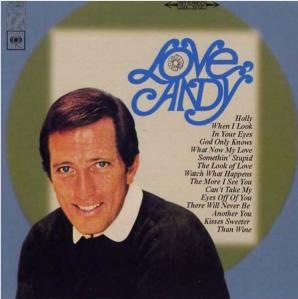
Andy WILLIAMS: Love, Andy


 (#55: 15 June 1968, 1 week)

Track listing: Somethin’ Stupid/Watch What Happens/The Look Of Love/What Now My Love/Can’t Take My Eyes Off You/Kisses Sweeter Than Wine/Holly/When I Look In Your Eyes/The More I See You/There Will Never Be Another You/God Only Knows

“With the sun and the sea and the sky she remains”
(“Holly”)

Following a period of violent, vivid destruction there must always come peaceful, or at the very least quiet, reconstruction. Both the I-Ching and the Bible speak of water, steadily accumulating to form a flood, sweeping away the world that had previously and presumptuously been built upon it, leaving an ocean, a liquidity, for its inhabitants to start again. Similarly there has long been philosophical, psychological and theological talk about man’s love of and need for water, man’s inherent desire to begin again, to return to the waters of the womb which they once inhabited.

Were some such distant shore ever to materialise after anyone’s apocalypse its sound might not be dissimilar to Love, Andy. Few albums are so concerned with the eyes as primary means of communication within the love song; five of its titles make that explicit, not least “The Look Of Love.” But there is also the feel of a Ballardian terminal beach, the great wave patiently waiting to engorge it with a new, terrifying but liberating fullness. A feeling that the singer’s love must encompass, and eventually form, the whole world.

It has always been apparent that Andy Williams is not quite one of our everyday, amiable crooners. An early giveaway was his dubbing of Lauren Bacall’s singing voice in To Have And Have Not, but his voice has, if anything, always projected an asexual, rather than a specifically androgynous, spirit, somehow above the everyday cares of the planet it inhabits. Compare the great, brassy and percussive thrust and barely concealed sexual craving of Frankie Valli’s “Can’t Take My Eyes Off You” with the smooth patience of Andy’s, its daubed echoes of Sportsnight With Coleman brass, lithesome alto sax and subtle, undulating undertow of reeds offering perspectives reminiscent of another Andy W. He is simultaneously connected and detached.

Side one passes by relatively peacefully in the manner of the standard late sixties album of easy listening slow jams, designed to be played late at night to one’s hoped paramour with a diplomatic drink and tactfully lessened lights, and Andy’s lounge is undoubtedly an enticing one. Still, even from his opening reading of “Somethin’ Stupid” it is clear that this is not going to be a straightforward record; Nick DeCaro’s arrangement is very different from the double-headed Sinatra original, its opening flutters of Claude Thornhill reeds and woodwind easing into smooth 1967 strings. Both pace and performance could have come from an old school (or old Palais) dance band, the odd contemporary flight of flute notwithstanding, but the harmonic differences with the original are subtle and telling; no chordal diminution before “And then I go and spoil it all” but there is a lovely minor augmentation on the “before” which closes the middle eight. A choir steals in unobtrusively, a melancholy trumpet wanders through the melody like a regretful, decommissioned Army colonel, and banks of trumpets and trombones sigh in breathy concordance. One modest key change takes the song out into its wider drift.

With “Watch What Happens,” Legrand’s tune from Les Parapluies de Cherbourg, a strange but serene spaciousness begins to become apparent; the same moody trumpeter (the sleeve offers no clue to their identity, but here the trumpeter sounds far closer to Bunny Berigan than Herb Alpert) opens up the song, allowing Williams to ski over the elegant titular major-minor-major arch. A tenor sax distantly buffers the infinitesimal breeze and the general bossa nova glide reminds us of the new sense of space which Jobim and his Tropicalia successors brought to the picture of pop throughout this decade; the Sinatra/Jobim 1967 collaboration is required supplementary hearing here. Following a slightly awkward edit to accommodate another key change, Williams effortlessly covers the gap with one of many extraordinary, unbroken slow-motion yodels to his highest achievable register, without once using falsetto, and transcending matters of gender and notions of earth.

His “The Look Of Love” – also covered not long thereafter by Scott Walker, on the latter’s Scott Sings Songs From His TV Series – commences with a stately brass chorale. Again, Williams’ voice seems to float in a sense of gravity different from but compatible with the song, anchored by the slightly assertive brass figures which appear in the choruses. But his “Don’t ever go” blends seamlessly into a high string figure before the song pauses, and he offers three “I love you so”s as both voice and strings mesh into stasis, momentarily start again in cumulonimbi of doubt and the alto reappears as everything fades into strings so static they could almost be synthesisers.

“What Now My Love” is taken against a fingersnapping chain gang rhythm with emphatic guitar/bass/bass drum thumps and tweaks decorating Williams’ increasingly dissolute vocal (“I feel…closing around me”). With his “There’s the sky” he seems to be swallowed by the strings before he can utter “…where sea should be.” There are brass blasts from the next galaxy, the flute again, and then Williams’ double-tracked harmonies come into being. The song finally dissolves into inchoate murmurs in the aether, barely exists beyond end horizon. This record is not quite what it presents itself as being.

The side ends with “Kisses Sweeter Than Wine”; the same easy swing tempo as “What Now My Love” but a two-bass, octave-leaping figure which almost certainly owes something to Gil Evans’ “Las Vegas Tango” is a sturdier buoy. The song moves into straightforward swing for its choruses, but throughout, with the tune’s endlessly ascending key changes, Williams again seems somewhat detached from the life of the self that he is describing (“She had…mmmmm….kisses sweeter than wine” he hums, as if consuming his own life slightly faster than he is living it). The double-tracked vocals reappear in the third verse, the increasingly icy high strings in the fourth. The alto sax takes us out of side one, accompanied by a curiously Cale-esque clanging piano. The feeling begins to be engendered that if Brian Eno were producing an Andy Williams album it would not sound dissimilar to this.

Little of this, however, prepares us for the astonishing second side, during which Williams appears ready to leave this world altogether. “Holly” was written by one Craig Smith, then of the folk-rock group The Penny Arkade; he subsequently drifted off to India and to drugs, and when he came back in the early seventies it was as Maitreya Kali, under which name he produced a couple of highly disturbing albums whose chill spirits owe more to Manson than Roky Erickson before he drifted off into complete obscurity. Williams’ reading of “Holly” with its peaceful, patient acoustic guitar balanced by busier electric one-note picking certainly radiates something of the mystical, this “Holly” enters his mind but it’s no longer clear whether Holly is a woman or simply (simply?) a state of a disturbed mind. “With the sun and the sea and the sky she remains” Williams sings as the song and arrangement crescendo behind him before settling down again into unsettled pacific blues. With the closing proto-Echoplex guitar figures he appears to disappear from the landscape.

“When I Look In Your Eyes” is a song and performance so exceptional one forgets that it comes from Doctor Doolittle; a beautiful song whose aches – first accompanied by piano alone, then (in the second verse) by sympathetic strings – link Williams with Walker. His increasingly enlarging statements – “I see the deepness of the sea,” “Autumn comes, summer dies” – are sung in a manner so similar to Scott that it’s uncanny and the high voice/strings unison ending cries like a butterfly about to fall off the edge of the globe.

Williams then returns slightly closer to Earth with his radically altered readings of Chris Montez’ two radically altered readings of Mack Gordon and Harry Warren. In contrast to the cheerful claps and vibraharps of Montez, his “The More I See You” is taken as a slow, bluesy drift. There is a stunning moment where Williams’ sigh expirates and strings instinctively enter, anticipating the chord changes to come. An alto flute dolphin skates atop the beach-kissing surface, and those long, sustained, vibratoless notes at the song’s end would not be out of place on Eno’s Ambient 4: On Land. “There Will Never Be Another You” is more solidly swinging with uncomplicated 4/4 beats, seductive strings and a rather cheesy organ solo, but its momentary return to inspect the lounge is deceptive.

Because Williams’ reading of “God Only Knows” makes him a God. With Williams and Walker – which came first, Ohio or Iowa? – and with Love, Andy and Scott 2 in particular, the parallels and contrasts are now clear. Scott 2 began with wanting to be God and ended by being content to be loved. Whereas Love, Andy begins with smelling her perfume and thinking that being loved would be a nice idea, and ends….by sitting with God. It’s not entirely clear to whom Andy is actually singing “I may not always love you” or “So what good would living do me?” – and the album’s subtle passage from a song written by Carson Parks to a song associated with, if not strictly speaking written by, Van Dyke Parks should also be noted – but let’s consider; he wants the girl, gets her, loses her, immediately starts seeing someone else…but as side one becomes side two, the concept of Other becomes abstract; she’s still there, but far away, and maybe only a mirage. In finality the singer becomes the whole world, his love has to encompass the ocean and the sky, become the world – is Love, Andy a disguised religious album? – or at the very merest addresses the world. Williams sings “God Only Knows” – a song its author considered so holy that he encouraged his brother to pray before singing it – out of tempo, with Lincoln Mayorga’s majestic piano suddenly accelerating into a world-engulfing cathedral of strings and woodwind, screaming out its crescendi before dying down to a chimera of chiming bells and French horn foghorns. Huge, warm (if slightly chilly at times) and embracing, Love, Andy sees the pearly dewdrops’ drops coming on the horizon, constructs its own song to sing to all reigning sirens.

Tuesday, 8 September 2009

Scott WALKER: Scott 2


 (#54: 18 May 1968, 1 week)

Track listing: Jackie/Best Of Both Worlds/Black Sheep Boy/The Amorous Humphrey Plugg/Next/The Girls From The Streets/Plastic Palace People/Wait Until Dark/The Girls And The Dogs/Windows Of The World/The Bridge/Come Next Spring

“As a single balloon must stand for a lifetime of thinking about balloons, so each citizen expressed, in the attitude he chose, a complex of attitudes…And so, while this man was thinking sullied, still there was an admixture of pleasurable cognition in his thinking, struggling with the original perception.”
(Donald Barthelme, “The Balloon,” from the short story collection Unspeakable Practices, Unnatural Acts, 1968)

“All they ask is where I’ve been/Knowing I’ve been West.”
(Tim Hardin, “Black Sheep Boy”)

Scott 2 stands alone in this gallery of 1968 number one albums, as alone as its creator perhaps always intended it to be. A radically different concept of the Worried Man from that of Dylan’s, and one possibly more attuned to that period’s other American viewing Britain through lovingly jaded eyes, Patrick McGoohan, the record has little in common with any of the other trends which this year covers – no particular connection with folk-rock, certainly none with what was left of the British beat boom, not much concretely to do with soul music and, despite the preponderance of cover versions and the rich orchestrations of Wally Stott, Reg Guest and Peter Knight, absolutely nothing in common with “easy listening”; Val Doonican was not apt to interrupt his musings on loneliness – never to be confused with Walker’s loneness – with reflections on “wine and piss,” as Walker does on “The Bridge.”

Yet no other number one album of its year has more in common with Sgt Pepper, and in particular its insistence upon the value of childhood and maybe even “second childishness.” Throughout these dozen songs, children and angels recur again and again – foreseeing the inevitable union of “Boy Child” on Scott 4 some 18 months later – and while the three Brel songs do not mention children at all, Walker cannot hide his childish glee at singing them; as with the startling, red meter-demolishing reading of “Mathilda” which commenced 1967’s debut Scott; suddenly he sounds shed of his lonely 1966 cloak, freed of the need to cater to all needs (or so he thought) – through his childishness he attains adulthood. And it ought not to be forgotten, the talk of Isle of Wight monasteries and moonlit flits to and from Fulham notwithstanding, that Walker was introduced to Brel’s work by a girlfriend he met one night at the Playboy Club. “Jackie” is one of the most cheerful demolitions of a teen idol’s own status ever to commence an album; banned by the BBC (despite Walker’s come-on tongue twisting of the phrase “authentic queers and phoney virgins”), he towers joyous, prepared to rule the world and even be its God, as long as he can hang on to that thing he once had, the time they called him something else, something shorter. That having been said, he doesn’t seem particularly keen on inhabiting any world he might come to rule (“’cause down below is really nowhere,” he smirks in the final verse).

Even the selection of standards seems to reflect and comment upon his renewed status; his record company did not yet feel confident about letting Walker loose on a whole album of self-penned songs and still wanted him to keep one foot pitched in the All-Round Entertainer camp (hence, amongst other things, his very moving reading of Tony Hatch’s “Joanna,” complete with characteristic Walker lyric rewrites, which made the top ten singles chart that summer and does not appear on any of his studio albums). Perhaps they had heeded the warnings posed by those Walker Brothers camouflage tracks and knew that this was a man who was doomed not to be argued with – the flugelhorn which introduces 1966’s “Oedipus” is the same one (Derek Watkins) which traces the cancerous smoke through 2006’s “Cue,” the chains which drag down 1965’s “Archangel” recur on Ute Lemper’s “Lulla-bye (Bye Bye)” four decades later.

“Best Of Both Worlds,” on the face of it a standard “him or me” MoR chestbeater – it was also recorded by Lulu but sounds as though Shirley Bassey were waiting to sing it – seems here more a comment on how Walker felt he was being perceived, simultaneously wanting to be a pop star and a closet experimentalist. His “Make your fickle mind up” is answered by a furious fusillade of French horns; he snarls the “take” of “Take your new lover” with an unanticipated ferocity (and his drawled “enjoy”s suggest a more threatening PJ Proby). Whereas this American never sounds more American than on his carefully casual reading of Hardin’s “Black Sheep Boy,” although again the arrangement comments on his self-destructive tendencies, with its unusually emphatic tambourine and the shrugged shoulder of strings which greets his singing of the title.

Abruptly, however, comes the undiluted Scott Engel. Humphrey Plugg was apparently an American cartoon and/or comic strip character from the thirties, although I could find nothing on the internet or elsewhere to confirm this; certainly “The Amorous Humphrey Plugg” could have been conceived and performed nowhere except in Britain. Brass, strings and even accordion and mandolin now float in Poussinesque slow motion, as though underwater, weighed down by the impossible demands of the protagonist’s island; he comes home, presumably late from the pub (“Every night with the boys”) and, slightly pissed, slips on the kitchen floor his wife has just waxed, concusses himself and imagines himself greater than his world, exceeding himself (“I’ve become a giant”). He reflects that he would be quite happy to die at this moment “in nine angels’ arms” (as the tubular bells toll and the French horn foghorn blows, Leonard Woolf-like), away from the banal – his contemptuous “and the TELLY” hisses like a sutured scythe – but as he takes his throne with the Muses, “Doreen of the candles” summons him back (“You’re all right now”), and this would-be Reginald Perrin returns with some reluctance to his “enchanting way.” Change the world once you’ve sorted out the tax returns and the gas bill. The underlying dream, however, cannot be ignored (“Why the hell should I care?”).

Although, as I have said, childhood as such plays no part in the Brel readings, “Next” materialises like a child forever condemned to be afraid of adulthood, with its shovelling in of prostitutes with far deadlier queues. One of two songs from this year and in this tale which would benefit from subsequent, earthier readings by the late Alex Harvey, Walker starts his “Next” relatively camp, as though revelling in the notion of boy band brigadier singing about gonorrhoea and queer lieutenants, before switching dramatically in the final “And the naked and the dead” verse into his more familiar, apocalypse-anticipating severity, such that concentration camps rather than mobile Army whorehouses are brought to mind. In “Jackie” he imagines his godlike self struck deaf, dumb and blind by pity; now he is prepared to cut his legs off and burn himself alive just to avoid intimate contact with another human being.

“The Girls From The Streets,” Walker’s most overt attempt to “do Brel,” finds him still in two minds. The deliberately leaden procession of the verses, combined with words like “Snap! The waiters animate, luxuriate like planets whirling ‘round the sun,” suggest a predication of Gary Numan, but the transition into the choruses sounds a little forced and its hideous Light Programme backing singers and accordion are more in keeping with Benny Hill avec comedy beret; it tries to be greater, more ambitious, than Brel, but Walker hasn’t yet worked out how to pull it off.

Then, at the beginning of side two, Walker suddenly pulls pop off. “Plastic Palace People” offers the record’s first real hint of the tilting and drifting to come; dreamy high strings and harp sees “Billy” soaring over the rooftops, an impatient child waiting in the gathering night back down on the ground pleading, demanding, that he “come down from there.” So far, a Mary Poppins fantasy, but then the waltz stops, a 4/4 guitar and tambourine enter, and Walker solemnly declaims, as though having crept right inside our head, “PLASTIC PALACE PEOPLE,” singing about Alice, too big to crawl into her desired world, too small to get back into the real one, about predestined fate – and then the song moves into a different waltz, a distorted (Leslie cabinet plus delayed automatic double tracking on Walker’s voice) mask of horror – “the whole eternal life” sounding like an irrevocable banishment to Hell as three glockenspiel notes awaken us back to what may or may not be nocturnal reality. The song then moves through the same motions, but the stakes are higher (“My mother weeps and weaves her hair” – so why doesn’t he just go home? And why can’t “Billy” come down?) and the horrors when the distortion recurs all the greater: “They’re laughing in the halls/They rip your face with lies,” and the ambition is turned to slaughter. Walker's hideously refracted echoes of "You cry for help" echo, of all people, the still trapped Presley of "Heartbreak Hotel," and also look forward to 2006's more explicit homage "Jesse."

The clouds and the altitude finally cause Billy – who is, after all, only a balloon – to burst; with posthumous melancholy he comes down to “morning square” (or should that be “mourning”?), and, in Walker’s most defeated tones, ends up “just hanging there” – a pause to check for final signs of life – “just hanging there.” Then the strings and harp themselves become distorted, an abstract mistral of synthesised discord to underline this tale of Icarus in negative; the boy on the ground, afraid to let go of his childhood, the ambitious adolescent in the air, ready to be shot down at the slightest provocation – by drugs, by lies, by “The Land Of Make Believe” (and “Plastic Palace People” has much in common with that doom-laying 1981 chart-topper). It may well be, as Lena suggested, that the whole of Scott 2 takes place in this one square – as indeed the stories of Scott 3 and the bulk of ‘Til The Band Comes In were concentrated on one block of flats – but indeed it may well all be taking place in the mind of the same person, and that person may well be Scott Walker (though we should always be wary of making the elementary mistake of definitively confusing the artist with the subjects of his art). Or else we think of this balloon as covering the cloisters of the city which the writer chooses to inhabit; it can petrify, inspire awe, make its observers curious or resentful.

Mancini's "Wait Until Dark" appears to provide an artful line back to "normality" - "a cheerless day may bring us little dreams" contrasting with the preceding multiplying nights of the balloon - but even this song is taken from the 1967 film of a murder thriller starring a blinded Audrey Hepburn (as "Suzy Hendrix"), such that Walker's titular enticements adopt a tone of menace; the plot turns on a stash of heroin hidden in a doll, which in itself could sum up the subsequent four decades of Walker work. The concluding waterfall of strings and acoustic guitar plunge into an eddying Hades.

"The Girls And The Dogs" is the third and most uncomplicatedly cheerful of the album's Brel readings, and the last occasion on the album where Walker appears to be having fun; essentially a sprechtesang list song of the "can't live with 'em, can't live without 'em" variety, the singer's alternating tones of bemusedness, fake boldness and palpable self-pity point directly to Billy MacKenzie's - did someone sing something about a doomed "Billy" soaring over the rooftops before bursting? - performance on the Associates' "It's Better This Way."

Then Bacharach and David's "Windows Of The World," a gentle reminder of the times in which this record existed. The record's two main thematic axes, children and angels (as the Brel and Brel-derived songs demonstrate, angels are sometimes barely distinguishable from devils but both are capable of crying "angels' tears" disguised as rain), are subtly united here; the rolling marimba and long, rhetorical pauses between verses serve to rack up the tension as Walker slowly moves from personal reflection to the rain which in 1968 seemed to be drowning the world (see also Fogerty's subsequent "Who'll Stop The Rain?"). "Let the sunshine through," sings Walker with infinite patience - although at the time of Scott 2 he was actually busy coordinating the UK branch of the Democrats Abroad campaign for votes to secure Robert Kennedy's nomination - and the high string unison which concludes the piece seems to suggest the intrusion of rays.

"The Bridge" is the album's last Walker original, and perhaps the most enigmatic (and certainly the quietest); on the face of it, he is looking out at a bridge which he is already personifying as a woman, mournful with memories of his Madelaine. White doves combine with cobblestone-staining sailors as Walker views the aftermath of this high Brelian life; the world has moved on, and so has Madelaine, but he hasn't - and by his bitter recollections of a more sinister departure ("Before the bottle dulled my eyes/And made me so I couldn't stand"), he reveals himself as an incurable exile; did he send Madelaine away by force, or did she simply drift off, without ever noticing or even remembering him? Lyrically the sequence and expression of the imagery owe a great deal to that seldom-cited influence on Walker's work, Leonard Cohen, but without the winking get-out clause; one feels that he would be the ideal subject of "Dress Rehearsal Rag."

But not everything is quite lost. "Come Next Spring" is a cathartic closer, Walker, the man who at the start of this record loudly wanted to rule the world and be God, now serenely accepts that all he wants is to be loved, by just the one person (not counting himself). In any other 1968 crooner's hands this would be a sentimental Cinemascope finale, but Walker's hopes remain by definition autumnal; he looks forward to a fresher, clearer year to dawn, he surrenders to his own vulnerability, wants to be touched and held and kissed again; unlike the dead eyes which ripped through the previous album's "Always Coming Back To You," he is now prepared to offer himself a happy ending; the iceberg created by the furrowed frost of "Such A Small Love" displays signs of melting - and since then he has continued to look for that happy ending, even if it means an unanswerable loneness, perhaps beyond life itself ("The Electrician"), or simply leaving everyone and everything else behind ("Blanket Roll Blues"), admitting "I gotta quit" at the end of Tilt, finally acknowledging Dylan's notion of the lonely room - although 1968 has already seen three of these, Walker's will turn out to be the loneliest and most alienated - in 1996's reading of "I Threw It All Away," through to the pestering but conclusive whisper of "It's OK" he gives himself at the end of The Drift. His is one of the greatest careers this tale has to tell, and also, by automatic association, the most confounding; almost alone of the subjects of this story, he has constructed his own path, defined his own parameters, defied logical gravity such that we are led to think that it is we who don't know our left foot from our right - and he is usually right.

"But it is wrong to speak of 'situations,' implying sets of circumstances leading to some resolution, some escape of tension; there were no situations, simply the balloon hanging there -- muted heavy grays and browns for the most part, contrasting with the walnut and soft yellows. A deliberate lack of finish, enhanced by skillful installation, gave the surface a rough, forgotten quality; sliding weights on the inside, carefully adjusted, anchored the great, vari-shaped mass at a number of points. Now we have had a flood of original ideas in all media, works of singular beauty as well as significant milestones in the history of inflation, but at that moment, there was only this balloon, concrete particular, hanging there."
(Barthelme, op cit)

Tuesday, 1 September 2009

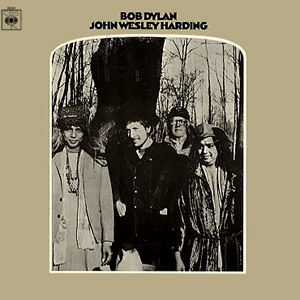
Bob DYLAN: John Wesley Harding


(#53: 9 March 1968, 10 weeks; 25 May 1968, 3 weeks)

Track listing: John Wesley Harding/As I Went Out One Morning/I Dreamed I Saw St Augustine/All Along The Watchtower/The Ballad Of Frankie Lee And Judas Priest/Drifter’s Escape/Dear Landlord/I Am A Lonesome Hobo/I Pity The Poor Immigrant/The Wicked Messenger/Down Along The Cove/I’ll Be Your Baby Tonight

“An avidity to punish is always dangerous to liberty. It leads men to stretch, to misinterpret, and to misapply even the best of laws. He that would make his own liberty secure must guard even his enemy from oppression; for if he violates this duty he establishes a precedent that will reach to himself.”
(Thomas Paine, Dissertations on First Principles of Government, 1795)

Although most think of it as a 1968 album, John Wesley Harding appeared in the record racks on 27 December 1967. There were many who could have justifiably laid that year to rest by having the last word on it but Dylan’s was the most avidly awaited and the least noticed or expected. The album sneaked out less than a month after the recording sessions had ended; Dylan was keen on there being no hype, for the work simply to materialise.

There were, as I said, a few other “last words” appended to 1967; Wild Honey saw the Beach Boys getting back to basics in a far more pragmatic way (because driven by necessity). Love’s Forever Changes sees its world dying and only gradually clears its mind as to what kind of new world it wants to replace it. Meanwhile, the Velvet Underground’s White Light/White Heat was as violent a repudiation of what 1967 stood for, or was supposed to stand for, as anything released by Engelbert Humperdinck; throughout “Sister Ray,” Reed and Cale meticulously pull apart every last atom of bubblegum to reveal an awful new dawn.

John Wesley Harding, however, became recognised,, and was prominent in a year from which its creator was otherwise largely absent. Note that the record stayed on top in the UK for some three months – interrupted for one week only by entry #54 - and that this run covered the period of the Paris riots, the King and Kennedy assassinations, the worsening of the Vietnam situation, the gradual return of Nixon. Clearly, 1968 was turning out to be the gruesome antithesis to everything 1967 had promised, and it was therefore the case that this album was needed – it spoke to a community which painfully needed to be reassured. True, May 1968 also saw the gleeful autodestructing fusillades of Mantler’s Communications – three of its five pieces were taped that month - and Brötzmann’s Machine Gun, but security was needed in tandem with revolutionary urges.

In particular, John Wesley Harding recognises that revolution has no point or purpose if, in its ashes, we cannot recognise and acknowledge our friends and neighbours. Sgt Pepper was all about community, but the stage remained raised. In contrast, Dylan spent most of 1967 laid low in Woodstock, with the band who would eventually become The Band, hanging out, making music and writing songs for its and their own sakes; he also became a father that year, and this all combined to a clarification – if not a simplification – of his aesthetic world view.

It is virtually impossible to speak of the album without reference to the (predominantly) Canadian group who, by finding and forming their own true identity, helped to identify a way out; not quite a third way, but the way 1967 had always intended. Music From Big Pink only peaked at #30 in the States and didn’t chart at all in Britain; nonetheless, its example subtly permeated most of the worthwhile music which would emerge from the remainder of its decade. With the partial exception of Levon Helm, the Band had accompanied Dylan through his most turbulent and ecstatic music and indeed had enabled it; the surge of excitable, righteous noise which constitutes the electric half of the 1966 “Albert Hall” concert retains a power second to few, if any, of its peers or successors. But one can only scream for so long before becoming hoarse, and before long both Dylan and the Band were looking for something else – namely, who and what they really were, what it meant to be “together” in 1967, how that could be perpetrated and extended into a meaningful future. Throughout The Basement Tapes the fun in music-making seems much more high than chill, since the intent was to help create, or at any rate suggest, a new notion of society. It’s arguable that John Wesley Harding was the most literal, and also the most serious – because, finally, it was the most lighthearted – interpretation of the Pepper message. The screams of post-Highway 61/Blonde On Blonde surrealism could only end up entangling themselves in their own constructs, as Lennon smartly demonstrated towards the end of 1967 on “I Am The Walrus,” the nearest aural equivalent of an artist’s brain exploding. You’ve turned the tables over, now what food do you propose to serve from them?

Music From Big Pink demonstrated, just as John Wesley Harding does, how much the Band and Dylan had learned from the Woodstock sessions; “Tears Of Rage” remains the most startling (because so unexpected – a ballad?) beginning to any 1968 “rock” album, and despite the appearances of 19th century revivalism, side two (from “We Can Talk” onwards) is as musically radical (but not in a spell-it-out, exhibitionist sense) as anything released in that year. It is the sound of a decade-old group getting inside itself and, by doing so, exceeding its own expectations, as well as inventing, not so much a new language, but a new perspective on the old language. Adult music without the oppression of adulthood to weigh its boots down, but by no means divorced from pop (Robbie Robertson knew his Curtis Mayfield licks all right in 1968).

Likewise, some still speak of the Dylan of John Wesley Harding as a savage repudiator of his own recent pop past, and even now people are saying similar things about Manafon, David Sylvian’s new album, with its opening gambit of a placid wrecking ball smashing down the false idols of a quarter-century’s misplaced trust. But I’m not so sure that either record – each about different perspectives of an individual as projections of the artists themselves, be it a 19th century American outlaw or the 20th century Welsh radical poet RS Thomas (who, as Sylvian notes with a smiling sadness on the album’s titular closing track, could be so purist that he ended up “not knowing his left foot from his right”) – could exist without a keen awareness and underlying love of pop. Both Highway 61 Revisited and Blonde On Blonde – both top five albums, but not number ones, in the UK – had erected a wall of nowness which was unbreachable and vital. But although Dylan pared his poetic language down – relatively - for John Wesley Harding and simplified the music (in terms of participants and arrangements, if not activity or inventiveness) considerably, the dozen songs here are hardly less radical than those of their two predecessors. If you choose to judge the record by its bare-boned bass/drums accompaniment and its procession of simple, parable homilies alone then it will seem less obviously radical than 61 or Blonde. The way Dylan sings and plays these songs, however, the spaces between his thoughts, between expression and fulfilment – these suggest that the adventure had simply been channelled into subtler waters.

The album was recorded over three sessions in Nashville with stalwarts Kenny Buttrey on drums and Charlie McCoy on bass – Dylan briefly considered calling in Robbie Robertson and Garth Hudson for some overdubs but both parties agreed that the songs were fine enough as they stood – and the opening title track, like so many of these albums under consideration, provides the key for the rest of the record; here is a straightforward song about a less than straightforward man who formed his own Robin Hood path to righteous redistribution. He never gets caught or nailed down, he helps those who deserve to be helped, and in particular he serves whatever community he finds himself inhabiting, even bringing multiple communities together by his peculiar example (“All along the telegraph/His name it did resound”). Johnny Cash would have recognised the air in an instant, and Buttrey and McCoy tick unobtrusively behind Dylan’s voice, guitar and harmonica until, alerted by a change in intensity in the vocals (on the line “To lend a helping hand”) and the electrifying intrusion of Dylan’s harmonica, Buttrey’s drums suddenly stir and become busy (and yet again provide an unlikely precedent for drum n’ bass); they too are breaking their bonds. This is the landscape against which Dylan’s dramas are played out, the land through which he himself – if he fancies himself as Harding – is travelling and from which he is reporting back his findings.

So he wanders out one morning, this worried man, sees a statue of Thomas Paine somewhere and gets to thinking, to the tune of a medieval lay; all of a sudden this girl in chains runs up to him, asking for unity, pleading to fly South – to the land of the oppressors? But the marbled example of Paine, rather than the true memory or material of the man himself, refutes her on his behalf, tears her away with the fateful avidity to punish that scars his would-be disciples. Dylan’s hurt arc of “as she was letting GO-O-O” speaks tears of its own forfeited heaven.

Comfort is very far away at this point. The worried man – where are those directions home? – has visions of the victimised monk, who growls “Go your way accordingly, and know you’re not alone” (we’ll get back to that “you’re not alone” much later on in this tale), and then imagines himself as one of his killers. Dylan’s concluding, devastated “and bowed my head and cried” was as excoriating a cry as any to be heard from the more easily excitable quarters of 1968.

“There must be some kind of way out of here,” he then tries to reassure us, to a fast, sprightly but disturbed beat which puts me in mind of the Four Tops, as he summons up and surveys the impending apocalypse. “Life is but a joke,” he sings, unconsciously (or not) echoing the Supremes’ “Is this game of life a mistake?” As his wind begins to howl – and his wildcat as terrifying a dead end as any black dog Johnson or Drake might have encountered – his harmonica honks and howls aridly, like a dessicated Pharaoh Sanders. Hendrix only needed to increase the tempo slightly, change the rhythmic accents, volumise his grief and impose three crucial worlds of mourning guitars upon its jigsaw to switch the lights on for an electrified world’s end – and, as Dylan and the Band would play it a few years and several lifetimes later on the Before The Flood collection, “Watchtower” can still come across as the last song issuing from a burned Earth.

This apocalypse, however, is recognisably the same one through which the narrator of “A Hard Rain” once travelled, and we know that he has simply continued his travels through the fire and the flood; John Wesley Harding could be interpreted as his most fulsome bulletin. “Frankie Lee And Judas Priest” bounds along joyfully on its trampolining rap for nearly six minutes – “With a soulful, bounding LEAP!” – with its fairly simple analogies; don’t mistake paradise for eternity, let alone the other man’s grass, but at the same time don’t imagine that you can get through this hellish world alone in order to make it heavenly. But Dylan makes the choices as icy and unavoidable as those offered to the hapless knight in Walker’s “The Seventh Seal,” and again his harmonica – John Wesley Harding offers much of Dylan’s bluntest and most passionate harmonica playing – seems to shred souls to the dimensions of shrunken early spring morning icicles. Side one concludes with Dylan’s most tortured vocal on the record: “Drifter’s Escape” sees his unwilling accused in near-indescribable worry (“Oh, help me in my weakness!” he numbly screams in a vacant lot of a falsetto at the song’s beginning) before his court is destroyed by a lightning bolt and, while everyone else kneels down to pray, he flees (knowing that this is “ten times worse” than any “trial”). Note how McCoy’s bass mimics the judge’s gavel at key points in the song and how, as the drifter (or Number 6, since the scenario is strikingly similar to that of “Fall Out”) escapes, so does his bass begin to roam free and breathe.

While the country influences on John Wesley Harding have long since been accentuated, the deep soul input is rarely summoned to anyone’s attention; “Dear Landlord,” however, has an arrangement which could have come straight out of Otis Redding, its considered piano duelling with McCoy’s emphatic, repeated high A bass notes (particularly noticeable on the phrase “beyond control”). The operatic midtempo setting also suggests the barren walls of James Carr, although Dylan’s pleas for understanding and tolerance to his mother nation are more in keeping, vocally, with John Lennon.

But what if the nation rejects its son anyway? On “Dear Landlord” the worried man begs for entry and acceptance, but on “I Am A Lonesome Hobo” he’s still trying to find his roots; he’s tried everything (bad) and gotten nowhere (fast) – as with all the other misguided perpetrators we meet on this record (if they are not all reflections of the narrator himself), he has found no joy or permanence in material things, but still knows enough to warn the rest of us not to end up like him, not to be crucified by “petty jealousies.” As though to ram the point home, his atonal harmonica crackles into the picture like fugitive Mary Chain feedback.

On “I Pity The Poor Immigrant,” however, the harmonica takes on the solemn, stately confidence of a church organ as Dylan demonstrates Paine-like compassion for the outsider who comes in to wreck the world – an allusion to Vietnam? As with “A Day In The Life,” he’s artful enough not to need to spell it out – but who ultimately only ends up destroying himself, the man who mistook Paradise for the nation across the sea, who can make nothing save foolish moves. Again there is the emphasis on rejecting the material – “Who falls in love with wealth himself/And turns his back on me” – and the nothingness to which this abject worship will, in anyone’s end, lead him. Pity for the enemy? Was this allowed in the 1968 of beaches underlying pavements? Dylan’s narrator has less time for serial complainants; “The Wicked Messenger” is only wicked by (anti-)virtue of his ceaseless, self-directed whining, and by the time his exhausted audience inform him, “If ye cannot bring good news, then don’t bring any,” he unaccountably finds that these words have “opened up his heart” – and so the album, finally, opens up to admit humanity and love.

And Pete Drake. The first noticeable thing about “Down Along The Cove” – other than how much it resembles a mid-period Elvis movie theme tune – is a fourth voice we haven’t heard before, that of a pedal steel, and since the song’s theme is summed up by the refrain “I spied my true love comin’ my way,” the precise antithesis to the stony rejection of “As I Walked Out One Morning,” it is apt that this new voice should speak in tones feminine. Here the man begins not to be worried, and finally discovers the life he surely knew was his for having all along, realises the joy in settling, in neighbourliness and companionship as well as love. “Ev’rybody watchin’ us go by,” exclaims Dylan, “knows we’re in love – YES – and they understand.” And all of a sudden the Edmund Spenser language and the multiple Old Testament references retreat into the background; this is life, this is nowness, this is how 1967 really intended and desired humanity to be.

Drake is there, too, for the home on the range, sunset on the prairie, finale, “I’ll Be Your Baby Tonight,” skiing tracks of elision carefully (but caressingly) under Dylan’s Hank Williams (or Slim Whitman?) semi-yodel (in the phrase “mocking bird”). The wanderer recognises his heart as happy – “bring that bottle over here” – and his world never warmer, but with the glow of heaven rather than the fires of hell. The happy ending “A Day In The Life” deserved, and 1968’s deserved - and most necessary - chart champion, which established a precedent which reached far beyond its begetter.

Monday, 24 August 2009

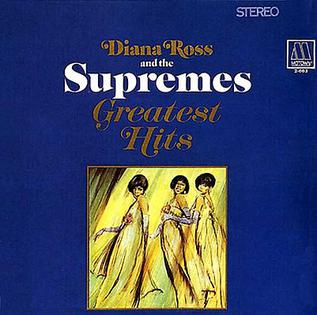
Diana ROSS and The SUPREMES: Greatest Hits


(#52: 17 February 1968, 3 weeks)

Track listing: Stop! In The Name Of Love/Nothing But Heartaches/When The Lovelight Starts Shining Thru His Eyes/My World Is Empty Without You/Where Did Our Love Go/Love Is Like An Itching In My Heart/Come See About Me/I Hear A Symphony/Reflections/Back In My Arms Again/You Keep Me Hanging On/Whisper You Love Me Boy/The Happening/Love Is Here And Now You’re Gone/You Can’t Hurry Love/Baby Love

Now we get the other side of the story, but also, and more importantly (and far too belatedly), the first all-female number one album. How does it feel when a man doesn’t love a woman, and moreover uses her as a willing doormat? When we listen to the Four Tops there is no doubt that Levi Stubbs loves the woman who will never love him back; his dolorous protests are Technicolor, raging, steadfast. But when we listen to the Supremes we do not hear such howls. Diana Ross has never had the broad power to her voice that someone like Martha Reeves has – so the Supremes could never have done, for example, “Nowhere To Run.” As the mounting anger of “You Keep Me Hanging on” demonstrates, she is more than capable of expressing reasonably passionate displeasure.

Mostly, however, Ross insinuates. Don’t knock it; insinuation is one of her deadliest and most effective weapons. She teases ultimata, purrs threats and caresses confessions out of sinning partners. Her various “ooh”s more indicative of triumph than submission. Even though all bar (in part) one of these sixteen songs was written by the same team responsible for the Four Tops’ central body of work, the Supremes’ feminisation of the Tops’ noise has proved durable and subtly potent, even if there isn’t the same “group” feel to the Supremes’ work as there is to the Tops; rather than four righteous horseman riding in the face of personal apocalypse, Ross and the Supremes are rather like three girls chatting at a ‘bus stop, one monopolising the conversation with her monologue of despair while the other two absentmindedly concur – those deeply unsettling, deadpan-verging-on-robotic “Baby, baby”s all the way through “Where Did Our Love Go” – while they powder their noses and polish up their lips, going along with her but not really listening.

As with the Four Tops collection, the songs here are assembled in commonsensical rather than chronological order. Dave Godin knew that any compilation of songs worth compiling had to tell a story, even if he had to make one up. The key song here is, for the third consecutive week, the opening one: the enormous swirl which whiplashes “Stop! In The Name Of Love” into existence is one of the great black pop intros that side of Chic’s “Good Times” (and the intro to the latter owes almost everything to it, even as its blast escorts it into the future). Here there is no overt evidence that Ross’ man is actually going off with this other girl; her paranoia is as radiantly rationalist as that of Stubbs’ on “Bernadette” but expressed in a radically more controlled manner. She wonders if “her sweet expression” is “worth more than my love and affection” – in other words, does the look of love supersede the reality of love? Both Mary Wilson and Florence Ballard are actively involved here, too; their shouts and cajoles forceful and dynamic, lively in a way which only resurfaces intermittently throughout the remainder of the record. The spectacle turns into one of an extended dream, inspired by Ross’ paranoia, where she imagines every possible and impossible betrayal scenario in her head.

In “Nothing But Heartaches” Ross reflects on how she loves him but how he can’t stop instilling doubt in her mind; her three-syllable “ooh” in the first half of each verse followed by the longer, downward-skiing monosyllabic “oooooh” in the second half suggests internal emotional confusion, magnified by the strange behaviour of the tambourine, which suddenly breaks into fortissimo double time, again in the second half of each verse. Both this track and “When The Lovelight Starts Shining Thru His Eyes” reach back solidly into the Shirelles/Chiffons girl group tradition, but neither displays the hapless, helpless submission evident on, for example, some of the Ronettes’ sides. “Lovelight” sounds less like Motown than anything else on the record, with its Dexy’s-anticipating baritone sax/trombone unison lines and thudding, on-the-beat beat, but here Ross finds happiness and enlightenment again, even though she is rudely interrupted by an isolated but abrupt tidal wave of “aaaaaAAAAH!” newly escaped from (or, more accurately, setting the scene for) “Reach Out, I’ll Be There.” “My World Is Empty,” however, takes the Supremes into “7-Rooms Of Gloom” antechambers of terrifying loneliness – again, the third empty house/room in as many weeks; what did this bode for 1968? – with its solemn introductory organ which soon begins to haunt Ross’ abandoned house (“I find it hard for me to carry on” she intones as an ominous harmonic modulation lurches into view).

Then we flash back to the beginnings of pain and, as far as the Supremes were concerned, their own beginning; “Where Did Our Love Go,” with its handclaps and foot stomps borrowed from the Dave Clark Five’s “Bits And Pieces” (and, with subsequent irony, borrowed back by McCartney for “Got To Get You Into My Life” and “Penny Lane”), its abrasively cuddlesome vibes and those beyond curious “baby, baby”s which put me in mind of no one as much as the Human League. As ever, Ross coos to keep her countenance, but the overall sound is noticeably softer than that of the Shirelles or even Motown colleagues such as the Marvelettes; as with those long, showbiz gloves the Supremes were apt to wear, this represented determined entryism, and the Supremes certainly succeeded in opening more doors throughout the sixties than most of their peers. So gentle, so welcoming…and don’t stop to notice the claws concealed under the gloves…

“Love Is Like An Itching” is a violent-ish wake-up call; a bristling Northern Soul stomper with a luminous vibes topline, the girls’ “Whoo!” inspiring a modulation from minor to major. Ross is on fire, and says so in a manner which makes me wonder whether she wasn’t the real inspiration for Eno’s “Baby’s On Fire”; she is sick with unrequited love (“Far beyond imagination”) but strangely seems to be enjoying it: “What’cha gonna DO-OOO!” she rhetorically exclaims in a shocking triple high jump, followed by a nearly offhand “Oh yeah!” Holland-Dozier-Holland have much fun with medical metaphors and the “-ation” section of their rhyming dictionary, particularly when the two sides cross swords in Ross’ “Causing my heart constipation.”

As side one approaches its end, catharsis makes itself distantly known; the fade-in tom-tom intro heralds “Come See About Me,” the Supremes’ most luminescent plea for twoness, and once more a great group performance, the song’s lines evenly divided between caller (Ross) and responders (Wilson and Ballard). There is a sublime pause in the music – as though gathering breath for the final onslaught of helplessness – before the final, gloriously climactic verse, which sets the best possible trail for the brilliant “I Hear A Symphony.” Here the frustration of “Where Did Our Love Go” – echoed in that solitary quote of “baby, baby” halfway through – is resolved, starting with a hesitant cushion of vibes, the arrangement building up almost imperceptibly as Ross wins back her own confidence, one breath at a time, until we are finally faced with lush grand piano, tambourines which turn into sleigh bells, endless upward key changes and “I hear violins” which anticipates both Hendrix (“Trumpets and violins I hear in the distance”) and Martin Fry (“When Smokey sings, I hear violins” – but note the way he sings “violins” with just enough inexactitude to make you wonder whether he’s really singing “violence”). It is a rush of unassailable, undeniable ecstasy and the perfect closer for this journey of a side of music.

Fittingly, side two begins with “Reflections,” and its “Are You Experienced?”-inspired (and “Don’t Stand So Close To Me”-inspiring) introduction. It is now 1967, times have become darker (for Ross if for no one else), and the Diana Ross we now hear is a new, less obviously welcoming woman; her tone is low and severe, with car alarm sirens regularly breaking into her numbed deconstruction of a love and a life destroyed, the “Reach Out” flute/piccolo lines now seeming to mock her plight. She becomes exasperated – “ALL this love that I gave ALL to you,” her terribly frustrated “wasted” and a “through the hollow of my tears” worthy of TS Eliot. Overall I am put in mind – or, to be precise, Lena put it in my mind – of Kraftwerk’s “The Hall Of Mirrors” and its semi-knowing protagonist (“Even the greatest stars discover themselves in the looking glass”). And, of course, of Syd Barrett, but those particular reflections are for another time.

“Back In My Arms Again” offers a happy ending, however, and never was a happy ending harder won. The “OOOOH!”s here are far more forceful than those on “Nothing But Heartaches” (“So satisfied….OOOOOH!!!!”), but this is a triumph of savage self-assurance, a defiance driven home by the thudding tom-toms which almost drown out the chorus. Ross is not listening to her friends’ advice, indeed has a friendly go at both “Mary” and “Flo” – the only point on the album where she actively acknowledges the other Supremes – before opting for self-determination and perseverance; but is she doing this out of unforeseen reserves of strength, or because she can’t exist without him, however much of a shit he might be?

More to the point is the escalating fury of “You Keep Me Hanging On” with its channel-swapping Morse code guitar, one of James Jamerson’s most inspired basslines and slapping/slapped percussion triplets (the latter again borrowed from, or foreseeing, “Reach Out”). Ross begins the song bewildered, baffled and broken.but it’s clear that Wilson and Ballard, with their “Oo-oo-oooo-woo-oooh”s, are encouraging Ross to break free. Gradually, she does, her anguished “HEYYYYY” bridging the way towards her now enraged “Why don’t you be a MAN about it?” and “You’re just USING me!,” finally leading to a defiant “Get OUT! Get OUT of my LI-IFE!!” The reticent insinuator discovers boldness, the transition is aesthetically faultless and, as Lena says, the whole is like a downer variant on “Always Something There To Remind Me.”

“Whisper You Love Me Boy” is a momentary return to the early (1964) days, but the restrained, old school feel of the track is again deceptive; the initial signifiers of devotion (“Hearing you say swee-eeet things”) give way (again, via a rhetorical key change) to buried frustration (he’s NOT loving her the way he should, or even at all), the girls’ “Come on and WHIS-per!” virtually demanding that he reveal himself.

“The Happening” is perhaps the most extraordinary song on the record; written for a now mostly forgotten 1967 comedy film starring Anthony Quinn by Holland-Dozier-Holland in conjunction with Frank de Vol (despite what the composer credits on the sleeve and label say), its coldly rationalist view of its year is directly contradicted by its chirpy, say-yeah musical setting which even the odd chordal shifts do not dispel unduly (nor indeed does its then-fashionable treated-guitar-as-sitar). In this song Ross suffers the most grievous of all her losses – real or imagined, perhaps, but then the song goes on to question reality: “Is it real? Is it fake? Is this game of life a mistake?” Suddenly we are in the land of Tim Hardin and Ian Curtis, and yet the laughing brass, the “fickle finger of fate” reference appear to decry or belie this innate misery. “It’s not a dream,” warns Ross, however, “It’s not all bliss.” 1967 will, she implies, surely and sternly turn into 1968. And still, in Ross’ own voice, is this weird aura of acceptance of her ghastly fate.

“Love Is Here” also verges on the psychedelic with its unending trapdoors of metric and harmonic irregularities, the plaintive harpsichord doing little to cushion Ross’ spoken grief: “Locked away from me….UHHHH!” she gasps as if felled, somewhere between a gulp and an electrified breath. “You persuaded me to love you,” she accuses. “You just WALKED!” she protests. “LOOK at me!” At song’s fade – “…and as the lonely song fades in the air...” – one senses that she is practically giving up on life.

Finally, two further gasps of emotional improvidence disguised as upbeat philosophies. “You Can’t Hurry Love” undermines its own homilies with its barely buried angst; the cries of “NO!” and “NOOOO!!,” Ross’ heartbroken “How many heartaches must I stand before I find someone to let me live again?,” the references to “You Keep Me Hanging On.” She’s open to patience but is being suffocated by impotence. And then the tale concludes with “Baby Love”; she’s missing him like the Chiffons or the Dixie Cups would have done (but not as melodramatically as the Shangri-La’s did), but every corner of the song is subverted by the unspoken; Ross’ drawn-out “I get this neeeed....” followed by a deep breath and a sighing cry of “OOOOOH!” She fades from our picture in evident pain – “’Til it’s hurting me, ‘til it’s HURTING me” – and we consider the strange role that baritone saxophonist Hank Cosby plays in these proceedings; he solos, gruffly, on almost every track – does he represent the Man, the Accused, who won’t or can’t talk? The dreamer awakens, sees him lying next to her, and wonders what goes on in her soul, and indeed in his. Would his name happen to be Frank? We could believe so.

Wednesday, 19 August 2009

The FOUR TOPS: Greatest Hits

FOUR TOPS - GREATEST HITS - TAMLA MOTOWN: Amazon.co.uk: Music
 
(#51: 10 February 1968, 1 week)
 
Track listing: Reach Out I’ll Be There/Where Did You Go/I Can’t Help Myself/7-Rooms Of Gloom/Loving You Is Sweeter Than Ever/Standing In The Shadows Of Love/Something About You/Baby I Need Your Loving/You Keep Running Away/Shake Me, Wake Me (When It’s Over)/Ask The Lonely/Bernadette/Darling, I Hum Our Song/Without The One You Love/It’s The Same Old Song/I’ll Turn To Stone
 
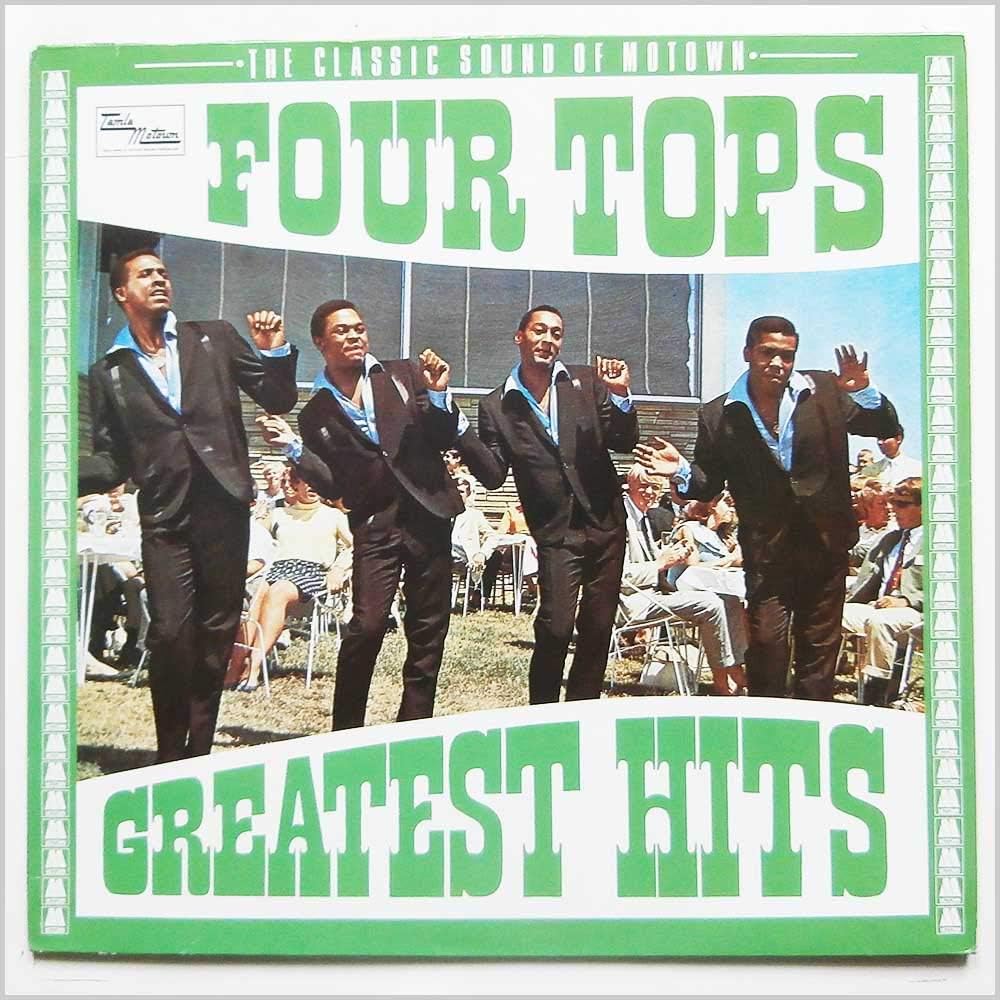
It is an extraordinary picture, and I have no idea of its origins, yet it can tell the story better than any given thousand words. There they are, four tall men in immaculately matching suits, open-to-the-sternum shirts and medallions, alive and kicking at the country club. Note that their voices are presumably so powerful that they do not require microphones to be heard. Behind them we see a largely attentive, appreciative and white audience – and to the left of Duke Fakir we can even glimpse Boris Johnson – astounded and rapt by the spectacle they are witnessing. The ghetto culture of Detroit, landed in the midst of the Young Republican khaki-clad gentry.

That, of course, was always one of Berry Gordy’s principal aims; to get white people to listen to black music, as well as – and more importantly – to establish black pop music as a long overdue commercial force in itself, to enter its nation’s transistor radios and transform their gummy static into florid, bold lines of colour communication. To prove that Hitsville USA could do it bigger and better than any Tin Pan Alley or Brill Building hustler.

And few, if anyone, did pop better in the sixties than Motown. After years of referencing on the part of the Beatles and Stones, this tale finally arrives at the first direct Motown entry. Ostensibly a collection of the Four Tops’ singles (with a few well-chosen B-sides) from 1964 to most of 1967 – their reading of the Left Banke’s “Walk Away Renee” appeared on the UK charts towards the end of 1967 but had to wait until 1971’s Greatest Hits Volume 2 to be compiled – and covering all of their key work with Holland-Dozier-Holland, the tracks on Greatest Hits do not appear in strict, academic chronological order, the failing of many a contemporary comprehensive CD anthology, but seem to tell a very specific story. Given that the album – a British-only issue – was almost certainly put together by the head of Motown’s UK A&R operations (and the man who thought up the compound name “Tamla Motown”), the late Dave Godin, a visionary who later proved himself more than capable of telling extremely profound stories in his Deep Soul Treasures tetralogy, this is not an unfeasible guess.

Consider, for instance, how “I Can’t Help Myself” appears early on in the proceedings, its Northern Soul-inventing dynamo underscoring Levi Stubbs’ hapless but curiously euphoric declaration of unfulfillable infatuation, only to be recast towards the end of side two in the despairing “It’s The Same Old Song.” Most of the critical applause in the Motown male group department continues to run towards the Miracles and especially the Temptations, and the Four Tops, whose history comfortably predated both, perhaps still await their proper critical due. But listening to the group at their finest, and to the fractious baritone of Levi Stubbs, a baritone as capable of going to screaming extremes as John Surman, demands some revision of thought.

Poor Levi. As with Gene Pitney in a parallel world, he was encouraged to suffer on our behalf; throughout these sixteen songs he is hardly ever happy, and even when love presents itself openly to him, he continues to worry about it ending or not actually existing, as on Jo Hunter and Stevie Wonder’s “Loving You Is Sweeter Than Ever,” one of the few songs here not written by the H-D-H team, with its “need to know you need me too” catch subtly undermining the song’s overall jaunty ecstasy.

And when his love is secure, he becomes ever the more paranoid. “Bernadette” is one of the most frightening, and certainly one of the loudest, declarations of insecurity in all of pop. Climaxing the gradual deconstruction of the Motown song which H-D-H had begun with “Reach Out,” the song’s attack and chord structure are more in keeping with the Chocolate Watch Band or the 13th Floor Elevators than, say, Junior Walker. Over James Jamerson’s restless, Mingusian Fender bass Stubbs howls his Othelloesque cry of doubt, presaging and far outdoing “Backstabbers” with his preacher roars – “I NEED you NEAR!,” “ALLLL!!!!” He admits to us that his feelings are going far beyond standard insecurity, and the sainted subtext of the song’s titled subject is not overlooked: “That’s why I place you high above,” “You mean more to me than a woman was ever meant to be.” There is a heartbreaking, stretched middle eight with flute, piccolo, bassoon and French horn unisons where Stubbs collapses in abject awe. Finally, when the song seems to have retreated to a land of echoes the other side of the Styx, Stubbs suddenly roars it back into existence; as with the Hendrix of “I Don’t Live Today,” he will not let go of whatever is destroying him.

“7-Rooms Of Gloom,” the follow-up, views the wreckage of the inevitable rift and destitution. H-D-H appear to be stretching the pop song, let alone the Motown model, beyond its perceived limits; the full rhythm section, whose appearances had gradually been getting later and later in Four Tops singles, does not appear until halfway through the second verse, and the words sound improvised, fearful. It is true that H-D-H modified “Gloom” into a more palatable form as the basis of R Dean Taylor’s “There’s A Ghost In My House” but here Stubbs’ desolation is worthy of Lear. “Lonely WALLS! They STARE at ME!” he soliloquises, before paraphrasing “Paint It, Black.” Apart from its being the obvious downside to the Supremes’ “The Happening” and a logical adjunct to Love’s “Seven And Seven Is,” “Gloom” does take the form of a theatrical performance far more clearly than it does that of the pop song. If David Ruffin was Motown’s Gielgud, his grief classically moulded, then Stubbs was the Olivier; elemental, quixotic, profound.

It was quite a journey from 1964’s “Baby I Need Your Loving,” the group’s first US hit. Commonly deemed the primary inspiration for the Righteous Brothers’ “You’ve Lost That Lovin’ Feelin’,” the parallels are obvious, not just in the song’s chorus but also in the pond splashes of florid piano, the incrementally increasing emotional scope of the song. Stubbs is no happier here than on “Gloom” but there still glimmers the option of hope – he has not yet been disappointed or betrayed by love. “Some say it’s a weakness for a man to beg,” he explains, before beginning to crumble (“’Cos lately I’ve been losing sleep” and the diplomatically coruscating “Has ALLLLLLLL been…”). But it would be wrong to focus on Stubbs alone and forget the immense contribution of the rest of the group; throughout, their responses to Stubbs’ calls are impeccable and their range – contrabass to operatic soprano/falsetto – deceptively startling. “Loving” in particular demonstrates their collective power; despite its woebegone sentiments it is one of the most alluringly elevating of all early Motown discs, the brownstone dwarfing rising sun of the chorus immediately recalling Drifters sides like “There Goes My Baby” and reminding us of the group’s roots in doo wop.

But “Ask The Lonely” from not long afterwards is equally as disorientating in its own way. Revealing the seldom visited cavern of the deep low register of Stubbs’ voice, this is a grandiosely damaged ballad in line with Jack Nitzsche epics like the Walker Brothers’ “Love Her” and PJ Proby’s draining “I Can’t Make It Alone.” Taking its lyrical cue from Sinatra’s “Only The Lonely,” Stubbs’ mournful intonations slowly develop into something more disturbed, as on the tightrope vibrato of “They’ll tell you” which in turn introduces grandiose piano, cinematic vocal harmonies and Stubbs reaching towards operatic skies. His final, terrifying cry of “Ask ME!” makes us remember that Jackie Wilson was his cousin.

On “Where Did You Go” dreamy Nelson Riddle strings are abruptly cut off by Stubbs’ stern lament. Like Val Doonican, he is alone in his room (“I now sit QUIETLY…/Hoping you’ll RETURN”), and an Erroll Garner piano tinkles bizarrely through the second and fourth bars of the first chorus, with its implied alternate jazz tempo. Again, Stubbs methodically and patiently breaks down; in the second chorus he asks, bemused, “Where DID you go?” only to be answered by an unbroken, conversational string line. “No matter what I try to do,” he finally confesses, “I can’t (here comes the crumble) go on without you,” and once again he falls to his spotlit knees, screaming “Where did YOU GO?”

“I Can’t Help Myself” is irresistibly buoyant, its diagonal piano/bass unisons and its confident tambourine/snare-driven strut providing the template for Northern Soul, but its singer remains besotten, unfulfilled, already dangerously obsessed. Stubbs’ “Sugar pie, honey bunch” becomes something approximating a threat, nicely offset by his above-it-all glides of “oooohh!” after every chorus. But “Standing In The Shadows Of Love,” the darkness to “Reach Out”’s light, is an exercise in smouldering paranoia to rival Gaye’s “Grapevine.” Here, Stubbs is more affronted than broken; witness his reproachful “Now, wait a minute!,” his stern reprimand about absence of conscience. He declares his rage more than he sings it. Following the song’s unexpected modulation he ups the ante, and in so doing – “Your cryin’ ain’t gonna help me now!” (i.e. “Tears Are Not Enough”) – provides one of this collection’s many roadmarkers towards New Pop. As with Lexicon, the increasing paranoia of the singer is matched by the increasing intensity of the songs, and the sequencing is indeed ingenious; “Something About You” begins with an incongruous chorus of Duane Eddy snarling saxes before morphing seamlessly and beautifully (because so unexpectedly) into the Northern Soul model, although the lead guitar is noticeably restless. Halfway through, a furious baritone sax rips into the song’s fabric, even getting cheered on by Stubbs, before more vocal call and response work of mounting dramatics.

On “You Keep Running Away,” Stubbs’ pleas deconstruct his manliness as semitones descend behind him – “Just look at me!,” “I used to be proud; I used to be strong” – with a surprising, mournful horn section straight out of Stax. “But I can’t get you into my arms,” he eventually confesses; as ever, the love strictly exists within his own mind. “Shake Me, Wake Me” takes Stubbs’ paranoia into new dimensions: “I hear my neighbours talking,” he proclaims, as the rest of the Tops distantly buzz “She don’t love him” over creeping bass and piano. Suddenly, in the second half of the song’s chorus, the song turns into something like a Tony Bennett ballad before a key change heralds a once again offended Stubbs: “I CAN’T believe I’ve been replaced!” he complains, before violently shifting into Lou Reed waters. “Somebody TELL me that I’m dreaming!” he wails. “Wake me when it’s over” he weeps into the encroaching nothingness.

“Without The One You Love” reaches back into the world of spirituals for its scant comforts (“I’m like a motherless child”), though note “I’m not living baby, I only exist” in light of Obi Benson’s subsequent contributions to Gaye’s What’s Going On? “Life’s not worthWHILE,” sobs Stubbs over a mildly dissonant harmony, while “I Turn To Stone” sees the group virtually abandon human form altogether, despite its uptempo shuffle appearance (its musical structure foretelling the Foundations’ “Build Me Up Buttercup,” not to mention the Electric Light Orchestra’s “Turn To Stone” a decade later). “I would be like a statue in the park,” admits Stubbs over a surprisingly seventies-sounding production.

But the Four Tops clearly presage New Pop, and certainly its key metapop aesthetic, in both “Darling, I Hum Our Song” and “It’s The Same Old Song.” The latter was a deliberate nod to “I Can’t Help Myself” but a very artful and emotionally affecting one, its archaic lyrical language (“Sentimental fool am I”) nicely balancing musical nods to the future; with Stubbs’ “dance to the music” we realise that the Four Tops will eventually turn into Sly and the Family Stone; and more tellingly it abandons “Myself”’s precarious optimism for unfettered, doomed pessimist realism. “Darling,” however, is a more astonishing achievement; taking the form of a Miracles-style smoocher (complete with Platters staccato piano), Stubbs and the Tops consider their loss, but all they can do to articulate the emotions they are feeling is to sing the inarticulable; long, gruff “HUMMMMMMM”s of varying length and intensity while Stubbs addresses the song through the fourth wall (“I’m sobbing through my song,” “That’s the part that I like best!”). Not only does this comfortably outdo similar efforts at the time by the likes of the Stones, but it also sets us up for Kevin Rowland’s in-depth expansion of the notion on “This Is What She’s Like.”

“Reach Out” comes first on the album, as it inevitably had to, but I have left it until last because, almost uniquely of these songs, it articulates a way out, it approaches fulfilment. As with Doonican’s “Scarlet Ribbons,” the song is the key to the rest of the album because it outlines in depth, both emotionally and artistically, what the other fifteen songs have been searching for. The opening flute/piccolo harmonies – quickly approximated by McCartney for “Penny Lane” – are set against whiplash side percussion and Jamerson’s already roving bass and its unfettered modality was as great a shock to Motown as “Good Vibrations” was to Mike Love. Here, encouraged by the rest of the group, alternatively harsh (their untranscribable, backwards roars of approval) and soothing (the androgynous sustenatos of “Reach out”), Stubbs offers a light of guidance. His voice is as comprehensive, all-embracing and unavoidable as that of Chuck D; as with Public Enemy, you have to listen to and acknowledge his power. As soon as the singer turns his mirror away from himself and out onto the world, his magic and capabilities become lucidly apparent; unlike the Dylan of “Like A Rolling Stone” he doesn’t condemn, but welcomes, embraces the uncertainty and insecurity of others. Remember that the song came out at a time when an entire society – and certainly the Four Tops’ own society - needed reassurance. The burning you sense is a righteous light, Stubbs reassures us; he leads us on and then gives the metaphorical game away, after many rhetorical pauses of semi-silence: “Just look over your shoulder!” Not “by your side” but “over your shoulder”; he has already climbed the mountain and is encouraging you to do the same, outdo him. His is the song of the spirit, the church of us. “Reach Out” is as holy as “God Only Knows” but necessarily more encyclopaedically global; like Billy MacKenzie, Stubbs’ voice holds nothing back; it is everywhere, smiling, overcoming its own failings, spreading its own successes. Whether it’s the streets of Detroit or the unshaded nooks of the country club, the Four Tops were there for everyone who was, and is, able to feel their message.

Monday, 10 August 2009

Val DOONICAN: Val Doonican Rocks, But Gently


(#50: 6 January 1968, 3 weeks)
 
Track listing: Scarlet Ribbons/If I Were A Carpenter/Rainin’/Hold Me/Yesterday/Small World/He’ll Have To Go/A Man Chases A Girl (Until She Catches Him)/Visions/Bella Rosa/My Colouring Book/The Folks Who Live On The Hill/Take Me
 
(Author’s Note: Sincere thanks are once again due to Mike Atkinson who with great kindness found a copy of this album for me just over a year ago, at a time when I had still planned to begin this story with entry #47; it has yet to resurface on CD but it is my modest hope that this article may lead in its small part towards that happening.)
 
A huge, deep but serene wave of strings sails in to underscore the nocturnal picture. A celeste makes an effort to cuddle. The man is possibly more distressed than he is letting on; he is quietly watching his daughter praying for something that he cannot hope to get her (and note the one crucial word hidden in those last three), worries himself to non-sleep as to how he is supposed to get them – the modest orchestral crescendi which accompany his nearly despairing “aching” and “breaking” quickly settle down for the greater good - but creeps back towards her bedroom door in the morning and to his astonishment sees that his prayer has been magically answered, and the bed is strewn with ribbons for the yet-to-awake girl.

We might be witnessing an early snapshot of the father snoring through “She’s Leaving Home,” someone who knows in his heart that the day when she is no longer sleeping in that bed, under his roof, will come quickly and soon, yet someone also fortunate enough to witness, and be astounded by, a miracle. “Scarlet Ribbons” is sometimes thought of as an aeons-old Irish folk song with multiple symbolism, religious or otherwise, but in fact was written by two Americans in the late forties; it is a measure of Val Doonican’s underplayed power that he can convey in his performance of the song an aura more in keeping with the last pages of Joyce’s Dubliners.

Doonican’s “Scarlet Ribbons” is not only the key track on this, his only number one album and the first Irish entry in this tale, but also a surprisingly effective postscript to the simultaneous end and beginning proposed by “A Day In The Life.” For now the consensus which had built up around the Beatles over the previous five years begins to fracture, atomise into endless scarlet ribbons; now, multiple different voices will begin to make themselves heard here, as though Pepper had already predicated that we would never again agree on something as strongly as we had done about Pepper.

And the first of these voices was an unassuming, good-natured forty-year-old cardigan-wearing, rocking chair-inhabiting singer and guitarist from Waterford who for nearly quarter of a century was a cornerstone of Saturday night light entertainment television. Easy on both ear and eye, it was clear that Doonican had already lived several lives before we became aware of him – almost twice as long as the artist responsible for that other worried Ireland-originating album of 1968, Astral Weeks – and that his easy-going nature had been hard won. The album title was more than fitting; knowing but reassuring – at least, if you took it literally and not as Val Doonican Loses His Mind, But Gently, since the portrait that the record paints appears to be one of a steadily disintegrating human being.

Consider that “Scarlet Ribbons” concerns itself with the wishes of childhood – no mother or wife figure appears in Doonican’s reading – and then hear his takes on Hardin’s “If I Were A Carpenter” (“Would you marry me anyway? Would you have my baby?”) and “Small World” from the musical Gypsy, the latter scarcely a typical choice one would expect from the singer. More intriguingly still, in the original Styne/Sondheim musical “Small World” is sung by Rose Lee herself, in an attempt to persuade the lead male character Herbie to become her children’s professional manager (is he the one who is moved to pray for scarlet ribbons?); she doesn’t necessarily mean what she’s singing but manages to persuade him anyway. Doonican’s performance is far more desolate, with no face or side whatsoever; his “It’s. A. Phe. No. Men. On.” is a manful attempt not to be mechanical, an invitation to lose his emotional countenance, but he knows finally that he must keep that countenance at whatever cost. His “funny guy” tails off into several “y”s (sounding like a concealed “Why?”) before streaking up an octave like an apprentice asteroid. “Small and funny and fine” he concludes, unsure of anything. His “Carpenter” meanwhile is funkier than either the Darin or Four Tops readings, with a nicely chunky bassline and rhetorical congas hammering nails in the background. I note how clearly and intensely Doonican concentrates on the word (if it is a word) “onliness,” and how much closer he approaches the original, debauched exhaustion of Hardin by doing so.

Most of the album’s tracks, however, base themselves on a Patsy Cline “Crazy”/Ray Charles Modern Sounds template of florid, commentative piano (for which pianist Frank Horrocks rightly receives credit in Doonican’s characteristically friendly sleevenote) with supple banks of orchestral and choral accompaniment. “Rainin’” is a Bobby Darin original (cunningly sequenced to come out of “Carpenter”) and Doonican is obligingly doleful in his delivery; note the despondent but unbroken slow motion rainfall of “Pourrrrrrr” into “maybe” and the resigned defeat of his “waiting around…the bend,” not too confident that anyone will be waiting for him there or anywhere. “Hold Me” is the same song which took PJ Proby into our top three in the summer of 1964 but Doonican completely excises Proby’s screeching carnality for a statelier, nobler approach; just gentle, but oddly reggae-like, high-pitched guitar, and the crucial “away” is taken out of the tag line “Never try to hold me away from you.” Doonican is desiring, but also patient; there is, after all, a “Take Me” waiting for him around this album’s final bend.

“Yesterday” provides the obvious link between Doonican and Pepper, though his version owes more to Tom Jones’ “Green, Green Grass Of Home” in terms of arrangement (Ken Thorne of “Legion’s Last Patrol” fame arranged and conducted all tracks on the album) although Thorne, as elsewhere on the record, is careful to vary his accompanying colour; harpsichord and guitar give way to an oboe whose figures may be slightly mocking, before reaching the inevitable choir, a flute zigzagging through the final verse and a faint high A lead violin, fainter and higher than the one heard on McCartney’s original, leads the song to its end. Still Doonican’s baritone is unswervable, solid, unbending, and, as Lena noted, he nobly resists the American ballad singer’s tendency to speak in the middle of the song.

With his easily-attainable bass notes and his general manner, Doonican inevitably drew comparisons with Jim Reeves, but the two voices seem markedly different to me; Reeves himself I will return to as the tale goes on, but Doonican’s reading of “He’ll Have To Go” posts a useful differential marker; this is at base a very sordid song, a dirtier Nashville variant on “One For My Baby,” except here the jilted man (or is he?) is drunkenly ringing his Other (or ex-Other, or was she ever his Other, or he hers?) from the bar; she’s in bed and we don’t hear her reaction at all but merely feel contemptuous pity for the sucker. Reeves, as with most of his songs, sings with the recently oiled confidence of an unbitten snake oil salesman, but Doonican knows he’s down; still, he tries to be dignified even though he knows that there’s no dignity to be rescued here. This brings to a close side one of a supposedly comforting album of songs requested by viewers of his TV show (and quite a contrast – or is it? Put “Rainin’” next to “It’s Raining Today” - to the likes of Scott Walker’s Scott Sings Songs From His TV Series); Doonican concluded every show by sitting in his rocking chair with his guitar, singing one of these unquiet songs, and although the sleeve works hard to portray him as our own Perry Como, with its shot of Val enjoying his pipe and wee glass of spirits on the rear, I can’t help but notice that some of the shots on the front cover uncomfortably make him resemble Kenneth Williams.

Irving Berlin’s “A Man Chases A Girl” is not only an unexpected echo of another key 1967 song, the Marvelettes’ “The Hunter Gets Captured By The Game,” but intriguingly is also another song best known for being performed by a woman; Marilyn Monroe does it in the film There’s No Business Like Show Business but Doonican’s reading is far more melancholic than mischievous, even with prompting from the strangely ghostly, uncredited female backing singer, as though aware that he has no real hope of either catching or getting caught, not that this can hope to break the stride of his determined amble. Thorne’s arrangement here – a fountain of fluttering flutes to illustrate Doonican’s “hello” – stretches to the over-florid, as he sometimes does elsewhere; the Home Service chorus (I’m unsure whether it’s the Mike Sammes Singers) not really scaling Ray Charles heights.

Then, however, the album becomes markedly darker. “Visions” is the same song which had been a top ten hit for Cliff Richard in 1966, and its painstakingly slow moving procession of vague images and confined mental torment secondary to emotional desertion seems even more agoraphobic in Doonican’s hands. Despite the return of the celeste, there is no reassurance to be sought here; his triptych of “When, when, when” gradually slopes down like a stooping, beaten head.

Darker visions yet are to come. Thorne’s flurry of mandolin on “Bella Rosa” bodes the worst but this is a strange song indeed; Doonican sings wistfully of this image (“Her image returns”) as she passes by his window each day, even though there is no evidence that she ever notices him, let alone talks to him. Far more disturbing than Richie’s “Hello,” we learn that the singer has apparently already turned down several willing brides in favour of this Bella Rosa – and yet the final verse finds him in a world Scott Walker would immediately recognise; “It’s Saturday night…it’s bare and it’s cold…I lie in my room…” Gradually we discern that this is a variant on Diamond’s “Red, Red Wine,” that the “Bella Rosa” seems to be a different kind of spirit and that indeed it is slowly killing him.

By the time both he and we reach “Lazy” – another Irving Berlin song – he seems unwilling to move, and happy with it; over Horrocks’ ironically enthusiastic piano commentary Doonican becomes the unlikely pioneer of slackerdom. “Under that awning they call the skyyyyyyy” he murmurs, before dreaming of his escape from “the deep, tangled, wild wood” (but not forgetting to semi-rhyme with “child would”) with his “valise full” (to rhyme with “peaceful”) of books. He appears to wish to approach the idyllic borderline between existence and non-existence.

He begins Kander and Ebb’s “My Colouring Book” alone, and although this song of grievous loss, whose notion of colour intentionally becomes blurred as it progresses (“Colour her…gone”), is best and most profoundly heard as sung by Dusty Springfield, Doonican continues not to bend or break, even though he is obviously breaking. Even when he reaches the crucial quatrain of “This is the room I sleep in…walk in…weep in…and hide in” he lets slip some emotion – a shakiness on “weep,” an ashamed whisper on “hide” – but not enough to invert the applecart. Walker would have broadcast his loss to the cosmos. Doonican whispers to his rocking chair who he knows can’t and won’t talk back.

As this unexpectedly draining record reaches its close – Doonican produced the album and clearly had some awareness of how to shape the whole as a concept – we reach near-full circle as the singer once again considers the ideal life, the outcome of those early promises of scarlet ribbons. He is aware that his “Folks Who Live On The Hill” cannot approach the imperious tenderness of Peggy Lee’s version, but since the latter is one of the key pop records of its century this is hardly surprising; the “Hold Me” reggae-lite arrangement returns but the song is suspended in a foreboding, out-of-tempo limbo throughout the course of its middle eight; what if Doonican never realises this dream? And again: “just we two” – no child praying for miracles. Or, if he finds his Other, can they learn to be children again?

Throughout this record – whose undercurrents have been far more rocky than gentle – Doonican has alternately won the girl and lost the girl, and more often than not has dreamt of either. It is difficult not to listen to the album without thinking of the impact it might have had on impressionable young ears, particularly in Doonican’s key constituencies of Irish expatriates in Scotland and in particular the northwest of England (as well as in Ireland itself); would the eight-year-old Morrissey have been familiar with it from his parents’ collection? We know that “Scarlet Ribbons” was one of the first songs the infant Sinead O’Connor learned to sing, and that she breaks down while singing it, aged 25, on Am I Not Your Girl?

“Take Me,” however, is an astonishing coda. A real connoisseur’s choice – Doonican says in his sleevenote that the record’s intention was to provide a mixture of old favourites and less obviously well known songs – “Take Me” was co-written (with Leon Payne) by George Jones, and, taking the “man singing in a woman’s voice” to its logical conclusion, is best known in Jones’ duet recording of the song with Tammy Wynette. Here, finally, Doonican achieves something resembling an emotional breakthrough, first by facing the fiercest demons; he begins with an entreaty to “take me to your darkest room” – the choir verges on buffoonery here, but the firewood-chopping guitar and harpsichord make up for that somewhat – followed by a request to “take me to your most barren desert” (his ascending spire of “Cro-o-oss” as he contemplates the latter prospect) and a plea to make both room and desert light and fertile, as only “she” can.

And then things become slightly surreal. “Take me to Siberia,” commands Doonican. With her presence, “it would be just like spring in California.” He glimpses more actively at this world surrounding him, and all of a sudden it expands, as do his ambitions; here, astoundingly but surely undeniably, germinates the seed, or indeed the scarlet ribbons, which will one day blossom into streets that have no name, beautiful days – the seven-year-old Dubliner’s ears must already have been glued to his family’s radiogram speaker. Did somebody say something about walking tall?