Monday, 30 March 2009

The SHADOWS: Out Of The Shadows


(#31: 27 October 1962, 3 weeks; 24 November 1962, 1 week; 22 December 1962, 1 week; 19 January 1963, 2 weeks)

Track listing: The Rumble/The Bandit/Cosy/1861/Perfidia/Little “B”/Bo Diddley/South Of The Border/Spring Is Nearly Here/Are They All Like You?/Tales Of A Raggy Tramline/Some Are Lonely/Kinda Cool

Here is where some Shadows purists got off the bus; by now, Jet Harris and Tony Meehan had both jumped or been pushed out of the Shadows, depending on whose accounts you read and trust, and been replaced by the allegedly more malleable Brian Bennett and Brian “Licorice” Locking on drums and bass respectively. Both Harris and Meehan reckoned that the Shadows lost it immediately thereafter, and setting the brooding thrust of their subsequent run of 1963 duo hits (“Diamonds,” “Applejack”) against the amiable politesse of parallel Shadows hits (“Dance On,” “Foot Tapper”) could theoretically go some way towards demonstrating this.

But the truth, as always, is necessarily more complicated. True, the Shadows offer on their second album perhaps the politest version of “Bo Diddley” one is ever likely to hear, all Home Counties vowels, a harmonica which owes more to Genevieve than Little Walter, and a shave and a haircut for tuppence out of the High Street barber’s (half day closing on Wednesday). But that has to be set against their strutting reading of “South Of The Border” with Hank stretching out in a bluesy middle section and a bass-led rhythm pattern which owed as much to Ricky Nelson’s version of “Summertime” as Deep Purple’s “Black Night” was later to do. Similarly, Ike Isaacs’ “The Rumble” initially resembles a sturdy petition from Tunbridge Wells churchgoers rather than a Thames Estuary Link Wray but is still tough enough by 1962 Britbeat standards.

Much of the credit for this toughness has to go to Brian Bennett, the album’s unexpected star, fresh from Marty Wilde and the Wildcats, who certainly does anything but lay back. “Tales Of A Raggy Tramline” was recorded when Harris was still in the band – indeed, was co-written by Harris - and together Harris and Bennett work up a startling pattern, drum n’ bass whichever way one looks at it, to heighten the otherwise standard Ventures-style workout. Speaking of the Ventures, the Shadows’ take on “Perfidia” is markedly more reflective, and set to a tango tempo (their big hit single of this period was, fittingly, “Guitar Tango”) which somehow turns into a tearoom cha-cha (complete with a curious “OOOOOOOHHHHHHHHH!!!” collective vocal eyebrow as though locked overnight in the gents’ toilets at Victoria Coach Station) but still displays some remarkably inventive exchanges between guitars and Bennett’s carefully patient tom-toms. Best of all, perhaps, is “Little ‘B’,” Bennett’s big feature, a cursory fast-paced rocker which slowly rises to a tumultuous boil over five minutes as Bennett’s solo, again accenting on the tom-toms and accompanied by occasional ooh-yah whoops, demonstrates dynamics that are extremely similar to some we shall hear at the opposing end of this decade (and for some while into the next); I expect that some young ears in Birmingham in particular were already perking up and taking aural notes. And then, completely unexpectedly, halfway through Bennett’s solo, extra bubbling percussion is added and we are suddenly encountered with the father of “Pump Up The Volume.”

Elsewhere, “1861” has a decidedly martial feel to it (a Civil War marching pattern in particular) but then cruises and plucks along like a cheerier variant on the “High Noon” theme; “Kinda Cool” features Hank on rebounding Cramer piano once again; and “Some Are Lonely” is an extremely rare example of a composition by the group's employer, Cliff Richard – as with much of the rest of the album (and other number one albums of this period) there is a decided Latin feel to its tempo and pace (complete with decorative castanets) but it’s not bad at all. There are two vocal harmony numbers; “Are They All Like You?” with its rather unsettling leitmotif of “Ring-a-ding-a-ding” is an Everlys variant, while “The Bandit” – adapted by “South Of The Border” composers Jimmy Kennedy and Michael Carr from a melody by, of all people, Milton Nascimento – is a solemn Kingston Trio-style lament, the solemnity of which belies its relatively trite lyrics (“Olé, I am a bandit,” “Blue Brazilian sky” – although the latter points forward, both lyrically and aurally, to Chris Isaak’s “Blue Spanish Sky”). The stentorian delivery of expressions such as “Shoot to kill” looks forward, not just to the Byrds, but even unto “Cortez The Killer.”

That last comparison is not farfetched; Neil Young was by this time in his last year at high school and it is impossible in particular to listen to this album’s dreamy (and, yes, rather shadowy) ballads without imagining the young Neil practising along; “Spring Is Nearly Here,” despite Norrie Paramor’s intrusive Ovaltine strings, floats as benignly as the pumpkin papa of all harvest moons; while “Cosy” is my own favourite of these tracks – I note the similarity of Hank’s slowly descending guitar motif to “Bend It” by Dave Dee & Co. but the limpid lanterns of dreaming tremolo arms as warm as those of Morpheus and the evening terrains of subtle rhythm progress in different dimensions thereafter; I see the forebears of “Albatross” and even, in places, the Durutti Column – a patient proceed towards eventual end horizons, a blue skyway of airy purchase, a land more wonderful than even 1962 might have thought possible.

Monday, 23 March 2009

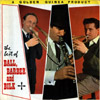
Kenny BALL, Chris BARBER and Acker BILK: The Best Of Ball, Barber And Bilk


(#30: 22 September 1962, 1 week; 20 October 1962, 1 week)

Track listing: Jump In The Line/Higher Ground/Willie The Weeper/Gladiolus Rag (Mr Acker Bilk and his Paramount Jazz Band)/Teddy Bears’ Picnic/Hawaiian War Chant/I Love You, Samantha/Chimes Blues (Kenny Ball and his Jazzmen)/Majorca/High Society/Tuxedo Rag/When The Saints Go Marching In (Chris Barber and his Jazz Band)

Twenty-five years before the Rave Generation will enter this tale, there were other ravers and other notions of undying “hardcore.” All night raves in doubtful clubs, attended by wayward youths dressed in seemingly incomprehensible tribal uniforms, sneered at by their assumed “superiors” for apparent “superficiality” and bearing the faint aroma of performance-enhancing drugs (mainly marijuana); here, unquestionably, is Rave but here too is Northern Soul (not to mention everything else from psychedelia via punk to dubstep). Over the differing generations the denominator has remained common; a deliberate retreat from a perceived bland music/societal mainstream into a corner which no one else can access or touch or hurt. All such retreats are by definition limited but these tribes tend to influence future ones as a means of escaping from their painted-in corners, if only by virtue of (in)action.

The trad jazz boom was an escape from the end of skiffle as well as a fleeing from what its adherents viewed as a smiling, neutered pop environment; here was something old, perhaps – historically, as old as its century – but something into which it was felt some vitality could still be breathed. A return to basics, an end to gloss, and, most importantly, a sense of community for a pregnant generation of youth not yet allowed proper freedom; they had narrowly escaped National Service but were still expected to behave themselves, become minor replicas of their parents and employers. Only in the jazz clubs, smoking away to the bluff and bluster of the leading trad bands, could they feel anything approaching free.

Not surprisingly, the leading exponents of Brit trad were amused but bemused by this devotion; there was of course also the political subtext – CND marches especially, and the consequent partial harnessing of trad as a temporary style of revolt – but Kenny Ball and Acker Bilk were far more cognisant of their responsibilities to showbiz than any palpable political commitment. This does not render their music ignorable. But Chris Barber, always the most perceptive and far-sighted of the “B” triad, remarked in a 1978 NME interview that all music lovers – whether they were into the Beatles or Ornette Coleman – were “essentially Max Bygraves fans”; in other words, the great majority of music consumers are inclined to stick with what and whom they know, a carrot of comfort deriving from a childhood or teenage time when…well, when other considerations still didn’t need to be taken into consideration. When life was still “pure” even if only for three minutes.

Ball’s Jazzmen were for many years the resident musical group on the BBC’s Morecambe And Wise Show; Bilk’s greatest commercial success came with “Stranger On The Shore,” a transitional pop record which had little to do with jazz but which hovered over the charts throughout the whole of 1962 like an uncertain beacon, not quite sure of what it should be lighting up. When the Beatles came in trad went straight out (and the Mods sprang up in its place). And yet, listening to this Pye Golden Guinea retrospective – an assemblage of archive tracks, four per band, ranging from 1954 to 1961 – I feel not only the inescapable scent of Sunday lunchtime roast but also a pace, a determination, which demands not to be taken for granted.

Bilk’s band opens the proceedings; “Jump In The Line” is a virile calypso-ish piece with immediate, and surprising, free vocalisations from Bilk’s clarinet and Ken Simms’ trumpet which would rematerialise at the other end of the decade in the Art Ensemble of Chicago ’s “Tutankhamun.” “Rock your body on time,” growls Bilk in another interesting precedent to 1988, and Ron McKay’s drums help batter the tune into a suburb of outer space by track’s end. “Higher Ground,” a Bilk original, gradually builds up from hushed horn voicings into a celebratory gospel workout, McKay having great fun tap dancing on his supplementary traps. “Willie The Weeper” features a splendidly guttural vocal from Bilk reminiscent of no one less than Beefheart (“Willie The Pimp” anyone?) climaxing in a startling shriek of “FI-IIIIIIIII-VE!!” while Joplin’s “Gladiolus Rag” is traced with great delicacy.

The unpromising titles of the four Kenny Ball selections might initially point to other Golden Guinea releases advertised on the rear sleeve (including, inter alia, Let’s Twist To The Oldies by Fats and the Chessmen, Hit Movie Themes Go Latin by the Orchestra Del Oro, Strictly For Dancing by the Statler Dance Orchestra, Continental Jazz by Les Cinq Modernes, Honey Hit Parade and the unlikeliest of them all, Charleston by Slim Pickins and his ‘Twenty Niners’) but all work surprisingly well. His “Teddy Bears’ Picnic” is done á la “Chant Of The Weed” and I note the more “produced” nature of this music; there is that same, partially submerged echo chamber air which pervades hits like 1961’s cheerily apocalyptic “Midnight In Moscow.” “Hawaiian War Chant” begins with a nod to “Big Noise From Winnetka” before Dave Jones’ doleful clarinet is drowned out by John Bennett’s outrageous trombone snarling and the entire track steps up at least two gears. “I Love You, Samantha” disposes with Bing’s easy grace entirely in favour of Ball’s Carry On Satchmo vocal; “Remember,” he winks, “I’m a one-two-three-four-five-six-seven-gal guy!” (and causing in this listener unlikely echoes of James Brown’s contemporaneously recorded Live At The Apollo) before drummer Ron Bowden drives the band into a train station cluster of an ending. “Chimes Blues” is played straight and displays great subtlety in its arrangement, slo-mo brass counterpoints met by adroitly tricky tempo shifts.

Finally we come to a quartet of tracks recorded by various editions of Chris Barber’s band. The first is a live reading of New Orleans revivalist trombonist Wilbur de Paris’ “Majorca,” an inventive Creole (out of Jelly Roll Morton) arrangement featuring banjo/bass unisons alternating with fortissimo front line declamations; Bowden is again on drums here, his dynamics allowing both band and tune to blossom out fully.

The remaining three tracks date from the mid-fifties and feature a man of partially spent destiny plucking away unobtrusively but inventively on banjo; one recalls that “Rock Island Line,” a realer beginning of time for British pop music (because more immediately accessible) than either “Clock” or “Hotel,” began life on a Barber album (New Orleans Joys) and that Donegan’s skiffle routine was the original interlude between full band sets onstage. But it was now getting late in 1962 and Donegan had largely seceded from the charts, been reabsorbed into mainstream entertainment and was about to view the fruits of his unlikely offspring. Skiffle had been and gone and in the (perceived) absence of anything better its roots had returned to take transient residence. “High Society” and “Tuxedo Rag” are both elegantly classicist constructions, Monty Sunshine’s clarinet beaming to the fore like a belatedly reluctant ray emerging from late winter.

But the album vibrates into extraneous life with the closing epic “Saints” reading, featuring an uncredited Ottilie Patterson on vocals, strong and truthful. After a false ending the band return, up an octave and up several gears and suddenly this dim corner of the world raves up into extralucid colour, Jim Bray providing the second bass solo to feature in this tale, Donegan now rampant on banjo, Graham Burbidge tearing down the curtains of the world with his drumming (“It almost sounds like a drum machine!” exclaimed Lena), and we are reminded very forcefully that this album’s second spell at number one coincided with the run of “Telstar” at the top of the singles chart and that both coincided with the apex of the Cuban missile crisis; with Barber’s “Saints” we feel as though we are all together, on the 3 AM eternal floor of Alexandra Palace, buttons and coats askew yet tightly wrapped, singing and dancing until the end of the world.

Monday, 16 March 2009

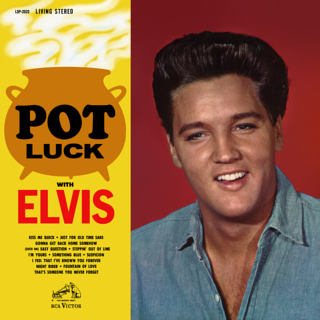
Elvis PRESLEY: Pot Luck

 Pot Luck with Elvis.jpg

(#29: 28 July 1962, 5 weeks; 8 September 1962, 1 week) 
 
Track listing: Kiss Me Quick/Just For Old Time Sake/Gonna Get Back Home Somehow/(Such An) Easy Question/Steppin’ Out Of Line/I’m Yours/Something Blue/Suspicion/I Feel That I’ve Known You Forever/Night Rider/Fountain Of Love/That’s Someone You Never Forget 
 
I must confess slight initial bafflement in relation to this record; so used am I to Elvis albums throughout the bulk of the sixties comprising of film soundtracks that I searched myself trying to recall a movie entitled Pot Luck – 1962? That would have been Follow That Dream, an amiable if hopeless sub-Beverly Hillbillies yarn, the not-bad-at-all boxing picture Kid Galahad and the dire shape of dregs to come entitled Girls! Girls! Girls!, but no Pot Luck as such - before realising that this was that rarest of sixties phenomena, a proper new Elvis studio album (even though some of its tracks eventually threaded their way towards the soundtrack of 1965’s entirely useless Tickle Me). That isn’t to say that Pot Luck is a very good album, although it’s never less than interesting and committed; simply that Presley demonstrates a sense of dramatic and emotional focus which, 1966’s How Great Thou Art excepted, would be largely absent from his conveyor belt of productivity until 1969.
 
Interestingly, and peculiarly contemporaneously with Coltrane (and well ahead of Adam Ant), Presley experimented with a double rhythm section on the Nashville sessions which produced the material for the album; Buddy Harman and DJ Fontana twin up on drums while Bob Moore’s acoustic bass is balanced out by Harold Bradley’s electric. The focus is broadly on post-“It’s Now Or Never” numbers with a vague Latin/bossa nova feel, coupled with some sombre country ballads, but there is a suggestion of incipient trouble and doubt coursing even through things like “Kiss Me Quick,” a superior Pomus and Shuman “Now Or Never” rewrite; despite Elvis still donning Dino’s mantle – complete with a “That’s Amore” backing choir standing in for the Jordanaires who will become increasingly irritating as the album wears on, and the inevitable mandolin – the sense of impermanence and transience is never far away from Presley’s leers and licks.
 
“Just For Old Time Sake” is yet another Tepper/Bennett number and clearly designed as a “Are You Lonesome Tonight?” clone (though unsurprisingly there are also hints of “When The Girl In Your Arms”) but Presley escorts it out of its marimba/piano-decorated supper club by his fiercely soft concentration. “I made my greatest mistake,” he muses. “Ih-if-a-a-ii-you loved me (doing a Dean pastiche) then, you could love me once again,” he pleads, before leaving a huge, gaping question mark of a pause. “Gonna Get Back Home Somehow,” another Pomus/Shuman tune, rocks out of the paddock but is curiously weighed down by Boots Randolph’s baritone sax, against which Presley palpably struggles to escape: “Leavin’ now” (answered by a wriggling worm of a Scotty Moore guitar figure), “I’m leavin’ nowwww-uuuuuuhhhhh” and finally “I’m leavin’ NOWWWWWWWWWWWWW!!!!” Stooges of octave piano (Floyd Cramer) and tambourine spice up the middle eight, while Presley’s determination is underlined by his title pronunciation accompanied only by double bass and finger snaps.
 
In contrast, “(Such An) Easy Question” is a lope through some airs of blue which sees Presley pacifically fuming, “Why can’t I get an answer? Tell me!” He gets prickly: “Can it be that you’re too sh-hyyy?” Then he begins to demand: “Can you – TELL ME YES?” and is immediately underwritten by grave mass harmonies. By track’s end all he can do is slur and lick the phantom of an escaped ice cream cone. “Steppin’ Out Of Line” was an outtake from the Blue Hawaii sessions and rocks and howls exactly like that soundtrack didn’t; ravenous, thirsty, his ski slope of “in your sleep,” an explosively pregnant tenor solo from Randolph to which Presley responds with a deranged “UUUUUUUUAAAAAAARRRRRRGGGGGGHHHHHHH!!!!!,” the shop finally being shut down by Harman and Fontana shattering the complacent glass. Side one, however, chooses to conclude with cheese: “I’m Yours” is a courtly wedding waltz with Patti Page-ish double tracked lead vocals (and narration) which might just have been tolerable had it not been wrecked by some terrible Ken Griffin/Junior Showtime ice rink organ.
 
And yet side two commences with the same scenario seen from a far more fearful perspective; “Something Blue” is an intensely internalised country performance, and while Elvis works through the song’s old/new/borrowed bits of lyrical business he suddenly finds himself facing a desert. In the aisle, walking behind her (remember Eddie Fisher?), he abruptly sobers up. “I feel I’m walking to my doom,” he intones, “I’m really not the best man in this ro-oo-oo-ooom” pronounced as though he’s about to roll right out of the room and into the pits of hell. There is some call and response work with the choir (as with the Jordanaires, far more effective on the ballads) and the scenario is tied up by a never more doleful, elongated baritone sax burp. “Suspicion” – Pomus and Shuman again, and top ten as a very belated single release in 1976 – echoes and presages its 1969 counterpart with scratching harpsichord, its references to “torment” and his wildly vanishing refraction of a shout of “Why torture me?” in each chorus as though Wile E Coyote has yet again failed to find ground beneath his feet as he hurtles off the edge of the cliff.
 
“I Feel That I’ve Known You Forever,” composed by Pomus with a lyric by Alan Jeffreys, might be the album’s most fragile track, another slow, uncertain (but comparatively brief – 99 seconds) Tennessee waltz with a lovely chord change on the “contraire” of “Your face so fair, me au contraire” before he suddenly erupts with an escalating triple breath cadenza of “Forever, forever, FOREVER!,” almost threatening to detach the roof from its studio. “Night Rider,” the last Pomus/Shuman track on the record, returns to fast Latin-tinged rock, led by Randolph’s stuttering tenor, though Presley’s half-tempo vocal presents us with the improbable picture of a Gerry Anderson theme tune. Despite terse commentaries from Cramer’s piano and Scotty’s guitar, and despite Presley’s evident angst (though tinged with more than a hint of the reasons why she ran away in the first place – “keep her at home”?) doesn’t really transcend its ultra-lite “Mystery Train” wannabe status.
 
With “Fountain Of Love” we are back in Dean Martinland, complete with light, extended double entendres – Presley makes “just come and drink” sound like “just come and breathe” – and Grady Martin offers some suitably sardonic commentary on his acoustic lead guitar but it struggles not to turn into “It’s Now Or Never Part 98.”
 
But then we arrive at the astonishing closer (and with more than a hint of Closer about it, if you’re asking) “That’s Someone You Never Forget,” the only song on the album to be co-composed (with Red West) by Presley himself (another one, “You’ll Be Gone,” co-written by Presley with West and Charlie Hodge, appears on the CD of Pot Luck and skilfully skirts as close as possible to “Begin The Beguine” as copyright royalties will allow; the CD version of the album, incidentally, plays wild and free with the original track order, interspersing five bonus tracks seemingly at random, but I have chosen to concentrate on that order as structurally and emotionally it makes the most sense). Here the backing singers begin to be used creatively, their sonorous “ooooohhhh-OOOOOOHHHHHH” ebbing waves exactly counterpointing Presley’s tortured vowels with a sense of tonality more akin to Debussy than the Opry. Presley himself, for the most part, barely ascends from a thinly detectable whisper and it is clear that we are intruding on a very private mourning – this is a lost love which has no hope of coming back in this world. “The LIT-tle things you planned,” he trembles. The “of” of “You’ll think of her each day” is obscured by a tremulous sob. The lullaby of celeste fails to resolve his stinging, lethal, internal pain. “But you know,” he concludes, “they’ll never replace the one who waits for you,” before working up to a terrible, if brief, crescendo and then settling down into the waves, the waves which won’t stop rolling, where have they been. The song was written with his mother in mind and provides the umbilical cord which would never break, and indeed leads in emotional part to the long black limousines we will subsequently encounter. The real Elvis, revealing himself before diving back under the Hollywood covers for the rest of the decade. We will rejoin him when the covers get brutally thrown off him, and he discovers, much to his surprise, that he’s the one who did the throwing.

Monday, 9 March 2009

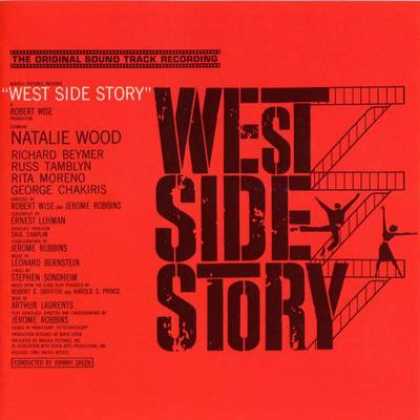
ORIGINAL MOTION PICTURE SOUNDTRACK: West Side Story


(#28: 23 June 1962, 5 weeks; 1 September 1962, 1 week; 15 September 1962, 1 week; 29 September 1962, 3 weeks; 17 November 1962, 1 week; 15 December 1962, 1 week; 12 January 1963, 1 week)

Track listing: Prologue/Jet Song/Something’s Coming/Dance At The Gym/Maria/ America /Tonight/Gee, Officer Krupke!/I Feel Pretty/One Hand, One Heart/Quintet/The Rumble/Cool/A Boy Like That and I Have A Love/Somewhere (Finale)

In my fourth year at school, our English class read out and studied the text of West Side Story. I think that this was a Shakespeare educational tie-in, even though the principal Shakespeare text we were given to study at the time was Julius Caesar, but given that this is now over thirty years ago I am necessarily a bit rusty about the detail. I’m pretty sure I’d seen the film on TV, and not recalled that much about it except that it was markedly more violent than any Hollywood musical I’d seen before (but then I hadn’t really seen Oklahoma!). What I do recall was a special screening of the film organised by our English teacher which took up the best part of the school morning.

My overall impression at the time was one of flatness; the text did not seem to sing, but then we had to recite it out piecemeal, including all the song lyrics, as though they were soliloquies (which, of course, they were). It seemed faintly trite, and detailed viewing of the film did little to change my opinion; like On The Town, it was filmed on location in New York (specifically in the Manhattan grounds which would one day house the Lincoln Center) but both flow and drive seemed fatally impaired. It looked like an artist’s impression of Hell’s Kitchen rather than the thing itself; none of the stars quite seemed to match with any of the singing; the story’s emotion seemed weighed down by compromise and strenuous efforts to impress the viewer with cinematic tricks – the opening descending panorama centring on Russ Tamblyn might as well be the Alps converging on Julie Andrews.

The latter comparison is not farfetched, since Robert Wise was responsible for directing both, and the suggestion that he needed a Welles to provoke him remains intact. Initially the show’s original Broadway director and choreographer Jerome Robbins was hired to direct, but he went painfully over budget and possibly wished to dot too many “t”s and cross too many “i”s; after ten weeks he was replaced by Wise who turned any residual sparkle into lumpy pudding. Likewise, screenwriter Ernest Lehmann had just come off North By Northwest, but his stilted scenarios for West Side Story would have been laughed off Mount Rushmore by Hitchcock. In addition, Natalie Wood and Richard Beymer both recorded full vocal tracks for all their songs but the producers heard them, shuddered and dubbed them over; Marni Nixon was back again to voice Maria, while one Jimmy Bryant covered for Tony. Rita Moreno did most of her own singing, though even she (as in The King And I) suffered one dubbed track; the voice of Anita on “A Boy Like That” belongs to Betty Wand. The result, unsurprisingly, was a sprawling porridge of a movie.

Perhaps the truth is that West Side Story was always unfilmable. Any enterprise involving a combination of Bernstein, Sondheim, Robbins and Hal Prince was necessarily going to result in an explosion of egocracy but – as with The White Album and Tusk – the consequent sense of conflict was enormously beneficial to the show’s impact on stage. And really West Side Story has always had to be seen on stage, and maybe it had to be witnessed in its age; its Romeo And Juliet-made-hip-for-The-Kids approach needed its fifties/sixties transitional compass and its explosions had to be seen close up, in person; the dances, the fights, spilling out into the auditorium, the embryonic electricity of danger and the scent of blood felt at that moment and none other, and an ending deliberately constructed to contradict every known law of the Broadway musical.

As Sondheim would doubtless still attest, however, one needs to learn the rules thoroughly before one may break them and his youthful tutelage under Hammerstein cannot be avoided; after all, West Side Story turns on the same plot premise as Oklahoma! – who’s taking the girl to the dance? – but then throws urban mud back in its complacent face; multiple descendents of Jud throwing the knife into Curly, and without the promise of future, prosperous union; as the Moebius comic strip of “Gee, Officer Krupke!” demonstrates, the Jets and Sharks can turn any way they like, but at every turn will fail to find the future. The song “Somewhere” – based on that increasingly sinister two-chord leitmotif which hovers like a neutron bomb over the show’s landscape, and which finally finds respective resolutions in Bacharach and David’s “Twenty-Four Hours From Tulsa,” a song about the impossibility of there ever being a thing called “home” again, let alone getting there, and Scott Walker’s “Big Louise” with the man-woman lamenting in her/his haunted house, on a “fire escape in the sky” which may or may not be the same one on which Tony and Maria pledge their troth (as Manilow would late ask in “Copacabana,” what happens when these victims live on?) – seems the precise reverse of “The Young Ones”; Cliff and his chums have nothing to worry about, fear is an unknown concept to them, the future is all laid out, they can even get on with their parents. But – as again demonstrated in “Krupke” – these societal self-rejects may not even know who their parents are, and “Somewhere”’s delivery is based in a trepidation as scarlet as the album’s bloody cover.

Listening to the music alone, however, one is struck by exactly how radical West Side Story was in so many unexpected ways, and it seems clear to me that its appearance here marks a boundary, an end of something and a beginning of something else, and perhaps a more significant dividing line than Please Please Me. The “Prologue” for instance offers remarkable fare for a 1962 number one album; beginning with a long, Morricone-predicating whistle, we move into finger snaps, rattles of percussion and dissonant (Bartok via Bob Graettinger) brass which wouldn’t have been out of place in Mingus’ Town Hall Concert of 1962. I had in my extreme youth thought the movie of West Side Story to have been shot in the mid-fifties, i.e. at the birth of rock ‘n’ roll, but when I discovered that it had been filmed and released in 1961 it made a parallel musical sense; Bernstein’s projection of what might have happened with pop had it taken the Mingus/Pithecanthropus Erectus path rather than the Elvis/”Heartbreak Hotel” avenue in 1956. Extreme volume alterations (quiet followed by sudden loud) foresee the Pixies and Nirvana. There are sequences of overlapping xylophones which essentially say hello to Steve Reich. Lena pointed out some harmonic/structural similarities to Rollins’ The Bridge (also released in 1962). Franticity is terminated by a police whistle before breaking into passages of brass/woodwind counterpoint which could have come off Gil Evans’ 1961 Into The Hot disc (either the John Carisi or Cecil Taylor sections). And yet, periodically peaking its nose through all of this newness, are hoedown passages straight out of Oklahoma!

Ironically, given the film’s huge reliance on dubbed singing voices, a substantial emphasis is placed on “non-singing” voices in the ensemble pieces, a trope which certainly would not have been lost on Carla Bley as she began to piece together Escalator Over The Hill half a decade later. Thus Russ Tamblyn’s untutored voice on “Jet Song” is a genuine but fresh shock. The song crisscrosses its own roadblocked rhythms as though knowing its subjects are going nowhere, never quite settles (a drunken, diagonal march marred by mud). This is Dobie Gray’s “In Crowd” stripped of the mythical belt of knowing manhood, revealed as a bunch of kneejerk racist misfits (rather than “the greatest”), who pronounce “bugging” in a way to make it sound as much like “fucking” as possible. And what’s that “bat out of hell” I see flying into the dim upper left corner?

“Something’s Coming” I am interpreting as an influence on Bacharach rather than vice versa, with many characteristic rhythmic and harmonic jumps and pauses which Bacharach would soon make his own; although Bryant imbues the song’s already defeated expectations with slight Presley-isms (e.g. his “the air is humming” and the surprisingly virile “Come on, deeeeeeeee-liver to me!” like a fuck-you-eagle Prometheus) his air is necessarily lighter than anything Elvis would have lent to it (Presley was the producers’ first choice for Tony but Col Parker said that his boy didn’t do no Broadway; Bobby Darin, Richard Chamberlain, Tab Hunter and, perhaps most intriguingly, Anthony Perkins were also considered for the role; Perkins would go on to resolve his own difficulties with society in Welles’ 1962 film of The Trial – that Freudian slip of “pornograph” for “phonograph” – a film as deliberately closed in as West Side Story which recognises that the only way out is the end of the world)..

It is also significant that Tamblyn and Beymer would eventually go on to portray vaguely lost souls in Lynch’s Twin Peaks, since much of West Side Story’s music plays as though fading in and out of a peculiarly foreboding dream; the vertiginous strings which slash into the start of the “Dance At The Gym” sequence, the echoes which haunt “Maria.” Twin Peaks serves as Riff’s and Tony’s afterlife, or hell; here they wash up, middle aged, not quite intact, Sherilyn Fenn as an undamaged Maria (unless she grew up and turned into Piper Laurie; see also de Palma’s Carrie as an improbable bridging point). “Dance At The Gym” itself is a virulent war of old versus new, the barn dance being obscured by odd moments of quiet, hoedowns facing off against swing (though the central Tony sees Maria/rest of dancehall dissolves trope was borrowed from the “Broadway Melody” ballet sequence in Singin’ In The Rain). The song “Maria” could even mark out West Side Story as the first New Pop musical – since it could properly be retitled, or subtitled, “The Word ‘Girl,’”; Tony seems lost, entranced in caverns of his own fatal making, in love with a name rather than a flesh and blood person, obsessed with the notion of love rather than the act itself.

“America” plays like the revenge of South Pacific; islanders knowing full well that the promise of a New Nation is a sham and yet, despite all their cynicism, mocking and suppressed terror, being utterly enchanted and hypnotised by its spectacle. Despite Sondheim’s extremely barbed lyrics this is clearly a celebration of the whooping new, anything, even slavery in different robes and disguises, being preferable to the deathly glare of the old. The Puerto Ricans see America as a challenge, but also as a potential suitor.

Amidst all this fiery furore, there lie surprisingly familiar oases of calm. “Tonight” structurally and emotionally is pure Rodgers and Hammerstein love duet; mindful of the shadow of “We Kiss In A Shadow” but with a pregnant cosiness which makes it feel like a resolved “If I Loved You” from Carousel; the “if” has disappeared, the promise young and profound. Similarly, “One Hand, One Heart” is a fulfilled “I Have Dreamed” even though its post-Tosca torrents of slo-mo augmented minor fifths intimate an unpleasant awakening.

The light relief also seems to underline some basic truths. “Krupke” seems to me more and more the show’s key song, since it not only outlines that every answer offers no answer at all, but also radicalises the Broadway musical’s vocabulary; if there was another preceding mainstream show which utilised words like “junkies,” “punks,” “marijuana” and (perhaps most significantly) “analyst” in its song lyrics, I’ve yet to hear it, but answers in the usual place if there be any. It is also the most terrifying song in the show, possibly because it comes across as the most lighthearted; it indicates with gleeful firmness that this may indeed be a war to the bloody death, and in the end always with themselves as their own enemies.

Likewise, “I Feel Pretty” is not as straightforward or cheery a post-My Fair Lady ditty as it might appear (Eliza and Freddy – they also have nothing to fear in comparison). Derived structurally in part from South Pacific’s “I’m In Love With A Wonderful Guy,” it continues the show’s policy of continuously deconstructing itself as it proceeds; Maria’s exclamation of “I can hardly believe I’m real” is disconcerting amongst all this surface perkiness.

The complex “Quintet” sequence of antiphonal apocalypse outlines to me why we had to read those lyrics out in school; these are difficult songs, hard to master or even control. Here all the strands come together, or at least ragingly co-exist briefly; “Tonight” is turned into a war chant, and the swarm of voices diagonally converging, channel to channel – and converging on what? – again strongly predict the devastating final sequences of Escalator. The “Rumble” sequence proceeds steadily to demolish all the structures which were quietly built up, and then suppressed, throughout the musicals previously discussed; the subtexts of received racism, violence, enchainment now fuse and fissure in the hands of the descendants of Oklahoma, Maine, Siam and Bali, and particularly in the fists of the Oklahomans; musically this plays, as Lena commented, like Copland’s “Appalachian Spring” turned inside out and then fiercely folded into itself. There are no crops of comfort to be dug here.

As the “America” sequence was predominantly female-led, and bright despite itself, “Cool” is chiefly male and as coldly rationalist as anything in the Broadway musical, its chants of “Let’s…go…crazy” foresee Cuckoo’s Nest far more than they do Prince but the dynamics and delivery seem also to earmark West Side Story, not only as the first rock musical, but also as the aesthetic birthplace of Tom Waits; the harsh whispers, the sudden lunges into the foreground, the “POW!!!!” followed by a catarrhal cackling, the extending deployment of space as a foil or undertow to rhythm.

In contrast the Anita/Maria medley is a last, desperate struggle of a cling to the old versus reluctant acceptance of the new; Anita’s is conversely the more modernistic-sounding of the two voices, jagged, abrupt, discordant, but she is eventually overcome by Maria’s quiet defiance, sourced from Carousel’s “What’s The Use In Wond’r’n’?,” and we know that this story will end similarly (Lena and I couldn’t help but think of Rihanna while listening), and without the gratifying tool of afterlife blessings to compensate. Together the two shakily harmonise at the end (and provide another preview of Escalator; compare with Bley and Ronstadt’s harmonising at the end of “Over Her Head”).

And, then, finally, the Passover, the Bodhisattva, the transference of the candle from one world to another; “Somewhere,” a love duet born out of a fear of everything, ready to embrace anything if only they could find it. “There’s a place for us,” “Peace and quiet and open air…wait for us…somewhere.” It is impossible not to listen to this pledge and think of it as a far wider statement; not just in terms of what happened in the States a few months ago but, in more immediate terms, what was going to happen with the sixties. Tony and Maria’s world was, as of 1962, still five years away, but they know that something is coming, has to come. And the paths remain multiple; at the other end of this decade will come Hair, where the old is finally shaken off, or at least seen to be shaken off; but still amongst the surviving Jets and Sharks there is already a fatalism about their (temporary?) pallbearing union at show’s end, a knowledge that some of them, the ones who don’t get sent off to get killed in an East Side Story, will grow up and become Johnny Boy or Travis Bickle. Or Frank Booth.

Monday, 2 March 2009

Cliff RICHARD and The SHADOWS: The Young Ones


(#27: 13 January 1962, 6 weeks)

Track listing: Friday Night/Got A Funny Feeling/Peace Pipe/Nothing’s Impossible/The Young Ones/All For One/Lessons In Love/No One For Me But Nicky/What D’You Know We’ve Got A Show & Vaudeville Routine (Have A Smile For Everyone You Meet/Tinkle, Tinkle, Tinkle [Evergreen]/Algy The Piccadilly Johnny/Captain Ginjah/Joshuah/Where Did You Get That Hat?/What D’You Know, We’ve Got A Show/Living Doll)/When The Girl In Your Arms Is The Girl In Your Heart/Mambo: (a) Just Dance; (b) Mood Mambo/The Savage/We Say Yeah

The original sleevenote for The Young Ones speaks of young Nicky Black (Cliff) and his chums’ stance against “the narrow and disappointing adult world,” so it comes as a great if predictable pity that so much of the film’s soundtrack seems bent on pleasing and doffing its multiple caps to the adults. The plot of The Young Ones is a cannibalised twisting of Babes In Arms, and as songs such as “Nothing’s Impossible” and “All For One” demonstrate, that’s not all it borrows from the thirties. Despite the potentially intriguing conflicts between the bad face of free market economics (that Cliff’s dad, creepily played by Robert Morley, can buy up his youth club and as many buildings as he wishes and close them down/demolish them without fear of reprimand or censure) and the good face (the plot’s surprisingly early deployment of pirate radio and even pirate TV), the film kowtows to the status quo just as surely as Cliff will stand up for his dad at the end and in doing so ensures that his club – apparently set in Paddington, but it’s not an early sixties W2 that either Michael Bond or Peter Rachman would have known – survives.

The soundtrack album is in its own way as distended an assemblage of different voices as Tusk, but markedly less profound or entertaining. Apart from Cliff and the Shads the record has to shoehorn in the likes of the Mike Sammes Singers, the Associated British Studio Orchestra under the firm but fair direction of Stanley Black, and Grazina Frame, whose job was to dub the singing voice of Cliff’s Zimbabwean co-lead Carole Gray, whose acting performance mirrored her surname; her sole solo feature, “No One For Me But Nicky,” is so dreary a non-event of a song that she seems to have difficulty remaining awake. All to placate the rapidly receding platoons of that demographic Holy Grail, “people of all ages.”

Spirits immediately sink with the opening bustle of “Friday Night,” musically reminiscent of those old Scotland Yard potboiler shows which always opened with a stern voice announcing “ London! Hub of the Universe!” before cutting to stock shots of busy Piccadilly Circus traffic and then Harry H Corbett in the cop shop, dolefully attempting to solve that week’s case. Various Sammes singers proclaim in uncomfortably varying accents – Cockney, RADA and mid-Atlantic – their unconvincing passion about the evening to come: “We’ll learn more tonight than we do at home,” before the music glumly thumps into a series of pastiches (West Side Story, Carousel, “Wheels Cha Cha”) and a dull cry of “See you at the dance tonight!” – West Side Story’s “Tonight” stripped of all its threat and ambiguity. Who knows? They might be real devils and stay up as late as ten!

Cliff and the Shads then proceed to stride straight into the number and admirably rip it up (to a point) with the moderately engaging but finally rather troublesome “Got A Funny Feeling.” Although Cliff growls and hiccups like a non-defected believer his Presleyisms are slightly forced and sentiments such as “Yes, you’re the one/Don’t try to run” regrettable (to say the very least). The song’s most interesting element is the John Cale-pre-empting one-note high piano motif which doesn’t quite chime in concordance with Hank Marvin’s guitar solo.

After “Peace Pipe,” a pleasant but by-the-book Shadows workout, Cliff seems to fit right back into 1952 with the feeble Palais swing of “Nothing’s Impossible” which despite rhyming “slab of granite” with “plan it,” offers nothing against which Hamilton Black would offer complaint. Ms Frame joins in midway and does her best (despite Cliff’s woefully underfed cry of “Ah, sing it, sister” – Beyoncé he is not). By the time Cliff proclaims “Those trumpets hit that rock ‘n’ roll beat” – those trumpets? – the war is already lost.

The seemingly inescapable Tepper and Bennett were prevailed upon to write a couple of songs for the movie but both are among their more convincing. The first is the title track, which as a single topped the charts over the exact same period that its parent album did, and moreover became the first single by a British act to debut at number one; it’s not a bad opening for its year, the first of several 1962 chart toppers to offer that wistfully hopeful horizon of the sea beyond Tilbury Docks, the opened air, the brighter new future proferred on the planners’ breezeblocks (see also “Wonderful Land,” “I Remember You” and above all “Telstar”), Norrie Paramor’s seesawing arches of strings flying like semi-liberated seagulls over Hank’s buoy-like guitar and Tony Meehan’s cymbal samba crests of the Newer Wave. Plus that never more hopeful purity of Cliff’s voice, a sense of quiet determination set within his eagerness which for whatever reasons always reminds me of Midge Ure.

The danger is of course when you end up teaching the young ones of your own the same thing that your parents might have mistaught you. While nowhere near as wretched as the similarly-titled 1994 effort (to listen to) by Bryan Adams, Rod Stewart and Sting (but then little is), “All For One” is a terrible affair designed to house one of those Big Production Numbers which has tended to sink British musical films in general; despite its lame lyrical lunges – “Call us square and oblong,” “Me and thou and thee and also you” – this is a very square pseudo-brightness, or as Lena put it, “No worries about nuclear war here – it’s all a ra-ra future!”

“Lessons In Love” again proves that when left to their own devices, as Cliff and the Shadows should have been throughout the entire project, they don’t come off too badly; it’s a good song, arranged with some imagination and well (and truthfully) performed (including Cliff’s central and totally unexpected wink of “Let me show you now!”). But then we have to negotiate the dim, tempoless wastes of “No One For Me But Nicky” before landing headfirst in the Dantean inferno of the properly wretched “Vaudeville Routine,” an interminable embarrassment which the cast appear to be performing at gunpoint. At least the George Mitchell Minstrels were what they were and could be taken or left, but to hear Cliff and his colleagues rhyme “berserk and” with “working” or go through some rancid old music hall tags (with accents so arch that the “jokes” are mostly obscured) a decade after the Goons had begun to deconstruct and demolish them, or much, much worse, the Mike Sammes Singers bleating their narrow way through various whiskery old pub singalong standards, brings to mind Olivier as Archie Rice (filmed in 1960, a year ahead of The Young Ones); essays from a decayed anti-culture, despite the archer references to West Side Story and entreaties of a “great and glorious, gay, uproarious” show, and despite the notion of the history of post-Victorian live entertainment apparently culminating in “Living Doll” (disposed of in a quickfire sideways reference). “That’s showbusiness – to coin a phrase,” winks Cliff, even then acutely conscious of the importance of The Industry. Was this really what the expectant youth of 1962 wanted?

“When The Girl In Your Arms” is the song credited in the film to the “Mystery Singer” (i.e. Cliff) in order to drum up publicity for his club’s fundraising concert (filmed at the Finsbury Park Empire – eventually to become the Rainbow Theatre) and the album’s second Tepper/Bennett effort, and again it works because of its relative, unhurried simplicity, the fact that both singer and Shadows can imbue themselves with the song’s hues, and the absence of any necessity to make a Big Number out of it.

The “Mambo” sequence, in contrast, is wretched (and the “Just Dance” segment bears no relation whatsoever to Lady GaGa), a succession of every cliché in the post-West Side Story book, and one understands why Lennon felt the need to employ these singers to yelp “Wooooo!!!” and “Oompah oompah stick it up yer joompah!” barely half a decade later. In its final stretch, however, the record manages to find a firm connection with the 1962 present; “The Savage” had already been a top ten hit for the Shadows and remains one of their darker, more jagged moments (even though it was composed by Paramor) including a tense, frustrated drum solo from Meehan as though impatient to wait for the explosion that surely had to come. It still sounds like the most advanced thing on the album. Finally, the young troops are rallied as Cliff and the Shads romp their way through “We Say Yeah” (“Mommy say no! Daddy say no! Brother say no!”) and it could be seen as a kind of triumph; the old ways having finally been overcome and the New Britain at long last allowed to flex its lungs and breathe independently. In addition, one of the bonus CD tracks is a rare instance of Cliff singing Bacharach and David; “(It’s) Wonderful To Be Young” was commissioned and recorded to fit the title the picture was given in the States, several months after the rest of the music had been taped, and its easy mastery of song construction and unexpected byways puts much of the rest of the album’s hackwork in its proper place. But catch that moment towards the end of “Lessons In Love” where Cliff plaintively whispers “Baby, love me do,” and see the wave steadily gathering in the distance.

(Postscript: listening to the Mike Sammes Singers grunting their pseudo-gleeful way through “Have A Smile For Everyone You Meet” reminds me to remind you of the excellent new album by Charles Spearin (of Broken Social Scene, Do Make Say Think etc.), The Happiness Project; a concept based on that same principle but applied to everyday speech and mildly steered conversations with friends to create exciting, entrancing and rather radical new music, thriving somewhere between Alvin Lucier and El Guincho, but based on a premise as old and as true as life as it should be lived)

Monday, 23 February 2009

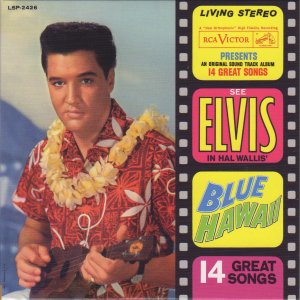
Elvis PRESLEY: Blue Hawaii


(#26: 6 January 1962, 1 week; 24 February 1962, 17 weeks)

Track listing: Blue Hawaii/Almost Always True/Aloha-Oe/No More/Can’t Help Falling In Love/Rock-A-Hula Baby/Moonlight Swim/Ku-U-I-Po (Hawaiian Sweetheart)/Ito Eats/Slicin’ Sand/Hawaiian Sunset/Beach Boy Blues/Island Of Love/Hawaiian Wedding Song

Elvis Exotica is a concept only imaginable in extreme retrospect, and I’m sure that enterprising souls at RCA (or elsewhere) will shove something resembling a compilation together in due course. It’s a pity that no one thought to link Elvis up with Martin Denny or Esquivel at the time, rather than rely on the stolidly stalwart likes of Tepper and Bennett to come up with pale photocopies. Still, throughout the Blue Hawaii soundtrack there are tempting hints of what might have been; Presley’s worried surfer of a voice floating carefully over shallow but colourful conduits of steel guitar, marimba, maracas and sombre Jordanaire harmonies, somewhat baffled as to how he has washed up on this island. In the film he is Chadwick Gates (as one is), a newly-demobbed GI (spotted the link yet?) who opts for the life of the beach bum over that of a trainee fruit company executive, much to the chagrin of his parents – one of whom, Angela Lansbury, was less than ten years Presley’s senior – and so Blue Hawaii set the tone for eight years or so of cinematic beach bumming, an era wherein Presley worked hard at seeming not to work at all, and probably wished that he wasn’t. My father – who knew his cinema, and knew his opinions even more – thought Blue Hawaii absolutely the worst movie ever made but I’m not sure whether he saw the subsequent Paradise, Hawaiian Style, next to which Blue Hawaii plays like The Magnificent Ambersons.

Presley’s sixties films by and large strolled carelessly (in all the wrong ways) through a dentist’s waiting office of glossy magazine covers masquerading as plots and the Blue Hawaii songs more or less act as the blandest of travelogues. Hawaii had only recently (August 1959) been admitted to the Union and was reasonably hip, but already the tourist industry was manfully assembling its own clichés and most, if not all, can be found here; “Aloha-Oe” is the same tune to which Spike Jones’ narrator previously announced their boat to be sinking slowly in the West, and though not straightforwardly structured – an out-of-tempo cod-operatic Hawaiian tenor introduction, oddly punctuated by Boots Randolph’s hissing tenor sax, and a final wriggle of an acoustic guitar chord which seems to cling on forever in the hope of something better – tells us instantly that tour guide is not Elvis’ calling in this life.

The introduction to “Blue Hawaii” itself is moderately startling, almost out of Les Baxter with its subaquatic booms of voices and eddying strings. Yet the song is an old Bing Crosby standard – possibly payback for Bing standing up for Elvis when first he appeared – and Elvis seems, here and elsewhere, to be marooned in a thirties neverland with controlled crooning and overbearing Jordanaires backing vocals (on “Blue Hawaii” they are back to their old tricks – “THE NIGHT IS YOUNG” and “AND SO ARE WE SO ARE WE” being the most intrusive). “Moonlight Swim”’s mild suggestiveness (“I’ll keep you warm/So very warm from your head to your feet”) is flattened entirely by the Anita Bryant disciples who come in and scrape their vocal nails down Elvis’ blackboard, such that the final effect is one of Rudy Vallee trapped in a greying elevator. “Hawaiian Wedding Song,” which went on to become one of Presley’s most popular stage songs of the seventies, dates from 1926 and sounds it; the arrangement is so suffocatingly “epic” (“Soon bells will be ringing” answered by the Jordanaires’ “ring, ring, ring, ring,” the latter crying out for a “w” prefix and a “their necks” suffix) that Presley sounds, as Lena suggested, as though he wants to marry the state of Hawaii rather than His Girl. His final cry of “blue skies” is a desperate grasp for oxygen in the sea that is placidly drowning him. He does a little better with “Ku-U-I-Po” despite, or because of, its strangely phrased sentiments (“I love you less today than I will tomorrow”) but “ Island Of Love ” is strictly tourist board daytime ad country.

“I resisted/Although my arm was twisted”
(“Almost Always True”)

Many of the songs of Blue Hawaii seem to have been sourced by sticking a pin in different issues of Billboard. Generally Presley sounds more engaged with the uptempo rockers – generally substandard though they are – and while Randolph’s excitable tenor and Hank Garland’s brake screech guitar (in an unusually long intro) make “Almost Always True” initially exciting, not to mention Presley’s expert ducking and diving into two-timing and mock innocence (the steady, minimalist drip drip staccato sequences which he swiftly terminates with an anguished/contented downward growl of “Ohhhhhh!!!!”), it took Lena to point out that melodically this was a recasting of children’s favourite “Alouette.” The fact that Elvis should spring to life singing a modified song about plucking the feathers of a dead bird should prove ample ammunition for future allegorists. “No More” also sounds suspiciously familiar in its Dean Martin-goes-Latin-for-a-day amble until you realise that it’s a reshaped “Amor” (subsequently a hit for Julio Iglesias in its original form).

Elsewhere there is congestion and confusion. “Hawaiian Sunset” is described as “peeping from the sun” (despite its melodic and lyrical portents of Richard Hawley’s “Darling Wait For Me”) and goes downhill from there. “Slicin’ Sand” is a feeble rocker (“Got a lot of ocean if it gets too hot”) with the Jordanaires loudly booming the song out of existence and Garland contributing a bored-sounding guitar solo. “Beach Boy Blues” is a case of pouring too many mixes into too small a pot; the Jordanaires’ bulbous bellowing battles with George Field’s harmonica, the rhythm section (and Presley himself) uncertain whether to rock or to play the blues ( Garland ’s solo does its best to negotiate midway). When singing “Only 30 days and 90 years to go” Presley sounds wearier and more prematurely exhausted than ever he had done, and the writhing continues until DJ Fontana mercifully puts the song out of its misery by hammering it to pieces. Worst of all is perhaps “Ito Eats,” a calamitous misreading of Harry Belafonte – and how and when did Hawaii suddenly become Jamaica ? Here, Presley sounds positively embarrassed, and with lines such as “Ito eat like teeth are out of style” and “He even eat the shell from the coconut” (are we suddenly listening to the George Mitchell Minstrels again?), nobody could blame him, apart from the terminal crime of going along with it and allowing it to happen. “Eat-o little faster!” he pleads (“One pineapple straight to the head!” yelled Lena ). It also bears one of the most bizarre endings to any Elvis song, a solitary, agonised, atonal, groaning, croaking Jordanaire (are we suddenly listening to Daniel Johnston?).

And yet and yet and yet…as with every manufactured clipboard of tourist attractions, magic sometimes occurs. The “Can’t Help Falling In Love”/”Rock-A-Hula Baby” double header single was huge and undeniably instrumental in keeping the soundtrack at number one for much of the first half of 1962 (though the single mixes downplay the more obvious Hawaiian elements) and even more surprisingly works. For once, on “Rock-A-Hula Baby,” corn though it may be (well, it’s sweetcorn), Presley actually sounds as though he’s enjoying himself, bouncing off the pinball streaks of steel guitar (Bernie Lewis, the album’s unsung hero). Even the Jordanaires are having fun, unchained with their near maniacal screams of “RockMAN rockMAN rockMAN!” (are we suddenly listening to the KLF?) behind Garland ’s unhinged solo, and wailing orgasmically over Fontana ’s closing drum demolition derby.

And the moment of true magic, of real blue in real air, dates back to 1780. “Can’t Help Falling In Love” was modelled on the song “Plaisir d’Amour” and with his reading Elvis stops the show altogether and starts other, newer things. There is no overarranging here – both marimba and steel guitar are positioned very subtly in the middleground – simply an ocean of celeste doo wop, weightless yet profound, Presley (relatively, emotionally) naked, offering his hand, his whole life too, kissing away the shadows of Rodgers and Hammerstein; as with its contemporary “Moon River” and its vague, slowly-to-the-sea metaphorical antecedent “Unchained Melody” its magic seems to shine a star upon the pop of its age. It utterly transcends the forced banality of its surroundings and reminds us of other important consequences which nobody could have foreseen from Blue Hawaii; not simply how deeply the record, as imagined experience, as sonographic environment, would have been absorbed and remembered by Brian Wilson (“Beach Boy Blues”) when he came to do SMiLE – and note how, in the final, reassembled SMiLE, his Worried Man’s adventures end – perhaps in the afterlife - in blue Hawaii, but also…well, throughout the album, quietly playing ukulele (and a little pedal steel guitar), barely noticeable but indispensable, appears Alvino Rey, grandfather of Arcade Fire’s Win and William Butler. If only Elvis had lived to sing “Wake Up” in an age when nobody would have been twisting his impossibly exotic arm.

Monday, 16 February 2009

The George MITCHELL MINSTRELS: Another Black And White Minstrel Show


(#25: 11 November 1961, 8 weeks)

Track listing: Meet The Minstrels (Ring Up The Curtain/Ring Ring Da Banjo/When The Saints Go Marching In/Chicago/You Made Me Love You/Mr Gallagher And Mr Shean/Put Your Arms Around Me Honey/Down Where The Swanee River Flows/When The Saints Go Marching In)/The Good Old Summertime (While Strolling Through The Park One Day/In The Good Old Summertime/Sweet Rosie O’Grady/I’ll Be Your Sweetheart/Little Annie Rooney/The Band Played On)/Alabamy Bound With Al Jolson (Alabamy Bound/Swanee/Is It True What They Say About Dixie?/Carolina/Toot Toot Tootsie)/The Old Ark’s A Moverin’/Western Style (Along The Navajo Trail/In Ole’ Oklahoma/Old Dan Tucker/Country Style/Skip To My Lou/Buffalo Gal)/Your Requests (Singin’ In The Rain/Together/No Two People/My Blue Heaven/Falling In Love With Love)/Ay Ay Ay! (Maria From Babia/I, Yi, Yi, Yi (I Like You Very Much)/When I Love I Love/The Bandit/Cielito Linda/Cuanta Le Gusta/I’ll Si Si Ya In Bahia)/More Stephen Foster Melodies (Hard Time Come Again No More/Gentle Annie/Way Down Upon The Swanee River)/Dry Bones/Goodbye-ee (Tell Me, Pretty Maiden/Put On Your Ta-Ta Little Girlie/Hello! Hello! Who’s Your Lady Friend/I Was A Good Little Girl Until I Met You/In The Twi-Twi-Twi-Light/Two Little Girls In Blue/Goodbye-ee)
Of the thousands of viewers who blew the ITV switchboard in February 1968 after watching the final episode of The Prisoner, it is likely that few had seen or remembered Ibsen’s Brand, or McGoohan’s apparently epochal performance as the lead in that same tractacus-as-play on stage in London in 1959. If they had done, they would have sensed the Brand allusions – verging on parody – in the climactic court scene, with Kenneth Griffith’s judge (or “President” as the credits had it) pleading with McGoohan to “lead us – or go.” The original Brand fails as a preacher or a leader because he cannot compromise the one-way bridge he has erected between faith and reason (cf. Kierkegaard); he knows that, because of the original sundering between God and man, the world can never be perfect, yet is driven to make that same world perfect even if no one else is willing to follow him and the whole world, including himself, is destroyed as a result.

There was that same sense of destructive perfection in McGoohan, a man constantly bewildered by the failure of others to see the world and life as he saw and lived it. The Prisoner’s rationale (and spearhead of attack against “rationalism”) is based entirely on freedom, but in McGoohan’s case freedom might have appeared to some to mean freedom to be left alone, to stand apart, to be a pronounced, hugely magnified individual, visible and unmissable in his individuality.

I was born too late and in the wrong place to see that barnstorming Brand, just as I failed to be alive when McGoohan played Starbuck to Welles’ Ahab in Moby Dick: Rehearsed, but as with so many of these life-altering experiences the dream is perhaps more pursuant, more cherishable, than any first hand reality could have been. When we consider McGoohan’s singular role in making television an art – and it is fully arguable that he was instrumental in facilitating that conversion – we have to think of Welles; Number 6 was McGoohan’s Kane, and it didn’t just come back again and again, regardless of what McGoohan went on to do after The Prisoner – he subtly carried on the series’ internal dialogue in the many episodes of Columbo in which he acted and/or directed – but refracted back onto what he had done before; think, as one of many possible instances, of the despairing, growling beast he portrayed in the latter stages of 1958’s Hell Drivers, less a thug losing his grip, more a Lear eviscerating his kingdom, screaming: “I AM NUMBER ONE!”

Nor was Welles absent from the making of The Prisoner; in town to do his bit on Casino Royale, Welles drove over to Borehamwood to visit his old friend – upon his arrival at reception, McGoohan joyfully announced “It’s all right ladies, let him through, genius is in the house!” McGoohan was shooting the crucial “Once Upon A Time” episode at the time and Welles helped out with the direction and made other key suggestions; somewhere there still exist films of dialogue from the 1955 Moby production, long dialogues between Ahab and Starbuck, out to destroy each other but still in the most precious depths of friendship, some of which appeared in suitably altered form in McGoohan and McKern’s variation on Beckett’s Endgame. And there was no escaping – least of all in “Fall Out” – the influence of Welles’ The Trial. But few paid attention to The Third Policeman.

It may seem wearily predictable to retain emphasis on The Prisoner in a career which spanned a jazz-drumming Iago (in All Night Long, with Mingus, Brubeck, Attenborough, Tubby Hayes, the other Beckett – Harry – et al), Jerry Lee Lewis as Iago (the McGoohan-directed film of Jack Good’s musical Catch My Soul), Disney and Cronenberg. But the series – just seventeen episodes, ten more than McGoohan ideally desired – not only raised the bar for television but virtually created it, and Dennis Potter, Alan Bennett, the Pythons and Jim Henson were only the most prominent television innovators who followed his path, knowingly or otherwise (Alexis Kanner in “Fall Out” miming to “Dry Bones” by the Four Lads - Canada sings Canada if we’re talking about a broken social scene - eighteen years ahead of The Singing Detective; and what is Basil Fawlty at the end but an ageing Number 6 locked into a diminishing circular hell of a Village? And as for Number 6’s other unlikely alter ego, Reggie Perrin, the exhausted man who vanishes on a beach and reappears under a different title…well, it could and should go on forever).

And yet it was also a programme which seemed to eat the rest of television as it set up its shop, including itself; contrast the relatively glamorous location shoots and setpieces of the early episodes with the blank childishness of “Once Upon A Time” or the unwinding of the ITC biscuit cutter melodrama spool which occurs throughout “Fall Out,” a piece more or less improvised as it was being shot. It drew some remarkable performances from undervalued actors; Colin Gordon’s two stints as Number 2, for instance, make one regret how badly this fine actor was wasted for virtually all of his career. And there were startling turns by people such as Eric Portman, Mary Morris and Nadia Gray, actors who didn’t make a point of appearing on television. Morris’ Number 2 in “Dance Of The Dead,” with all her foretelling of Thatcher (and astonishingly a last-minute replacement for an unwell Trevor Howard), might still count as the most frightening villain ever to appear on the small screen. Cuddly Patrick Cargill rips “Hammer Into Anvil” apart with something in him that is genuinely terrifying (and which he seldom displayed elsewhere in his long and distinguished career). McKern was famously driven to a nervous breakdown and/or heart attack by the intensity of the “Once Upon A Time” shoots and took a lot of persuading (not to mention a shave and a haircut, two bits) to be resurrected for “Fall Out” a year later, and yet even in his starkest moments there is a bearable lightness which strives to preserve his being.

Number 6, that entirely logical alter ego of Eastwood’s Man With No Name – their eventual and inevitable meeting in Escape From Alcatraz merely underlined that particular hall of mirrors – wants merely to retire from a world of which he has grown tired and finds himself planted in a world which he cannot quite understand, a compulsory retirement stripped of meaningful work in which he is encouraged to settle for less, fit in, comply. He paces every world he inhabits with the fatal impatience of someone unfit to live in any world – or for whom no world is entirely, i.e. satisfactorily, fit. McKern’s bank manager looks forward to the transformation of the whole world into the Village; McGoohan dreams of being the first man to live on the moon. It is telling that one of the few moments of extended peace he finds is in the self-directed “Many Happy Returns,” the first half hour of which contains perhaps a couple of lines of dialogue, both rendered in unreachable foreign – or invented – languages, as well as some of the most sublime images of the British countryside ever portrayed on film, easily comparable with the work of Michael Reeves. The London into which he literally falls – off the back of a lorry, if you will – never quite transcends the nature of a dreamed fantasy; the curious widow who offers him a kindness he had nearly forgotten (McGoohan is very moving in this sequence, as he tries falteringly to thank her), fashion shoots in Hyde Park Corner, the reassuring tones of Donald Sinden, the slightly nightmarish glare of Patrick Cargill. And it all turns out to have been a dream; he is obligingly parachuted back into the Village, the generous widow is the black-badged Number 2, the reverie swims to its graceful end.

Broadly The Prisoner is a story of three halves; he begins by repeatedly attempting to escape before realising that this will get him nowhere; then he attempts to understand and subvert the mechanisms (and mechanics) which run the Village; then his mind evacuates the Village altogether and we are thrust into the dreamed land of Westerns, Danger Man/Avengers pastiches, Number 6 portrayed by a different actor before he ends up, no longer dreaming, in the underground detention centre in which he might have been held all along (however long that may have been – years? A week? Half an hour?). And then he falls out of the bottom of the system. Nothing works out logically; no one – but no one - can be trusted (the woman who wakes up in a replica of her own house and becomes a screaming, gibbering wreck when she finds out where she is turns out to be a candidate for Number 1 – “It was a good idea and you did your best – I’ll stress it in my report”); the Moebius strip is surfed bilaterally; Sisyphus’ stone will be mounted again and again. Democracy is by definition pocket (“Free For All”), information cannot be confused with education (“The General”), the right to dream is almost worth dying for (“A, B & C”).

Or simply a portrait of a fatal purist determined to find out why everyone else is not like him – so 6 being 1 makes perfect sense; in fury, he is intent on creating a society of worshipful clones – or a far simpler portrait of a human being struggling to understand the world and relate to it. Consider how in “Do Not Forsake Me Oh My Darling” – one of the most dismissed episodes, but one of the most crucial - Nigel Stock as Number 6 suddenly, in his stout, fiftyish body, becomes everything McGoohan can’t be; he kisses his fiancée passionately (contrast with an eternally tensed up Number 6 who has an inbuilt difficulty dealing with women), his determination becomes focused, he is somehow adult in a way which 6 can never really grasp; thus the second childishness of the playroom and Number 48; the boychild running off with the little child-man, the better to begin a more colourful circle.

Or maybe McGoohan just caught The Black And White Minstrel Show on TV one evening and got irritated. Once again we have effusive (as in “effusion” in the knee) sleevenotes by Derek Johnson – it is beyond remarkable that this man was still the NME’s News Editor until well into the New Pop age – which in their somewhat forced ebullience betray the orders of the strapped down community. “…concentrating on the type of songs which are tailor-made for community or party singing,” “Always easy-on-the-ear, continually provoking memories” (of why they resigned?), “…keep feet a-tapping, to banish cares, and to create an atmosphere of bonhomie and carefree relaxation.” Questions evidently being a burden to others.

Moreover, Johnson is keen to paint a picture of the programme as the world’s greatest achievement: “Few will deny that the “Black and White Minstrel Show” is one of the most generally satisfying and consistently entertaining television presentations ever conceived in this country. Indeed, in one’s assessment of its merits, one could encompass the entire world…”

“The whole world…as the Village?”
“That is my hope. What’s yours?”
“I’d like to be the first man on the moon.”

What to say of the second Minstrels album itself? The musical focus seems to move away from placid accordion strolls towards energetic big band enemas but the concept is hardly less nullifying, if marginally more listenable. On the weakly positive side, Dai Francis seems to have done a bit more work on his Jolson impressions since last time, though by the time we reach his “Toot Toot Tootsie” Donald Duck has once again raised his beak and we get wordless elisions (“WAAAAAUUUUUGGGGHHHH!!”) reminiscent of Leslie Phillips slipping off a tea tray and landing in Joan Sims’ bath. Otherwise it largely remains a mystery how such difficult listening could ever have been categorised as easy listening. The Television Toppers girls appear to have attended refresher courses in estuary English with the expected dire consequences; witnessing them plod through the over-enunciated likes of “You Made Me Love You” or “I Was A Good Little Girl Until I Met You” (on the latter they are met by a sinister rising chorus of mass Jack-the-Rippers: “UNTIL YOU MET ME!”) is akin to listening to Margaret Thatcher auditioning for the Nolan Sisters. Their periodic squeals of “Hold me Ti-IGEEEEGHT!!” are unsettling in entirely the wrong way. Meanwhile, the boys chant “MY MY MY MY” or, much, much worse (on “The Band Played On”) “Oom-PAH-PAH oom-PAH-PAH!” and I have to be reminded that “His Latest Flame/Little Sister” and “Tower Of Strength” were riding atop the singles chart at the same time and that this was not the whole story, that the yearnings and intentions of early sixties youth could not be summarised by the verb “spooning” (as heard in the otiose “No Two People”), that “a cosy room” (in the second “My Blue Heaven” to arrive in as many weeks) does not have to be answered by a corny fragment of cod/sub-Shearing Swedish furniture “sophistication.”

When straining to expand their panorama, the Minstrels usually come a cropper; the Latin medley is intruded upon by incongruous Dixieland horns and if there were lovable, cheeky Southern black sharecroppers born within the sound of Bow Bells then the Cockney voicings of “Hello! Hello! Who’s Your Lady Friend” seem determined to prove that this is not merely careless thinking. Still more nauseating are the occasional uprisings of patently false bonhomie with whoops and cheers reminiscent of an office party where one is clearly being forced to have “fun.” Their “Singin’ In The Rain” is steadily drained of all life, aspiration and water with nauseating dots of “pitter patter” harmonies. As for the concluding “girlie” medley with such items as “Put On Your Ta-Ta Little Girlie” and “Two Little Girls In Blue” – the bluest of veils is best drawn over such affairs.

And yet two songs from this interminable medley of medleys – “I, Yi. Yi, Yi” and “Dry Bones,” the latter of which gets a whole track to itself – play crucial roles in the final episode of The Prisoner (well, the latter does, anyway; the former serves as a nice audiovisual pun to accompany the meltdown of Rover) and I wonder whether McGoohan had the Minstrels at least partially in mind when trying to set so many things right (“Toot Toot Tootsie,” along with Seeger’s “Little Boxes,” was also on the shortlist for songs to be played while 6 walks down the corridor of jukeboxes before McGoohan plumped for “All You Need Is Love”). “Dry Bones,” of course, being about rebirth, not to mention resurrection, not to mention clean slate, the right to embark upon a fresh start without the past tagging you like a can tied to the hind leg of a frightened dog (and all due acknowledgement to Simon Barnes for that metaphor); and so 6/1, 2 and 48 jive around in their truck on the A2 (but weren’t they in North Wales? Forget The Man Who Was Thursday at your peril – “I never knew that we were so close to London ”), absolutely liberated even though they are still, strictly speaking, in a cage.

Then there are the times when the Minstrels break away from possum-eating knees-ups, stop pretending to be someone else and begin to sing music they actually feel. Once again the Stephen Foster medley works well because it is clearly heartfelt and no showbiz is involved; just simple but effective choral work and at least the possibility of there being a lump in the throat – the closing “Swanee River” is done slowly and patiently, with a sadness which may or may not mask defiance. Also surprisingly successful is the “Western Style” cowboy sequence of songs wherein the Minstrels, singing authentically white music, suddenly sound entirely at home and at ease. The opening “Along The Navajo Trail” is a fine ballad reading and even the typical wake-up jumpcut to hoedown is manageable; here there seems genuine gusto (even if still relatively clichéd; “hear that banjo” being duly answered by a banjo, etc., and quite what a Bunny Berigan-esque muted trumpet has to do with barn dances is beyond my ken) and at least a semblance of life. And buried deep in the busy scratch mix towards the end is “Buffalo Gal” and it is impossible not to see a fifteen-year-old Malcolm McLaren taking notes.

This is not the only unexpected trail laid by the record; the album concludes with the old World War I song “Goodbye-ee,” and I note that a not dissimilar version of the same song made the Top 40 towards the end of 1975 under the name 14-18, a pseudonym for the young Pete Waterman (in conjunction with the other Peter Shelley). Curiouser, however, is the album’s colourful inner sleeve, listing other HMV albums the listener might wish to buy; one side is devoted to classical music, whereas the “popular” side advertises, as well as songs from The White Heather Club and Joe Loss’ Come Dancing, records by Ella Fitzgerald, Lloyd Price, Ray Charles and, dominating the list at top left, An Evening With Paul Robeson. Did the success of the Minstrels – over Christmas 1961 they held down both first and second places in the album chart – subsidise the production of the real thing? When one considers that HMV at the time also had the UK rights to the Impulse! Catalogue – so that other 1961 releases would have included Coltrane's Africa/Brass – the mind starts spinning as busily as the inner workings of Number 1’s rocket (to destroy or recreate the world?). Still, the second Minstrels album plays like Village music to which not contributing to “community singing” would doubtless be deemed “unmutual.” When McGoohan becomes himself again, the Beatles start playing. We have, of course, several more steps to take before we reach that door marked “WELL COME,” and they do not all trace as you might expect.