Thursday, 3 June 2021

PULP: Different Class


(#540: 11 November 1995, 1 week)


Track listing: Mis-Shapes/Pencil Skirt/Common People/I Spy/Disco 2000/Live Bed Show/Something Changed/Sorted For E's & Wizz/F.E.E.L.I.N.G.C.A.L.L.E.D.L.O.V.E/Underwear/Monday Morning/Bar Italia


Had I begun this tale twenty years earlier than I did, then I might have had a very different story to tell about this record. Perhaps this current story will not be too different; I won't know until I've finished writing it. 


However, while Then Play Long centres upon how we feel about particular records now, as opposed to a chimerical "then," to deny my own past would represent a dreary and decimating dereliction of duty. The first piece of music writing that I published online - getting on for twenty years ago now - was about Pulp. Laura and I loved Pulp. I'm not going to kid on to you that we didn't. They were, by some considerable degree, our favourite band. We saw them at the Shepherd's Bush Empire on 19 October 1995 - the Thursday before this album came out - when they were supported by the long-forgotten art-pop collective Minty (which had previously involved the late Leigh Bowery) and performed a fifteen-song set, including two encores and eight of Different Class' twelve songs. The record wasn't even available yet, but everybody sang along, word-perfect, even to things like "Pencil Skirt" and "Live Bed Show." We emerged from the theatre, jubilant, and at Jarvis Cocker's personal request helped restart his stalled car.


It was a glorious evening - and it was, for us, a moment, perhaps the apex of this curious phenomenon called "Britpop"; that is, if you don't count their performance at the Theatre Royal Drury Lane on Sunday 18 December 1994, where we heard "Common People" and "Underwear" for the first time, although the evening's biggest hit - inspiring so much dancing that the theatre's ancient balconies were in danger of imminent collapse - was "We Can Dance Again," surely a number one to come (as it turned out, the song didn't make the final cut for the album, presumably because it was thought too similar in structure and approach to "Disco 2000," and it was eventually recorded by the London indie band Spearmint, although Pulp's own demo of the song can be heard on the second CD of the deluxe edition of the album which appeared in 2006).


But we had known about Pulp since their first John Peel session in November 1981 (the song "Wishful Thinking" seems to emanate from an entirely different musical universe). They had been the perennial, stalwart underachievers on the British indie scene right through the eighties. As late as October 1991, when "My Legendary Girlfriend" had come out and people were beginning to take serious notice of the band, I saw them third on the bill one Friday at the Town and Country Club, dutifully supporting Slowdive and Catherine Wheel.


And when they became famous - it was, I think, a foregone conclusion in Cocker's mind that when he came up with the idea for "Common People," this was destined to be his moment - it felt euphorically good. Here, at long last, were a band who spoke for us; the disenfranchised autodidactic intelligentsia. laughed at and openly scorned by people in the street or the supermarket (and by some people in Drury Lane that Sunday evening - no, I haven't forgotten or forgiven you c*nts; why were you even there?), those who were already being denied the lives permitted to boorish others. Oh, I empathised all right, and if Laura were still here she'd tell you the same thing.


A moment from one of the emails Laura sent to a friend some 2-3 weeks before she died - she talked about Jarvis Cocker being funny, down to earth and genuinely intelligent, as opposed to what she perceived as the schoolboy antics of Oasis; oh look, we're swearing and being loudly controversial, aren't we big and clever?


That about sums Cocker and Pulp's wider appeal up. Equally, however, I see with dismay repeated references in the writing of now about that golden age of "Common People," invariably accompanied by stock photos of Cocker as he was over quarter of a century ago, and despair at some people's evident inability just to let go. Really, it is like Lester Bangs encountering the teddy boys of 1977, forever scanning and reliving the old days when they and their culture mattered. As he said about the Lennon mourners in late 1980; it's not him you're mourning, it's your own past.


With the benefit of our old "friend" Captain Hindsight, I can also glimpse what might be rather patronising views of the working class from the grammar school-educated son of a Conservative councillor. Do "common people" really do nothing but dance and drink and screw? Are the others really "so bleeding thick" (and this is not a new complaint; the previous album's "Joyriders" referred to the protagonists' inability to do anything other than "eat, shit and drink")? And as for "Mis-Shapes"' masterplan to win the war using "our minds," one can view the present carnage and sardonically observe: well, that way of thinking worked out successfully, didn't it, Jarvis (the white-shirted beer-drinkers were always going to have the police, army and media on their side - that is if the whole stance isn't recognised as the chimera it is, engineered by cynical, monied scavengers, most of whom went to Oxford or Cambridge)?


Nonetheless, to press that point now would taste like the sourest of grapes. How does Different Class stand up as an entity? Cocker took the band into the studio with only two songs ready - "Common People" and "Underwear." He felt it vitally important that the former be released, at least as a single ("Underwear" initially appeared as the B-side), and when it broke as big as it did, Island Records politely asked when the rest of the album would be arriving. In a frenzy of activity, Cocker and the band came up with another dozen or so songs in relatively quick time - possibly reminiscent of What's Going On?


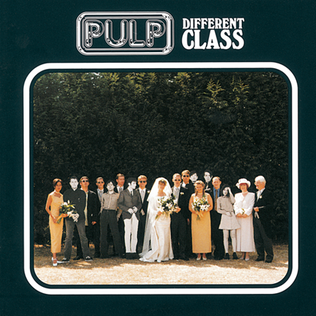
The album came decorated by pictures of various idealised suburban middle-class scenarios into which lifesized monochrome cardboard cutouts of the band members were inserted. The analogy was clear; they wanted to break into that complacent and otherwise inaccessible world and shake it up a bit. The opening "Mis-Shapes" - coming on like a Broadway musical overture, as I am sure was the intention - makes their mission, and Cocker's immense personal anger, clear. Chris Thomas' production is trebly and compressed but not muddy.


As for "Common People" - and it has to be listened to in its full-length five minutes and fifty seconds, in context - this song seems increasingly like an Exocet aimed at the rest of mid-nineties mainstream society, let alone its pop. He begins by humouring the Greek student (who appears to have been based on Danae Stratou, the future wife of the former finance minister Yanis Varoufakis) but becomes increasingly impatient and angry with what he sees as a fatally condescending attitude towards "the lower orders"; in the song's final verse, routinely excised from oldies radio spins, his is a terrifying rage, backed by what sounds like a vacuum cleaner being switched between two speeds. I have caused raised eyebrows in the past by comparing Cocker's singing to that of Bob Geldof (it's there - listen to "Pink Glove") but "Common People" seems like the end stage which the Boomtown Rats could never quite reach - the stagey, practised furrowed brow of "Rat Trap" explodes into a kaleidoscope of, "oh, but you don't know the HALF of it!"


Many still regard "Common People" as the apex of Britpop and Different Class the album which justified the entire movement (if it could so be termed). Yet what seemed so funny at the time - oh, look at daft, geeky Jarvis on "I Spy" making out like he's Intake's Serge Gainsbourg - now sounds positively scary. What the fuck is going on in the pensive, shoegazey (it had to be said) "Pencil Skirt"? Her and both of her parents?


And when we reach the big setpiece "I Spy," one has to wonder what he is fighting against. He seems to loathe both his fancy bit on the side and her unseen, unheard husband with equal intensity. All that matters to him, as he indeed mutters ("It's not a case of woman v. man, it's more a case of haves against haven'ts"). Sidestepping his subtle nod to Morrissey ("except that you're clever swines" - but he is a month older than Johnny Marr), the Anne Dudley orchestration, the Sheffield setting and especially the song title and its setting, can all be regarded as an extreme development of what Martin Fry had suggested on Lexicon a lifetime earlier.


Perhaps the icily forlorn couple of "Live Bed Show" - the record's greatest song, up, or down, there with "You Don't Bring Me Flowers," "You've Lost That Lovin' Feelin'" and especially "Always Coming Back To You"; never in pop has so much sorrow been poured into the words "seven years ago" - are the same couple being targeted by the protagonist of "I Spy." Is Cocker singing about himself, or does the plaintive voyeurism of "F.E.E.L.I.N.G." and "Underwear" stem from what, of all unlikely forebears, Momus had proposed back in the eighties ("Closer To You," "A Complete History of Sexual Jealousy [Parts 17-24]")?


Pulp were about sex in ways which the rest of Britpop never quite addressed - with the pronounced exceptions of Elastica and Blur (Cocker's subjects here are the same as on "Stereotypes," but not spoken about at one remove). And yet they were also about - if not exactly celebrating failure, then making it a mainstay of their approach. Perhaps the saddest thing about "Disco 2000" is that it's still being played twenty-one years after its time has passed, but its dance gallop barely conceals a bitter self-realisation of the singer's unutterable, premature failure as a functioning human being. He never gets to be with Deborah and, decades later, she has become a wife and mother and he seems to have progressed nowhere. The concluding asides ("What are you doing Sunday," etc.) are ineffably tragic (the real Deborah, who was actually Deborah Bone MBE, became a distinguished NHS worker in the field of mental health, and was amused by the song but said that her house was bigger than Cocker claimed and that it most definitely did not contain woodchip on the wall! Sadly, she died of multiple myeloma aged just fifty-one in December 2014, the day on which her MBE nomination was announced).


Returning to the Shepherd’s Bush Empire performance I mentioned at the beginning of this piece: Pulp have just played their then-current single, “Sorted For E's & Wizz” to a tumultuous reception. After the applause and cheers have died down, Jarvis reflects aloud to his group having been kept at number two for the second time that year, “this time by Mick Hucknall.” Cue loud boos. “He’s a decent bloke, though,” Cocker muses. “Sound politics.”


“Sorted” was issued as a double A-sided single with “Mis-Shapes” to pacify nervous radio programmers, but everyone bought the single for “Sorted” with its brilliant fusion of Ziggy Stardust and Unique 3, where Cocker dares to suggest that the rave culture might simply be the newest and most desperate of façades: his final, sobbed whisper of “What if you never come down?” is one of the most quietly terrifying endings of any pop song - and that ending's implications will reverberate dramatically in times to come ("Weak Become Heroes" by The Streets outlines exactly what happens to you when, or if, you never come down). "Mates" for a few overnight hours, and then it's "who the hell are you, pal, piss off" premature, greying sobriety. "The scene" is not a substitute for humanity.


"Something Changes," with its arch of a string figure from Anne Dudley which will go on to act as a sort of leitmotif on The Lexicon Of Love 2, represents the only time on the record when Cocker is happy and settled. Even here, he can't stop asking himself pointless "what if" questions, as though this weren't his romantic ideal, but the invisible "she" laughs softly, tells him to quit the pointless pondering and kisses him, and he's finally content with that.


The album's final two songs are linked. "Monday Morning" is a desperate study of untrammelled hedonism which culminates in unearthly shrieks and screams from Cocker, as though experiencing the same nightmare Bowie's brother had all those years ago watching Cream. Finally, its comedown sequel, "Bar Italia," a woozy singalong; it is actual Monday morning, everybody else in the "normal world" (still seeming "very, very far away"), and the Worried Man and his unnamed companion are staggering through the Soho streets, sleep-derived and hungover, attempting to continue living. Despite all of what he said before, he still ends up in trendy Soho. Is his doom sealed?


* * * * * *


Different Class is the final "Britpop" album of 1995 (and perhaps of ever) that I'll be writing about, and most people still regard it as Britpop's highest point. It topped that year's SELECT Magazine albums poll, came joint top (with Maxinquaye) in Melody Maker and won the Mercury Music Prize for 1996. It probably spawned as many poor imitations as Closer had done before it. Yet this was chiefly the work of a mind reared on the ethics (or non-ethics) of Closer. Cocker was, at the time, thirty-two years old - only three months younger, and in the long run perhaps somewhat less of a sex symbol, than George Michael - and only very slightly younger than Joanne Catherall and Susan Ann Sulley of the Human League.


Cocker was somebody who had waited an awfully long time to have his pent-up say. Perhaps that's why I identified with him so strongly; it was as if I had made a record in 1995. Where does it stand today, and who really cares? Were I a boxing commentator, I'd survey this year's Britpop albums and remark "I made Black Grape win that round" because, virtually alone, they are having uncomplicated fun and don't give a shit. Sometimes the prize goes to the player or team who need it least.


Had I the proper time and resources which this tale deserves, I would bring other significant Sheffield-based albums of 1995 into arenas of detailed comparison - Octopus by the Human League, I Was Born A Man by Baby Bird, Your Majesty, We Are Here by Earl Brutus, to name but three - and would also comment on how close the desired meeting point of "Disco 2000" is to the Coles Corner of which future Pulp aide (but, in 1995, still a Longpig) Richard Hawley would sing a decade later. But it does feel, in retrospect, that Different Class - the double meaning of that title need not be emphasised - marks the end of something. These days that we were so fortunate to have seen and lived through; Jarvis, the days that we have seen!

Wednesday, 2 June 2021

SIMPLY RED: Life


(#539: 21 October 1995, 3 weeks)


Track listing: You Make Me Believe/So Many People/Lives And Loves/Fairground/Never Never Love/So Beautiful/Hillside Avenue/Remembering The First Time/Out On The Range/We're In This Together


The fifth Simply Red album almost certainly went quintuple-platinum on the back of “Fairground,” a strange candidate for their only number one single, and a rather more complex opponent than songs “we” sang in the war (see entry #541).


For a start, “Fairground” is the least typical and most experimental of all Simply Red singles. Making heavy use of a percussion track sampled from Dutch dance group the Goodmen’s 1993 top five favela-House hit “Give It Up” (acknowledged by Hucknall in the line “Let’s make amends like all good men should," and in the album's credits, where he identifies the primary source of that sample, namely "Fanfarra (Cabua-Le-Le)," the opening track on Sergio Mendes' 1992 album Brasiliero), there are at least two other tempi superimposed on top of the basic rhythm with a disorientated synth-organ floating rootlessly around Hucknall’s equally atypical whispered, vibratoless vocal, which in turn seems to give a very different perspective on the rave scene, and a noticeably more sinister one, since the song – I keep thinking of “Driving Away From Home” by It’s Immaterial for some what-if-Hucknall-had-stayed-indie-for-a-little-while-longer reason – appears to concern itself with the singer, either alone or with friends, driving around endlessly at night, stopping every so often for “pleasure at the fairground.” The source of this pleasure is located in the someone who’s always leaving alone.


Then, in its choruses, the song shifts into a jaunty, Chris Rea-style motoring salute (but with that House piano persisting amid its jangle): “I love the thought of coming home to you/Even if I know we can’t make it,” and while I do harbour some affection towards the record on account of that first line – very pertinent when you’re returning home, knackered, on an Oxford Tube coach and trying to persuade the driver of the 100 bus at George Street that your monthly pass is valid on local services – the confidence with which Hucknall sings the second line is almost irrational. “Yes, I love the thought of giving hope to you/Just a little ray of light – shining through.”


While I suppose this could be the record singing to its buyer, the picture becomes clearer; this is a “Wherever I Lay My Hat” scenario, the “fairground” a metaphor for a Simply Red gig, Hucknall meeting the fans backstage and maybe taking one or two home with him for a one-night stand – but still he remains rootless when he’s back on the tour bus, and the road stretches forth with no apparent end. From accounts of the period, and by Hucknall’s own admission, this would not be farfetched, and not that far from the Rod Stewart of “You Wear It Well” either, but at least he wears his odd mixture of shame and swagger with considerably more grace.


The rest of Life is, sadly, a masterclass in eventless centrism.  Stars had been an inventive, enterprising and sometimes challenging record, but here Hucknall seems only too happy to be the rootless global wanderer, and everywhere he treads you can hear the squelch of bland broth. He addresses the state of the planet ("So Many People" - "Love is not only for the human"), continued extended political metaphor (the "revolution" at the centre of "Never Never Love") and emotional collapse ("Out On The Range" with its moderately intriguing chord progressions), but Ian Kirkham's multitracked blanket of saxophone security overdoes the smoothness (though the device will be used to rather greater rhetorical effect elsewhere; see entry #549) and the overall picture is that of a rich, if deeply worried, man strolling aimlessly through an endless shopping mall of a Wednesday afternoon.


Names like Sly and Robbie, Bootsy Collins and Hugh Masekela turn up here and there, but they cannot lift the heat haze of consensual dullness; it is rather absurd that singing in a cod-Jamaican accent was still considered a thing in 1995 ("Hillside Avenue"). The non-committal gloop-filled pomposity of "We're In This Together" convinced FIFA to use the song as their "official" Euro 1996 theme, but England fans weren't fooled and cheerily went for chanting the proudly unofficial "Three Lions" instead. The problem of Life can be summed up by the chorus of "Walk On The Wild Side" derivé "So Beautiful" - "So beautiful, but oh so boring - I'm wondering if anyone out there really cares." Where be the blood and fire, or were these not considerations any more? The distance from Denton, where Hucknall grew up, to Burnage is nine miles. The aesthetic distance of Life from its predecessor at number one seems more like nine years.

Tuesday, 1 June 2021

OASIS: (What’s The Story) Morning Glory?


(#538: 14 October 1995, 1 week; 13 January 1996, 6 weeks; 2 March 1996, 3 weeks)


Track listing: Hello/Roll With It/Wonderwall/Don’t Look Back In Anger/Hey Now!/Untitled track (a.k.a. The Swamp Song – Excerpt 1)/Some Might Say/Cast No Shadow/She’s Electric/Morning Glory/Untitled track (a.k.a. The Swamp Song – Excerpt 2)/Champagne Supernova


Let me tell you why we make a fuss.


We are forced to make a fuss because it's the only way you'll listen to us.


Because otherwise people like me, who have been meticulously hacking away at the coalface of music writing for nearly twenty years - that's a generation - won't get listened to, or end up getting patronised or belittled, or are made to feel like Alison Moyet does in that song or Arabella Weir in that sketch - invisible.


Because you view us as low-level filth, the shit on the toes of your societal shoes.


All of you, from schooldays onward -  the down-the-nose sneering happened then, oh yes it did, the smug ones with the cosy detached houses in Douglas Gardens and Kylepark, those who probably have still never had to worry about a thing in their lives; oh look, they live in a tenement on the Main Street, they have to order school uniforms through the catalogue, haha fuck off you scumshite.


Yes, that wacky psycho Carlin and his weird books and weirder music, he's no proud son of the parish, he's going to end up in a bad way, he probably won't make it to twenty-five. From those who were already learning to drive aged sixteen because their parents had cars, I mean excuse me for being born! Not like all we proper middle-class types in the A stream who are being trained to run things, or the factory/office fodder in the B stream who will take our orders, or the no-hopers in C.


And it didn't end at school and still hasn't ended - everywhere I have tried to get in life has been systematically blocked by the privileged, by those who do not miss the merest opportunity to remind me that I am inferior and should bend my head. That includes empire-building former Eton head boys who begin a music blog and proceed, with their pals, to rub my nose in it, or, as has happened on more than one occasion (Resonance FM, the k-punk anthology), to pretend that I never existed.


If the shop isn't closed, rest assured that those who run things will rush to close it. A closed shop, everywhere I look. Whether in print or online, the same narrowing circle of names recurs over and over, like Chinese water torture, with all their long-standing mates applauding each other. That stands for music writing as much as anything else; the "pioneers" of the seventies and eighties have pulled up the drawbridge ladder behind them, to ensure that no further generations gain access to their fort, other than the compliant ones who get invited inside.


Lester Bangs wouldn't stand a fucking chance of getting anywhere now; who'd employ him these days? An individual voice? Perish the thought; it's not "house style," that supreme slayer of character and humanity.


I posted a 100-track, nine-and-a-quarter-hour-long Spotify playlist last week, outlining all the great music from 1977 that wasn't punk or new wave. To date the playlist has received thirteen "likes." Whereas those who are "better known" online post the most elementary of playlists and get a hundred likes an hour.


How much longer am I expected to fart against thunder?


But yes, I am apparently of the "lower orders." Didn't go to a public school. Went to Oxbridge, too (one of only two pupils in my entire time at school who made it - so at least one of us was serious about getting there, and it wasn't the one my best friend at school thought it was going to be), but that doesn't seem to have made any difference to my life, nor the prizes or scholarship and suchlike. More fool me for being a dullard and working and studying, when I should clearly have been spending my time networking with the "right" people.


So it is that people like me who don't all have it laid out for them have to try harder. We want it more. We want what you are withholding from us - does that sound pre-emptively familiar (see entry #540)?


It is a working class thing and as far as this piece of writing goes it's also a Northern Celtic thing. Because what do you do when all the doors are systematically slammed shut in your face on account of who you are and where you came from?


If you have it, you use what we in Glasgow call "the patter." That's what got me into Oxford (that plus, admittedly, some actual previous experience of university life, at St Andrews - it does help if you know the territory), not exam grades - they don't give a toss if you have three As and a B or three Bs and an A, they're interested in seeing how you're going to fit into their environment. It's all about the patter. You talk non-stop, off the top of your head, and express what is inside you. Not all that received crap you're expected to express. In other places they call it "chutzpah."


The Gallaghers, they have plenty of patter, and Christ how splendidly they use it (still). Won't let us in, Scene That Celebrates Itself? Fine...we'll just break the door down and upend your complacent little set-up. You music papers who sneered at us because your middle-class student demographic wants evasive artiness rather than direct communication - well FUCK you, you don't matter (never did - I remember the late seventies when they all wanted their arty pet mascot Howard Devoto to become a star, and how dare Gary Numan from Hammersmith overtake him on the outside populist lane!).


They sneered at the second Oasis album too, and no I'm not going to get all sodding Captain Hindsight revisionist and pretend to be all cleverly detached from the Morning Glory experience. They got the album title from the movie of Bye Bye Birdie, whose authors got it from Mary Lou Williams, but what is this, the ground floor of the Naismith Memorial Basketball Hall of Fame?


Who couldn't identify with that cover, taken at about 4:30 a.m. in an empty Berwick Street, the sun rising and everything reeling with hope and promise? It felt, as did Oasis in general, like a fresh start (whereas the primary function of The Great Escape may perhaps have been to help bury the old order of things), a start which those whose profession is to hate "us" could never understand (see also the preferential treatment given out to Luke Haines, the Howard Devoto of the nineties).


Because the sunrise of Morning Glory rose over and cut through everything. It's no accident that the title track, "Champagne Supernova," "Roll With It" etc. sound like folk songs since that is basically what they are - updated, furiously compressed jigs. Theirs is a far more populist take on the we're-here-for-YOU contemporary folk groups like the Levellers or Carter USM, because these songs are really here for everybody, especially those who had long since stopped buying, or buying into, music.


The twelve songs on the main album - had it not been for Stevie Wonder's lawyers not unreasonably wanting a royalty share for "Step Out" (as with the Kevin Rowland/My Beauty/"Thunder Road" situation, this may have been the case of McGee's people simply neglecting to process the necessary legal paperwork) it would have been thirteen - are linked, for those with the open ears to listen, right from the beginning, when we hear Noel Gallagher practising his wah-wah guitar perched high on a wall outside Rockfield Studios in deep rural Monmouthshire (wonderwall - you see?) at about six in the (late spring, hence still cold) morning to an audience of bemused cattle, with accompanying birdsong and passing traffic; the odd tonalities you hear occur when he accidentally steps on and breaks his wah-wah pedal.


That launches straight into "Hello," and they are fully back, louder and less compromising than ever, singing about how they can't live in the shadows any more (there'll be more about that later on the record) with a demonic shuffle which puts the polite likes of the Wonder Stuff to frank shame. The maximalist compression which producer Owen Morris puts on the band's work as a whole tends to make their music come over as a flaming remnant of "rock" - it is all treble, with bass and drums mixed back to a semi-distant supporting role. This outlines the continuing influence of My Bloody Valentine and Loop on their rockier music. It is not quite rock, yet at the same time manages to exceed rock. The P Gadd quotation at the song's end - remember, this was a time when the not-yet-disgraced glam-rocker abided in the suburbs of National Treasure status - is merry, insolent and entirely fitting.


Then it's hit after hit after hit, as all the best albums are. "Roll With It", then "Wonderwall," then "Don't Look Back In Anger." That's a pretty unanswerable triptych which also covers the entire gamut of Oasis' approach; the upbeat(-ish) rocker, the pensive ballad, the anthemic singalong. Much Captain Hindsight X-ray vision has been applied to the meaning of "Wonderwall" - it's about Meg, it's about a one-night stand in Glasgow who insisted on giving Noel Gallagher a wishing stone (hence the song's working title for ages was "Wishing Stone"), it's about a Harvey-style non-existent friend to whom to turn in times of woe, it's about basic insecurity.


It actually doesn't matter what the song's about. What did matter was the aesthetic scythe that it cut through the iceberg of received opinion about pop. "Wonderwall" broached everybody's barriers, including mine. This was when the song and album were new and the wonder had not yet been ironed out by chronic radio overplaying. "I don't believe that anybody feels the way I do about you now" touched people who didn't buy records or keep up with the charts or the music papers, particularly when sung by what sounded like the Incredible Hulk seeking reform. The voice is deliberately coarse, rough and unrefined - and there is a rare directness which this roughness conveys to the listener. It was like Johnny Rotten fulfilling his life's concealed ambition of going on Radio 4's With Great Pleasure and reading poems. The piano coda, which utilises no more than four different notes, is all that the song requires. What sounds like a 'cello is probably a mellotron or a Kurzweil string synthesiser (ironically, the latter set of keyboards was co-owned, as a brand, by Stevie Wonder). I note that the ending to this globally popular song deploys a Cocteau Twins guitar coda. Nobody felt the way they did about Oasis with anybody else on the scene, that was for sure.


As for "Don't Look Back In Anger," well, it is a portrait at one remove of what was commonly perceived as "post-war Britain" - but, then again, wasn't "Revolution 9"? It was, again, a folk song of succour for what was effectively a displaced generation; it was grand, not quite as predictable as you might recall - those strings are definitely Kurzweil flyers, while the song's frame of reference manages to encompass both John Osborne and the Thirteenth Floor Elevators - and finally rather moving; Noel sings it alone, as he was maybe always meant to, and niftily pricks any potential nostalgia balloon by pleading with his audience not to put their lives in the hands of a rock and roll band - what can we do, he seems to ask, when you look at how spectacularly all of our predecessors screwed things up? There are different interpretations of "Sally" and whom or what, if anyone or anything, she is waiting for (though Noel is adamant that it isn't the Sally of "Sally Cinnamon" by the Stone Roses, whose influence on this album is imperceptible), but anyone of an Irish upbringing will immediately know what standing up beside the fireplace and taking that look right off your face (so I can take your picture, young man) means.


That in turn leads me to think that "Don't Look Back," a song whose subject is pointedly about not living in the past, has some rather elegant red Beatle John herrings. What the song reminds me of far more securely is the "real" people's music of the sixties, which never really "swung" outside of central London, the sternly sexless but reassuring ballads of the likes of Jim Reeves and The Bachelors, the music which got deliberately phased out by 21st-century media (but which stations such as Boom Radio UK are currently attempting to rehabilitate). That music acknowledges, and speaks up for, a deep and long-enduring tradition (for many, including, I suspect, the Gallaghers' parents, the defining song of 1967 was not "A Whiter Shade Of Pale," but Frankie McBride's "Five Little Fingers").


How is "Don't Look Back" folk music? It isn't just because of its use as Daniel Craig crosses that bridge at the end of Our Friends In The North. In May 2017, following the Manchester Arena bombing, the song became a symbol of both remembrance and endurance. People started singing it together, spontaneously, in Manchester city centre. Half of Coldplay performed the song at the One Love Manchester concert a week later. It revealed itself as something deeper than some had assumed a generation earlier. The song, as with Oasis' best songs in general, had become embedded in the soul of Manchester. It was meant for the city's people and sung with and by these people.


As I intimated earlier, don't you fucking sneer at us.


"Hey, Now!" is an immense, slithering wall of post-MBV glide with great propulsion, if an inconclusive ending to side one ("Step Out," one of the band's best rockers, part "Uptight" and paer "Rosalie" by Bob Seger, no doubt via Thin Lizzy - who of Noel's generation of players didn't practise their guitar to the accompaniment of Live And Dangerous? - would have provided a real uplifting climax).


The ghost of a late sixties blues jam floats by momentarily in the middle distance, before side two commences with "Some Might Say." The song is monumental, and deliberately set out to be as such. Rather than reheating the dessicated leftovers of 1969 Abbey Road, the song actually represents the subtle triumph of shoegazing.


Its stalwart avalanche of largely hand-free guitars (assisted by a judicious use of echo and delay by Owen Morris) would not have been conceivable without the prior examples of MBV, Ride and the pre-“The” Verve. Over this seamless mineshaft of amethyst rock, Liam twists his vowels so ardently that they virtually become another layer of abstract sound to ride astride all of the others – so the purposeful nonsense of dirty dishes, sinks full of fishes and education in the rain make perfect sense, but so do the more telling words: “Some might say they don’t believe in heaven/Go and tell that to the man who lives in hell,” is an admirable spear of directness, and the fervent connection which the group still felt with their fanbase is celebrated in the socialist couplet: “Some might say you get what you’ve been given” (the latter half sung by Liam with genuine smouldering rage) “If you don’t get yours I won’t get mine as well.”


The song's speed is slow and authoritative, but as Liam turns from his itching dog to exchange chants of “You know what some might say” with Noel, as the latter’s lead guitar prepares to take off, the song moves into a blissful state of exultation which was sorely needed at this time – compare Ali Campbell’s indifferent “whoo!” near the end of Pato Banton’s “Baby Come Back,” a number one single a few months before "Some Might Say") with Noel’s gliding yelp of “Whooh!” here – and handclaps and snare drum smacks help the massed guitars to ascend into Hüsker Dü (via the Wedding Present – remember “My Favourite Dress”?) territory (the Americana reference is not gratuitous; the song was apparently inspired by Grant Lee Buffalo's "Fuzzy," which makes perfect sense - "We've been lied to"). A record worthy of proper awe, “Some Might Say” finds Oasis at their unassailable and justifiably insolent peak.


Having proved their point, Oasis now proceed to explore less obvious musical avenues. "Cast No Shadow" tweaks the "Wonderwall" template into picturesque lamentation, and since the song is dedicated to Richard Ashcroft, it fittingly sounds more Verve than The Verve. Once again, the words take precedence over any assumed meaning - they could be singing about any downtrodden working man who treads the lifelong avenue of painful compromise. Those who still hurt from Thatcherism and its consequences knew exactly what was meant by "As they took his soul, they stole his pride."


"Bound with all the weight of all the words he tried to say" - tell me about it.


"She's Electric," in contrast, is stupidly dopey and lovely. Is it a go at "the Blur song"? Perhaps, perhaps not - but its likeable cheer, its children's television paraphrases, its midpoint between "With A Little Help From My Friends" and "The Passenger" made one feel alive that shadily sunny Saturday morning of late 1995. Sunshine to chase away learned doom.


But then it is a direct plunge into the hallucinatory hospital nightmare ("need a little time to wake up", indeed) of "Morning Glory" itself, which again is an assemblage of various elements of The Sixties, particularly Vietnam, but which also, one-third of the way through, unexpectedly detours into an extended passage of rootless guitar noise which is a direct descendant of "You Made Me Realise." As with much of the album, I am surprisingly put in mind of R.E.M. (yes, I know, "The One I Love," but also "World Leader Pretend" and "Ignoreland"). Already, as some commentators noted at the time, U2 were now more palpable rivals for them than Blur could ever have been.


Slowly crawling out of this post-intensive care syndrome scenario (I experienced it three summers ago, so know precisely what I'm talking about), we encounter another fleeting glimpse of blues-rock, complete with agonised harmonica, before we settle most gracefully and gratefully in the bring-our-survivors-home finale of "Champagne Supernova." Or so we imagine, before guest "supersub" Paul Weller comes in and takes the song to a thunderous Crazy Horse climax before it subsides once more into satisfied silence. As for that couplet - if you'd ever seen Chigley, you would have known what "walking slowly down the hall" meant, while "faster than a cannonball"; well, isn't speed all relative when you're getting high? Millions of people singing it weren't bothered by the absence of wry lyrical curlicues - the song got into their gut. What the hell did "awopbopaloobop" etc. mean, other than, move over, it's our turn now?


And then, in 2014, the thing was deluxe-reissued with two bonus discs, one of which contained all the single B-sides and other miscellanea:


What's The Story) Morning Glory? - Back Cover - Michael Spencer Jones – The  Archivist's Gallery


Track listing: Talk Tonight/Acquiesce/Headshrinker/It's Better People/Rockin' Chair/Step Out/Underneath The Sky/Cum On Feel The Noize/Round Are Way/The Swamp Song/The Masterplan/Bonehead's Bank Holiday/Champagne Supernova (Brendan Lynch Mix)/You've Got To Hide Your Love Away


Honestly, if this had been released as a double CD album at the time, the record's impact would have been even more seismic than it was. I don't think anybody could have beaten it.


The first three songs were B-sides to the CD single of "Some Might Say." “Talk Tonight” is the most delicate and moving song Noel ever recorded, more or less solo and in one take (“Let me take my watch off”), singing a true story about how talking with a fan at her home in San Francisco after having walked out on the group in a suicidal fury saved his life, with its sublimely minimalist two-note electric piano solo and modest structural nod to "Ziggy Stardust." “Acquiesce,” recorded after Noel's return, features Liam singing lead on the verses and Noel on the choruses, exultant, forgiving and cocksure of the moment which they were just about to grasp (“We be-LIEEEEEEVE in one another!”) - it is the brightest and greatest song the band ever did. “Headshrinker” was one of the increasingly rare occasions when Oasis sped up and rock (and in so doing reveal their considerable debt to The Faces).


"It's Better People," with its sped-up "Wonderwall" pattern forming the foundation of a jubilant handclap of musical optimism, likewise wouldn't have been out of place in the more reflective corners of Ooh La La. "Rockin' Chair," the other B-side of "Roll With It," is a profound meditation of regret-filled departure that ranks with anything on the second side of Wake Up! - Liam sounds genuinely hurt in places ("I think you're rude") and this reluctant wanderer is dutilfully casting no shadows.


Then it's the "Don't Look Back" B-sides; "Step Out" finally finds a release, "Underneath The Sky" is filled with all the delicious chord changes and modulations you're too scared to consider, and their "Cum On Feel The Noize" is clearly symbolic, acknowledging their real stylistic forefathers, even though Noddy Holder was amused by the band's need to take the song one-and-a-half octaves down to accommodate Liam’s voice. That takes away Noddy’s multiple punctums of scream; contrast Holder’s sonorous “Baby baby BAY-BEEEEE-AH!” intro [and he was just warming up in the studio!] with Liam’s “am I bovvered?” mumble - and yet the latter is far more fitting to its times. Everyone in the office sings along at the end and we get some cod-Brummie bantz to see Britpop off.


Finally, the "Wonderwall" B-sides; "Round Are Way" (deliberately misspelt in tribute to Slade) is a swinging punch of a romp which is happily borne by Mark Feltham's solo harmonica and the enthuasistic ranks of distinguished British jazz musicians (at least one of whom had previously worked with The Beatles) who formed the horn section. "The Swamp Song," with Weller guesting on more back-to-basics harmonica, is the full-length version of the track whose snippets we have previously heard twice.


And then there is the phenomenal "The Masterplan" in which Noel gazes at "Hey Jude" and says, with confidence, we can have that. Always at his best when, ironically, pleading ("Please, brother, let it be" - and we know to whom he is singing), this is a majestically dolorous meditation on what-does-it-all-mean-basically (did you think Oasis didn't know their Chameleons?) and what-if-there's-no-masterplan? The voice itself disappears about halfway through the song, and the music then eddies with steady subtlety into an uneasy silence.


The remaining three songs are inessential but useful. "Bonehead's Bank Holiday" is the band's sole "Ringo" moment and remarkably turns out to be less than rubbish. Brendan Lynch softens out ands simplifies "Supernova" for the Late Lounge audience. Finally, Noel acknowledges John with a rough but heartfelt reading of perhaps the most coded of Lennon's songs.


The patter. Oasis, or the two guys up the front anyway, had the patter. There is a characteristic that I lack, which has led to my becoming perhaps the most obscure and least read of all music writers. A breezy, easy self-confidence, you might call it. As with the Gallaghers and their father, I had all of that beaten out of me at a perilously early age. The thing is, my father succeeded, whereas Gallagher senior didn't. So Oasis perhaps speak for the whole bloody lot of us. We listen to them still, turned Morning Glory fourteen times platinum (and it's still on the chart), because they made a fuss.


What does it take for you to listen to me?