Wednesday, 2 July 2014

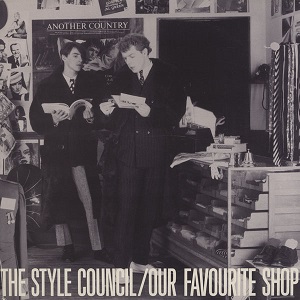
The STYLE COUNCIL: Our Favourite Shop


(#316: 8 June 1985, 1 week)

Track listing: Homebreakers/All Gone Away/Come To Milton Keynes/Internationalists/A Stone’s Throw Away/The Stand Up Comic’s Instructions/Boy Who Cried Wolf/A Man Of Great Promise/Down In The Seine/The Lodgers (or She Was Only A Shopkeeper’s Daughter)/Luck/With Everything To Lose/Our Favourite Shop/Walls Come Tumbling Down!

(Author’s Note: This was another album to which I listened in two formats. The LP is essential for the elaborately-designed photographic cover display and for the quotes from Jimmy Reid, Lenny Bruce, Oscar Wilde and Tony Benn. Side two of the cassette edition comprises “Gary Crowley Meets The Council,” wherein the chirpy disc jockey talks through the record – which plays quietly in the background throughout – with Weller and Talbot. I haven’t reminded myself of it yet because I don’t want their views to influence mine. It’s up on YouTube if you’re curious.)

In June 1985, David Peace was eighteen, or seventeen – he appears rather coy about revealing his date of birth. All I am saying is that some things stay with you for life, if they hit you at a certain time.

However old he was, there is no excuse for you not going off and reading Red Or Dead. The book is large, long and best read quickly; it works best if you see it as a Miltonian epic poem, and you will subsequently want to go back over key passages many times. Especially affecting is the book’s second half; Shankly retires from Liverpool, knowing almost immediately that he has made a mistake but too proud and/or stubborn to go back on his decision. His life busily winds down over its remaining seven years and he finds that, bit by bit, the world has no further need of him. The board of Liverpool Football Club are silently relieved by the retreat of someone whom they view as a faintly embarrassing anachronism. His testimonial match is under-attended and doesn’t raise that much money. The offers from clubs and chairmen slowly dwindle to nothing.

But he can’t let go, this Shankly; he’ll talk about the world and football as he knows them to anybody; sitting in a café, watching his tea go cold, waiting for someone else to come in and chat with, or ringing up fellow managers asking them what they thought of Match Of The Day, or reminiscing with any reporter, journalist or punter who turns up. Eventually he is prepared to talk to himself, sitting on the promenade in Blackpool. He can’t stop because he is aware that he may already have outlived his own legend; one of the book’s bleakest, shortest and most poignant chapters is the one where Thatcher wins the 1979 election and he sits silently in his chair, looks out of his window at the silent streets and locked doors, and feels himself, his time, to be passing. Is he really the last person alive who feels this way about football, and life?

Eventually the streets of Anfield turn into boarded-up, empty slums. The world has changed, and for the worse; everybody has gone away, and soon Bill Shankly will go away as well. Then what, or who, will be left? The heart attack comes during the riots, while his city is burning.

What I am asking you to do is to hold this picture in your mind as you listen to “All Gone Away,” a cheery Radio 2 samba, complete with a cheesy flute interlude straight from a mid-seventies BBC sitcom, over which Paul Weller sings about “how monetarism kills whole communities.” The first song in this tale to include the word “monetarism.” The Style Council were New Pop in the way Miles was free jazz; in other words, they weren’t really, but were carving out a parallel path.

Our Favourite Shop couldn’t be more different from Brothers In Arms if it tried – and it doesn’t need to try. I will leave the minutiae of the “shop” as displayed on the cover for you to discover but it is worth noting that very little, if anything, of what is in this shop is from the present (mid-eighties) time; it’s all from, or just before, or just after, the sixties, and this extends into the anything-you-like-as-long-as-it’s-not-rock approach to the Council’s music; its influences are mostly from the past (funk, soul-jazz, bossa nova, Beatles, psychedelia) but its intention is to deal with the (1985) present in order to enable a future.

Viewed in that context, the first six songs of Our Favourite Shop represent a dazzling index of pop possibilities; it is one of those rare records where every new song suggests a different, exciting (or imposing) world. And unlike Dire Straits, the record wastes no time pointing fingers and naming names. This is an anti-Thatcher, anti-Conservative polemic of fire, and perhaps the most depressing thing about it is that it could have been written and recorded last week.

The record begins, bravely, with “Homebreakers”; a railway platform announcer ushers in an odd vocal – how did Weller’s voice get so deep and gruff? – which is only odd until you realise that it is Mick Talbot singing; a brave introductory tactic for somebody as residually popular as Weller. The family can’t find work so are breaking up; the singer goes to the station and gets on the train with no real joy or hope. The accusation is that it is the Government who has done this, with their insistence on people getting on their bikes to find work. Anybody who came of age in eighties Scotland will recognise the pain instantly. The music is brooding, breakbeaty, organ-dominant; as Dee C Lee’s voice hangs on the last syllable of “responsible” like the mother clinging to the carriage door of the departing train, hindsight reconfigures what we hear; it actually sounds like Portishead.

“Come To Milton Keynes” is a neon nightmare of newness – the names of the great liberals John Milton and John Maynard Keynes misused to promote misleading, fallible brightness – mostly thanks to John Mealing’s astonishing orchestrations (Joe Loss meets “A Day In The Life”) but also to Weller’s deceivingly chirpy paean to drugs, violence and suicide and Talbot’s unhinged, Theremin-like keyboard which proposes a Home Counties Mercury Rev. “Internationalists” – performed at Live Aid, and the album’s title song in the States – is the kind of dynamic funk of which Wham! were once capable. “A Stone’s Throw Away” recasts “Eleanor Rigby” in a world drowning in state brutality, and depressingly it has not dated a jot. This is succeeded by a brief monologue by Lenny Henry, impersonating Bernard Manning over nightmare working man’s club organ, about how “light entertainment” is actually a malevolent, dark and gruesome death-ray  - and we now know that the reality was, if anything, much, much worse than that.

So far, this is a bold record, merrily displacing everybody’s preconceptions about Paul Weller’s art, if not his politics. The ride is thrilling. But about halfway through “Boy Who Cried Wolf” – better Culture Club than Culture Club had managed in eighteen months – you can sense some of the energy sapping, the urge to settle down and make a “Style Council record” becoming more apparent. The song itself is fine but far too long. And side two shrinks back from the musical challenge. Weller sings of frustrated suicides, French passion and, several times again, the dismal state of his nation but the music doesn’t keep pace, settling for a reasonable but none too exciting mix of Europop and American soul/funk styles (whereas the bossa nova of “All Gone Away” subtly reminds us that Tropicalia was primarily the expression of the desire for political and societal revolution via music; for the most exquisite blend of the two, see Tom Jobim’s matchless Matîta Pere). “The Lodgers,” with its undersold nod to the work of Jam and Lewis, works best in this respect, but the fact that “With Everything To Lose” was reworked, with entirely new lyrics, as “Have You Ever Had It Blue?” for the soundtrack of the following year’s Absolute Beginners, makes one wonder how closely people were listening to the words, or even bothering with them.

“Walls Come Tumbling Down!,” the album’s closer and big hit single, is like a supercharged and focused “Beat Surrender,” uplifting and hopeful. And this may be the first number one album actively to encourage its listeners to go out and do something to change things; hence the sleeve’s contact details for CND, International Youth Year and the Youth Trade Union Rights Campaign. In Like Punk Never Happened, Dave Rimmer refers to the Style Council as a kind of “loyal opposition.” This is streets ahead of The Gift – and the jury remains out as to whether the Style Council were really streets ahead of The Jam – but the fact remains that the album came out after the miners’ strike had drizzled into non-existence. Overlying all of these songs, like the heaviest and saddest of clouds, is the question which Charles Shaar Murray, in the NME, asked about the songs on Born In The U.S.A., namely “what do you do the morning after defeat?”

It is as if Weller knows that in the summer of 1985 “we” have already been beaten – and he remains careful to keep “pop” at a distance from him; the second line of the lyric to “Walls Come Tumbling Down!” is printed as saying: “You don’t have to sit back and Relax (capital “R” Weller’s, italics mine)” – and that what the Style Council are proposing, both philosophically and artistically, isn’t going to be enough to effect a change. So Our Favourite Shop is half a great album – although that was still half an album more than most other musicians managed in 1985 – whose inner dread is powered by the increasing knowledge that the shop is eventually going to go out of business, close down and be replaced by a tanning salon. As most of our favourite shops have now done.

Next: Pop’s Silver Surfer seeks solace but finds only self-willed solitude.

Tuesday, 1 July 2014

DIRE STRAITS: Brothers In Arms


(#315: 25 May 1985, 2 weeks; 3 August 1985, 2 weeks; 18 January 1986, 10 weeks)

Track listing: So Far Away/Money For Nothing/Walk Of Life/Your Latest Trick/Why Worry/Ride Across The River/The Man’s Too Strong/One World/Brothers In Arms

If you wonder why so many of these albums sound big and empty, it is down to the advent of this new thing called the compact disc. It was a status symbol, a benchmark showing just how far above the bench you were, reassuring you that you were far ahead of, and superior to, the masses. Compact discs in the eighties were expensive luxury affairs; they were typically priced at £20-25, and even in the late nineties price tags of £16 or £17 were not uncommon.

Now, compact discs are my preferred method of listening to music, far less bothersome to store and search through than ancient gramophone records. I do not harbour a nostalgia for warps, jumps and scratches. But it must be said that the success of the format prompted an awful lot of indulgence, allowed a lot of things to pass which perhaps should never have been let through.

Moreover, the compact disc was essentially, in its initial stages, a deeply conservative concept. I do not simply mean thrusting Thatcherkids blasting out nothingness from their wall-to-wall car speakers on their way down Threadneedle Street. Like stereo twenty years previously, it caused spectators to gawp and gasp at the astonishing sounds that the phenomenon could produce, but these same spectators elected to use the new system to listen to conservative music. James Last and Ray Conniff in the sixties; Phil Collins and Brothers In Arms a generation later.

Brothers In Arms was not the first album to be released on CD, nor to be recorded on digital rather than analogue. But it was certainly the first major album to promote itself as primarily being a CD. The LP and cassette editions provided an abridged first side; the CD was eight minutes longer (but even at the abridged length of forty-seven minutes, the record still sounds as though it needs to be edited down by half that length). In other words, if you joined the CD revolution, you were given the whole story.

Read the Wikipedia entry on the record, or reviews of it on Amazon, and you will get miles of prose about studio size, microphone and speaker placements, types of keyboards used, the superior quality of SACD. Anything, in fact, except the music that is allegedly being listened to.

Listening to the record, on a first generation CD which cost me £1.75 from the charity shop, I could almost marvel at the middlebrow vacuum which it presents. It would appear that the CD format principally allowed a lot more noodling and longer but equally pointless fadeouts. “Why Worry” is a decent enough two-and-a-half minute Everly Brothers-type song encased within eight-and-a-half minutes of ambient fumbling; it labours under the illusion that it is John Martyn’s “Small Hours.”

Nothing really happens on Brothers In Arms, and happens expensively. The darkness, worries and menace of Love Over Gold have been distilled down to a blandly blue motorway, just as David Lean boiled down turn-of-the-century Russia to the deadening snowscape of Doctor Zhivago. If 1985 rock were a Stanley Kubrick filmography, then if No Jacket Required is Full Metal Jacket, Brothers In Arms is Barry Lyndon; a gentler, sleep-inducing bludgeoning.

As for the standard view of Dire Straits as earth-honest pub-rockers, it should be noted that Knopfler is the only guitarist here; there are two keyboard players, and aside from some flourishes at the beginning of “Money For Nothing,” it is Omar Hakim, rather than Terry Williams, who plays the drums. Moreover, the few sparks of interest which the record ignites are usually down to outside players; “Your Latest Trick” is musically seductive, largely because of Michael Brecker impersonating Jan Garbarek (and a rather spiky out-of-tempo introductory duet between Randy Brecker’s trumpet and an angry-sounding Knopfler guitar). The bouillabaisse of “Ride Across The River” would be even more aimless without Dave Plews’ Mariachi trumpet touches. And so on.

But there is, overall, a terrible mixture of indolence and arrogance about this music, and how it is played. The second and far less well-known side of the record is largely about war, but skilfully avoids naming any names or identifying any real causes or cures, such that, by the closing title track – Dave Gilmour covering “Bird Of Paradise” – all that we have learned is, essentially, that war, war is stoo-peed and pee-pul are stoo-peed. And despite the folky touches on two of these songs, Knopfler is so far away from being Dick Gaughan, or even the Billy Bragg of “Between The Wars.”

Mixed with this arrogance is a world-weariness which you don’t feel Knopfler has really earned. It is a record of entitlement, smugness and assumed superiority. On “Money” he sneers that he shoulda learned to play the gee-tar, but on “Walk Of Life” he is sneering even at the poor sod busking for pennies in Tottenham Court Road tube station. He has a go at the one-night stand he bumps into on “Your Latest Trick,” even complains at the hapless lover on the other end of the telephone on “So Far Away” as if it were her fault that he was successful and on a world tour.

And, of course, “Money For Nothing” is where all of Knopfler’s worst tendencies coalesce. Getting past its grotesquely pretentious introduction, ninety-seven seconds of warming up and Sting humming the MTV jingle, we get some very horrid old school rock. No doubt Knopfler identified himself with the everyman – and vice versa – but all he is doing is sneering at New Pop and their funny ways.

Much, much worse is his use of the “f” word – the section that is handily edited out on oldies radio – and even if he is writing in character, he has previous form, both in terms of gay-baiting (1980’s “Les Boys”) and cussed philistinism (1978’s “In The Gallery”). At a time when the facts about HIV and Aids were struggling to become known, this was, to put it VERY mildly, unhelpful. All he – with Sting, who co-wrote the song, as well as providing vocal back-up – is doing is hammering home to the listener how Mark Knopfler and Dire Straits are so much better than everybody and everything else. And mumbling the words can be an especially deadly form of arrogance.

And yet this broad expanse of rock desert outsold every other album in eighties Britain (even Thriller), remained on top in the States for nine weeks, has at the time of writing sold some thirty million copies worldwide. Its success implied that “bigness” with all content evacuated was enough. Like virtually every other number one album of 1985, there are practically no laughs (“Money For Nothing” is certainly no laughing matter). We were all expected to be grown-up and serious…but about what? How much direct influence has this album of albums had on anything which has come after it – as opposed to the indirect influence of sizeable streams of large vacuums which the CD era has permitted? I would instead point to a far better and far more pointed example of Northeastern technological folk music in 1985, namely Prefab Sprout’s Steve McQueen. But Brothers In Arms is strictly prefab “class” (pronounced with a flat “a”); music for people who don’t like music, a record for people who don’t buy records. It looks to fill a gap which Dark Side Of The Moon had occupied in the previous decade, but the cover is ominous - Knopfler's 1937 National Style O Resonator guitar floating into the blue air, without visible means of support, as if to say, rock and roll? That's your lot; grow up.

Next: the same problem from the opposite perspective.

Sunday, 29 June 2014

VARIOUS ARTISTS; The Hits Album 2


(#314: 13 April 1985, 6 weeks)

Track listing: You Spin Me Round (Like A Record) (Dead Or Alive)/Things Can Only Get Better (Howard Jones)/Love & Pride (King)/Wide Boy (Nik Kershaw)/Mr Telephone Man (New Edition)/A New England (Kirsty MacColl)/Since Yesterday (Strawberry Switchblade)/1999 (Prince)/Easy Lover (Philip Bailey [Duet with Phil Collins])/Solid (Ashford and Simpson)/This Is My Night (Chaka Khan)/Yah Mo B There (James Ingram)/Let It All Blow (Dazz Band)/Close (To The Edit) (Art of Noise)/I Want To Know What Love Is (Foreigner)/Everything Must Change (Paul Young)/You’re The Inspiration (Chicago)/I Should Have Known Better (Jim Diamond)/Friends (Amii Stewart)/Nightshift (Commodores)/That Ole Devil Called Love (Alison Moyet)/Kiss Me (Stephen “Tintin” Duffy)/Who Comes To Boogie (Little Benny and The Masters)/More Than I Can Bear (Matt Bianco)/This House (Is Where Your Love Stands (Big Sound Authority)/Legs (ZZ Top)/Just Another Night (Mick Jagger)/Breaking Up My Heart (Shakin’ Stevens)

(Author’s Note: Judging by the sleeve design, this record may well be called Hits 2 The Album, but I have let common sense prevail. The track listing is what is written on the rear sleeve; you know and I know that “Yah Mo B There” is a duet between James Ingram and Michael McDonald and that the erstwhile founder member of Duran Duran was at the time called, strictly speaking, Stephen “Tin Tin” Duffy, but CBS/WEA were presumably not that bothered about accuracy, given that the record went double platinum. I do know that the cassette edition was entitled The Hits Tape 2.)


I am not adhering to my recent promise of more concise blog posts. Around a thousand words on the Smiths, 750 on Phil Collins and over 1200 on Paul Young. Well, I could argue that everything needs to get in there one way or another, but you could equally counter-argue that this is not The Key To All Mythologies.

So be it. I had little idea how to deal with the proliferation of compilations that still await us in this tale, but from listening to Hits 2 it is clear that the novelty of the compilation was beginning to wear off. This is pop as fire sale. Where the first Hits record had quality and direction, I am unsure what, if anything, this latest collection of thirty-two songs is trying to tell us.

What I do recall from the period is that the beginning of the year saw a lot of 1984 flops on fire sale discount, in the hope that cheapness might propel them into the charts, and that hope proved to be founded. The impression is one of arriving late at a party where all the food and drink are gone and you have only leftovers and half-asleep partygoers telling you what a fine time they had had. Some of the 1984 leftovers were very good indeed; it is baffling how records of the quality of “Solid” and “Yah Mo B There” couldn’t have cleaned up first time around. But others are not so good, and in many cases time is being marked. There are no less than four songs here from 1983, including two reissues and two remixes. There are cover versions ranging from Billy Bragg (his second consecutive number one album) to Billie Holiday.

The songs here by Prince, Chaka Khan, ZZ Top and Chicago prompt no further will on my part to say anything further or different to what I have already written. In the spirit of the exercise, therefore, I propose to cannibalise my previous writing and recycle the thoughts that they express, and which have not noticeably changed in the years (or, in some instances, the decade) since I wrote them.

Dead Or Alive

If 1985 was New Pop's 1974, then Pete Burns was New Pop's Alvin Stardust, and not simply because of the Pete Waterman connection - both veterans of a previous era, both hitching a belated ride on the rapidly defuelling gravy train. Older and considerably more resilient than Boy George - it's that Northern thing again - Burns belatedly reintroduced a notion of dagger-thrusting glamour which George had by this time largely abandoned in favour of cups of tea, whining about "I hate all that Labour crap" and heroin.

The production team of Mike Stock, Matt Aitken and Pete Waterman had first come to full notice some 12 months previously with a "Relax" ripoff entitled "The Upstroke" sung by some female session singers grouped under the name of Angels Aren't Aeroplanes. A big club hit, it led to further mainstream hi-NRG crossovers more indebted to "Blue Monday," such as Hazell Dean's "Wherever I Go (Whatever I Do)" (with an astonishing, apocalyptic 12-inch mix), Divine's "You Think You're A Man" and, eventually, "You Spin Me Round." Though classified as the first major product of the Hit Factory, Burns and the group wrote the song and SAW produced it pretty much in accordance with Burns' unsurprisingly firm instructions. Charting in November 1984, it proved to be yet another sleeper, hitting especially big in Scotland and the North West, but bided its time over Christmas before nudging its way into the Top 40 and thereafter hurtling to the top; the most prominent of several underperforming 1984 releases which found renewed success in the bargain basement clearance sales of early 1985.

Nevertheless "You Spin Me Round" is an important transitional record, the most direct link between the fading embers of New Pop and the imminent age of SAW (and to a degree New Order) dominance. Its beats are trebly but resonant, harshly staccato and slightly crude but finally rather compelling. Over the top Burns flashes his "I"s and swims deliriously in the pre-E ecstasy palindromic roundelay of the chorus, riding a Moebius rollercoaster, with some ingenious touches of near-punctum, e.g. the bass-led descending harmonic figure linking the first chorus to the second verse possibly inspired by UB40's "Food For Thought."

It falls just short of being a great pop record  largely because Burns' undeniably fulsome operatic tenor sometimes falls through the Tom Jones trapdoor of knicker-happy pomp (for instance, on the line "I've got to have my way now, ba-BEEEEEE") and at other times he grits his teeth too hastily (the sneer on "You look like you're lots of fun"). But "You Spin Me Round" was undoubtedly the liveliest number one since "I Feel For You" and in the light of the dour drear which would characterise much of the rest of 1985's upper reaches, its blue glow was as near to the carrying of a New Pop torch as was likely to be discovered.

Howard Jones

1985’s equivalent of Ed Sheeran’s “Sing.” He has a full band, complete with slap bass and horn section, and somehow I think that wasn’t the original idea. “Things” is the usual panacea with a “funk” interlude which is more Tony than Herbie Hancock and bearing all the persuasive oomph of a Special K commercial. Join Weightwatchers and lose £££!

King

Poundland ABC.

Nik Kershaw

Could have been on the soundtrack of Buddy’s Song but always far more interesting than his residual image would have you think. I haven’t disliked any of his contributions to TPL thus far. In fact, I rather like him.

New Edition

It took the Jackson 5 three-and-a-half years to move from “I Want You Back” to gluey gloop like “Hallelujah Day” but with New Edition eighteen months was enough. Here they don’t seem to get the message; they ring “twenty times,” get the voice of “some strange man,” ask the operator whether there’s a problem. I’ll tell you the problem, pal; you’re creeping her out. You can’t take no for an answer. And one of New Edition is already an apprentice jerk.

Kirsty MacColl

Asked Bragg to write an extra verse and for the chorus to be feminised. It’s very fine like the average 1987 Smiths B-side is very fine. What else am I meant to say, or think?

Strawberry Switchblade

“The lassies who know” says the gnomic sleeve comment. Know what? 1983’s “Trees And Flowers” was a gentle, sad study of agoraphobia. “Since Yesterday,” eventually a top five hit, is part “Beach Baby” and part “As Tears Go By,” and they might have something to communicate but it’s buried beneath the trebly avalanche of a stupid producer who thought he was Trevor Horn.

The Two Phils

The only number one performed by two singing drummers called Phil with part-time solo careers - although only Collins plays drums on the record - the utilitarian video for "Easy Lover," depicting Bailey and Collins rolling up their sleeves and getting on with making the record in the studio, gave early notice of the re-emergence of frills-free "Real Music" in 1985, a catchment area which somehow managed to snare everybody from Dire Straits to Trouble Funk. No more trivial dressing up and colouring in of fading New Pop books - and, to echo my first year Home Economics teacher at grammar school, wasn't it all a bit of an irrelevance when there are people starving in Africa?

"Easy Lover" accordingly "rocks" with Collins' cavernous Big Bang of percussion filtering out any subtlety or real swing - such things are left to Nathan East's occasionally inventive bass. And while it provides partial redemption for Earth, Wind and Fire never having had a UK number one single in their own right ("September" and "Let's Groove" both made #3, although Maurice White did produce Deniece Williams' "Free"), it is, like so many number ones of this period, utterly functional - it comes in, hangs about and does its job for a little while (in the case of "Easy Lover," for five minutes, although you don't really notice it) and then wanders off, leaving minds unchanged and souls untouched.

Ashford and Simpson

It strikes you slowly and subtly – they’re trying to do Marvin and Tammi, like they should have lived to live and sing this song and mean it.

James Ingram and Michael McDonald

You could just swim in Quincy Jones’ productions and Temperton’s chord changes, couldn’t you? Don’t understand the faith but somehow I’m persuaded to believe theirs.

Out Of Battle

Clever sequencing; follow a record inspired by Art of Noise with the thing itself. But Motown’s Dazz Band actually sound marginally more alive; the music is strictly mid-eighties BBC World Cup highlights montage but there is a continuation of the brittleness of “Superstition” and the slacker work chants of Funkadelic.

Whereas “Close (To The Edit)” is magisterial and glorious, and everybody should have Who’s Afraid Of…?, but the mystique was by now being steadily stripped away by endless overexposure and remixes. It is a mighty and important record but making the top ten in early 1985 was like “Heartbreak Hotel” not becoming a hit until 1958. And ZTT in 1985 was in danger of becoming as unhip, or anti-hip as 1958 Elvis.

Jim Diamond

PhD's "I Won't Let You Down" was one of the great one-off hits of 1982, a Jon and Vangelis derivé which manages to become something more, especially in its hosanna of a final section when Tony Hymas' cathedral organ and Jim Diamond's pinched contralto turn it into a New Pop hymn, just the other side of yellow from the Teardrop Explodes' "Tiny Children" and the two prog rock/pub rock veterans succeed in exceeding themselves.

Hymas proceeded to a curious career which involved both extensive session work and some toe-dipping in the world of improv - playing and recording with, inter alia, Lol Coxhill, Steve Beresford and Tony Coe - while Diamond, a stockily cropped Glaswegian with an alarming resemblance to Jimmy Somerville's unfunny uncle, returned as a solo artist, managing to squeeze himself into the top slot for just one week in between the heavier hitters.

"I Should Have Known Better," co-written by Diamond and Graham Lyle, and nothing to do with either the Beatles or Wire, is a far more conservative proposition than "I Won't Let You Down," a fairly straight would-be power ballad - a Cumbernauld "Careless Whisper" - which with its pre-Knopfler guitar solos seems to belong in 1974. Although there are some interesting touches - the regretful, shoulder-shrugging three-step semitone descent after Diamond's "I know that you saw me...you turned away," his rueful "yeah!" in the third line of the first verse - the dominant strains are Diamond's yodel of "Ay-ay-ay-ay-ay," which unintentionally echoes in part the next number one, and his rather less attractive vocal stridency, a patch of grass somewhere between Freddie Mercury and Kevin Rowland on which you wouldn't wish to sit for more than four minutes, not to mention the completely out-of-place phlegmatic "ooh yeah!" just before his final assault. After PhD, it's a bit of a letdown. If I say that “I Should Have Known Better” is a song that Deek would love, fans of River City will understand exactly what I mean.

Amii Stewart

Six years before, she’d done sixties covers and sounded like the nineties. Now she was in Europe and suddenly singing potential 1972 Eurovision entries (Luxembourg?). All quiet, no storm.

Commodores

Their only major hit without Lionel Richie, and better and more heartfelt than anything on Can’t Slow Down. But it wasn’t 1985’s only homage to Marvin and Jackie; there was the very touching “Only Survivor” on Bobby Womack’s So Many Rivers, wherein he also ponders Otis, Sam and others. And now there are no survivors. Get everything Womack recorded, touched or breathed on. He never did anything that was less than remarkable.

Alison Moyet

Difficult for me to forget the grinning TV-AM presenter (although I’ve long forgotten his name) who after broadcasting the video for “Ole Devil” made some patronising comment about how nice it is that Alison Moyet is recording proper songs. You know the sort; in 1956 he’d have complained about why Billie Holiday couldn’t be clean, prim or proper like that Joan Regan. Moyet didn’t particularly like this record, either, but it reached number two regardless, kept off the top by “Easy Lover.” It was just three years since “Party Fears Two” and “Ghosts.”

Kiss Me

The best member of Duran Duran finally got a hit, after several remixes; the best is the 12-inch of the hit version, with its “James Joyce” loop (Art of Noise, more or less). Petition idiot radio stations who stop the song before the long, menacing, Frankie’s “War”-segueing-into ending.

Wake Me Up, Go-Go

The DC sound never quite caught on outside of certain London postcodes, which I think is more of a shame than I did ten years ago. The sleeve commentary terms go-go “a certain style which has been well known on the soul/funk/rap scene for a number of years.” Well, that’s one way of not putting it. “Who Comes To Boogie” sounds a bit timid now but Little Benny does a good square dance caller routine. Art of Noise are kind of go-go, when you think about it (and that thought would eventually lead to “Slave To The Rhythm”). But, unlike Trouble Funk’s Montreux performance of “Still Smokin’” from the same year, I could happily live out the remainder of my life without ever hearing this again.

Matt Bianco

The sleevenote calls them “those fast-emerging masters of stylish dance-orientated pop.” Actually they were respectable mid-table performers for around half a decade. “More Than I Can Bear” begins with some icy Basha harmonies and a harmonically chilling, static verse but then moves back into Jimmy Young Show territory and that about sums this, and them, up. The single peaked at #50, just two places higher than the contemporaneous, WEA-released “Never Understand” by the Jesus and Mary Chain. I recently bought the 2CD deluxe reissue of Blue Rondo Á La Turk’s Chewin’ The Fat. Entertaining enough but really you had to be there, preferably watching and experiencing them live.

Big Sound Authority

Soulcialism! They weren’t on Respond but might as well have been. Actually “This House” might be this record’s most influential song, pointing decades ahead to the Duffys and Palomas to come. But singer Julie Hawden growls far too much, possibly to conceal some questionable pitching.

ZZ Top

“The beards get longer and the boogie gets stronger.”

Mick Jagger

Jeff Beck! Bill Laswell! What could possibly go wrong? Mick is hungry. Then he’s thirsty. The fadeout sounds like a shootout. And this was NOT his “first solo single.” That had been “Memo From Turner,” fifteen years older and infinitely superior.

Shakin’ Stevens

Even poor old Shaky couldn’t escape the power-drilling 1985 ill-lit pop skip. Same plot as “Man In The Iron Mask” but far creepier, as the singer promises to be at his cheating lover’s side “every step of the way.” I heard “Cry Just A Little Bit” earlier on this evening on the radio, a record I’d been innocently enjoying for three decades. But: “Forbidden love is never what it seems”? What the hell is going on here?

Fragmentary and not very satisfying, which is much what the record offers us. What do you mean I’m nearly up to three thousand words? Damn!