Sunday, 6 May 2012
LED ZEPPELIN: Presence
(#168: 24 April 1976, 1 week)
Track listing: Achilles Last Stand/For Your Life/Royal Orleans/Nobody’s Fault But Mine/Candy Store Rock/Hots On For Nowhere/Tea For One
The circumstances surrounding the conception and recording of Presence differ slightly in the telling, depending on whose history you read, so the best way to tell the story is to itemise:
1. Following the success of Physical Graffiti and their successful run of shows at Earls Court, Jimmy Page and Peter Grant decide the time is right for a major Zeppelin world tour. This is tentatively scheduled to begin on 23 August 1975; meanwhile there is time for Page and Robert Plant to take a holiday with their families.
2. Page and Plant first travel to the Atlas Mountains in Morocco in order to realise a long-cherished dream of recording with the Berber tribes there; this is directly referenced on “Achilles Last Stand.”
3. Page then travels to Sicily as he has heard that a farmhouse there which once belonged to Aleister Crowley is up for sale. Plant, his then wife Maureen, and his children, as well as Page’s daughter Scarlett, settle on the island of Rhodes.
4. On 5 August 1975, eighteen days before the start of their tour, Plant and his wife are involved in a major road accident when their car crashes in Rhodes. Plant’s wife is not expected to survive, but pulls through. The children are miraculously unhurt. Meanwhile, Plant has suffered multiple leg fractures and is under doctors’ orders not to walk for the next six months; there is the risk that he may never be able to walk again.
5. Page and Grant decide that, since a tour is now out of the question, the band should devote their energies to recording a new album. For various bureaucratic reasons the Plants have to wait for some time before they can leave Rhodes, and for a while lodge in Jersey. As “Hots On For Nowhere” implies, Plant in part blames Page and Grant for the hold-up.
6. The band rent a beach house in Malibu and work on some material. While they are doing this, a freak storm washes half the house away. Not to be deterred, they move to a recording studio in Hollywood where they do more writing and rehearsing.
7. They eventually relocate to Musicland Studios, situated in the basement of a hotel in Munich. Plant is in a wheelchair, claustrophobic and severely homesick. If you believe the account in Hammer Of The Gods, a taste for heroin starts to infiltrate the sessions.
8. Zeppelin can only use Musicland for eighteen days, as the Stones have booked the same studio to come in and work on Black And Blue. Realising that he is not quite going to make the deadline, Page telephones Jagger and asks for and gets two days’ grace. He and engineer Keith Harwood stay up for 20 hours a day to finish all the guitar overdubs and mixing. When the Stones come to town, they can’t believe that the album is finished and mixed. On listening to the final product, Keith Richards comments that the band should seriously consider hiring a second guitarist since Page is now in his opinion the most overworked guitarist in rock. But how can they? They are Led Zeppelin; their “fourness” is unique and indivisible.
The main reason for telling this story is to underline how much of a reaction against everything surrounding them Presence was; it really was a case of Zeppelin versus the world. I am still unsure whether the record has ever been completely understood; it alternately baffled and annoyed reviewers when it came out, and if Wikipedia is to be trusted it remains Zeppelin’s lowest-selling studio album. Much of the commentary at the time was to do with the alleged enigma of the black mini-obelisk which Hipgnosis had added to stock fifties photographs on the outer and inner sleeves; Page has spoken of a force, an aura, that was Zeppelin and was there wherever you went, but being Zeppelin I am sure there was at least one private joke at work.
Nevertheless, the puzzle effectively detoured any proper addressing of the record itself, and in the Zeppelin discography it has remained something of a puzzle. On the contrary: Presence contains some of the most brutal and direct music Zeppelin ever made, and had to represent a war against the chain of disasters detailed above.
For Zeppelin were not only battling their own misfortunes but the wider notion that they were slowly slipping from favour, that they weren’t quite as immutable as they had been even a year previously; that they represented some kind of unwelcome decadence and opulence in rock, getting further and further away from the things which originally powered them. One question would be: what would Pink Floyd have done if the same things had happened to them, and why didn’t they? The answer is that Pink Floyd stayed in Britain and Zeppelin didn’t. It’s true that much of Zeppelin’s situation arose from their tax exile status, but it was their decision, and it’s far too late to quibble whether the record could have been done at Olympic or Wessex, and if so – given infinitely more time and resources to make it – the record would have carried quite the same degree of urgency that it does.
It’s very rare that I come across a number one album that was made because it absolutely needed to be made, but Presence is one of those, and there are fewer opening tracks to any album which carry the same degree of uncompromising desperation as the ten-and-a-half minutes of “Achilles Last Stand.” As extreme a piece of music as any band of Zeppelin’s status would have dared to record in 1976, it is the sound of four men fighting to bring down the world. The rhythm rocks like a not-quite-out-of-control train. Bonham’s drums exceed thunder; they are as pitiless and single-minded as anything he ever played – at one point you can clearly hear his cymbals cracking in half. Plant ostensibly sings about his adventures in Morocco, but his tone betrays a greater message, one of weariness with the world, and of the suspicion that what he and the band have worked for these past eight years may amount to nothing. The Albion reference inevitably conjures up Blake, the analogy of Atlas the mountains and Atlas the god is not overcooked, and Page intelligently varies his approach so as not to overload the track; his first solo is slow and pensive but undoubtedly heartfelt. But the song grinds on relentlessly with a terrible yet compelling certainty. While Plant again points the way to Jeff Buckley (the “I know the way…” sequence), Page is busy setting up his stalls for the future; the military staccatos – almost inhuman – pave a path to Metallica. It’s also the case that Heart – big Zeppelin fans, and about to break big themselves – got some inspiration from here (as “Barracuda” would soon demonstrate). Moreover, as the surprising but logical quiet guitar interlude makes clear, there is unfinished sixties business; that the song contains elements of both “The Green Manalishi” and “Rhiannon” confirms that the band are building something of a bridge between Peter Green’s Fleetwood Mac and Lindsey Buckingham’s Fleetwood Mac, between what has come and what has yet to pass. This being borne in mind, it is entirely correct that so seemingly unforgiving a piece of music should conclude, or fade, with a carillon of guitars that could have come straight out of the Byrds.
The attendant irony of a band once known as the New Yardbirds should now record a song entitled “For Your Life” need not be underlined, since there is no real connection between the two songs (the composer of “For Your Love” at this time being involved in such affairs as “I’m Mandy, Fly Me”) and there is certainly no jolly sixties optimism at work here; against a backdrop skilfully constructed to sound random and ungainly, Plant cites “The Lemon Song” before going into a long rant against cocaine, and the difference between drugs and love, using none too subtle sexual metaphors. Page’s soloing is more agitated than has ever been heard on a Zeppelin record, while Plant’s own delivery veers from the disinterested (his second “damned” in “Oh, oh, babe, damned”) to the vulnerable (his voice wavers in the “flow” of “I said, just go with the flow”). Once more recalling Buckley fils, Plant’s vocal culminates in a long, piercing, upward, drawn-out cry.
“Royal Orleans,” a shaggy dog tale in the recent tradition of “Lola,” attempts some light relief (Plant’s exasperated hisses of “Whiskers!”), but nobody told Bonham, who rumbles on like an express train jammed with nuclear chemicals. Furthermore, Page’s needling guitar and John Paul Jones’ sighing bass musically make me wonder whether this isn’t 1981 and Josef K.
“Nobody’s Fault But Mine,” a Blind Willie Johnson derivé which may or may not be about drug addiction (“The m-m-m-monkey on my back-back-back”), complicates the picture further. Page begins the track with a phased wasp drone of chattering guitars akin to splintering glass. After a brief wordless voice and guitar unison, the track settles down into the blues – except that it never seems to settle, stopping and starting almost at random while Plant describes his story of woe (he grits his teeth on the line “Gonna change my ways tonight” as though he knows he’s never going to do it). Page’s guitar fights not to bury itself with its own feedback. Indeed, the whole structure of the track suggests to me that Steve Albini must have been listening; specifically, the relationship between guitar, drums and silence is further explored in Albini’s work with the Breeders (Pod) and PJ Harvey (Rid Of Me - and we know that the younger Polly grew up listening to this stuff). And there is still a pitilessness in the track’s approach that leads directly into Big Black, even if Albini used a drum machine there rather than a Bonham (Then again, the quiet-loud-quiet-loud format was about to be kick started by Boston, whose debut album came out at around this time; also largely masterminded by a studio-obsessed guitarist with pictures flowing through his mind).
The whole album plays like an indie Zeppelin; there is only the briefest of gaps between tracks (I note Frank Black is at this time twelve) and the attempted throwback of “Candy Store Rock” might be the record’s most Albini-esque track; it pretends to go back to fifties Elvis (and, having deposited a get well telegram to meet Plant at the airport as he flew to California, it’s inconceivable that Presley wouldn’t have heard this). Plant cheerfully goes through every “baby baby” cliché/double entendre he can conjure up, but the drumming is out of place, the guitar is more reminiscent of Hendrix than of Scotty Moore, and some of the desperation even transmits to Plant (“Don’t make me sta-harve!” he wails at one point; and his repeated assurances that “it’s alright” are maybe the least convincing I have ever heard).
“Hots On For Nowhere” gets steadily more disturbing as it goes on, particularly the nonsensical “La la la” chorus which gets more menacing and prominent with each repeat. A fairly standard Zeppelin strut of a shuffle, periodically intercepted by sudden scrabbling noises, Plant expresses his frustration and disgust at the whole situation (“I’ve got friends who will give me fuck all,” and he tries to sing it as “fluck” but nobody was convinced); he is getting older and the old games won’t work any more.
As indeed they do not on the closing track, “Tea For One,” one of the most moving things Zeppelin ever recorded. The sprightly opening is deceptive, for the track swiftly settles for a long and mournful blues workout. Bonham seems to be drumming a million miles away, yet his rising snare rolls under Page’s guitar and his general air of compassionate rectitude put me in mind of the late Levon Helm. Jones’ deep but resigned bass holds the track together. And in the middle of all this, or to one side of it, there is Plant; while this does not literally repeat the trope of previous number one albums in concluding with the singer alone at sea, miles from shore, it as good as defines it.
Plant is alone, impatient, sad, watching the clock that never changes, wanting, aching to go back to his woman; memories slip through his unglued mind and not once does he explode, emotionally; he sits back and lets the song come to him. But he knows this whole business may always have been for nothing, and is not comfortable in this knowledge. He is plainly asking us: this rock ‘n’ roll thing…what was it ever supposed to be about, and if it were ever supposed to be about anything, but primarily making us feel better and more alive, then how come it has brought us here? Here, where it might as well still be 1968, Page standing on a provincial stage, playing the blues…and “Tea For One” is anything but rock ‘n’ roll, and everything to do with the blues. There are two abrupt moments of hammering grief from Page and Bonham, but otherwise nobody does so much as raise his voice. There is an impatience at work here, but also a balancing wisdom which says that all this anguish about waiting is only going to make you wait more. With his endless perfectionism, overdubs and overall sonic vision, Page perhaps isn’t that far away from Brian Wilson, and “Tea For One” only (only?) a close neighbour of “Caroline No.” But Page’s solos here are among his most nakedly emotional and articulate; in his first (and main) solo he combines the explosive efficiency of Hubert Sumlin with the declamatory yet compassionate eloquence of BB King, while at track’s end he nods to Freddie King – somewhere in between these, an overlap with Mike Oldfield cannot be overlooked. His playing throughout this track is like a parade of ghosts – shadows (capital or small “s”) from the sixties, that decade that just won’t leave this decade alone, come filtering through in solemn procession…and what is this song, in the end, if not another cry to go home?
I feel a kinship between Presence and another major British rock album which came out at around the same time, another record of relatively few (but long) songs concerning alienation and the questioning of one’s role in the world, let alone in rock, and which concludes with a long, meditative wander through an old movie ballad. That record is Station To Station - those who don’t feel the relationship between the reserved pain of “Tea For One” and the expressive restraint of “Wild Is The Wind” aren’t really listening to either – and, in common with Presence, and so many other records under consideration in this year, their fear and resolution (not a contradicting pair) are based on knowing that time is running out and that something else is coming. But Zeppelin weren’t going to go down without a fight, even if on a personal level there was much, much worse to come; that this is not their last appearance in this tale suggests that the will to fight was unquenchable, regardless of whatever came along to try to quench it.
Sunday, 29 April 2012
ORIGINAL TELEVISION SOUNDTRACK: Rock Follies
(#167: 10 April 1976, 2 weeks; 1 May 1976, 1 week)
Track listing: Sugar Mountain/Good Behaviour/Stairway/Daddy/Lamplight/The Road/Glenn Miller Is Missing/Biba Nova/Talking Pictures/Hot Neon/Roller Coaster/Rock Follies
“I know what it's like not to be able to do what you want to do, 'cause when I go home that's what I see. It's no fun. It's no joke. I see my sister and her husband. They're living the lives of my parents in a certain kind of way. They got kids, they're working hard. They're just real nice, real soulful people. These are people you can see something in their eyes. It's really something. I know a lot of people back there..." The picture looms vivid in his mind, so does what can only be described as his mission. "That's why my album, a big part of it, is the way it is. It's about people that are living the lives of their parents, working two jobs... It's also about a certain thing where they don't give up. I asked my sister, 'What do you do for fun?' 'I don't have any fun,' she says. She wasn't kidding... I'm just really thinking about a whole lot of things.”
(Robert Duncan, “Lawdamercy, Springsteen Saves!,” Creem, October 1978)
“The problem lay buried, unspoken, for many years in the minds of American women. It was a strange stirring, a sense of dissatisfaction, a yearning that women suffered in the middle of the twentieth century in the United States. Each suburban wife struggled with it alone. As she made the beds, shopped for groceries, matched slipcover material, ate peanut butter sandwiches with her children, chauffeured Cub Scouts and Brownies, lay beside her husband at night—she was afraid to ask even of herself the silent question—Is this all?"
(Betty Friedan, The Feminine Mystique, WW Norton and Co, 1963, Chapter 1)
“Rock was experienced as a new sort of sexual articulation by women as well as men. The music was, in Sheila Rowbotham’s words, ‘like a great release after all those super-consolation ballads.’ Rock, writes Karen Durbin, ‘provided me and a lot of women with a channel for saying ‘want,’ and for asserting our sexuality without apologies and without having to pretty up every passion with the traditionally ‘feminine’ desire for true love and marriage, and that was a useful step towards liberation.’ At a time when girls were still being encouraged from all directions to interpret their sexuality in terms of romance, to give priority to notions of love and commitment, rock performers like the Rolling Stones were exhilarating because of their anti-romanticism, their concern for ‘the dark side of passion,’ their interest in sex as power and feeling. But the problem quickly became a different one: not whether rock stars were sexist, but whether women could enter their discourse, appropriate their music, without having to become ‘one of the boys.’”
(Simon Frith, Sound Affects: Youth, Leisure And The Politics Of Rock ‘N’ Roll. London: Constable and Company Ltd, 1983, Chapter 10: “Rock And Sexuality”)
There have not been too many journeys into the musical in this tale since The Sound Of Music. In fact, with the exception of 25% of the That’ll Be The Day soundtrack, there has been none since 1965. There have been plenty of musicals in the interim, of course: Fiddler On The Roof, Oliver!, Hair, Tommy, Jesus Christ Superstar, Godspell, Cabaret, The Rocky Horror Show (and Escalator Over The Hill) to name but a few. None of the accompanying albums made it to number one in Britain since there was greater competition than there had been in the pre-Beatles days. Rock Follies is not without its own history - Julie Covington appeared in the original casts of the UK premieres of Godspell and (as the female lead) Rocky Horror - but it is fair to say that there has been nothing like it before in Then Play Long, and no clear precedents in the 166 number one albums which preceded it.
Its radicalism remains startling – for this is one of the most radical albums ever to top the chart. In 1975, expatriate New York writer Howard Schuman was commissioned by Thames Television to come up with a series about a three-piece girl group – to be called, with much deliberate irony, The Little Ladies – and their sundry travails while trying to make it through the murky streams of the music business. Note that there were in the mid-seventies television executives with enough vision and imagination to commission a work of this nature. There was no “demand” on the part of the public for a series of this type, just as there were no focus group calls for The Prisoner or Boys From The Blackstuff or Father Ted. While it is somewhat overdoing it to cite the show as a direct precedent to Dennis Potter’s musical dramas, as happens in the Wikipedia entry – Potter’s use of music in Pennies From Heaven onwards comes from an entirely different aesthetic and historical viewpoint, and was in any case something Potter had been working towards for some time (since 1969’s tale of fatal Al Bowlly obsession Moonlight On The Highway) – its story remains an engrossing one; an initial six-episode series, shot on minimum budget directly to video, with careful balances of grim reality and dream fantasy and a decidedly pessimistic, if not contemptuous, view of the music business in general and of men in particular. The three lead female characters are constantly pitted against egotistical con artists and swines, all of whom are men; there is not one sympathetic male character to be found anywhere. The fusion of song and story was not yet complete; long, combative dialogues were the programme’s mainstay, although the sought fusion was more closely and clearly realised in the following year’s sequel Rock Follies Of ‘77. But other things had happened by then, and many of them are anticipated in this record.
Throughout one or two mutual friends, Roxy Music’s Andy Mackay was asked to write the music for the series, and for Schuman’s lyrics in particular; with Roxy about to go on an extended sabbatical after Siren, this was the perfect opportunity for Mackay to develop what he had learned from and in that group. Mackay was also charged with putting a house band together for the series and the songs; as lead guitarist and occasional string arranger, a wild card was enlisted – Ray Russell.
Russell’s story is one of the most singular in the admittedly singular-centred history of post-Beatles British music. Today, in his mid-sixties, he is recognised as a world-class guitarist, having worked with just about everybody worth working with, a highly-respected music educationist and tutor, and a renowned television composer; his credits include A Touch Of Frost and The Inspector Alleyn Mysteries amongst many others. But in the years preceding his work on Rock Follies the story was rather different. Some of his work from this period was briefly made available on CD at the turn of the millennium; 1969’s Dragon Hill is mostly a record of bracing, straight-ahead jazz-bordering-on-rock workouts with a quartet and occasional horn section. But on its final track, “Mandala,” Russell moves into free improvising territory with a ferocity that is still in some ways intimidating. Inevitably, this indicated the direction in which he would move; 1971’s Rites And Rituals, probably his best album of the period, is an exhausting yet oddly poignant blast of post-Ascension modal catharsis; Russell and his rhythm section seem to want to eradicate “rhythm” entirely, shrieking and rumbling against the horns’ counterpoint of mournful klezmer melodies. His Live At The ICA set from the same period, involving amongst others Harry Beckett and Gary Windo, gives new definition to the term “uncompromising.” Add to this his tormented work on Bill Fay’s Time Of The Last Persecution and the unhinged out-ness of his Rock Workshop project (some of which involved his erstwhile West End Hair pit band colleague Alex Harvey) and it’s clear that Russell was shaping up as Islington’s own Sonny Sharrock. He did time in a prog-rock band called Mouse. Beckett hired him for his otherwise airy, laid back group Joy Unlimited, and initially Russell was anything but; listening to 1975’s live Ogun set Memories Of Bacares, he scratches, snaps and squeals throughout, like a paranoid jaguar, and Brian Miller’s demented electric piano at times almost outdoes Russell (see for instance “Can’t Think About Now”).
But then something happened. Listen to the third Joy Unlimited album, 1978’s Got It Made, and the playing of Russell, the only other musician retained from Bacares, is a model of restraint and close melodic attention. Since then he has moved steadily away from being merely The Noisy One, and although I would not wish to speculate here about reasons for this change, or transition, Rock Follies may well have been a turning point for him; a lot of the record’s tension relies on his barely-coiled guitar playing – although he never plays “out” as such on Rock Follies, the listener does get the feeling that he’s barely suppressing the urge; for instance, the downward high-pitched babble which accompanies Covington’s “nappies” on “Good Behaviour” or the abrupt way in which his guitar snarl shuts down the end of the title track. Peter van Hooke, the record’s drummer, would become a regular musical partner of Russell’s; both, for example, resurface seven years later on Scott Walker’s Climate Of Hunter.
But then the record is all about suppressed tension, the need to escape the living death of mundanity, and above all expressing the woman’s point of view to a degree not previously seen on Then Play Long (despite, or possibly because of, the words being written by an American male). That Covington’s is the best of the three voices was a deliberate choice; the original premise was that her character (Dee Rhoades – see “The Road” formulating out of that already?) was the only trained singer of the trio. Q, played by the then-unknown Rula Lenska, was a lapsed chanteuse, while Anna Wynd, played by Charlotte Cornwell (the half-sister of John le Carré), was a slightly pompous Shakespearean actress. The three bump into each other at an audition for a crappy play, and although they don’t get the parts, and don’t particularly get on well to begin with, they agree to come together and form a group. They tour, and find that, although the life is dank and joyless, the buzz they get from appearing on stage, however bad the venue or the audience, is, they feel, more than worth it.
There was in-depth examination of the girls breaking away from their fairly dull lives, families and friends, and then it got a little silly; a sneaky impresario signs them up as an Andrews Sisters tribute act and they do their best to get out of the situation, but nothing is resolved until the theatre in which they plan to perform a WW2 salute is blown up by a bomb, and they are free to be themselves again. Perhaps the world of early 1976 demanded such ready and prophetic anarchy.
Still, some thirty-six years later – the series has never been rerun on terrestrial British television, though is readily available, as is its sequel, on DVD – it is the music that needs to stand up, and stand up it does. One of the most remarkable things about the record is that its Island Records packaging is surprisingly contemporary; look at the deep blue inner sleeve, complete with pictures and lyrics, and you’d be forgiven for thinking it was 1979, or 1981. Nothing on the record sounds like 1976; much of it, indeed, sounds like 1978 has already happened.
“Sugar Mountain,” with van Hooke’s stern four-bang gavel of a drum intro, is I suspect closely and sardonically based on “Big Rock Candy Mountain,” and along with the remarkably pre-emptive jerky New Wave of “Good Behaviour,” demonstrates that the beginning of the record more or less tells us how the girls are going to go about the record, and hence their career; “Sugar Mountain” is an already world-weary treatise on ambition, where the group plans to go, whereas “Good Behaviour” describes what they’re getting away from; annoying kids, alcoholic three-fucks-a-year husband, but note the empty lift shaft of echo which answers every “hey hey hey” – to be followed by a moderately ironic cry of “I’m free again.”
“Stairway” is, I think, the record’s key song; the group have already made up their minds to take the risk, to try to make their music work. Will they escape or get stuck in quicksand? “Stairway – is it iron and marble/Rococo gilt stairway/Or rotting old pine and jerry built?” The music is a nice halfway house between meditative “Past, Present And Future”-era Shangri-La’s (the out-of-tempo verses) and jaded Shirelles (the choruses). They end the song by climbing the stairway, singing about it as though going to their execution.
The lyrics to “Daddy” are not printed on the sleeve, and although the track itself is a brisk two-minute rocker, its sentiments again appear central, not least the demonstrative repeats of “I want to be a WOMAN” and “A WOMAN wants a MAN.” But this is still far away from what the teenage Runaways would unleash a couple of months hence; the Little Ladies never let you forget that they are adults, and British adults at that.
The last two tracks on side one are relatively restrained. “Lamplight” – not the David Essex song – is a very touching and stark ballad about the absence of love and light whose 1971 folk tinges recall the younger Covington of “Winter Kept Us Warm” vintage; her husband hardly talks to her, makes love to her with the light out so he can’t see her, while her one night stand keeps the light on but disappears, leaving only “two grey hairs on the pillowcase.” In both cases she ends up crying, while Mackay’s technical skills lead the song through sundry trapdoors of harmonic modulation before a cradle of saxophones provides some scant comfort. Side one finishes with “The Road,” which pitilessly describes the gruelling slog of touring, and having to play before three drunks at the Cambridge Geology Disco – and yet somehow they feel it’s worth it, for “those incredible gigs” where “every cell is electrified.” The “energy rise” expressed here – the song varies between mid-tempo ballad and rock ‘n’ roll rave-up, with Russell and Mackay trading some fours – made Lena think of Courtney Love; although barely eleven when this came out, and almost certainly entirely unaware of the show, there is a similar dedication – both Love and the song are very vocal at expressing what it is like to be a female performer, what a woman gets out of being on stage (“There’s a buzz/Shakes the nicotine in your chest”). This, it is implied, is why any musician goes out and lives this kind of life; more importantly, it suggests that women both could and should be doing it too.
Side two is more angular and emotionally unexpected. Given that this album coincided with the Glenn Miller “revival,” “Glenn Miller Is Missing” couldn’t have been more timely; it is a desolate number with distant soprano sax and tinkling electric piano suggesting, of all things, the work of the ECM record label. There is no joy or nostalgia to be gained from trying to bring the music, and therefore the musician, back again; as the song makes clear, such a desire verges on necrophilia (“But the music/Lies dead/Like a ghost/In my head/He’s still missing”). The song disappears with the ethereal sigh, “Why do I feel so old?” There is deep sorrow and deeper trouble, and reviving something from three-plus decades ago isn’t going to help anybody. As they see it.
“Biba Nova” plays a similar game with the past, and were it not for the rock section of the song (“We’re all gonna live forever”), we might as well be listening to Saint Etienne; sparky, spacey bossa nova backdrop, words about silent ghostly limousines taking them to spent Chelsea nightclubs, even a violin solo (performed by one Robin Williams; I don’t think it’s that one). “It’s after four/The stars won’t wait/She’s feeling faint/He’s feeling fate/They dream of 1968 and Biba Nova,” sung in a breathy proto-Sarah Cracknell voice, succeeded by a mournful trudge of an ending (“Biba Nova/It’s all over”). The implication this side is making is that we remain in the past at our peril, perhaps even at the cost of our own lives.
“Talking Pictures” is a jaunty rock shuffle, Mackay’s sax stutters very predictive of Madness, and a broad forties parody with words which wouldn’t be out of place on the second Throbbing Gristle album (“A tiny bit of tit,” “A modern Goldilocks who is raped by a bear – YEAH!”). The introduction to “Hot Neon” – Russell and van Hooke – invents future Island recording artists U2. The vocals are bending, warping, undulating, swoon on the title, as the Greek Street view is gradually revealed as a prison. The middle eight is reasonably raunchy, but Covington’s howl of “GO!” on the second “It won’t let her GO!” sounds desperate as the track builds up to its big finish. Still, the relative absence of gravity in the track, and much of the vocal delivery, put me in mind of early Kate Bush.
The brief “Roller Coaster” is the track with the most obvious debt to Roxy, with its Eno-ish synth burps, its onomatopoeically unstoppable, rapid rush and another preview of stop-start New Wave mores. As the girls shriek “And we’re sure we’re gonna die tonight” the track cuts off immediately, as though snipped with a carving knife.
The album ends with the title track and theme tune; beginning with the “Be My Baby” drumbeat played as though at a funeral, accompanied by a terrible, distant guitar drone. Strings dazedly wander in and out of the mix as the singers spit out a fusillade of vitriol which could easily have been delivered by John Lydon, with the song’s talk of “plastic haunted smiles” and “men willing power” (not to mention “the publishers and wankers”). The song heads towards apocalypse as thousands cram into the metaphorical theatre (“The stage begins to crumble/It cannot hold them all”) and we remember the origin of the term “Follies,” from the French word for madness. The strings take precedence towards the end, as the chorus line of ambition is revealed as a concentration camp queue, and, as I said near the beginning, are finally yanked into non-existence by Russell’s grumbling guitar.
As potentially furtive and pointless the push, however, the record leaves no doubt that the need to push ahead is predominant. A generation ahead of the Spice Girls, Rock Follies looks at its own background and circumstances and finds just about everything wanting. This was an argument sufficiently powerful in its time to pull in 20 million viewers and release a soundtrack album which even managed to keep Wings At The Speed Of Sound at number two. And in many ways it could not be followed. As I said above, there followed Rock Follies Of ‘77 which periodically involved a fourth Little Lady – one Sue Jones-Davies – and even produced a top ten single (“OK”; “You want to do me/But I don’t want/To be done/OK?”). But the run was fraught with problems; a technicians’ strike at Thames meant that the second half of the second series didn’t run until November 1977, a full six months after the first half. Momentum was lost and the soundtrack album only managed a five-week chart stay, peaking at #13. However, as already intimated, by then irreversible changes had happened; maybe its time had been and gone. As a direct result of her performance in the first series, Covington was approached by Andrew Lloyd Webber and Tim Rice with a view to taking the female lead in the album recording of Evita! (their first choice Elkie Brooks having declined the offer). Her recording of “Don’t Cry For Me Argentina” made number one in early 1977 and sold just a few copies short of a million; at the time the biggest-selling single by a solo British female artist (and the record would stand for some years afterwards). So by the time Rock Follies Of ‘77 convened, she was already a bigger star than Lenska and Cornwell, although in the end all three returned to full-time acting. But those changes I mentioned? They had happened in music and in other areas of British life. None of this, however, alters my perspective, which is that, although in common with much other music of this period, Rock Follies knows that something is about to happen, that something must happen, even if it doesn’t quite yet know what form it will take. The difference is that Rock Follies looks and plays as though punk had already happened; although its schemata inevitably radiates more of the West End stage show than rock ‘n’ roll as such, the music and outlook are ahead of their time and the implications are felt even today – the need for “the problem with no name” to be solved, the realisation that life is about more than just surviving, and above all a clarion call for the voices of women to be heard, on their own terms and on their own behalf. A more engaging year, this 1976, than I suspect some might have initially suspected.
Saturday, 21 April 2012
STATUS QUO: Blue For You
(#166: 20 March 1976, 3 weeks)
Track listing: Is There A Better Way/Mad About The Boy/Ring Of A Chance/Blue For You/Rain/Rolling Home/That’s A Fact/Ease Your Mind/Mystery Song
“I like reality. It tastes like bread.”
(Jean Anouilh)
“Don’t you ever lose it, don’t you ever blues it
Don’t you ever change your way
People try to ban you, they don’t understand you
Don’t you think that that’s a shame?”
(Status Quo, “Rolling Home”)
I get quite a lot of emails from people, generally younger than me, seeking advice about how to set about becoming a music writer. Objectively I am probably the last person they should ask, since on closer questioning what most of them really want to do is to become a music journalist, an entirely separate and distinct thing from being a music writer. More than just a “thing,” music journalism, like any form of journalism, is a profession which requires thorough training; whereas I fell into being a published music writer out of a relatively limited number of options available to me a decade or so ago. No need to retell the story; it’s all there in the original blog and in the book. Nonetheless, the questions persist: what do I need to listen to? What do I need to read? Is there anything else I need to do? What is the difference between a good writer and a great writer? What is the leap I would need to make?
If most of these questions are unanswerable because of the inapt choice of verb – all these “need”s which should be replaced by “want”s – then the last couple of questions are without doubt the least answerable. I cannot even say, “Well, ask a great writer,” because no great writer knows whether or not they are great; greatness is a quality needing time and perspective to assess properly, and only braggarts and bores go out of their way to proclaim their own “greatness.” Plenty of less charitable adjectives have been thrown my way with regard to my supposed qualities as a writer.
But a differential between the merely efficient and the potentially visionary might be able to be reached, though it would involve going back into the world of journalism, a world in which I have next to no experience. When I was sixteen the opportunity did arise for a trainee journalist on the Glasgow Herald; they knew of me and made it fairly clear that they were keeping the vacancy open for me. My father was unusually enthusiastic about this prospect, I remember; but I was expected to go to university after school, and more importantly I wanted to go to university. Had I taken the Herald’s offer I would no doubt be better equipped for this kind of work now , along with the myriad other chances it would have afforded me. But it would have meant starting at the bottom, trudging the streets of Blackhill and Easterhouse, reporting on junior cup ties at Yoker, or on jam-making competitions in Lenzie. This is not the place to explain the many factors which drove me to get away from Glasgow over three decades ago, but suffice it to say here that I wanted to get out, to see more of the world, even if it were only another university campus.
Anyway, enough of my journalistic non-career. Suppose I were editor of the NME - I know it can never happen, but suppose I ran the paper, hired new, young writers? Where and to whom would I guide them? Well, I could always make with the pleasant generalities – try to listen to as much music as possible, try to read as much as possible, any music, anything on paper, as long as you can listen to it or read it; avoid cliché, don’t just recycle press releases, respect word limits and deadlines and last-minute emergency changes of plan depending on the news – but how would that make them anything more than efficient? The extra kick has to come from them. And I remain firm in my belief that, when it comes to selecting noteworthy writers, and to the messy business of awards ceremonies and yearly “best music writing” anthologies, what would mark out any British writer as special would not be their consideration of the potential sociocultural importance of Azealia Banks, or their backwards glances at the White Album or It Takes A Nation Of Millions, but what they thought about the new Status Quo record. If I were in the business of hiring writers, that’s where I would first direct them, since anybody who can write entertainingly and compellingly about the new Status Quo record is clearly a future master, or mistress, of their profession.
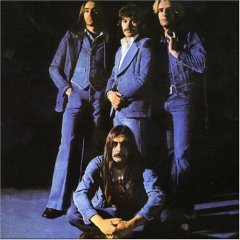
Me, I’m not too sure if I’m capable of it. It is also true that such an assertion is grossly insulting to Status Quo, as it would make them out to be nothing more than the rock equivalent of a mid-season, mid-table Blue Square Premier League 0-0 draw. Still, with Blue For You, the football analogy is not misplaced; Phonogram ensured that advertisements for the album were visible on the touchline of that year’s League Cup Final a full month ahead of its release. Moreover, the title and cover were almost certainly the result of a done deal with Levi’s jeans, where the band would pose in Levi’s gear, and thousands of special posters were sent to clothing and department stores throughout the UK. So instantly recognisable were the band that, like the Stones and Beatles before them, they did not need to put any title or group information on the cover.
I am aware that more than a few of my readers have long since buried their heads in their hands, wailing: “Oh, no, not THEM again!” But like a good reporter, I’m only reporting on what has already happened, and the fact is that in 1976 the Quo were huge. In July they managed to sell out a festival bill (20,000 tickets) at Cardiff Castle; their support acts were Curved Air, Hawkwind and the Strawbs. This was only a couple of weeks since the Ramones had supported the Flamin’ Groovies on bicentennial night at Camden.
And, it ought to be said, they were so huge they could get away with two singles from the album featuring Rick Parfitt on lead vocals, neither of which was an obvious hit (and yet they both made the Top 20); an album, moreover, that isn’t quite as approachable or predictable as might have been expected. For a start, it is clear that the Quo of this period were an entirely democratic organisation; Alan Lancaster wrote or co-wrote four of the album’s songs, Parfitt another two, Francis Rossi three (with Bob Young, although he was the co-writer on two of Lancaster’s songs), and all three share lead vocals between them. Rossi is certainly present on the album but his is by no means the dominant voice.
Furthermore, a look at the song titles themselves – “Is There A Better Way,” “Ring Of A Chance,” “Ease Your Mind” – suggests that they knew full well what was coming, and the need for change. I don’t intend to paint the Quo as art-rock minimalist project – less than two months after Blue For You was released, import copies of the first Ramones album began to appear in record racks, and AC/DC were also beginning to make themselves known outside of Australia – but I believe there is a great sense of awareness here that time is, in some senses, running out.
As for the songs themselves, there is not too much to say about most of them, and certainly nothing constructive to be said about the lyrics; for the most part it is business as usual – fairly morose lyrics about lost love and missed chances set against Quo’s staple musical trademarks. Yet releasing “Rain” and (a heavily edited) “Mystery Song” as singles represented a risk; there is no defining anthem as such on this record, no “Caroline” or “Down, Down.” Probably their best-known track from this period, their cover of “Wild Side Of Life” was recorded specifically as a single, some time after the album’s release (although it appears, in both demo and hit forms, among the bonus tracks on the Blue For You CD). “Mad About The Boy” is not the Noël Coward ballad. “\Rolling Home,” a Lancaster/Rossi composition, is not the same song as the Quo’s 1986 top ten hit “Rollin’ Home.”
And yet the first track is punk rock.
“Is There A Better Way,” co-written and sung by Lancaster, was probably Quo’s most atypical piece of work since “Pictures Of Matchstick Men,” a furious, guitar-heavy gallop of a naggingly familiar riff (which, on eventual recollection, turns out to be a speeded-up variant on “Roll Over, Lay Down”). With the exception of its incongruous 6/8 instrumental interlude and a slight Russian overtone to the melody, this is clearly a portent of what would in a year or two’s time be the lingua franca of British rock music, an attack which anticipates the Damned and Buzzcocks, although the compositional touches and the general air of the performance both suggest that this is punk arrived at from a pub-rock perspective. It is certainly the most startling piece of work here.
“Mad About The Boy” is a more familiar, Rossi-led jaunt, as is “Ring Of A Chance.” The former briefly tips its hat to Bolan’s “Hot Love,” the latter demonstrates their playfulness as they mess around with tempi in the song’s introduction and middle section, with some odd Queen-like harmonies making themselves briefly felt at the back of the mix. Both owe a curious debt to the fifties. The title track, however, is Lancaster again, and is a slow blues-ish canter with a tint of music hall which overall sounds surprisingly close to the Bay City Rollers; however, Rossi’s guitar solo is impatient to state its case. If Rossi is soloing again on “Rain,” then he doesn’t take long to wriggle his way out of the barlines, eventually playing out of tempo. Parfitt is anxious to underline his Cockney credentials (his pronunciation of the title in the chorus, together with his “ain’t” in the line “How can I write you when there ain’t no light?” and the whole is like a doleful British reversal of the optimistic “Raindrops Keep Falling On My Head.” There are times, though, when the track is just a breath away from becoming Queen or the Raspberries, especially in its outstanding harmonic middle eights. There’s a nice touch at fade where the ambiguous vocal harmonies from the latter are superimposed on the song’s central guitar riff, with its hint of discordancy aptly reflecting the tenor of the lyric.
“Rolling Home” plays like Quo at 78 rpm, a super-fast “Spirit In The Sky” variant. Again, as with “Ring Of A Chance,” their display of musicianship is almost throwaway; they can play with different tempi as assiduously as Zeppelin but don’t make nearly so much of a show about it; see also the trip-up missing bar in the first middle eight of the nonsensical “That’s A Fact,” which is funky like Zeppelin are funky. Lancaster takes over again on “Ease Your Mind,” another fifties throwback, if one of redemption.
The album closes with the full “Mystery Song”; beginning with a ruminative, mid-tempo prelude, the song’s more familiar riff then takes centre stage and gives rise to one of the group’s most assured and breakneck performances on the record; Parfitt sings of his dealings with a lady of the night, being hustled through the chorus like a drunken dodgem, in the same way that someone else would sing of “Roxanne” a couple of years later. Without warning, the song then turns into an Eagles jam session, followed by a bit of Who-style pseudo-build-up and then, towards fade, an electric hoedown. The song is fittingly named.
That’s about it. We’re still with the working class vote (that pronunciation of “rain”) but the household perspective is different; there are the parents downstairs, listening to Jim Reeves or Slim Whitman, occasionally banging on the ceiling to ask their son upstairs to turn Status Quo down; the son, meanwhile, is busy learning all the chords, that is when he is not indulging in simple headbanging. Note the stage photos in the CD booklet; Rossi, Lancaster and Parfitt, all heads firmly down, thrusting as though they had all accidentally landed on the same vaulting horse at the same time. The people’s rock band? I suppose they were – if the students were away unravelling the mysteries of Zeppelin – and even if they weren’t supposed or expected to change, they stayed there, rather like the Queen, finally making a virtue out of their absence of change. Yet Blue For You makes it clear that they knew change was coming. Yes, Status Quo were, and are, as real and reliable as bread, and sufficiently wise to know that bread alone can never be enough.
Sunday, 15 April 2012
Slim WHITMAN: The Very Best Of Slim Whitman
(#165: 7 February 1976, 6 weeks)
Track listing: Rose Marie/Cool Water/I’ll Take You Home Again Kathleen/I Remember You/Secret Love/Snowbird/Ramblin’ Rose/Love Song Of The Waterfall/The Old Spinning Wheel/It’s A Sin To Tell A Lie/Happy Anniversary/The Twelfth Of Never/Serenade/Roses Are Red (My Love)/China Doll/Walking In The Sunshine/When You Were Sweet Sixteen/Honeymoon Feelin’/Have I Told You Lately That I Love You/Indian Love Call
“Country music deals with everyday problems that most people can identify with. Some of it is about beer halls and broken homes and divorces, some of it about ordinary, everyday occurrences. When people hear that music, they get a feeling that they belong to the music and the music belongs to them.”
(“Cousin” Minnie Pearl, quoted in Tony Palmer, All You Need Is Love: The Story Of Popular Music, London: Weidenfeld & Nicolson and Chappell & Company Limited, 1976, chapter 10: “Making Moonshine – Country Music”)
“I have had a time of seriousness, and I have known the importance and reality of a religious belief. Lately, I acknowledge, much of my seriousness has gone off, whether from new company, or some other new associations; but I still retain at bottom a conviction of the truth, and a certainty of the usefulness of religion.”
(Charles Lamb, letter to Walter Wilson, August 1801)
I do not intend to overplay the importance of the working class vote in this current run of number one albums, but then I do not feel it can be overplayed. When the Scots and Irish first came to settle in America, making their way to the Ozarks and Appalachians, they found an enclosed kind of impoverishment, a hard and tough living that was in many respects only made bearable by their sense of community. Isolated by geography and circumstance, they learned to rely on themselves and developed their own music; by “developed” I mean take the ancient folk songs they had taken over with them and adapt them so that they would become relevant to their current way of living and their current society. As these things have a way of developing, what became known as hillbilly music, and finally as country music, evolved from these beginnings. It’s not so far a step to think of mid-seventies Glasgow, in its own ways suffering its own kind of impoverishment, with a similar bunking-in of communities, sticking together with its means and its music. In direct contrast to nineteenth century America, the North suffered while the South prospered and modernised.
As the twentieth century “progressed,” country music had its own ambitions. Jimmie Rodgers was the key figure here with his yodels and his shared fascination for that abstract goal known as “the West.” More than anyone, he, or at least one strand of his music, paved the way for the singing cowboys, the likes of Gene Autry and Roy Rogers, whose aim was certainly more concerned with “ordinary, everyday occurrences,” just as they built a cinematic fantasia of an idealised West where everybody got on, ornery rustlers were rounded up and horses were rode into the sunset.
So it is not surprising that both Rodgers and Autry were early idols of Slim Whitman, who came from the decidedly non-Western town of Tampa, in Florida, and who after seeing wartime service in the US Navy set about developing a musical career for himself. He followed the tried and trusted route of Louisiana Hayride and suchlike, and by the early fifties had become a major country star, in large part due to the efforts made by his discoverer and manager, one Colonel Tom Parker; at one open-air concert in Overton Park, Memphis, another Parker client, Elvis Presley, appeared as Whitman’s support act.
Curiously this popularity did not enable crossover to the pop market; Whitman’s only major pop hit was “Indian Love Call,” which peaked at #9 on Billboard in 1953. In Britain, however, the story became rather different; “Rose Marie” had been a “sleeper” single, released here in October 1954, it had done nothing for nine months until a marketing push was applied, in part the 1954 MGM musical adaptation (or bastardisation, since little of the original material was retained) of the twenties operetta Rose Marie, starring Ann Blyth and Howard Keel (set amongst the community of Mounties, the work, and therefore the song, are secretly Canadian), and in part the efforts of an enthusiastic plugger and a receptive Radio Luxembourg. The single went to number one here and stayed there for eleven consecutive weeks, a record that stood until 1991 (and, with great generosity of spirit, when Bryan Adams broke that record, he was playing a season at Wembley and invited Whitman to come onstage and perform the song), and thus launched a brief but very successful chart career for Whitman here. Less than two years later, Elvis had triumphed and Whitman’s hits dried up, but the point remains that marketing played a vital role in his popularity to an extent which at the time was not really paralleled.
When the hits stopped, Whitman was not particularly concerned; he had become a popular live draw and simply continued to tour and record for the next few decades, averaging two or three albums a year. In the autumn of 1974 he unexpectedly returned to the UK Top 20 with “Happy Anniversary,” and shortly afterwards took advantage of the telemarketing boom; he was perhaps the first artist to benefit from specially assembled albums to be advertised on TV. The Very Best Of Slim Whitman, despite a cover illustration that makes Whitman look more like Howard Keel, and an Our Price sticker-style note on the upper right of the cover which indicates “20 SUPERB TRACKS,” was an immediate beneficiary; this is a year where nearly all the number one albums depended either on the power of television, in one way or another, or on the continued popularity of rock superstars (only two of these fourteen albums do not fall under either category, and they may well be the year’s two most significant albums). Indeed, in South Africa, the album was simply entitled 20 Superb Tracks, and I wish more of today’s acts would have the brassneck to entitle their albums similarly.
Then again, note that the album offers “20 SUPERB TRACKS” rather than the “20 ORIGINAL TRACKS” of the Roy Orbison collection. In other words, and with the exception of “Happy Anniversary,” these are not the original recordings; rather they are compiled from the long series of albums Whitman recorded for Imperial, and then United Artists, spanning the years 1962-1974, with particular emphasis on 1967’s 15th Anniversary Album, from which many of the more familiar tracks are taken. Strangely enough, and unlike Orbison, the added years do not seem to make much palpable difference; Whitman’s songs and delivery are so timeless as to defy dating. The tracks do not encompass the entirety of Whitman’s UK chart career – two 1956 Top 20 hits, “I’m A Fool” and “Tumbling Tumbleweeds,” are absent – but, if anything, age improves his perspective on these songs. Given that Whitman was already in his thirties at the time of his initial breakthrough, the difference is minimal enough to pass for immaterial.
His original “I’ll Take You Home Again, Kathleen,” for instance, contains little of the world-weariness and barely concealed despair we hear in the 1967 reading; written by an Indiana reform schoolmaster in the 1870s, probably with the traditional Irish ballad “Blow Out The Candle” in mind, this version casts Whitman as a more obvious redeemer, and even saviour; dreadful things have clearly happened to his once (and, in his mind, still) “bonnie bride” and he rushes to return her to life and hope. Here his habitual and abrupt leaps from counter-tenor to falsetto (not quite yodelling) carry emotional weight, for example in the line “Your voice is sa-AD when you speak.” He speaks of delivering her from the hostile outside world “to where your heart will feel no pain.” The supra-falsetto he finds on the climactic “green” is heartbreaking; these are adult feelings and emotions, scraps from lives lived, and he is trying to see whether a life can not only be relived, but saved. It is an extremely moving performance.
“Love Song Of The Waterfall” was his first major country hit and set out his trademarks; a high, wordless falsetto opening, contrasted with his deeper natural singing voice – a bridge between female and male. “This is heaven’s mating call” he gasps, ready to ride the rougher terrain of the “Plunging over rugged rocks” middle eight. “Indian Love Call” followed shortly thereafter, the singer answering his own echoes – he is crying out for love but only really talking to himself – with a characteristic background of sustained vibraharp, gentle acoustic guitar and distant, wan pedal steel. Were it not for the pedal steel, and the entirely different emotional approach, this, as with many of these tracks, could be a Jim Reeves record, except that I find Whitman’s voice and approach considerably easier going than Reeves. Where Reeves suffers nobly, or ignobly, in the manner of Thomas Hardy – he’ll endure anything but never lets the listener forget that there’s something he’s trying to tell them, to communicate to them – Whitman is much more of a Charles Lamb figure; he floats benignly above his songs and affably warns against taking them too seriously.
Then again, Whitman’s sustained good humour and conventionality do sometimes make the listener wonder about the underbelly, if any; more than Orbison, he seems the perfect David Lynch figure – he’s so seamlessly normal that there must be something awry (not the case in his actual, blameless life) – and “Rose Marie” is an extremely strange song to be at number one for eleven weeks. The opening piano, one swooping note pedal steel and acoustic guitar set the scene for another wordless, near-androgynous vocal incantation, and as Whitman settles into the song, you realise how unsettling the song actually is: “Sometimes I wish I’d never met you,” “Of all the queens that ever lived, I’d choose you to rule me” – this is not an uncomplicated declaration of love, much more of an expression of deadly obsession. And, when not in falsetto, he does sound awfully close to Orbison.
Still, I wondered where I’d heard that combination of pleading-verging-on-craving vocal, weeping pedal steel and general use of space before. I thought of “Harvest Moon” – needless to say, there’s a lot of Whitman in Neil Young (when it’s not Slim, it’s Walt) – but then the penny dropped; the record reminds me of nothing so much as “Boyfriend” by Justin Bieber. That downward-weeping drone which persists throughout the song might as well be a pedal steel; and Bieber, too, is almost praying for love and faith with his vulnerability (see also Elton John’s “Blue Eyes” which, with its accent on the singer’s rarely-used lower register, is practically a Whitman song in reverse); it is by some distance his best record to date.
Then “Indian Love Call” finally became a hit here; its double A-side “China Doll” was listed separately and is this record’s strangest and most disturbing song. On the rear sleeve is a photo of a white-suited Whitman onstage, putting his band through their paces (by the looks of things, indicating a downbeat), and with his florid handlebar moustache, sideburns and general air of tall rectitude, the picture could almost pass as Nick Cave and the Bad Seeds (except Cave would never dress in white). He begins the song by exclaiming “I’m tired of cryin’” and proposes to live his life hereafter with a China doll who will not cheat on him or lie to him as his Other has done (“someone just like you with a heart of stone”). “Her eyes are bluer,” he croons, “her faults are fewer.” He can trust her not to lie to him, for lying represents to Whitman the line in the moral sand (“It’s A Sin To Tell A Lie” indeed). I note the little section of Chinese music which concludes the piece, and shiver at the song’s implications.
Not that Whitman was much for going into the darkness. His “Snowbird” and “Ramblin’ Rose” are regretful rather than accusatory (and neither song is really suited to Whitman, the busy single-note sitar-like guitar picking on the first verse of “Snowbird” notwithstanding, which made me briefly think of the Stylistics). His “It’s A Sin To Tell A Lie” is nearly drowned under Ray Conniff choir treacle but it’s a fine and dramatic performance, as his hurting “Just because these words are spo-oh-KEN!!” demonstrates. Likewise, his “Roses Are Red” – very different from Perry Como’s, but it’s remarkable how this same circle of songs comes round again and again – is polite and noble. His take on “Cool Water” is markedly different from Frankie Laine’s; instead of clenched rage, he appears to merge with the desert, so serene and unconcerned is his vocal. If nobody else sees the oasis, is that because he himself is, or has become, the oasis? The feeling, with judicious use of echo and brushes, and a similar tenor of dislocation, is not far removed from Presley’s “Blue Moon,” and again there is that single note, humming drone of pedal steel – Joe Meek, yes, but also OMD (see 1980’s “Statues”).
Generally, however, Whitman deals with happy songs, either concerning long-lasting love – in several songs he emphasises the importance of weddings and marriage – or reflections on times past. His “I Remember You” is a subtle sideways nod to Frank Ifield, whose original recording was inspired by Whitman, and although this doesn’t have Ifield’s rugged Brave New World approach, overall it’s probably a better reading; his two-syllable “ca-all” as part of the word “recall” and his subtle reorganisation of the song’s harmonies. As an incidental finding, I also note some precedence for the work of Jimmy Somerville, who would have been about fifteen when this record was first around (Billy MacKenzie I am taking as a given). Nothing disturbs Whitman too much; he canters amiably through “Secret Love” as though riding a horse throughout, with whistling to fade and a few characteristic touches such as the upward arch of “doo-oo-oor” to make the listener forget to wonder exactly what is supposed to be so secret about Whitman’s love; he is one of the least “secret” figures in this tale.
“Serenade,” originally a 1956 hit here, was also tackled by Mario Lanza; wisely, Whitman ignores the temptation to do a Lanza and drifts through the song, with its restless solo violin line – since it is harmonically a very tricky song, this is quite an achievement, although note the appearance of the bolero rhythm at the song’s climax (“I have known the magic…”). Taken in tandem with the very Orbison-esque tom-toms which soundtrack Whitman’s “Twelfth Of Never,” complete with the little harpsichord figure which twirls out of the phrase “April snow” (possibly influenced by the Beatles’ “In My Life” since the record was made in 1968), and we get a picture of a benign Orbison, one without paranoia, doubt or heartache.
There is a series of songs of happiness and devotion. Roger Miller’s “Walking In The Sunshine,” from 1969, is a chirpy affair with rinky-dink organ and an almost reggae-like rhythm (Whitman too was popular in Jamaica). “A snowy pasture, a green and grassy field” – it’s all the same to Slim; he finds equal or matching pleasures in both. “When You Were Sweet Sixteen” (again repeated from the Como collection) is an extremely different reading from Como’s; there are no verses at all, just the chorus (and he changes “since first I saw you on the village green” to “since first I met you”), followed by a talking section; despite its deliberate anachronisms (“Our first date together,” “Yes, honey”), it is a particularly affecting piece, largely because Whitman plays it absolutely straight and sounds as though he means it; I realise that he may be singing directly to his wife, to whom he was married for sixty-six years (she died in 2009, having been ill for some time with kidney disease; he has two children and at the time of writing continues to record). See also “Have I Told You Lately That I Love You” – not the Van Morrison song, but it must have helped inspire it – where he sings of his devotion but only partly buries the dread of his world ending (cf. his life ending, as he fears, in “Rose Marie”).
But the two songs explicitly devoted to celebrating the joys of marriage are maybe the most touching. “Happy Anniversary” may sound a little corny if, like me, you were ten when it came out, but as a happily married man of nearly fifty I find it a very sweet song, delivered with truthfulness. “It’s not getting older, just much better” indeed! And “Honeymoon Feelin’,” co-written by the same author, Gary Paxton, is a dainty celebration of the joys of…well, still doing it (“Every time you touch me, it’s still the living end”). An onomatopoeic pedal steel gives its approval, and the song makes you wonder that this is a subject matter rarely touched upon in popular song; that of long-term partners still, shall we say, making whoopee.
The only song not yet touched upon is “The Old Spinning Wheel,” hymn-like with a miraculous middle instrumental section where pedal steel and guitars electric and acoustic meld into a sort of organ-like drone. “There’s that old spinnin’ wheel in the parlor,” muses Whitman, “Spinnin’ dreams of the long, long ago,” and with its meditative use of words like “twilight,” “organ” and “Old Black Joe,” it feels like a song going back to the very beginnings, of those early arrivals on the East Coast and the songs, memories and beliefs they brought with them.
That’s all there is to the album, I could say at this point, an album I remember being played on neighbours’ record players, or hearing in the shops in Hamilton; the notion of gatherings of family and friends, a few wee drams, a bit of a singalong (this album is primed towards a “singalong” audience). And yet I know that isn’t all there is to the album, or indeed Whitman. This, after all, is the first man the young George Harrison saw holding a guitar, let along playing it, and therefore inspired him to take up the instrument. Likewise, Paul McCartney, noting the left-handed set-up of Whitman’s guitar, thought there might be a place for left-handed guitarists after all, and started playing. An aspiring young Irish guitarist named Gilbert O’Sullivan, who also happened to be left-handed, wrote to Whitman asking if he could send him one of his custom left-handed guitars, but unsurprisingly never received a reply; frustrated, he switched to drums for awhile before settling for the piano.
It just keeps expanding. On a compilation CD variously titled The Paul Weller Jukebox and The Roots Of Paul Weller, the man from Woking picks the tracks which he felt most influenced him in his youth, and among them is Whitman’s 1953 reading of “Danny Boy” (a song not reproduced here). Moreover, Michael Jackson named Whitman as one of his ten favourite singers of all time. Impressive for a man who gained international stardom just about everywhere except his own country; in the late seventies, taking his TV-inspired success as a model, he started to advertise his albums on TV, available on mail order only, and found that these began to sell in the millions. The original “Love Song On The Waterfall” is the song played at the tollbooth in Close Encounters Of The Third Kind. A strange but logical futurism marks Whitman’s every move, or at least seemed to do so.
But the Michael Jackson approval might be the most significant factor here. I believe that this album did so well in Britain because it represented something a large number of British people needed; a reliable singer, singing to his audience in a language they could instantly understand, offering songs to lean on (Sydney Devine, a huge star in Scotland from the seventies onwards, is effectively Bellshill’s answer, or strictly speaking Cleland’s answer, to Whitman, with his songs about silver-haired grannies and renegade grandchildren). But it’s that indeterminate register again, the female/male bridge I mentioned earlier, the notion that these performances could as well be given by women as by men. There is a similar indeterminacy, or encyclopaedic desire to reach as many people as possible, in Jackson’s work; consider, for instance, his sudden intervallic leaps in “Beat It.” Or think of Roxy Music’s “More Than This,” a song sung entirely in the style of Whitman (Bryan Ferry himself is somewhere between Noel Coward, Alex Glasgow and Whitman, and not necessarily a stranded somewhere), a song which could well be done as a country tune. If Johnny Cash was the Man in Black, Whitman is the irrepressible Man in White, his purity of tone and intent indicating that his music belongs to you, and you to it.
Sunday, 8 April 2012
Roy ORBISON: The Best Of Roy Orbison
(#164: 31 January 1976, 1 week)
Track listing: Oh Pretty Woman/Borne On The Wind/Today’s Teardrops/The Crowd/Crying/Evergreen/Candy Man/Blue Angel/Up Town/Only The Lonely (Know The Way I Feel)/It’s Over/Lana/Leah/In Dreams/Pretty Paper/Blue Bayou/Running Scared/Falling/Goodnight/Dream Baby (How Long Must I Dream)
“It is death to mock a poet, death to love a poet, and death to be a poet.”
(Old Irish saying, possibly derived from Virgil)
But first, let us speak of Harry Barry and the Big Elastic Band.
One of my favourite songs is “When Big Roy Sang on Annie McGregor’s Juke Box,” the title track of the Big Elastic Band’s 1996 debut album. Some perspective is needed here; Harry Barry comes from Uddingston, a village about seven miles southeast of Glasgow, and the place where I grew up. Or to be precise, he comes from Viewpark, a postwar housing scheme just to the northeast of Uddingston. On the old bus route from Uddingston Cross to Bellshill, Viewpark more or less marked the halfway point of the journey. It was originally created for the benefit of heavy industry workers who certainly appreciated having decent homes in which to live. In time, as adjacent Tannochside decanted its mining community – it demolished the old miners’ cottages to make way for a new industrial estate (which is now mostly business and retail parks, but in the heyday of Ranco, Blue Circle Cement etc. it was quite a spectacle; from the back of the playground at Muiredge Primary School you could see the whole estate, which looked oddly flat and two-dimensional) – the miners and their families also made their way to Viewpark, which meant it became a solid working class community, full of (as Mr Barry either states or implies in his notes and songs) mass football matches, fish fry-ups and the accordion of Jimmy Shand on the wireless to remind folk of their roots. It developed a bad reputation in the seventies; my father would turn around at the old gasometer which marked the boundary between Uddingston and Bothwell, point at the distant estate and declaim “Colditz!” Things were rough there for a while, but the community rallied together and from the eighties onward there was marked improvement.
Harry Barry himself is a drummer, singer and songwriter who has been in the music business probably for as long as I’ve been alive. He played the drums on Andy Cameron’s 1978 World Cup anthem “Ally Tartan’s Army.” I recall a single he had out on RCA in 1974 entitled “Friday Night” which was a moderate local hit but faded into obscurity, which is a shame for it is really not bad. If you grew up listening to Radio Clyde, chances are you heard a lot of Mr Barry’s jingles, for jingle-writing was, along with session work, his main occupation for some considerable time. Like Chas and Dave, however, he became anxious to sing of his own culture and in his own accent; hence the formation of the Big Elastic Band, a predominantly middle-aged group with unabashed nostalgia for growing up in fifties South Lanarkshire. Instruments such as accordion, mandolin and harmonium indicate their general artistic approach – the music is a deliberately familiar and welcoming blend of straight pop, country, folk and reels.
“When Big Roy Sang…” is a song about the moment that inspired Mr Barry to pursue a career in music. Since I mostly grew up in seventies Uddingston, I cannot pretend that the Osborne Café wasn’t before my time – it had certainly vanished by the time I would have been old enough to appreciate it – but the memories, and more importantly the emotions, are still present within the song. There they are, Mr Barry and his Uddingston Grammar pals, “smoking fags and dogging school” (the latter a lovely Lanarkshire euphemism for playing truant) in Annie McGregor’s place, and there is a juke box. This juke box Mr Barry loves to use and listen to; it plays what you would expect from the time and place: “Buddy Holly, Elvis, Jerry Lee.”
But one lunchtime he puts his money in and a different record is played by mistake; but what a mistake. It is “Only The Lonely” by Roy Orbison, and soon the whole crowd is wreathed in a “magic spell.” He and/or Annie play this record over and over, try to get into its grooves, within its heart, to work out just what magic it is creating. And he knows, because the song delves into “Only The Lonely” with varying degrees of subtlety, that this is the moment that will change his life, that this is the talisman which will guide him down his path. In 1996 (“Nearly forty years have come and gone”) he remains entranced by the record (“it still sounds fresh and strong to me”), and while he’s at least partly aware that he’s living in the past (“But nostalgia’s no’ like it used to be”) he still recognises the record as a beacon; artfully constructed so as to emulate the climax of an Orbison ballad, the song peaks with Mr Barry stating that he knew his life would never be the same after having heard it. It is one of the most moving musical instances I know of how a person can be taken over, almost occupied, by a record, how music can move its listener to change his or her life. Give it a Sheffield accent, different scenery and a slightly more elaborate orchestration and it could be Richard Hawley. In his brief note, Mr Barry says of the song: “On hearing ‘Only The Lonely’ for the first time. How many million others had the same experience?” Listening to it now, over half a century since it was recorded, I would imagine that the numbers climb into the realm of the innumerable.
For this is one of the most important records in Then Play Long, despite its appearance. When I came across this not especially easy to find Arcade compilation in the record racks, I was amused to find it filed next to 1987’s In Dreams: The Greatest Hits. On the face of it, there seems no competition; one a perfunctory cut-and-paste job which looks as though it took marginally less time to put together than it did to look at it, the other a luxuriously-packaged collection fit for a comeback. But remember Mingus’ remarks in “The Chill Of Death” about the two long roads waiting for him to choose; the less appealing-looking album is actually the superior record. Although the track listing is not really logical and reads as though the compilers put the song titles into a hat and drew them out, and despite the perhaps misleading copyright renewal dates (1971, 1972) which lead to immediate suspicion of questionable re-recordings, these twenty tracks – as the album sleeve actually makes completely clear – are the original Monument masters. It is not the same album as 1973’s definitive double The All-Time Greatest Hits Of Roy Orbison nor the record which will eventually appear here as entry #378 – the hits are ordered differently and the auxiliary tracks are also different on each – but they are the originals, whereas In Dreams consists of re-recordings, and sounds like it; the rhythmic and arrangemental subtleties of the originals are flattened out to match the tenor of the times, as has been all too often the case from the eighties onward, and while Orbison can still reach those high notes, the emotion, the guilelessness, appear to have evaporated. He sounds like an old man trying to remember his dreams, whereas the originals, as represented on this collection, capture him at the point when he was still dreaming these dreams.
As I don’t think approaching the album in track order is going to prove especially helpful, it is better to start with “Only The Lonely,” a record which in itself marked the formation of a radical bend in the road of rock which had not previously existed, or been imagined. I am very much bearing in mind the listening habits of the younger Roy, out in the barren oil fields of Wink, Texas, including the strong radio signals he would have got from Nashville and Mexico, not to mention opera and pre-rock pop (so much of his work seems just to avoid being sung in Spanish, the “yi-yi-yi” in the climactic “crying” of “Crying” being just a single example). It is probably also accurate to say that it was Del Shannon, and not Orbison, who was rock’s first neurotic, but Orbison unquestionably introduced an extra psychological layer to rock, a music which had not hitherto been much concerned about self-doubt or suffering. It is true that Orbison used tropes and constructs which were common parlance in country, blues, jazz, folk, the Broadway musical, and about every other pre-rock 20th century musical movement of popular significance, but these had not yet been used within rock itself, and its consequences in terms of influence can properly be described as immeasurable. In songs like “Falling,” “Goodnight,” “Leah” and “In Dreams,” Orbison seems to be doing Blood On The Tracks over a decade ahead of Dylan – the same incrementally increasing piles of imagery, both abstract and concrete, the same underlying, unimaginable pain – and in terms of emotional and aesthetic complexity, Orbison was there first.
There was of course a song called “Only The Lonely” already in existence, written by Sammy Cahn and Jimmy van Heusen as a sort of title track for Sinatra’s 1958 album. But, as magnificent a soliloquy of hopelessness as Sinatra’s “Only The Lonely” is – and the album is full of definitive Sinatra setpieces of melancholia including “What’s New?,” “Angel Eyes” (“’Scuse me while I disappear”), “Goodbye” and “One For My Baby” – it does seem rather to wallow in its own sorrow, find a strange kind of euphoria in doing so.
Whereas Orbison’s “Only The Lonely” is the superior song and performance because both suggest a way out. As a jobbing songwriter, Orbison had tried to pitch it to Elvis (who hadn’t got out of bed yet) and the Everlys (who weren’t interested), and finally resorted to recording it himself. He brought two friends into the Nashville studio to do the Everly-style backing vocal refrain. Producer Fred Foster protested that the music was too quiet to record; Orbison replied that he’d better find a way of recording it because that was the way he did it. And he was right; the musical background is integral but unobtrusive, and Orbison takes the opportunity to use almost his whole vocal range, and by doing so make his sadness empathetic and universal. At points the voice engages in rhetorical dialogues with Bob Moore’s strings, but what is vital about the record is how both voice and arrangement build up, layer by layer, so that by the time Orbison climaxes on the extended, out-of-time falsetto on the “you” of “that’s the chance you gotta take,” he allows himself a death-pondering pause between the “you” and the “gotta take,” and thereby makes his meaning and message clear; he is not seeking to mourn or to die, but is simply asking for the freedom to try again, even if he fails again. He tells us quite firmly here that he is not a quitter, that he’s ready to take whatever life and people throw at him, swallow it and start again.
There was some initial difficulty in following the song up. “Blue Angel”’s arrangement is simply too fussy for the song to come through and palpate; the backing vocals swallow the song up (so that in places Orbison scats where he would have otherwise put a lyric, before abruptly rushing into the middle eight). In between all this, we sense that Orbison is offering himself in the rare (for him) role of saviour, protector; his low “low” and “around” imbued with authority (although he finishes on a falsetto). Nor were the likes of “Today’s Teardrops” any way forward; the song was co-written by Gene Pitney, whose voice Orbison resembles throughout, and although a later collaboration would have been something to behold – Pitney eventually becoming Orbison’s only serious rival in damaged opera-pop suffering, and largely because of his own innovations as a producer and sound artist – this early effort is an uncomfortably jaunty uptempo affair, complete with Psycho-type string slashes, would-be rootsy sax and guitar solos, and imbecilic “Yeah yeah yeah!”s from the backing singers. In fact Orbison generally (but not wholly; there are at least two sterling exceptions to the rule here) sounds not only uncomfortable in uptempo settings, but also different; his voice a lot more nasal and maybe more carnal. “Lana,” not released as a single in Britain until 1966, sees him having to contend with a curious bass (proto-synth bass? Tuba?) and absurd backing vocals which go “Ling-a-ling-a-linga” when they are not going “Mamamamamamamamamama” (which I admit may have been partial inspiration for “Make Me Smile (Come Up And See Me)” and maybe young Robert Plant knew the record). “Up Town,” meanwhile, is JC Penney Elvis (specifically “Stuck On You”) where Orbison is compelled to leer about the potential to live in “penthouse number three,” to ride with the unsubtle drum hammering (“You want be my Ev! Er! Lov! In! Ho! Ney!”) or, in a particularly priceless moment, proclaim “I’m just a bellhop/You see I can’t stop.”
But “Running Scared,” his first US number one, put him quite defiantly back on track. The first of his hits to deploy the classic bolero structure – indeed, the song was inspired by Ravel’s Bolero - the song remains one of the most frightening rock has ever offered, not just because of the screaming subtext of sexual inadequacy and sexual jealousy, but because, as with so many of his subsequent hits, the action may only be happening in Orbison’s head; the song is a pocket examination of what happens when a man feels he is obliged to drag his past around with him like a ball and chain; she is not scared, may not even realise that he harbours these doubts, but who is this “him” who obsesses Orbison, so much so that he cannot stop or pause for breath? Whatever he is, Orbison conjures him up so tirelessly and persistently that eventually all he can do is appear (“And then, all at once, he was standing there”). This man, who is “afraid to lose” – he is already spelling it all out for us – at least summons the nerve to look him in the eye (if he even exists), and as his voice methodically ascends from dread to liberation we not only realise that few pop songs depend so violently on one word, but also that no listener would have entertained the thought of the girl walking away from Orbison; the whole twist is that she walks away with him, and he had nothing to worry about all along. Not that she’ll ever know that she never really had a say in the matter.
“Crying” upped the ante even more. Parallel to Sinatra’s slowly burning take on “What’s New?,” the song tells a similar story; he sees an old flame in the street, they get on and part on good terms, and at no point dare he tell her that his flame for her still burns, is close to obliterating him. The tom-toms and vibes seem not desolate, but disused. His “hello” is consumed by fear. His “crying” at the end of the first verse is audibly shaky. But the bolero continues to build and he has no option but to unleash everything his voice has to offer; the impartial, affable baritone of the first verse, the eventual move into falsetto, the final explosion into his real upper register (yet again resting on that “you”). All the while, the song’s triple beats are nailing him into the sand. No one else in rock was even trying to sound like this. He climbs the mountain, wanting only to scream at the summit. No wonder he needed to provide some relief with “Candy Man,” the B-side (and eventually a UK hit in its rather listless Brian Poole and the Tremeloes incarnation) which even in its upbeat sensuality comes across as slightly menacing; the too-rough harmonica, the ongoing likeness of a politer cousin of Howlin’ Wolf’s “Smokestack Lightning.”
Next came “Dream Baby” which, though ostensibly bright and uptempo, retains the bolero structure, from double bass introduction through acoustic guitar and thumping drums, and here it is that Orbison begins not to be quite of this world; his desired one may not exist other than in his dreams, and as the female backing singers become more animated, and baritone sax and agitated solo guitar muscle their way into the picture, the intensity increases. Suddenly there’s a silence, as though a coffin lid has slammed shut on the singer, before the song resumes, now with handclaps and Orbison’s readiness to insert a final, high, tormented “sweet” before the record fades; the air is one of a more deceptive variant on “Hit The Road Jack.” It was not a format to which Orbison would for the most part adhere in his subsequent singles (although “Mean Woman Blues,” the double A-side to “Blue Bayou” and, in the States, the bigger hit, is strangely absent from this collection).
The follow-up, “The Crowd,” found Orbison back in familiar territory; first the slow wheels of the tom-toms – we could almost be listening to Queen Victoria’s funeral – then bass drum, bass guitar and piano mimicking a heartbeat (“For the heart of the crowd is gone from sight”). Unlike, say, Andy Williams, Orbison cannot hope to lose even himself in a crowd; there is a bizarre, string-driven tango of a middle eight, and once more the build-up to Orbison’s near-hysterical “Make be-LIEVE!” before strings and beats push him over the edge of the cliff. This is perhaps the most obviously Mexican-influenced of his singles, though he already had to be careful not to repeat himself (“Evergreen,” which is included here, is a nice but minor work, with strings swooning at the line “When the cold winds begin to blow” and so forth).
However, 1963’s “Leah,” double A-side to the likewise absent “Workin’ For The Man” – a shame about the latter, since both help set the scene for “Blue Bayou” – threatens to dovetail into psychosis. An introduction for floor tom and watering can immediately conjures up “Caroline No” and the scenario in this song is perhaps Orbison’s weirdest; he goes out of his beach hut and into the sea, diving for pearls he can give to his Other. But while doing so, his leg catches on something, something heavy enough to drag him down, and he knows he is dying. Musically the hint of “Bali Ha’i” is strongly evident, mixed with a little Les Baxter exotica (including marimba) – but he awakens to find he died in his own dream, and maybe even prefers things that way (“I could sleep in my dream,” he sings, somewhat horrifically in terms of what it really tells us about the singer; a morbid Walter Mitty who actually favours fictitious oblivion as a relief from boredom).
Then comes “In Dreams” itself, and it’s not difficult to see how this song in particular provoked David Lynch – for what is Blue Velvet if not an extended bad dream, or – worse? – a wet daydream by someone who is able to hear but not yet listen; what else can that severed ear signify? – as it moves with nearly infinite patience from candy-coloured sandmen through prayers via recollections of life to stark bereavement. He knows which world he wants, and it’s the one he wills into being, nightly; again he meticulously climbs the mountain, only to discover discarded oxygen bottles at the peak. Yes, the cold reality of loneness hits him; yes, he can’t help crying, but still - still! - he refuses to end everything, instead tries to shrug it all off with his “It’s too bad,” but just along the road the first syllable of his “Only” – the big “O,” so to speak – lurks there to crucify him. This was the sound of rock tearing itself up, of a man who indulged in no Brel-style theatricality on stage, who merely stood stock still behind his guitar, never moved, and wore thick, and then dark, glasses – all to conquer stage fright, though as his early employer Sam Phillips astutely noted, if he’d taken the glasses off he would have been dead within the week – and yet was capable of more intensity and emotional openness than any of his peers. More to the point,, where could Orbison go with his dreams after this coda?
Into fantasies of near-derangement. “Falling” begins with ride cymbal and acoustic guitar alone, then joined by bass and castanets; it is Orbison’s starkest admission yet: “I was lying all the time/Pretending to be falling in love with you.” The twist here being: despite himself, he really is falling in love with her (“But it’s different now,” “Forgive me, forgive me” he pleas, as though at the church confessional). He gulps on his own words as he phrases “Don’t leave me now” in the manner of a spoilt child, and the question is not just whether he is saying any of this out loud, or only thinking it, but also: why the extended pretence? The only rational explanation is that this is a one-night stand, or a regular one-night stand, to whom he has become gradually attached; how often, I note, is Orbison actually on the winning side? Here he doesn’t even know he has won. As I said: Blood On The Tracks ahead of schedule – or even Here, My Dear?
There was one more dream to come, and it was the most terrifying of the lot. “I’m so lonesome all the time,” Orbison sings on “Blue Bayou,” still thinking of the Everlys. The part of Texas where he grew up was a day-and-a-half’s Greyhound ride from any bayou, blue or otherwise – though his regular songwriting partner Joe Melson might have known more – and yet his lament is not for some imagined paradise (“Oh to see my baby again/And to be with some of my friends”) but the horrible everyday world he is forced to inhabit (“Saving nickels, saving dimes/Workin’ ‘til the sun don’t shine/Lookin’ forward to happier times/On Blue Bayou”). The bass and brushes ostinato in the introduction foresees “Rikki Don’t Lose That Number,” and the harmonica is a bug which won’t leave Orbison alone. His idea of paradise? Somewhere “where you sleep all day.” In other words, there is no real evidence of his ever having been in Blue Bayou; it is a protest against the humdrum, cold, unforgiving world – that he can dream all he likes, but can never get away. Or possibly die in the process. The dreaming credit is running out.
“Borne On The Wind” followed in early 1964, and it is one of the album’s most fascinating songs, as well as featuring one of Orbison’s most bravura performances. Here we are not even in the world of dreams anymore, but approaching the graveyard; the bolero framework is the same as before but the performance more quietly intense. The choir has never been more ghostly; here it borders on “Johnny Remember Me” territory. The song is constructed like an extended elegy: “So tenderly, your memory lingers with me…/And you will live in my dream” (those dreams do not entirely fade from view; not just yet, anyway). And then there is the hint of “Jezebel” and some rare but genuine Orbison anger as he spits out the words “You don’t love me but you’d love me to be in love with you.” If it sounds as though we’re getting awfully close to “Eloise” again, it’s not an accident; but Orbison avoids hysterics here and leaves it to the drums to provide emotional beat accentuation before he dives from the top of the tower with a high C.
Then it was the reckoning; “It’s Over,” a British number one in the midst of the beat boom. While I do sympathise with Lena’s view that this is a rock equivalent of Sinatra’s “Learnin’ The Blues” – a consolatory arm around a pal’s shoulder as he relates what he himself has seen in an effort to reassure the wronged friend that he’s not the only one it’s happened to – I see it more as Orbison’s natural release. Throughout this anthology, Orbison has repeatedly been a passive recipient of pain and sorrow rather than an active motivator of them; he lets things happen to him, relies on the security of dreams to pretend that they didn’t really happen.
But “It’s Over” ruthlessly strips away that last mask. The florid orchestration and even more florid lyrics are there to distract the listener’s attention from what is really going on in the song; that Orbison is having his dreams taken away from him and being forced to look the reality of loss in the eye. And if a man really loves the thing he fears most, then it must be admitted that “It’s Over” is a grand, even magisterial gesture of release. That is, if he is singing to and for himself; but those final four exclamations of the title for me represent escape, a flight from pain and illusion, his most gratifying of freedoms.
I probably don’t have to talk too much about Orbison’s 1964 Christmas offering, Willie Nelson’s very slyly accusatory “Pretty Paper” – or possibly I should, since the tinsel and snow settings are systematically subverted by a zoom-in on the grieving man on the sidewalk (Orbison himself, although he never lets this on). “If you stop…better not…you’re too busy”; this conversational approach to pop lyricism leads directly to the work of Scott Walker (who grew up in another, greener part of Texas), Gilbert O’Sullivan, Elvis Costello and Morrissey. “And in the midst of the laughter, he cries” – was a better self-description ever achieved in pop? There is also “Goodnight,” belatedly released by Monument in the States as a single in early 1965 as Orbison moved to MGM, and away from the peak of his career, which is tough emotional going; Orbison begins by addressing his lover as “My lovely woman child” but she’s been cheating on him, is in fact doing it with someone else, and it is only as the song progresses that you realise that, far from never walking out on her, she in fact has long since walked out on him. His “goodnight”s become more and more wrenching, and, as in “In Dreams,” “I can’t help it if I cry.” Or repeat himself.
No, best to leave with “Oh Pretty Woman,” his biggest hit and his greatest uptempo achievement, and here is what Orbison has maybe been all along; a stud in the club, looking for love, eyeing up someone he fancies (not really that far removed from David Lee Roth in Van Halen’s “Jump”). “I don’t believe you/You’re not the truth!” he exclaims at one point, but he knows why she’s here just as surely as he is; and as his “me-e” moves from major to minor in time for the middle eight, his Tony the Tiger growl and “Mercy!” sneer fade to reveal the old, needful Orbison (with music aptly reminiscent of “Only The Lonely”). Various signifiers of the age flash by (“Yeah yeah yeah,” “Don’t walk on by”) and then something extraordinary happens. Orbison steps out of the song to assess the situation. It doesn’t look as if he’s been lucky. He muses for some time on the credibility of the word “okay.” But he doesn’t go home and cry like Morrissey, since he followed Petula Clark’s advice and went downtown; the club is dark, so he can stay in the shadows, perhaps see others more clearly. Instead he shrugs his shoulders and prepares to go home. What the hell, try tomorrow night, you never know…
….but wait. She’s walking back to him. He can’t believe it. She actually wants him. And his “yeah!” gradually formulates into a huge, euphoric grin as the music steps up behind him. He got his happy ending at last.
This is not the last time I have to face the spectre of Roy Orbison here, because of course, shortly after recording this music, real hardcore shit began to happen to him. And so it was that by the time 1976 rolled around he could have been forgiven that nobody remembered him; he hadn’t had a hit in Britain since “Penny Arcade” in 1969, his records gradually became less noticed and noticeable. But he never stopped working, or touring; in 1976 he was glad to play for whoever would have him, be it the Marquee Club or Batley Variety Club. He could go on a TV programme like The Wheeltappers And Shunters Social Club and make the rest of the programme wonder why it bothered turning up. On stage, whether in Britain, or elsewhere in Europe, or in Australia, or even Asia, he’d find to his incredulity that he was still being worshipped.
But this doesn’t begin to explain why Orbison’s music continued to carry such currency. I refer you to my opening quote; Orbison was, in his own way, a poet, and for him it proved to be a kind of death. But where and how does his legacy live on? In as many ways as there were fans of his music, is the only answer. Think not just of the obvious ones, like George Harrison (“Something”) and Jeff Lynne (“Telephone Line”), but also people like Neil Young (“A Man Needs A Maid”), Bryan Ferry (“In Every Dream Home, A Heartache”) and Michael Stipe (“Everybody Hurts”) – all songs Orbison could easily have done. Or Dusty Springfield, in many ways our female version of Orbison, though Roy would never have gone near Bacharach and David (but how else to compare a performance as draining as Springfield’s “I Just Don’t Know What To Do With Myself”?).And then there was Bono, who ended up writing a song for Orbison; the same passive-over-active attitude in most of his songs, the same seemingly effortless high notes – “With Or Without You,” by its composer’s own admission, is so much of an Orbison song as makes no difference. And Springsteen, who took Orbison’s urban operatics and made them breathe within a post-Spector structure (together with Dylan abstractions and bits and pieces from the whole twenty years that rock had so far given to him).
Or, for that matter (thanks, Lena), Marvin Gaye. “I know a man ain’t supposed to cry/But these tears I can’t hold inside,” “But I can’t help bein’ confused/If it’s true, please tell me, dear.” The same phrasing, the same structure, the same theme; I can’t imagine either Gaye or Norman Whitfield giving Orbison a second thought when putting together “Grapevine” but he, or his example, is there, in plain view.
The best response is to go back to the Big Elastic Band, and the business of a working class community. Who was buying Roy Orbison records in 1976 Britain? It can’t have been just nostalgia. There is undoubtedly an overlap with the Jim Reeves audience – it’s that Texas thing again, the yarragh redolent of howling coyotes; it’s there, too, in the bell of Ornette’s alto – but none, I think, with Perry Como. As with Reeves, and Max Boyce, it’s the working class vote again, and I’m sure we all saw Orbison as the working classes’ own Caruso, a brilliant and emotional technician on whom we could rely for answers, authority, and guidance. Even to the point of changing the lives of those kids in the Osborne Café, all those decades ago, when life was no simpler then, and probably a lot more complex, than now.
Subscribe to:
Posts (Atom)