Wednesday, 5 August 2009

The BEATLES: Sgt Pepper's Lonely Hearts Club Band


Sgt. Pepper's Lonely Hearts Club Band - Wikipedia


(#49: 10 June 1967, 23 weeks; 25 November 1967, 1 week; 23 December 1967, 2 weeks; 3 February 1968, 1 week)

Track listing: Sgt Pepper’s Lonely Hearts Club Band/A Little Help From My Friends/Lucy In The Sky With Diamonds/Getting Better/Fixing A Hole/She’s Leaving Home/Being For The Benefit Of Mr Kite!/Within You Without You/When I’m Sixty-Four/Lovely Rita/Good Morning, Good Morning/Sgt Pepper’s Lonely Hearts Club Band (Reprise)/A Day In The Life

“All that I can ultimately comprehend is the importance of devoting myself to one end: to investigating, by curious squints, what combinations of aural and visual shocks, performed on a lighted stage before a darkened auditorium, can cause the great white mottle of watching faces simultaneously to flush, blench, gasp, shriek, recoil, or stare in awe. I must admit myself to the audience’s secrets, their lowest psychological factors, and play on them quite openly, but with deep guile. I do not concern myself with slow absorption, with what they may feel before the rise or after the fall of the curtain. My business is with immediacy, the sudden start of here and now.”
(Kenneth Tynan’s general advice to theatrical producers, quoted in his review of the 1946 Alec Guinness production of The Brothers Karamazov at the Lyric, Hammersmith: included in the anthology A View From The English Stage – Mr H challenges an earlier Mr H, and thereby the WORLD! – published by Davis-Poynter Limited in 1975)

With the highly exceptional exceptions of the Rodgers and Hammerstein musicals – and the only slightly less exceptional exception of the Monkees - little attention has thus far been paid in this tale to children, or childhood. There have been many records for teenagers, more still for those who chose to progress into adulthood, and even a few aimed at those approaching second childishness, but no children’s records, as such. Many readers of a certain age may recall the era of Disneyland albums in particular, where the music formed only part of the package; there were bound books of illustrations, colourful pictures of the characters under consideration, a cheerily minimalist narrative; all designed to lead the child into Disney’s world, but with a secondary motive of leading children, whether by accident or on purpose, into the wonder of appreciating long-playing records as spectacles, events, in themselves. Certainly such things as the soundtrack album to The Jungle Book – also released in 1967 – helped steer this youthful writer towards a doubtful lifetime of considering, or at the very least fetishising, the picturesque attractions of the record.

In some cases – the various Winnie the Pooh albums, for instance – there were included party games, sometimes even masks to cut out and wear. So, just as the core long-term British audience for the Monkees’ television show turned out to be children, Sgt Pepper seemed designed to attract the curious and still open-minded child before all other listeners. The original plan was for a whole grab bag of goodies to be included with each copy of the album, including cutout masks, but financial restrictions limited the Beatles to including their own pop-up characters with the record. Still, for most it was more than enough, and Sgt Pepper conveyed the instant idea of a child’s birthday party record, with lots of primary colours and famous (and not so famous) faces on the cover, a gatefold sleeve, and even, in true children’s record fashion, the full lyrics to the album so that everyone could sing along with these songs, all about different characters, just like Camberwick Green or Trumpton. Then, when or if the children eventually grew up, they would realise what the album was really about.

But the latter conjecture suggests a deviousness that was certainly not the record’s aim; here, the Beatles seem to say to us, we are opening this record up to you, it is for you, the public, and meant for you, only for you. Whether young or old, square or hip, there’s something for everyone here; we intend to leave no one out. Like the work which took Pepper’s most extreme suggestions to their own ultimate extreme, Carla Bley and Paul Haines’ Escalator Over The Hill (with its “Multiple Public Members”), Pepper is a very public record, as though the Beatles were abdicating, handing their keys over to the world to lock and unlock as and how they will. Anyone, they appear to be saying, could sing or play these songs, anyone on or off the street, in the nursery or in the nursing home. Few albums in this tale insist so passionately on addressing their listeners in a markedly determined second person.

Indeed the original intention behind the eighth studio Beatles album was wholly to do with childhood, specifically their own Liverpudlian ones; then “Strawberry Fields Forever” and “Penny Lane” were swiftly appropriated for an urgently-required single and they had to rethink. But much of this deceptively delicate childishness survives throughout Pepper – as does a rather unexpected core of hardness. Children here drift into hastily-drawn abstract pictures of ungraspables, or leave home, or grow old, or learn about more than one world, or in some instances learn nothing. Lucy is far more innocent a protagonist than Alice since not only does she not realise that she is a protagonist (or, more correctly, a catalyst) but also that she herself might be both Pepper’s subject and object, as only a four-year-old Julian Lennon could have imagined her. She loses herself in marmalade and tangerine but keeps the turnstile open so that she might be found.

Losing themselves was certainly on the Beatles’ minds when they arrived at the Pepper concept. There is absolutely no need to underline the attendant irony of two albums by the Monkees – a manufactured band who to everyone’s surprise turned into a real group – being followed by an album wherein the Beatles pretend to be another, fictitious group. The Beatles, however, were by early 1967 somewhat fed up with having to be “The Beatles,” had stopped touring, badly needed to get off the treadmill, and McCartney came up with the Pepper idea as a means of releasing themselves from their own history, to come back as someone, or something, else, preconceptions thoroughly abandoned. To begin again, even as the planet stared hopefully at them like an outsized Labrador awaiting its dinner. And so they appeared, on the cover, primary-coloured and moustache-laden, their besuited former selves mourning their own demise as cutout idols crowded around, or at least behind, them.

And, following the orchestral tune-up and the audience noises, the first spectacle we see is, of all improbable spectacles, Jimi Hendrix, that imminent cover star of We’re Only In It For The Money; two days before starting work on the title track Lennon and McCartney had seen the Hendrix Experience at the Savile Theatre and been dutifully blown away; as a nice bookend, Hendrix added “Sgt Pepper” to his live act two days after it hit the shops. There is an unavoidable bumping grind about Ringo’s 3D drums and McCartney’s snarling lead guitar (and howling voice) which instantly recalls “Foxy Lady,” even though the intended overtone is one of Edwardian-cum-Butlin’s chirpiness. A quartet of French horns arrives midsong to add a raised eyebrow; what are the crowd laughing at? Meanwhile, just before a deep gulf of a pause, Lennon remarks, brightly, “We’d love to take you home.”

Then McCartney introduces “Billy Shears” – shades of that already doomed other Liverpudlian Fury? – to a shrieking 1964 reaction and the album’s first palpably whole song is given to the voice of...Ringo, as the Common Man. The party is already so well under way and its illuminations are so dazzling that the unwary listener barely notices that the record’s real purpose is already being spelled out; don’t be alone, shrugs a what-me-worry “Shears,” you’ll need some neat help to find out about yourself. What do they see when you turn out the light, and what happens if you dare to switch it on again? Still at this late stage indebted to the example set by the girl groups – check the extended calling and responding throughout the length of “Friends” – the song also subtly declares its musical allegiances to Pet Sounds with the staccato, echoed keyboard, the upwardly leaping Carol Kaye bass tropes. Ringo/Billy knows the answer already, has it all sorted; hear his good-humoured “no” or his boyish “mmmm” – this is someone who has succeeded in coming to terms in his world with the outside world, and the clear example we should all follow. So infectious is the singer’s intrinsically good nature we hardly pause to wonder what happened to the audience at song’s end.

We then drift into the primary school pictures of “Lucy”; inspired specifically by the “Wood and Water” chapter of Through The Looking Glass (as well as by his son’s painting), the dissolving traceries of treated guitar and echoed/doubled-up basses are balanced out by a surprising return to Hendrix stomp in the chorus, even if McCartney’s deadpan organ suggests a hidden close kinship with the Monkees. Lucy is being followed, and it becomes clear that this is merely the latest of Lennon’s attempts, following “Girl,” to find his ideal Other. And, unlike the subject (or object?) of “Girl,” Lucy is there, smiling and waiting for him, when he manages to catch up with her. “Lucy”’s delicacy is one of Pepper’s more obvious nods to the congruent influence of Syd Barrett, then ensconced in Studio 1 at Abbey Road with the rest of Pink Floyd recording The Piper At The Gates Of Dawn – another work based on a children’s book, even if it’s one of the chapters that children wait awhile before reading – as the Beatles were busy in Studio 2; each group intermittently paid the other a visit to see what they were up to but the real bond between the two didn’t start until Lennon and McCartney saw them onstage at the Alexandra Palace Technicolor Dream towards the end of April. Barrett’s portraits were always slightly harder edged and cheekier than those of the Beatles’ – his “Emily” is a rather more purposeful and assured Lucy, and “Arnold Layne” would not even have occurred to the Beatles at that time (though it would, in markedly different form, occur to Scott Walker a year or so later). The Beatles had their own “Interstellar Overdrive” too, in the still-awaiting-legitimate-release “Carnival Of Light,” but the eyes-of-a-child approach was something that bound Lennon and Barrett very tightly together as songwriters.

But the eyes of a child cannot avoid reality, and the idealistic fantasia of “Lucy” gives way to a domestic trilogy of songs as hard-hitting as anything emerging from the kitchen of dramatic sinks at the time. While promising escape, Pepper is loath to let us forget exactly what we – and they – are escaping from; a June 1967 which, among other far from flowery things, saw sundry Stones-related drug busts, the definitive legal moves towards the suppression of pirate radio, race riots in Detroit and Boston and the death of John Coltrane. In British terms you could visit or live in most places outside London, and quite a few places within London, and wonder whether it was really still 1937; the old order was firmly in place, and McCartney’s yell of “It was twenty years ago today” reminds us that it was just over twenty years since the end of the war, that cross which most British people still appeared willing to bear in 1967 – a generation behind the times.

“Getting Better” addresses the hidden quandary – the incipient fear – of the new generation ending up exactly like the old. Another bright staccato McCartney melodic and rhythmic construct in the line of “Penny Lane,” its sunny surface belies the underlying rage, and it is disturbing enough to hear McCartney singing lyrics which pointedly allude to (and were largely written by) Lennon. If “Penny Lane” derived its rhythmic impetus from “Got To Get You Into My Life” and transposed it onto an entirely new planet (though eerily resembling the old one), Harrison’s hard guitar staccatos on “Getting Better” take the original Supremes model into more disquieting territory (specifically the Morse code guitar of “You Keep Me Hangin’ On” is brought irresistibly to mind). The song’s first verse, outlining a now-regretted feral youth, suggests a reluctant, eventual acceptance of the singer’s reborn self – he’s a believer, as it would be, despite Lennon’s background murmurs of “It can’t get no worse” and McCartney’s careful delineation of “a little better” in the first chorus. In its climactic third verse, however, hallucinatory swarms of sitar swim into echoing sight as McCartney, with equal cheer, speaks of beating his woman and keeping her apart from the things that she loves, thereby going far further than even “Run For Your Life” had dared. If it’s all getting better, however, then to whom – or, more pointedly, what - is he singing “since you’ve been mine” when he has just been singing about “my woman”? LSD?

The disorientating sonic picture soundtracking “Getting Better”’s third verse is, as with so much else on and in Pepper, apparently the most accurate description of the minute-verging-on-gigantic perceptual distortions brought on by acid; the woozy haze, the blurred semi-reality – and I am not overlooking the unexpected return of a Hendrix-esque determination in the song’s overlapping rhythms, nor the subtly reproachful tabla working underneath. “Fixing A Hole” is, in contrast, somewhat self-reproachful; wholly McCartney’s song, its homely harpsichord and rueful foursquare march the closest Pepper gets to emulating the Pet Sounds sound with the heartbreaking “God Only Knows” falsetto rising above the downwardly-arching bass in the bridges; yet the twin lead guitars of Harrison and McCartney either comment sardonically on the singer’s domestic woe, or hang off the song’s scaffolding like a condemned man (the sinister “and it fills up” flowing through the wall’s purple veins). The jerkily violent Stratocaster guitar solo – played by McCartney (thanks to Tony Hazzard for clearing that up, and also for reminding me that this song wasn't actually recorded at Abbey Road) – is musically as angry as the album gets.

Finally, the new generation has had enough; the waltzing harp which introduces “She’s Leaving Home” – motif-wise, a replica of “Lucy” after its dreamer has awakened – gives way to the third in McCartney’s stringed soliloquies, except he is not quite alone here; his matter-of-fact description of the girl’s quiet but not ashamed departure, the mother’s reaction (significantly we never get to find out how the father feels about this, except that he “snores”; the mother is quick to apportion credit for emotional blackmail with her “How could she do this to me?”), the girl’s new life is echoed by Mike Leander’s very literal orchestration – the subtle, Psycho-resembling quick strokes responding to the mother finding the letter (and “standing alone”), the bowed heads of ‘celli offering the handkerchief to “She breaks down and cries” as the words leap across the scansion border checkpoint, the stately Genevieve figures which accompany the “man from the motor trade” – but Lennon breaks the heart with his ghostly elegy of premature mourning, all of it concerned with the parents, and the girl scarcely an afterthought. His closing “Bye, bye” is not free of menace, or partially hidden feelings of triumph. But no 1967 song so clearly underlines what was wrong (“We didn’t know it was wrong”) with those who chose to drown in the vodka-and-Valium tears of easy, Brylcreemed balladry – the Vikki Carr who sobs her way through “It Must Be Him,” a #2 hit single that year, could be the missing link between the mother of “She’s Leaving Home” and Eleanor Rigby.

Originally it was felt that “She’s Leaving Home” would be the ideal closer to side one of Pepper, but Lennon cannily bookmarked the triptych of homebound frustration (Wesker’s trilogy of betrayed socialism plays of the late fifties/early sixties comes to mind more readily than Osborne or Delaney) with another escape into fantasy, except that Mr Kite is far less fulsome or welcoming than Lucy; aware that some of the music with which this tale has thus far concerned itself, most notably 101 Strings and the George Mitchell Minstrels, with music and idioms consciously stretching back to the middle of the nineteenth century, Lennon inverts the crap boasts of the 1843 Rochdale poster – but how colourful it looks, or is made to sound! – to furnish something approximating a nightmare, the other side of the “Yellow Submarine” coin and the logical conclusion of the Germanic march tendency in Lennon’s composing which (also) began with “Girl.” He transfers the Rochdale spectacular to (an offhand-sounding) Bishopsgate but concentrates on disorientating our understanding of the carny, or its underbelly; Mr K challenges the WORLD but is the WORLD listening? There is no precedent – with the structural exception of “Tomorrow Never Knows” – for “Kite”’s hurdy gurdy mutation into clashing lights and sounds; the strongman will “perform his tricks without a sound,” but just as “Lucy” owes more to the incipient awe of childhood than any drug input, Henry the Horse dancing the Waltz does not suggest heroin any more than the holes of “Fixing A Hole” or “A Day In The Life,” yet its impact remains shocking. This sounds like an escape to nowhere, with the bizarre blasts of barrelhouse piano, the backwards one-man-band of Ringo’s percussion, and finally the cauldron of cut-up tapes and samples, as though ripping the Victorian ethic to pieces, with its doomed-sounding organ anticipating the Jerry Dammers of “Ghost Town,” the emptied/refilling London of Modern Life Is Rubbish. A final clash of murmuring, conflicting tonalities, and then abrupt cutoff (see “The Eternal” by Joy Division and ultimately “Unfinished Sympathy” by Massive Attack, or maybe simply see “Bike” by Pink Floyd) – and this is still supposed to be a jolly, Aquarian age-anticipating record? In fact, beneath its sheen it has proved, so far, one of the darkest records of its age, up (or down) there (or here) with The Velvet Underground And Nico.

But where the Velvets had Nico (and Warhol), the Beatles had George Harrison to put it all together. Readers may recall that Harrison had to be talked very hard out of quitting the group in the autumn of 1966, and his relatively low-key contributions to Pepper – his total contribution to “A Day In The Life,” for instance, consists of playing some bongos - reflect his continuing doubts about their viability, as well as the growing “space between us” which he felt existed. On “Within You Without You” he stares the ambivalence of Pepper in the face and patiently furnishes the glue which holds the entire record together; everything on side one has led to this warning masquerading as a meditation, everything else on side two will lead out of its implications. Involving no other Beatles at all, and an unconvinced George Martin in the production booth, Harrison speaks, fairly bluntly, about why rebirth is needed and why it has to start with oneself (or one’s self – see also, and eventually, “Man In The Mirror”). This was the moment which convinced a listening Carla Bley to contact her friend Paul Haines, then resident as a teacher in India, with the proposal for Escalator; and, just as after four sides of the most askew, dreamy and nightmarish takes on popular music conceivable, Don Cherry’s patient pocket trumpet debuts on side five to elevate the music to heights of holiness. “Within You Without You” takes Pepper to its next and most necessary dimension. Brilliantly constructed, Harrison’s sitar conversing expertly with strings and his North London Asian Music Circle fellow players, the song escalates to the height of heartbreaking as Harrison pleads “With our love we could save the world if only we KNEW” (and this is also where the young Salman Rushdie and eventually the young Hanif Kureishi come in and realise how hip it is to be them at that time). And Harrison is unavoidably singing to us: “They can’t see – are you one of them?” he intones, very quietly. He first urges us to look at ourselves, within ourselves, and then to look beyond ourselves, to understand that life will go on without any of us and that every public community worthy of being called a human society has to flow in and out of this innate, central understanding. As Gandhi might have said, “Within You Without You” is not an interruption of Sgt Pepper – it is its purpose.

Harrison’s mordant chuckles provide a good segue into McCartney’s “When I’m Sixty-Four.” Artfully positioned on the album so as to reassure the Beatles’ older followers that there was indeed something for everyone on the record (and that the Beatles hadn’t gone entirely bonkers, could still knock out happy, singalong standards like the old 1963 days), the song is still not as straightforward as it would seem. In fact it was a very early McCartney composition from the Cavern/Hamburg days which, as McCartney’s father was then approaching 64, its writer felt a good idea to dust down. Here, very subtly, is the other side of the “She’s Leaving Home” argument – “You’ll be older too” warns McCartney over floating, psychedelic backing vocal harmonies and Don Redman-ish crying clarinet unisons, as though the parents of the girl in “She’s Leaving Home” are advising her that she’ll end up like them. McCartney happily details all the little things which will keep us together (while the war’s going on); mending a fuse, digging up weeds, a little cottage on the Isle of Wight (“if it’s not too dear”) – it might all sound banal, he seems to be saying, but one day you’ll be grateful for it and want it.

But note Lennon’s mournful “We shall scrimp and save” (and remember his “We struggled all of our lives to get by” in “She’s Leaving Home”), following which the song takes a strange turn; suddenly the happiness of old age is all to do with filling out forms, stating points of view, “yours sincerely, wasting away.” Of course, one has to view this in the context of what was originally a harmless, Temperance Seven-ish novelty period song which the group could play when their PA system broke down; but in the context of Pepper it also appears to be warning against complacency in any quarters. Grandchildren named Vera, Chuck and Dave (then again: Vera Lynn, Chuck Berry and Dave Clark)? Or perhaps simply another expression of the fear of growing old, growing into compromise, "many years from now."

As if to refute all of that premature oldness, or if nothing else set it aside for now, McCartney then goes straight into “Lovely Rita,” the album’s most carnal moment, even if his passions are all kept strictly on a Carry On Orton level. Here the child finally grows up to become a man – or a manneredly mannish boy (women in uniform, and other boyish pursuits) – as the group offer a comb-and-paper horn section, George Martin provides a trapdoor pub piano solo. “Ree-TAH!” yells Paul as he settles down with her and her “sisters” and the song, bridged by McCartney’s bounding bass, moves into proto-“Magical Mystery Tour” liquidity, all echoed sighs and pants, spectral high-note piano, carburettor bass rumbles. In the Pet Sounds sense it’s like following up “Caroline No” (“She’s Leaving Home”) several tracks later with “Wouldn’t It Be Nice?” (the influence of Pet Sounds on Pepper is, as I hope I have demonstrated, largely osmotic).

Paul is happy, while John is content to grumble in an explosive manner. “Good Morning, Good Morning” is the album’s most vicious track; if the comb-and-paper on “Rita” sounds like a horn section, the Sounds Incorporated horns on “Good Morning” sound like papered-over combs, violently compressed as Lennon rants and smoulders entertainingly; cereal commercials, dusty sitcoms, nothing to do but save his life (is that Lennon’s life?), nothing to say…but it’s OK. Ringo is outstanding here, his colossal ride cymbal blows smashing into the end of every splenetic line, his extremely sardonic-verging-on-empathetic bass drum thwack in response to Lennon’s “feeling low down,” and a beat so crisp it’s worthy of sampling. The song comes very near to blowing up as in its centre a James Brown revved-up R&B interlude rudely pushes into its fibres; eventually it resembles a noisy neighbour hi-fi battle with McCartney’s deranged guitar solo adding the dash of absinthe to Lennon’s bitter cake. The song eventually vanishes into the ether as the story of evolution is told backwards in sound effects; no “Good Day Sunshine” here, and nothing much resembling cheer or the future – rather, the trumpets and hounded whoops of foxhunting, another relic from the time Pepper is secretly hoping to negate.

The tension is palpable as Lennon enthusiastically counts into the speeded-up reprise of the title song, as Ringo accidentally (or not) invents the Beastie Boys with his firewood-chopping snare and another secret is subtly spelt out; “Sgt Pepper’s lonely” again and again – the uniting of lonely hearts, minds made solitary by what the world has done to them, a world which, if the previous dozen tracks are anything to go by, has perhaps outlived its use, or perhaps simply its perspective. Yet Pepper’s land is one which desires to become a settlement, and quickly before time runs out: “It’s getting very near the end.”

The trope works, as we know in our bones that something special is still coming, something which may not resemble anything we have known or felt before, and the audience duly returns into audibility. McCartney whoops his thanks, but Lennon offers a very troubling wink of a “Bye!” The show is over, the characters have shown what they are about (but what are they for?), and it’s time to take our leave…

“JUST A MINUTE!... Just…one…slight…matter.”
(McKern’s 2 to McGoohan’s 6 as he leaves the office, having just been given a job, from “Once Upon A Time”)

“And you, she says, what’s the idea of you, she says, what are you meant to mean?”
(Winnie in Beckett’s Happy Days, looking directly at her audience)

I quoted the Tynan extract at the beginning of this piece, not merely as a sad pointer to Oh! Calcutta or as an inadequate substitute for the Times piece in which Tynan wrote the famous quote about the Decisive Moment, but in order to try to demonstrate how much Pepper is not about simply “aural and visual shocks” or up-sleeve tricks of perspective. It spread round the world but could only have originated in Britain, the buttoned-up Noel Coward land of making do and not being very good at mending. It takes a look, sometimes quizzical, more often accusatory, at where the Britain of 1967 had dragged itself, or been dragged, and offers some escape routes, even though the record makes it clear that these escape routes can only ever be mental. Like its television counterpart The Prisoner, the masks are important; they conceal truths (or possibly preserve them), are easy to hide behind when the chaos of the world proves inconvenient.

And, as with Number 6 and the mask and evolution, One is finally faced, or facing, a mirror.

The casually strummed guitar which leaks out of the applause like a hidden cloud of gas, the already slightly ominous piano; and all Lennon wants to do is – well, chat about the day he’s had, the 17th of January 1967, and principally what he’s read in the paper. The song as proto-blog, or extremely belated post-Walter Benjamin postscript? He looks at the paper, can’t quite grasp why other people are failing to grasp; someone he thinks he knew has been killed in a car crash, speeding through red lights at the junction of Redcliffe Gardens and Redcliffe Square, London SW10, and smashing into an oncoming truck; he can’t quite work himself up, or wake himself up, to mourn but is curious about the crowd which gathers; a crowd not really consumed by grief or sorrow – how could they if they didn’t know the victim? – but wondering where they’d seen his face before. Him off the telly. Or in Parliament. No actual concern for humanity; simply fascination in unqualified images. The cannibalistic craving for a good story.

Just before the piano is about to rise up dramatically and consume his meditation in rage, he hushes it and then goes to the cinema, to see a film he’s just made, all about the war, and he gets to thinking about another, real war (but is wise enough not to spell it out to us), and wonders at the crowd – and is it the same crowd, and are you one of them? – turning away from actual blood and horror, and in any event what’s the difference; aren’t they already “existing” rather than living (see also Hendrix's "I Don't Live Today" and especially "Third Stone From The Sun" in which latter he frees himself from the earth altogether).

“I’d love to turn you on,” he turns to us and sighs, in the manner of a sympathetic but frustrated schoolteacher. Somebody in the middleground starts counting – what are those numbers for? - and a literal semitonal seesaw of strings gradually erupts into an increasingly deafening fullness, as though slowly, and never more surely, ripping the false, foggy world apart with the exhausted patience of a Creator, excoriating, destroying the masks and façades before they end up destroying us. Nothing on Pepper has prepared us for this, especially our own expectations. We are being told to…

WAKE UP! as the alarm clock rings, there are puffs and pants of exhaustion before you have even risen out of bed, and the apocalypse/rebirth is interrupted for a commercial, or the last dispatch from this land of Pepper; McCartney’s ordinary (twenty years ago today?) Joe gets up, runs to catch the bus (while all the time, far in the background, John and Paul almost imperceptibly giggle about how they’re writing a real drug song), lights up, hears a voice and goes into a dream…

…but the dream is the “reality” he’s been dreaming, all this making do, this compromising, this twelfth best noose against which all the musicals I have written about in this tale have been battering themselves, albeit far more politely; Lennon’s wail of anguish crests over collapsing fort walls of blunt orchestral chords…

…and then the two worlds finally meet, the bounce of McCartney’s smoke and hat meeting Lennon’s doleful Dylan amble (as if we could have left him out) as he returns to the paper, reads about the survey which says about the holes in Blackburn, and whether they need fixing, and whether we’ll all drown in the Albert Hall, and there just HAS to be more than this and so the engulfment returns, fortified, harder (Tristan Fry’s crisp cymbal clashes, like red daggers), leave it all behind, the illusion, the Beatles, the FEAR…

A pause.

Are we prepared?

A sustained E major triad of a chord, played by six pairs of hands on three grand pianos (all overdubbed many times), a chord which according to Wilfred Mellers has been used for centuries to symbolise heaven, and it is not the last day of the world (as so many continue to believe), but the final day of a used-up world, the first day of a new, unused one. It gives Pepper the happiest of endings but also gives us the warning that it’s up to us to take advantage of it. Here is a door; dare you go through it and not feel the urge to return? As though you’d ever walk alone. As the record spins to a close, the atoms of that last chord resound, quieter and quieter, until finally they are absorbed into the lining of the office sofa, the grind of the air conditioner, the essence of you; you look the same, and so does the room, and the street outside – but are you the same? Sgt Pepper changed the world, all right, and that includes (as though we’d leave Debord out) the way we walk through the world; the crescendi of “A Day In The Life” offer the air and water to the scorched surf of Wilson’s “Mrs O’Leary’s Cow.”

And, just as we prepare to leave the room, we are accosted:

“NEVER COULD BE ANY OTHER WAY!”
They yell, shockingly, in a looped final groove, not ridiculing you, but encouraging your progress, your advancement, within you but hopefully not (in the literal sense) without you. It is the greatest story to be told within this tale, even though, as with cover star TE Lawrence venturing into Arabia, their mission is, despite their never bettered intentions, likely to result in a more divided world than ever. Pepper was a challenge to the world; the rest of this tale is principally concerned about how the world chose to respond, or otherwise. As though we were all still its children.

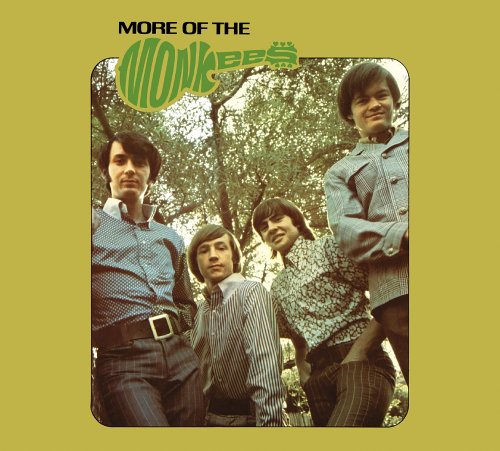
Monday, 27 July 2009

The MONKEES: More Of The Monkees


(#48: 13 May 1967, 1 week; 27 May 1967, 1 week)

Track listing: She/When Love Comes Knockin’ (At Your Door)/Mary, Mary/Hold On Girl/Your Auntie Grizelda/(I’m Not Your) Steppin’ Stone/Look Out (Here Comes Tomorrow)/The Kind Of Girl I Could Love/The Day We Fall In Love/Sometime In The Morning/Laugh/I’m A Believer

Around this time the first, and only, single by the Soft Machine, “Love Makes Sweet Music,” was around, a song which the Monkees at their best could have recorded and which I’m sure they would love to have recorded (although the heavier sonic picture, bottomed out by Kevin Ayers’ diagonally descending bass, is perhaps more in keeping with the early work of the Guess Who). Not only was it fitting that Robert Wyatt’s next venture into 45 rpm pop some seven years later was a re-reading of “I’m A Believer,” but I was also put in mind of his characteristic “mouth music” vocal improvising while listening to the middle section of the Monkees’ own “Your Auntie Grizelda.” This was Peter Tork’s first major recorded contribution to the group’s work, as lead vocalist, and Tork probably gave the song the treatment it deserved; written as a derivé of the Stones’ “19th Nervous Breakdown” with (hopefully) deliberately ludicrous lyrics (“I know she’s having a fit! I know she doesn’t like me a bit!”) and a liberal spread of whole tones in its melodic topline, Tork literally chews up the song and spits it out anew. Over the long instrumental break he begins to scat, mimic, raspberry, bleat, and the effect is simultaneously disturbing and uplifting, as the rhetorical emphasis of the drummer’s tom toms seems to confirm. I am certain that the younger Wyatt would have heard it and loved it.

The B-side to “Love Makes Sweet Music” was the extraordinary “Feelin’, Reelin’, Squealin’” with Ayers’ gravedigger vocal holding the song down while all goes untethered around him, including the uncredited guitar of Jimi Hendrix. Hendrix and his Experience were booked to support the Monkees on tour in the States in the spring of 1967 but it was a disaster, and it is probable that the manufactured outrage of the likes of the Daughters of the Revolution was a convenient trope for Hendrix to get off the tour (in contrast, Hendrix’s British package tour conducted at around the same time, in the unlikely company of Engelbert Humperdinck and the Walker Brothers, seemed to work far more effectively; indeed Hendrix went on record saying how much he learned about stagecraft and handling audiences from watching Humperdinck onstage from the wings). Still, it’s hardly surprising that by the middle of 1967 the Monkees wanted to be more where Hendrix was, at least in terms of credibility (and in the case of Dolenz and Tork wandering around that year’s Monterey Festival, they literally wanted to be where he was). They were apt to conclude their stage act of the time with a purposely “freak out” performance of “Steppin’ Stone” and were therefore naturally impatient with their would-be paymasters who wanted them to stay clean cut, wacky and neutral, or work them into the ground in attempting to do so.

More Of The Monkees is the first album in this tale to be was released against the artists’ express consent; indeed, the group didn’t know that their second album existed until a slightly shamefaced Don Kirshner presented them with copies, complete with its cover shot originally intended for a JC Penney’s advertising campaign. Dolenz and Jones shrugged their shoulders and resigned themselves to the way showbiz went, but Nesmith and Tork spoke out virulently against the record; they had been assured that the second Monkees album would have given them scope and space for their own material, their own voices. The record was effectively disowned by the band since it was mostly taken up with songs supposedly only ever intended for use in their TV series, and mostly recorded against the band’s will.

Side one, however, holds together pretty well in itself. “She” begins with a “Wild Thing”-referencing guitar dive before moving into interestingly-constructed pop, the deadpan steadiness of the organ balanced out by the vigorous tambourine rattling throughout the bridge. Its stop/start motions and its varying angles of vocal intensity – group “HEY!”s answered by Dolenz’s anguished “Yeah?” (“YEAH!”) and downhill ski ride of “SHEEEEEEE…..” – are reminiscent of Them’s “Here Comes The Night” as filtered through the Arthur Lee of Da Capo (again, writers Boyce and Hart were keen to reference Love and the Doors, as well as the Leaves – who also covered “Hey Joe” – as aesthetic markers; they were almost as anxious to be hip as the Monkees themselves). Set against that, Neil Sedaka and Carole Bayer’s “When Love Comes Knockin’” is efficient but unspectacular Brill pop although it does at least locate Davy Jones in his real, relatively undemanding element.

Nesmith’s “Mary, Mary,” however, is still a knockout; immediate exposure to its breakbeat – one of the finest uses of the tambourine in all of pop – signals how right Run-DMC were to acknowledge it, in their 1988 reading, as a forebear of hip hop. Unlike many of the album’s tracks, which literally required the group to do nothing more than put down a vocal or guitar line on top of a backing track pre-recorded in New York and bussed into Hollywood with firm instructions to do it as Carole King or whoever did it on their demo, everyone here sounds committed, even happy. “Hold On Girl” is necessarily a lesser piece, but still notable in terms of the album’s increasingly strange deployment of Davy’s vocal leads; here we have a harpsichord streaking downhill and Jones’ bizarre tiptoe croon of “Help is on its way” accompanied by dramatic pauses, moments of minimalism, and then sudden onsets of Latin percussion and handclaps.

After the aforementioned “Auntie Grizelda,” we reach “Steppin’ Stone” – a song deemed, largely thanks to the fact that the song was one of the first the Sex Pistols ever learned to play, the Monkees’ “punk” record and still a snarlingly startling pre-emptive declaration of independence. Its steely-scissored organ drive probably owes more to the Seeds than the Doors – and both melody line and rhythm are in considerably greater debt to “Liar, Liar” by the Castaways – but as a pop record it remains spectacular, Dolenz providing one of his most ardently scything vocal performances as he growls and hisses about fashion magazines and public scenes. “No girl, not ME!” he yells, before whooping (again, proto-Iggy style) “WHOA!” as the band race into the uptempo dodgem-dodging section of the song.

So how could Nesmith dismiss an album which by the end of its first side can be argued to have presaged punk, hip hop and Robert Wyatt’s End Of An Ear as “the worst album in the history of the world”? Even given the circumstances of its creation, some evidence for this is audible on side two. Neil Diamond’s “Look Out (Here Comes Tomorrow)” is a fine side opener and continues the writer’s early stylistic trend of gospel-type song structures sometimes pressed into modest lyrical irony. “Oh, how I wish tomorrow would never coooooome!” sighs Davy in mock-ecstasy as he rides the tough chorus, and then cymbals, handclaps and organ combine to increase the arrangement’s intensity with the arrival of the second chorus, before ducking down again to allow Jones’ spoken whisper of “I love you…darling!” (N.B.: the bonus tracks on the CD edition of this album include a far superior alternate take complete with hilarious spoken commentary by Tork over the instrumental breaks. Also featured is a prototype, Tork-sung version of “I’ll Spend My Life With You,” later to appear on Headquarters, which is quite, quite beautiful, Peter taking the band right back to Greenwich Village) Nesmith’s “The Kind Of Girl I Could Love” refines the Latin/country fusion set out in “Papa Gene’s Blues,” the simmering fury of massed percussion and hissed cymbals supported by a furiously insistent tom tom beat (perhaps slightly influenced by, or influencing, the work of Dave Dee, Dozy, Beaky, Mick and Tich – though it’s hard not to think of what a living Buddy Holly might have been doing in early 1967 - and certainly with more than a tinge of “Love Is Strange” in its structure) and some guttural guitar work from James Burton and Glen Campbell.

“The Day We Fall In Love,” a spoken word and string section feature for Davy, however, is simply creepy. Intended by Kirshner to be “I Wanna Be Free ’67,” the track almost entirely lacks the gormless innocence of its predecessor and its staginess is rather embarrassing, even though Jones does get slightly endearing on lines like “Whether roses are blooming, or snowmen stand by” and there’s a moment of genuine stillness when a lead violin hiss seeps into the cavity of silence caused by Jones’ “Time will stop”; the overall effect is not one of poignancy, but similar to that of Peter Wyngarde’s “The Way I Cry Over You”; in other words, one wants to walk very carefully and quietly away from it, one stealthy step at a time, before vanishing from the speaker’s view and running like blazes, and the Monkees themselves appear to have been of a similar opinion. “Sometime In The Morning” is a flaccid, under par Goffin/King midtempo number – another of those ‘phoned-in backing tracks - with a markedly bored-sounding Dolenz vocal; it aspires to the airborne harmonic adventures of the Association but remains firmly grounded.

But “Laugh” was the straw that broke many backs. Written by four anonymous hacks, doubtless all graduates of the Mitch Miller Academy of Yellowing Bouncing Ball Wholesomeness and noticeably absent from Kirshner’s otherwise gushing sleevenote, this song provides an unwelcome antecedent to “Don’t Worry, Be Happy” and one can hear the hapless Monkees grinding their teeth trying to keep their countenance throughout this thankless shit. “It’s based on the beat. Ain’t that neat?” is as visionary as the lyric gets, and soon the band are reduced to “Ho, ha ha ha!” mirthless backing vocals as Davy manfully negotiates the locker of “When you can’t find your shoes to cover your feet” and has to utter the verb “chuckle,” the latter answered not only by the band’s “ha ha ha!”s but by the most sardonic floor tom roll to be heard this side of Levon Helm. After this, even the normally imperturbable Dolenz and Jones had had enough, and soon Kirshner and other Screen Gems yeasayers were shown the door; Kirshner retaliated by inventing a group that wouldn’t talk back or get uppity, namely the Archies.

“I’m A Believer” was used to flesh out and conclude the album and it is impossible for this writer to be objective about its power and friendly persuasion; I will content myself here by saying that for someone who always considered himself an actor first and musician second, Dolenz is one of the great sixties singers; on “Believer” he sounds renewed, confirmed, reborn, euphoric, and all of the record’s irreducible elements – the steamship calliope organ, Dolenz’s “Ohhhh!”s and “AaaaaaaAAAHH!”s, his dazed disbelief at the rediscovery of life, the rhythm’s easy swing, the subtle “Wipeout” quote in the central instrumental break, the kissing curls of that guitar figure, the released ecstasy of that final, crucial vocal octave leap – point to the kind of 1967 that its generation wanted.

But finally its generation wanted more than the Monkees. They finally gained control – of a sort – and gratifyingly saw the apocalyptic “Randy Scouse Git (Alternate Title),” the first Monkees single to be entirely written and performed by the band themselves, become their second biggest UK hit. Of their subsequent albums, Headquarters (#2 through July/August 1967) and Pisces, Aquarius, Capricorn And Jones (#5 through February/March 1968) are both superb and nearly faultless. Then their actual creators – Rafelson and Schneider; remember them? – got bored and decided to kill them off with the help of Jack Nicholson; Head, as both movie and soundtrack album, is neither a deathless classic nor an unmitigated disaster – nothing including “Porpoise Song” could ever be thought of as the latter – but the producers’ self-imposed drift would continue into the likes of Five Easy Pieces and The King Of Marvin Gardens. As for the Monkees, they slowly disintegrated and wandered off to invent MTV or Metal Mickey, breed racehorses or return to the folk club circuit; but grown-up nostalgia demanded a partial reunion in 1980 with the surprisingly effective and timely Pool It! comeback album. Since then they have intermittently come together for old times, sometimes with Nesmith but usually without, but unlike the Beatles or the Experience they have all survived, intact, as individuals. And, by virtue of their TV show, they managed to get Tim Buckley on peak-time television for one of the few times in his entire life. How could their sweetest music not be loved?

Monday, 20 July 2009

The MONKEES: The Monkees


(#47: 4 February 1967, 7 weeks)

Track listing: (Theme From) The Monkees/Saturday’s Child/I Wanna Be Free/Tomorrow’s Gonna Be Another Day/Papa Gene’s Blues/Take A Giant Step/Last Train To Clarksville/This Just Doesn’t Seem To Be My Day/Let’s Dance On/I’ll Be True To You/Sweet Young Thing/Gonna Buy Me A Dog

Here is the point where I was originally intending to begin this tale. The initial notion was to undertake this exercise as a semi-formal but private blog to be read by my wife only, and to cover only those albums which have topped the chart during my wife’s lifetime. The Monkees’ debut album would have been the first “new” album to make number one in this period – just as “I’m A Believer” was the number one single at the time of Lena’s birth – and after some debate about whether or not to include The Sound Of Music (the album which actually was number one on the day she was born), we initially agreed for convenience’s sake to stick with the Monkees and proceed from there. However, following fuller and wider discussion with Lena and others, I felt that it would be no bad thing to open the concept up further and try to tackle the lot. So, almost a year after I embarked on this story, I have reached its “starting” point and certainly do not regret taking in the whole picture, since it has been educational in more ways than one. Moreover, I have done my best to minimise any “personal” or autobiographical content; readers curious about the latter are directed to any of my blogs listed under the “Previous Form” heading at the top of this page.

The Monkees, as a record, is a perhaps unexpectedly rich starting point for a lot of things. But, in the beginning, it is worth briefly considering the supposed evil that svengalis do (especially given the hidden “evil” scrambled amidst that word) and wondering whether all svengalis, in the music business or elsewhere, are necessarily puppetising demons. Although this is the first number one album of 1967, The Monkees is at its core a 1966 record, and already gives indications that among their supposed controllers, artists as well as artisans were at work.

There was, of course, another American-based group with a strange British member who were assembled by an arty svengali intent on stirring things up as well as making a living in 1966. That the Velvet Underground have gone on to be lionised and elder statesmenised was always going to be inevitable; but listening to Jimmy Bryant’s fiddle scraping dronefully away in perfect John Cale fashion throughout Mike Nesmith’s “Sweet Young Thing” is in itself enough to startle me into rethinking history. Moreover, the glockenspiel pacificity of Davy Jones’ “I’ll Be True To You” – a song previously a UK top ten hit for the Hollies in early 1965 under the title “Yes I Will” - complete with grave low register vocals and a moderately menacing spoken interlude, would, if sung by Nico, have long since been revered as a spacious classic.

But it is not easy or convenient to consider Bob Rafelson and Bert Schneider in the same hall of glowering mirrors as Warhol, even though both had their uncommon ambitions. I am unsure whether they viewed the Monkees, as David Thomson has argued, as their Dada project, but both were frustrated aesthetes with a lot of time and money to spend on correcting the perceived deficit. Mickey Dolenz has recalled how, when he attended for his Monkees audition, he was faced with a room full of Coca-Cola bottles, behind which the impassive heads of Rafelson and Schneider were barely visible. He eyed both producers and bottles briefly before casually moving one of the bottles a little further down the row and announcing: “Checkmate.” The thinking was rightly light as well as lateral and the job was his.

There is no question that the early Monkees music bears a general lightness – though using arguably heavier arrangements and musical set-ups – which was increasingly becoming absent from the work of the Beatles, and that this was the light which drew a few of Larkin’s fabled Cavern cloakroom girls into the Monkees’ embrace; the light itself may have refracted back onto the Beatles, given the very marked lightness of their next major work. The Monkees’ music, however, has very little in common with that of the Beatles. Their theme song does have elements of “Can’t Buy Me Love”’s swing but owes considerably more to the Dave Clark Five’s “Catch Us If You Can”; similarly, the ecstatic jumpcuts of the verses of “This Just Doesn’t Seem To Be My Day” are clearly modelled on “I’ve Just Seen A Face,” and there is a case for “Clarksville” being a speeded-up, de-neuroticised “Ticket To Ride” (and, unlike “Ticket To Ride,” the song bears a gleam of hope in Dolenz’s “I’ve made your reservation” in its final verse).

Listening to The Monkees, however, suggests an entirely different approach to pop. In particular there is a definite folk-rock aspect to its dozen songs, but a different kind of folk-rock from that popularised by the Byrds; in Nesmith’s songs in particular there is more than a hint of what was shortly to come from Buffalo Springfield – as Stephen Stills narrowly missed the Monkees cut and Neil Young contributed guitar to some of the group’s later 1967 tracks, this is not entirely surprising. Equally, however, there are signs of a grander fusion; “Papa Gene’s Blues,” written and produced by Nesmith and featuring a stellar cast – James Burton, Glen Campbell and Tork himself (at Nesmith’s insistence) among the guitarists, Hal Blaine and Jim Gordon on drums, etc. – offers an unlikely paradigm for Latin-folk fusion with its busy, multidirectional percussion working alongside Nesmith’s so-laid-back-he’s-horizontal lead vocal. Nesmith’s voice is noticeably more boisterous on “Sweet Young Thing” and seems to be approaching the territory of Arthur Lee (though co-writing the song with Goffin and King, at the insistence of Don Kirshner, may account for his exhausted sigh at song’s end); indeed, Tommy Boyce and Bobby Hart, then the group’s principal songwriters and producers, are on record as stating that they were seeking with the Monkees to emulate the sound of LA bands of the period such as Love and (thankfully not evident at all) the Doors.

The Monkees theme itself, of course, despite (or because of) its peremptory door-slamming tympani thud of an intro, is all about lightness of approach and mind; they’ve got something to say but in truth are not too bothered about whether you listen to them or not, as demonstrated by Dolenz’s fractured “ahhh…” into a strange, brief reverb/feedback interlude before the song resumes its frantic, key-chasing cheerleader strut, complete with finger snaps and cymbals on which vinegar could sizzle. Still, did any album of this period begin which as forcible a self-advertisement? They were quickly creating their own mythology, and the cartoon aspect is carried over into tracks like “Let’s Dance On,” in which Dolenz excitedly goes through the Pony/Jerk card while other voices whoop (“Wooh!”) around him, a harmonica blasts its way out of the furnace, Spector’s “Be My Baby” bass drum/tambourine pattern briefly muscles its way into the picture, Hart contributes an earsplitting Vox Continental solo, and the general punk jumparound and, above all, the concluding cry of “Hey hey hey HEY!” reveal the truth – here we are witnessing the embryo of the Ramones.

“Saturday’s Child” continues this modified strain of garage rock, with drums stumbling out of its choruses, luminous 6/8 guitar triplets, the disorientated “She looks at meeeee….” which slows down to a reeling pause before restarting, the very dirty guitar playing of one or two or all of Louie Shelton, Wayne Erwin and Gerry McGee (all outstanding throughout the album) and the momentary forgetting that the song was written by David Gates. In contrast, Jones tremulously fumbles his Peter Noone-waylaid-in-a-Bolton-side street choirboy way through the ballad “I Wanna Be Free,” slightly off pitch but very touching (particularly on the moving “Say you like me”) as harpsichord and string quartet couch his quiet distress. “Tomorrow’s Gonna Be Another Day” bears some superficial resemblance to what the Stones were doing at that time – both bands were using RCA’s Hollywood studios – but the swampy guitar exchanges are of a different fibre to those of Brian and Keith, the harmonica slightly more buried in the mix and Dolenz’s self-swallowing echo on the word “day” not really related to any Stone masonry.

“Clarksville” was their first single, a US number one and a UK Top 30 entry (since its chart run preceded the BBC’s broadcasting of the TV series here), and Boyce and Hart’s clear Vietnam analogy arguably goes beyond anything the Beatles were prepared to declare at the time (compare with “Taxman” for proof). The bounce is more pronounced but Dolenz’s voice is forlorn, alternately demanding and whimpering; against the onomatopoeic vocal cascades of railway lines and descending showers of guitars in the song’s centre, Dolenz offers a hesitant “Oh!” followed by a pained “Ohhhhhhh…” which is abruptly shut off. He doesn’t know if anyone, including himself, is ever coming home. This was hardly a candy and rainbow antidote to “Eleanor Rigby.”

But “Take A Giant Step” and “This Just Doesn’t Seem…” take pop in entirely new directions. The first is another Goffin and King number – and, as demonstrated by “Goin’ Back,” etc., the couple were looking to stretch themselves at that time – but its arrangement veers alarmingly between near-silence and gigantic explosions. There are tender harpsichord and glockenspiel, Dolenz’s voice conversational but with a surreptitiously creeping rhythm undertowing it. “Let’s leave yesterday behind,” Dolenz sighs, to be answered by pealing bells of single note guitar, and then, as the track itself can’t quite believe where it is heading, the “…outside your mind” is a hesitant trigger for a swirl of tremolo atoms before the music fixates itself on intense tom tom rhythms over which backward guitars slide and fervid atonality blossoms into the track’s collapsed centre – this too ends suddenly before the song pulls back to its original form but in execution and intent it subtly approaches the radicalism of “Tomorrow Never Knows.”

With “This Just Doesn’t Seem…” the rules (if indeed there were any in the first place) get cut loose into the Pacific Ocean as we witness bitonal Indian-style interludes – with a ‘cello acting as feedback – and the aforementioned, careering “I’ve Just Seen A Face”-type swoon, Davy in his element, before in turn becoming a proto-psych rock workout, the ‘cello still prominent, and then resolving with Jones’ dazed “Oh my, oh my” over a ticking clock. Whatever Bobby Hart’s day band the Candy Store Prophets sounded like, this sounds like prophecy of a different order.

The album ends as only this album could; everyone from Kirshner on down realised “Gonna Buy Me A Dog” was a joke of a song and so the “goof” version was selected over the “straight” reading. Starting out as a lumbering 12-bar blues, Dolenz initially attempts to deliver the lyrics with a straight a face as is permissible, but Jones is soon distracting him: “You’re gonna need all the friends you can get, I’m telling you,” he grins, and Dolenz loses his countenance. “I can’t teach your dog to do that!” he giggles, while Jones snickers about the need to “train elephants” (a reference to Dolenz’s previous life as the juvenile star of the TV series Circus Boy). Comparable with the Velvets’ “Temptation Inside Your Heart” (though recorded two years earlier), the track eventually collapses in hilarious chaos, Dolenz’s offhanded “yeah, yeah”s balancing out Jones’ cries of “Can someone open the door and let us out? We’ve been in the studio far too long!” and recitation of increasingly absurd dance crazes. Too busy singing to put anybody down, generously overlooking the funniest looks they get, an uncaring cheerfulness that should never be confused with not caring, The Monkees revolves us into a 1967 dawn of perfect sunshine, the ideal introduction to all the colour to follow. What a world to be born into.

Monday, 13 July 2009

The BEATLES: Revolver


 (#46: 13 August 1966, 7 weeks)


Track listing: Taxman/Eleanor Rigby/I’m Only Sleeping/Love You To/Here, There And Everywhere/Yellow Submarine/She Said She Said/Good Day Sunshine/And Your Bird Can Sing/For No One/Dr Robert/I Want To Tell You/Got To Get You Into My Life/Tomorrow Never Knows


“Evading any form of literal interpretation, Rothko's huge, indistinct, darkly vibrant blocks of colour are all about feeling and transcendence, about things beyond words.”
(Richard Williams, “Sounds Like Mark Rothko,” The Guardian, 1 February 2002)

“You should tell him that indistinctness is my forte.”
(JMW Turner)

Over the weekend we visited Tate Britain; for Lena this was an especial pleasure as she had not visited it since 1988, when it was still the solitary Tate Gallery. The current creative rejig of the gallery’s Turner stock centres upon direct comparisons with Turner’s late flow(er)ing work and Rothko’s Seagram murals. Looking at both sets of paintings anew (as is always the case every time I revisit them, in whatever setting or order), a presumably very facile point of comparison sprung into my mind. The point of disturbance in the otherwise unrelenting red and black m(or)ass of the Seagram appears in two examples; in one, there are not quite faint tinges of sky blue over which the black paint seems to have been applied particularly aggressively. The impression is of someone screamingly anxious to evade and erase the light of the day, the outside world, to imprison himself in their tormenting but secure world. In another there is what looks like daylight, purplish, but with such scrambled indistinctness that the light seems three dimensional, alive, challenging.

Whereas in Turner’s late seascapes in particular the painting is always directed towards this central beacon of light, indistinct but never harshly so. The details are scored down to a minimum of perceptibility – the crowds, the cliffs, are felt rather than explicitly explained – and all leads to this light, even the two-in-one reversible seascape (turn it upside down and it tells you the same story, or a parallel one). This world welcomes the light into its fibres, indeed cannot seem to function or even exist without it. Where Rothko’s world is all red and black, Turner’s is shiny and yellow.

In his cover collage for Revolver, Klaus Voormann – an old pal of the group from their Hamburg days, then playing bass with Manfred Mann – details the Beatles’ world as a black and white one, but its jumble is a challenge on account of its cheerful solemnity. The album itself – think of that title for a moment; a revolver can mean a long playing record, or the axis of gravity, or a gun – seems better equipped than most to embody both of the worlds described above. Turner’s cynosure of revelatory light is “the void” into which Lennon happily tumbles in “Tomorrow Never Knows” (so much so that the song was originally titled “The Void”). The Rothko darkness reflects Eleanor Rigby, or the self-denying, defeated protagonist of “For No One”; worlds carefully and deliberately sealed off from the outside; the dissolvable crowds cheering at Turner’s Portsmouth Harbour represent the hallucinatory coach parties of “Yellow Submarine.” Or it may simply be the case that Revolver presents fourteen different ways of looking at the world, every one of them wanting to make the world different, or invisible, or irrelevant.

In other ways, even before we penetrate the cover of Revolver and reach for the record, the Beatles are now definitively announcing themselves as somehow above the rest of us, while simultaneously sitting right by us. Voormann’s huge, rockface sketches of the four faces resemble a pop Rushmore – an allegory aided further by Lennon’s remarkable resemblance to Abraham Lincoln in his central snapshot – and the glum, bean counting “one, two, three, four”s which kick off “Taxman,” and the album as a whole, contrasts sharply with the throwaway time beginning of the “1-2-3-4!” which introduced “I Saw Her Standing There” just over three years previously.

Readers will have noticed the quite staggering speed at which this tale is currently progressing; we are now only a baker’s dozen of entries away from Summer Holiday but the world seems to have sped up to a point barely comprehensible; already we have arrived at Revolver, and it seems indecent that a year as abundant in radical long playing records as 1966 should only be touched upon twice (although most of these will be mentioned in more than passing as the story progresses), not to mention the fact that the rapid pace of this survey is in inverse proportion to the slow movement predominant in the album charts of the mid-sixties. Still, the speed seems to suit Revolver; the shaded back cover group portrait (with George bearing an uncanny resemblance to Keith Richards) helps nail it down as the Beatles’ “Mod” record, even if “Taxman” is its only really obvious link to that movement.

Ah, yes, “Taxman,” for many years this listener’s personal barrier to identifying Revolver as the best Beatles album. Musically it whacks the Pickett/Dorsey stop-start strut of “The Word” into narrower trousers; the track is almost bare save for McCartney’s juddering bass riff (and his subsequent psychogeometric guitar outburst) and was one of the most ferocious and unforgiving tracks the group had so far laid down. But while the notion of starting a Beatles album with a George composition was an admittedly pretty radical one, his sourly griping lyric and delivery are not in keeping with a helpful or useful revolution; the late Steven Wells summed it up, not entirely unreasonably, as saying, “Why should we pay for the upkeep of schools and hospitals when we could just shove it up our noses?” Instead of 1963’s four cheery chaps, here are a quartet of 1966 grumps holed up in Weybridge and Esher, moaning about the top rate of income tax to the pinched strains of Hefti’s Batman theme. Then again, Harrison has a go, however grudgingly, at both Wilson and Heath so as not to make the song sound like a Tory election manifesto, and it is arguable that the song’s mean spiritedness is gradually undermined by what happens on the remainder of the album.

And why, of all couplings, were “Eleanor Rigby” and “Yellow Submarine” released as a double A-side single two months after Revolver came out, in direct contravention of accepted record company policy of the period? Partly it was because EMI needed a single and the group was then in the middle of an extended break following their retirement from touring and therefore without any new material to hand. But the nearness of the two songs helped demonstrate in microcosm the dichotomy that Revolver was trying to unravel; the division between hiding from the world (which results in death, either physical or mental) or deciding to join the world (which results in life, in all of its stripes). Eleanor Rigby and Father McKenzie live for nothing because they do not meet until it is too late; Rigby because she has cut herself off from the world so fully and definitively, McKenzie because no one listens to his sermons since religion has lost its meaning – some people in 1966, not necessarily excluding John Lennon, supposed the Beatles to be “bigger” than Jesus. Neither has the ability to communicate directly with the world as a whole, and the only memorial to either is McCartney’s song, with his unusual Home Counties-accented “lonely,” and the strings remorselessly scraping away, suggesting either Rigby placing her face back in the jar or McKenzie gloomily – or indifferently - sweeping away the dirt from the grave; something about the speed of their sweep also subliminally suggests Herrmann’s music for Psycho. As with “Yesterday,” climactic poignancy is reached with a prolonged high A over (the first half of) the final verse on lead violin (performed by the same violinist, Sidney Sax), though this too is brushed away by the brisk, matter-of-fact 4/4 and the final, coldly rationalist five downward steps into nothing.

“Yellow Submarine,” in contrast, could only have been given to Ringo to sing; its dead end is a more colourful one than anything Rigby could have dreamed up but it is happy, embracing, inclusive; the drinks party plays like the introduction to Cliff’s 21 Today gone seriously askew, Brian Jones and Marianne Faithfull clink glasses, everyone sings along and (through the assorted sound effects and brass band clip) George Martin introduces sampling to the world of number one singles. Isn’t this, the song cries, far more attractive a future than the no future we described on the other side? Furthermore, thanks to his lyric suggestion of “sky of blue, sea of green,” Donovan makes his long overdue debut in this story (see the latter’s 1968 McCartney-produced “Atlantis” for the sequel).

Meanwhile, in Lennon’s world, “I’m Only Sleeping” – some people think he’s bonkers but Lennon clearly doesn’t. Musically a development from “Girl,” in every other sense an immense step forward, Lennon floats upstream in innocuous ignorance of whatever the world – any world – might demand of him (a state of mind, as with so many stated on this record, not unconnected with Lennon’s then-recent introduction to LSD). Another track bearing the clear influence of Ray Davies, Lennon takes it slowly and sneakily; the chilling tinge of backwards Harrison guitar which answers Lennon’s “touch of speed,” McCartney’s dutiful, Boswellesque bass pauses, the unexpected jumpcut from the middle eight’s “taking my time” back to the verse, and the fast gat that concludes the track (and links it directly to the next) – nothing here is “as played on stage”; every move a trompe l’oeil.

Harrison follows with his second number, and his first Indian-flavoured Beatles song, “Love You To.” Recorded with members of the North London Asian Music Circle, and concomitant with important records such as the John Mayer/Joe Harriott Double Quartet’s Indo-Jazz Fusions – it is possible that some musicians played on both – the track signals Harrison’s increasing withdrawal from the banality of everyday “love” towards something more universal. “You don’t get time to hang a sign on me,” he sighs, still defiant. Lines like “love me while you can” suggest a mutation of the blues far beyond what the Stones or Mayall could visualise at the time. “Wake up all day long,” he dreamily chants in direct riposte to Lennon’s eternal sleeping, “Wake up singing songs.” Finally, he climaxes: “I’ll make love to you…if you want me to,” at which point the song speeds up from slow to a very bodily fast gat; perhaps the definition of “universal” here still has its roots in the earthy.

McCartney’s “Here, There And Everywhere” is likewise not quite as straightforward as it appears, with its author’s thin thirties croon (and the song’s old fashioned preface). Usually acknowledged as the point on Revolver where the Beatles meet the Beach Boys, it would not be quite correct to detect specific signs of a Pet Sounds influence (especially as that album had not yet been released while Revolver was being recorded), but the harmonies – particularly the descending ones heard in the final verse - and general air of disturbed stillness are clearly redolent of songs such as “In My Room” and “The Warmth Of The Sun.” Moreover, McCartney’s lyric moves almost imperceptibly from the first person (“Running my hands through her hair”) to a strange, unaccountable third person (“Someone is speaking, but she doesn’t know he’s there”). Structurally the song is immaculate, its quietly disturbing minor scale arch recalling both “Michelle” and the raga; Emmylou Harris would go on to record the definitive version of the song in 1976, every element a separate star connected in a convivial sky.

Lennon’s “She Said She Said” occasions the need to call up one of those crucial 1966 albums, Fifth Dimension by the Byrds, since this was another song inspired by a session (this time involving LSD and a disturbing Peter Fonda) with McGuinn and Crosby. Anticipating R.E.M. and the Paisley Underground as a whole by a generation, the song’s stuttering conversational nature dictates the paths of its melody; the diving refrain of “she said, I know what it’s like to be dead” suggests a ghostly conference with Eleanor Rigby, but the song’s gears constantly shift as Lennon’s mind wanders, most noticeably to the pained “When I was a BOY, everything was ALL RIGHT” – and Lennon would soon return to his childhood memories to fuel some of his greatest work.

McCartney begins side two with “Good Day Sunshine.” While the Lennon of “I’m Only Sleeping” stiffly admits dawn before abruptly dismissing it, McCartney welcomes in the rays, as evinced in the song’s introductory slow awakening of a low register piano/guitar throb. Inspired directly by the Lovin’ Spoonful’s hit “Daydream” – and recorded in the same week as “Sunny Afternoon,” in which the Kinks managed to fuse the disinterest of “I’m Only Sleeping” with “Good Day Sunshine”’s jolly barrelhouse canter, with a soupcon of “Taxman” real world cynicism added on the side – “Sunshine” jaunts down its lane with enviable confidence. Even McCartney’s “Burn my feet as they touch the ground” doesn’t come across as amiss.

Thereafter Lennon takes up the reigns again with “And Your Bird Can Sing,” the starting point for Big Star and power pop in general, and maybe also for Lindsey Buckingham – the cunning acidity of Lennon’s vocal and guitar work in particular – in which Lennon begins to subvert the whine of “Taxman” (“When your prized possessions start to bring you down”) and assert a new lightness and simplicity of approach. This is followed by the mainstream darkness of McCartney’s “For No One”; meanwhile, in this other, “straight” world, she’s finished with him and he wanders desolately up and down his snakes and ladders board, looking for a reason or resolution, but the song’s maze-like structure defeats him every time. As with Eleanor Rigby, he will not recover – “You stay in. She goes out,” intones McCartney in one of his most knowingly dispassionate vocal performances – and maybe he turns into Father McKenzie (closeted cloisters summoned up by Alan Civil’s magnificently irrelevant French horn figure).

Lennon again sweeps all of this desolation away with the acerbic “Dr Robert,” the closest Revolver comes to the Monkees, where he has a pre-emptive go at the snake oil salesman he is already feeling that Timothy Leary really is, including the mock solemnitude of the harmonium-underscored “Well, well, well” like stranded penguins impersonating Flanders and Swann; but, as with “And Your Bird Can Sing,” the song’s swing is so irresistible – Harrison masterfully, if unexpectedly, fusing Ravi Shankar and Chet Atkins in his guitar work - that the meaning is communicated directly through its undeniable good humour.

“I Want To Tell You” was an unprecedented third George song on the same album and shows him already to be reaching out somewhat further than either Lennon or McCartney was prepared to do at the time, not in terms of music – though the repeated dissonant piano figures (played by McCartney) in the verses are disturbing enough – but in the wider scale of outlook; can he commit to love? Who, indeed, is he? “I don’t mind…I could wait forever…I’ve got TIME!” George declares as Oriental curlicues descend. The Motown handclaps are almost surreal in their juxtaposition, and as George works out who he is, constantly changing the perspective – at the same time as a bored Irish-American actor was beginning work, on the coast of North Wales, on a television series concerning the elusive nature of identity and self – McCartney accelerates his upper register piano work until the track sounds like Varese acupuncture.

The track leads directly, if improbably, into McCartney’s own “Got To Get You Into My Life,” his attempt at Holland-Dozier-Holland – although it should be noted that, by the composers’ own admission, the rhythmic arrangement of “Where Did Our Love Go?” was directly inspired by the Dave Clark Five’s “Bits And Pieces,” and indeed McCartney’s voice is hoarse and passionate enough to stand comparison with the DC5’s Mike Smith. Though Lennon later went on record as saying he reckoned that the song was about McCartney wanting to try LSD, the song’s open embrace of life, its desperate enthusiasm, sweeps away so many cobwebs, as does the sterling five-man horn section work, led by trumpeter Eddie “Tan Tan” Thornton (later of Aswad, among many, many other enterprises) whose orgasmic high C on the point of fadeout suggests paradise regained.

Then we reach the final track, and the world comes apart, or, more accurately, reunites.

The practice for the release of Revolver was to issue out two or three tracks at a time to radio stations. As with the album, “Tomorrow Never Knows” was deliberately left until last (although it was in fact the first song recorded for the album). The experience of the nascent listener in 1966 can only, from my perspective, be imagined; suffice it to say that it was a very long way away from “She Loves You” and yet in other ways no way away from it at all.

The first thing to say is that “Tomorrow Never Knows” could not have existed without Ringo – he came up with the title, and his drumming holds the whole structure together. Anyone still labouring under the illusion that Ringo was no good as a drummer should listen to his work on “Tomorrow Never Knows” and be lifelong corrected. Insistent, yet strangely relaxed; forceful, but never overpowering, even though it sounded like the universe reshaping itself for a rebirth. Out front – or wherever planet or Himalayan mountaintop he’s radioing in from – Lennon cuts up Leary’s The Psychedelic Experience and The Tibetan Book Of The Dead to reassure us that it is all illusion and that revelation is the only revolution that’s real. As his vision unfurls, the elements of the album all seem to converge into its central “void”; elements from McCartney’s “Taxman” solo, fugitive seagulls from “Yellow Submarine,” sitars, Mellotrons, backwards, reeled over, linked up live in the studio, and it is like some Northern/Eastern equivalent of Spencer’s The Resurrection, Cookham; Eleanor Rigby and the jilted lover are resuscitated (“It is not dying!”), the world reforms itself in a newly and more easily revolving shape. The upstream float of “I’m Only Sleeping” is superseded by the “relax and float downstream” of “Tomorrow Never Knows,” and – George Martin’s final coup on an album of collaborative coups – the whole ends with the receding piano figure from the Goons’ “I’m Walking Backwards For Christmas” (and some reports state, if not MacDonald, that the piano part was played by Peter Sellers himself), the producer putting renewed vigour into those production ideas he’d come up with a decade earlier to accommodate Milligan’s world. There is some evidence of Who attack, but the overriding influence on the track is the Beatles’ own “Ticket To Ride”; the drone, the drums, are all accentuated and expanded here, and “Tomorrow Never Knows” became their key to the new kingdom; in now come Stockhausen (but don’t forget Joe Meek) and Cage (and the young Steve Reich), in (but of course!) comes India, and in comes a vision for which even the rest of 1966 hadn’t been prepared. The Beatles were now the mountain, and we were the awestruck monks at its foot, ready to worship and perhaps even to chant, however indistinct the words might at first seem.

Monday, 6 July 2009

The ROLLING STONES: Aftermath


(#45: 30 April 1966, 8 weeks)

Track listing: Mother’s Little Helper/Stupid Girl/Lady Jane/Under My Thumb/Doncha Bother Me/Goin’ Home/Flight 505/High And Dry/Out Of Time/It’s Not Easy/I Am Waiting/Take It Or Leave It/Think/What To Do

A lifetime or two after the event, the wonder is how the Beatles and the Stones were ever set up as “rivals” when they were clearly on such different paths. Admittedly, the development of Jagger and Richards as songwriters wouldn’t have happened, or at the very least would have slowed down immensely, without Oldham buttonholing them, and all three were inspired by the example that Lennon and McCartney had set, but the Stones’ first album to consist entirely of original Jagger/Richards compositions shows little sign of any particular awareness of the Beatles, let alone any direct competition with them.

Except, perhaps, that the Stones were always keen to come off as a little darker than the Fabs. The cover of Aftermath sees them (and the Decca logo) drenched in radioactive purple, miraculously preserved; Wyman deadpan (and resembling a young Graham Gouldman), Watts cautiously grinning, Jones looking askance in terror at the impassive faces of the two men who had taken the group he had formed and named and led them somewhere else, nearly out of his reach.

I am mindful that Patti Smith, along with innumerable others, begins here but also that the version of Aftermath that she got was the American one with the single “Paint It, Black” substituting for “Mother’s Little Helper” as opener and “Goin’ Home” left until the end. Still, the Stones weren’t about album track sequencing alone and wouldn’t have been worth anyone’s bother if they had been; what mattered was that unweddable Mick n’ Keith purple, the remnant residuals of threat and menace, the hitherto unspeakable sensuality that sometimes overrides what to many observers still reads like unrepentant misogyny. But then again, as Smith perceptively notes, Jagger spends the records talking women down, pretending that he can dominate them, thereby revealing a subliminal will to be dominated, such that his Other finally becomes his “queen.” And sometimes, in certain Americas of certain 1965s, it was refreshing to the point of orgasm to see and hear someone unambiguously howling the reverse of anything Anita Bryant or Pat Boone could throw at their coweringly obedient subjects.

For this reason it’s a pity that “Mother’s Little Helper” wasn’t retained as the album’s opening track in the States – possibly its vaudevillian graveyard strut and innate Britishness were untranslatable, but substitute the word “graveyard” and those qualities would sum up Herman’s Hermits’ two US chart toppers from this period – since the song directly attacks what one might term the Stones’ anti-constituency; those who didn’t swing into line with the coming of the New Sixties Thing, who clung onto fifties or even forties behavioural notions of community, who were still paralysed by fear of falling, or poverty, or institutionalised sexism; the helpless housewives slowly killing themselves with tranquilisers as Housewives’ Choice competed with the Hoover for volumatic brain occupation. Richards’ opening guitar drone recedes into the foreground of the song’s intro in reverse as Jagger hisses, not entirely unhappily, “What a drag it is getting old.” Clearly inspired by Ray Davies’ character studies and song structures (“A Well Respected Man” in particular), “Helper” has little of the succour of the redeeming love that Davies has for his characters, however reprehensible they may be; Jagger seems to be revelling in the woman’s slow and steady decline as an ugly tongue of Leslie cabinet guitar sticks, Cossack red, out into the song’s fibres. The song itself appears to be played inwardly with elastic bands for guitar strings and a general, troublesome, lo-fi, skitty, skiffly rattle which reminded Lena of the Fall’s “Rowche Rumble” (a song not unrelated in terms of subject matter and the songwriter’s attitude towards his main character). And note that climactic “Oi!” directly after Jagger relishes the suicide’s demise. This was clearly not going to be a friendly, face-licking album.

The defence for the likes of “Stupid Girl” and “Under My Thumb” has tended to be that the Stones, faced with the spectres of the Who, the Animals and the reverse of their own coin, the Pretty Things, were forced to toughen up their act in order to keep their core (mainly teenage male) following and that the primary purpose of songs like these was to undermine and (with any luck) demolish the tired Denmark Street tropes of moon, June, cooing and inevitable/irreversible happy endings in the popular song rather than to have a go at women as such. My own feeling on re-hearing both “Stupid” and “Thumb” is that either could have been retitled “You Don’t Fancy Me, Then?” and that this is, as several intervening decades have since proved, simply a case of Jagger being Jagger. Still, both songs are musically inventive enough; Ian Stewart’s Booker T tribute of an organ pumps satisfyingly throughout “Stupid” and with Jagger’s increasingly hysterical putdowns – “She’s the worst thing in this world…yeah” (that “yeah” so languid you could place a teabag in it and drink it), “She pushes (or did I just hear “pusses”?) back,” “She’s the SICKEST thing in this world” – we are reminded not only of Iggy but also, a dozen years early, of the Elvis Costello of This Year’s Model. Their “Thumb” must be one of the few unfriendly songs to feature marimbas, though its slightly too dragging post-Motown undertow made it an unsurprising candidate (via Wayne Gibson’s cover, eventually a UK Top 20 hit single in 1974) for the Northern Soul treatment; still, I prefer and relish Tina Turner’s rendition of the same song onstage, directed fiercely and firmly at Ike and all others who would have sought to crush her.

In between these two songs we are faced with the ghostly – as in starved-sounding - “Lady Jane,” a dowdy Dowland derivé which would have been comical had it not been for Jagger’s deadly seriousness of delivery and Jones’ deathlike harpsichord to render it into ice. Unthinkable from the Stones even 12 months previously, the song – an ode to, and lament on behalf of, marijuana – indicates with sweet starkness the general (virtually daily) raising of musical standards which 1966 appeared to demand from its leading practitioners; one can easily visualise their peers listening to the first four tracks of Aftermath, jaws irrevocably agape, for whatever varying reasons. Much more subtly and deeply than the easy shocks of “Helper,” “Lady Jane” already appears to see the car crash towards which it knows its decade to be heading.

As if slightly taken aback themselves, the group then retreat into R&B. “Doncha Bother Me” would be a routine workout except for Jagger’s self-accusatory cries of “Tryin’ to get high! Oh! NO!!” and especially Watts’ drumming work; he alternates between knitting needle stick inserts and violent cymbal and tom tom assaults, and the closing extended hiss of cymbals which seem to be drawing all of the oxygen out of Jagger is genuinely terrifying.

I will return to “Goin’ Home” later as it is the record’s clear, if initially unpromising, centrepiece (and major setpiece). Suffice it to say here, however, that the general standard of side one of Aftermath is so dramatically high – at least, musically – that the Stones may have been baffled about how to equal it on side two. Although there was no film to accompany Aftermath, its second side has the distinct flavour of “and other songs” and these songs’ main interest lies in observing how the Stones were developing as musicians rather than any intrinsic worth.

“Flight 505” is a semi-absurd shaggy dog story about a bored man who decides for no good reason to board a ‘plane. Yet its intro – distant piano jangling out the “Satisfaction” riff – gives the impression of “not quite here,” in a parallel but different world (as do the intros to several of the other tracks); so many echoes, too many living ghosts? Thereafter, however, the band quickly settle into a tough Motown groove, though the song itself is a straightforward post-Berry rocker; the performance itself is superb, clearing the ground for the great Stones rockers of their ’68-’72 purple patch, and Jagger is demonstrably having fun singing it. There are disturbing, infrequent blasts of fuzzed bass from Wyman – indicating trouble ahead – and a fabulous web of interweaving Jones/Richard guitar lines before the inevitable comedown of the flight into the sea. Jagger greets his own imminent demise with amused resignation; Wyman and Watts bring the song down to land with an ironic aquamarine bump.

“High And Dry” too looks forward to the goofball slacking of Exile (and is the ancestor of things like “Faraway Eyes”); a jaunty Surrey jug band stomp with gravelly harmonica, Watts’ subtly backward cymbals and Jagger mewling about nothing much. Their “Out Of Time,” however, is overlong – five and a quarter minutes – and rather pedestrian. Quieter than Chris Farlowe’s hit version and with marimbas replacing Mike Leander’s parodic baroque string arrangement, the song stretches out a little more (Jagger’s hapless baby now also being “discarded” as well as “obsolete” and “old fashioned”) but simply plods on for too long, Richards’ crisp guitar accents give the track a reggae feeling (and the acoustic guitar strokes irritate in the manner of impatient daggers), although the song’s structure owes much more to the Brill Building. “Sing the song!” squeaks a mirthless Jagger halfway through, and it’s clear how much Farlowe made the song pop; Andy White’s exuberant drumming, Joe Moretti’s lovely little Spanish guitar improvisation under the second verse, Leander’s bells, bass trombone and baritone sax, and above all Farlowe’s passionate, Springsteen-anticipating vocal – all of these combined to make it the perfect number one for World Cup week, a desperately triumphant V-sign to the past, to the war, a gasping embrace of the future and above all nowness.

“It’s Not Easy” is initially hilarious on account of Jagger’s attitude; his offhand “…living on your own,” his Dylan (“Hard Rain”) parody in his limp carrot of a “and it’s…haaaaaard,” and another swipe at his ex’s “stately home.” But the track steadily increases in intensity and by its end Jagger is raging and hissing his “haaaaaard”s. “I Am Waiting” is a slightly wan exercise in quiet/loud alternation, its folky ballad template, dominated by Jones’ deadpan dulcimer, and its hushed meditations (“Waiting for someone to come out of somewhere”) alternating with harsh rock attack, driven by the echoing footsteps of Watts’ floor toms.

“Take It Or Leave It” provides the only reasonably obvious sign of Beatles (in particular, Lennon) influence, though is far more markedly influenced by the ballad style of Roy Orbison, even if the Big O would have avoided the adolescent trapdoor of melting butter that is Jagger’s “it’s just my li-ii-yi-i-ife.” Once again Jones provides a subtle dulcimer (or possibly sitar) undertow, although the song’s overly casual construction is betrayed by the sloppy backing vocals which drown it out at fadeout. “Think” is a makeshift R&B thud, distinguished only by Richards’ snarling guitar refrain and more desperation on Jagger’s part; towards the fadeout he furtively cries “What about last year?” “What To Do,” meanwhile, takes the album out with its C&W lope, and here we find the boys still attempting to get out of Richmond; Jagger’s “nothing to do”s and “nowhere to go”s reminded Lena of the Ramones’ “I Wanna Be Sedated,” and even if the track didn’t feature on the US edition of Aftermath its sentiments would have immediately been understood by the thousands of garage bands who sprung up as a result of the Stones’ existence. Even so, it’s curious to hear Jagger taking out a song of desired escape with the lament “no way home” (accompanying his “sick and tired”) – again, seeing the signpost to 1969 ahead of anyone else.

The subject matter, however, inevitably leads me back to “Goin’ Home” (and not quite “back to Richmond”). The track starts off as an entirely generic 12-bar workout and indeed would have stayed that way had Oldham not persuaded engineer and sleevenote author Dave Hassinger to keep the tapes running. Even in its initial form piano and harmonica echo at each other like winding ghosts in the most forlorn corners of an abandoned mansion house, but once the song itself has been dealt with, Wyman switches to a one-note bassline and the real interest starts. Jagger starts to examine his little ad lib slurps and hiccups and mould them into an alien sculpture whose shape grows increasingly ominous. Watts’ drums do a sidestep before he and Wyman double the tempo. Gradually this Animals-ish blues number metamorphoses into a raga; even if Jagger’s “AL-right! AL-right! AL-right!,” together with the subsequent passage of foot stomping, directly predicate Noddy Holder and Slade (see “Gudbuy T’Jane” for proof), the embryos being created here seem to involve the Velvets’ “Sister Ray” and, of course, Patti Smith, as is inescapably evident in Jagger’s barks, hisses and whoops, all underlined by a curious but logical patience in the face of immolating fury. Both Richards and Jones harass Jagger, increase in volume and comment depth, hit back. On occasion Wyman switches to strobe bass, a humming throb predating Pink Floyd and Acid House. In amongst all this there are strange throwbacks to Stax in Jagger’s asides – “Sweet, sweet love,” “Sha la la.” The track eventually crouches down to meet Richards’ reverberating triple stroke chords before Jagger whips everyone back up with his “COME ON!” Wyman’s bass now begins to rove freely. “I’m gettin’ OUT!” howls Jagger with no small glee. Finally, and with welcome inevitability, the track drifts out of tonality, even as Jagger roars “MAKE SO SWEET!” Richards signs off with a crocodile rasp of a guitar kiss. At a shade over 11½ minutes “Goin’ Home” is the first of the great extended Stones setpieces and sees them finally cutting loose from the Beat Boom dummy into something they hadn’t even imagined before. It is arguable that the source of the real Stones innovations in 1966 lies in the extraordinary triptych of singles they released that year – “19th Nervous Breakdown,” “Paint It, Black” and “Have You Seen Your Mother Baby, Standing In The Shadow?,” possibly the most extreme run of singles to be released by any artist in that year of extremes; and, though still a huge advancement for the group, Aftermath ultimately remains a curate’s egg of an album – the cake is still not quite fully baked, but, as will be expressly demonstrated by the Stones’ next entry in this tale, the cake will eventually emerge, fully formed and glorious.

Monday, 29 June 2009

The BEATLES: Rubber Soul


Rubber Soul - Wikipedia


(#44: 25 December 1965, 8 weeks)

Track listing: Drive My Car/Norwegian Wood (This Bird Has Flown)/You Won’t See Me/Nowhere Man/Think For Yourself/The Word/Michelle/What Goes On/Girl/I’m Looking Through You/In My Life/Wait/If I Needed Someone/Run For Your Life

One of the pitfalls of being an experienced (or possibly over-experienced) listener is that when it comes to a literal re-view of albums long since acknowledged to be “landmarks” or “classics,” one sometimes takes refuge in a bizarre mixture of trepidation and cynicism; the gimlet eye aimed at its subject, the mouth silently accusatory – come on then, prove yourself; are you really as good as all that? This tends to be a convenient mask for the writer’s incipient dread at having to think of something new to say about it.

Immediately we cruise into the sternly optimistic highway of “Drive My Car,” however, such fears dissipate. The sonic difference between this and the previous five Beatles albums is something akin to the changeover from black and white to colour television; every sound is now crisp, direct and still startlingly modern-sounding. The Beatles themselves sound, perhaps for the first time, genuinely liberated, in that they have begun the process of liberating themselves from their hard-cast images and now seem free to write and sing about anything and anybody they like.

Moreover, “Drive My Car” marks a key step forward for Lennon and McCartney as composers in that it signifies a move towards the observational, a shift from general love/woe songs to sharper-focused character studies. This may have been in part inspired by the examples already being set by the likes of Pete Townshend and Ray Davies (although their best examples come from 1966 onwards) but musically there is a wider curiosity at work; struck by the militantly spontaneous polish of Otis Redding’s “Respect,” Harrison suggested it as a model to McCartney in terms of arranging “Drive My Car,” and McCartney’s gobstopper-profound bass drive throughout the track (as well as his own funky piano vamps) indicates how well he absorbed its lessons. Both Paul and John shriek their way through the song’s accumulating double entendres as though it were Christmas morning (so it is fitting that Rubber Soul ascended to number one in Christmas week), while George’s askew (and possibly varispeeded) guitar solo takes the music hall into the arena of the surreal.

If the Beatles were hardening up in the face of the Who, the Kinks and the Animals, however (not to mention the Stones), then they were similarly softening up in the prospect of the Byrds. That Harrison’s initial interest in Indian music was sparked off by doodling on a sitar he found in the props room while filming Help! is well known, but his deeper interest – the first manifestation of which was his playing and Lennon and McCartney’s writing on “Norwegian Wood” – was ignited following a long night in the company of Roger McGuinn and David Crosby when things to do with the raga were discussed and demonstrated. But while “Eight Miles High” proved that McGuinn’s mind was more on Coltrane’s mutation of the raga form, Lennon and McCartney preferred to subvert the folk song from within. Overall there is not much direct evidence of Dylan’s influence on Rubber Soul – though Dylan’s “Norwegian Wood” send-up (“4th Time Around” on Blonde On Blonde) suggests a coolness towards the record on his part – but “Norwegian Wood” uses Dylan’s bleakly dark comedy (Lennon’s markedly Scousean “rug”) to take the “Baby’s In Black” sea shanty trope to less fathomable depths, its vaguely grotesque punchline giving the impression of Roald Dahl dabbling with the Dorian mode.

In any event, both of these “comedy songs” (as its composers described them at the time) seemed new, astonishing, and perhaps a little unsettling, to Beatles followers, and if they had been pushed to some extent into raising their game, they met the challenge with wicked aplomb, to such an extent that even the record’s lesser songs are pulled into its ascending orbit. “You Won’t See Me” sees McCartney using the same chord sequence as “Eight Days A Week” (and, metaknowingly, the Four Tops’ “It’s The Same Old Song”), and is the strangest of his “Asher” songs to date; a chirpy major key melody and arrangement (those “oooh la la la”s which Steve Harley would use a decade later on “Make Me Smile (Come Up And See Me)”) hiding a lyric which veers between admonitory and suicidal, ironically decorated by one of Harrison’s most ringing and transcendent Stratocaster solos, its progressively ascending bell chimes resolving in a doorbell-to-heaven false high note peak, which in turn is subverted by Mal Evans’ malevolent high A organ sustenato throughout the final verse and chorus, a gratingly sniggering reversal of the high A lead violin sustenato throughout the final verse and chorus of “Yesterday.” As though to prove McCartney’s claims to invisibility, Lennon uses almost the same backing vocal trick (“ooooh-la la la la”) on “Nowhere Man,” less a putdown of the hapless 1965 George Mitchell Minstrels fan, more a carefully tender assassination of his own Weybridge self., the final bullets shooting from between the laughingly clenched teeth of his final “NO, BO, DY!”

Then it’s George’s turn to address nothingness; “Think For Yourself” is the first of his half-formed but surprisingly aggressive addresses to The Man, sneering about “the ruins of the life that you had in mind” as two McCartney basses buzz around him, the more prominent fuzzed-up and mixed to the forefront of the picture (fourteen years before Unknown Pleasures). The rhythmic rush is Motown-ish, the ending sharp and abrupt and the general tenor nudging in the direction of Mod.

The Mod flower is blossomed open in “The Word,” for me Rubber Soul’s standout and most forward looking track; a brilliant, stuttering rhythm, half Pickett, half “Papa’s Got A Brand New Bag,” a swooning joint lead vocal by John and Paul, falsetto octave-doubling passages which could pass for gospel, even a hint of ska shuffle and endless decorations of arrangemental interest, including McCartney’s schoolteacher piano introduction and George Martin’s walrus-like harmonium interceptions midway – and, above all else, the flowering optimism: “Say The Word and be like me,” “Have you heard, The Word is Love!,” “I’m here to show EVERYBODY the light!” A shivering frisson of shiny yellow descents through the “So fine/Sunshine” couplets, 1967 announced with just over a year to go.

After that peak it’s back to the “comedy songs,” though McCartney’s cod-chanson “Michelle” manages to transcend its pastiche status through the writer’s studiously earnest vocal – he keeps the straightest of faces through the Nina Simone “Spell On You” quote and also the line “I think you know by now,” while his solo, possibly on speeded-up bass, foretells the Hugh Hopper of Wyatt’s “Alife.” There is only the faintest hint of a protruding tongue. Ringo follows with his feature “What Goes On,” a perfunctory but cheerful stroll through avenues of C&W betrayal, George going through the Chet Atkins motions.

A deeper humour reveals itself in Lennon’s “Girl,” the most peerless of songs about the thing rather than the thing itself (or herself). If the Green Gartside of 1985 knew how to play the listener and the camera with his deconstructions, then here are its roots; Lennon’s melodramatic indrawn breaths (of wonder or exhaustion?), the manner in which he steadily reveals that the girl is indeed no ideal, insofar as his dreams include, for the first time in three Lennon songs on side two of Rubber Soul which deal directly with death, the notion of mortality; his tropes move as seamlessly and sneakily as “The ‘Sweetest Girl’” would move from bubbling gum to revolution, the song’s Greek taverna stranded amidst a bier keller march more emphatic and less ironic than McCartney’s Seine reveries.

McCartney returns for “I’m Looking Through You” – now it’s “Asher” who is invisible, and McCartney’s voice is high in register, indignant in emotion and vituperative in its accusations. “The only difference,” he sneers at one point, “is that you’re down there,” prior to concluding, with a moderately terrifying euphoria, “And you’re NOWHERE!” (i.e. she’s the real Nowhere Girl) – again, the song’s emotion is subverted by the song’s bright swing, its sunny twists directly predicating the Monkees, especially Ringo’s minimalist Vox Continental organ riff and supporting tambourine.

Then we come to “In My Life,” Lennon’s “Yesterday” and the most profound song any of the Beatles had yet written. Much of its profundity stems from its considerably slimmed-down prolificity; Lennon originally conceived the song as a long-form epic memoir of childhood Liverpool but eventually pared it down to its emotional elements, and for the better. For the first time he faces down his loves and demons, and refuses to be wiped out by the things which once might have wiped him out. Moreover, he stays perfectly calm while doing so (although suppressed hyperactivity is implied by Martin’s sped-up electric piano-as-harpsichord pop-up interlude), the only crack in the façade coming with his final, whimpered, impossibly moving “In my life” for which the entire song stops. The past is what it was and will always be, but it’s who and what are here now that matter; cutting himself from his past is palpably akin to cutting off at least one limb, but he knows that death (“Some are dead and some are living”) is not – yet – an option. As indeed did the young man in Los Angeles who would listen to this album, and in particular this song, with untold wonder, such that he knew that he had to produce something at least as profound and radical in order to survive.

Thereafter, however, Rubber Soul becomes curiously unresolved. “Wait” is a sombre variant on the Stax/”Drive My Car” model with gloomily descending minor chords and a manfully valiant attempt at an upbeat chorus. Still, Lennon’s concluding “Oh, how I’ve been alone,” reveals an exhaustion and oldness beyond his years, as McCartney’s bass rallentandos to a rumbling rattle beneath him like a disregarded Tube train – even though the song is purportedly about coming home. Harrison’s “If I Needed Someone,” in which his Rickenbacker Fireglo 12-string is more assertive than his voice, is the album’s clearest debt to the Byrds (in particular, “Bells Of Rhymney”) but as an exercise in sustained self-denial rivals as well as precedes (by a decade) “I’m Not In Love.”

Lennon provides a peculiarly unsatisfying ending to the album with “Run For Your Life,” the third of his triptych of death-related songs and perhaps the starkest – “I’d rather see you dead, little girl, than with another man” was originally from Elvis’ “Baby Let’s Play House” but Lennon runs it into a grassless knoll of low-spirited rock, markedly lacking even the character or energy of his “Dizzy Miss Lizzy.” It runs morosely around its self-constructed circle of jealousy and is most notable for Lennon’s first clear admission of same (“I was born with a jealous mind”) and the curious glee with which he chews off the end of each chorus (“Thatssszeend-UH!”). Best viewed, perhaps, as a final glance towards a past he was so keen to forsake (but since he was yet to meet Yoko, possessed no real means of doing so), but the final petering out of Rubber Soul (which could easily have been solved by more judicious track selecting and sequencing) should not detract from its immensity as a whole. On the cover the group are still in the park, but now through a deliberately distorted lens, staring down at us just as they had done on the front of their debut; are we watching them or are they merely imagining us? God only knows.

Monday, 22 June 2009

The BEATLES: Help!

Help! - Wikipedia


(#43: 14 August 1965, 9 weeks) 


Track listing: Help!/The Night Before/You’ve Got To Hide Your Love Away/I Need You/Another Girl/You’re Going To Lose That Girl/Ticket To Ride/Act Naturally/It’s Only Love/You Like Me Too Much/Tell Me What You See/I’ve Just Seen A Face/Yesterday/Dizzy Miss Lizzy 


Another soundtrack to another movie musical, but the difference here is that where the songs of The Sound Of Music are indivisible from the story, I can listen to the Help! songs without once thinking of Help! the movie. This is not to say that the movie of Help! is no good, since I have previously said quite the opposite, but that the story these songs seem to be telling in the context of the album is quite different from a story climaxing in Leo McKern being chased down a beach.


“Help!” the song must have been as electrifying a shock as the song “A Hard Day’s Night” but electrifying in the sense of accidentally placing one’s forefinger on a careless live wire, since here the mounting tension which Lennon has hitherto been manfully attempting to suppress through songs like “When I Get Home” and “No Reply” finally explodes into something living next door to terror. Now he admits, in a prematurely hoarse voice, that he can’t cope with all this – whether “all this” involves endless touring and one night stands, or living in Weybridge, or having to raise Julian – and pleads for signifiers of hope, of rescue, as the song’s dodgem contours repeatedly slam his hopes against their white walled pads, though “I do appreciate” indicates a nouveau riche KT13 politesse which he can’t wait to rip apart.


But then virtually all of the songs on Help! are about relationships in one sense or another, and practically all drawn from uncomfortable and inconveniently sweaty real life. Throughout the album, McCartney appears to be constantly addressing Jane Asher, or more precisely dressing her down (as opposed to undressing her), as the accusatory thrust of “The Night Before” and “Another Girl” make clear; Lennon continues to theorise himself into getting out of his stoned armchair (but as “Ticket To Ride” proves, he can’t quite muster the energy until the very end). George is clearly besotted with Patti Boyd, if uncomfortable in other ways. Meanwhile, Ringo is happy to be their misery mascot (and thereby subvert the whole process).


Both “The Night Before” and “Another Girl” take the reggae tinges of McCartney’s “She’s A Woman” a little deeper (as, more subtly, Lennon does with “Help!”). “The Night Before” must be one of the most underrated of Beatles performances, Lennon having great fun pumping out deadpan chords on Abbey Road’s brand new electric piano (with increasing harmonic boldness in his comping during the song’s second half), Harrison’s extraordinary double-octave guitar break ramping up McCartney’s crossness into near-hysteria.


“Another Girl” is even more adventurous since McCartney endeavours to marry skanking rhythm to country rolls. Harrison is again outstanding here, cutting into the song’s second middle eight with surprising venom, though McCartney is working at the very lowest end of his vocal range, giving the aura of an admonitory undertaker.


This balances well, however, with the track’s overall lightness and bounce which point forward towards the Scritti of “Jacques Derrida” and even to some extent (in pop/fusion terms) towards the work of Eddy Grant. George, meanwhile, is nervous but clearly bowled over. With “I Need You” and “You Like Me Too Much” we continue to see the evolution of his distinctively rhetorical style of songwriting – more conversational, less structurally fussed than Lennon or McCartney. Borrowing a feeling and adapting a hands-free rueful two-chord guitar motif from the Searchers’ “Needles And Pins,” “I Need You” sees Harrison attempting to articulate his love as cleanly as possible; note the courteous-verging-on-courtly confessional of “I could never really live without you” (and set it against Clapton’s subsequent howls directed towards the same subject on “Layla”). Its easy stroll and residual wistfulness indicate a path leading towards developments in Boston indie music; the likes of the Lemonheads, Dinosaur Jr/Sebadoh and Juliana Hatfield all take their lead from here.


Lena describes “You Like Me Too Much” as “adorably clunky” and though clearly a minor developmental staging post of a song compresses more of Harrison’s fumbled thoughts (“I couldn’t really stand it”) into a bizarre aural scenario involving a hilarious, recurring pub barrelhouse piano figure (played by both McCartney and Martin) and some sardonic electric piano commentary from Lennon.


Lennon seems to be struggling with his own life as much as the need for anyone else’s; on “You’ve Got To Hide Your Love Away,” a neater development of the sea shanty folk tropes introduced on “Baby’s In Black,” his voice is perhaps the most exhausted we’ve yet heard it; plaintive, somehow defeated, head in hand, face to the wall, “feeling two foot small,” wanting something or someone more/else but not quite sure what is involved in getting it/them. The question of whether it is or isn’t about Epstein and/or closeted thoughts is superseded by the singer’s palpable desperation, the faux-merry Dorian “HEY!” constantly dragged down by Ringo’s funereal tambourine. Johnnie Scott’s closing dual-flute coda – hello, Jethro Tull – does little to clear the picture or offer logical succour.


Yet three tracks later his old swagger is back, as is his fixation with the Shirelles; “You’re Going To Lose That Girl” is yet another girl group tribute in which Lennon at least attempts to come across as bold and noble, though his warnings are ironically underscored by Ringo’s near freeform bongo playing, perhaps cleft in twain by the jarring key change which introduces Harrison’s distressingly magnificent guitar solo. “Watch what you do!” Paul and George warn him. “Yeah…” drawls Lennon offhandedly.


But then the ball and chain of rhythm returns with a vengeance on “Ticket To Ride,” at this stage the most extreme thing the Beatles had recorded (although clearly track 13 would also qualify from the McCartney perspective). Though its rumbling power gives a quite different picture from the Beatles to which we had previously been used, its dutifully stumbling rhythms indicate a group, or a writer/singer at least, no longer clear as to which path they are clearing. Despite all his pleads and protestations to the contrary, Lennon is now so deeply sunk into the floor of his own making that he can do nothing to stop her leaving; the whole song seems constructed to warp and wane his body such that he cannot rise upwards. And yet she is “riding so high,” in a place he cannot reach or penetrate; and so the song’s subtext expands to incorporate the immediate future of high flying, leaving the straight minded grounded (and thereby lays an unlikely path for Nick Drake; see “Betty” in “River Man,” the subject of “Cello Song,” etc.). The most audible protest Lennon is capable of offering in the song is his exhausted/exhilarated downhill slide of “Ahhhh!” as he dips to meet the final chorus. Thereafter there is nothing – not even the noble nothing of the final stretch of the Carpenters’ version – but to snigger/weep “My baby don’t care” (paving a way for “Pretty Vacant”?) as McCartney’s lead guitar slowly corrodes an already imperfect heart. The precedent for Fleetwood Mac’s “Go Your Own Way” is extremely evident in the song’s rhythmic construct, but Buckingham’s active uncaring in the passive seventies was as searing a scald as Lennon’s passive uncaring in the active sixties turned out to be. The performance is not quite heavy metal or even particularly redolent of a Who/Yardbirds inspiration, but could be said to be heavy metal in terms of its being in chains of imagined iron


Following “Ticket”’s torpid tumult, Ringo’s cheery stroll through the unchained ironic misery of Buck Owens’ “Act Naturally” comes as very welcome light relief at the start of side two and is as perfect a peacekeeper for the album as Christine McVie’s “Songbird” would prove to be for Rumours; here, Starr seems to be saying, sadness is relative and one might as well face it with a grin and lots of labial lip rolls (“play the part so WELLLLL!!!!”).
 
 
Thereafter side two hits something of a lazy lull; as with the Hard Day’s Night soundtrack, only the songs on side one appear in the actual film, but at some points Help! does seem to kneel towards the floor of scraped outtakes. Lennon’s “It’s Only Love” is something of a throwaway piece, and its author treats it as such (in the phrase “bright…very bright” he audibly cracks up); only some early adventures with Harrison’s guitar and a Leslie cabinet take it out of the Hamburg/”Besame Mucho” days. 
 
Likewise, McCartney’s “Tell Me What You See” is thought to be a resuscitated early composition and sounds sixteen years old; elementary and not quite finished, a shockingly harsh Lennon/McCartney shrill of the title, underscored by a harsh tambourine rattle from Ringo (Help! features some near-demonic tambourine work throughout) leading to some fumbling electric piano from McCartney which in turn leads to nowhere in particular. McCartney’s voice is again low and menacing, although his emphasis on the phrase “Open up your eyes now” does indicate the road which would follow.
 
And then, suddenly, McCartney is jolted, or jolts himself, into life with “I’ve Just Seen A Face”; essentially McCartney’s take on Dylan’s style, it proceeds swiftly from its deceptive slow introduction to jumpcut gloriously between internal rhyming schemata and breathlessness born of justified optimism, clearly setting the scene for the further folk-rock (bordering on Mod) adventures to be undertaken throughout Rubber Soul.
 
Then, amidst this cutting room floor of a side, almost as the album peters to its end, we get “Yesterday.” Such an assertively unassuming song, so obstructively unobtrusive that McCartney kept it on ice for two straight Beatles albums and only reluctantly agreed for it to go on Help! as the album was on the point of being finished (George Martin has confirmed that McCartney wrote the song at the beginning of 1964), partly because he was unsure whether he had subconsciously plagiarised an old standard; indeed, by the time of its recording he was on the verge of offering the song to Billy J Kramer. For a song which appears to disclose and sum up all of the angst and doubt to which the other songs on the album have led, and for the one Beatles song which would unquestionably have appealed to and been understood by even the starchiest of Sound Of Music appreciators, “Yesterday” plays its cards remarkably close to its chest; it dwells in guilty semi-darkness (“There’s a shadow hanging over me”) and McCartney leaves George Martin’s typically Boswell-like string quartet arrangement – the raised eyebrow of the arched ‘cello figure in the first half of the second statement of the middle eight, the gently weeping high A of Sidney Sax’s lead violin sustained through two-thirds of the final verse – to speak the words he’s afraid even to hear (“Yesterday came suddenly,” “Why? She wouldn’t say,” “I said something wrong”). 
 
But the song not only summarises the multiplying shades of gloom which have been building up throughout Help! but also confirms that there is no answer save to evade answers (since all answers would require explanations); Lennon states that he’s got to hide his love away, McCartney reluctantly concurs that he too needs a place to hide away, possibly even from the other Beatles. As with a surprising number of the songs on side two in particular, one wonders whether this could have been transposed directly in a time machine from the 1968 White Album sessions (and certainly neither its evasive elegy nor its ‘cello lines were disregarded by the Nick Drake of 1968). But then Harrison’s clanging alarm bell guitar wakes us all up – no, we can’t finish like this – to commence a deranged rampage through “Dizzy Miss Lizzy”; Lennon’s screams are more wild than high but he is determined to reinject life into the corpus of limp guilt; he roars and whoops with something resembling joy on a branch line stretching out between Freddy Cannon and Iggy while Harrison will not let go of his clingy clangs and McCartney takes a turn on the Fender Rhodes punp. The last of the great album closer Beatles rave-up covers, and a signpost that the adventure is on again, the beach now as alive, or more so, than the hills.